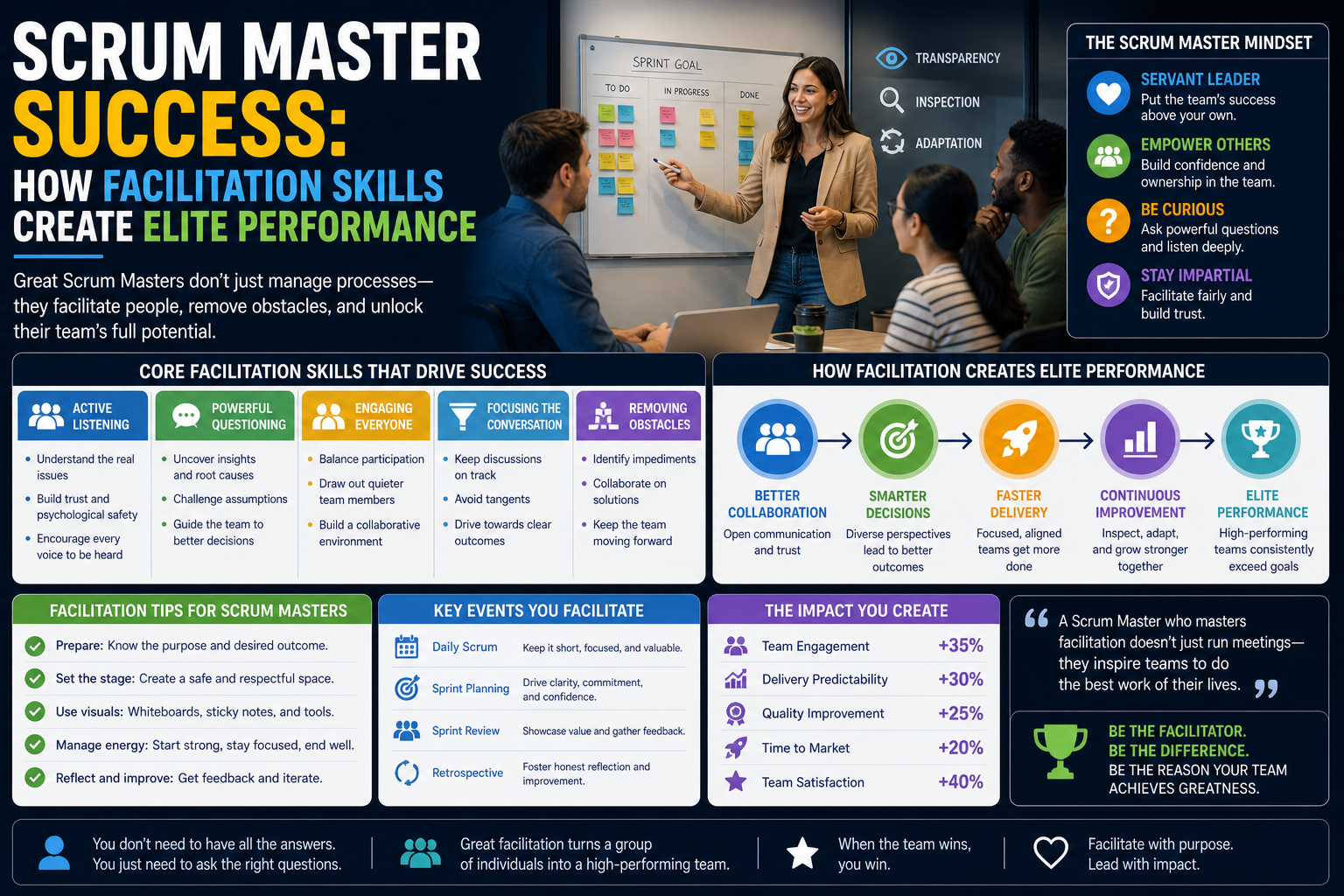
A Scrum Master plays a role that is often misunderstood as purely administrative, but in practice it is deeply rooted in facilitation, behavioral guidance, and team enablement. Within Agile environments, the Scrum Master does not act as a traditional manager who assigns tasks or dictates outcomes. Instead, the role centers on helping a group of professionals work together in a structured yet flexible way so that they can consistently deliver value. The idea of facilitation sits at the core of this responsibility because it emphasizes guiding a process rather than controlling it. A facilitator helps individuals and teams communicate more effectively, make better decisions collectively, and maintain focus on shared objectives without imposing personal opinions or authority.
In Scrum environments, teams are intentionally designed to be self-organizing, which means they are responsible for planning, executing, and improving their own work. This creates a unique challenge for the Scrum Master, who must ensure that autonomy does not turn into confusion or misalignment. Facilitation becomes the bridge between independence and structure. It allows the Scrum Master to create conditions where team members can collaborate productively while staying aligned with Agile principles such as transparency, inspection, and adaptation. The effectiveness of a Scrum Master is often measured not by how many decisions they make, but by how well they enable others to make decisions together.
The facilitative nature of the Scrum Master role also requires a strong understanding of human behavior within group settings. Teams are not just systems of tasks; they are systems of relationships, emotions, assumptions, and communication styles. A Scrum Master who functions as a facilitator must constantly observe how individuals interact, where misunderstandings arise, and how information flows across the group. This awareness helps in shaping conversations that lead to clarity rather than confusion. Over time, the Scrum Master becomes less of a directive presence and more of a guiding influence that supports continuous improvement in both process and interaction.
The Core Nature of Facilitation in Agile Teams
Facilitation in Agile teams is fundamentally about creating an environment where collaboration can happen naturally and effectively. It is not about directing outcomes but about enabling conversations that lead to outcomes. In this sense, facilitation is a subtle but powerful leadership approach that influences how teams think, communicate, and solve problems. In Scrum, where adaptability is essential, facilitation ensures that teams remain responsive rather than reactive. It helps maintain balance between structure and flexibility, allowing teams to adjust their direction without losing coherence.
A key aspect of facilitation is neutrality. The Scrum Master must avoid taking sides or imposing personal interpretations of problems. Instead, they guide discussions in a way that encourages the team to explore multiple perspectives before arriving at a shared understanding. This neutrality builds trust within the team because members feel that their voices are heard equally. When trust is established, communication becomes more open, and teams are more likely to surface issues early rather than hiding them until they become larger problems.
Facilitation also involves shaping the rhythm of team interactions. Agile teams operate in cycles of planning, execution, and review, and each of these stages requires structured conversations. Without proper facilitation, these conversations can become chaotic, overly technical, or dominated by a few individuals. The Scrum Master ensures that every voice is included and that discussions remain focused on objectives rather than distractions. This does not mean controlling conversations, but rather guiding them gently so that they remain productive and aligned with Scrum principles.
Another important dimension of facilitation is adaptability. No two teams behave the same way, and even the same team may behave differently under varying conditions. A facilitator must therefore adjust their approach depending on the maturity of the team, the complexity of the work, and the interpersonal dynamics at play. Sometimes this requires more structure, while at other times it requires stepping back and allowing the team to self-organize more freely. The ability to sense when to intervene and when to observe is a defining trait of an effective Scrum Master acting as a facilitator.
Daily Stand-ups as a Facilitation Practice
One of the most visible examples of facilitation in Scrum is the daily stand-up meeting. This short, time-boxed session is not just a status update but a coordination and alignment opportunity for the team. The Scrum Master facilitates this meeting not by controlling the content of each update but by ensuring that the structure and intent of the conversation are preserved. The goal is to help the team stay synchronized, identify obstacles early, and maintain momentum toward their sprint goals.
During stand-ups, facilitation is essential because without it, the meeting can easily drift into unrelated discussions or detailed technical debates that are better suited for separate sessions. The Scrum Master guides the team back to the purpose of the stand-up whenever necessary, ensuring that the conversation remains concise and relevant. This requires a delicate balance because excessive interruption can feel controlling, while too little guidance can lead to inefficiency. The skill lies in subtle redirection rather than direct intervention.
The questions typically asked during stand-ups, such as what was accomplished, what will be done next, and what obstacles exist, are not meant to be interrogative but reflective. A facilitator encourages honest communication by creating a safe space where team members feel comfortable sharing challenges without fear of judgment. This openness is critical for early problem detection, which is one of the key advantages of Agile frameworks. When issues are surfaced quickly, they can be addressed before they escalate into significant blockers.
Beyond structure, facilitation during stand-ups also involves observing team energy and engagement. A skilled Scrum Master can often detect disengagement, confusion, or tension simply by paying attention to tone, body language, and participation patterns. These subtle cues help identify deeper issues that may not be explicitly stated. Over time, the stand-up becomes not just a meeting but a diagnostic tool for understanding team health and collaboration effectiveness.
Neutrality and the Art of Guiding Without Controlling
Neutrality is one of the most important characteristics of effective facilitation. In the context of Scrum, neutrality means that the Scrum Master does not influence the team’s decisions based on personal preferences or external pressures. Instead, they focus on ensuring that decisions are made collaboratively and transparently. This does not mean absence of leadership; rather, it represents a form of leadership that prioritizes process integrity over personal opinion.
Guiding without controlling is a subtle skill that requires patience and emotional intelligence. The Scrum Master must resist the urge to solve problems directly, even when solutions seem obvious. Instead, they create conditions where the team can arrive at solutions independently. This approach strengthens team ownership and accountability, which are essential for long-term agility. When teams solve their own problems, they develop confidence and capability, reducing dependency on external direction.
Neutral facilitation also involves managing conflicts in a constructive way. Conflicts are natural in collaborative environments, especially when individuals have different perspectives or priorities. The Scrum Master does not suppress conflict but facilitates conversations that help the team understand underlying concerns. By doing so, conflict becomes a source of insight rather than disruption. The focus shifts from winning arguments to achieving shared understanding.
Maintaining neutrality can be challenging in environments where stakeholders expect quick decisions or clear direction. However, the Scrum Master’s responsibility is to protect the integrity of the Agile process. This often means resisting pressure to take control and instead reinforcing the importance of team-driven decision-making. Over time, this approach strengthens both the team’s autonomy and the organization’s trust in the Scrum framework.
Building Psychological Safety in Scrum Teams
Psychological safety is a foundational element of effective facilitation and high-performing Agile teams. It refers to an environment where individuals feel safe to express ideas, ask questions, and admit mistakes without fear of punishment or embarrassment. The Scrum Master, acting as a facilitator, plays a crucial role in establishing and maintaining this environment.
When psychological safety is present, team members are more likely to share incomplete thoughts, raise concerns early, and experiment with new approaches. This openness leads to better decision-making and faster learning cycles. In contrast, environments lacking psychological safety often suffer from hidden problems, delayed feedback, and reduced collaboration. The Scrum Master must therefore be attentive not only to what is being said but also to what is being withheld.
Facilitation contributes to psychological safety by ensuring that all voices are heard equally. This includes encouraging quieter team members to participate and preventing dominant voices from overwhelming discussions. The goal is not to enforce equality of speaking time but to ensure diversity of thought is represented in decision-making. When individuals feel that their input is valued, they become more engaged and invested in outcomes.
Another important aspect is how mistakes are treated within the team. A facilitator helps shift the perception of mistakes from failures to learning opportunities. This cultural shift is essential in Agile environments, where experimentation and adaptation are constant. The Scrum Master reinforces this mindset by guiding retrospectives and discussions in a way that focuses on improvement rather than blame. Over time, this builds resilience and continuous improvement within the team.
Communication Patterns that Shape Team Behavior
Communication is the foundation of all team interaction, and facilitation plays a key role in shaping how communication occurs. In Scrum teams, communication is not limited to formal meetings but extends to everyday interactions, digital collaboration tools, and informal discussions. The Scrum Master observes these communication patterns to identify strengths and areas for improvement.
Effective facilitation encourages clarity, brevity, and relevance in communication. Teams often struggle with overcommunication or undercommunication, both of which can lead to inefficiencies. The Scrum Master helps the team find balance by modeling effective communication behaviors and gently guiding discussions when they become unfocused. This includes helping team members articulate their thoughts more clearly and encouraging active listening among participants.
Miscommunication is one of the most common sources of inefficiency in teams. A facilitator addresses this by ensuring that assumptions are surfaced and clarified early. Rather than allowing misunderstandings to persist, the Scrum Master encourages questions and verification of understanding. This proactive approach reduces rework and enhances collaboration quality.
Over time, communication patterns become indicators of team maturity. A team that communicates openly, directly, and respectfully is more likely to be high-performing. The Scrum Master supports the development of these patterns through consistent facilitation practices, reinforcing behaviors that contribute to transparency and collaboration while discouraging those that create confusion or fragmentation.
Handling Team Alignment and Shared Ownership
Alignment is a critical outcome of effective facilitation. Without alignment, even skilled teams can struggle to deliver meaningful results because their efforts are fragmented or misdirected. The Scrum Master ensures alignment by facilitating conversations that connect individual tasks to broader goals. This helps team members understand not only what they are doing but why they are doing it.
Shared ownership is closely tied to alignment. In Scrum, the responsibility for outcomes lies with the entire team rather than individuals. Facilitation reinforces this principle by encouraging collective decision-making and shared accountability. When team members feel ownership over both success and failure, they become more engaged and proactive in their work.
Alignment is not a one-time achievement but an ongoing process. As priorities shift and new information emerges, teams must continuously realign their understanding. The Scrum Master facilitates this through structured discussions that revisit goals, clarify expectations, and adjust plans when necessary. This adaptability ensures that the team remains focused on delivering value even in changing conditions.
Shared ownership also requires trust among team members. Facilitation helps build this trust by creating environments where collaboration is prioritized over individual performance. The Scrum Master encourages team-based problem solving rather than individual heroics. Over time, this fosters a culture where success is seen as a collective achievement rather than a personal accomplishment.
Deepening Facilitation Through Advanced Scrum Master Practices
As Scrum Masters grow in experience, facilitation shifts from being a structured activity into a more intuitive and adaptive practice. At a basic level, facilitation ensures meetings run smoothly and conversations stay on track. At an advanced level, it becomes a way of influencing how teams think, how they solve problems, and how they evolve their working habits over time. This deeper form of facilitation requires a refined understanding of group psychology, communication dynamics, and organizational behavior.
An experienced Scrum Master does not simply guide events; they shape the conditions under which effective collaboration becomes natural. Instead of focusing on individual ceremonies, they begin to see patterns across multiple interactions. They notice how decisions are made, how conflicts emerge, and how energy flows within the team. This awareness allows them to intervene less frequently but more meaningfully, creating a stronger long-term impact.
Advanced facilitation also requires comfort with ambiguity. Not every situation has a clear structure or predictable outcome. Teams may face shifting priorities, unclear requirements, or interpersonal tension that cannot be resolved through standard techniques. In these moments, the Scrum Master must rely on judgment rather than process alone. They must sense what the team needs in the moment and adjust their facilitation approach accordingly, whether that means slowing down a conversation, reframing a problem, or allowing silence to create reflection.
Facilitating Complex Team Dynamics and Behavioral Patterns
Teams are dynamic systems influenced by personalities, communication styles, cultural backgrounds, and professional experiences. These factors create behavioral patterns that can either support or hinder collaboration. A Scrum Master acting as a facilitator must be able to observe and interpret these patterns in real time.
Some teams naturally gravitate toward collaboration, while others may fall into silos where individuals work independently with limited interaction. In such cases, facilitation is used to gently shift the team toward greater cohesion. This does not happen through instruction but through structured interactions that encourage shared thinking. For example, group discussions, collaborative planning, and open reflection sessions can gradually break down communication barriers.
Behavioral patterns often become more visible under pressure. When deadlines approach or challenges arise, teams may revert to familiar habits such as avoiding difficult conversations or relying heavily on specific individuals. A skilled facilitator recognizes these shifts and helps the team remain grounded in Agile principles. Rather than allowing stress to dictate behavior, the Scrum Master reinforces constructive interaction and shared responsibility.
Understanding group dynamics also involves recognizing informal leadership within the team. Not all influence comes from formal roles. Some individuals naturally shape opinions or guide discussions without holding official authority. The Scrum Master observes these dynamics carefully and ensures that influence is balanced, preventing dominance while encouraging healthy contribution from all members.
Conflict Navigation as a Core Facilitation Skill
Conflict is an inevitable part of collaborative work, especially in environments where diverse perspectives are encouraged. Rather than avoiding conflict, effective facilitation treats it as an opportunity for clarity and improvement. The Scrum Master plays a crucial role in ensuring that conflict remains constructive rather than destructive.
When conflict arises, the facilitator does not rush to resolve it immediately. Instead, they create space for each perspective to be fully expressed. This allows underlying concerns to surface rather than remaining hidden. Often, what appears to be disagreement about a technical issue may actually stem from misaligned expectations or communication gaps. By uncovering these deeper layers, the Scrum Master helps the team address root causes rather than surface symptoms.
Managing conflict requires emotional neutrality and patience. The facilitator must avoid taking sides or reinforcing existing divisions. Instead, they guide the conversation toward shared understanding. This involves reframing statements, asking clarifying questions, and helping individuals see situations from different perspectives. Over time, this process builds mutual respect within the team.
Healthy conflict can actually strengthen team relationships when handled correctly. It encourages critical thinking, improves decision quality, and reduces the likelihood of assumptions going unchallenged. A skilled Scrum Master ensures that conflict remains focused on ideas and processes rather than personal attributes, preserving trust while encouraging open dialogue.
Designing Effective Scrum Events Beyond the Basics
Scrum events such as planning sessions, reviews, and retrospectives are often seen as standard ceremonies, but their effectiveness depends heavily on facilitation quality. Beyond simply organizing these events, the Scrum Master must design them in a way that maximizes engagement, clarity, and outcome quality.
Each event serves a different purpose and requires a different facilitation approach. Planning sessions require alignment and clarity of scope, while reviews focus on feedback and stakeholder engagement. Retrospectives emphasize reflection and improvement. The facilitator adjusts tone, structure, and participation methods accordingly to ensure each event achieves its intended goal.
An advanced facilitator also considers energy levels and cognitive load when designing events. Long or poorly structured meetings can lead to disengagement and reduced productivity. By carefully structuring discussions, incorporating breaks when needed, and encouraging active participation, the Scrum Master ensures that events remain effective and meaningful.
Another important aspect of event facilitation is inclusivity. Every team member should have the opportunity to contribute, regardless of personality type or communication style. Some individuals may prefer speaking in groups, while others may express themselves better in written form or smaller discussions. The facilitator ensures that multiple modes of participation are available so that valuable input is not lost.
Coaching Mindset: From Facilitator to Enabler of Growth
As Scrum Masters evolve, their facilitation approach naturally integrates with coaching. While facilitation focuses on guiding group interactions, coaching emphasizes individual and team growth. The two roles complement each other, creating a powerful combination that enhances overall team capability.
A coaching mindset shifts the focus from solving immediate problems to developing long-term capability. Instead of providing answers, the Scrum Master asks questions that encourage reflection and independent thinking. This helps individuals develop problem-solving skills and increases their confidence in handling challenges.
Coaching also involves recognizing potential within team members and helping them unlock it. This may include encouraging quieter individuals to take on more active roles or supporting experienced members in refining their leadership abilities. The facilitator acts as a catalyst for growth rather than a source of direction.
The transition from facilitator to coach is gradual and requires strong interpersonal awareness. It involves understanding when to step back and when to engage more deeply. Too much intervention can hinder independence, while too little support can leave individuals feeling unsupported. Finding the right balance is a key aspect of mastery in the Scrum Master role.
Decision-Making Frameworks Within Facilitated Teams
Decision-making is a central part of team collaboration, and facilitation plays a key role in ensuring that decisions are made effectively and collectively. In Scrum environments, decisions are ideally made by the team rather than imposed by external authority. The Scrum Master supports this process by guiding structured discussions that lead to clarity and consensus.
Different situations require different decision-making approaches. Some decisions benefit from quick agreement, while others require deeper analysis and discussion. A skilled facilitator helps the team determine the appropriate level of discussion needed for each situation. This prevents both rushed decisions and unnecessary delays.
Facilitation also ensures that all relevant perspectives are considered before decisions are finalized. This reduces the risk of oversight and improves the quality of outcomes. The Scrum Master may encourage structured brainstorming, comparison of options, or step-by-step evaluation of alternatives depending on the complexity of the decision.
Once a decision is made, the facilitator helps the team commit to it collectively. This shared commitment is essential for execution, as it ensures that all members are aligned and accountable for the outcome. Without this alignment, even well-made decisions can fail during implementation.
Handling Resistance and Building Engagement
Resistance is a natural response to change, especially in Agile environments where teams are encouraged to adopt new ways of working. The Scrum Master encounters resistance at both individual and team levels, and facilitation plays a critical role in addressing it constructively.
Rather than confronting resistance directly, the facilitator seeks to understand its underlying causes. Resistance often arises from uncertainty, lack of clarity, or previous negative experiences. By identifying these factors, the Scrum Master can address concerns in a more meaningful way.
Building engagement requires creating a sense of ownership among team members. When individuals feel that they are part of the decision-making process, they are more likely to contribute actively. Facilitation techniques such as collaborative discussions, open forums, and shared planning sessions help strengthen this sense of involvement.
Over time, consistent facilitation helps reduce resistance by building trust in the process. As teams experience the benefits of Agile practices, they become more open to participation and change. The Scrum Master plays a key role in guiding this transformation through patience, consistency, and structured engagement.
Working with Stakeholders Through Facilitative Leadership
Scrum Masters do not only facilitate within teams; they also interact with stakeholders who influence or depend on team outcomes. These interactions require a different but related set of facilitation skills. Stakeholders often have diverse expectations, priorities, and communication styles, making alignment more complex.
Facilitation in this context involves ensuring that expectations are clearly communicated and understood. The Scrum Master helps bridge the gap between technical teams and business stakeholders by translating priorities into actionable discussions. This reduces misunderstanding and improves collaboration.
Stakeholder facilitation also involves managing expectations regarding delivery timelines, scope, and outcomes. Rather than making commitments on behalf of the team, the Scrum Master ensures that commitments are made transparently and realistically. This protects both the team and the organization from misalignment.
By maintaining open channels of communication, the Scrum Master helps build trust between teams and stakeholders. This trust is essential for long-term collaboration and supports smoother decision-making across the organization.
Improving Retrospectives as a Driver of Continuous Improvement
Retrospectives are one of the most powerful tools in Agile frameworks for continuous improvement. However, their effectiveness depends heavily on how they are facilitated. A poorly run retrospective can become repetitive and unproductive, while a well-facilitated one can lead to meaningful change.
Effective facilitation ensures that retrospectives remain engaging and focused on actionable outcomes. The Scrum Master encourages honest reflection while preventing discussions from becoming overly critical or unfocused. The goal is to identify improvement opportunities and convert them into practical actions.
Variety in facilitation techniques helps maintain engagement over time. Different formats and discussion methods can be used to keep retrospectives fresh and meaningful. This prevents routine fatigue and encourages deeper participation from the team.
A key aspect of retrospective facilitation is ensuring follow-through. Identified improvements must be tracked and revisited in future cycles to ensure they are implemented. Without this continuity, retrospectives lose their impact and become purely reflective exercises rather than drivers of change.
Recognizing and Addressing Team Dysfunction Patterns
Every team experiences dysfunction at some point, whether in communication, collaboration, or decision-making. The Scrum Master, acting as a facilitator, plays a critical role in identifying and addressing these patterns before they become deeply embedded.
Common dysfunctions include lack of trust, unclear roles, poor communication, and avoidance of accountability. These issues often manifest subtly and require careful observation to detect. Once identified, facilitation techniques are used to bring awareness to these issues without assigning blame.
Addressing dysfunction requires patience and consistency. It is rarely resolved through a single intervention. Instead, the Scrum Master works gradually to shift team behavior through repeated reinforcement of healthy practices and open dialogue.
Over time, teams become more aware of their own dynamics and are better able to self-correct. This shift from external guidance to internal regulation is a key indicator of maturity in Agile environments.
Strengthening Agile Maturity Through Facilitation
Agile maturity refers to the ability of a team to consistently apply Agile principles in a disciplined yet flexible manner. Facilitation is one of the key drivers of this maturity because it shapes how teams think, communicate, and adapt.
As teams mature, they require less direct intervention and more subtle guidance. The Scrum Master transitions from active facilitation to more observational support, stepping in only when necessary. This allows the team to take greater ownership of its processes and outcomes.
Maturity is also reflected in how teams handle complexity and uncertainty. Mature teams are more comfortable adapting to change and making decisions collaboratively. Facilitation helps build this capability over time by reinforcing structured thinking and shared responsibility.
Maintaining Energy, Focus, and Flow in Agile Environments
Sustaining energy and focus is essential for long-term team performance. Agile environments can be fast-paced and demanding, making it important to maintain balance between productivity and sustainability. Facilitation contributes to this balance by ensuring that work is organized, communication is clear, and distractions are minimized.
Flow refers to the state where teams can work efficiently without unnecessary interruptions or confusion. The Scrum Master helps maintain this flow by ensuring that processes support rather than hinder productivity. This includes removing obstacles, clarifying priorities, and facilitating smooth transitions between tasks and activities.
Energy levels within a team are influenced by engagement, clarity, and workload balance. Effective facilitation helps monitor these factors and ensures that teams remain motivated and focused. Over time, this contributes to a healthier and more sustainable working environment.
Mastering Facilitation as a Strategic Leadership Capability
At an advanced level of Scrum mastery, facilitation stops being just a set of techniques used in meetings and becomes a strategic leadership capability that shapes how an entire team or even an organization thinks and behaves. The Scrum Master begins to operate less like a meeting guide and more like a systems thinker who understands how communication patterns, decision structures, and organizational habits interact.
In this stage, facilitation is not limited to visible events such as stand-ups or retrospectives. It extends into informal conversations, stakeholder interactions, conflict moments, and even silent observations of team behavior. The Scrum Master becomes highly intentional about when to speak, when to stay silent, and when to redirect energy. This level of awareness is what separates routine practitioners from elite Scrum Masters.
Strategic facilitation also involves recognizing that every interaction within a team has ripple effects. A single poorly handled discussion can influence trust, motivation, and future collaboration. Similarly, a well-facilitated conversation can resolve long-standing tension and unlock performance improvements. The Scrum Master operates with this awareness, treating facilitation not as isolated interventions but as continuous shaping of team culture.
Systems Thinking in Scrum Facilitation
Systems thinking is essential for understanding how teams function as interconnected units rather than collections of individuals. A Scrum Master who applies systems thinking sees beyond surface-level issues and looks for underlying patterns that influence behavior over time.
For example, repeated delays in delivery may not be caused by individual performance issues but by unclear priorities, excessive work in progress, or weak communication with stakeholders. A facilitative Scrum Master does not immediately jump to solutions but instead helps the team explore how different parts of the system are interacting.
This approach changes the nature of facilitation conversations. Instead of focusing on “what went wrong,” discussions shift toward “what patterns are emerging” and “how are we contributing to this situation.” This subtle shift encourages collective responsibility rather than blame.
Systems thinking also helps the Scrum Master understand that changes in one area often impact other areas. Improving communication may affect decision speed. Changing workflows may affect morale. Adjusting priorities may influence stakeholder expectations. Facilitation at this level requires awareness of these interconnected effects.
Advanced Listening as a Facilitation Tool
Listening is often underestimated, but at the elite level of Scrum Mastery, it becomes one of the most powerful facilitation tools. Advanced listening goes beyond hearing words; it involves understanding tone, emotion, intention, and what is not being said.
A skilled Scrum Master listens for patterns in conversations. For example, repeated hesitation from team members may indicate lack of psychological safety. Overly technical discussions may signal avoidance of deeper issues. Silence may represent disagreement, confusion, or disengagement.
Advanced listening also involves distinguishing between symptoms and root causes. A team member saying “this task is unclear” might actually be expressing broader issues such as lack of alignment, missing context, or unclear ownership. The facilitator helps surface these underlying concerns through thoughtful questions.
In group settings, listening becomes even more complex. Multiple conversations occur simultaneously, and the Scrum Master must track how ideas evolve across participants. This requires focus, patience, and the ability to connect fragmented points into a coherent understanding of the team’s situation.
Facilitating Organizational Change Beyond the Team Level
As Scrum Masters gain experience, their facilitation often expands beyond individual teams into broader organizational contexts. This introduces new complexity because organizational change involves multiple stakeholders, competing priorities, and deeply embedded cultural habits.
At this level, facilitation becomes less about guiding discussions and more about shaping alignment across groups. The Scrum Master may facilitate conversations between teams, departments, or leadership groups to ensure shared understanding of goals and constraints.
Organizational facilitation requires sensitivity to hierarchy and influence. Different groups may have different levels of authority, and the Scrum Master must navigate these dynamics carefully. The goal is not to enforce agreement but to create conditions where meaningful dialogue can occur.
Change at the organizational level is often slow and nonlinear. Resistance is more pronounced because changes affect established structures and responsibilities. The Scrum Master facilitates these transitions by helping stakeholders understand the value of Agile principles and how they improve collaboration and outcomes.
Facilitating Transparency in Complex Environments
Transparency is one of the core principles of Agile, but achieving it in complex environments is challenging. Information is often distributed across tools, teams, and individuals, making it difficult to maintain a shared understanding.
The Scrum Master facilitates transparency by ensuring that information flows clearly and consistently. This includes helping teams articulate progress, risks, and dependencies in ways that are understandable to all stakeholders. Transparency is not just about sharing data but about making information meaningful.
In practice, this means encouraging teams to communicate openly about challenges rather than hiding them. It also means helping stakeholders interpret progress in context rather than relying on isolated metrics. Facilitation ensures that transparency becomes a shared practice rather than a reporting requirement.
Transparency also builds trust. When teams consistently communicate openly, stakeholders gain confidence in their reliability. The Scrum Master plays a key role in reinforcing this behavior through consistent facilitation practices that prioritize openness and clarity.
Elevating Retrospectives into Strategic Improvement Sessions
At a basic level, retrospectives focus on team reflection and incremental improvement. At an advanced level, they become strategic sessions that influence long-term team evolution.
An elite Scrum Master facilitates retrospectives in a way that goes beyond surface-level observations. Instead of only asking what went well or what didn’t, they guide teams to explore systemic issues, behavioral patterns, and structural improvements.
These sessions often involve deeper reflection on questions such as how decisions are made, how collaboration can be improved, and how dependencies affect delivery. The facilitator ensures that discussions remain constructive and focused on actionable insights.
One of the key challenges at this level is avoiding repetitive discussions. Teams can fall into patterns where retrospectives become routine and lose impact. The Scrum Master addresses this by introducing variation in facilitation methods and encouraging deeper exploration of issues.
Importantly, strategic retrospectives focus not just on improvement actions but on capability building. The goal is to help the team become more self-aware and self-correcting over time.
Emotional Intelligence in Facilitation Practice
Emotional intelligence is a defining trait of elite Scrum Masters. It enables them to understand and respond to the emotional dynamics within a team effectively.
Facilitation is not purely logical; it involves managing emotions such as frustration, excitement, uncertainty, and tension. The Scrum Master must recognize these emotions and respond in ways that maintain psychological safety and constructive engagement.
For example, when tension arises during discussions, an emotionally intelligent facilitator does not suppress it. Instead, they acknowledge it and guide the conversation toward understanding its source. This helps transform emotional energy into productive dialogue.
Emotional intelligence also involves self-awareness. The Scrum Master must be aware of their own emotional reactions and ensure that these do not influence their facilitation decisions. Maintaining neutrality requires constant reflection and discipline.
Over time, emotionally intelligent facilitation builds stronger relationships within the team and creates an environment where individuals feel understood and respected.
Enabling High-Performance Team Culture Through Facilitation
High-performance teams do not emerge automatically; they are shaped through consistent behaviors, shared values, and effective facilitation. The Scrum Master plays a central role in cultivating this environment.
Facilitation helps reinforce cultural norms such as accountability, collaboration, and continuous improvement. These norms are not imposed but developed through repeated interactions and structured conversations.
A high-performance culture is characterized by clarity of purpose, strong communication, and mutual trust. The Scrum Master supports these elements by ensuring that team interactions consistently reflect Agile values.
Culture also evolves through feedback loops. The facilitator ensures that teams regularly reflect on their behavior and adjust accordingly. Over time, this creates a self-reinforcing cycle of improvement.
Navigating Organizational Politics with Facilitative Neutrality
Organizational environments often include competing interests, priorities, and perspectives. The Scrum Master must navigate these dynamics without becoming aligned with any single group.
Facilitative neutrality is critical in such situations. It allows the Scrum Master to maintain credibility across teams and stakeholders. Rather than advocating for specific outcomes, they focus on ensuring that conversations remain balanced and productive.
This neutrality does not mean avoiding difficult conversations. Instead, it means ensuring that all perspectives are heard and considered fairly. The Scrum Master facilitates dialogue that reduces misunderstanding and builds alignment.
Organizational politics can sometimes create tension between short-term demands and long-term Agile goals. The facilitator helps bridge this gap by encouraging transparency and reinforcing shared objectives.
Encouraging Self-Organization at Scale
Self-organization is a core principle of Scrum, but achieving it at scale requires careful facilitation. Teams must not only manage their own work but also coordinate effectively with other teams.
The Scrum Master supports this by facilitating cross-team communication and alignment. This ensures that dependencies are managed proactively rather than reactively.
Self-organization also requires clarity of boundaries. Teams must understand their responsibilities while maintaining flexibility in how they achieve outcomes. Facilitation helps define and reinforce these boundaries without imposing rigid control.
As organizations grow, maintaining self-organization becomes more complex. The Scrum Master plays a key role in preserving this principle by ensuring that autonomy is balanced with alignment.
Sustaining Continuous Improvement as a Cultural Habit
Continuous improvement is not a one-time initiative but an ongoing cultural habit. The Scrum Master facilitates this by embedding reflection and adaptation into everyday work practices.
Rather than treating improvement as a separate activity, it becomes part of how teams operate. Regular feedback loops, open discussions, and iterative changes ensure that improvement is constant.
Facilitation helps sustain this habit by reinforcing its importance in every Scrum event and interaction. Over time, teams begin to naturally seek opportunities for improvement without external prompting.
Continuous improvement also requires patience. Not all changes produce immediate results. The Scrum Master helps teams stay committed to long-term growth even when progress feels slow.
Conclusion
Facilitation sits at the heart of what makes a Scrum Master truly effective in Agile environments. It is not simply about running meetings or keeping discussions on track, but about shaping how teams think, communicate, and make decisions together. Through facilitation, the Scrum Master creates an environment where collaboration becomes natural, conflicts become constructive, and continuous improvement becomes part of daily work rather than an occasional effort.
As teams mature, the Scrum Master’s role shifts from active guidance to subtle influence. Instead of providing answers, they focus on asking the right questions, encouraging reflection, and ensuring that every voice contributes to shared outcomes. This approach strengthens team ownership and builds long-term accountability, which are essential qualities of high-performing Agile teams.
Facilitation also extends beyond the team itself. It influences relationships with stakeholders, supports organizational alignment, and helps bridge gaps between strategy and execution. By maintaining neutrality and fostering transparency, the Scrum Master ensures that decisions are made collectively and with clarity.
Ultimately, becoming an elite Scrum Master is not defined by technical expertise alone, but by the ability to facilitate meaningful interactions that unlock team potential. It requires emotional intelligence, patience, systems thinking, and a deep commitment to Agile values. Over time, consistent facilitation transforms not only how teams work, but also how they grow, adapt, and succeed in complex environments.
In this sense, facilitation is not just a skill for Scrum Masters—it is the foundation of Agile leadership itself.