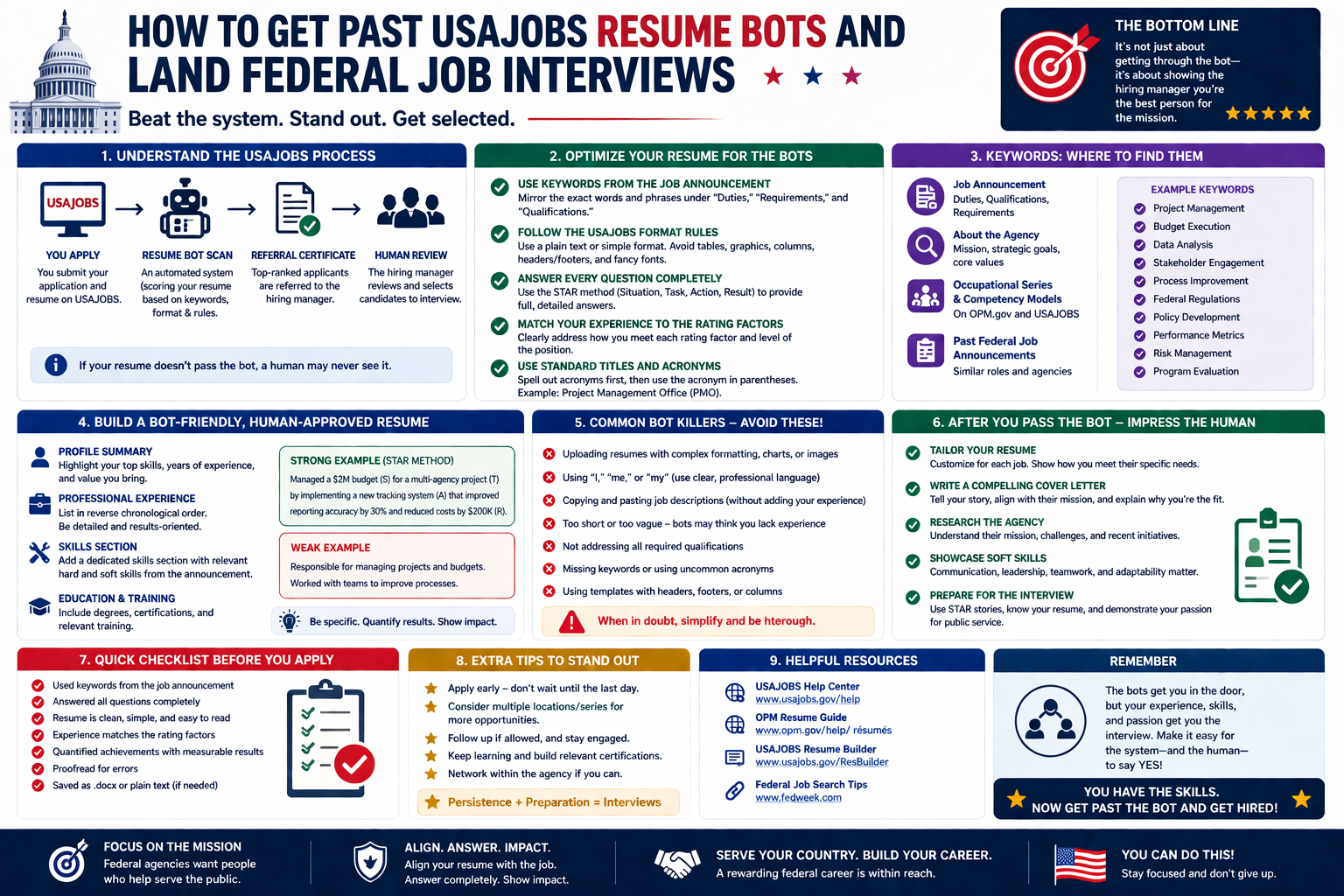
Applying for federal jobs through USAJobs.gov often feels very different from applying in the private sector. Many applicants describe the experience as slow, highly structured, and sometimes confusing. This is not because the system is poorly designed, but because it is built to manage an extremely large number of applications while ensuring fairness, compliance, and consistency across government hiring.
At its core, USAJobs.gov is a centralized platform where federal agencies post job openings and collect applications. Unlike many private companies that may rely heavily on recruiter intuition or informal screening, federal hiring is governed by strict rules. These rules are intended to ensure equal opportunity, transparency, and merit-based selection. As a result, much of the early screening is automated or checklist-driven before a human ever reviews a resume in detail.
This system creates what many applicants describe as “bots,” but in reality, it is a combination of automated scoring tools and structured human review processes. The goal is not to reject candidates randomly, but to filter applications based on clearly defined criteria such as education, experience, keywords, and eligibility requirements.
Understanding this structure is the first step toward improving your chances of success. If you know how the system evaluates applications, you can prepare your resume and responses in a way that aligns with what the system is designed to recognize.
How Automated Screening Shapes Federal Hiring Decisions
When a job is posted on USAJobs.gov, it usually attracts a large number of applicants. For popular positions, this can mean hundreds or even thousands of submissions. To manage this volume, federal agencies rely on a structured filtering process that narrows down applicants before detailed human review begins.
The process typically starts with a basic eligibility check. This determines whether an applicant meets the minimum requirements outlined in the job posting. These requirements may include citizenship status, educational background, years of experience, or specialized certifications.
Once eligibility is confirmed, applications are often evaluated using a scoring system. This is where many applicants encounter the first major challenge. The system looks for alignment between the job announcement and the applicant’s resume. It checks for keywords, relevant experience, and whether the applicant has demonstrated the required competencies.
However, the system is not purely mechanical. Human HR specialists also play a major role in reviewing applications that pass initial screening. They verify whether the applicant truly meets the qualifications and whether their experience aligns with the job duties.
Because of this hybrid system, success depends on more than just having the right skills. It also depends on how clearly those skills are presented in a format that matches the expectations of the federal hiring system.
Why Many Applicants Get Rejected Before Human Review
One of the most frustrating aspects of federal hiring is that many applicants never reach the stage where a hiring manager sees their resume. This often happens not because they are unqualified, but because their application does not align with the structured evaluation system.
There are several common reasons this occurs.
First, applicants may fail to meet eligibility requirements. Federal jobs often have strict criteria regarding citizenship, clearance levels, or specialized experience. Even if an applicant is highly skilled, failing to meet a single eligibility requirement can result in automatic disqualification.
Second, many applicants underestimate the importance of matching their resume language to the job description. Federal HR systems rely heavily on structured comparison between job announcements and application materials. If the wording in a resume does not reflect the language used in the job posting, the system may not recognize the experience as relevant.
Third, applicants sometimes assume that general experience is enough. In reality, federal hiring often requires very specific examples of work that directly match the duties listed in the job announcement. Vague descriptions of responsibilities may not be sufficient.
Finally, incomplete applications are a major issue. Federal job applications often require detailed information such as exact employment dates, hours worked per week, and specific duty descriptions. Missing or incomplete details can lead to rejection without further review.
Understanding these pitfalls is essential for improving your chances of moving through the screening process successfully.
Eligibility Rules and Why They Matter More Than You Think
Before any consideration is given to experience or qualifications, federal hiring begins with eligibility. This step is often overlooked by applicants who focus primarily on their skills and credentials.
Eligibility determines whether an applicant is legally and administratively allowed to apply for a specific position. Federal jobs are often categorized based on who is allowed to apply. Some positions are open to all applicants, while others are restricted to current government employees, veterans, or individuals with specific status classifications.
If an applicant applies to a position for which they are not eligible, their application is typically removed from consideration immediately. This happens regardless of how strong their qualifications may be.
Eligibility may also include factors such as security clearance requirements. Some positions require background investigations or access to sensitive information. If an applicant cannot meet these requirements, they cannot proceed in the hiring process.
Because eligibility is strictly enforced, understanding the “who may apply” section in job postings is critical. This section is often overlooked, but it determines whether an application has any chance of progressing.
Understanding the Structure of Federal Job Announcements
Federal job announcements are highly structured documents. They are designed to provide all necessary information about a position in a standardized format. However, this structure can be overwhelming for applicants who are not familiar with it.
A typical job announcement includes sections that outline duties, qualifications, eligibility, and evaluation criteria. Each section serves a specific purpose in the hiring process.
The duties section describes what the job actually involves. This is not just a general overview, but a detailed breakdown of responsibilities. These descriptions are important because they often contain the keywords used in the evaluation process.
The qualifications section outlines the minimum experience and education required for the position. This is one of the most important parts of the announcement, as it determines whether an applicant is even eligible to be considered.
The evaluation section explains how candidates will be assessed. This may include self-assessment questionnaires, knowledge evaluations, or structured scoring systems based on experience and education.
Understanding how to read and interpret these sections is essential for aligning your application with what the system is looking for. Many applicants fail not because they lack qualifications, but because they do not fully understand how to translate their experience into the language used in the job announcement.
How Federal Hiring Grades Shape Expectations
Federal jobs are organized using a grading system known as the General Schedule. This system ranges from lower-level positions to senior executive roles, and each grade reflects a different level of responsibility, experience, and compensation.
While the details of the grading system can seem complex at first, its purpose is relatively straightforward. It helps standardize job levels across different agencies and regions, ensuring consistency in hiring and compensation.
Lower grades typically represent entry-level positions, while higher grades indicate increased responsibility and specialized expertise. Each grade has specific expectations in terms of education and experience.
Applicants often make the mistake of applying for positions that are significantly above or below their experience level. This mismatch can lead to rejection, even if the applicant has strong qualifications in other areas.
Understanding how your experience aligns with different grade levels helps you target positions more effectively. It also helps you tailor your resume so that it reflects the appropriate level of responsibility and expertise expected for the role.
The Role of Structured Experience in Federal Applications
One of the most important aspects of federal applications is how experience is presented. Unlike many private sector resumes, federal resumes require detailed descriptions of job duties, responsibilities, and accomplishments.
This level of detail is necessary because the evaluation process is highly structured. HR specialists are not simply looking for general familiarity with a field. They are looking for specific evidence that an applicant has performed tasks that directly match the job requirements.
This means that each job listed on a federal resume should include clear explanations of what was done, how it was done, and what tools or systems were used. The more closely your experience matches the language of the job announcement, the better your chances of being selected for further review.
It is also important to include measurable details whenever possible. This helps demonstrate the scope and impact of your work, which can be important in distinguishing your application from others with similar experience.
Why Keywords Matter in Federal Hiring Systems
Keywords play a central role in how applications are evaluated. These keywords are often derived directly from the job announcement and are used to identify relevant experience in resumes.
However, keyword usage in federal hiring is not about simple repetition. It is about context and alignment. The system is designed to recognize whether an applicant has genuinely demonstrated the required skills, not just whether certain words appear in the document.
This means that effective keyword usage involves integrating relevant terminology naturally into descriptions of past experience. Instead of listing skills in isolation, applicants must show how those skills were applied in real work situations.
The challenge is that different job announcements may use slightly different language to describe similar responsibilities. This is why careful reading and adaptation are essential when preparing an application.
The Importance of Early Preparation Before Applying
One of the most overlooked aspects of federal job applications is preparation before the application process begins. Many applicants start applying immediately after finding a job posting, without fully analyzing the requirements or aligning their resume accordingly.
Taking time to review the job announcement in detail can significantly improve the quality of the application. This includes identifying key responsibilities, required qualifications, and evaluation criteria.
It also involves reviewing your own experience and identifying areas where you can clearly demonstrate alignment with the job requirements. This preparation phase is often what separates successful applicants from those who struggle to move past initial screening.
Careful preparation allows you to present your experience in a way that is both accurate and strategically aligned with the expectations of the hiring system.
How the Screening System Sets the Stage for Everything That Follows
The early stages of the federal hiring process determine whether an applicant will move forward or be removed from consideration. These stages are heavily structured and rely on consistent evaluation criteria.
While this may seem rigid, it is designed to ensure fairness and consistency across a wide range of applicants. Every application is measured against the same standards, regardless of background or personal connections.
This structure means that success is not random. It is based on how well an applicant understands the system and how effectively they align their materials with its requirements.
By understanding how eligibility, keywords, experience structure, and grading systems work together, applicants can significantly improve their chances of moving beyond initial screening and into the hands of hiring managers.
Why Federal Resumes Are Completely Different from Private Sector Resumes
One of the most common mistakes applicants make when applying through USAJobs.gov is assuming that a private-sector resume will work just as effectively in a federal hiring environment. This assumption is usually incorrect.
Federal resumes are not just longer versions of traditional resumes. They are structured documents designed to meet specific evaluation criteria used by government HR systems. While private-sector resumes often prioritize brevity and impact, federal resumes prioritize detail, clarity, and traceability of experience.
In a federal resume, every role must be fully explained. This includes job duties, employment dates, hours worked per week, supervisor information, and detailed descriptions of responsibilities. The reason for this level of detail is simple: HR specialists must be able to verify whether an applicant meets the exact qualifications listed in the job announcement.
Unlike private-sector hiring, where a recruiter might interpret your experience holistically, federal hiring relies heavily on structured comparisons between job requirements and resume content. This means that missing details or vague descriptions can significantly reduce your chances of being selected.
A strong federal resume does not just summarize experience. It demonstrates alignment with the job announcement in a way that is explicit, measurable, and easy to evaluate.
Building a Resume That Matches Federal Evaluation Criteria
To succeed in federal hiring systems, your resume must be designed with evaluation in mind. This means understanding how HR specialists and automated systems interpret your application.
Federal HR reviewers are not evaluating creativity or personal branding. They are checking whether your experience matches specific requirements listed in the job announcement. This process is highly structured and often follows a checklist approach.
Each job posting includes defined qualifications such as years of experience, technical skills, and specialized knowledge areas. Your resume must clearly demonstrate that you meet these requirements through real-world examples.
For instance, if a job requires experience in network administration, it is not enough to simply state that you worked in IT. You must describe specific tasks such as configuring networks, managing servers, or troubleshooting infrastructure issues.
The goal is to make your experience unmistakably relevant. The more clearly your resume reflects the job requirements, the easier it becomes for HR systems to certify your application.
Understanding the Role of Keywords in Application Success
Keywords play a central role in federal hiring systems, but their function is often misunderstood. Many applicants believe that simply repeating keywords from a job posting will improve their chances. While keywords are important, their effectiveness depends on context and integration.
Federal HR systems look for evidence that an applicant has actually performed the tasks associated with those keywords. This means that keywords must be embedded naturally within descriptions of real experience.
For example, if a job posting mentions “cybersecurity monitoring,” it is not enough to list it as a skill. Instead, your resume should describe situations where you actively performed cybersecurity monitoring, including tools used, environments managed, and outcomes achieved.
This approach ensures that keywords are not just present but meaningful. It demonstrates that your experience aligns with the responsibilities of the role rather than simply echoing terminology from the job posting.
Another important aspect of keyword usage is variation. Federal job announcements often use multiple terms to describe similar skills. Understanding these variations helps ensure that your resume captures all relevant language used in the evaluation process.
How HR Specialists Evaluate Resume Content
Once an application passes initial automated screening, it is typically reviewed by human HR specialists. Their role is to verify whether the applicant meets the minimum qualifications and to rank candidates based on how closely their experience matches the job requirements.
This evaluation is highly structured. HR specialists often use scoring systems or qualification checklists to assess each application. They are not interpreting resumes subjectively but instead comparing them against predefined criteria.
Because of this, clarity is essential. If experience is not clearly stated or if it requires interpretation, it may not be counted toward qualification requirements.
HR specialists also focus heavily on relevance. Even if an applicant has extensive experience, only experience that directly aligns with the job duties is considered.
This is why tailoring your resume for each application is so important. A generic resume may contain relevant experience, but if that experience is not clearly connected to the job requirements, it may not be fully recognized during evaluation.
The Importance of Aligning Experience With Job Duties
Job announcements in federal hiring are highly detailed, and each duty listed represents a specific expectation for the role. To improve your chances of success, your resume should reflect these duties as closely as possible.
This does not mean copying job descriptions directly. Instead, it means translating your past experience into language that reflects similar responsibilities.
For example, if a job requires managing system security protocols, your resume should include examples of how you have implemented or maintained security measures in previous roles.
The goal is to create a clear alignment between what the job requires and what you have done in your career. This alignment helps HR specialists quickly identify you as a qualified candidate.
When experience is clearly mapped to job duties, it reduces ambiguity and increases the likelihood that your application will move forward in the process.
Structuring Experience for Maximum Clarity and Impact
Federal resumes require a structured approach to presenting experience. Each role should be broken down into detailed descriptions that clearly outline responsibilities and accomplishments.
A strong structure typically includes job titles, employment dates, organization names, and detailed duty descriptions. Each duty should be written in a way that demonstrates both action and impact.
Instead of general statements, focus on specific tasks and outcomes. For example, rather than saying you “worked in IT support,” describe the types of systems you supported, the issues you resolved, and the scale of your responsibilities.
This level of detail helps HR specialists understand exactly what you have done and how it relates to the job requirements.
It also ensures that automated systems can accurately identify relevant experience based on keyword matching and structured data evaluation.
How Federal Hiring Systems Interpret Experience Levels
Experience in federal hiring is not only about what you have done but also about how long you have done it and at what level of responsibility.
Federal job announcements often specify required years of experience. However, not all experience is weighted equally. More complex or higher-responsibility roles are typically valued more than entry-level experience.
This means that simply meeting the minimum number of years is not always sufficient. The quality and relevance of that experience also matter significantly.
For example, two candidates may both have five years of IT experience, but one may have worked in advanced system administration roles while the other performed basic support tasks. The system will likely favor the candidate with more advanced responsibilities.
Understanding this distinction helps you present your experience more effectively. It also helps you identify which job levels are most appropriate for your background.
The Role of Education and Certifications in Application Strength
Education and certifications are important components of federal applications, but they are evaluated alongside experience rather than independently.
In many cases, education can substitute for some experience requirements, especially for entry-level positions. However, higher-level roles typically require both education and relevant experience.
Certifications are particularly valuable in technical fields. They serve as standardized proof of knowledge and can help validate skills that may not be fully captured through job experience alone.
In federal hiring systems, certifications can also help strengthen keyword alignment. Many job announcements explicitly list preferred or required certifications, making them an important factor in evaluation.
However, certifications alone are not sufficient. They must be supported by relevant experience that demonstrates practical application of the skills they represent.
How Self-Assessment Questionnaires Influence Ranking
Many federal job applications include self-assessment questionnaires. These questionnaires ask applicants to rate their level of experience or proficiency in specific areas.
While these responses are self-reported, they play an important role in determining whether an application moves forward in the selection process.
The responses are often scored and used to rank candidates. However, HR specialists may later verify whether these self-assessments are supported by the resume.
This creates a balance between self-representation and documented experience. Overstating abilities without supporting evidence can negatively affect an application, while underestimating experience may prevent an application from advancing.
The key is consistency. Your self-assessment should align with the experience described in your resume. This ensures that your application presents a coherent and credible profile.
Why Precision Matters More Than Volume in Federal Applications
Many applicants assume that submitting a large amount of information increases their chances of success. In federal hiring systems, however, precision is more important than volume.
A lengthy resume filled with irrelevant details can actually reduce clarity and make it harder for HR specialists to identify qualifying experience.
Instead, the focus should be on relevance and alignment. Every section of your resume should contribute to demonstrating that you meet the job requirements.
This does not mean reducing detail, but rather ensuring that every detail serves a purpose. Each statement should reinforce your qualifications and directly relate to the job announcement.
Precision also applies to language. Clear, specific descriptions are far more effective than broad or generic statements.
The Strategic Role of Tailoring Each Application
One of the most important strategies in federal hiring is tailoring your resume for each job application. Unlike some private-sector processes where a single resume may be reused repeatedly, federal applications require customization.
Each job announcement has its own set of requirements, keywords, and evaluation criteria. Tailoring your resume ensures that your experience is presented in a way that directly aligns with these factors.
This process involves more than editing a few words. It requires analyzing the job description, identifying key competencies, and restructuring your experience to highlight relevant qualifications.
Tailoring also improves keyword alignment and ensures that your application is accurately interpreted by both automated systems and human reviewers.
Although this process can be time-consuming, it significantly increases the likelihood of moving forward in the selection process.
Understanding How Application Scoring Systems Influence Outcomes
Federal hiring systems often use scoring mechanisms to rank applicants. These scores are based on factors such as experience, education, self-assessment responses, and keyword alignment.
While the exact scoring formulas may vary, the underlying principle is consistency. Every applicant is evaluated using the same criteria, ensuring fairness and transparency.
Understanding this scoring approach helps explain why small differences in resume structure or keyword usage can have a significant impact on outcomes.
Even if two applicants have similar qualifications, differences in how their experience is presented can result in different scores and ranking positions.
This is why strategic resume construction is essential. It ensures that your qualifications are fully recognized within the scoring system.
How Early Positioning Determines Final Selection Potential
The early stages of the federal hiring process play a critical role in determining whether an applicant will be considered for further review.
If an application is not properly aligned during initial screening, it may never reach the stage where hiring managers evaluate candidates.
This makes early positioning extremely important. Every detail in the application contributes to how it is ranked and whether it progresses through the system.
Strong positioning involves ensuring eligibility, aligning experience with job duties, using relevant keywords, and presenting information in a structured and consistent format.
When these elements are properly aligned, the application is far more likely to advance to the next stage of the hiring process.
Why the Final Stages of USAJobs.gov Matter More Than Most Applicants Realize
By the time an application reaches the later stages of the federal hiring process, the pool of candidates has already been significantly reduced. What remains is a smaller group of applicants who have passed eligibility checks, resume screening, and preliminary HR evaluation.
At this point, the focus shifts from whether an applicant meets minimum qualifications to how well they demonstrate their experience, judgment, and ability to perform the role in real-world situations. This is where many candidates either strengthen their position or lose momentum.
The final stages often involve deeper evaluation methods such as structured questionnaires, detailed narrative responses, and validation of certifications or specialized skills. These steps are designed to distinguish between candidates who are technically qualified and those who are truly the best fit for the role.
Unlike earlier screening stages, which rely heavily on structured data and keyword matching, later stages focus more on context, examples, and demonstrated problem-solving ability. This shift requires a different approach from applicants, one that emphasizes clarity, depth, and credibility.
Understanding the Purpose of KSA Assessments in Modern Federal Hiring
Knowledge, Skills, and Abilities assessments, commonly referred to as KSA responses, are a key part of many federal hiring processes. While the format has evolved over time, the underlying purpose remains the same: to evaluate how well an applicant can apply their experience to real job scenarios.
KSAs are designed to move beyond resumes. A resume can show what you have done, but KSAs show how you think, how you approach challenges, and how you apply your expertise in practice.
These responses are typically structured as scenario-based or competency-based questions. Applicants are expected to describe specific situations from their work history and explain how they handled them.
The goal is not just to confirm experience, but to assess depth of understanding, decision-making ability, and practical application of skills.
Because KSAs are often scored, they play a significant role in determining final rankings. Strong responses can elevate a candidate’s position, while weak or vague responses can reduce their chances even if their resume is strong.
Why Many Candidates Struggle With KSA Responses
One of the most common difficulties applicants face with KSAs is knowing how much detail to include. Some responses are too brief and fail to demonstrate competence, while others are overly long and lack focus.
Another challenge is translating resume content into narrative form. Many applicants list accomplishments effectively in their resume but struggle to expand those accomplishments into structured explanations.
KSAs require a different style of communication. Instead of listing responsibilities, applicants must describe situations, actions, and outcomes in a clear and logical sequence.
A strong response typically includes context about the situation, the specific actions taken, and the measurable or observable results achieved. Without this structure, responses can feel incomplete or unconvincing.
Applicants also sometimes underestimate the importance of specificity. General statements about experience are not enough. Evaluators look for clear examples that demonstrate real-world application of skills.
How to Structure Strong KSA Responses for Maximum Impact
Effective KSA responses follow a clear and consistent structure that helps evaluators understand your experience quickly and accurately.
A strong response begins with context. This means explaining the situation or challenge you faced, including relevant background information that helps set the stage.
Next comes action. This section describes what you specifically did to address the situation. It is important to focus on your individual contributions, even if you worked as part of a team.
Finally, the response should include results. This is where you explain the outcome of your actions, ideally using measurable or clearly defined improvements whenever possible.
This structure ensures that your response is complete and easy to evaluate. It also helps demonstrate not just what you did, but how effectively you applied your skills.
Clarity is essential throughout the response. Evaluators should not have to interpret your meaning or infer details. Everything should be stated explicitly and logically.
The Importance of Demonstrating Problem-Solving Ability
Federal hiring processes place a strong emphasis on problem-solving ability. This is because many government roles involve complex systems, regulatory requirements, and high-stakes decision-making.
KSAs are often designed specifically to evaluate how applicants approach challenges. This means that simply describing tasks is not enough. You must show how you analyzed problems, considered options, and made decisions.
Strong responses often highlight critical thinking. This includes explaining why certain decisions were made and how alternative approaches were evaluated.
It is also important to demonstrate adaptability. Many federal roles require working within changing environments, shifting priorities, or constrained resources.
By showing how you handled challenges in previous roles, you provide evidence that you can succeed in similar situations in a federal environment.
Why Specific Examples Are More Powerful Than General Statements
One of the most important principles in KSA writing is the use of specific examples. General statements about ability or experience are not persuasive on their own.
For example, saying that you have “experience in IT support” is too broad to be meaningful. Instead, describing a situation where you resolved a complex technical issue, supported a large number of users, or implemented a system improvement provides concrete evidence of your ability.
Specific examples help evaluators visualize your experience. They also make it easier to assess whether your skills align with the requirements of the job.
The more detailed and relevant your examples are, the stronger your response becomes. However, detail must always be balanced with clarity. The goal is to provide enough information to be convincing without becoming overly complex or difficult to follow.
How Certifications Strengthen Federal Job Applications
Certifications play a significant role in federal hiring, particularly in technical fields such as information technology, cybersecurity, engineering, and project management.
A certification serves as standardized proof that you possess specific knowledge or skills. Unlike experience, which can vary in interpretation, certifications provide a clear benchmark of competency.
In many job announcements, certifications are listed as either required or highly desirable. Meeting these requirements can significantly improve your chances of selection.
Certifications also help strengthen keyword alignment in your application. Many federal hiring systems are designed to recognize certification titles as indicators of relevant expertise.
However, certifications are most effective when combined with practical experience. They demonstrate knowledge, but experience demonstrates application. Together, they create a stronger overall profile.
How Certifications Influence Candidate Ranking
In competitive federal hiring environments, certifications can act as differentiators between candidates with similar experience levels.
When multiple applicants meet the basic qualifications, certifications can help determine ranking order. This is especially true for technical positions where specific certifications are closely tied to job responsibilities.
Certifications also help validate self-assessed skills. If an applicant claims advanced expertise in a particular area, relevant certifications provide supporting evidence.
However, certifications alone are not sufficient to secure a position. They must be part of a broader application strategy that includes strong resume alignment and well-developed KSA responses.
The Relationship Between Experience, Certifications, and KSAs
Successful federal applications are built on the alignment of three key elements: experience, certifications, and KSAs.
Experience provides the foundation. It demonstrates what you have done in real-world settings over time.
Certifications provide validation. They confirm that you have acquired specific knowledge or skills according to recognized standards.
KSAs provide depth. They show how you apply your experience and knowledge in structured, problem-solving scenarios.
When these three elements are aligned, they create a consistent and compelling narrative about your qualifications.
If one element is missing or weak, the overall application may be less competitive. For example, strong experience without clear KSAs may not fully demonstrate problem-solving ability, while strong certifications without experience may not show practical application.
Why Consistency Across All Application Materials Matters
One of the most overlooked aspects of federal applications is consistency. All parts of your application—resume, KSAs, and self-assessments—must align with each other.
Inconsistencies can raise concerns during evaluation. For example, if your resume suggests advanced experience but your KSAs do not reflect that level of expertise, evaluators may question the accuracy of your application.
Consistency does not mean repetition. It means ensuring that all parts of your application tell the same story from different perspectives.
Your resume outlines your experience, your KSAs demonstrate how you apply that experience, and your certifications validate your knowledge.
When these elements reinforce each other, your application becomes more credible and easier to evaluate.
How Final Selection Decisions Are Made
Once all applications have been evaluated, HR specialists typically create a ranked list of candidates. This list is based on overall scoring, qualifications, and alignment with job requirements.
Hiring managers then review the top candidates. At this stage, the focus shifts from eligibility to suitability. Managers look for candidates who not only meet requirements but also demonstrate strong potential for success in the role.
This may involve additional interviews, reference checks, or further review of application materials.
Final selection decisions are based on a combination of factors, including experience, demonstrated skills, communication ability, and overall fit for the position.
While the process is structured, there is still an element of judgment involved in selecting the final candidate.
The Importance of Professional Readiness and Long-Term Positioning
Success in federal hiring is not just about individual applications. It is also about long-term professional positioning.
Applicants who consistently develop relevant experience, earn certifications, and refine their ability to communicate their skills effectively are more likely to succeed over time.
Federal hiring is competitive, but it is also predictable in its structure. Understanding how the system evaluates candidates allows applicants to make strategic decisions about career development.
Over time, this approach leads to stronger applications, better alignment with job opportunities, and increased chances of selection.
How Mastering the Process Leads to Stronger Career Outcomes
Becoming successful in federal hiring requires more than just applying to jobs. It requires understanding how the system works and adapting your approach accordingly.
When applicants learn how to structure resumes effectively, align experience with job requirements, write strong KSA responses, and leverage certifications strategically, they significantly improve their chances of success.
This process is not about shortcuts or tricks. It is about clarity, structure, and alignment with evaluation criteria.
As applicants become more familiar with these principles, they gain greater control over their career direction and improve their ability to compete effectively in federal hiring environments.
Conclusion
The federal hiring process through USAJobs.gov often feels intimidating at first glance, especially for applicants who are used to the faster, less structured nature of private-sector recruitment. Between eligibility rules, grading systems, keyword alignment, detailed resumes, and KSA evaluations, it can seem like there are too many layers to navigate successfully. However, once the structure behind the system is understood, it becomes far more predictable and manageable.
At its core, federal hiring is not designed to exclude qualified candidates—it is designed to evaluate them consistently and fairly. Because government agencies receive a high volume of applications for every position, they rely on structured methods to ensure that each applicant is assessed using the same standards. This is where many of the challenges arise, but also where the opportunity lies. Candidates who learn how to work within this structure gain a significant advantage over those who approach the system casually or assume that traditional resume strategies will be enough.
Beyond eligibility, alignment becomes the central factor in determining success. Federal hiring systems are built to match experience with specific job requirements. This means that resumes must do more than summarize a career—they must translate that career into structured, job-relevant language. Every responsibility, achievement, and skill should clearly connect to the duties listed in the job announcement. Without this alignment, even highly experienced professionals may struggle to move forward in the selection process.
Keywords also play a crucial role, but not in the simplistic way many applicants assume. It is not about repeating phrases mechanically; it is about demonstrating real, applied experience that naturally reflects the language of the job description. When keywords are integrated into meaningful context, they help both automated systems and human reviewers recognize relevance more effectively.
As candidates progress further in the process, KSAs and narrative responses become increasingly important. These elements allow applicants to demonstrate depth, judgment, and problem-solving ability. While resumes show what a person has done, KSAs show how they think and operate in real-world situations. Strong responses are structured, specific, and grounded in actual experience, making them one of the most influential parts of the evaluation process.
Certifications further strengthen an application by providing standardized proof of knowledge and skill. In technical fields especially, they serve as valuable validation of expertise and can help differentiate candidates with similar experience levels. However, certifications are most powerful when paired with relevant, real-world application, rather than being viewed as standalone qualifications.
Consistency across all application materials is another critical factor. A strong federal application tells a unified story across the resume, KSAs, and self-assessments. When these elements align, they reinforce each other and create a clear, credible profile. When they conflict, even unintentionally, they can weaken the overall impression of the candidate.
Ultimately, the federal hiring process rewards preparation, clarity, and alignment. It is not about trying to “beat” the system in a competitive sense, but rather about understanding how the system evaluates information and presenting your experience in a way that fits within that framework. Candidates who take the time to learn this structure are able to approach applications with far more confidence and effectiveness.