The modern digital ecosystem is built on data. Every interaction, transaction, and communication generates information that must be stored, processed, and protected. From multinational financial institutions handling sensitive customer records to individuals uploading personal memories to digital platforms, the volume of data being created has reached unprecedented levels.
This explosive growth is not just about quantity. It is also about diversity. Data now comes in many forms—structured records in databases, unstructured files like videos and images, and semi-structured formats such as logs and sensor outputs. Each type places different demands on storage systems, requiring greater adaptability than traditional models were designed to handle.
Organizations are no longer dealing with storage as a passive backend function. Instead, storage has become a critical part of business continuity, performance optimization, security enforcement, and even innovation. The ability to store and retrieve data efficiently can directly influence competitiveness, customer experience, and operational resilience.
As digital transformation accelerates across industries, the expectations placed on storage infrastructure continue to grow. Systems must scale quickly, remain reliable under heavy workloads, support automation, and integrate seamlessly with evolving application environments.
Traditional Storage Architectures and Their Limitations
To understand why newer storage models like software-defined storage have become necessary, it is important to first examine how traditional storage systems were designed.
Historically, storage environments were tightly coupled with physical hardware. Storage arrays, disks, and controllers were bundled together into specialized appliances. These systems were engineered for reliability and performance, but they also came with significant limitations.
One of the primary challenges was rigidity. Expanding storage capacity often required purchasing additional hardware, which involved procurement delays, installation processes, and manual configuration. Scaling was not instantaneous; it was a planned and sometimes disruptive activity.
Another limitation was resource inefficiency. Traditional storage systems frequently led to underutilization or overprovisioning. Organizations either purchased more capacity than needed to prepare for future growth or ran into shortages when demand exceeded expectations. In both cases, resources were not used optimally.
Management complexity was also a major concern. Each storage device often had its own management interface and operational behavior. Administrators needed to work across multiple systems, each with its own configuration methods and monitoring tools. This fragmented approach increased the likelihood of errors and made automation difficult.
Additionally, traditional storage systems were often expensive to maintain. Hardware upgrades, vendor-specific components, and specialized support contracts contributed to high operational costs. For smaller organizations, this created barriers to adopting enterprise-grade storage capabilities.
These limitations created a clear need for a more flexible, scalable, and software-driven approach to managing storage resources.
The Evolution Toward Software-Centric Infrastructure
As computing environments evolved, so did the way infrastructure was designed and managed. One of the most significant shifts in IT has been the move from hardware-centric systems to software-defined architectures.
Virtualization played a foundational role in this transformation. By abstracting compute resources from physical hardware, virtualization allowed multiple virtual machines to run on a single physical server. This improved efficiency, reduced costs, and introduced a new level of flexibility in resource allocation.
The same conceptual shift eventually extended to storage. Instead of relying entirely on hardware-based intelligence, organizations began exploring ways to manage storage through software layers. This approach laid the groundwork for software-defined storage.
The idea was simple but powerful: separate storage functionality from the underlying hardware and manage it through intelligent software systems. This separation allows storage resources to be pooled, automated, and dynamically allocated based on demand.
This shift aligns with broader trends in IT infrastructure, where software is increasingly responsible for orchestration, automation, and optimization. In this model, hardware becomes a flexible foundation rather than a rigid constraint.
Understanding Software-Defined Storage at a Foundational Level
Software-defined storage represents a fundamental rethinking of how storage systems are designed and operated. Instead of relying on specialized hardware to deliver storage services, SDS uses software to control and manage storage resources across a variety of hardware platforms.
At its core, SDS decouples storage intelligence from physical devices. This means that functions such as data replication, deduplication, compression, provisioning, and snapshot creation are handled by software rather than being embedded in hardware controllers.
This architectural shift introduces a high degree of flexibility. Storage resources can be aggregated from different types of hardware, regardless of vendor or configuration. This creates a unified storage pool that can be managed centrally.
One of the key advantages of this model is abstraction. Applications and users interact with storage services without needing to understand the underlying physical infrastructure. This simplifies management and improves operational efficiency.
SDS environments are typically designed to run on commodity hardware, which reduces dependency on expensive proprietary systems. This allows organizations to scale storage more economically while maintaining performance and reliability.
Key Characteristics of Software-Defined Storage Systems
Software-defined storage is defined by several core characteristics that distinguish it from traditional storage architectures.
The first is abstraction. Physical storage resources are abstracted into logical pools that can be managed independently of hardware. This abstraction layer allows administrators to allocate resources dynamically without worrying about physical constraints.
The second characteristic is automation. SDS systems are designed to reduce manual intervention by automating tasks such as provisioning, balancing workloads, and managing data placement. Automation improves consistency and reduces the risk of human error.
Another important characteristic is scalability. SDS environments are built to scale horizontally, meaning that additional storage capacity can be added by simply integrating more hardware into the existing pool. This scalability is typically more seamless than traditional approaches.
Flexibility is also a defining feature. Because SDS is not tied to specific hardware, organizations can mix and match storage devices based on cost, performance, or availability requirements. This reduces vendor lock-in and increases architectural freedom.
Finally, SDS emphasizes centralized control. Administrators can manage the entire storage environment from a single interface, even if the underlying infrastructure is distributed across multiple systems or locations.
How Software-Defined Storage Handles Core Storage Functions
In a software-defined storage environment, traditional storage functions are handled by software layers rather than hardware controllers.
Data replication is one such function. SDS systems can automatically create copies of data across multiple locations to ensure redundancy and availability. This improves resilience in the event of hardware failures or disasters.
Thin provisioning is another key capability. Instead of allocating physical storage upfront, SDS systems allocate space dynamically as data is written. This improves utilization efficiency and reduces wasted capacity.
Snapshot functionality allows administrators to capture point-in-time versions of data. These snapshots can be used for backup, recovery, or testing purposes without impacting the original dataset.
Data deduplication and compression are also commonly handled by SDS systems. These processes reduce storage consumption by eliminating redundant data and optimizing file storage structures.
Together, these functions enable organizations to manage large-scale storage environments more effectively while reducing operational overhead.
The Role of Software Intelligence in Storage Management
One of the most significant advantages of software-defined storage is the introduction of intelligence into storage management.
In traditional systems, hardware plays a dominant role in determining performance and behavior. In SDS environments, software takes on this responsibility. This allows for more adaptive and responsive storage management.
For example, SDS systems can monitor workload patterns and automatically adjust resource allocation based on demand. If a particular application requires more storage performance, the system can prioritize resources accordingly.
Similarly, SDS can optimize data placement across different storage tiers. Frequently accessed data may be placed on high-performance storage, while less frequently used data can be moved to lower-cost storage options.
This intelligent behavior improves overall system efficiency and ensures that resources are used where they are most needed.
Infrastructure Flexibility and Hardware Independence
One of the most transformative aspects of software-defined storage is its independence from specific hardware platforms.
Traditional storage systems are often tightly integrated with proprietary hardware. This creates limitations in terms of scalability, cost, and interoperability.
In contrast, SDS systems can operate on a wide range of hardware configurations. This includes commodity servers, standard disk arrays, and flash-based storage devices. The software layer abstracts these differences, allowing them to function as a unified system.
This hardware independence provides several advantages. Organizations can choose hardware based on cost and performance rather than compatibility requirements. They can also upgrade or replace hardware components without disrupting the overall storage architecture.
This flexibility is particularly valuable in environments where technology evolves rapidly and infrastructure needs to adapt quickly.
Early Adoption Trends and Industry Movement Toward SDS
The adoption of software-defined storage has been driven by several industry trends.
One of the most significant is the rise of cloud computing. Cloud environments rely heavily on abstraction and automation, both of which are core principles of SDS. As organizations move workloads to the cloud, they increasingly adopt similar architectures on-premises.
Another driving factor is the need for scalability. Modern applications generate large and unpredictable volumes of data. SDS provides a way to scale storage infrastructure dynamically without major hardware investments.
Cost optimization has also played a role. By leveraging commodity hardware and reducing reliance on proprietary systems, SDS helps organizations lower capital and operational expenses.
Finally, the demand for automation in IT operations has accelerated SDS adoption. Organizations are seeking ways to reduce manual intervention and improve efficiency, and SDS aligns closely with these goals.
Vendor Ecosystem and Technological Diversity
The software-defined storage landscape includes a wide range of vendors and technologies. Each provider offers different approaches to implementing SDS principles, resulting in a diverse ecosystem.
Some solutions focus on enterprise-scale deployments with advanced data management features, while others prioritize simplicity and cost efficiency. This diversity allows organizations to choose solutions that best align with their specific requirements.
However, this variety also introduces complexity. Differences in implementation, feature sets, and compatibility mean that careful evaluation is necessary before selecting an SDS solution.
Despite these differences, the underlying principle remains consistent: separating storage intelligence from hardware to create a more flexible and scalable environment.
Emerging Importance of Storage in Modern IT Strategy
Storage is no longer a passive component of IT infrastructure. It has become a strategic asset that directly influences business performance.
As data continues to grow in volume and importance, organizations must ensure that their storage systems can support evolving demands. This includes not only capacity and performance but also security, compliance, and accessibility.
Software-defined storage represents a shift toward treating storage as a dynamic and intelligent resource. By leveraging software-driven control, organizations can build storage environments that are more responsive to change and better aligned with modern application requirements.
The Shift from Physical Storage to Logical Abstraction
As data environments grew more complex, organizations began looking for ways to simplify how storage resources were managed. Physical storage systems, while powerful, required direct interaction with hardware components that were often distributed, rigid, and difficult to scale efficiently. This created operational friction in large IT environments where agility and rapid provisioning were becoming essential.
Virtualized storage emerged as a solution to this challenge by introducing a logical layer between physical storage devices and the systems that use them. Instead of applications interacting directly with disks or arrays, they interact with a virtual representation of storage that hides the underlying complexity.
This abstraction changes the way storage is perceived and used. Rather than thinking in terms of individual physical devices, administrators and applications work with pooled resources that appear unified and consistent. This shift makes storage environments easier to manage, scale, and optimize without constantly adjusting physical infrastructure.
The idea of abstraction is not new in computing, but applying it to storage has had a profound impact. It allows organizations to decouple storage capacity from hardware limitations and manage resources more dynamically.
Understanding Virtualized Storage in Practical Terms
Virtualized storage can be understood as a system that combines multiple physical storage devices into a single logical unit. This logical unit is then presented to servers, applications, and users as if it were a single storage resource.
In reality, the underlying data may be distributed across multiple disks, arrays, or even geographically separated systems. However, the virtualization layer handles all routing, mapping, and data retrieval operations automatically.
This means that when a system requests data, it does not need to know where that data physically resides. The virtualization layer ensures that the correct information is delivered efficiently and transparently.
One of the most important aspects of virtualized storage is its ability to mask complexity. Storage administrators no longer need to manually track where each piece of data is stored. Instead, they manage logical pools and policies that govern how data is distributed and accessed.
This approach significantly reduces operational overhead and improves consistency across storage environments.
How Storage Virtualization Works Behind the Scenes
Behind the simplicity of virtualized storage lies a complex system of mapping, translation, and coordination. At its core, storage virtualization relies on a control layer that maintains a relationship between logical storage addresses and physical storage locations.
When data is written to a virtual storage system, it is first processed by the virtualization layer. This layer determines where the data should be physically stored based on factors such as availability, performance, and capacity utilization.
Once a decision is made, the data is written to the appropriate physical device, and a mapping table is updated. This table keeps track of where every piece of data resides within the physical infrastructure.
When data is requested, the same process works in reverse. The virtualization layer consults the mapping table, retrieves the correct physical location, and delivers the data to the requesting system.
This continuous translation process is what allows virtualized storage to present a unified view of multiple underlying devices.
The system also includes mechanisms for load balancing and optimization. Data can be redistributed across storage devices to ensure that no single device becomes a bottleneck. This dynamic movement of data helps maintain performance consistency across the environment.
Types of Storage Virtualization Approaches
Storage virtualization can be implemented in several different ways, depending on where the virtualization layer is placed within the infrastructure.
One common approach is block-level virtualization. In this model, storage is abstracted at the block level, allowing physical storage blocks to be pooled and managed collectively. This approach is often used in high-performance environments where granular control over data placement is required.
Another approach is file-level virtualization. Here, entire file systems are abstracted and managed as logical units. This simplifies file sharing and improves accessibility across distributed systems.
There is also network-based storage virtualization, where the virtualization layer is implemented within the storage network itself. This allows multiple storage devices to be managed centrally through a network controller, improving scalability and flexibility.
Each approach has its own advantages and trade-offs. Block-level virtualization tends to offer higher performance and control, while file-level virtualization is often easier to manage. Network-based approaches provide strong scalability and centralized management capabilities.
Storage Area Networks and Virtualization Integration
Storage Area Networks (SANs) play a significant role in modern storage virtualization environments. A SAN is a dedicated network that connects storage devices to servers, allowing them to communicate at high speeds.
In traditional SAN environments, storage devices are presented directly to servers, which manage data access independently. However, when virtualization is introduced, the SAN becomes part of a larger abstraction layer.
Virtualized storage systems can sit on top of SAN infrastructure, creating a unified pool of storage resources that spans multiple devices. This allows organizations to manage storage at a higher level without worrying about individual SAN components.
The integration of virtualization and SAN technology enables more efficient use of storage resources. Data can be moved across different storage devices within the SAN without disrupting applications or users.
This flexibility is particularly useful in environments where storage demand fluctuates frequently. Virtualization ensures that resources can be reallocated dynamically based on changing workloads.
Data Mobility and Dynamic Resource Allocation
One of the most powerful capabilities of virtualized storage is data mobility. Because data is no longer tied to a specific physical device, it can be moved freely within the storage environment.
This mobility allows administrators to optimize performance and storage utilization without downtime. For example, frequently accessed data can be moved to faster storage devices, while less frequently used data can be shifted to slower, more cost-effective storage.
Dynamic resource allocation also plays a key role in improving efficiency. Virtualized storage systems can automatically adjust how storage resources are distributed based on demand.
If a particular application requires more storage capacity or performance, the system can allocate additional resources without manual intervention. This responsiveness is a major advantage in environments with unpredictable workloads.
Data mobility also supports maintenance and hardware upgrades. Physical storage devices can be taken offline for maintenance while data is automatically redistributed to other devices, ensuring continuous availability.
Improving Storage Utilization Through Virtualization
One of the persistent challenges in traditional storage environments is inefficient resource utilization. Organizations often overprovision storage to avoid shortages, which leads to wasted capacity.
Virtualized storage addresses this issue by pooling resources and allocating them dynamically. Instead of dedicating fixed amounts of storage to specific applications, resources are shared across the entire environment.
This pooling approach ensures that storage capacity is used more efficiently. When one application is not using its allocated space, that capacity can be temporarily used by another application.
Over time, this leads to higher overall utilization rates and reduced storage waste. It also allows organizations to delay hardware purchases, as existing resources are used more effectively.
Thin provisioning is often used in conjunction with storage virtualization to further improve efficiency. This technique allows storage to be allocated on demand rather than reserved in advance.
The Role of Centralized Management in Virtualized Storage
Virtualized storage environments are typically managed through centralized control systems. These systems provide administrators with a single interface for monitoring and managing all storage resources.
Centralized management simplifies administrative tasks by eliminating the need to interact with multiple physical devices individually. Instead, administrators can define policies that govern how storage is allocated, optimized, and maintained.
These policies can include rules for data placement, redundancy, performance prioritization, and backup scheduling. Once defined, the system automatically enforces these rules across the entire storage environment.
Centralized management also improves visibility. Administrators can monitor storage usage, performance metrics, and system health from a single dashboard, making it easier to identify and resolve issues.
This level of control is particularly important in large-scale environments where storage infrastructure may span multiple locations or data centers.
Interoperability Across Different Storage Systems
One of the key advantages of storage virtualization is its ability to integrate heterogeneous storage systems. In traditional environments, different storage devices often operate independently, making it difficult to manage them collectively.
Virtualization breaks down these barriers by creating a unified layer that can communicate with multiple types of storage hardware. This includes different vendors, models, and storage technologies.
As a result, organizations are not locked into a single hardware ecosystem. They can mix and match storage devices based on cost, performance, and availability without sacrificing manageability.
This interoperability also supports gradual infrastructure upgrades. New storage devices can be added to the environment without replacing existing systems, reducing disruption and cost.
Performance Considerations in Virtualized Storage Environments
While virtualized storage offers many advantages, it also introduces additional processing layers that must be carefully managed to maintain performance.
The virtualization layer itself requires computing resources to handle mapping, translation, and data routing. If not properly optimized, this can introduce latency.
To address this, modern virtualized storage systems are designed with performance optimization techniques such as caching, load balancing, and parallel processing.
Caching allows frequently accessed data to be stored closer to the application, reducing retrieval times. Load balancing distributes workloads evenly across storage devices to prevent bottlenecks.
Parallel processing enables multiple storage operations to occur simultaneously, improving throughput and responsiveness.
These optimizations ensure that virtualized storage systems can maintain high performance even in large and complex environments.
Data Protection Mechanisms in Virtualized Storage
Virtualized storage environments incorporate multiple data protection mechanisms to ensure reliability and availability.
Redundancy is a key feature. Data is often replicated across multiple storage devices so that it remains accessible even if one device fails.
Snapshot technology allows point-in-time copies of data to be created quickly. These snapshots can be used for recovery in the event of data corruption or accidental deletion.
Some systems also support automated failover, where workloads are automatically redirected to backup storage resources if a failure is detected.
These protection mechanisms are integrated into the virtualization layer, allowing them to operate transparently without requiring manual intervention.
Virtualized Storage in Distributed and Cloud-Connected Environments
As IT environments become more distributed, virtualized storage plays an increasingly important role in connecting resources across multiple locations.
In distributed environments, storage devices may be located in different data centers or geographic regions. Virtualization allows these distributed resources to be managed as a single logical system.
This capability is particularly important in cloud-connected environments, where on-premises infrastructure must integrate with cloud storage services.
Virtualized storage provides a consistent interface across these environments, allowing data to move seamlessly between local and remote systems.
This integration supports hybrid architectures where organizations use a combination of private and public storage resources.
Relationship Between Storage Virtualization and Modern Application Demands
Modern applications are highly dynamic and data-intensive. They require storage systems that can respond quickly to changing workloads and provide consistent performance.
Virtualized storage supports these requirements by offering flexibility, scalability, and centralized control.
Applications can access storage resources without needing to understand underlying infrastructure complexities. This simplifies application design and improves portability across environments.
At the same time, storage systems can adapt to application demands in real time, ensuring that performance and availability requirements are met.
This alignment between application needs and storage capabilities is one of the key reasons virtualized storage has become widely adopted in modern IT environments.
Understanding Why the Two Concepts Are Often Confused
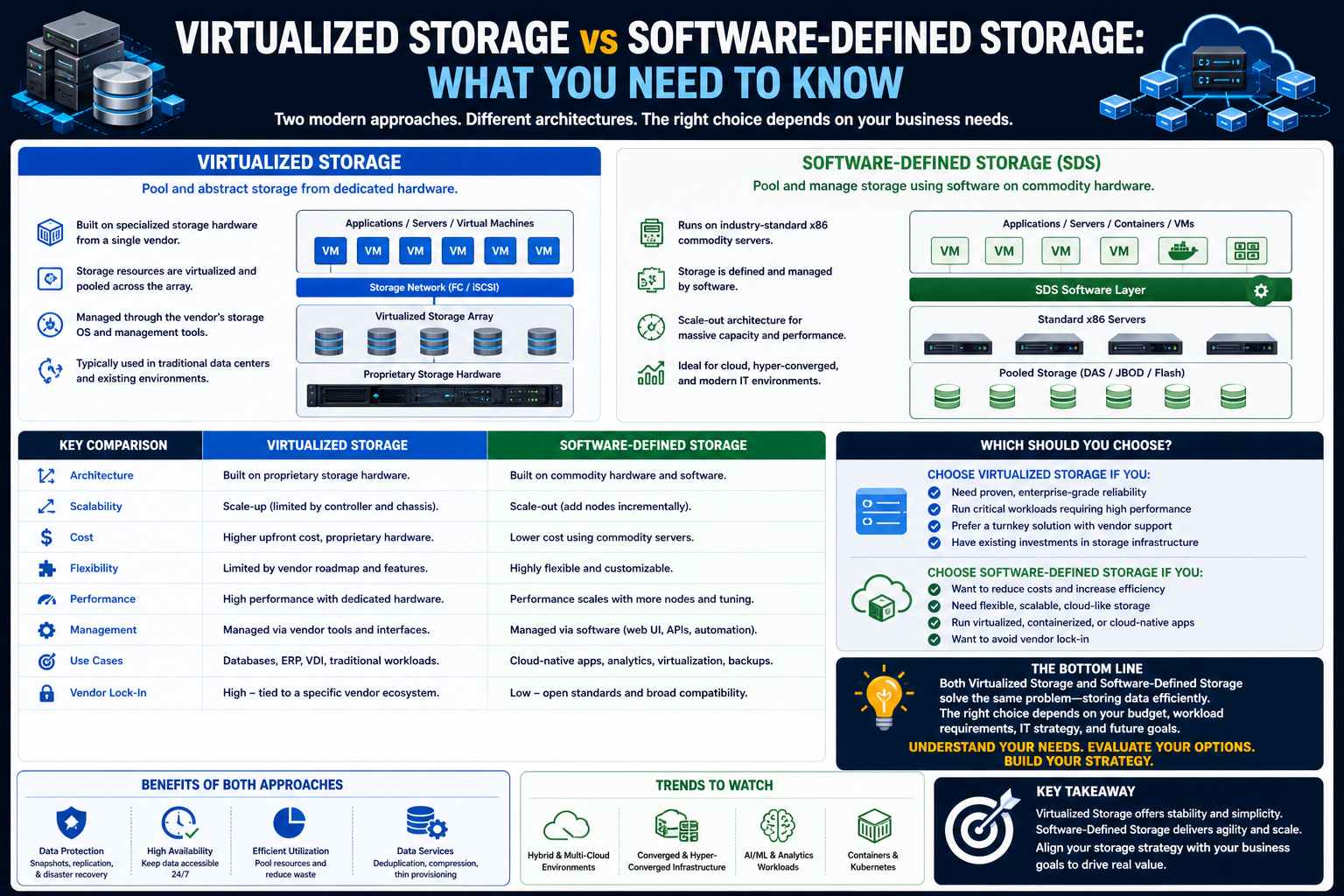
Software-defined storage and virtualized storage are frequently mentioned together, sometimes even interchangeably in casual discussions, but they address different layers of the storage problem. The confusion comes from the fact that both approaches introduce abstraction, both improve flexibility, and both reduce dependency on physical hardware.
However, the intent behind each model is different. Virtualized storage focuses primarily on pooling and abstracting existing physical storage resources. Software-defined storage goes further by decoupling storage intelligence and services from hardware entirely and placing them under software control.
This subtle but important distinction shapes how each technology is deployed and what problems it solves. Virtualization is primarily about unification and visibility. Software-defined storage is about orchestration, automation, and programmable infrastructure.
In modern enterprise environments, both approaches often coexist. Rather than replacing one another, they complement each other depending on workload requirements, infrastructure maturity, and operational goals.
Architectural Differences Between SDS and Virtualized Storage
At a structural level, the difference between software-defined storage and virtualized storage lies in where intelligence is placed and how storage services are delivered.
Virtualized storage is typically implemented as an abstraction layer sitting above physical storage devices. It aggregates multiple storage arrays into a unified pool and presents them as logical volumes to servers and applications. The underlying hardware still plays a significant role in defining performance, capabilities, and limitations.
Software-defined storage, on the other hand, shifts storage control into a software layer that is not dependent on any specific hardware configuration. It defines storage services independently and then maps them onto available resources, which may include commodity servers, cloud storage, or hybrid environments.
This architectural separation allows SDS to operate in environments where hardware diversity is expected. Virtualized storage, while flexible, is often still anchored to storage arrays or SAN-based infrastructures.
Another key architectural difference is control granularity. Virtualized storage operates primarily at the level of data abstraction and pooling. SDS operates at a higher level, controlling policies, automation workflows, data placement logic, and service orchestration.
The Role of Control Layers in Each Model
Control layers are central to both technologies, but they function differently.
In virtualized storage systems, the control layer is responsible for mapping logical storage requests to physical storage locations. It maintains metadata tables, manages routing of data requests, and ensures consistency across the storage pool. Its primary job is translation and coordination.
In software-defined storage systems, the control layer is significantly more sophisticated. It not only handles data mapping but also enforces policies, automates provisioning, manages replication strategies, and dynamically adjusts resource allocation based on workload behavior.
This means that SDS control layers behave more like orchestration engines, while virtualized storage control layers behave more like translation and abstraction engines.
The difference in intelligence level directly impacts scalability and automation capabilities. SDS environments are designed to self-adjust with minimal human intervention, while virtualized storage environments typically require more predefined configuration and oversight.
Data Flow Differences Between SDS and Virtualized Storage
Understanding how data moves through each system helps clarify their functional differences.
In virtualized storage, data flows from the application to the virtualization layer, which determines where the data should be stored and then writes it to the appropriate physical device. When data is retrieved, the same mapping system is used to locate it.
This flow is relatively straightforward and heavily dependent on the mapping tables maintained by the virtualization system.
In software-defined storage, data flow is influenced by additional decision-making layers. When data is written, the SDS controller evaluates multiple factors such as performance requirements, storage tier policies, replication rules, and system load before determining placement.
This means that data flow in SDS environments is more dynamic and context-aware. It is not simply about location mapping but about intelligent placement and lifecycle management.
For example, frequently accessed data might be automatically moved to high-performance storage tiers, while archival data may be shifted to lower-cost storage without manual intervention.
Storage Resource Management: Static Pools vs Dynamic Policies
Virtualized storage typically relies on static or semi-static resource pools. Storage devices are grouped into logical pools, and administrators assign volumes or quotas based on expected usage.
Once configured, these pools tend to remain relatively stable unless manually adjusted. While some optimization features exist, the system does not fundamentally rethink how resources are allocated in real time.
Software-defined storage introduces policy-driven management. Instead of assigning fixed resources, administrators define rules that determine how storage should behave under different conditions.
These policies may include rules such as performance thresholds, data retention requirements, redundancy levels, and cost optimization strategies.
The system then continuously evaluates these policies and adjusts resource allocation dynamically. This creates a living storage environment that evolves based on demand and system behavior.
Automation Depth and Operational Intelligence
One of the most significant differences between the two approaches is the level of automation.
Virtualized storage introduces automation primarily in the context of storage provisioning and basic load balancing. It reduces manual effort by simplifying how storage is allocated and managed across multiple devices.
However, many operational tasks still require human intervention, especially when it comes to optimization, scaling decisions, and policy adjustments.
Software-defined storage takes automation significantly further. It is designed to minimize manual intervention by automating not only provisioning but also performance tuning, data migration, fault recovery, and capacity planning.
In many SDS environments, the system can detect performance degradation and automatically redistribute workloads or move data between tiers without administrator involvement.
This level of automation is essential in large-scale environments where manual management would be too slow or error-prone.
Storage Scalability Models and Expansion Behavior
Scalability is another area where SDS and virtualized storage differ in implementation.
Virtualized storage systems typically scale by adding more physical storage devices into the existing pool. While this expands capacity, it often requires careful planning to maintain balance and performance across the system.
Scaling may involve reconfiguring pools, redistributing data, or updating mapping tables. Although virtualization simplifies the process compared to traditional storage, scaling is still somewhat structured.
Software-defined storage is designed for horizontal scalability. New nodes or storage resources can be added dynamically, and the system automatically integrates them into existing policies and workloads.
This allows SDS environments to scale more fluidly, often without requiring manual redistribution of data. The system continuously rebalances itself as new resources are added.
This difference makes SDS particularly well-suited for cloud-like environments where scaling needs to be rapid and frequent.
Performance Management and Optimization Approaches
Performance optimization in virtualized storage systems is largely based on load balancing and caching strategies. The system distributes workloads across available storage devices to prevent bottlenecks and improve responsiveness.
However, optimization is typically reactive rather than predictive. The system responds to changes in workload but does not always anticipate them.
Software-defined storage introduces more advanced performance optimization techniques. Because SDS systems continuously monitor workload behavior, they can proactively adjust resource allocation before performance issues become noticeable.
For example, if a workload begins to show increased latency, the system may preemptively migrate it to higher-performance storage or allocate additional resources.
SDS environments also often incorporate tiered storage strategies, automatically moving data between performance tiers based on usage patterns.
This proactive approach to optimization allows SDS to maintain more consistent performance under variable workloads.
Integration with Cloud and Hybrid Environments
Modern enterprise storage rarely exists in isolation. Most organizations operate hybrid environments that combine on-premises infrastructure with cloud-based storage services.
Virtualized storage can integrate with cloud systems, but its role is typically limited to extending existing storage pools or providing connectivity between environments.
Software-defined storage is inherently more aligned with hybrid and cloud architectures. Because it abstracts storage services from hardware, it can seamlessly span across on-premises and cloud resources.
In hybrid setups, SDS can treat cloud storage as another tier within the storage ecosystem. Data can be moved between local and cloud environments based on cost, performance, or compliance requirements.
This flexibility enables organizations to build unified storage strategies that span multiple environments without requiring separate management systems.
Data Lifecycle Management and Policy Enforcement
Data lifecycle management refers to how data is stored, accessed, archived, and eventually deleted over time.
In virtualized storage systems, lifecycle management is often implemented through manual policies or external tools. Administrators define retention rules, but enforcement may require additional processes.
Software-defined storage integrates lifecycle management directly into the storage system. Policies are embedded into the control layer and automatically enforced across the entire environment.
This means that data can be automatically classified, moved to different storage tiers, archived, or deleted based on predefined rules.
For example, frequently accessed data may remain on high-performance storage, while older data may be gradually migrated to cheaper storage tiers or long-term archival systems.
This automated lifecycle management reduces administrative burden and ensures consistent policy enforcement.
Security Considerations Across Both Models
Security is a critical component of any storage architecture, and both virtualized storage and SDS approaches incorporate security mechanisms, but in different ways.
Virtualized storage typically relies on traditional security models such as access control lists, encryption at rest, and network segmentation. Security is enforced at the storage system level and often configured manually.
Software-defined storage integrates security into its policy-driven framework. This allows security rules to be applied dynamically based on data type, location, or usage behavior.
In SDS environments, encryption, access control, and compliance policies can be automated and consistently enforced across all storage resources.
This reduces the risk of misconfiguration and ensures that security policies remain consistent even as the storage environment changes dynamically.
Role of Storage in Containerized and Cloud-Native Applications
Modern application architectures increasingly rely on containers and microservices. These environments require storage systems that can dynamically provision resources at the speed of application deployment.
Virtualized storage can support container environments, but it often requires integration with additional orchestration tools to provide dynamic provisioning capabilities.
Software-defined storage is more naturally aligned with containerized environments. It can integrate directly with orchestration systems and provide storage resources on demand as containers are created and destroyed.
This dynamic provisioning capability is essential in environments where applications scale rapidly and frequently.
Storage systems must be able to keep pace with application lifecycle changes, and SDS is designed specifically for this level of agility.
Operational Complexity and Administrative Overhead
One of the key differences between the two approaches is the level of operational complexity involved.
Virtualized storage simplifies management compared to traditional storage systems but still requires administrators to manage pools, mappings, and performance configurations.
Software-defined storage significantly reduces operational complexity by automating many of these tasks. Administrators focus more on defining policies and less on managing individual storage components.
This shift changes the role of storage administrators from infrastructure managers to policy architects.
Coexistence in Enterprise Environments
In many real-world environments, software-defined storage and virtualized storage are not mutually exclusive. Instead, they coexist within layered architectures.
Virtualized storage may be used within specific infrastructure domains to manage legacy systems or SAN-based environments, while SDS provides a higher-level orchestration layer across distributed resources.
This layered approach allows organizations to gradually transition toward more software-driven architectures without replacing existing infrastructure entirely.
It also enables flexibility in choosing the right tool for the right workload. High-performance environments may rely on virtualized storage, while large-scale distributed systems may leverage SDS capabilities.
Emerging Trends in Storage Architecture Evolution
Storage systems continue to evolve toward greater abstraction, automation, and intelligence. Several emerging trends are shaping how both SDS and virtualized storage will develop in the future.
One major trend is the increasing use of artificial intelligence and machine learning in storage management. These technologies are being used to analyze workload patterns and optimize storage behavior automatically.
Another trend is the continued convergence of storage, compute, and networking into unified infrastructure platforms. This convergence reduces silos and improves overall system efficiency.
There is also a growing emphasis on policy-driven infrastructure, where administrators define desired outcomes rather than configuring low-level system details.
These trends suggest that future storage systems will become increasingly autonomous, adaptive, and integrated across multiple environments.
Conclusion
The evolution of modern storage technologies reflects a broader transformation in information technology, where flexibility, automation, and abstraction have become essential rather than optional. As organizations continue to generate and depend on vast amounts of data, traditional storage approaches struggle to keep pace with demands for scalability, efficiency, and agility. This shift has given rise to both virtualized storage and software-defined storage, two closely related but fundamentally different approaches that address modern storage challenges in complementary ways.
Virtualized storage introduced a significant improvement over traditional hardware-centric models by abstracting physical storage resources into unified logical pools. This abstraction simplifies management, improves utilization, and enables organizations to work with heterogeneous storage systems as if they were a single cohesive environment. By masking the complexity of underlying hardware, virtualized storage reduces administrative burden and allows more efficient use of existing infrastructure. It has become a foundational technology in environments where centralized control and interoperability are important, particularly in enterprise storage networks.
Software-defined storage, however, extends this concept much further by decoupling storage intelligence from hardware entirely. Instead of simply pooling resources, it introduces a software-driven control layer that manages provisioning, automation, data placement, and policy enforcement dynamically. This allows storage systems to behave more intelligently, adapting in real time to workload demands, performance requirements, and capacity changes. SDS environments are designed to be highly flexible, scalable, and resilient, often operating across diverse hardware platforms and even spanning hybrid cloud infrastructures.
The key distinction between the two lies in scope and control. Virtualized storage focuses on unification and abstraction of physical resources, while software-defined storage focuses on orchestration and automation of storage services. One simplifies how storage is viewed and accessed; the other transforms how storage behaves and responds. Together, they represent different stages in the broader journey toward fully software-driven infrastructure.
In practical enterprise environments, these technologies are not mutually exclusive. Many organizations deploy them side by side, using virtualized storage to manage specific hardware layers while leveraging SDS for broader automation and policy-driven control. This layered approach allows businesses to modernize gradually without discarding existing investments, ensuring continuity while still benefiting from innovation.
As data continues to grow in volume, velocity, and variety, the importance of intelligent storage systems will only increase. Future storage environments are expected to become even more autonomous, with greater reliance on analytics, predictive optimization, and self-healing capabilities. The boundaries between storage, compute, and networking will continue to blur, leading to more unified infrastructure models that prioritize outcomes over configuration complexity.
Ultimately, both virtualized storage and software-defined storage represent critical steps in the ongoing evolution of data management. They reflect a clear industry direction toward systems that are more adaptable, efficient, and responsive to real-world demands. Understanding their differences and relationships is essential for designing storage architectures that can support the next generation of digital workloads and applications.