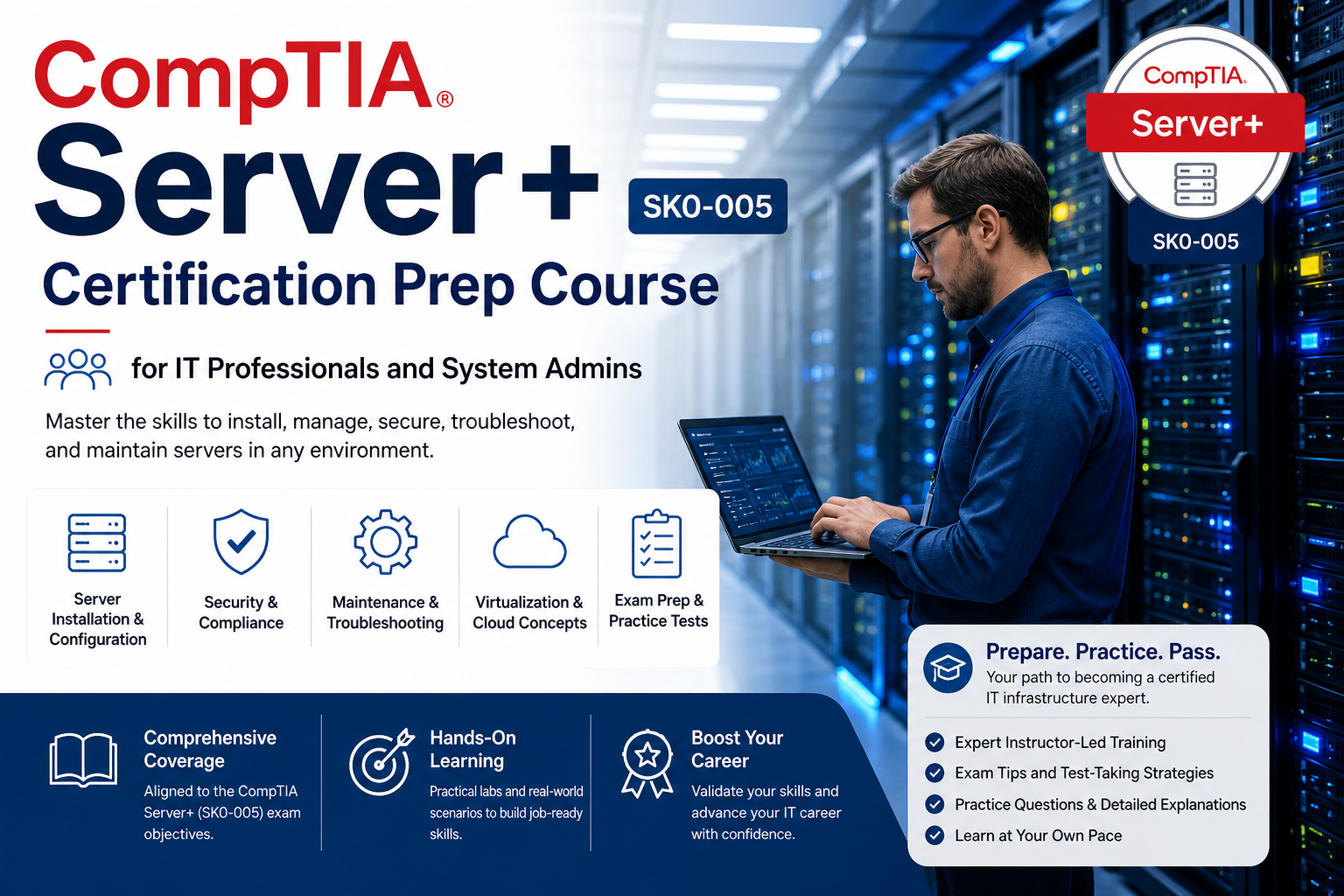
In today’s digital-driven world, servers form the backbone of nearly every service, application, and online experience. Whether a person is streaming a video, accessing cloud storage, or working within a corporate system, there is always a server working behind the scenes to deliver data efficiently and securely. As organizations continue to expand their digital infrastructure, the demand for skilled professionals who can manage these systems has grown significantly.
Server environments are no longer limited to traditional on-premises data centers. They now span across hybrid and cloud-based infrastructures, where systems must communicate seamlessly across multiple platforms. This evolution has increased the complexity of server management, making it essential for IT professionals to develop a strong understanding of how servers operate in different environments.
At the core of server systems is the responsibility of maintaining uptime, ensuring data availability, and supporting enterprise applications. These systems must be carefully installed, configured, monitored, and maintained to ensure continuous operation. Even a small disruption in server performance can lead to significant business impact, including financial losses and reduced productivity.
Understanding server systems requires more than just familiarity with hardware. It involves knowledge of operating systems, storage technologies, networking principles, security practices, and troubleshooting methodologies. Each of these areas plays a critical role in ensuring that server infrastructure remains stable and efficient.
The Importance of Vendor-Neutral Server Knowledge
One of the most valuable aspects of modern server education is the emphasis on vendor-neutral knowledge. In many IT environments, professionals encounter hardware and software from a variety of manufacturers. If training is tied to a specific vendor, it can limit a technician’s ability to adapt to different systems.
Vendor-neutral knowledge focuses on universal principles that apply across different platforms. This includes understanding how servers are built, how they store and process data, and how they interact with networks and users. By learning these core concepts, IT professionals gain the flexibility to work in diverse environments without being restricted to one ecosystem.
This approach is particularly important in organizations that use hybrid infrastructures. In such environments, some servers may be hosted on-premises while others operate in cloud platforms. Despite the differences in deployment, the fundamental principles of server management remain consistent.
A strong foundation in vendor-neutral concepts also improves problem-solving skills. When technicians understand how systems work at a fundamental level, they are better equipped to diagnose and resolve issues regardless of the specific hardware or software involved. This adaptability is essential in fast-paced IT environments where technologies are constantly evolving.
Server Hardware Fundamentals and Physical Infrastructure
Server systems begin with physical hardware, which serves as the foundation for all computing operations. Unlike standard desktop computers, servers are designed for reliability, scalability, and continuous operation. They are typically housed in data centers where environmental conditions such as temperature, humidity, and airflow are carefully controlled.
A server’s hardware includes components such as processors, memory modules, storage drives, power supplies, and network interfaces. Each component plays a critical role in system performance. For example, processors handle computation tasks, while memory allows for fast data access. Storage systems retain long-term data, and network interfaces enable communication with other systems.
Proper installation of server hardware is essential for stability. This includes physically mounting servers in racks, connecting power supplies, and ensuring proper cable management. In data center environments, structured cabling systems are used to organize connections and minimize clutter, which helps improve airflow and simplifies maintenance.
Maintenance of server hardware also involves monitoring component health. Over time, parts such as hard drives and cooling fans may degrade and require replacement. Proactive maintenance helps prevent unexpected failures and ensures continuous system availability.
Another important aspect of server hardware is redundancy. Many servers are designed with duplicate components such as power supplies and storage drives. This ensures that if one component fails, another can take over without interrupting operations. This level of resilience is crucial for mission-critical systems.
Storage Systems and Data Management in Server Environments
Data storage is one of the most critical functions of server systems. Organizations rely on servers to store vast amounts of information, including business records, application data, and user files. As data continues to grow exponentially, efficient storage management has become increasingly important.
Server storage systems come in different forms, including direct-attached storage, network-attached storage, and storage area networks. Each type serves different purposes depending on performance requirements and scalability needs. Understanding how these storage systems operate helps IT professionals design efficient data architectures.
One key concept in server storage is redundancy through RAID configurations. RAID allows data to be distributed across multiple drives to improve performance and protect against hardware failure. Different RAID levels offer different balances between speed, capacity, and fault tolerance.
In addition to redundancy, storage performance is also influenced by drive types. Traditional hard disk drives offer large capacity at lower cost, while solid-state drives provide faster performance and improved reliability. Many modern server environments use a combination of both to balance cost and efficiency.
Data management also involves organizing how information is accessed and secured. Proper file system configuration ensures that users and applications can retrieve data efficiently without compromising system stability. As organizations scale, storage systems must also scale to accommodate increasing data demands.
Server Operating Systems and Software Configuration
While hardware forms the foundation of server systems, software defines how those systems function. Server operating systems are designed specifically to manage hardware resources and provide services to users and applications.
These operating systems differ from standard desktop systems in several ways. They are optimized for stability, performance, and multitasking capabilities. They also include advanced features for managing users, permissions, and network services.
Installing and configuring a server operating system is a critical step in system deployment. This process involves selecting appropriate settings for performance, security, and connectivity. Once installed, administrators must configure services such as file sharing, web hosting, and database management depending on organizational needs.
Server operating systems also provide tools for monitoring system performance. These tools allow administrators to track CPU usage, memory consumption, and disk activity. By analyzing this data, potential issues can be identified before they affect system performance.
Another important aspect of server software is patch management. Regular updates are necessary to address security vulnerabilities and improve system stability. Failing to apply updates can leave systems exposed to potential threats.
Identity Management and Access Control Principles
Security is a fundamental aspect of server administration. One of the most important components of server security is identity and access management. This ensures that only authorized users can access specific systems and data.
Identity management involves creating and maintaining user accounts within a server environment. Each user is assigned credentials that determine what resources they can access. These permissions are carefully controlled to prevent unauthorized activity.
Access control systems use policies to define levels of authorization. For example, some users may only have read access to certain files, while others may have full administrative privileges. This layered approach helps reduce security risks by limiting access based on job roles.
Authentication mechanisms also play a key role in server security. These mechanisms verify the identity of users before granting access. Common methods include passwords, multi-factor authentication, and digital certificates.
In enterprise environments, centralized identity management systems are often used. These systems allow administrators to manage user accounts across multiple servers from a single location, improving efficiency and consistency.
Server Virtualization and Resource Optimization
Virtualization has become a fundamental technology in modern server environments. It allows multiple virtual machines to run on a single physical server, each operating as an independent system. This improves resource utilization and reduces hardware costs.
Through virtualization, organizations can deploy multiple operating systems and applications on the same physical infrastructure. Each virtual machine is isolated from others, ensuring stability and security.
One of the key benefits of virtualization is flexibility. Virtual machines can be created, modified, and deleted quickly without affecting physical hardware. This makes it easier to test new applications and scale resources as needed.
Virtualization also improves disaster recovery capabilities. Virtual machines can be backed up and restored more easily than physical systems, reducing downtime in the event of failure.
Modern server environments often use hypervisor technology to manage virtual machines. Hypervisors allocate resources such as CPU, memory, and storage to each virtual machine, ensuring balanced performance across the system.
Data Center Environments and Physical Security Considerations
Servers are often housed in data centers, which are specialized facilities designed to support large-scale computing infrastructure. These environments are carefully controlled to ensure optimal performance and security.
Temperature regulation is one of the most important aspects of data center management. Servers generate significant heat, and without proper cooling systems, equipment can overheat and fail. Air conditioning systems and airflow management techniques are used to maintain stable temperatures.
Physical security is equally important in data centers. Access to server rooms is typically restricted to authorized personnel only. Security measures may include access cards, biometric scanners, and surveillance systems.
Power management is another critical factor. Data centers often use redundant power supplies and backup generators to ensure continuous operation during power outages. This redundancy helps prevent downtime and data loss.
Cable management and structured layouts are also essential in data centers. Proper organization of cables improves airflow, reduces maintenance complexity, and minimizes the risk of accidental disconnections.
Monitoring, Troubleshooting, and System Reliability
Maintaining server reliability requires continuous monitoring and proactive troubleshooting. Monitoring tools provide real-time insights into system performance, allowing administrators to detect anomalies early.
When issues arise, troubleshooting involves identifying the root cause of the problem. This may include analyzing system logs, checking hardware components, or reviewing configuration settings.
Common server issues include hardware failures, software conflicts, network disruptions, and resource bottlenecks. Each of these issues requires a systematic approach to diagnosis and resolution.
Preventive maintenance plays a key role in reducing system downtime. Regular inspections, updates, and performance evaluations help ensure that servers remain stable and efficient over time.
Reliability is ultimately achieved through a combination of proper configuration, ongoing monitoring, and effective problem-solving techniques.
Server Troubleshooting Methodologies and Structured Problem Solving
In complex server environments, problems rarely present themselves in a straightforward way. A server may slow down, services may become unresponsive, or network communication may fail intermittently without clear warning signs. Because of this complexity, effective troubleshooting is not just a technical skill but a structured approach to identifying, isolating, and resolving issues in a logical manner.
A disciplined troubleshooting methodology begins with understanding the symptoms of the problem. Symptoms are the visible effects experienced by users or systems, such as delayed responses, failed logins, or inaccessible applications. However, symptoms alone do not reveal the root cause. They only provide clues that guide further investigation.
The next step involves gathering information. This includes reviewing system logs, monitoring performance metrics, and checking recent configuration changes. Logs are especially valuable because they record events that occurred before, during, and after an issue. By analyzing patterns in these logs, technicians can often identify anomalies that point toward the source of the problem.
Once sufficient data has been collected, the issue is isolated. Isolation involves narrowing down possible causes by testing different components of the system. For example, if a server is unreachable, the problem could lie in network connectivity, firewall rules, hardware failure, or service misconfiguration. Each possibility must be tested systematically to eliminate uncertainty.
After identifying the root cause, the next step is implementing a solution. This may involve restarting services, replacing hardware, correcting configuration errors, or applying updates. However, resolving the immediate issue is not enough. It is equally important to verify that the solution has fully resolved the problem without introducing new complications.
Finally, documentation plays a critical role in troubleshooting. Recording the issue, the steps taken to resolve it, and the final outcome helps build institutional knowledge. This information becomes valuable for future reference, especially when similar issues occur.
Advanced Network Architecture in Server Environments
Servers do not operate in isolation; they are deeply integrated into network infrastructures that allow communication between systems, users, and applications. Understanding network architecture is essential for maintaining reliable server performance.
At the foundation of server networking is the concept of IP addressing. Each server must have a unique address that allows it to be identified within a network. These addresses can be static or dynamically assigned depending on organizational requirements. Static addressing is often used for critical servers to ensure consistent accessibility.
Routing is another key component of network architecture. Routers direct data packets between different networks, ensuring that information reaches its intended destination. In server environments, routing must be carefully configured to optimize performance and minimize latency.
Switches play a crucial role in connecting multiple devices within a local network. They manage data traffic between servers, storage systems, and client devices. Proper switch configuration helps prevent bottlenecks and ensures efficient data flow.
Network segmentation is commonly used to improve both performance and security. By dividing a network into smaller segments, administrators can isolate traffic, reduce congestion, and limit the spread of potential security threats.
Firewalls are another essential component of server networking. They act as barriers between trusted and untrusted networks, filtering incoming and outgoing traffic based on predefined rules. Proper firewall configuration is critical for protecting servers from unauthorized access and malicious activity.
Server Security Hardening Techniques and Risk Mitigation
Security in server environments extends far beyond basic access control. It involves a layered approach known as defense in depth, where multiple security mechanisms work together to protect systems from threats.
Server hardening is the process of reducing vulnerabilities by minimizing attack surfaces. This includes disabling unnecessary services, removing unused software, and closing unused network ports. The fewer entry points a system has, the harder it becomes for attackers to exploit it.
Patch management is a fundamental aspect of security hardening. Software vulnerabilities are regularly discovered, and vendors release updates to address them. Keeping servers up to date ensures that known vulnerabilities are mitigated before they can be exploited.
Encryption is another critical security measure. Data stored on servers and data transmitted across networks can both be encrypted to prevent unauthorized access. Even if data is intercepted, encryption ensures that it remains unreadable without proper keys.
Access logging and auditing are also important for security monitoring. By tracking user activity, administrators can detect suspicious behavior and respond to potential threats before they escalate.
Physical security should not be overlooked. Even the most secure software systems can be compromised if physical access to hardware is not controlled. Data centers often implement strict access policies to prevent unauthorized entry.
Backup Strategies and Disaster Recovery Planning
Data loss can have severe consequences for any organization, making backup and disaster recovery strategies essential components of server management. These strategies ensure that data can be restored in the event of hardware failure, cyberattacks, or natural disasters.
Backups involve creating copies of data at regular intervals. These copies are stored separately from the original data to prevent simultaneous loss. Different backup strategies exist, including full backups, incremental backups, and differential backups. Each method offers a different balance between storage efficiency and recovery speed.
Storage location is another important consideration. Backups can be stored locally, offsite, or in cloud environments. Offsite storage provides additional protection against physical disasters such as fire or flooding.
Disaster recovery planning goes beyond backups. It involves creating a structured plan for restoring systems and resuming operations after a major disruption. This includes defining recovery time objectives and recovery point objectives, which determine how quickly systems must be restored and how much data loss is acceptable.
Testing disaster recovery plans is essential to ensure they work effectively when needed. Regular simulations help identify weaknesses in the plan and allow organizations to make improvements before an actual disaster occurs.
Server Lifecycle Management and Infrastructure Evolution
Servers, like all technology, go through a lifecycle that includes deployment, operation, maintenance, and eventual decommissioning. Managing this lifecycle effectively ensures that infrastructure remains efficient and cost-effective.
The deployment phase involves planning and installing server systems based on organizational needs. This includes selecting hardware, configuring software, and integrating systems into existing infrastructure.
During the operational phase, servers are actively used to support business processes. This phase requires ongoing monitoring, maintenance, and optimization to ensure performance and reliability.
As technology evolves, older servers may become less efficient or incompatible with new systems. This leads to the maintenance and upgrade phase, where components are replaced or systems are enhanced to meet new requirements.
Eventually, servers reach the end of their useful life. Decommissioning involves securely removing systems from operation. This includes data wiping, hardware disposal, and documentation updates to ensure compliance with security and regulatory standards.
Hybrid Infrastructure and Multi-Environment Server Integration
Modern organizations often operate in hybrid environments that combine on-premises infrastructure with cloud-based services. This approach provides flexibility, scalability, and cost efficiency.
In hybrid environments, servers must be able to communicate across different platforms. This requires careful network configuration and integration between systems. Data synchronization is also essential to ensure consistency across environments.
Cloud-based servers offer scalability that traditional infrastructure cannot easily match. Resources can be adjusted dynamically based on demand, allowing organizations to handle workload fluctuations more efficiently.
However, hybrid environments also introduce complexity. Managing multiple platforms requires strong coordination and consistent configuration practices. Security policies must also be applied uniformly across all environments to prevent vulnerabilities.
Integration tools and management platforms help unify hybrid infrastructures. These tools provide centralized visibility and control, allowing administrators to monitor both on-premises and cloud-based systems from a single interface.
Server Automation and Configuration Management
Automation has become increasingly important in modern server environments. It reduces manual workload, minimizes human error, and improves consistency across systems.
Configuration management tools allow administrators to define system settings in a structured format. These configurations can then be automatically applied across multiple servers, ensuring uniformity.
Automation is also used for routine tasks such as software updates, system monitoring, and backup execution. By automating these processes, administrators can focus on more complex tasks that require human judgment.
Scripting plays a key role in automation. Scripts can be used to perform repetitive tasks quickly and accurately. This improves efficiency and reduces the risk of configuration drift, where systems gradually become inconsistent over time.
In large-scale environments, automation is essential for maintaining control over thousands of servers. Without it, managing such environments manually would be impractical and error-prone.
Performance Optimization and Resource Management
Server performance is influenced by how effectively resources such as CPU, memory, storage, and network bandwidth are utilized. Poor resource management can lead to slow performance and system instability.
Monitoring tools provide insights into resource usage, allowing administrators to identify bottlenecks. For example, high CPU usage may indicate inefficient applications, while memory exhaustion may point to memory leaks or insufficient allocation.
Load balancing is a technique used to distribute workloads evenly across multiple servers. This prevents any single server from becoming overwhelmed and ensures consistent performance.
Caching mechanisms also improve performance by storing frequently accessed data in faster storage locations. This reduces the need to retrieve data from slower storage systems.
Performance tuning involves adjusting system configurations to optimize efficiency. This may include modifying memory allocation, adjusting network settings, or optimizing database queries.
Logging Systems and Event Analysis in Server Operations
Logging systems play a critical role in server management by recording events that occur within the system. These logs provide valuable insights into system behavior and are essential for troubleshooting and security monitoring.
Different types of logs capture different kinds of information. System logs record operating system events, application logs track software behavior, and security logs monitor authentication and access attempts.
Analyzing logs requires identifying patterns and anomalies. For example, repeated login failures may indicate a security threat, while sudden spikes in resource usage may signal a performance issue.
Centralized logging systems are often used in large environments to collect logs from multiple servers. This allows administrators to analyze data from a single location, improving efficiency and visibility.
Incident Response and Operational Continuity in Server Systems
When unexpected issues occur in server environments, a structured incident response process is essential to minimize impact and restore normal operations. Incident response focuses on detecting, containing, resolving, and learning from disruptions.
The first stage of incident response involves detection. Monitoring systems and alerts help identify issues as soon as they occur. Early detection is critical for reducing downtime and preventing further damage.
Once an incident is detected, containment measures are applied. This may involve isolating affected systems, restricting access, or disabling compromised services to prevent the issue from spreading.
After containment, the resolution phase begins. Technicians work to eliminate the root cause of the incident and restore normal system functionality. This may require collaboration across multiple teams depending on the severity of the issue.
Following resolution, a review process is conducted to analyze what happened, why it happened, and how it can be prevented in the future. This continuous improvement cycle helps strengthen overall system resilience and operational continuity.
Modern Data Center Design and Infrastructure Optimization
Modern server environments depend heavily on well-designed data centers that can support high-density computing, scalability, and continuous uptime. As organizations expand their digital operations, data centers have evolved from simple server rooms into highly engineered facilities designed for efficiency, resilience, and controlled environmental conditions.
A key principle in data center design is redundancy. Everything from power supplies to network connections is duplicated to ensure that a single point of failure does not disrupt operations. This redundancy extends across multiple layers, including power distribution units, cooling systems, and internet connectivity.
Cooling is one of the most critical aspects of data center infrastructure. Servers generate significant heat during operation, and if that heat is not managed effectively, it can lead to hardware failure or performance degradation. Modern facilities use advanced cooling techniques such as hot aisle and cold aisle containment to separate airflow and maintain stable temperatures.
Power management is equally important. Data centers often rely on uninterruptible power supplies and backup generators to maintain continuous operation during outages. These systems ensure that servers remain operational even when the primary power grid fails.
Physical layout also plays a significant role in data center efficiency. Server racks are arranged in structured configurations to optimize airflow and simplify maintenance. Proper spacing between equipment reduces heat buildup and improves accessibility for technicians.
Cable management is another important design consideration. Poorly organized cabling can obstruct airflow, complicate troubleshooting, and increase the risk of accidental disconnections. Structured cabling systems help maintain order and improve overall system reliability.
Hyperconverged Infrastructure and Modern Server Integration
As server environments become more complex, organizations are increasingly adopting hyperconverged infrastructure models. This approach integrates computing, storage, and networking into a single system, simplifying management and improving scalability.
Traditional infrastructure separates these components into distinct systems, which can lead to complexity and inefficiency. Hyperconverged systems combine them into unified platforms managed through software-defined technologies.
One of the primary benefits of this model is simplified administration. Instead of managing multiple systems independently, administrators can control all resources through a centralized interface. This reduces operational overhead and improves consistency.
Scalability is another advantage. Organizations can expand their infrastructure by simply adding more nodes to the system. Each new node increases computing power, storage capacity, and network bandwidth simultaneously.
Hyperconverged systems also improve resource utilization. By pooling resources across multiple nodes, workloads can be distributed more efficiently, reducing bottlenecks and improving performance.
However, implementing hyperconverged infrastructure requires careful planning. Organizations must ensure that their workloads are compatible with this architecture and that performance requirements are met.
Advanced Server Security Architecture and Threat Prevention
Server security has become increasingly sophisticated due to the growing number of cyber threats targeting enterprise environments. Modern security architecture is built on multiple layers designed to protect systems from both external and internal threats.
One of the foundational principles of server security is segmentation. By dividing networks into isolated zones, organizations can limit the spread of potential attacks. Even if one segment is compromised, others remain protected.
Intrusion detection and prevention systems are commonly deployed to monitor network traffic for suspicious activity. These systems analyze patterns and identify potential threats in real time, allowing administrators to respond quickly.
Endpoint security is another critical layer. Servers must be protected from malware, unauthorized access, and malicious scripts. Security software continuously monitors system activity to detect anomalies.
Access control remains one of the most important aspects of security architecture. Least privilege principles ensure that users only have access to the resources necessary for their roles. This reduces the risk of accidental or intentional misuse.
Security policies are enforced through centralized management systems, ensuring consistency across all servers. These policies define authentication methods, password requirements, and access restrictions.
Encryption plays a key role in protecting sensitive data. Both data at rest and data in transit must be encrypted to prevent unauthorized access. Even if data is intercepted, encryption ensures it remains unreadable without the proper keys.
Identity Lifecycle Management in Server Environments
Managing user identities is a continuous process that extends beyond simple account creation. Identity lifecycle management involves controlling user access from onboarding to offboarding.
When a new user joins an organization, their identity must be created within the system. This includes assigning roles, permissions, and access rights based on job responsibilities.
During active employment, user access may change as roles evolve. Administrators must ensure that permissions remain aligned with current responsibilities. This prevents privilege creep, where users accumulate unnecessary access over time.
When a user leaves an organization, their accounts must be deactivated or removed. Failure to properly manage offboarding processes can leave systems vulnerable to unauthorized access.
Centralized identity systems help streamline this process by managing user accounts across multiple servers and applications. This ensures consistency and reduces administrative overhead.
Multi-factor authentication adds an additional layer of security to identity management. By requiring multiple forms of verification, organizations reduce the risk of unauthorized access even if credentials are compromised.
Server Storage Evolution and Data Architecture Strategies
Server storage systems have evolved significantly to meet the growing demands of data-intensive applications. Modern storage architectures focus on scalability, performance, and reliability.
Traditional storage systems often relied on direct-attached storage, where drives were physically connected to individual servers. While simple, this approach limits scalability and flexibility.
Network-attached storage allows multiple servers to access shared storage resources over a network. This improves collaboration and simplifies data management.
Storage area networks provide even greater performance by creating dedicated high-speed networks for storage communication. These systems are commonly used in enterprise environments where performance is critical.
Data tiering is a strategy used to optimize storage efficiency. Frequently accessed data is stored on high-performance storage, while less frequently used data is moved to lower-cost storage systems.
Data deduplication is another important technique that reduces storage requirements by eliminating duplicate copies of data. This improves efficiency and reduces costs.
Virtualization Security and Isolation Mechanisms
While virtualization improves efficiency and flexibility, it also introduces unique security challenges. Ensuring isolation between virtual machines is critical for maintaining system integrity.
Each virtual machine operates independently, but they all share underlying physical resources. Hypervisors are responsible for managing this separation and ensuring that one virtual machine cannot interfere with another.
Virtual machine isolation prevents unauthorized access between systems. Even if one virtual machine is compromised, others remain protected.
Security updates must be applied not only to guest operating systems but also to hypervisors themselves. Vulnerabilities at the hypervisor level can affect all virtual machines running on the host.
Snapshotting is commonly used in virtual environments to capture system states. These snapshots can be used for recovery in case of failure or misconfiguration.
However, snapshots must be managed carefully, as they can consume significant storage resources if left unchecked.
Network Security Protocols and Secure Communication Channels
Secure communication is essential in server environments where sensitive data is constantly transmitted across networks. Various protocols are used to ensure that data remains protected during transmission.
Secure shell protocols are commonly used for remote server administration. These protocols encrypt communication between clients and servers, preventing interception.
Transport layer security is used to encrypt web traffic and other application-level communications. This ensures that data exchanged between systems remains confidential.
Virtual private networks create secure tunnels between remote users and internal networks. This allows secure access to server resources from external locations.
Network access control systems enforce security policies at the network level, ensuring that only authorized devices can connect to server environments.
Capacity Planning and Infrastructure Scaling Strategies
As organizations grow, their server infrastructure must scale accordingly. Capacity planning involves predicting future resource requirements and designing systems that can accommodate growth.
Resource forecasting is based on analyzing current usage patterns and estimating future demand. This helps organizations avoid performance bottlenecks.
Vertical scaling involves increasing the capacity of existing servers by adding more resources such as CPU or memory. While simple, this approach has physical limitations.
Horizontal scaling involves adding more servers to distribute workloads. This approach offers greater flexibility and is commonly used in modern distributed systems.
Elastic scaling, often used in cloud environments, allows resources to be adjusted dynamically based on demand. This ensures optimal performance while minimizing costs.
Server Monitoring Tools and Performance Analytics
Continuous monitoring is essential for maintaining server health and performance. Monitoring tools collect data on system metrics such as CPU usage, memory consumption, disk activity, and network traffic.
Real-time monitoring allows administrators to detect issues as they occur. Alerts can be configured to notify administrators when certain thresholds are exceeded.
Historical data analysis helps identify long-term trends and patterns. This information can be used to optimize system performance and plan for future upgrades.
Performance dashboards provide visual representations of system health, making it easier to interpret complex data.
Automation in Large-Scale Server Management
Automation has become indispensable in managing large server environments. It reduces manual intervention, increases consistency, and improves operational efficiency.
Configuration automation ensures that all servers are set up identically according to predefined standards. This reduces configuration drift and simplifies management.
Patch automation ensures that systems are regularly updated without manual intervention. This improves security and reduces administrative workload.
Provisioning automation allows new servers to be deployed quickly and efficiently. This is especially important in environments where rapid scaling is required.
Workflow automation integrates multiple processes into streamlined sequences, improving overall operational efficiency.
Cloud Integration and Distributed Server Ecosystems
Cloud computing has transformed the way server environments are designed and managed. Many organizations now operate distributed ecosystems that combine local infrastructure with cloud services.
Cloud integration allows organizations to extend their server capabilities without investing heavily in physical hardware. Resources can be provisioned on demand, providing flexibility and scalability.
Data synchronization between cloud and on-premises systems ensures consistency across environments. This is essential for hybrid infrastructures.
Latency management is important in distributed systems. Data must be delivered quickly and efficiently regardless of location.
Security in cloud-integrated environments requires careful configuration to ensure that data remains protected across all platforms.
Incident Detection, Response Coordination, and Recovery Systems
Incident management in server environments requires coordination between detection systems, response teams, and recovery processes. The goal is to minimize downtime and restore normal operations as quickly as possible.
Detection systems continuously monitor for anomalies and trigger alerts when issues are identified. These alerts must be prioritized based on severity.
Response coordination involves assigning tasks to appropriate teams based on the nature of the incident. Communication is critical during this phase to ensure efficient resolution.
Recovery systems restore affected services using backups, failover mechanisms, or redundant infrastructure.
Post-incident analysis is conducted to evaluate response effectiveness and identify areas for improvement. This ensures continuous enhancement of operational resilience.
Emerging Trends in Server Infrastructure and Operational Efficiency
As server environments continue to evolve, organizations are increasingly adopting technologies that improve efficiency, resilience, and scalability. One of the most significant trends is the shift toward software-defined infrastructure, where traditional hardware limitations are reduced through abstraction layers managed by software. This allows administrators to allocate resources dynamically, rather than being restricted by fixed hardware configurations.
Automation continues to expand beyond basic task execution into intelligent orchestration. Modern systems can now adjust workloads, redistribute resources, and even predict failures before they occur. This predictive capability is powered by continuous monitoring and analysis of performance metrics, enabling systems to respond proactively rather than reactively.
Edge computing has also become an important development in server architecture. Instead of relying solely on centralized data centers, processing is increasingly distributed closer to where data is generated. This reduces latency and improves response times, particularly for applications requiring real-time processing such as industrial automation and IoT systems.
Energy efficiency is another growing focus area. Data centers consume large amounts of electricity, making power optimization a critical concern. New server designs prioritize lower energy consumption without sacrificing performance. Techniques such as dynamic power scaling and workload consolidation help reduce unnecessary energy usage.
Security continues to evolve alongside infrastructure advancements. Zero-trust models are becoming more common, where no user or device is automatically trusted, even within internal networks. Every access request is continuously verified, reducing the risk of internal threats and lateral movement within systems.
Containerization is also reshaping how applications are deployed on servers. Instead of running full virtual machines, applications can be packaged into lightweight containers that share system resources more efficiently. This improves deployment speed and reduces overhead, making it easier to manage complex application environments.
Finally, resilience engineering is becoming a key principle in server design. Rather than simply preventing failures, modern systems are designed to withstand and recover from disruptions with minimal impact. This includes built-in redundancy, automated failover mechanisms, and distributed architectures that ensure continuous availability even during partial system failures.
Conclusion
Modern server environments represent one of the most critical foundations of today’s digital world, supporting everything from enterprise applications and cloud services to communication platforms and data-driven systems. As technology continues to advance, the role of servers has expanded far beyond simple data storage or processing tasks. They now operate as highly integrated systems that must deliver reliability, scalability, security, and performance in increasingly complex infrastructures.
Across all server environments—whether on-premises, hybrid, or cloud-based—the core responsibilities remain consistent. Servers must be installed correctly, configured for optimal performance, secured against threats, and maintained throughout their operational lifecycle. However, the methods used to achieve these goals have evolved significantly. Automation, virtualization, and intelligent monitoring have transformed server management from a manual, reactive process into a proactive and highly optimized discipline.
One of the most important themes in modern server management is adaptability. Organizations no longer rely on a single type of infrastructure. Instead, they operate across distributed systems that combine physical servers, virtual machines, and cloud resources. This hybrid approach allows businesses to scale efficiently while maintaining flexibility. It also requires IT professionals to understand a wide range of technologies and be capable of working across different environments seamlessly.
Security remains a central concern in every aspect of server administration. As cyber threats become more sophisticated, server systems must be protected using layered security strategies that include access control, encryption, monitoring, and continuous patching. The concept of zero-trust architecture further reinforces the idea that no system or user should be automatically trusted, ensuring that every interaction is verified and secured.
Equally important is the emphasis on resilience and continuity. Server systems are expected to remain operational at all times, even in the face of hardware failures, network disruptions, or unexpected incidents. This expectation has driven the adoption of redundancy, backup strategies, disaster recovery planning, and fault-tolerant architectures. These mechanisms ensure that services remain available and data integrity is preserved under all conditions.
As server technologies continue to evolve, the importance of foundational knowledge remains unchanged. Understanding how servers function at a fundamental level—how they process data, manage storage, communicate over networks, and enforce security policies—remains essential for anyone working in IT infrastructure roles. This knowledge provides the flexibility needed to adapt to new technologies and changing environments.
Ultimately, server systems are at the heart of modern computing ecosystems. Their reliability and performance directly impact the services that individuals and organizations depend on every day. As technology continues to advance, the demand for skilled professionals capable of managing and optimizing these systems will only continue to grow, reinforcing the importance of strong server administration expertise in the broader IT landscape.