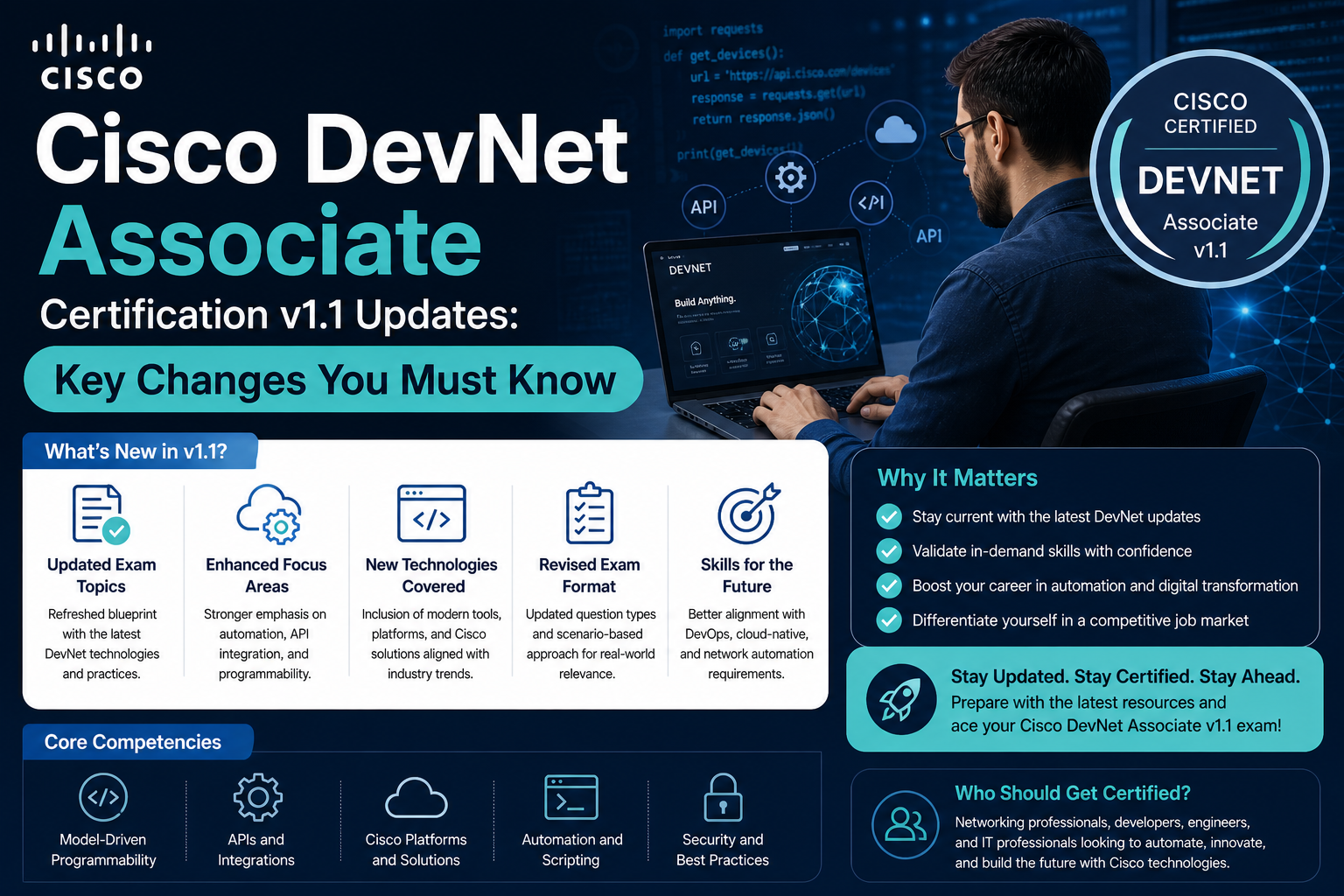
The Cisco DevNet Associate certification exists in a space that has changed more rapidly in the last few years than in the previous decade combined. Traditional network engineering once focused heavily on manual configuration of routers, switches, and firewalls through command-line interfaces. However, modern networks are no longer static infrastructures. They are dynamic systems that behave more like software platforms than isolated hardware environments.
This shift has been driven by several major forces. The first is the rise of cloud computing, where infrastructure is provisioned and managed through code rather than physical interaction. The second is the increasing adoption of DevOps practices, where development and operations teams work together using automation pipelines. The third is the demand for scalability, where organizations need networks that can adapt instantly to traffic, security threats, and application requirements.
In this environment, certifications must evolve to remain relevant. Cisco’s DevNet Associate exam reflects this reality by aligning itself with modern automation workflows and software-driven networking principles. The v1.1 update is not simply a revision of topics; it represents a shift in how Cisco expects engineers to think about infrastructure, automation, and programmability.
Candidates preparing for the exam must therefore understand that they are not just learning tools—they are learning a new way of designing and operating networks where code, APIs, and automation pipelines are central components.
The Philosophy Behind the DevNet Associate Certification Update
Cisco did not update the DevNet Associate exam arbitrarily. The revision reflects a strategic decision to align certification content with real-world industry demands. As enterprises continue to modernize their infrastructure, the gap between traditional networking skills and software-based networking skills has widened.
The DevNet Associate certification was originally designed to bridge this gap by introducing network engineers to programming concepts and automation tools. However, as technologies evolve, certain tools and practices become outdated while new ones gain importance. The v1.1 update ensures that the certification remains a reliable indicator of current industry capabilities.
One of the core philosophies behind the update is relevance. Cisco aims to ensure that professionals certified under this program are capable of working in environments that rely on modern automation frameworks rather than legacy systems. This includes understanding how applications interact with networks through APIs, how infrastructure can be defined using code, and how automation pipelines are integrated into production environments.
Another key principle is simplification through modernization. Instead of requiring candidates to learn multiple outdated tools that are no longer widely used in industry, the updated exam focuses on technologies that reflect current enterprise practices. This reduces unnecessary complexity while improving real-world applicability.
The Shift from Traditional Networking to Network Programmability
Network programmability is at the core of the DevNet Associate certification. It refers to the ability to manage and control network devices using software-based instructions rather than manual configuration. This approach allows for faster deployment, improved consistency, and reduced human error.
In traditional environments, network engineers would configure each device individually using command-line interfaces. This approach worked well in small environments but became inefficient at scale. As networks grew more complex, organizations began to adopt automation tools that could configure multiple devices simultaneously.
The DevNet Associate v1.1 exam reflects this shift by emphasizing programmable interfaces such as REST APIs, configuration models, and automation frameworks. Instead of focusing on device-level configuration, candidates are expected to understand how systems interact through structured data formats and programmable interfaces.
This transition is also closely tied to the concept of infrastructure as code. In this model, network configurations are treated as software artifacts that can be version-controlled, tested, and deployed using automated pipelines. This approach brings networking closer to software development practices, which is why programming knowledge—especially in Python—plays such an important role in the certification.
Why the DevNet Associate Exam Needed a Version Update
The transition from v1.0 to v1.1 was driven by several practical considerations. One of the most important was the rapid evolution of enterprise automation tools. Technologies that were once widely used have gradually been replaced by more efficient and scalable alternatives.
For example, certain configuration management tools that were previously included in the exam are now rarely used in modern enterprise environments. At the same time, newer tools have become essential for automation workflows, particularly those that integrate more seamlessly with cloud-native environments.
Cisco also recognized that its own product ecosystem had evolved significantly. Platforms such as collaboration tools, security systems, and network management solutions have been rebranded or replaced with more advanced versions. Without updating the exam, candidates would be preparing for outdated terminology and workflows that no longer reflect real-world usage.
Another reason for the update is the increasing importance of hybrid and multi-cloud environments. Modern networks are no longer confined to on-premises infrastructure. Instead, they span across data centers, public cloud platforms, and edge environments. This requires engineers to understand a broader set of tools and integration methods.
By updating the exam, Cisco ensures that certified professionals are prepared to operate in these complex, distributed environments.
The Role of Automation in Modern Network Environments
Automation is one of the defining characteristics of modern networking. It allows organizations to manage large-scale infrastructures efficiently while reducing operational overhead. In the context of the DevNet Associate certification, automation is not just a topic—it is a foundational concept.
Automation in networking involves using scripts, tools, and frameworks to perform tasks that would otherwise require manual intervention. These tasks include device configuration, policy deployment, monitoring, and troubleshooting.
The v1.1 update places greater emphasis on automation tools and methodologies that are widely used in enterprise environments. This includes understanding how automation frameworks interact with APIs and how they integrate into continuous integration and continuous delivery pipelines.
A key aspect of automation is consistency. When configurations are applied manually, there is always a risk of human error. Automation eliminates this risk by ensuring that the same instructions are executed consistently across all devices.
Another important aspect is scalability. As networks grow, manual configuration becomes impractical. Automation allows organizations to scale their operations without increasing operational complexity.
The Increasing Importance of APIs in Networking
APIs, or Application Programming Interfaces, are a central component of modern network automation. They allow different systems to communicate with each other in a structured and predictable way. In the context of networking, APIs enable engineers to interact with devices, controllers, and cloud platforms programmatically.
The DevNet Associate exam places strong emphasis on understanding how APIs work and how they are used in real-world scenarios. This includes REST-based APIs, which are commonly used for network automation tasks.
APIs allow engineers to perform actions such as retrieving configuration data, updating device settings, and monitoring network performance. Instead of logging into individual devices, engineers can use scripts to interact with multiple systems simultaneously.
This approach not only improves efficiency but also enables more advanced use cases such as automated remediation, where systems can detect and fix issues without human intervention.
Understanding APIs is therefore essential for anyone preparing for the DevNet Associate certification, as they form the foundation of most modern automation workflows.
The Evolution of Cisco’s Network Ecosystem
Cisco’s ecosystem has undergone significant transformation in recent years. Many of its platforms have been updated, renamed, or replaced to better align with modern networking requirements.
These changes reflect Cisco’s broader strategy of moving toward intent-based networking, where administrators define desired outcomes rather than individual configurations. The system then automatically translates those intentions into network policies and configurations.
This approach requires a deeper level of integration between software and hardware components. It also requires engineers to understand how different Cisco platforms interact with each other.
As part of this evolution, several legacy tools have been replaced with more advanced solutions. These newer platforms are designed to support automation, analytics, and cloud integration more effectively.
The DevNet Associate v1.1 exam reflects these changes by updating terminology and focusing on current platforms rather than outdated systems.
The Role of Programming in Network Engineering
Programming is a core skill in the DevNet Associate certification because it enables engineers to automate complex tasks and build scalable solutions. Python is the primary programming language emphasized in the exam due to its simplicity and versatility.
In modern network environments, programming is used for tasks such as parsing configuration data, interacting with APIs, and automating repetitive processes. It also plays a key role in integrating different systems within a network infrastructure.
The ability to write scripts allows engineers to move beyond manual configuration and focus on higher-level problem solving. Instead of configuring devices individually, they can create scripts that automate entire workflows.
This shift represents a fundamental change in the role of network engineers. They are no longer just device operators; they are becoming software-enabled infrastructure specialists.
Understanding the Shift Toward Intent-Based Networking
Intent-based networking is one of the most important concepts influencing the DevNet Associate certification. It represents a shift from manual configuration to outcome-driven network management.
In an intent-based model, administrators define what they want the network to achieve rather than specifying how each device should be configured. The system then automatically translates these intentions into actionable configurations.
This approach relies heavily on automation, APIs, and data models. It also requires advanced analytics and feedback mechanisms to ensure that the network continuously aligns with the defined intent.
The DevNet Associate exam reflects this shift by emphasizing technologies and concepts that support automation and programmability. Understanding intent-based networking helps candidates appreciate why these tools are important and how they are applied in real-world environments.
The Increasing Demand for DevOps Skills in Networking
DevOps practices have become increasingly important in network engineering. Traditionally, development and operations teams worked separately, often leading to delays and inefficiencies. DevOps bridges this gap by promoting collaboration and automation.
In the context of networking, DevOps practices involve integrating network configuration and management into software development pipelines. This includes using version control systems, automated testing, and continuous deployment workflows.
The DevNet Associate certification incorporates these concepts by emphasizing tools and practices that support automation and collaboration. Candidates are expected to understand how network configurations can be managed like software code.
This approach improves consistency, reduces errors, and accelerates deployment cycles. It also enables organizations to respond more quickly to changing business requirements.
The Broader Impact of the DevNet Associate v1.1 Update on Career Development
The updated DevNet Associate exam has implications that extend beyond certification. It reflects the skills that are increasingly required in modern IT roles. Professionals who understand automation, APIs, and network programmability are in high demand across industries.
As organizations continue to adopt cloud-native architectures and automated infrastructure, the ability to work with programmable networks becomes a critical skill. The DevNet Associate certification serves as a foundation for these advanced capabilities.
By aligning the exam with current technologies and practices, Cisco ensures that certified individuals are better prepared for real-world challenges in modern IT environments.
How the Exam Domains Reflect Modern Network Engineering Practices
The DevNet Associate exam is structured around several domains that collectively define the skills required for modern network automation roles. While the overall domain structure remains stable in version 1.1, the content inside each domain has been significantly refined to reflect current technologies, workflows, and industry expectations.
Rather than changing the foundation of the certification, Cisco has updated the internal components of each domain. This means candidates are still evaluated across familiar areas such as network fundamentals, APIs, automation, security, and Cisco platforms, but the specific tools and technologies have been modernized.
This approach ensures continuity for learners while also improving relevance. It also signals an important shift: success in the exam is no longer about memorizing outdated tools, but about understanding modern automation ecosystems and how different technologies integrate within them.
Each domain now places stronger emphasis on real-world implementation rather than theoretical familiarity. This is particularly important in areas such as infrastructure automation, where practical skills like writing automation scripts, interpreting API responses, and understanding data models are essential.
Infrastructure Automation: The Most Significant Area of Transformation
One of the most heavily updated areas in the DevNet Associate v1.1 exam is infrastructure automation. This domain reflects how organizations build and manage networks using software-driven processes instead of manual configuration.
Infrastructure automation now focuses on tools and technologies that are widely adopted in enterprise environments. One of the most important additions is Terraform, which has become a standard for infrastructure as code in cloud and hybrid environments.
Terraform allows engineers to define infrastructure using declarative configuration files. Instead of manually provisioning resources, engineers describe the desired state, and the tool automatically creates or modifies infrastructure to match that state. This approach significantly reduces complexity and improves consistency across environments.
In the updated exam, candidates are expected to understand how Terraform fits into broader automation workflows. This includes how it interacts with APIs, how it integrates with version control systems, and how it works alongside other automation tools.
Another important aspect of infrastructure automation is the continued emphasis on Ansible. Ansible remains a core tool for configuration management and automation in network environments. It is widely used for tasks such as device configuration, software deployment, and orchestration of network services.
The combination of Terraform and Ansible reflects a broader industry trend where multiple tools are used together to manage different layers of infrastructure. Terraform typically handles provisioning, while Ansible focuses on configuration and orchestration.
Cisco NSO (Network Services Orchestrator) also remains relevant in this domain. It is used for service orchestration across complex network environments, particularly in service provider and large enterprise networks.
The Removal of Legacy Automation Tools and Why It Matters
A key aspect of the v1.1 update is the removal of older automation tools that are no longer widely used in modern environments. Tools such as Puppet and Chef have been excluded from the updated exam scope.
This does not mean these tools are obsolete in the industry, but rather that they are no longer central to Cisco’s vision of modern network automation. The focus has shifted toward tools that are more closely aligned with cloud-native architectures and API-driven workflows.
By removing these legacy tools, Cisco reduces cognitive overload for candidates and ensures that study efforts are focused on technologies that are more likely to be encountered in real-world job roles.
This change also reflects the broader consolidation of automation tools in the industry. Many organizations are standardizing on fewer, more versatile platforms that integrate easily with cloud services and CI/CD pipelines.
Cisco Modeling Labs and the Shift in Network Simulation
Another important update in the DevNet Associate exam is the replacement of older network simulation tools with Cisco Modeling Labs. This change reflects Cisco’s effort to align certification content with its current product ecosystem.
Cisco Modeling Labs is a network simulation platform that allows engineers to design, test, and validate network topologies in a virtual environment. It is widely used for learning, experimentation, and pre-deployment validation.
The tool enables candidates to simulate complex network scenarios without requiring physical hardware. This is particularly important for learning automation workflows, as it allows engineers to test configurations safely before applying them in production environments.
Compared to older simulation tools, Cisco Modeling Labs provides more flexibility and better integration with modern Cisco platforms. It also supports more realistic network behavior modeling, which is essential for understanding how automation scripts interact with network devices.
In the updated exam, candidates are expected to understand how simulation environments are used in development and testing workflows. This includes using simulations to validate automation scripts, test API interactions, and troubleshoot configuration issues.
APIs and the Expansion of REST-Based Technologies
APIs continue to be one of the most important areas in the DevNet Associate certification, but version 1.1 expands the depth of knowledge required in this area. Candidates are expected to understand not only how APIs work but also how they are structured and implemented in modern network systems.
REST APIs remain the primary focus, but the exam now includes deeper exploration of RESTCONF and NETCONF protocols. These protocols are specifically designed for network configuration and management.
RESTCONF provides a REST-like interface for accessing network configuration data, while NETCONF is a more traditional protocol that uses structured XML-based communication. Both are widely used in modern network automation systems.
Understanding these protocols requires familiarity with how data is structured and exchanged between systems. This includes concepts such as resource modeling, hierarchical data structures, and transactional configuration updates.
The inclusion of these protocols in the updated exam reflects the growing importance of standardized interfaces in network automation. Instead of relying on device-specific commands, engineers are increasingly working with standardized APIs that abstract underlying hardware complexity.
YANG Models and Structured Network Data
Another important addition in the v1.1 exam is the emphasis on YANG models. YANG is a data modeling language used to define the structure of configuration and state data in network devices.
YANG models provide a standardized way to describe network elements, making it easier for automation tools to interact with devices in a consistent manner. Instead of dealing with device-specific configurations, engineers can work with structured data models that are independent of hardware platforms.
In practical terms, YANG models define what configuration parameters exist, how they are structured, and how they relate to each other. This allows automation systems to generate configuration commands dynamically based on standardized definitions.
The inclusion of YANG in the DevNet Associate exam highlights the importance of understanding data models in modern networking. It also reinforces the shift away from manual configuration toward model-driven automation.
Code Review, Unified Diffs, and Development Practices in Networking
One of the more subtle but important updates in the exam is the inclusion of software development practices such as code review and unified diffs. These concepts are borrowed directly from software engineering and applied to network automation.
Code review refers to the process of evaluating automation scripts before they are deployed. This ensures that code is accurate, efficient, and free from errors. In network environments, code review helps prevent misconfigurations that could lead to downtime or security vulnerabilities.
Unified diffs are a method of displaying changes between different versions of code. They allow engineers to see exactly what has been added, removed, or modified in a script or configuration file.
These concepts are essential in environments that use version control systems. They enable teams to collaborate effectively and maintain a clear history of changes over time.
The inclusion of these topics in the DevNet Associate exam reflects Cisco’s emphasis on treating network configuration as software development. This approach improves reliability and makes it easier to manage complex infrastructures.
API Sequence Diagrams and Workflow Understanding
The updated exam also introduces the concept of interpreting API call sequence diagrams. These diagrams illustrate how different systems interact with each other over time during an automation workflow.
Understanding these diagrams is important because modern network automation often involves multiple systems working together. For example, a single action such as provisioning a new network service may involve interactions between controllers, APIs, authentication services, and backend systems.
Sequence diagrams help visualize these interactions in a structured way. They show the order of operations, the systems involved, and the data being exchanged at each step.
In the context of the DevNet Associate exam, candidates are expected to interpret these diagrams to understand how automation workflows function. This skill is particularly useful for troubleshooting and optimizing automation processes.
Security Enhancements in the Updated Exam Scope
Security remains a critical component of the DevNet Associate certification, but the v1.1 update introduces more modern security concepts and tools.
One of the key additions is the inclusion of advanced threat detection and analytics platforms. These systems are designed to identify and respond to security threats in real time using data-driven approaches.
Instead of focusing solely on traditional security concepts, the updated exam emphasizes how security is integrated into automated workflows. This includes understanding how security tools interact with APIs and how they can be incorporated into automation pipelines.
Another important aspect is the increased focus on encryption and secure communication between systems. As network automation becomes more widespread, ensuring secure data exchange between APIs and services is essential.
The updated exam also reflects Cisco’s broader security ecosystem, which includes tools for endpoint protection, malware analysis, and threat intelligence. These tools are designed to work together to provide a comprehensive security framework.
Version Control Systems and Collaborative Development Workflows
Version control systems play a central role in modern network automation environments. The DevNet Associate v1.1 exam places strong emphasis on tools like Git, which are used to manage changes in code and configuration files.
Version control allows multiple engineers to work on the same project simultaneously without conflicts. It also provides a complete history of changes, making it easier to track modifications and roll back to previous versions if necessary.
In automation workflows, version control is often integrated with CI/CD pipelines. This allows changes to be tested and deployed automatically, reducing the risk of human error.
The updated exam reflects this reality by emphasizing the importance of collaboration and structured development workflows in network engineering.
CI/CD Concepts in Network Automation Environments
Continuous Integration and Continuous Deployment (CI/CD) are core principles in modern software development, and they are increasingly being applied to network automation.
CI/CD pipelines automate the process of testing, validating, and deploying code changes. In network environments, this means that configuration changes can be tested in simulated environments before being applied to production systems.
This approach improves reliability and reduces downtime. It also allows organizations to deploy changes more quickly and with greater confidence.
The DevNet Associate exam includes CI/CD concepts to ensure that candidates understand how automation workflows are integrated into broader development pipelines.
The Role of Data Formats in Automation Workflows
Data formats such as JSON, XML, and YAML play a crucial role in network automation. These formats are used to structure data exchanged between APIs, automation tools, and network devices.
JSON is widely used in REST APIs due to its simplicity and readability. XML is often used in more structured protocols such as NETCONF. YAML is commonly used in configuration files for automation tools like Ansible.
Understanding these formats is essential for interpreting API responses and writing automation scripts. They provide a standardized way to represent complex data structures in a format that machines can process efficiently.
The DevNet Associate v1.1 exam ensures that candidates are familiar with these formats and understand how they are used in real-world automation scenarios.
How Modern Network Engineering Has Shifted Toward Software-Centric Thinking
Modern network engineering no longer revolves around manually configuring devices or troubleshooting isolated hardware issues. Instead, it has evolved into a discipline that blends traditional networking knowledge with software development, automation, and systems thinking.
In this new environment, networks are treated as programmable systems. Every configuration, policy, and operational task can be expressed through code, APIs, or automation workflows. This shift has fundamentally changed what it means to be a network engineer.
The DevNet Associate v1.1 exam reflects this transformation by emphasizing software-centric thinking. Candidates are expected to understand not only how networks function, but also how they can be controlled, monitored, and optimized using programmable interfaces.
This requires a different mindset. Instead of thinking in terms of individual devices, engineers must think in terms of systems, services, and workflows. A network is no longer just a collection of routers and switches; it is an integrated platform that supports applications, security policies, and business services.
This evolution is why the certification places such strong emphasis on automation, APIs, data models, and software development practices.
The Growing Importance of Network Automation in Enterprise Environments
Network automation is now a foundational requirement in modern IT organizations. Enterprises operate large, complex infrastructures that span data centers, cloud environments, and edge locations. Managing these environments manually is no longer feasible.
Automation solves this challenge by enabling engineers to define network behavior programmatically. Instead of configuring each device individually, engineers create automation scripts that apply consistent configurations across multiple systems.
This approach reduces human error, improves efficiency, and ensures consistency across environments. It also allows organizations to respond more quickly to changing business needs.
In the DevNet Associate v1.1 exam, automation is not treated as an optional skill. It is a core competency that underpins nearly every domain of the certification.
Candidates are expected to understand how automation tools interact with network devices, how workflows are structured, and how different systems integrate to form end-to-end solutions.
This includes understanding how scripts are executed, how data flows between systems, and how automation pipelines are monitored and maintained.
Understanding the Role of Cisco Platforms in Modern Networks
Cisco platforms play a central role in enterprise networking environments, and the DevNet Associate exam reflects this by including several key Cisco technologies.
These platforms are not standalone tools. Instead, they are integrated systems that provide network management, automation, security, and analytics capabilities.
In modern environments, Cisco platforms are often accessed through APIs rather than traditional command-line interfaces. This allows engineers to automate configuration tasks, retrieve telemetry data, and manage network policies programmatically.
The v1.1 exam emphasizes familiarity with these platforms from an automation perspective. Candidates are expected to understand how these systems interact with APIs and how they support programmable workflows.
This includes understanding how network controllers manage devices, how policies are enforced across distributed systems, and how telemetry data is collected and analyzed.
The focus is not on memorizing platform features but on understanding how they fit into automation ecosystems.
Cloud Integration and the Expansion of Hybrid Network Architectures
One of the most significant trends in modern networking is the shift toward hybrid architectures that combine on-premises infrastructure with cloud services.
Organizations are no longer relying solely on local data centers. Instead, they are distributing workloads across multiple environments to improve scalability, resilience, and performance.
This shift has introduced new challenges for network engineers. They must now manage connectivity between cloud platforms, ensure consistent security policies, and automate workflows that span multiple environments.
The DevNet Associate v1.1 exam reflects this reality by emphasizing cloud integration concepts. Candidates are expected to understand how network automation extends into cloud environments and how APIs are used to manage cloud-based resources.
This includes understanding how infrastructure is provisioned in cloud environments, how networking services are configured, and how hybrid connectivity is maintained.
Cloud integration also reinforces the importance of automation tools like Terraform, which are commonly used to manage infrastructure across multiple platforms.
Observability and the Rise of Network Telemetry
Observability has become a key concept in modern network engineering. It refers to the ability to understand the internal state of a system based on the data it produces.
In networking, observability is achieved through telemetry data, logs, and performance metrics. This data is collected from network devices and analyzed to identify issues, optimize performance, and ensure reliability.
The DevNet Associate v1.1 exam introduces concepts related to telemetry and data analysis. Candidates are expected to understand how data is collected from network devices and how it is used in automation workflows.
Instead of relying on manual troubleshooting, engineers can use telemetry data to detect anomalies, identify bottlenecks, and automate remediation processes.
This shift from reactive troubleshooting to proactive monitoring is a key aspect of modern network operations.
Observability also plays a critical role in automation pipelines. Automated systems can use telemetry data to make real-time decisions, such as scaling resources or adjusting configurations based on network conditions.
Security in Automated Network Environments
Security is deeply integrated into modern network automation workflows. In traditional environments, security was often treated as a separate layer. In modern architectures, it is embedded into every stage of the network lifecycle.
The DevNet Associate v1.1 exam reflects this integration by emphasizing security concepts within automation contexts. Candidates are expected to understand how security policies are applied programmatically and how automated systems enforce compliance.
This includes understanding encryption mechanisms, secure API communication, and threat detection systems.
Security automation is particularly important in large-scale environments where manual enforcement is not practical. Automated systems can continuously monitor network activity, detect suspicious behavior, and apply corrective actions in real time.
This approach improves response times and reduces the risk of human error in security operations.
The exam also emphasizes the importance of secure coding practices in automation scripts. This includes validating input data, handling authentication securely, and ensuring that APIs are accessed safely.
The Role of Collaboration in Network Automation Projects
Modern network automation is rarely performed by a single individual. Instead, it involves collaboration between network engineers, software developers, security teams, and operations staff.
This collaborative approach is reflected in the DevNet Associate v1.1 exam through its emphasis on version control systems and shared development workflows.
In automation projects, teams use version control to manage changes to scripts and configurations. This allows multiple contributors to work on the same project without conflicts.
Collaboration also extends to code review processes, where team members evaluate changes before they are deployed. This ensures that automation scripts are reliable, efficient, and secure.
Unified diffs are often used to review changes in code. They provide a clear view of what has been modified, added, or removed, making it easier to understand the impact of changes.
This collaborative workflow is essential in enterprise environments where multiple teams are responsible for different aspects of network operations.
Interpreting Complex Automation Workflows
Automation workflows in modern networks are often complex, involving multiple systems and steps. Understanding how these workflows function is an important skill for DevNet Associate candidates.
Workflows typically involve interactions between APIs, automation tools, controllers, and network devices. Each step in the workflow contributes to a larger process, such as provisioning a new service or updating a network policy.
Candidates are expected to understand how these workflows are structured and how data flows between systems.
This includes interpreting sequence diagrams that show the order of operations in automation processes. These diagrams help visualize how different components interact over time.
Understanding workflows is essential for troubleshooting and optimization. If an automation process fails, engineers must be able to identify which step caused the issue and how to resolve it.
The Importance of Data Modeling in Network Automation
Data modeling is a critical concept in modern networking. It involves defining how data is structured, stored, and exchanged between systems.
In network automation, data models are used to represent configurations, policies, and operational states. These models provide a standardized way to interact with network devices.
YANG models are one of the most important examples of data modeling in networking. They define the structure of configuration data and ensure consistency across different systems.
By using standardized data models, automation tools can interact with devices in a predictable way. This reduces complexity and improves interoperability.
The DevNet Associate v1.1 exam includes data modeling concepts to ensure that candidates understand how structured data is used in automation workflows.
The Transition from Manual Troubleshooting to Automated Diagnostics
Traditional network troubleshooting involved manually checking device logs, configurations, and performance metrics. This process was time-consuming and often reactive.
In modern environments, troubleshooting is increasingly automated. Systems can detect issues automatically and provide diagnostic information without human intervention.
This shift is enabled by telemetry data, automation scripts, and AI-driven analytics tools.
The DevNet Associate exam reflects this trend by emphasizing automated diagnostic processes. Candidates are expected to understand how systems identify and resolve issues using automation.
This includes understanding how alerts are generated, how logs are analyzed, and how corrective actions are triggered automatically.
Continuous Integration and Continuous Delivery in Network Operations
Continuous Integration and Continuous Delivery (CI/CD) are essential practices in modern software development, and they are increasingly being applied to network operations.
In CI/CD pipelines, code changes are automatically tested and deployed. This ensures that updates are validated before being applied to production systems.
In networking, CI/CD pipelines can be used to test configuration changes, validate automation scripts, and deploy updates across network devices.
This approach improves reliability and reduces the risk of downtime caused by configuration errors.
The DevNet Associate v1.1 exam includes CI/CD concepts to ensure that candidates understand how automation workflows are integrated into development pipelines.
The Role of Real-World Scenarios in Exam Preparation
One of the key strengths of the DevNet Associate certification is its focus on real-world scenarios. The exam is designed to test practical knowledge rather than theoretical memorization.
Candidates are expected to understand how concepts are applied in enterprise environments. This includes automation workflows, API interactions, and network programmability.
Real-world scenarios help bridge the gap between theory and practice. They ensure that certified professionals are capable of performing tasks in actual job roles.
This practical focus is one of the reasons why the DevNet Associate certification is highly valued in the industry.
The Long-Term Impact of DevNet Skills on IT Careers
The skills covered in the DevNet Associate v1.1 exam have long-term implications for IT careers. As organizations continue to adopt automation and cloud-native architectures, the demand for professionals with these skills will continue to grow.
Network engineers who understand programming, APIs, and automation are better positioned to work in modern IT environments. They are also more likely to transition into advanced roles such as network automation engineer, DevOps engineer, or cloud network architect.
The DevNet Associate certification serves as a foundation for these career paths. It provides the essential knowledge required to work in software-driven networking environments and prepares candidates for more advanced certifications and roles.
As the industry continues to evolve, these skills will become even more important, reinforcing the value of the DevNet Associate certification as a stepping stone into modern network engineering careers.
Conclusion
The Cisco DevNet Associate (200-901) v1.1 update is more than a routine certification revision—it reflects a clear shift in how modern networks are designed, managed, and automated. Instead of focusing on isolated tools or legacy technologies, the updated exam aligns closely with how real enterprise environments operate today: through automation, APIs, software-driven infrastructure, and cloud-integrated systems.
At its core, this update signals a transformation in the role of a network engineer. The traditional image of manually configuring devices through command-line interfaces is steadily being replaced by engineers who think in terms of code, workflows, and system-wide automation. In this model, networks are not static infrastructures but dynamic platforms that respond to application demands, security requirements, and business objectives in real time.
The removal of outdated tools and the introduction of modern technologies such as Terraform, Cisco Modeling Labs, RESTCONF, NETCONF, and YANG models highlight Cisco’s commitment to aligning certification content with industry reality. These changes ensure that candidates are not preparing for obsolete environments but are instead developing skills that directly apply to modern enterprise networks.
Equally important is the increased emphasis on APIs, automation frameworks, and structured data formats. These elements form the backbone of network programmability. Understanding how systems communicate through APIs, how configurations are modeled using structured data, and how automation pipelines are executed is now essential for any professional entering the networking field.
The updated exam also reinforces the importance of DevOps practices in networking. Concepts such as version control, CI/CD pipelines, code review, and collaborative workflows are no longer limited to software development teams. They are now fundamental to how network changes are planned, tested, and deployed. This convergence of networking and software engineering is one of the most significant trends shaping the IT industry today.
Security, observability, and cloud integration further expand the scope of modern network engineering. Networks are no longer confined to on-premises environments; they extend across hybrid and multi-cloud architectures. As a result, engineers must understand how to secure, monitor, and automate systems that span multiple platforms and technologies.
Ultimately, the DevNet Associate v1.1 update is not just about passing an exam. It represents a shift in mindset—from manual operations to automated systems thinking. Candidates who embrace this change are not only preparing for certification success but also positioning themselves for long-term career growth in areas such as network automation, cloud networking, and DevOps engineering.
In an industry that continues to evolve rapidly, the ability to adapt is just as important as technical knowledge. The DevNet Associate certification serves as a foundation for this adaptability, equipping professionals with the skills needed to navigate increasingly complex and software-driven environments.
Those who approach this certification with a focus on understanding concepts rather than memorizing tools will find themselves better prepared for both the exam and the real-world challenges that follow.