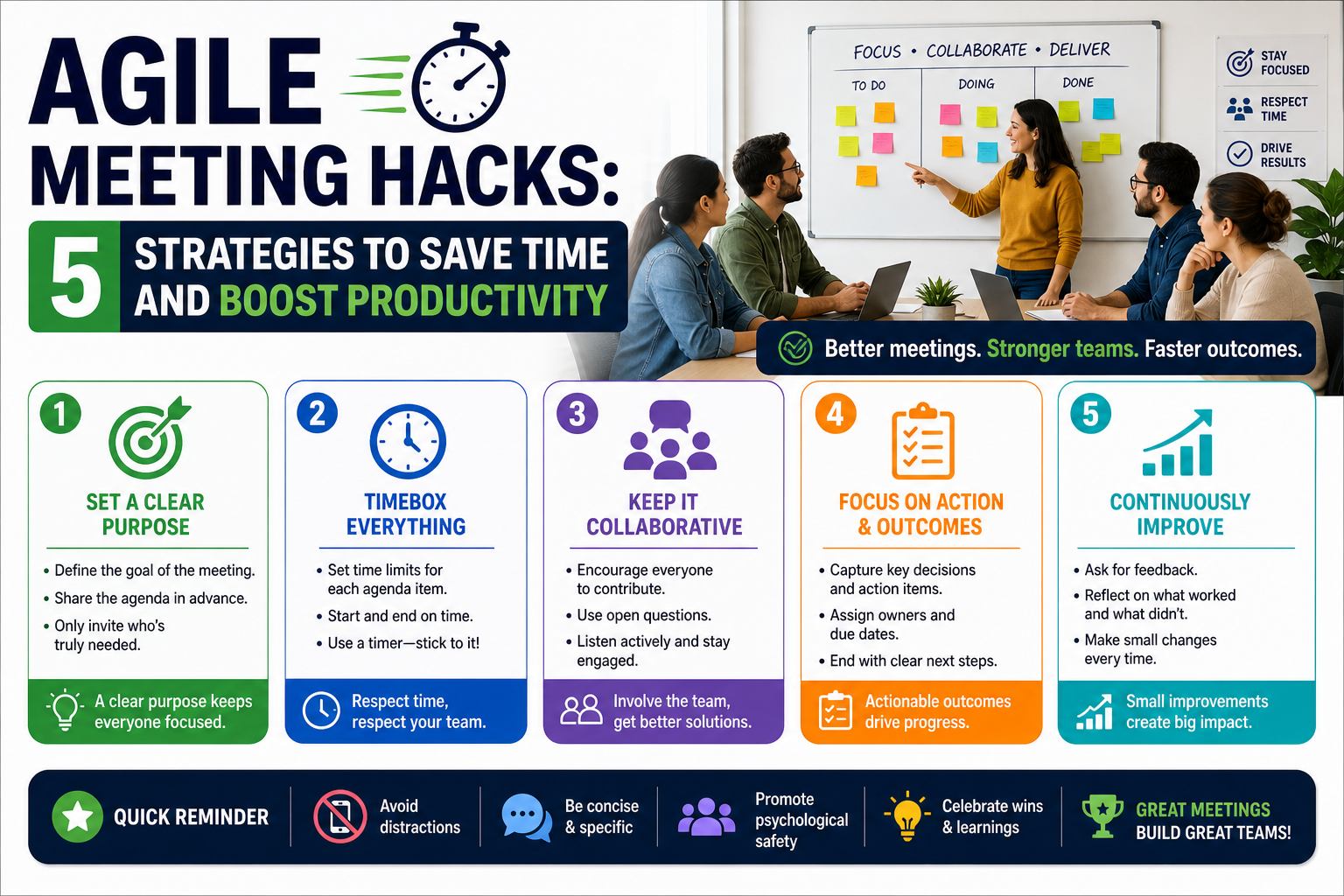
Agile has reshaped the way teams approach work, communication, and decision-making. What began as a software development methodology has expanded into a widely adopted mindset that influences how organizations plan, collaborate, and deliver outcomes across industries. One of the most significant areas Agile has impacted is the structure and purpose of meetings.
In traditional work environments, meetings often become lengthy, unfocused, and overloaded with information that does not always require group discussion. Agile challenges this pattern by emphasizing clarity, relevance, and continuous feedback. Instead of treating meetings as formal reporting sessions, Agile reframes them as short, purposeful interactions designed to support progress rather than slow it down.
At the heart of Agile thinking is the belief that communication should be direct, frequent, and meaningful. However, this does not mean more meetings—it means better ones. Teams are encouraged to prioritize face-to-face communication, but in a way that respects time and focus. The goal is not to eliminate meetings but to transform them into tools that actively contribute to productivity.
As Agile practices have matured, organizations have adapted these principles beyond software development. Marketing teams, operations departments, HR groups, and even executive leadership structures now borrow Agile ideas to improve collaboration. Yet despite this evolution, one challenge remains consistent: meetings can still become inefficient if not carefully structured.
Understanding how Agile addresses this issue is key to improving workplace productivity. The following sections explore foundational principles and practical approaches that help reshape meetings into efficient, focused, and valuable interactions.
The Core Philosophy Behind Agile Communication
Agile communication is built on simplicity, transparency, and responsiveness. Instead of relying on long reports or complex documentation, Agile encourages teams to communicate continuously and directly. This approach reduces misunderstandings and ensures that problems are identified early.
One of the most important aspects of Agile communication is its emphasis on real-time interaction. Rather than waiting for formal updates, team members share progress as it happens. This creates a dynamic environment where everyone stays aligned with current priorities. It also reduces the need for long explanatory meetings because information is already flowing naturally within the team.
Another key principle is shared responsibility. In Agile environments, communication is not limited to managers or team leads. Every member is expected to contribute actively to discussions. This ensures that meetings are not one-sided presentations but collaborative conversations where everyone has a voice.
However, Agile does not suggest that all communication should happen informally or constantly. Without structure, communication can become chaotic. This is where meetings still play a crucial role. They act as checkpoints that organize information, align goals, and identify obstacles.
The challenge lies in balancing structure with flexibility. Too much structure leads to rigid, time-consuming meetings. Too little structure leads to confusion and inefficiency. Agile seeks a middle ground where meetings are intentional, focused, and time-conscious.
This philosophy is what drives modern Agile meeting practices. It encourages teams to rethink not just how often they meet, but why they meet in the first place.
Why Traditional Meetings Often Fail Agile Principles
Before understanding how Agile improves meetings, it is important to recognize why traditional meetings often fall short. In many workplaces, meetings are scheduled by default rather than necessity. This leads to gatherings where not all participants are directly involved in the discussion, resulting in wasted time and reduced engagement.
One of the most common issues is lack of focus. Traditional meetings tend to cover multiple topics at once, often shifting between unrelated subjects. This makes it difficult for participants to retain information or contribute meaningfully. As a result, discussions become scattered, and key decisions may be delayed.
Another challenge is uneven participation. In many meetings, a small number of individuals dominate the conversation while others remain passive. This imbalance reduces collaboration and limits the diversity of ideas being shared. Over time, participants may disengage entirely, viewing meetings as unproductive obligations rather than valuable sessions.
Time management is also a major concern. Without strict time boundaries, meetings can extend far beyond their intended duration. This not only affects productivity but also disrupts the flow of other tasks scheduled throughout the day.
Additionally, traditional meetings often rely heavily on verbal updates that could easily be shared through written communication or dashboards. This redundancy further contributes to inefficiency.
Agile addresses these issues by introducing structure, clarity, and purpose into every meeting. Instead of treating meetings as routine events, Agile frameworks treat them as strategic tools that must earn their place in the workflow.
By redefining the role of meetings, Agile helps organizations eliminate unnecessary discussions and focus only on what truly requires collaboration.
Stand-Up Meetings as a Discipline of Focus and Efficiency
One of the most recognizable Agile practices is the stand-up meeting. Unlike traditional meetings where participants sit for extended periods, stand-ups are intentionally brief and conducted while standing. This physical change is not symbolic—it serves a practical purpose.
Standing naturally encourages brevity. When people are standing, they are less likely to engage in long, detailed explanations. Instead, communication becomes concise and focused. This helps ensure that meetings remain short and to the point.
Stand-up meetings are typically held daily, providing a consistent rhythm for team communication. During these sessions, each participant shares progress updates, upcoming tasks, and any obstacles they are facing. The structure is simple, but highly effective in maintaining alignment across the team.
One of the key benefits of stand-up meetings is punctuality. Because they are short and frequent, teams develop a strong habit of starting on time. Late arrivals become immediately noticeable, reinforcing accountability without the need for formal enforcement.
Another advantage is improved awareness. Team members gain a clear understanding of what others are working on, which helps identify dependencies and potential conflicts early. This reduces surprises later in the workflow and allows for quicker adjustments.
Stand-up meetings also discourage unnecessary detail. Since time is limited, participants must prioritize the most important information. This improves communication discipline and ensures that meetings remain productive.
However, the effectiveness of stand-ups depends on consistency. When teams start expanding the scope of discussion or allowing meetings to overrun, the benefits begin to diminish. Maintaining strict time boundaries is essential to preserving their efficiency.
The Importance of Structured Participation in Agile Meetings
Agile meetings are most effective when every participant understands their role and contribution. Unlike traditional meetings where attendance may be passive, Agile encourages active engagement from all members.
Structured participation ensures that meetings remain balanced and productive. Each participant is expected to provide updates on specific areas, such as progress, upcoming tasks, and challenges. This creates a predictable rhythm that keeps discussions organized.
One of the key advantages of structured participation is clarity. When everyone follows a consistent format, it becomes easier to track progress and identify issues. There is less confusion about what is being discussed and more focus on actionable information.
Structured participation also helps prevent dominance by a few individuals. In many traditional meetings, louder voices tend to overshadow others. Agile counters this by giving each participant equal opportunity to speak within a defined structure.
Another benefit is efficiency. When participants know what is expected of them, they can prepare in advance. This reduces hesitation and minimizes time wasted on unorganized explanations.
Additionally, structured participation supports accountability. When individuals are regularly asked to share updates, they become more aware of their responsibilities and progress. This encourages ownership and improves overall team performance.
However, structure does not mean rigidity. Agile allows flexibility within the framework, enabling teams to adapt the format as needed. The goal is not to restrict communication but to guide it in a way that maximizes value.
Visual Collaboration and the Role of Shared Workspaces
One of the most powerful elements in Agile environments is the use of visual tools to support communication. Instead of relying solely on verbal updates, teams often use shared workspaces such as task boards to track progress.
These visual tools provide a clear representation of work status, including tasks that are in progress, completed, or blocked. This transparency allows everyone to quickly understand the overall state of a project without needing lengthy explanations.
Visual collaboration enhances meeting efficiency by reducing the need for detailed status reports. Instead of describing progress verbally, team members can simply refer to the board and focus on discussing key issues.
Another advantage is improved problem-solving. When challenges are visible to everyone, it becomes easier to identify patterns and address bottlenecks. This collective awareness leads to faster decision-making and more effective solutions.
Shared workspaces also support alignment. When all team members are working from the same visual reference, misunderstandings are reduced. Everyone has access to the same information, which improves coordination and reduces duplication of effort.
In Agile meetings, these visual tools often serve as the central focus of discussion. Instead of abstract conversations, teams engage directly with tangible representations of their work. This makes meetings more grounded and actionable.
Over time, visual collaboration becomes an integral part of team culture. It reinforces transparency, accountability, and shared understanding, all of which contribute to more efficient meetings.
Encouraging Engagement Through Rotation and Interaction Methods
Agile meetings often incorporate techniques designed to increase engagement and ensure balanced participation. One such approach involves structured turn-taking, where participants contribute one at a time in a controlled sequence.
This method helps maintain order and prevents interruptions, ensuring that each voice is heard clearly. It also encourages active listening, as participants must wait for their turn and pay attention to others.
In some teams, interactive tools or randomized selection methods are used to determine speaking order. This introduces an element of unpredictability, which helps maintain attention and engagement throughout the meeting.
These techniques are not intended to be rigid rules but rather tools to support effective communication. They help reduce passive behavior and encourage more thoughtful participation.
By rotating participation, teams can also uncover insights that might otherwise be overlooked. Different individuals bring different perspectives, and structured interaction ensures that these perspectives are consistently included.
Engagement-focused practices also help reduce meeting fatigue. When participants are actively involved rather than passively listening, they are more likely to remain focused and contribute meaningfully.
Over time, these methods contribute to a more dynamic and inclusive meeting environment where communication is balanced and productive.
Designing Agile Meetings Around Purpose Instead of Habit
As Agile practices mature within teams, one of the most important shifts is moving away from meetings held out of routine and toward meetings designed with a clear purpose. In traditional environments, meetings are often scheduled because “it’s time for an update” or “this is our weekly slot,” regardless of whether a discussion is actually needed. Agile challenges this mindset by asking a simple but powerful question before any meeting: what outcome should this meeting produce?
Purpose-driven meetings are fundamentally different from habitual ones. Instead of gathering people because the calendar says so, Agile teams gather only when collaboration is necessary to move work forward. This reduces unnecessary interruptions and protects focused work time.
Each Agile meeting is expected to serve a specific function. It might be to synchronize progress, resolve a blocker, plan upcoming work, or review completed tasks. When the purpose is unclear, the meeting risks becoming a discussion without direction, which Agile seeks to avoid.
A clear purpose also helps determine who should attend. Unlike traditional meetings where attendance lists are often broad and unfocused, Agile encourages selective participation. Only individuals who contribute directly to the topic are included, which naturally reduces meeting size and improves efficiency.
Purpose clarity also influences preparation. When participants know exactly why the meeting exists, they come prepared with relevant information. This reduces time spent gathering context during the session itself and keeps discussions focused on decision-making.
Over time, this approach creates a cultural shift where meetings are no longer seen as default obligations but as intentional tools used sparingly and effectively.
The Role of Timeboxing in Controlling Meeting Expansion
One of the most effective mechanisms Agile uses to improve meeting efficiency is timeboxing. A timebox is a fixed, non-negotiable time limit assigned to a meeting or activity. Once the time expires, the session ends regardless of whether all topics have been fully explored.
This approach forces teams to prioritize what truly matters. Instead of attempting to cover every detail, participants focus on the most important issues first. Less critical discussions are either deferred or handled separately.
Timeboxing also helps prevent one of the most common meeting problems: uncontrolled expansion. In many traditional settings, meetings gradually extend beyond their intended duration as discussions drift or new topics emerge. Agile eliminates this by enforcing strict boundaries.
The psychological impact of timeboxing is significant. When participants know time is limited, they naturally become more concise. This reduces unnecessary explanation and encourages clearer communication.
Timeboxes also improve energy levels. Short, focused meetings are less mentally draining than long, unstructured ones. Participants remain more engaged because they know the session has a defined endpoint.
Another important benefit is decision acceleration. When time is limited, teams are more likely to make decisions rather than postponing them for later discussion. This helps reduce delays and keeps momentum moving forward.
However, effective timeboxing requires discipline. If teams consistently ignore time limits, the system loses its effectiveness. Agile environments treat timeboxes as commitments, not suggestions, reinforcing respect for shared time.
Sprint-Based Meetings and the Rhythm of Delivery
Agile frameworks such as Scrum introduce the concept of sprints, which are short, structured work cycles designed to deliver incremental progress. These cycles typically last from one to four weeks and serve as the backbone of planning and review activities.
Sprint-based meetings are aligned with this rhythm. Instead of holding continuous open-ended discussions, teams organize their communication around the beginning, middle, and end of each sprint.
At the start of a sprint, planning meetings establish goals and define the work to be completed. These sessions focus on clarity and prioritization, ensuring that everyone understands what success looks like for the upcoming cycle.
During the sprint, shorter check-ins help monitor progress and address emerging issues. These are not meant to re-plan the entire workload but to ensure alignment and remove obstacles.
At the end of the sprint, review sessions evaluate what was achieved and what needs improvement. This creates a structured feedback loop that continuously refines both the product and the process.
Sprint-based meetings reduce chaos by introducing rhythm into collaboration. Instead of reacting constantly to changing priorities, teams operate within a predictable cycle that balances planning, execution, and reflection.
This structure also helps prevent meeting overload. Because work is organized into cycles, discussions are naturally grouped, reducing the need for frequent ad-hoc meetings.
Over time, sprint rhythms create stability within Agile environments, allowing teams to focus more on delivery and less on constant coordination.
Agile Meeting Facilitation and the Importance of Leadership Roles
Effective Agile meetings depend heavily on facilitation. Unlike traditional meetings where a manager may dominate discussion, Agile introduces facilitation roles that focus on guiding conversation rather than controlling it.
A facilitator ensures that the meeting stays aligned with its purpose and time constraints. They are responsible for maintaining structure, encouraging participation, and preventing discussions from drifting off-topic.
One of the key responsibilities of facilitation is balancing participation. In any group, some individuals may naturally dominate conversation while others remain quiet. A good facilitator ensures that all voices are heard and that contributions are distributed fairly.
Facilitators also help manage conflict. In Agile environments, differing opinions are common and often valuable. However, without proper guidance, discussions can become unproductive. A facilitator helps keep debates constructive and focused on solutions.
Another important role is time management. Facilitators monitor the flow of discussion and ensure that timeboxes are respected. When necessary, they redirect conversations or suggest deferring topics to maintain efficiency.
Facilitation also includes summarizing outcomes. At the end of a meeting, participants should have a clear understanding of decisions made, actions assigned, and next steps identified. Without this clarity, meetings lose their value.
Importantly, facilitation is not about authority but about service to the team. The facilitator supports the group rather than directing it, reinforcing Agile’s collaborative nature.
Reducing Meeting Overload Through Asynchronous Communication
One of the most powerful ways Agile reduces meeting dependency is through asynchronous communication. Instead of requiring everyone to be present at the same time, information is shared in ways that allow individuals to respond when they are available.
Asynchronous updates can include written progress reports, task boards, shared documents, or messaging platforms. These tools allow information to flow continuously without requiring scheduled gatherings.
This approach significantly reduces meeting frequency. When updates are already visible and accessible, there is less need for verbal repetition during meetings.
Asynchronous communication also improves flexibility. Team members working in different time zones or schedules can contribute without being forced into inconvenient meeting times.
Another advantage is better documentation. Written updates create a permanent record of progress and decisions, which can be referenced later without needing to revisit discussions.
However, asynchronous communication must be structured to remain effective. Without clarity, information can become fragmented or overlooked. Agile teams often establish guidelines for how updates should be written and where they should be stored.
By combining asynchronous communication with targeted meetings, teams achieve a balanced system where meetings are reserved for discussion and decision-making, while updates are handled continuously in the background.
Decision-Making Efficiency in Agile Meetings
A major goal of Agile meetings is to improve the speed and quality of decision-making. In traditional environments, decisions are often delayed due to unclear ownership, excessive discussion, or lack of information.
Agile addresses this by clarifying who is responsible for decisions and ensuring that the necessary information is available during discussions. This reduces uncertainty and allows teams to move forward quickly.
Decision-making in Agile meetings is typically collaborative but structured. While input from multiple participants is encouraged, final responsibility is often assigned to specific roles or individuals. This prevents decisions from becoming stuck in endless group debate.
Another important factor is limiting the number of decisions made in a single meeting. Instead of attempting to resolve everything at once, Agile encourages prioritization. Only the most important decisions are addressed immediately, while others are deferred.
This reduces cognitive overload and ensures that attention is focused on high-impact issues.
Agile also promotes data-informed decisions. Rather than relying solely on opinion, teams use available information such as progress metrics, task status, and historical performance to guide choices.
Over time, this approach improves consistency and reduces rework, as decisions are made with greater clarity and alignment.
Managing Blockers and Interruptions Without Disrupting Flow
In any project environment, blockers are inevitable. These are issues that prevent progress and require resolution before work can continue. Agile meetings play a critical role in identifying and addressing these blockers quickly.
However, not all blockers require group discussion. One of the key principles in Agile is distinguishing between issues that need immediate collaboration and those that can be handled separately.
During meetings, blockers are surfaced briefly and clearly. If a blocker requires deeper discussion, it is moved to a separate focused session involving only relevant participants. This prevents the main meeting from becoming derailed by complex problem-solving.
This separation helps maintain flow. Instead of interrupting the entire team’s progress, only those directly involved in the issue spend time resolving it.
Agile also emphasizes rapid visibility of blockers. The sooner an issue is identified, the easier it is to resolve. Waiting until formal meetings can delay resolution and increase impact.
By integrating blocker management into meetings in a structured way, teams ensure that problems are addressed without compromising overall efficiency.
Continuous Improvement Through Meeting Reflection Practices
One of the defining characteristics of Agile is continuous improvement. This applies not only to products and workflows but also to meetings themselves. Teams are encouraged to regularly reflect on how their meetings are functioning and identify ways to improve them.
These reflections focus on practical questions. Are meetings too long? Are all participants contributing? Are decisions being made efficiently? Are meetings actually necessary, or could some updates be handled asynchronously?
By consistently evaluating meeting effectiveness, teams avoid falling into inefficient habits. Small adjustments over time can lead to significant improvements in productivity.
Continuous improvement also encourages experimentation. Teams may try different formats, adjust timeboxes, or modify participation structures to find what works best for them.
Importantly, these reflections are not about criticism but about optimization. The goal is to refine processes so that meetings remain valuable and aligned with team needs.
Over time, this creates a self-improving system where meetings evolve alongside the team’s workflow, becoming more efficient and effective with each iteration.
Strengthening Agile Meetings Through Advanced Collaboration Practices
As Agile practices evolve within teams, meetings begin to shift from basic coordination tools into advanced collaboration spaces. At this stage, the focus is no longer just on reducing meeting time or improving structure, but on increasing the quality of interaction. Teams start refining how they communicate, how they make decisions, and how they collectively solve problems within limited timeframes.
Advanced Agile collaboration is built on a simple idea: meetings should not only be efficient but also highly meaningful. Every interaction should contribute directly to progress, clarity, or alignment. When this principle is applied consistently, meetings become more than routine check-ins—they become strategic alignment points that accelerate delivery.
One of the most important developments in advanced Agile collaboration is the increasing emphasis on clarity before conversation begins. Teams invest more effort in preparing context ahead of time so that meeting time is not wasted on explaining background information. This allows discussions to immediately focus on decisions, trade-offs, and problem-solving.
Another key shift is the growing reliance on shared understanding rather than repeated explanation. When teams operate with strong visibility into tasks, goals, and dependencies, meetings become less about reporting and more about refining direction.
As teams mature in Agile practices, they also become more selective about what qualifies as a meeting-worthy topic. Issues that can be resolved asynchronously or independently are no longer brought into group discussions. This filtering process significantly reduces unnecessary meetings while improving focus during those that remain.
Advanced collaboration also introduces a stronger sense of ownership. Instead of relying on group consensus for every decision, individuals or small groups are empowered to act within defined boundaries. This reduces decision bottlenecks and ensures that meetings are used primarily for alignment rather than approval.
Deepening Communication Efficiency Through Intentional Dialogue
One of the most powerful transformations in Agile meetings is the shift toward intentional dialogue. Unlike traditional discussions that often unfold without structure, Agile communication is guided by purpose, relevance, and outcome orientation.
Intentional dialogue begins with clarity of intent. Before speaking, participants understand what they are contributing and why it matters. This reduces unnecessary elaboration and ensures that every statement adds value to the discussion.
Another important aspect is conversational discipline. Participants are encouraged to avoid digressions and remain focused on the topic at hand. While creativity and idea-sharing are still valued, they are directed toward solving immediate problems rather than exploring unrelated concepts.
Intentional dialogue also emphasizes listening as much as speaking. In Agile environments, understanding is considered as important as contribution. Participants are expected to actively process information shared by others rather than preparing their response while someone is speaking.
This creates a more balanced communication environment where ideas are exchanged efficiently and respectfully.
A key benefit of intentional dialogue is reduced repetition. When participants communicate clearly and listen attentively, there is less need to re-explain concepts or revisit previous points. This significantly improves meeting speed and effectiveness.
Over time, teams that adopt intentional dialogue develop stronger communication habits that extend beyond meetings and improve overall collaboration.
Scaling Agile Meetings in Larger Teams and Organizations
As Agile adoption expands beyond small teams into larger organizations, meeting complexity increases. More participants, more dependencies, and more overlapping priorities can make coordination challenging. However, Agile principles can still be applied effectively at scale with the right adaptations.
One of the first adjustments in large-scale Agile environments is the introduction of layered communication structures. Instead of involving all team members in every discussion, communication is organized across multiple levels. Smaller groups handle detailed work, while larger groups focus on alignment and strategy.
This structure ensures that meetings remain manageable even as organizational size grows. It prevents overcrowding and allows discussions to remain focused and relevant.
Another important scaling strategy is delegation. In larger teams, not every issue needs to be escalated to a central meeting. Many decisions can be handled at the team or subgroup level. This reduces pressure on high-level meetings and improves responsiveness.
Synchronization also becomes more structured. Instead of frequent large meetings, organizations rely on scheduled alignment points where key representatives share updates and coordinate direction.
These scaling techniques ensure that Agile principles remain effective even in complex environments.
However, scaling also introduces new challenges. Communication gaps can emerge between layers, and information can become diluted as it moves upward or downward. To address this, organizations must maintain strong transparency and ensure that information flows freely across all levels.
When properly implemented, scaled Agile meetings retain the same benefits as smaller teams: clarity, efficiency, and alignment.
Managing Cognitive Load in Agile Meetings
One often overlooked aspect of meeting efficiency is cognitive load—the mental effort required to process information during discussions. Agile meeting design actively aims to reduce cognitive overload so participants can think clearly and contribute effectively.
Cognitive load increases when meetings contain too many topics, excessive detail, or unclear structure. Participants struggle to retain information, leading to confusion and slower decision-making.
Agile reduces cognitive load by limiting the scope of each meeting. Instead of covering multiple unrelated topics, meetings focus on specific objectives. This allows participants to concentrate fully on one area at a time.
Another way cognitive load is reduced is through visual support tools. When information is displayed visually, such as through task boards or progress indicators, participants do not need to mentally track everything. They can rely on external representations of information.
Agile also reduces cognitive load by encouraging pre-meeting preparation. When participants already understand context before the meeting begins, they can focus on discussion rather than comprehension.
Timeboxing also plays a role in managing mental fatigue. Short, structured meetings prevent exhaustion and help maintain attention throughout the session.
By controlling cognitive load, Agile meetings become more productive and less mentally draining, allowing teams to maintain high performance even in fast-paced environments.
Enhancing Accountability Through Transparent Communication
Accountability is a central element of Agile meeting culture. Unlike traditional environments where responsibilities can sometimes be unclear, Agile emphasizes transparency in both communication and task ownership.
During meetings, individuals openly share their progress, challenges, and commitments. This visibility ensures that everyone understands who is responsible for what and how work is progressing.
Transparency also helps prevent misalignment. When tasks and responsibilities are clearly communicated, there is less risk of duplication or misunderstanding.
Another important aspect of accountability is follow-through. Agile meetings are not just about discussion—they are about action. Decisions made during meetings are expected to translate into clear next steps.
To support this, Agile teams often maintain visible tracking systems that record decisions and assigned tasks. This ensures continuity between meetings and prevents important actions from being forgotten.
Accountability also improves motivation. When individuals know their contributions are visible to the team, they are more likely to stay engaged and deliver consistent results.
However, Agile accountability is not about pressure or surveillance. It is about shared responsibility and collective progress. The goal is to create an environment where transparency supports trust rather than creating tension.
Over time, this leads to stronger team cohesion and more reliable execution.
Reducing Dependency on Meetings Through Autonomous Workflows
A mature Agile environment gradually reduces dependency on meetings by enabling autonomous workflows. In this context, autonomy means that individuals and teams can move forward with their work without needing constant approval or discussion.
Autonomous workflows are supported by clear guidelines, shared understanding, and strong communication systems. When expectations are well-defined, team members can make decisions independently within agreed boundaries.
This reduces the need for frequent meetings to clarify direction or resolve minor issues. Instead, meetings are reserved for high-level alignment and complex decision-making.
Autonomy also increases speed. When individuals do not need to wait for group consensus on every action, progress becomes faster and more continuous.
However, autonomy does not mean isolation. Agile maintains strong communication channels to ensure that work remains aligned. The difference is that communication becomes more selective and purposeful rather than constant.
Another benefit of autonomy is reduced meeting fatigue. When teams are not required to attend frequent coordination sessions, they have more uninterrupted time for focused work.
Over time, autonomous workflows create a more balanced environment where meetings support work rather than dominate it.
Agile Meeting Evolution and Cultural Transformation
As organizations continue to adopt Agile practices, meetings undergo a cultural transformation. They are no longer viewed as administrative requirements but as strategic tools that support collaboration and decision-making.
This cultural shift is gradual but powerful. Teams begin to value efficiency over formality, clarity over volume, and outcomes over process. Meetings become shorter, more focused, and more intentional.
One of the most significant cultural changes is the reduction of unnecessary hierarchy in communication. Agile encourages open dialogue where ideas can come from any level of the organization. This flattens communication structures and makes meetings more inclusive.
Another important cultural shift is the normalization of change. Agile meetings are not rigid structures; they evolve based on team needs. This flexibility allows teams to continuously refine how they communicate.
Over time, Agile meeting culture becomes self-sustaining. Teams naturally adopt behaviors that improve efficiency, such as preparing in advance, staying focused during discussions, and respecting time boundaries.
This cultural transformation is what ultimately enables Agile to succeed beyond methodology. It becomes a shared mindset that influences how people interact, solve problems, and make decisions.
Sustaining Long-Term Meeting Efficiency in Agile Environments
Maintaining efficient meetings over the long term requires ongoing attention and adaptation. Even well-structured Agile systems can drift toward inefficiency if habits are not regularly reinforced.
One of the key factors in sustaining efficiency is consistency. Teams must consistently apply Agile principles such as timeboxing, structured communication, and selective participation. Without consistency, meetings can gradually revert to unproductive patterns.
Another important factor is feedback. Teams should regularly assess whether meetings are still serving their intended purpose. If meetings become repetitive or unfocused, adjustments must be made.
Adaptability also plays a critical role. As projects evolve, meeting structures may need to change. Agile encourages flexibility so that communication methods remain aligned with current needs.
Leadership support is also essential. When leaders prioritize efficient meetings and model effective communication behavior, teams are more likely to follow suit.
Finally, cultural reinforcement ensures long-term success. When efficient meetings become part of team identity, they are naturally maintained without constant enforcement.
Sustaining Agile meeting efficiency is not about rigid control but about continuous alignment between communication practices and team goals.
Refining Agile Meetings Through Continuous Feedback Loops
As Agile practices mature further within teams, one of the most impactful improvements comes from establishing strong feedback loops around meetings themselves. In earlier stages, teams often focus on making meetings shorter or more structured. At a more advanced level, the focus shifts toward making meetings continuously self-correcting.
A feedback loop in this context means that every meeting becomes an opportunity to evaluate and improve the next one. Instead of assuming that a meeting format is fixed, teams actively question whether it is still effective. This creates a living system where communication evolves alongside the project.
One of the most effective ways to build this feedback loop is through brief reflections at the end of meetings. These reflections are not long discussions but quick assessments of what worked and what did not. For example, teams may notice that certain topics consistently take too long, or that some participants are not contributing enough. These observations become inputs for improving future sessions.
Over time, this habit builds a culture of awareness. Meetings are no longer passive events but active learning opportunities. Teams begin to recognize patterns in their communication behavior and adjust accordingly.
Another important element of feedback-driven improvement is psychological safety. Participants must feel comfortable pointing out inefficiencies without fear of criticism. When people can openly suggest improvements, meeting quality increases naturally because issues are addressed early rather than ignored.
Feedback loops also extend beyond individual meetings. Teams may review meeting effectiveness over a sprint or project cycle, identifying broader trends. For instance, they might discover that certain types of meetings consistently fail to produce decisions, indicating a need for structural change.
This continuous improvement mindset ensures that Agile meetings do not stagnate. Instead, they evolve in response to real team needs, maintaining relevance and efficiency over time.
Strengthening Decision Velocity Without Sacrificing Quality
One of the core goals of Agile meeting optimization is increasing decision velocity—the speed at which teams can make and implement decisions. However, increasing speed should never come at the cost of poor decision quality. Agile achieves this balance through structured communication and clear decision pathways.
Decision velocity improves when information is readily available. Instead of gathering data during meetings, Agile teams ensure that relevant context is already prepared beforehand. This allows discussions to focus on evaluating options rather than searching for information.
Another factor that accelerates decision-making is limiting the number of decision-makers involved in each discussion. While input from multiple perspectives is valuable, final decisions are often made by a smaller, clearly defined group. This prevents delays caused by excessive consensus-building.
Agile also improves decision velocity by categorizing decisions based on complexity. Simple decisions are made quickly within teams, while more complex ones may require deeper analysis or escalation. This prevents all decisions from being treated with the same level of formality, which can slow down progress unnecessarily.
At the same time, Agile ensures that speed does not compromise quality by encouraging transparency. When decisions are documented and visible, teams can review and refine them if needed. This creates a safety net that allows for faster decision-making without fear of irreversible mistakes.
Another important factor is trust. High-performing Agile teams develop strong trust in each other’s judgment. This reduces the need for prolonged validation and allows decisions to be made more confidently and quickly.
When combined, these practices create a balanced system where decisions are both fast and reliable.
The Long-Term Impact of Agile Meeting Discipline on Organizational Culture
As Agile meeting practices become deeply embedded in an organization, their influence extends beyond individual teams and begins to shape broader cultural norms. Meetings are often one of the most visible expressions of organizational behavior, and improving them can significantly shift how people collaborate across departments.
One of the most noticeable long-term effects is increased respect for time. When meetings are consistently short, focused, and purposeful, individuals begin to value time more consciously. This leads to better scheduling, fewer unnecessary interruptions, and more intentional communication across the organization.
Another cultural shift is improved clarity in communication. As teams adopt structured meeting formats and concise dialogue, this behavior spreads into emails, messaging, and informal discussions. Communication becomes more direct and less ambiguous.
Agile meeting discipline also strengthens accountability culture. When progress is regularly shared in a transparent and structured way, individuals naturally become more aware of their responsibilities and commitments. This reinforces a sense of ownership throughout the organization.
Conclusion
Agile meeting practices represent a fundamental shift in how teams communicate, coordinate, and make decisions. Rather than treating meetings as routine obligations, Agile reframes them as purposeful, time-conscious interactions designed to support progress. This change in mindset is what ultimately leads to more efficient collaboration and reduced time wastage.
Across Agile environments, several consistent principles emerge. Meetings are kept short and focused through timeboxing, ensuring that discussions remain structured and outcome-driven. Participation is intentional, with only relevant individuals included, which reduces noise and improves clarity. Visual tools and shared workspaces further enhance understanding by providing real-time visibility into progress and priorities.
Another key strength of Agile meetings lies in their adaptability. Whether through stand-ups, sprint cycles, or structured dialogue, teams continuously refine how they communicate based on feedback and evolving needs. This creates a system that improves over time rather than becoming rigid or outdated.
Equally important is the cultural transformation that Agile encourages. Meetings become more collaborative, transparent, and inclusive, shifting away from hierarchy-driven discussions toward shared ownership and accountability. As a result, teams not only work faster but also develop stronger alignment and trust.
Ultimately, Agile does not aim to eliminate meetings but to make them meaningful. By focusing on purpose, structure, and continuous improvement, organizations can transform meetings from time-consuming interruptions into valuable tools for coordination and decision-making.
When applied consistently, these principles lead to significant gains in productivity, communication quality, and team efficiency. Meetings become shorter, clearer, and more impactful—supporting work instead of slowing it down.