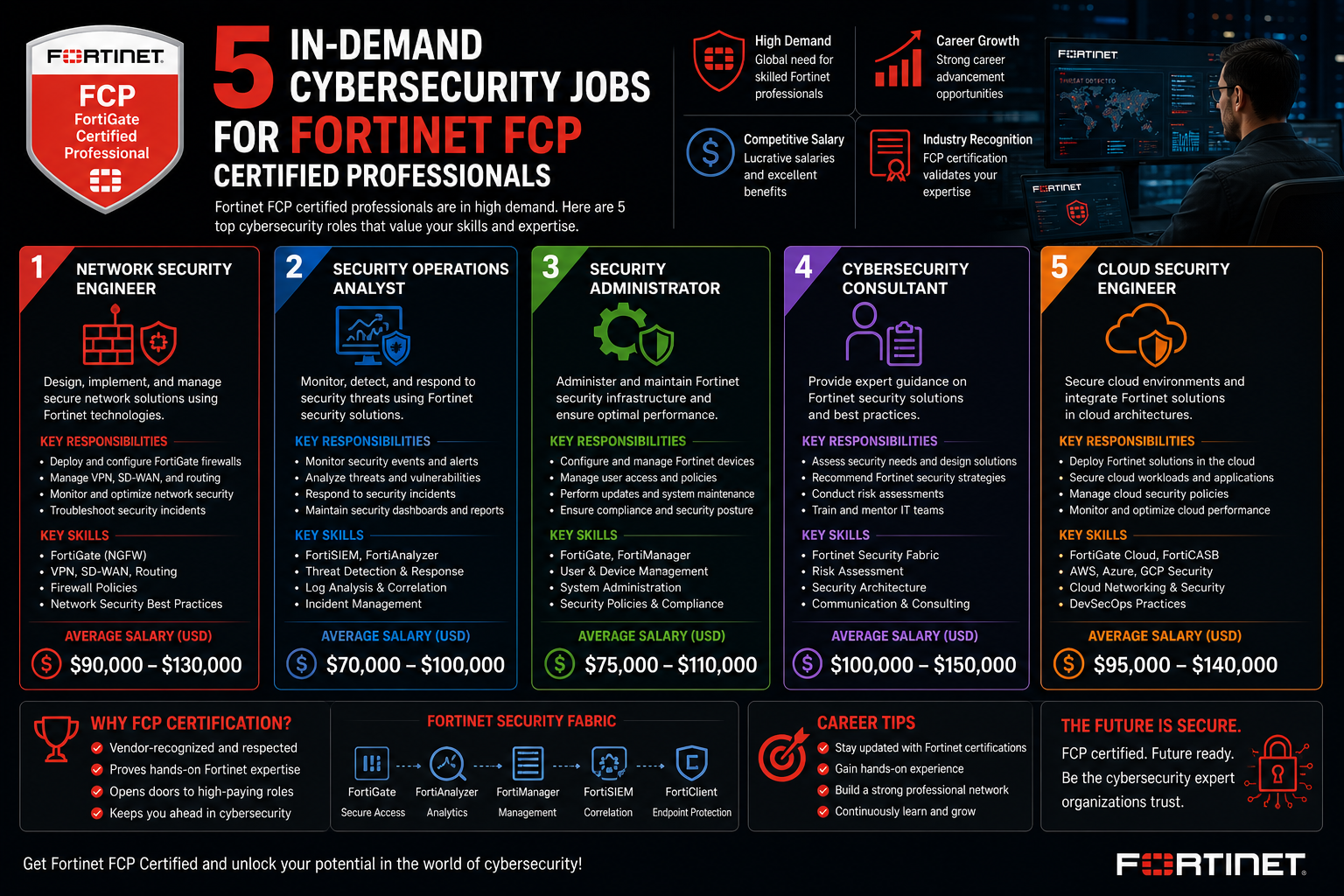
The cybersecurity industry continues to evolve at a rapid pace, and certification frameworks are evolving alongside it. In late 2025, Fortinet reorganized its certification structure, shifting away from the long-running NSE ladder and introducing a more streamlined progression model. Instead of multiple loosely connected levels under a single umbrella, the new system defines clearer stages: FCF, FCA, FCP, FCSS, and FCX.
This restructuring reflects a broader industry trend toward role-based certification paths rather than purely exam-based tiers. The intention is to better align certifications with real job functions in enterprise environments, especially as organizations increasingly rely on integrated security ecosystems rather than isolated tools.
Within this updated structure, the Fortinet Certified Professional (FCP) certification occupies a critical position. It represents a professional-level validation of skills in deploying, managing, and troubleshooting Fortinet technologies across network security environments. Unlike entry-level credentials that focus primarily on awareness or foundational concepts, FCP signals that an individual can actively work within complex security infrastructures.
A key element of this certification is its relationship to the NSE 4-level exam content, which remains active even after the restructuring. However, it no longer stands as an independent credential in the same way it once did. Instead, it functions as a foundational requirement within broader certification tracks. This means that passing NSE 4-related content alone is not the end goal; it is part of a larger progression toward demonstrating applied professional competence.
This shift has had a noticeable impact on how professionals approach certification preparation. Rather than viewing exams as isolated achievements, candidates are now encouraged to think in terms of capability development. The emphasis is less on collecting certifications and more on building job-ready skill sets that map directly to industry roles.
Why Fortinet Skills Matter in Modern Enterprise Environments
Enterprise IT environments today are significantly more complex than they were a decade ago. Organizations are no longer operating within purely on-premises infrastructures. Instead, most have adopted hybrid architectures that combine local data centers, public cloud services, remote access systems, and distributed applications.
Security in this environment is not a single-layer concern. It requires coordination across multiple systems, consistent policy enforcement, and real-time threat visibility across both cloud and on-premises assets. Fortinet technologies are widely deployed in these environments because they are designed to operate across multiple domains rather than being restricted to a single security perimeter.
What makes Fortinet skills particularly valuable is their practical orientation. Professionals working with these systems are not just configuring theoretical policies; they are implementing live security controls that directly influence network traffic, user access, and application behavior. This hands-on aspect is one of the reasons employers place strong value on FCP-level knowledge.
Another important factor is integration. Fortinet solutions are commonly used alongside major cloud platforms and enterprise infrastructure tools. This means professionals who understand Fortinet are often expected to work across multiple systems simultaneously, ensuring that security policies remain consistent regardless of where workloads are running.
As a result, FCP-level expertise is not limited to traditional security roles. Instead, it intersects with networking, cloud engineering, DevOps, and systems administration. This overlap is what makes the certification particularly relevant in modern IT career paths.
The Practical Value of FCP-Level Knowledge
One of the defining characteristics of FCP-level knowledge is its focus on applied understanding rather than theoretical concepts alone. Professionals at this level are expected to understand how security policies are created, how traffic flows through security appliances, and how to troubleshoot issues when configurations do not behave as expected.
This type of knowledge is especially important in environments where downtime or misconfiguration can have significant operational consequences. A misconfigured firewall policy, for example, can disrupt application availability across an entire organization. Similarly, incorrect routing or VPN settings can impact remote workforce productivity.
FCP training emphasizes understanding these relationships between configuration, behavior, and outcomes. It is not enough to know what a setting does; professionals must understand how it interacts with other components in the system.
This depth of understanding is what allows individuals to transition into higher-level technical roles. Employers are not just looking for people who can follow documentation step by step. They need professionals who can interpret system behavior, identify root causes of issues, and implement long-term solutions rather than temporary fixes.
Hybrid Cloud Engineer as an Emerging Security-Centric Role
One of the most relevant career paths connected to FCP-level expertise is that of a hybrid cloud engineer. This role has become increasingly important as organizations move away from single-environment infrastructures and adopt distributed systems that span both on-premises data centers and multiple cloud platforms.
A hybrid cloud engineer is responsible for designing, implementing, and maintaining systems that allow these environments to operate together seamlessly. This includes ensuring that workloads can move between environments when needed, that data remains accessible and secure, and that performance remains consistent regardless of where applications are hosted.
Security plays a central role in this process. Every connection between systems represents a potential risk point, and these connections must be carefully managed. This is where Fortinet knowledge becomes particularly relevant.
Professionals working in hybrid cloud environments must ensure that security policies are consistently applied across all platforms. This includes managing firewall rules, controlling access between networks, and ensuring that encryption standards are maintained during data transfer.
FCP-level understanding helps engineers navigate these challenges because it provides insight into how Fortinet systems enforce security policies across distributed environments. Instead of treating security as a separate layer, hybrid cloud engineers integrate it directly into infrastructure design.
Another important aspect of this role is automation. Hybrid environments are often too large and dynamic to manage manually. Engineers frequently rely on automated processes to deploy configurations, enforce policies, and monitor system behavior. Understanding how Fortinet tools interact with automation frameworks allows engineers to build more efficient and scalable systems.
In practice, hybrid cloud engineers often act as a bridge between networking teams, cloud architects, and security specialists. They must understand how decisions made in one area affect the others. This interdisciplinary nature makes FCP-level knowledge particularly valuable, as it provides a shared foundation of security understanding across different domains.
DevOps Engineering and the Expansion of Security Responsibilities
Another career path where FCP-level skills are increasingly relevant is DevOps engineering. Traditionally, DevOps focused on improving collaboration between development and operations teams, with an emphasis on automation, continuous integration, and continuous deployment.
However, the scope of DevOps has expanded significantly in recent years. Security is now a core component of the DevOps lifecycle, often referred to as a shift-left approach, where security considerations are integrated earlier in the development process rather than being addressed after deployment.
This evolution has created a new set of expectations for DevOps engineers. They are no longer solely responsible for ensuring that applications are deployed efficiently. They must also ensure that those applications are secure, compliant, and resilient under real-world conditions.
Fortinet technologies often play a role in securing the infrastructure that supports DevOps pipelines. This includes securing network traffic between development, testing, and production environments, as well as enforcing access controls for automated systems.
FCP-level knowledge helps DevOps engineers understand how these security layers operate. For example, when deploying applications across multiple environments, engineers must ensure that security policies remain consistent. Misalignment between environments can create vulnerabilities that are difficult to detect.
Another key aspect of DevOps work is infrastructure as code. In modern environments, infrastructure is often defined and managed through code-based configurations rather than manual setup. This allows systems to be replicated, scaled, and modified more efficiently.
However, this also introduces new security challenges. If infrastructure definitions are not properly secured or validated, misconfigurations can be deployed across entire environments quickly. Understanding how Fortinet systems enforce security policies helps DevOps engineers build safeguards into their automation processes.
DevOps engineers with FCP-level understanding are also better equipped to troubleshoot complex system issues. When problems arise in distributed environments, they must consider multiple layers of interaction, including networking, application behavior, and security enforcement. Without a strong foundation in how these systems operate together, diagnosing issues becomes significantly more difficult.
In many organizations, DevOps engineers are now expected to collaborate closely with security teams rather than working in isolation. This collaboration requires a shared understanding of security principles and tools. FCP-level knowledge provides that common ground, making communication between teams more effective and reducing the likelihood of misconfigurations or misunderstandings.
The Growing Intersection of Networking, Cloud, and Security Roles
Both hybrid cloud engineering and DevOps engineering highlight a broader trend in the IT industry: the convergence of traditionally separate disciplines. Networking, cloud computing, and cybersecurity are no longer distinct career paths with clear boundaries. Instead, they are increasingly interconnected.
This convergence is driven by the complexity of modern IT environments. Systems are no longer static or isolated. They are dynamic, distributed, and constantly evolving. As a result, professionals are expected to understand multiple domains rather than specializing narrowly in one area.
Fortinet technologies sit at the center of this convergence in many enterprise environments because they operate across network, cloud, and security layers simultaneously. This makes FCP-level expertise particularly valuable for professionals who want to work in cross-functional roles.
Understanding how traffic flows through a secure network, how policies are enforced across hybrid environments, and how automation impacts security outcomes is essential for success in these roles. FCP certification helps formalize this knowledge and ensures that professionals are equipped to handle real-world challenges.
As organizations continue to adopt multi-cloud strategies and remote-first architectures, the demand for professionals who can operate across these domains is expected to grow. This makes the skills validated by FCP certification increasingly relevant in long-term career planning.
Network Engineering in Fortinet-Driven Enterprise Environments
Network engineering has always been a foundational discipline in IT, but its scope has expanded dramatically as organizations transition into hybrid and cloud-connected infrastructures. In earlier eras, network engineers focused primarily on physical connectivity, routing protocols, switch configuration, and maintaining internal LAN and WAN environments. Today, that role extends far beyond traditional boundaries.
Modern network engineers are expected to design and maintain environments that span on-premises systems, cloud platforms, remote users, and distributed applications. This means they are no longer just managing traffic between internal devices; they are managing connectivity across multiple ecosystems that must remain secure, stable, and highly available at all times.
Fortinet technologies are widely deployed in these environments because they combine networking and security capabilities into a unified framework. Firewalls, secure gateways, SD-WAN solutions, and integrated policy management tools are often central components of enterprise network architecture. As a result, professionals with FCP-level knowledge are better equipped to operate in environments where networking and security are deeply interconnected.
A network engineer working in a Fortinet-enabled environment must understand how policies affect traffic flow across different segments of the network. This includes internal communication between departments, external connectivity to cloud platforms, and secure access for remote users. Each of these pathways must be carefully controlled to ensure both performance and security requirements are met.
One of the most significant changes in modern networking is the shift toward software-defined infrastructure. Instead of manually configuring individual devices, engineers now define network behavior through centralized controllers and policy-driven systems. Fortinet’s ecosystem aligns closely with this approach, allowing network engineers to manage complex environments through unified interfaces and automated policy enforcement.
This shift requires a deeper understanding of abstraction layers. Network engineers must not only understand how packets move through the network but also how high-level policies translate into low-level configurations. Misunderstanding this relationship can lead to performance bottlenecks, security gaps, or connectivity failures that are difficult to diagnose.
FCP-level knowledge helps bridge this gap by providing insight into how Fortinet systems interpret and enforce network policies. This allows engineers to make more informed decisions when designing or troubleshooting network architectures.
Cybersecurity Engineering and Defensive Architecture Design
Cybersecurity engineering represents one of the most direct applications of FCP-level expertise. While network engineers focus on connectivity and performance, cybersecurity engineers focus on protection, detection, and response. These roles often overlap in practice, especially in environments where security is embedded into every layer of the infrastructure.
Cybersecurity engineers are responsible for designing systems that defend against unauthorized access, malware, data breaches, and advanced persistent threats. This involves configuring security controls, monitoring system behavior, and responding to incidents when they occur.
Fortinet systems are commonly used in these environments because they provide a wide range of integrated security functions. These include intrusion prevention, application control, web filtering, endpoint protection integration, and centralized logging. Understanding how these components interact is essential for effective cybersecurity engineering.
At the FCP level, professionals are expected to understand not just individual features but how those features work together to form a cohesive defense strategy. For example, a firewall policy may block certain types of traffic, while an intrusion prevention system analyzes allowed traffic for malicious behavior. These layers must be aligned to ensure that threats are not simply shifted from one detection point to another.
Cybersecurity engineers must also understand the concept of defense in depth. This approach assumes that no single security control is sufficient on its own. Instead, multiple overlapping layers of protection are used to reduce risk. Fortinet architectures are often designed with this principle in mind, integrating network security, application security, and endpoint protection into a unified system.
Another important aspect of cybersecurity engineering is threat visibility. Engineers must be able to see what is happening across the entire environment in real time. This includes monitoring network traffic, analyzing logs, and identifying anomalies that may indicate malicious activity.
FCP-level knowledge contributes to this capability by helping engineers understand where data originates, how it flows through the system, and where it can be inspected or controlled. Without this understanding, security monitoring becomes fragmented and less effective.
Incident response is another critical responsibility. When a security event occurs, engineers must quickly determine its scope, identify affected systems, and implement containment measures. This requires both technical knowledge and analytical thinking.
Fortinet tools often play a central role in this process by providing centralized visibility and control. However, the effectiveness of these tools depends heavily on the operator’s understanding of how they function. FCP-level training ensures that engineers are not simply reacting to alerts but are interpreting them within the broader context of system behavior.
Technical Analysts and Cross-Domain Problem Solving
Technical analysts occupy a unique position in IT environments. Unlike specialists who focus on a single domain, technical analysts are expected to understand and interact with multiple systems across networking, security, applications, and infrastructure. This makes their role both challenging and highly valuable.
In many organizations, technical analysts serve as the first line of investigation when complex issues arise. They are responsible for diagnosing problems, identifying potential causes, and escalating issues when necessary. This requires a broad understanding of how different systems interact.
Fortinet environments add an additional layer of complexity to this role because security controls can influence behavior across the entire network. A connectivity issue, for example, may not be caused by a network fault but by a security policy blocking traffic. Without an understanding of how these systems interact, troubleshooting becomes significantly more difficult.
FCP-level knowledge helps technical analysts develop a systems-oriented mindset. Instead of viewing issues in isolation, they learn to consider how different components influence one another. This includes understanding how firewall rules affect application access, how VPN configurations impact remote connectivity, and how traffic inspection can influence performance.
Technical analysts must also be comfortable working with logs, alerts, and diagnostic tools. These data sources provide critical insight into system behavior, but they must be interpreted correctly to be useful. Misinterpretation can lead to incorrect conclusions and extended downtime.
One of the key skills in this role is pattern recognition. Over time, technical analysts develop the ability to recognize recurring issues and identify underlying causes more quickly. FCP-level training accelerates this process by exposing professionals to real-world scenarios where multiple systems interact simultaneously.
Another important aspect of the technical analyst role is communication. Analysts must be able to explain complex technical issues in a way that is understandable to both technical and non-technical stakeholders. This requires clarity, structure, and the ability to translate system behavior into meaningful insights.
In Fortinet-enabled environments, technical analysts often act as intermediaries between networking teams, security teams, and application teams. Each of these groups has a different perspective on the system, and the analyst’s role is to bridge those perspectives to identify and resolve issues efficiently.
How Fortinet Skills Influence Enterprise Operations
Beyond individual job roles, FCP-level expertise has a broader impact on how enterprise IT operations function as a whole. Organizations that rely heavily on Fortinet technologies often structure their operational workflows around the capabilities of these systems.
One of the most significant impacts is centralization. Fortinet platforms allow organizations to manage multiple security functions from a unified interface. This reduces complexity and improves consistency across environments.
However, centralization also increases the importance of understanding how changes in one area affect the entire system. A policy update made at the central level can impact multiple networks, applications, and user groups simultaneously. Professionals working in these environments must therefore understand the broader implications of their actions.
Another important operational factor is automation. Many Fortinet environments rely on automated processes to enforce policies, respond to threats, and maintain system consistency. While automation improves efficiency, it also requires careful configuration and monitoring.
FCP-level knowledge helps professionals understand how automated systems behave and how to intervene when necessary. This is particularly important in situations where automated responses may conflict with business requirements or introduce unintended consequences.
Scalability is another key consideration. As organizations grow, their network and security infrastructures must scale accordingly. Fortinet systems are designed to support this scalability, but effective implementation requires careful planning.
Professionals with FCP-level expertise are better equipped to design scalable architectures because they understand how different components interact under increased load. This includes understanding performance limitations, policy enforcement behavior, and resource allocation.
Security Operations and Real-Time Monitoring Environments
Security operations centers, often referred to as SOCs, play a critical role in modern cybersecurity strategies. These environments are responsible for monitoring, detecting, and responding to security threats in real time.
Fortinet technologies are frequently integrated into SOC environments because they provide detailed visibility into network activity and security events. This includes real-time logging, threat detection, and automated alerting systems.
Professionals working in SOC environments must be able to interpret large volumes of data quickly and accurately. This requires both technical knowledge and situational awareness.
FCP-level expertise contributes to this capability by providing a clear understanding of how security events are generated and what they represent. Without this understanding, analysts may struggle to distinguish between benign anomalies and genuine threats.
SOC analysts must also be able to correlate events across multiple systems. A single security incident may generate alerts from firewalls, intrusion detection systems, and endpoint protection tools simultaneously. Understanding how these alerts relate to one another is essential for accurate threat assessment.
In many cases, SOC environments operate under time-sensitive conditions. Delays in identifying or responding to threats can have significant consequences. As a result, efficiency and accuracy are both critical.
Fortinet systems support this need by providing centralized dashboards and automated correlation tools. However, the effectiveness of these tools depends on the operator’s ability to interpret the information correctly.
FCP-level training helps professionals develop this interpretive skill, enabling them to make informed decisions quickly in high-pressure environments.
The Expanding Role of Integrated Security Knowledge in IT Careers
As IT environments continue to evolve, the boundaries between networking, security, and systems administration are becoming increasingly blurred. Professionals are no longer expected to operate within isolated domains. Instead, they are expected to understand how different systems interact and influence one another.
Fortinet’s integrated approach to security reflects this shift. By combining multiple security functions into a unified platform, it encourages professionals to think in terms of systems rather than individual components.
FCP-level expertise is valuable in this context because it reinforces systems thinking. Professionals learn to consider not just how a single configuration affects a device, but how it impacts the broader environment.
This perspective is becoming increasingly important in modern IT careers. Whether working in networking, cybersecurity, DevOps, or technical analysis, professionals are expected to understand cross-domain interactions and make decisions that account for multiple layers of complexity.
As organizations continue to adopt hybrid infrastructures and distributed systems, this integrated approach to IT operations is likely to become even more important.
Enterprise Security Architect and System Design Responsibility
As organizations scale their digital infrastructure, the need for professionals who can design entire security ecosystems becomes more important than ever. This responsibility typically falls to enterprise security architects, individuals who operate at a strategic level rather than focusing on day-to-day configuration tasks.
In environments where Fortinet technologies are widely deployed, security architects must understand how different components of the ecosystem interact across multiple layers of infrastructure. This includes firewalls, intrusion prevention systems, secure access gateways, endpoint integrations, and cloud security services.
The core responsibility of this role is not just to implement security tools, but to design how those tools work together as part of a unified security posture. Every decision made at the architectural level has downstream consequences. A choice about how traffic is segmented, for example, influences how policies are enforced across branches, cloud environments, and remote users.
FCP-level knowledge becomes important here because it provides a practical understanding of how Fortinet systems behave under real operational conditions. Security architects must anticipate how configurations will perform not only in ideal scenarios but also under load, during incidents, and across hybrid environments.
One of the most critical aspects of this role is balancing security with usability. Overly restrictive designs can slow down business operations, while overly permissive designs increase risk exposure. Architects must find a middle ground that ensures both protection and efficiency.
In Fortinet-driven environments, this often involves designing segmented networks, defining layered access policies, and ensuring that security enforcement points are distributed appropriately. These decisions require a deep understanding of traffic flows, authentication mechanisms, and policy inheritance structures.
Security architects also play a key role in long-term infrastructure planning. As organizations adopt new technologies, such as cloud-native applications or remote workforce solutions, the architecture must evolve without compromising security integrity.
SOC Evolution into Security Engineering Leadership
Security Operations Centers have become central to modern cybersecurity strategies. However, the role of SOC teams has evolved significantly over time. What was once a reactive monitoring function has now become a proactive security engineering discipline.
SOC analysts are no longer just responding to alerts. They are now involved in refining detection rules, improving threat intelligence integration, and optimizing response workflows. In more advanced environments, SOC teams operate almost like engineering units within the security organization.
Fortinet technologies are often deeply integrated into SOC environments because they provide rich telemetry data and centralized visibility across networks. This allows analysts to observe traffic patterns, detect anomalies, and correlate events across multiple systems.
As SOC teams mature, leadership roles emerge that focus on designing and improving these detection and response systems. These roles require a combination of technical expertise and strategic thinking.
FCP-level understanding contributes to this evolution by ensuring that professionals understand not only how alerts are generated but also why they occur. This knowledge is essential when tuning detection systems to reduce false positives while maintaining high sensitivity to genuine threats.
SOC leaders must also coordinate across multiple teams, including network engineering, cloud operations, and incident response. This requires a shared understanding of security architecture, which is where Fortinet expertise becomes valuable.
Over time, SOC environments often transition from manual monitoring systems to semi-automated or fully automated security platforms. This shift requires careful design to ensure that automation does not introduce blind spots or reduce visibility into critical events.
Professionals with FCP-level knowledge are better equipped to participate in this transition because they understand the underlying mechanics of Fortinet security tools and how they interact with broader infrastructure components.
Incident Response and Digital Forensics Career Path
Incident response is one of the most dynamic and high-pressure areas in cybersecurity. Professionals in this field are responsible for investigating security breaches, containing threats, and restoring systems to normal operation as quickly as possible.
Unlike routine monitoring roles, incident response requires rapid decision-making under uncertainty. Analysts often work with incomplete information and must piece together evidence from multiple sources to understand what has occurred.
Fortinet systems play an important role in this process by providing detailed logs, traffic analysis, and security event records. These data sources are essential for reconstructing timelines and identifying the origin of an attack.
FCP-level knowledge is particularly useful in incident response because it helps professionals understand how normal system behavior differs from malicious activity. Without this baseline understanding, it becomes difficult to distinguish between legitimate network anomalies and actual security incidents.
Digital forensics extends this process further by focusing on the detailed analysis of compromised systems. This includes examining logs, analyzing network traffic, and identifying indicators of compromise.
In many cases, forensic analysts must trace the movement of an attacker through a network, identifying how access was gained and what systems were affected. This requires a deep understanding of network architecture and security policy enforcement.
Fortinet environments provide valuable forensic data because they operate at multiple points within the network. Firewalls, intrusion prevention systems, and endpoint integrations all contribute to a comprehensive view of system activity.
Professionals working in this area must also be familiar with persistence mechanisms, lateral movement techniques, and data exfiltration methods commonly used by attackers. Understanding how these techniques interact with security systems is essential for effective investigation.
Incident response and forensics roles often serve as stepping stones to more senior security positions, including security engineering leadership and architecture roles.
Cloud Security Engineering Across Multi-Platform Environments
As organizations continue to adopt cloud technologies, the role of cloud security engineer has become increasingly important. These professionals are responsible for ensuring that cloud-based systems remain secure, compliant, and properly configured.
Cloud environments introduce unique security challenges because they are highly dynamic and distributed. Resources can be created, modified, and deleted at scale, often through automated processes. This creates a constantly changing attack surface that must be carefully managed.
Fortinet solutions are frequently used in cloud environments to provide consistent security enforcement across different platforms. This includes virtual firewalls, secure gateways, and integrated monitoring tools that extend traditional security controls into cloud infrastructures.
FCP-level knowledge is valuable in this context because it helps professionals understand how security policies translate into cloud environments. This includes understanding how traffic flows between virtual networks, how access controls are enforced, and how security visibility is maintained across distributed systems.
Cloud security engineers must also manage identity and access controls across multiple platforms. This is particularly challenging in multi-cloud environments where different providers use different security models.
Another important aspect of cloud security engineering is configuration management. Misconfigured cloud resources are one of the most common sources of security incidents. Engineers must ensure that infrastructure is deployed consistently and securely across all environments.
Automation plays a major role in cloud security. Many organizations rely on infrastructure as code to define and deploy cloud resources. This allows for repeatable and scalable deployments but also introduces risks if configurations are not properly validated.
Professionals with FCP-level understanding are better equipped to integrate Fortinet security controls into automated cloud workflows, ensuring that security remains consistent regardless of how infrastructure is deployed.
SD-WAN and Secure Connectivity Specialization
Software-defined wide area networking has become a key technology in modern enterprise environments. It allows organizations to manage connectivity between branch offices, data centers, and cloud platforms in a more flexible and efficient way.
Fortinet SD-WAN solutions are widely used because they combine networking and security into a single framework. This allows organizations to optimize traffic routing while maintaining strong security controls.
Professionals specializing in this area must understand how traffic is prioritized, how routes are selected, and how security policies are enforced across distributed networks.
FCP-level knowledge is particularly relevant because SD-WAN environments rely heavily on policy-driven configurations. Understanding how these policies interact with network behavior is essential for maintaining performance and security.
Secure connectivity specialists must also consider redundancy and failover mechanisms. In distributed environments, connectivity disruptions can have significant operational impacts. Ensuring that systems remain resilient under failure conditions is a key responsibility.
Another important aspect of this role is performance optimization. SD-WAN systems often make real-time decisions about traffic routing based on network conditions. Understanding how these decisions are made allows professionals to fine-tune performance and improve user experience.
Security Consulting and Implementation Engineering in Enterprise Deployments
Security consultants and implementation engineers play a critical role in deploying Fortinet solutions across enterprise environments. These professionals are responsible for translating business requirements into technical implementations.
Unlike internal engineering roles, consultants often work across multiple organizations and industries. This requires adaptability and a broad understanding of different IT environments.
Implementation engineers must ensure that security systems are deployed correctly, configured according to best practices, and integrated with existing infrastructure.
FCP-level knowledge is essential in this context because it provides a standardized understanding of Fortinet systems. This allows professionals to apply consistent deployment methodologies across different environments.
Consultants must also be able to identify potential design flaws before systems go live. This requires both technical expertise and practical experience with real-world deployments.
In many cases, consultants are brought in to resolve complex security challenges that internal teams have been unable to address. This requires strong problem-solving skills and the ability to quickly understand unfamiliar environments.
Compliance, Governance, and Risk-Oriented Security Roles
Beyond technical implementation, many organizations require professionals who can align security systems with regulatory and compliance requirements. These roles focus on governance, risk management, and policy enforcement.
Industries such as finance, healthcare, and government operate under strict regulatory frameworks that dictate how data must be protected and how systems must be configured.
Fortinet systems are often used to enforce these requirements through centralized policy management and detailed logging capabilities.
Professionals in compliance-focused roles must understand how technical configurations map to regulatory obligations. This includes ensuring that access controls are properly implemented, that data is encrypted where required, and that audit logs are maintained.
FCP-level understanding helps professionals bridge the gap between technical systems and compliance frameworks. Without this understanding, it becomes difficult to ensure that security controls meet regulatory standards.
Automation, Orchestration, and API-Driven Security Environments
Modern security environments increasingly rely on automation and orchestration to manage complex infrastructures. This includes automated threat response, policy deployment, and system monitoring.
Fortinet platforms provide extensive support for automation through APIs and integration capabilities. This allows organizations to connect security systems with broader IT workflows.
Professionals working in this area must understand how to design automated processes that are both efficient and secure. Poorly designed automation can introduce vulnerabilities or create unintended system behavior.
FCP-level knowledge is valuable because it provides insight into how Fortinet systems behave under automated control. This helps professionals design workflows that align with system capabilities and limitations.
Industry-Specific Demand and Specialized Deployment Contexts
Different industries have different security requirements, and Fortinet technologies are often deployed in specialized ways depending on the sector.
In financial services, security systems must support high levels of transaction security and regulatory compliance. In telecommunications, scalability and performance are critical. In healthcare, data privacy and system reliability are primary concerns.
Professionals with FCP-level expertise are often able to adapt to these different environments because they understand the core principles underlying Fortinet systems rather than just surface-level configurations.
This adaptability makes them valuable in a wide range of enterprise contexts, where security requirements may vary significantly but underlying architectural principles remain consistent.
Progression Toward Advanced Fortinet Skill Domains
As professionals gain experience with Fortinet systems, they often progress toward more advanced roles that require deeper architectural understanding and broader system integration skills.
This progression typically involves moving from operational responsibilities to design and strategic roles, where decisions influence entire enterprise environments.
FCP-level knowledge serves as a foundation for this progression, providing the technical grounding needed to understand more complex security ecosystems and prepare for higher-level responsibilities within enterprise IT environments.
In addition to technical advancement, career progression in Fortinet-centered environments increasingly depends on the ability to understand organizational context, not just system behavior. Many professionals reach a point where their responsibilities extend beyond configuring or maintaining systems and begin to include advising stakeholders on risk, architecture direction, and long-term infrastructure planning.
At this stage, decision-making becomes less about individual features and more about system-wide trade-offs. For example, enabling deeper traffic inspection might improve threat detection but could introduce latency in high-throughput environments. Similarly, increasing segmentation improves security boundaries but can add operational complexity if not carefully designed. Professionals who understand Fortinet systems at an FCP level are better prepared to evaluate these trade-offs because they understand how configurations behave under real workloads rather than only in isolated test scenarios.
Another important development is the increasing emphasis on collaboration between technical teams. Security is no longer managed by a single department in isolation. Instead, it is distributed across networking teams, cloud teams, DevOps teams, and application owners. Each group has different priorities, and successful implementation depends on alignment between them.
In this environment, professionals with Fortinet expertise often act as translators between domains. They help networking teams understand security constraints, assist cloud engineers in implementing consistent policies, and support DevOps teams in embedding security into deployment pipelines. This cross-functional communication role becomes especially important in large organizations where misalignment between teams can lead to security gaps or operational inefficiencies.
There is also a growing demand for professionals who can evaluate emerging technologies in the context of existing security infrastructures. As organizations adopt artificial intelligence, edge computing, and distributed application models, they must assess how these technologies interact with established security frameworks. Fortinet environments often serve as the backbone for these evaluations, and professionals familiar with the ecosystem are frequently involved in pilot projects and architecture reviews.
Finally, long-term career growth in this field is increasingly tied to adaptability. The tools, platforms, and threats continue to evolve, and professionals must continuously update their understanding of both technology and security principles. Those who maintain a strong foundation in core concepts while adapting to new environments are best positioned to move into senior engineering, architecture, or strategic security leadership roles over time.
Conclusion
Fortinet FCP-level expertise represents far more than a certification milestone; it reflects a practical understanding of how modern enterprise security systems operate in real-world environments. As organizations continue shifting toward hybrid infrastructures, multi-cloud deployments, and distributed workforces, the need for professionals who can manage security across interconnected systems has become increasingly critical.
Across networking, cybersecurity, DevOps, cloud engineering, and technical analysis roles, a common theme emerges: security is no longer a separate layer of IT. It is embedded within every component of infrastructure design and operations. Fortinet technologies are widely adopted because they support this integrated approach, allowing organizations to unify security enforcement across diverse environments.
Professionals who build expertise at the FCP level gain the ability to interpret system behavior rather than simply react to it. This distinction is important because modern IT environments are highly dynamic, with constant changes in traffic patterns, application deployments, and user access requirements. Understanding how security policies influence these environments allows professionals to make more informed decisions and respond more effectively to issues when they arise.
Another key takeaway is the increasing overlap between traditional IT disciplines. Network engineers are now expected to understand security principles, cybersecurity engineers must understand infrastructure behavior, and DevOps professionals must integrate security into automated workflows. This convergence means that FCP-level knowledge is not limited to one career path but is applicable across multiple technical domains.
As organizations continue to scale and adopt new technologies, the demand for professionals who can operate across these boundaries will continue to grow. Those who understand how Fortinet systems function within broader enterprise ecosystems will be better positioned to contribute to architecture design, operational efficiency, and long-term strategic planning.
Ultimately, FCP-level expertise is about developing a systems-oriented mindset. It equips professionals to see how individual components interact within complex infrastructures and to understand the impact of their decisions across entire environments. In a rapidly evolving IT landscape, this ability to think holistically and act decisively remains one of the most valuable skills in the industry.