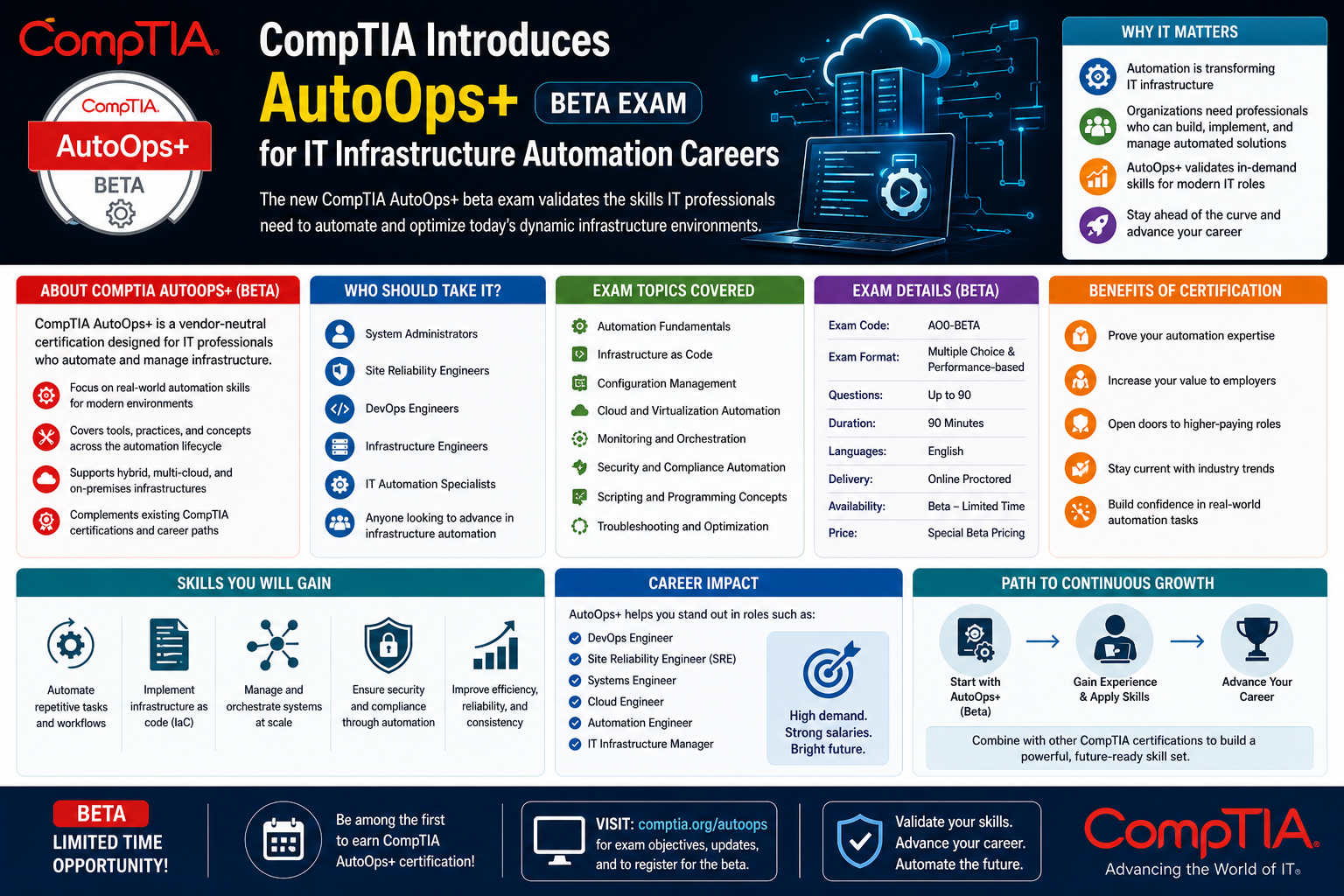
The world of IT infrastructure has been undergoing a steady transformation for more than a decade, but the pace of change has accelerated dramatically in recent years. Systems that once required manual configuration and hands-on management are now increasingly controlled through automation tools, scripts, and orchestration platforms. This shift has not only changed how systems are built and maintained but also redefined what it means to work in infrastructure roles.
In this evolving environment, traditional job descriptions such as systems administrator, network administrator, or support engineer no longer reflect the full scope of responsibilities professionals are expected to handle. Instead, modern infrastructure roles demand a blend of operational knowledge and automation expertise. Tasks that once involved repetitive manual effort are now expected to be handled through automated workflows, reducing human error and improving efficiency.
It is within this broader transformation that the CompTIA AutoOps+ certification has emerged. Designed to reflect current industry needs, it represents a structured attempt to formalize the growing importance of automation in IT infrastructure careers. The introduction of a beta exam for AutoOps+ signals a significant step toward defining new standards for professionals working across cloud, hybrid, and on-premises environments.
Understanding the Purpose Behind CompTIA AutoOps+
The primary goal of CompTIA AutoOps+ is to align certification pathways with the reality of modern IT operations. Instead of focusing solely on traditional system management concepts, this certification emphasizes automation as a core competency. The shift reflects how infrastructure teams now rely heavily on automated systems to deploy, manage, and monitor complex environments.
At its core, AutoOps+ is designed to validate an individual’s ability to integrate automation into everyday infrastructure tasks. This includes automating repetitive administrative functions, managing infrastructure through code, and ensuring consistency across multiple environments. These capabilities are becoming essential as organizations adopt cloud-native architectures and distributed systems.
Another key objective of the certification is to bridge the gap between legacy IT operations and modern DevOps-style workflows. Many infrastructure professionals still work in environments where manual processes coexist with automated systems. AutoOps+ acknowledges this reality and focuses on helping professionals transition smoothly into automation-first roles without requiring them to abandon foundational skills.
By introducing this certification, CompTIA is effectively recognizing that automation is no longer a specialized skill reserved for developers or engineers in niche roles. Instead, it is becoming a core requirement for nearly all infrastructure-related positions.
Why Automation Has Become Central to IT Infrastructure
To fully understand the significance of AutoOps+, it is important to explore why automation has become such a critical component of IT operations. Several key trends have contributed to this shift.
First, the scale of modern IT environments has increased dramatically. Organizations now manage thousands of servers, virtual machines, containers, and cloud services simultaneously. Managing these resources manually is not only inefficient but also prone to human error. Automation provides a scalable way to handle large and complex environments with consistency.
Second, businesses today demand faster deployment cycles. Applications are expected to be updated frequently, sometimes multiple times per day. Manual infrastructure changes cannot keep up with this pace. Automation enables continuous integration and continuous delivery workflows that allow infrastructure to evolve at the same speed as application development.
Third, hybrid and multi-cloud environments have become the norm. Organizations rarely rely on a single infrastructure platform. Instead, they operate across multiple cloud providers, on-premises systems, and edge environments. Automation tools help unify management across these diverse platforms, reducing complexity and improving operational visibility.
Finally, security and compliance requirements have become more stringent. Automated systems help enforce consistent configurations, apply security patches, and monitor compliance in real time. This reduces the risk of misconfigurations, which are a common source of security vulnerabilities.
In this context, automation is not simply an enhancement to IT operations. It is a foundational requirement.
The Role of CompTIA in Defining Industry Standards
CompTIA has long been known for creating vendor-neutral certifications that define baseline skills for IT professionals. Over the years, certifications such as A+, Network+, and Security+ have helped establish widely recognized standards in the industry.
With AutoOps+, CompTIA is extending this approach into the field of infrastructure automation. Rather than focusing on a single vendor’s tools or technologies, the certification is designed to reflect general principles and skills that apply across platforms. This includes scripting, infrastructure management practices, and operational automation concepts.
The introduction of a beta exam is particularly important because it allows the certification framework to be tested and refined based on real-world feedback. Beta participants contribute to shaping the final structure of the certification by engaging with early exam content and helping validate its relevance to actual job roles.
This approach ensures that the final version of the certification is closely aligned with industry expectations and practical requirements. It also helps CompTIA maintain its reputation for producing certifications that are both credible and widely applicable.
Target Audience for the AutoOps+ Certification
The AutoOps+ certification is designed for professionals who already have foundational experience in IT infrastructure roles. Typically, it is aimed at individuals with two to three years of hands-on experience in environments such as systems administration, network administration, cloud operations, or technical support.
These professionals often find themselves at a turning point in their careers. They have gained solid technical knowledge but are now expected to work with automation tools and modern infrastructure practices. AutoOps+ provides a structured way to validate and expand those skills.
The certification is particularly relevant for roles such as:
Cloud administrators who manage cloud-based infrastructure and services across multiple platforms.
Cybersecurity administrators responsible for securing systems and enforcing policies across environments.
Linux systems administrators who manage server environments and increasingly rely on automation for configuration and maintenance.
Network administrators who are transitioning from manual network configuration to automated network management.
Systems administrators who oversee a combination of hardware and software infrastructure.
Senior technical support specialists who handle complex troubleshooting and system maintenance tasks.
Each of these roles shares a common requirement: the ability to integrate automation into daily operational responsibilities.
The Structure of the Beta Exam Experience
The beta phase of the AutoOps+ certification plays a critical role in shaping the final exam. During this period, selected candidates are given the opportunity to take an early version of the exam. This version is designed to test both the structure and content of the certification in real-world conditions.
Participation in the beta exam is not open to everyone without consideration. Candidates are expected to meet certain experience criteria, typically involving several years of infrastructure-related work. This ensures that participants have enough practical knowledge to provide meaningful feedback.
The registration process involves completing a screening phase, after which candidates may be selected to participate. Those who are chosen gain access to the beta exam at no cost. This makes the beta phase both an evaluation opportunity and a professional development experience.
One unique aspect of the beta exam process is the delayed release of results. Unlike standard certification exams, where results are typically available immediately or shortly after completion, beta exam results are released later. This delay allows CompTIA to analyze performance data, refine exam questions, and ensure fairness and accuracy in the final version.
Participants who pass the beta exam are awarded the certification once the official version is launched. This creates a strong incentive for experienced professionals to engage with the beta process early.
The Importance of Real-World Feedback in Certification Development
One of the most significant advantages of a beta certification process is the incorporation of real-world feedback into exam development. Unlike theoretical exam design, which relies heavily on assumptions about job roles and responsibilities, beta testing introduces actual practitioner experience into the evaluation process.
Participants interact with exam questions that reflect emerging industry trends and provide insight into how well those questions align with real job tasks. Feedback collected during this phase helps identify areas where the exam may be too difficult, too easy, or misaligned with practical requirements.
This iterative process ensures that the final certification is both relevant and fair. It also helps bridge the gap between academic knowledge and workplace reality. In rapidly evolving fields such as IT automation, this feedback loop is essential for maintaining certification credibility.
The Evolution from Traditional Systems Administration to AutoOps Thinking
The introduction of AutoOps+ also reflects a broader shift in how systems administration is understood. In the past, systems administrators were primarily responsible for installing, configuring, and maintaining physical and virtual servers. Much of this work was manual and required direct interaction with individual systems.
Today, however, infrastructure environments are far more dynamic. Servers can be provisioned automatically, configurations can be deployed through code, and entire environments can be replicated in minutes. This has fundamentally changed the nature of the job.
AutoOps thinking represents this new approach. Instead of focusing on individual systems, professionals are encouraged to think in terms of workflows, automation pipelines, and system-wide orchestration. The goal is not just to manage infrastructure but to design systems that manage themselves.
This shift requires a different mindset. It involves understanding not only how systems operate but also how they can be automated, scaled, and optimized. It also requires familiarity with tools and practices that support automation, such as version control systems and infrastructure-as-code principles.
Core Skill Areas Underpinning AutoOps+
Although the detailed exam structure continues to evolve during the beta phase, several core skill areas are central to the AutoOps+ certification framework.
One of the most important areas is automation fundamentals. This includes understanding how automation works at a conceptual level and how it can be applied to everyday infrastructure tasks.
Another key area is scripting. Professionals are expected to be comfortable with writing and interpreting scripts that automate repetitive processes and system configurations.
Infrastructure-as-code is also a major focus. This practice involves defining infrastructure configurations using code-based templates rather than manual setup processes. It allows for consistency, repeatability, and version control across environments.
Version control systems play a supporting role by enabling teams to track changes to infrastructure code and collaborate more effectively. This ensures that changes are transparent and reversible if needed.
Pipeline management is another essential concept. It involves designing automated workflows that handle tasks such as deployment, testing, and configuration updates in a structured and repeatable way.
These skill areas collectively represent the foundation of modern infrastructure automation practices.
The Broader Impact on IT Infrastructure Careers
The introduction of AutoOps+ has broader implications for IT infrastructure careers as a whole. As automation becomes more deeply integrated into operational environments, professionals who understand these concepts will be better positioned for career advancement.
Organizations are increasingly looking for individuals who can not only manage systems but also improve how those systems operate. This means identifying inefficiencies, automating repetitive tasks, and contributing to the design of scalable infrastructure solutions.
As a result, certifications that validate automation skills are becoming more valuable. They signal to employers that a candidate is capable of working in modern environments where speed, efficiency, and reliability are critical.
The AutoOps+ certification represents an important step in formalizing these expectations and providing a clear pathway for professionals to develop relevant skills.
Core Architecture of Automation-Driven Infrastructure
Modern infrastructure is no longer built around isolated servers or manually configured networks. Instead, it is designed as an interconnected system where automation plays a central role in nearly every operational layer. This shift has fundamentally changed how infrastructure is architected, deployed, and maintained.
At the foundation of automation-driven infrastructure is the concept of abstraction. Rather than interacting directly with physical hardware or individual virtual machines, engineers define desired outcomes. These outcomes are then translated into automated processes that configure and maintain the system accordingly. This approach reduces dependency on manual intervention and allows infrastructure to adapt dynamically to changing demands.
Another key architectural principle is modularity. Infrastructure is increasingly broken down into smaller, reusable components that can be managed independently. Each component can be automated, scaled, and updated without affecting the entire system. This modular approach improves flexibility and reduces the risk of system-wide failures.
Automation-driven architecture also relies heavily on orchestration layers. These layers coordinate multiple automated processes across different systems and environments. For example, provisioning a new application might involve automatically creating virtual machines, configuring networking rules, deploying application code, and setting up monitoring systems. Orchestration ensures that all these steps occur in a controlled and predictable sequence.
In the context of AutoOps+, understanding this architectural foundation is essential. It provides the conceptual framework for how automation is applied across infrastructure environments, helping professionals design systems that are both scalable and resilient.
Infrastructure-as-Code in Practice
Infrastructure-as-code represents one of the most transformative practices in modern IT operations. Instead of manually configuring servers, networks, and services, infrastructure is defined using machine-readable configuration files. These files describe the desired state of the system, which is then automatically implemented by automation tools.
This approach brings several important advantages. First, it introduces consistency across environments. Whether deploying to development, staging, or production, the same configuration definitions can be reused, reducing discrepancies and configuration drift.
Second, infrastructure-as-code enables version control for infrastructure. Every change to the system is tracked, reviewed, and documented, just like application code. This makes it easier to understand how environments evolve over time and to roll back changes if necessary.
Third, it improves scalability. Large environments can be replicated quickly by reusing predefined configurations. This is particularly important in cloud environments where resources are often created and destroyed dynamically based on demand.
In practical terms, infrastructure-as-code requires a shift in mindset. Instead of thinking about individual tasks, professionals must think in terms of system states. The focus moves from “how do I configure this server?” to “what should this system look like when it is fully operational?”
AutoOps+ places significant emphasis on this concept because it represents a foundational skill for modern infrastructure roles. Professionals who understand infrastructure-as-code are better equipped to manage complex environments efficiently and reliably.
Scripting and Automation Logic in Modern Operations
Scripting remains one of the most fundamental tools in IT automation. While high-level orchestration platforms and infrastructure-as-code frameworks handle large-scale operations, scripts are often used to perform detailed, task-specific automation.
In modern infrastructure environments, scripting is not limited to a single language or tool. Instead, professionals may use multiple scripting languages depending on the system they are working with. These scripts can automate tasks such as system configuration, log analysis, user provisioning, and performance optimization.
What distinguishes modern scripting from traditional manual automation is its integration into broader workflows. Scripts are no longer standalone tools; they are embedded within automation pipelines and triggered by specific events or conditions.
Automation logic plays a critical role in determining how scripts behave. Instead of executing fixed instructions, scripts often include conditional logic that allows them to adapt to different environments or system states. This makes automation more flexible and responsive.
For example, a script might check system load before deploying an update, or verify security settings before applying configuration changes. This dynamic behavior ensures that automation processes are both safe and efficient.
Within the AutoOps+ framework, scripting is viewed as a bridge between human decision-making and automated system execution. It allows professionals to translate operational knowledge into repeatable, machine-executable processes.
Version Control as Infrastructure Backbone
Version control systems have traditionally been associated with software development, but their role in infrastructure management has become equally important. In modern automation-driven environments, version control acts as the backbone of infrastructure management.
By storing configuration files, automation scripts, and deployment templates in version control systems, teams gain complete visibility into how infrastructure evolves over time. Every change is recorded, along with information about who made the change and why it was made.
This traceability is essential in complex environments where multiple teams may be working on different parts of the same infrastructure. It ensures accountability and reduces the risk of unintended configuration changes.
Version control also enables collaboration. Multiple engineers can work on the same infrastructure definitions simultaneously without overwriting each other’s work. Changes can be reviewed, tested, and merged in a controlled manner.
Another important benefit is rollback capability. If a configuration change introduces issues, teams can quickly revert to a previous stable version. This reduces downtime and improves system reliability.
In the context of AutoOps+, version control is not treated as an optional tool but as a core operational requirement. It supports the principles of consistency, transparency, and repeatability that define modern infrastructure automation.
CI/CD Pipelines for Infrastructure Operations
Continuous integration and continuous delivery pipelines are widely used in software development, but their application in infrastructure management is equally important. In automated infrastructure environments, CI/CD pipelines handle the deployment, testing, and validation of infrastructure changes.
A typical infrastructure pipeline begins when a change is made to configuration files or automation scripts. This change is then automatically validated through a series of checks. These checks may include syntax validation, security scanning, and compliance verification.
Once the change passes validation, it is deployed to a testing environment. Here, additional automated tests ensure that the infrastructure behaves as expected. If all tests are successful, the change is promoted to production.
This pipeline-based approach introduces a high level of control and reliability into infrastructure management. It ensures that changes are tested before they reach production systems, reducing the risk of outages or misconfigurations.
CI/CD pipelines also enable faster deployment cycles. Instead of waiting for manual approvals and execution steps, changes can move through the system automatically based on predefined rules.
AutoOps+ emphasizes this concept because it reflects how modern infrastructure teams operate. The ability to design and manage automated pipelines is a critical skill for professionals working in automation-driven environments.
Cloud, Hybrid, and On-Prem Integration
Modern infrastructure rarely exists in a single environment. Instead, organizations operate across a combination of cloud platforms, on-premises data centers, and hybrid configurations. This complexity makes automation even more important.
In cloud environments, infrastructure is highly dynamic. Resources can be created, modified, and destroyed on demand. Automation tools are essential for managing this level of flexibility efficiently.
On-premises systems, on the other hand, often involve more static configurations. However, they still benefit from automation, particularly in areas such as provisioning, patch management, and monitoring.
Hybrid environments combine both models, creating additional complexity. Systems must be able to interact seamlessly across different platforms, often with varying levels of control and visibility.
Automation acts as the unifying layer across these environments. It ensures that operations remain consistent regardless of where resources are located. For example, a single automation workflow might deploy services across both cloud and on-prem systems simultaneously.
Understanding how to design and manage automation in hybrid environments is a key focus of AutoOps+. It reflects the real-world challenges faced by infrastructure teams today.
Observability and Automated Monitoring Systems
Observability has become a critical component of modern infrastructure management. It refers to the ability to understand the internal state of a system based on external outputs such as logs, metrics, and traces.
In automation-driven environments, observability is closely tied to automated monitoring systems. These systems continuously collect and analyze data from infrastructure components to detect anomalies, performance issues, and potential failures.
Automation enhances observability by enabling real-time responses to system conditions. For example, if a monitoring system detects high CPU usage on a server, an automated workflow might trigger scaling operations or redistribute workloads.
This integration between monitoring and automation creates self-regulating systems that can adapt to changing conditions without manual intervention.
Another important aspect of observability is data correlation. Modern systems generate large volumes of telemetry data, and automation tools help correlate this data to identify root causes of issues more effectively.
Within the AutoOps+ framework, observability is not just about monitoring systems but about enabling automated decision-making based on system data.
Security Automation and Policy Enforcement
Security is a critical concern in any infrastructure environment, and automation plays a major role in enforcing security policies consistently across systems.
In traditional environments, security configurations are often applied manually, which increases the risk of inconsistency and human error. Automation addresses this issue by enforcing security rules through predefined policies.
For example, access control settings, encryption requirements, and network security rules can all be defined as code and applied automatically across environments. This ensures that security standards are maintained consistently.
Automation also enables continuous compliance monitoring. Systems can be regularly checked against security benchmarks, and any deviations can trigger automatic remediation actions.
This approach reduces the burden on security teams and improves overall system resilience. It also helps organizations respond more quickly to emerging threats.
AutoOps+ includes security automation as a core concept because modern infrastructure professionals are expected to integrate security considerations into every aspect of system design and operation.
Incident Response Automation and Self-Healing Systems
One of the most advanced applications of infrastructure automation is incident response. In traditional environments, detecting and resolving system issues often requires manual intervention. In automated environments, however, systems can respond to incidents automatically.
Self-healing systems are designed to detect failures and take corrective actions without human involvement. For example, if a service becomes unresponsive, an automated system might restart it, reroute traffic, or provision a replacement instance.
Incident response automation also includes alerting mechanisms that notify teams when critical issues occur. However, in many cases, automated systems can resolve minor issues before human intervention is needed.
This reduces downtime and improves system reliability. It also allows IT teams to focus on more strategic tasks rather than routine troubleshooting.
Within AutoOps+, understanding how to design and implement self-healing systems is an important aspect of modern infrastructure management.
Tools Ecosystem Behind AutoOps Concepts
The automation landscape is supported by a wide range of tools and platforms that enable infrastructure management at scale. These tools cover areas such as configuration management, orchestration, monitoring, and deployment automation.
While specific tools may vary across organizations, the underlying principles remain consistent. Tools are used to define infrastructure states, execute automation workflows, and monitor system behavior.
The AutoOps+ framework focuses on understanding these principles rather than relying on any single tool. This vendor-neutral approach ensures that professionals can apply their skills across different environments and technologies.
Real-World Operational Scenarios for AutoOps Skills
In practical environments, AutoOps-related skills are applied to a wide variety of operational scenarios. These include automating server provisioning, managing network configurations, deploying applications, and maintaining system health.
For example, when a new application needs to be deployed, automation workflows can handle the entire process from infrastructure setup to application configuration. Similarly, routine maintenance tasks such as patching and updates can be automated to reduce manual workload.
In large-scale environments, automation is also used to manage resource allocation dynamically. Systems can automatically scale up or down based on demand, ensuring optimal performance and cost efficiency.
These real-world applications demonstrate how automation has become deeply integrated into every aspect of infrastructure management.
The Broader Industry Shift Toward Automation-Centric Operations
The introduction of automation-focused certifications such as AutoOps+ reflects a much larger transformation taking place across the entire IT industry. Infrastructure operations are no longer defined by manual system administration tasks. Instead, they are increasingly shaped by automated workflows, intelligent systems, and platform-driven operations.
This shift has not happened overnight. It is the result of years of gradual change driven by cloud computing, virtualization, DevOps practices, and the increasing complexity of distributed systems. As organizations adopted more advanced technologies, the limitations of manual infrastructure management became more obvious. Systems became too large, too dynamic, and too interconnected to manage effectively without automation.
As a result, automation is no longer viewed as a specialized skill set. It has become a fundamental requirement for maintaining modern infrastructure environments. This shift is visible across industries, from finance and healthcare to telecommunications and government systems.
AutoOps+ represents an attempt to formalize this reality. Rather than treating automation as an optional enhancement, it positions it as a core competency for infrastructure professionals. This reflects the direction in which the entire industry is moving.
How Automation Is Reshaping Infrastructure Roles
One of the most significant impacts of automation is the transformation of traditional job roles. Positions such as systems administrator, network engineer, and technical support specialist are no longer defined by repetitive manual tasks. Instead, they are evolving into roles that focus on system design, automation strategy, and operational optimization.
In earlier IT environments, professionals spent much of their time performing tasks such as configuring servers, applying updates, and troubleshooting individual system issues. While these tasks still exist, they are increasingly handled through automated processes.
This has led to a shift in job expectations. Infrastructure professionals are now expected to understand how systems behave at scale and how automation can be used to manage that behavior. They are also expected to contribute to the design of automation workflows rather than simply executing predefined procedures.
This evolution does not eliminate traditional skills, but it builds upon them. A strong understanding of networking, operating systems, and system architecture remains important. However, these skills are now complemented by automation, scripting, and orchestration capabilities.
AutoOps+ is designed to reflect this blended skill set. It recognizes that modern infrastructure roles require both foundational knowledge and advanced automation expertise.
The Emergence of the Automation-First Mindset
A key concept underlying the AutoOps framework is the automation-first mindset. This refers to the idea that repetitive or predictable tasks should always be considered for automation before being performed manually.
In traditional environments, manual execution was often the default approach. Automation was introduced only when tasks became too time-consuming or complex. In modern environments, this logic has reversed. Automation is now the default assumption, and manual processes are used only when necessary.
This mindset shift has significant implications for how infrastructure teams operate. It encourages professionals to constantly look for opportunities to improve efficiency through automation. It also promotes standardization, as automated processes require clearly defined and repeatable steps.
The automation-first mindset also supports scalability. As systems grow, manual processes become increasingly difficult to maintain. Automation ensures that operations can scale without a proportional increase in workload.
Within the context of AutoOps+, this mindset is not just a technical skill but a conceptual foundation. It influences how professionals approach problem-solving, system design, and operational management.
Impact on Career Development in IT Infrastructure
The rise of automation-focused certifications has a direct impact on career development paths in IT infrastructure. Professionals who develop automation skills are often better positioned for advancement into higher-level roles.
This is because automation skills are closely tied to system efficiency, reliability, and scalability. Organizations value individuals who can improve operational processes and reduce manual workload. These contributions often translate into leadership opportunities and specialized roles.
For example, professionals with strong automation skills may move into positions such as infrastructure engineer, DevOps engineer, cloud operations specialist, or automation architect. These roles typically involve greater responsibility and more strategic decision-making.
In contrast, roles that rely solely on manual system administration are gradually becoming less common. While foundational infrastructure roles still exist, they are increasingly expected to incorporate automation into their responsibilities.
AutoOps+ supports this transition by providing a structured way for professionals to validate their automation capabilities. It helps bridge the gap between traditional infrastructure roles and modern automation-driven positions.
The Role of Hybrid Infrastructure in Modern Enterprises
Most organizations today operate in hybrid environments that combine on-premises systems with cloud-based infrastructure. This hybrid model introduces both opportunities and challenges for automation.
On one hand, cloud environments offer a high degree of flexibility and scalability. Resources can be provisioned and managed dynamically, making them ideal for automation. On the other hand, on-premises systems often involve legacy technologies that may not support modern automation tools directly.
This creates a need for integration across different platforms. Automation systems must be capable of interacting with both cloud and on-prem environments seamlessly. This requires standardized workflows and consistent management practices.
Hybrid infrastructure also increases complexity. Different environments may have different security requirements, configuration standards, and operational procedures. Automation helps unify these differences by applying consistent logic across all systems.
AutoOps+ reflects this reality by emphasizing cross-platform automation skills. Professionals are expected to understand how to design workflows that operate across diverse infrastructure environments.
Cloud-Native Operations and the Expansion of Automation
Cloud-native technologies have significantly accelerated the adoption of automation in infrastructure environments. Concepts such as containers, microservices, and serverless computing rely heavily on automated management and orchestration.
In cloud-native environments, infrastructure is designed to be ephemeral. Resources are created and destroyed dynamically based on demand. This makes manual management impractical and reinforces the need for automation.
Containers, for example, are often deployed through automated pipelines that handle everything from image creation to deployment and scaling. Microservices architectures rely on automated service discovery, load balancing, and monitoring systems.
Serverless computing takes automation even further by abstracting infrastructure entirely. Developers focus on writing code, while the underlying infrastructure is automatically managed by the platform.
These technologies demonstrate how deeply automation has become embedded in modern computing environments. AutoOps+ aligns with this trend by preparing professionals to work in cloud-native ecosystems where automation is the default operating model.
The Growing Importance of Observability in Automated Systems
As infrastructure becomes more automated, the need for observability increases significantly. Observability refers to the ability to understand system behavior through the analysis of logs, metrics, and traces.
In automated environments, systems often operate without direct human intervention. This means that understanding system behavior requires visibility into internal processes. Observability provides this visibility.
Automated systems generate large volumes of data. Observability tools help collect, organize, and analyze this data to identify patterns and detect anomalies. This allows teams to understand not just what is happening in a system, but why it is happening.
In advanced environments, observability is closely integrated with automation. When certain conditions are detected, automated responses can be triggered. This creates a feedback loop where systems continuously monitor and adjust their behavior.
AutoOps+ recognizes the importance of observability as a supporting pillar of automation. Without visibility into system behavior, automation cannot be effectively managed or optimized.
Security Challenges in Automated Infrastructure Environments
While automation provides many benefits, it also introduces new security challenges. Automated systems often have elevated levels of access, allowing them to perform changes across multiple environments. If not properly controlled, this can create security risks.
One of the primary concerns is the risk of misconfigured automation scripts. A single incorrect configuration can be propagated across an entire infrastructure environment quickly. This makes validation and testing extremely important.
Another challenge is access control. Automated systems require permissions to perform their tasks, but these permissions must be carefully managed to prevent unauthorized actions.
There is also the issue of visibility. In highly automated environments, it can sometimes be difficult to track exactly when and how changes were made. This requires strong logging and auditing mechanisms.
To address these challenges, organizations implement security automation practices. These include automated policy enforcement, continuous compliance monitoring, and automated remediation of security issues.
AutoOps+ includes these considerations as part of its broader focus on operational responsibility in automated environments.
Incident Management in Self-Regulating Systems
In traditional infrastructure environments, incident management involves detecting issues, diagnosing root causes, and manually applying fixes. In automated environments, this process is increasingly handled by systems themselves.
Self-regulating systems are designed to detect anomalies and respond automatically. For example, if a service becomes unavailable, an automated system may restart it, reroute traffic, or replace the failed component.
This reduces the need for manual intervention and improves system uptime. However, it also requires careful design to ensure that automated responses do not create unintended consequences.
In more advanced environments, incident management systems use machine learning and pattern recognition to improve their response strategies over time. This allows systems to become more efficient at handling recurring issues.
AutoOps+ reflects this evolution by emphasizing the role of automation in incident response and system recovery.
The Shift Toward Platform Engineering Models
A growing trend in modern infrastructure is the adoption of platform engineering models. In this approach, infrastructure teams build internal platforms that provide standardized tools and services for development teams.
These platforms are heavily automated and designed to simplify infrastructure management for end users. Instead of interacting directly with infrastructure systems, developers use predefined interfaces and workflows.
Platform engineering relies heavily on automation to provide consistency, scalability, and reliability. It also reduces the complexity of infrastructure management for individual teams.
AutoOps+ aligns with this trend by focusing on the skills required to design and maintain automated infrastructure platforms.
Long-Term Evolution of Infrastructure Automation
Looking ahead, infrastructure automation is expected to become even more intelligent and autonomous. Systems are likely to incorporate more advanced decision-making capabilities, including predictive analytics and adaptive workflows.
Future automation systems may be able to anticipate system failures before they occur and take preventative actions. They may also be able to optimize resource usage dynamically based on real-time conditions.
As these systems evolve, the role of infrastructure professionals will also continue to change. Instead of focusing on routine operational tasks, professionals will increasingly focus on designing, governing, and improving automation systems.
AutoOps+ represents an early step in preparing for this future. It establishes a foundation of skills that will remain relevant as automation continues to evolve.
Workforce Readiness and Organizational Transformation
The adoption of automation-focused certifications also reflects a broader need for workforce readiness. Organizations are under pressure to modernize their infrastructure systems and adopt more efficient operational models.
This requires not only new technologies but also new skill sets within IT teams. Employees must be able to work effectively with automation tools, understand system-level interactions, and contribute to process improvement initiatives.
Training and certification programs play an important role in this transformation. They help ensure that professionals are equipped with the skills needed to support modern infrastructure environments.
AutoOps+ contributes to this effort by defining a clear set of expectations for automation competency in infrastructure roles.
Conclusion
The introduction of CompTIA AutoOps+ reflects a turning point in how the IT industry understands infrastructure work. What was once a field centered on manual configuration, repetitive system maintenance, and reactive troubleshooting is steadily evolving into a discipline driven by automation, orchestration, and system intelligence. This shift is not temporary or experimental—it is structural, and it is reshaping the expectations placed on infrastructure professionals across every sector.
At the core of this transformation is the recognition that modern IT environments are too complex and too fast-moving to rely on manual processes alone. Cloud platforms scale dynamically, hybrid infrastructures span multiple environments, and services are expected to operate continuously with minimal downtime. In such a landscape, automation is no longer a convenience; it is a necessity. AutoOps+ formalizes this reality by focusing on the skills required to design, manage, and optimize automated systems rather than simply operate them.
This evolution also signals a deeper change in professional identity for infrastructure teams. The role of the administrator is expanding into that of an automation-aware engineer—someone who understands not only how systems function, but how they can be made self-managing, self-healing, and self-scaling. Instead of repeatedly performing operational tasks, professionals are increasingly expected to build the frameworks that perform those tasks on their behalf. This shift elevates the strategic value of infrastructure roles within organizations, aligning them more closely with business outcomes such as efficiency, reliability, and speed of delivery.
Another important aspect of this transition is the integration of multiple disciplines into a single operational model. Automation in modern infrastructure is not limited to scripting or configuration management; it spans security enforcement, observability, incident response, and deployment pipelines. Each of these domains is interconnected, forming a unified system where changes in one area can automatically influence others. This interconnectedness requires professionals to think holistically, understanding how different components interact rather than focusing on isolated tasks.
The rise of automation-first thinking also introduces new responsibilities. While automation reduces manual workload and minimizes human error, it also demands greater attention to design, governance, and control. Poorly designed automation can propagate errors at scale, making systems harder to manage rather than easier. As a result, professionals must balance efficiency with caution, ensuring that automated processes are thoroughly tested, monitored, and secured.
From a career perspective, the implications are equally significant. Professionals who develop strong automation skills are increasingly positioned at the center of infrastructure innovation. They are the ones enabling faster deployments, more resilient systems, and more efficient operations. Certifications like AutoOps+ help formalize these capabilities, providing a structured benchmark for what it means to be competent in modern infrastructure environments.
Ultimately, the direction of the industry is clear. Infrastructure is becoming more abstract, more dynamic, and more automated. The focus is shifting away from manual intervention and toward intelligent system design. AutoOps+ represents an acknowledgment of this shift and a step toward preparing professionals for the realities of next-generation IT operations.
As automation continues to evolve, so too will the expectations placed on those who manage and design infrastructure systems. The future belongs to environments that can operate with minimal friction, maximum adaptability, and continuous intelligence—qualities that are only achievable through well-designed automation at every layer.