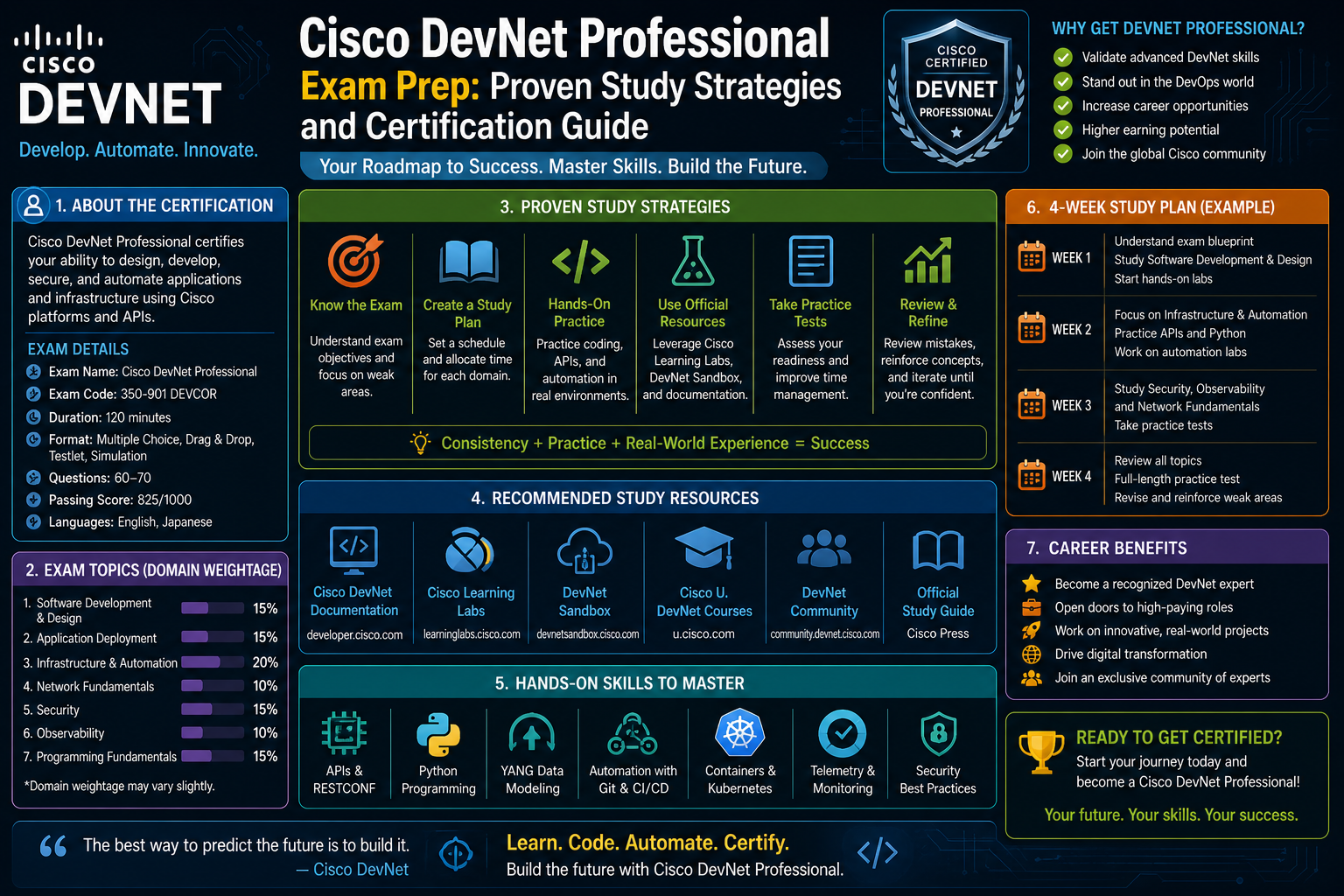
Modern networking has changed in a way that would have been difficult to imagine a decade ago. Earlier, networks were primarily built, configured, and maintained through manual interaction with physical or virtual devices. Engineers would log into switches, routers, and firewalls, apply configurations line by line, and troubleshoot issues using command-line tools that required deep familiarity with vendor-specific syntax. While this approach built strong foundational skills, it also created limitations in speed, scalability, and consistency.
As organizations expanded their digital presence, networks began to grow in complexity. Data centers became more distributed, cloud platforms introduced dynamic infrastructure, and applications started demanding rapid provisioning and continuous availability. In such an environment, manual configuration quickly became inefficient. Even small changes required careful coordination, and the risk of human error increased as networks scaled.
This is where software-driven infrastructure began to take center stage. Instead of treating network devices as isolated hardware components, the industry started to view them as programmable resources. This shift introduced automation, orchestration, and API-driven control as core elements of networking. Rather than manually configuring devices one by one, engineers could now define desired outcomes through code, allowing systems to apply configurations consistently across entire environments.
This evolution also changed the skill set expected from network professionals. Understanding routing protocols and switching fundamentals is still important, but it is no longer sufficient on its own. Today’s engineers are also expected to understand programming concepts, automation workflows, and system integration techniques. The ability to communicate with devices using APIs has become just as important as understanding how those devices forward packets.
The Cisco DevNet Professional certification exists within this context. It reflects the industry’s transition from hardware-centric networking to software-defined infrastructure. It is designed for professionals who want to operate at the intersection of networking and software development, where automation and programmability define how modern systems are built and managed.
Understanding the DevNet Professional certification landscape
The Cisco DevNet Professional certification represents an advanced level of expertise in network automation and application development within Cisco environments. Unlike traditional certifications that focus primarily on infrastructure configuration, this certification emphasizes software development practices applied to networking systems.
At its core, the certification validates a professional’s ability to design, build, and maintain applications that interact with Cisco platforms. These applications may automate network configurations, integrate services across different systems, or enhance operational visibility through programmable interfaces. The focus is not just on understanding networking concepts but on applying them through software solutions.
What makes this certification distinctive is its hybrid nature. It blends knowledge from multiple domains, including networking, programming, cloud computing, and DevOps practices. Candidates are expected to understand how these domains interact and how automation can improve efficiency, reliability, and scalability in enterprise environments.
The certification is structured in a way that ensures both breadth and depth. It does not merely test theoretical knowledge but emphasizes practical application. This means that professionals are expected to understand how to solve real-world problems using code, APIs, and automation frameworks rather than relying solely on manual configuration techniques.
In many ways, this certification reflects the direction in which the entire IT industry is moving. Organizations are increasingly adopting infrastructure as code principles, where networks are defined, deployed, and managed using automated processes. The DevNet Professional certification aligns closely with this approach by encouraging engineers to think in terms of systems, workflows, and programmable logic rather than isolated device configurations.
The structure of the certification and what it represents
The Cisco DevNet Professional certification is built around a two-exam structure that ensures both foundational knowledge and specialized expertise. This structure is intentional, as it reflects the layered nature of modern network automation environments.
The first component is a core examination that evaluates a candidate’s understanding of software development principles as applied to networking systems. This includes topics such as application design, API usage, data handling, automation workflows, and platform integration. The core exam serves as the foundation because it ensures that all certified professionals share a common understanding of how software interacts with network infrastructure.
The second component is a concentration exam. This allows candidates to specialize in a particular domain of network automation. These domains may include enterprise networks, data centers, security systems, collaboration platforms, service provider environments, or DevOps practices. Each specialization focuses on applying automation principles to a specific type of infrastructure or operational context.
This dual structure is significant because it mirrors real-world job roles. In practice, network automation engineers often begin with general automation knowledge and then specialize in areas that align with their work environment. For example, an engineer working in a data center will need different automation skills than someone working in enterprise collaboration systems.
The certification also reflects the increasing importance of cross-disciplinary skills. A professional in this field must be comfortable working with both networking concepts and software development practices. This includes understanding how applications are built, how APIs expose system functionality, and how automation frameworks can be used to orchestrate complex workflows.
Another important aspect of the certification structure is its emphasis on practical application. The exam scenarios are designed to simulate real operational challenges rather than abstract theoretical questions. This ensures that certified professionals are not only knowledgeable but also capable of applying their skills in realistic environments.
Core exam DEVCOR mindset and expectations
The core exam, often referred to as DEVCOR, represents the foundation of the DevNet Professional certification. It is designed to evaluate a candidate’s ability to understand and apply software development concepts within the context of networking systems.
Unlike traditional exams that focus heavily on memorization, this exam requires analytical thinking and problem-solving ability. Candidates are expected to interpret scenarios, analyze code behavior, understand API interactions, and identify appropriate solutions based on system requirements.
One of the most important aspects of the DEVCOR mindset is the ability to think in terms of systems rather than individual devices. In traditional networking, engineers often focus on configuring one device at a time. In contrast, automation requires thinking about how multiple systems interact, how data flows between applications, and how changes in one component affect the overall environment.
Another key expectation is familiarity with software development practices. This does not necessarily mean becoming a full-time software developer, but it does require understanding how code is structured, how functions operate, and how applications communicate with external systems. Concepts such as version control, testing, debugging, and modular design become relevant in this context.
The exam also places strong emphasis on APIs, which serve as the primary interface between software applications and network devices. Understanding how APIs work, how they are authenticated, and how they exchange data is essential. Candidates must be able to interpret API documentation and determine how to use endpoints effectively to achieve specific tasks.
Time management is also an implicit expectation. The exam presents scenarios that require careful reading and analysis. Rushing through questions can lead to misinterpretation of requirements. Successful candidates typically develop a structured approach to analyzing each question, identifying key information, and eliminating incorrect options logically.
Software development fundamentals for network professionals
One of the most important transitions for candidates pursuing this certification is moving from traditional networking concepts into software development thinking. While deep programming expertise is not always required, a strong understanding of foundational development principles is essential.
At the core of software development is the idea of writing instructions that a machine can execute. These instructions must be precise, logical, and structured in a way that produces predictable outcomes. For network professionals, this translates into writing scripts or applications that automate tasks such as configuration changes, monitoring, or data retrieval.
Understanding variables, loops, conditions, and functions becomes important because these elements form the building blocks of automation scripts. A variable might store device information, a loop might iterate through multiple network devices, and a function might perform a specific configuration task across multiple systems.
Another important concept is modularity. In software development, complex problems are often broken down into smaller, manageable components. This approach is especially useful in network automation, where tasks can be divided into reusable functions or modules. For example, one module might handle authentication, while another manages configuration deployment.
Debugging is another essential skill. In automation, errors can occur due to incorrect input, network issues, or unexpected system responses. Being able to identify and resolve these issues efficiently is critical. This requires a methodical approach to analyzing logs, testing components, and validating outputs.
Version control also plays an important role in modern development workflows. It allows engineers to track changes, collaborate with others, and maintain a history of modifications. In network automation, this is particularly useful because configuration scripts often evolve over time as systems change.
APIs as the backbone of modern networking
Application Programming Interfaces, commonly known as APIs, are at the heart of modern network automation. They act as bridges between different software systems, allowing them to communicate and exchange data in a structured way.
In traditional networking, configuration changes were often made directly on devices through command-line interfaces. While this approach is still used in some cases, APIs provide a more scalable and automated alternative. Instead of logging into each device individually, engineers can send structured requests to an API, which then applies changes across multiple systems.
APIs typically follow a request-response model. An application sends a request to a server, which processes the request and returns a response. This interaction allows automation tools to retrieve information, modify configurations, or trigger specific actions within a network environment.
One of the most widely used architectural styles for APIs is REST. RESTful APIs use standard HTTP methods such as GET, POST, PUT, and DELETE to perform operations. Each method corresponds to a specific type of action, such as retrieving data or updating configurations.
Understanding how to interact with APIs requires familiarity with endpoints, authentication methods, and response structures. Endpoints define the specific locations where requests are sent, while authentication ensures that only authorized users or applications can access the system.
In network automation, APIs are used to perform a wide range of tasks. These may include retrieving device inventories, updating configuration settings, monitoring network performance, or integrating with external systems such as cloud platforms or security tools.
The ability to work with APIs effectively is one of the most important skills for professionals in this field. It allows them to move beyond manual configuration and toward fully automated network management systems.
Data formats and how systems communicate
When systems communicate through APIs, they need a standardized way to exchange information. This is where data formats come into play. The most commonly used formats in network automation are JSON and XML.
JSON, or JavaScript Object Notation, is widely used because of its simplicity and readability. It represents data in key-value pairs, making it easy for both humans and machines to interpret. JSON is commonly used in API responses to deliver structured information such as device status, configuration details, or performance metrics.
XML, or Extensible Markup Language, is another format used in some systems. It is more verbose than JSON but offers strong structure and flexibility. XML is often used in older systems or environments where strict data validation is required.
Understanding these formats is essential because they define how information is structured and transmitted between systems. When working with APIs, professionals must be able to read, interpret, and manipulate data in these formats to achieve desired outcomes.
In addition to understanding the structure of data, it is also important to understand how data is parsed and processed. Applications must be able to extract relevant information from API responses and use it in automation workflows. This requires logical thinking and attention to detail.
Introduction to automation thinking
Automation thinking represents a shift in mindset from manual operations to system-driven processes. Instead of performing repetitive tasks manually, professionals design systems that can execute those tasks automatically based on predefined rules or triggers.
This approach has several advantages. It reduces the likelihood of human error, increases efficiency, and allows networks to scale more effectively. In large environments, automation can handle thousands of devices simultaneously, something that would be impossible through manual configuration.
Automation also introduces consistency. When tasks are performed manually, variations can occur due to human differences in execution. Automation ensures that processes are applied uniformly across all systems, improving reliability and predictability.
Developing automation thinking requires the ability to identify repetitive tasks and convert them into logical workflows. This involves breaking down processes into steps, identifying inputs and outputs, and determining how those steps can be executed programmatically.
It also requires an understanding of triggers and conditions. Automation systems often operate based on specific events, such as network changes or performance thresholds. Defining these conditions accurately is essential for building effective automation solutions.
Security awareness in programmable networks
As networks become more programmable, security becomes an even more critical concern. Automation introduces new interfaces, such as APIs and scripts, which must be properly secured to prevent unauthorized access.
One of the key principles in secure automation is authentication. Systems must verify the identity of users or applications before allowing access to sensitive operations. This is often achieved through tokens, keys, or credential-based systems.
Another important concept is authorization, which determines what actions a user or application is allowed to perform. Even if access is granted, permissions must be carefully controlled to prevent misuse.
Data protection is also essential. Information exchanged between systems must be encrypted to prevent interception or tampering. This ensures that sensitive configuration data or operational information remains secure during transmission.
In addition to technical controls, secure design practices play an important role. Automation systems should be designed with security in mind from the beginning, rather than treated as an afterthought. This includes limiting access points, validating inputs, and monitoring system activity for anomalies.
Security awareness in programmable networks is not just about preventing attacks. It is also about ensuring stability and reliability. Poorly designed automation can introduce vulnerabilities or unintended behavior that affects overall system performance.
Building practical automation skills in modern networking environments
As network environments evolve, the gap between theoretical knowledge and real operational capability becomes more noticeable. Understanding concepts such as APIs, scripting, or infrastructure automation is only the beginning. The real value emerges when these concepts are applied consistently to solve day-to-day operational challenges.
In modern enterprise environments, network engineers are no longer limited to configuring devices manually. Instead, they are expected to interact with systems that are increasingly abstracted through software layers. This means that the traditional idea of logging into a device and making direct configuration changes is gradually being replaced by automated workflows, centralized controllers, and programmable interfaces.
Practical automation skills begin with exposure to real systems. Engineers must understand how data flows between applications, how requests are processed by APIs, and how responses are interpreted and acted upon. This is not something that can be fully learned through reading alone. It requires interaction with live systems, experimentation with different inputs, and observation of system behavior under varying conditions.
One of the most important aspects of building practical skills is repetition. Automation becomes intuitive only after repeated exposure to similar tasks. For example, retrieving device information from an API may seem complex at first, but after performing the task multiple times across different scenarios, it becomes a natural part of the workflow.
Another critical factor is understanding failure scenarios. In real-world automation, things do not always work as expected. APIs may return errors, devices may be unreachable, or data formats may not match expectations. Learning how to interpret these failures and adjust automation logic accordingly is a key skill for any professional working in this domain.
This practical mindset is also central to the Cisco DevNet Professional certification philosophy. The certification is not designed to test memorization alone but to evaluate whether candidates can apply automation principles in realistic environments. This is why hands-on experience is emphasized so strongly in preparation.
The role of APIs in real-world network automation
APIs are not just theoretical constructs; they are the operational backbone of modern network automation systems. In practical environments, APIs serve as the primary communication channel between automation tools and network infrastructure.
When an engineer interacts with a network controller through automation, they are not directly configuring devices. Instead, they are sending structured requests to an API endpoint, which then translates those requests into device-level actions. This abstraction allows for greater scalability and consistency.
In enterprise networks, APIs are commonly used to perform tasks such as device provisioning, configuration updates, monitoring, and reporting. For example, instead of logging into multiple switches to update VLAN configurations, an engineer can send a single API request that propagates changes across the entire network.
This approach significantly reduces operational complexity. It also minimizes the risk of configuration drift, where different devices end up with inconsistent settings due to manual intervention.
However, working with APIs effectively requires a deep understanding of how they are structured. Each API has its own set of endpoints, request formats, authentication methods, and response structures. Engineers must be able to read API documentation carefully and translate requirements into correct API calls.
Another important aspect is error handling. APIs do not always return successful responses. They may return error codes indicating issues such as authentication failure, invalid input, or system overload. Understanding how to interpret and respond to these errors is essential for building reliable automation systems.
In advanced environments, APIs are also chained together. This means that the output of one API call becomes the input for another. This chaining allows for complex workflows, such as retrieving device information, analyzing performance metrics, and then automatically applying configuration changes based on predefined conditions.
Infrastructure as code and its impact on networking
One of the most transformative concepts in modern networking is infrastructure as code. This approach treats infrastructure configuration in the same way that software code is treated. Instead of manually configuring devices, engineers define infrastructure requirements using declarative or procedural code.
This shift has profound implications for how networks are managed. It introduces version control, repeatability, and automation into infrastructure management. Every configuration change can be tracked, reviewed, and rolled back if necessary.
Infrastructure as code also improves consistency. When infrastructure is defined in code, the same configuration can be deployed across multiple environments without variation. This reduces human error and ensures that systems behave predictably.
Another key advantage is scalability. In traditional environments, scaling a network required significant manual effort. With infrastructure as code, scaling can be achieved by modifying configuration templates and reapplying them across systems.
In practice, infrastructure as code is often implemented using automation tools and frameworks that interact with APIs. These tools interpret code definitions and translate them into API calls that configure network devices or cloud resources.
This approach aligns closely with the goals of modern network automation. It allows engineers to focus on defining desired outcomes rather than executing individual configuration steps.
Understanding infrastructure as code requires a shift in thinking. Instead of asking how to configure a device, engineers must ask what the desired state of the system should be. The automation system then ensures that the actual state matches the desired state.
Software development principles applied to networking
Software development principles play a central role in network automation. While traditional networking focused on device-level configuration, modern automation requires thinking in terms of applications, logic, and system design.
One of the most important principles is abstraction. In software development, abstraction allows complex systems to be simplified into manageable components. In networking, this means hiding low-level device details behind APIs and automation frameworks.
Another important principle is modularity. Modular design involves breaking down complex systems into smaller, reusable components. In network automation, this might involve separating authentication logic, data processing, and configuration deployment into distinct modules.
Reusability is closely related to modularity. Once a module has been created, it can be reused across different automation workflows. This reduces duplication of effort and improves maintainability.
Error handling is another critical principle. In software development, systems must be designed to handle unexpected conditions gracefully. In network automation, this means anticipating issues such as network outages, API failures, or invalid data inputs.
Testing is also essential. Before deploying automation workflows in production environments, they must be tested thoroughly to ensure they behave as expected. This includes unit testing individual components as well as integration testing entire workflows.
Version control is another foundational principle. It allows engineers to track changes to automation scripts over time, collaborate with others, and revert to previous versions if necessary. This is particularly important in environments where multiple engineers are working on the same systems.
Understanding Cisco platforms and ecosystem integration
Cisco environments provide a wide range of platforms that support automation and programmability. These platforms expose APIs and interfaces that allow engineers to interact with network devices, security systems, collaboration tools, and data center infrastructure.
Each platform has its own characteristics and capabilities. Some are focused on enterprise networking, while others are designed for data centers, security operations, or collaboration services. Understanding how these platforms fit together is essential for building effective automation solutions.
In enterprise environments, platforms are often integrated into a centralized management system. This system provides a unified interface for managing devices, monitoring performance, and applying configurations. Automation tools interact with this system through APIs, allowing for centralized control of distributed networks.
Data center platforms focus heavily on scalability and performance. Automation in these environments often involves managing virtualized infrastructure, load balancing, and dynamic resource allocation.
Security platforms introduce additional complexity. Automation in security environments must take into account threat detection, policy enforcement, and identity management. This requires careful coordination between automation workflows and security controls.
Collaboration platforms, on the other hand, focus on communication systems such as messaging, video conferencing, and team collaboration tools. Automation in these environments often involves integrating communication workflows with external systems.
Understanding how these platforms interact is important because modern networks are rarely isolated. Instead, they form part of a larger ecosystem where different systems must work together seamlessly.
Application deployment models in automated environments
Application deployment in automated network environments differs significantly from traditional software deployment. Instead of manually installing applications on servers, deployment is handled through automated pipelines and orchestration systems.
These pipelines define the steps required to build, test, and deploy applications. Each step is executed automatically based on predefined rules, reducing the need for manual intervention.
In network automation contexts, applications may be deployed to manage network devices, provide monitoring capabilities, or integrate with external systems. These applications must be designed to operate reliably in dynamic environments.
Containerization plays a key role in modern deployment models. Containers allow applications to be packaged with all their dependencies, ensuring consistency across different environments. This makes it easier to deploy automation tools across development, testing, and production systems.
Orchestration systems manage the deployment and scaling of these containers. They ensure that applications are running correctly, distribute workloads, and handle failures automatically.
Continuous integration and continuous deployment practices are also important in this context. These practices ensure that changes to automation code are tested and deployed regularly, reducing the risk of errors in production environments.
Understanding deployment models is essential for network automation professionals because many automation tools themselves are deployed as applications within these environments.
DevOps practices in network automation
DevOps practices have had a significant impact on network automation. Originally developed for software development teams, DevOps principles emphasize collaboration, automation, and continuous improvement.
In network environments, DevOps practices help bridge the gap between development and operations teams. Instead of working in isolation, these teams collaborate to design, build, and maintain automation systems.
One of the key principles of DevOps is continuous integration. This involves regularly merging code changes into a shared repository and testing them automatically. In network automation, this ensures that changes to automation scripts are validated before being deployed.
Continuous deployment extends this concept by automatically deploying validated changes into production environments. This reduces deployment time and ensures that improvements are delivered quickly.
Another important principle is infrastructure monitoring. DevOps practices emphasize continuous monitoring of systems to detect issues early. In network automation, this involves tracking performance metrics, system logs, and API behavior.
Collaboration is also a core aspect of DevOps. Engineers, developers, and operations teams work together to design automation workflows that meet both technical and operational requirements.
The adoption of DevOps practices in networking reflects the broader shift toward software-driven infrastructure. It highlights the importance of treating network systems as dynamic, programmable environments rather than static configurations.
Security considerations in automated workflows
As automation becomes more widespread, security considerations become increasingly important. Automated systems introduce new interfaces and access points that must be carefully protected.
One of the primary concerns is unauthorized access. Since automation systems often have elevated privileges, securing authentication mechanisms is critical. This includes ensuring that only authorized users or systems can execute automation tasks.
Another concern is data integrity. Automated workflows must ensure that data is not modified or corrupted during transmission or processing. This requires secure communication channels and validation mechanisms.
Access control is also essential. Not all users or systems should have the same level of access to automation tools. Implementing role-based access control helps ensure that permissions are appropriately managed.
Auditability is another important aspect. Automation systems should maintain logs of all actions performed, including who initiated them and what changes were made. This is important for troubleshooting and compliance purposes.
In addition to these technical measures, secure design principles must be applied during the development of automation systems. This includes minimizing attack surfaces, validating inputs, and designing systems that fail safely in case of errors.
Observability and monitoring in automated networks
Observability refers to the ability to understand the internal state of a system based on external outputs. In automated network environments, observability is critical for ensuring system reliability and performance.
Monitoring systems collect data from network devices, applications, and automation workflows. This data is then analyzed to detect issues, identify trends, and optimize performance.
Logs, metrics, and traces are the three primary components of observability. Logs provide detailed records of system events, metrics provide quantitative data such as performance indicators, and traces show how requests move through systems.
In automated environments, observability tools often integrate directly with APIs. This allows them to collect real-time data and provide insights into system behavior.
Effective observability enables proactive management of network systems. Instead of reacting to issues after they occur, engineers can identify potential problems early and take corrective action.
This is particularly important in large-scale environments where manual monitoring is not feasible. Automation combined with observability ensures that systems remain stable, efficient, and resilient.
Expanding role of network engineers in programmable systems
The role of network engineers has evolved significantly with the rise of automation and programmability. Instead of focusing solely on device configuration, engineers now play a broader role that includes software development, system design, and automation architecture.
This expanded role requires a combination of skills. Engineers must understand networking fundamentals, but they must also be comfortable working with programming languages, APIs, and automation frameworks.
In many organizations, network engineers are now involved in designing automation workflows that span multiple systems. This includes integrating network devices with cloud platforms, security tools, and application services.
Engineers are also responsible for ensuring that automation systems are reliable and scalable. This involves testing workflows, monitoring system performance, and continuously improving automation processes.
The shift toward programmable networks has also created new opportunities for innovation. Engineers can now build custom solutions that solve specific operational challenges, rather than relying solely on vendor-provided tools.
This evolution reflects a broader trend in the IT industry toward convergence between networking and software development.
Advancing from core knowledge to specialization
Once the foundational concepts of network automation are understood, the next stage is specialization. This is where professionals move beyond general knowledge and begin focusing on specific domains that align with real operational environments. The Cisco DevNet Professional structure encourages this progression by requiring a concentration exam after the core assessment.
Specialization is important because modern networks are not uniform. Enterprise environments, data centers, security infrastructures, and collaboration systems each have distinct architectures, tools, and operational requirements. A network automation approach that works well in one environment may not translate directly to another without adaptation.
For example, enterprise automation often focuses on large-scale device configuration, policy enforcement, and branch connectivity. Data center environments emphasize virtualization, high availability, and workload distribution. Security-focused automation deals with identity management, threat response, and policy compliance. Each domain requires a slightly different mindset, even though the underlying automation principles remain consistent.
Choosing a specialization is not just about passing an exam; it shapes how a professional will interact with real-world systems. Engineers who specialize tend to develop deeper expertise in their chosen domain, allowing them to design more efficient and reliable automation solutions.
This stage of learning also introduces more complex integration scenarios. Instead of working with a single API or system, professionals often need to coordinate multiple platforms simultaneously. This requires stronger architectural thinking and the ability to design workflows that span across different technological layers.
Building real automation workflows end-to-end
At an advanced level, automation is no longer about isolated scripts or single API calls. It becomes about building complete workflows that handle entire operational processes from start to finish.
An end-to-end automation workflow typically begins with a trigger. This could be an event such as a device failure, a configuration change request, or a scheduled task. Once triggered, the system collects relevant data, processes it, makes decisions based on predefined logic, and executes actions across one or more systems.
For example, in a network environment, an automation workflow might begin when a new device is added to the network. The system could automatically detect the device, retrieve its details through an API, apply baseline configuration settings, and register it within a monitoring system.
Building such workflows requires careful planning. Each step must be clearly defined, and dependencies between steps must be understood. If one step fails, the system must know how to respond—whether by retrying the operation, logging the error, or rolling back changes.
Another important aspect is scalability. A workflow that works for a small environment may not perform well when applied to hundreds or thousands of devices. Engineers must consider performance implications and design workflows that can handle large-scale execution without degradation.
Reusability also becomes critical at this stage. Instead of building separate workflows for each task, engineers often design modular components that can be reused across different automation scenarios. This reduces duplication and makes systems easier to maintain.
Troubleshooting in automated network systems
Troubleshooting in automated environments differs significantly from traditional network troubleshooting. In manual systems, engineers typically log into devices, inspect configurations, and analyze command outputs directly. In automated systems, the problem is often distributed across multiple layers.
Issues may originate in the automation script itself, the API layer, the network device, or even the underlying infrastructure. This makes systematic debugging essential.
The first step in troubleshooting is identifying where the failure occurred. Logs play a crucial role in this process. Automation systems typically generate detailed logs that record each step of execution. These logs help engineers trace the sequence of events leading up to a failure.
Another important tool is error categorization. Not all errors are equal. Some indicate authentication issues, others suggest connectivity problems, while others may point to invalid data structures. Understanding the nature of the error helps narrow down the root cause more quickly.
Testing individual components is also an important strategy. Instead of analyzing the entire workflow at once, engineers often isolate specific steps to determine where the breakdown occurs. This modular approach simplifies debugging and reduces complexity.
In some cases, issues arise due to timing or synchronization problems. For example, an API call may fail because a device is not yet fully initialized. In such cases, introducing delays or retry mechanisms can help stabilize the workflow.
Troubleshooting automation systems requires patience, analytical thinking, and a structured approach. Over time, engineers develop intuition for common failure patterns, which helps them resolve issues more efficiently.
Cloud-driven networking integration
The integration of cloud technologies into networking has fundamentally changed how automation is designed and implemented. Cloud environments introduce elasticity, scalability, and abstraction that were not possible in traditional on-premise systems.
In cloud-driven networking, infrastructure is often dynamic. Resources can be created, modified, or destroyed on demand. This requires automation systems to be equally flexible and responsive.
APIs play a central role in cloud integration. Cloud providers expose extensive API ecosystems that allow engineers to manage virtual networks, compute resources, and storage systems programmatically. This enables seamless integration between on-premise networks and cloud environments.
One of the key challenges in cloud-driven networking is managing hybrid environments. Many organizations operate both traditional data centers and cloud platforms simultaneously. Automation systems must bridge these environments, ensuring consistent policies and configurations across both domains.
Security is also a major consideration. Cloud environments introduce new attack surfaces and require careful management of identity, access, and encryption. Automation must incorporate security controls to ensure that cloud resources are properly protected.
Another important aspect is cost optimization. Cloud resources are often billed based on usage, so automation systems must be designed to avoid unnecessary resource consumption. This includes automatically scaling resources up or down based on demand.
CI/CD pipelines in network automation lifecycle
Continuous integration and continuous deployment practices are becoming increasingly important in network automation. These practices ensure that changes to automation scripts are tested, validated, and deployed in a controlled and consistent manner.
In a typical pipeline, changes are first committed to a version control system. These changes then trigger automated testing processes that validate functionality, check for errors, and ensure compatibility with existing systems.
If tests pass successfully, the changes are moved to deployment stages. Here, automation scripts are applied to staging environments where they can be evaluated under realistic conditions. This helps identify potential issues before changes reach production systems.
Once validated, changes are deployed to production environments. This process is often fully automated, reducing the need for manual intervention and minimizing deployment delays.
CI/CD pipelines also improve collaboration. Multiple engineers can work on different parts of automation systems simultaneously without interfering with each other’s work. Version control ensures that changes are tracked and merged systematically.
In network environments, CI/CD pipelines are particularly valuable because they reduce the risk associated with configuration changes. Even small errors in network automation can have significant impacts, so rigorous testing and validation are essential.
Conclusion
The Cisco DevNet Professional certification represents a clear reflection of how networking has evolved from traditional hardware-focused administration into a software-driven, highly automated discipline. Modern networks are no longer managed through isolated device configurations or manual command-line adjustments. Instead, they are shaped through APIs, automation frameworks, and programmable infrastructure that demand a blend of networking knowledge and software development thinking.
What makes this certification especially relevant is its practical orientation. It is not designed around memorization or theory alone, but around the ability to solve real operational problems using automation. This means understanding how systems interact, how data flows between applications, and how infrastructure can be controlled programmatically at scale. Professionals who pursue this path are expected to think beyond individual devices and focus on entire ecosystems of interconnected services.
The combination of a core exam and a specialization path also mirrors real-world career development. It ensures that professionals first build a strong foundation in automation and development principles before moving into specific domains such as enterprise networking, security, data centers, or cloud integration. This layered approach helps build both depth and flexibility, which are essential in modern IT environments where technologies are constantly evolving.
Hands-on experience remains the most important factor in mastering these skills. Working with APIs, building automation workflows, and experimenting with real or simulated environments helps bridge the gap between theoretical understanding and practical execution. Over time, this experience develops not only technical ability but also problem-solving intuition, which is crucial when working in complex systems.
As organizations continue to adopt cloud computing, DevOps practices, and infrastructure as code, the demand for professionals who understand network automation will continue to grow. Networks are becoming more dynamic, distributed, and software-defined, requiring engineers who can adapt quickly and design scalable solutions.
Ultimately, the DevNet Professional path is about transformation. It transforms traditional network engineers into automation-aware professionals who can design, implement, and manage modern programmable infrastructures. Those who develop these skills position themselves at the center of one of the most important shifts in the IT industry, where networking and software engineering increasingly operate as one unified discipline.