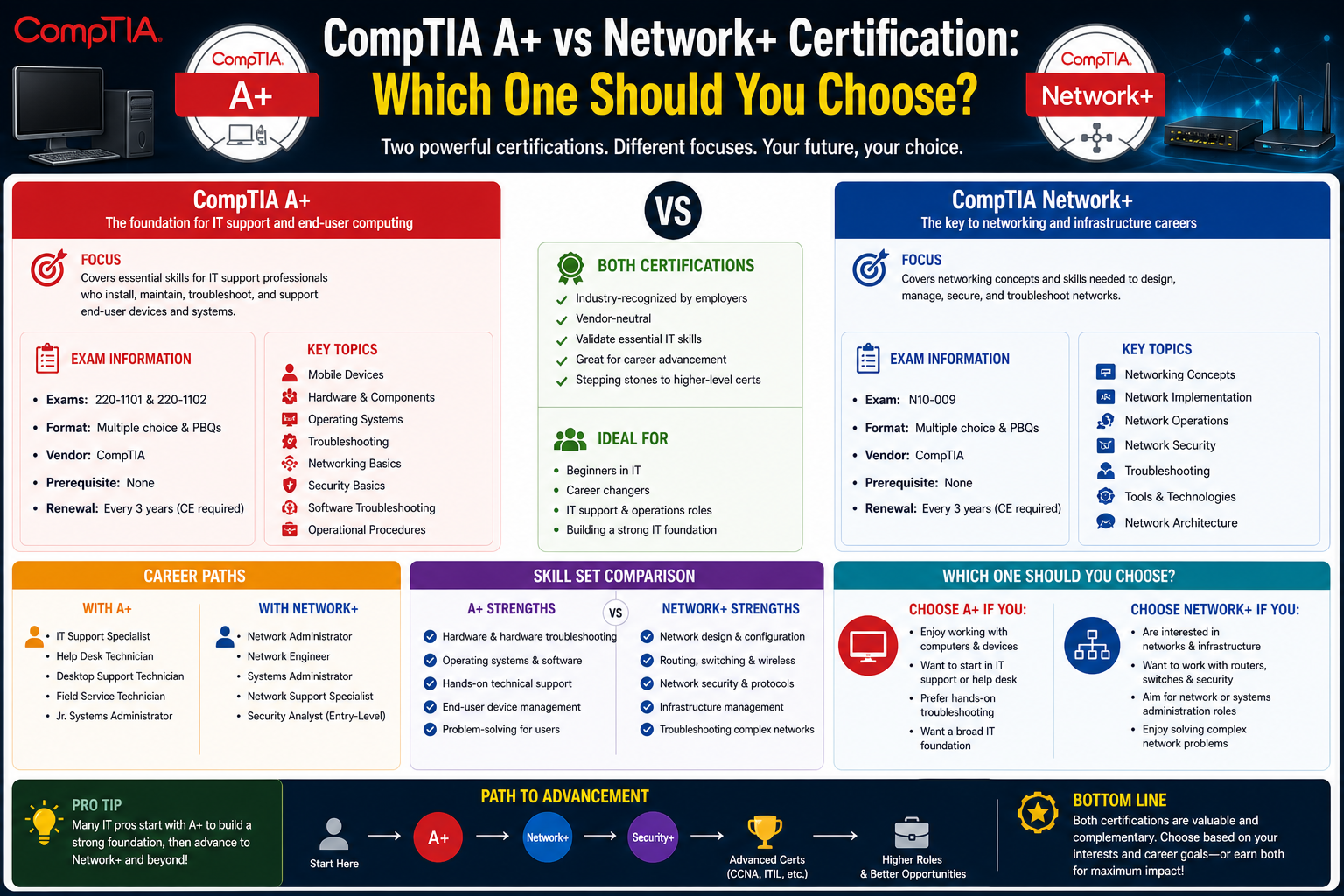
In today’s IT environment, entry-level certifications often serve as the first structured bridge between curiosity and professional capability. Among the most widely discussed options for newcomers are the CompTIA A+ and CompTIA Network+ certifications. While both are foundational in nature, they serve distinctly different purposes and shape a learner’s technical thinking in different ways.
The CompTIA A+ certification is generally associated with the fundamentals of computing. It focuses on how computers work at a practical level, covering hardware components, operating systems, troubleshooting methodologies, and basic security principles. It is designed to help learners understand what a computer is made of, how it operates internally, and how to resolve common technical issues that users encounter in everyday environments.
On the other hand, CompTIA Network+ shifts the focus outward from individual systems to the communication between systems. Instead of concentrating on a single machine, it introduces learners to how multiple devices connect, exchange data, and operate within structured network environments. Topics typically include routing concepts, switching, wireless networking, network troubleshooting, and foundational infrastructure design.
What makes the comparison interesting is that both certifications are not competing in the same category, yet they are frequently positioned as alternative starting points. This creates a natural question for beginners: should they first understand how a computer works, or should they begin with how computers communicate with each other?
This question does not have a universal answer, and that is exactly why professionals in the field often disagree slightly in their recommendations. The decision depends heavily on prior exposure, learning style, and long-term career direction.
How Foundational IT Skills Are Built Through A+
The CompTIA A+ certification is often described as the “ground floor” of IT knowledge. It builds confidence by helping learners recognize and understand the physical and logical components of a computing system. This includes understanding processors, memory, storage devices, power systems, and peripheral devices.
More importantly, A+ introduces structured troubleshooting. Instead of guessing why something is not working, learners are taught a methodical approach: identify symptoms, isolate the problem, test potential causes, and apply corrective action. This approach is not limited to hardware; it extends to operating systems and software environments as well.
Another major component of A+ is exposure to operating systems. Learners gain familiarity with different environments such as Windows, Linux basics, and mobile operating systems. This exposure is essential because most IT roles require interaction with multiple platforms rather than a single system.
A+ also includes foundational security awareness. While it does not go deeply into cybersecurity, it introduces concepts such as authentication, malware types, secure configuration, and basic data protection principles. These concepts help shape a security-conscious mindset early in a learner’s journey.
What makes A+ particularly important for beginners is that it reduces uncertainty. Many newcomers to IT feel overwhelmed by terminology and system complexity. A+ breaks this complexity into structured, understandable layers, allowing learners to build confidence before moving into more abstract topics like networking.
What Network+ Actually Prepares Learners For
Network+ represents a shift from individual systems to interconnected environments. Instead of focusing on what happens inside a computer, it focuses on what happens between computers.
At its core, Network+ teaches how data moves. This includes understanding IP addressing, subnetting concepts, routing mechanisms, and switching behavior. These topics are essential for anyone who wants to understand how the internet, corporate networks, and cloud environments function.
Learners are also introduced to network architectures. This includes how different devices such as routers, switches, firewalls, and access points interact within a network structure. The goal is not only to recognize these devices but to understand their roles in maintaining communication and security.
Wireless networking is another key area. Modern IT environments rely heavily on wireless connectivity, and Network+ helps learners understand signal behavior, encryption methods, interference issues, and performance optimization.
Troubleshooting in Network+ is also more system-wide compared to A+. Instead of focusing on a single machine, learners must consider multiple points of failure across an entire network. This requires a different type of thinking, where problems may originate from configuration issues, infrastructure faults, or external connectivity problems.
The certification also introduces foundational cloud and virtualization concepts. As IT systems increasingly move toward cloud-based environments, understanding how virtual networks operate becomes essential for long-term relevance.
Network+ therefore prepares learners for roles that involve system interconnectivity, infrastructure support, and network administration tasks. However, it assumes a certain level of comfort with basic computing concepts, which is where the debate about learning order begins.
Why Beginners Often Feel Confused About the Starting Point
The confusion between A+ and Network+ arises because both certifications appear foundational, yet they operate at different layers of abstraction.
A+ is more tangible. Learners can physically see hardware components, interact with operating systems, and directly observe troubleshooting outcomes. This makes it easier for absolute beginners to grasp.
Network+ is more conceptual. It requires understanding invisible processes such as data packets, routing logic, and network topologies. For someone without prior IT exposure, these concepts can feel abstract and harder to visualize.
At the same time, some learners are naturally more interested in connectivity and systems behavior than hardware components. For them, Network+ may feel more engaging despite being conceptually more complex.
This difference in perception is one of the main reasons trainers often disagree. Their recommendations are shaped not only by technical structure but also by how different learners absorb information.
Trainer Perspective: Jeremy Cioara and the A+ First Approach
One of the strongest arguments for starting with A+ comes from Jeremy Cioara’s perspective. His recommendation emphasizes the importance of understanding computing fundamentals before moving into networking concepts.
The logic behind this approach is simple. A network is made up of computers. If a learner does not understand how a computer functions, it becomes difficult to fully grasp how multiple computers interact.
From this viewpoint, A+ is not just about hardware knowledge. It is about building mental models of how systems behave. Once these models are established, networking concepts become easier to understand because they extend from familiar foundations.
This approach also reduces cognitive overload. Beginners are not forced to learn system internals and network behavior simultaneously. Instead, they build knowledge in layers, starting from the most tangible level.
Trainer Perspective: Keith Barker and Context-Based Starting Points
Keith Barker presents a more conditional perspective. Rather than strictly favoring one certification, his approach depends on the learner’s background.
If a beginner has no experience with computers at all, A+ becomes the logical starting point. It introduces basic interaction with hardware and operating systems, making it easier for learners to feel comfortable with technology in general.
However, if a learner already has some familiarity with computers, Keith’s perspective suggests that Network+ may be an acceptable entry point. This implies that prior exposure can reduce the need for foundational hardware training.
This flexible approach highlights an important idea: the best starting point is not universal. It depends on where the learner is starting from, not just where they want to go.
Trainer Perspective: Garth Schulte and the Value of Both Paths
Garth Schulte emphasizes that both certifications hold value and should not be seen as mutually exclusive. His perspective suggests that limiting oneself to only A+ or only Network+ creates an incomplete skill set.
From this viewpoint, IT professionals benefit most when they understand both system-level and network-level concepts. A technician who only understands hardware may struggle in networked environments, while someone who only understands networking may lack awareness of endpoint behavior.
This perspective introduces the idea of synergy between the two certifications. Instead of choosing one over the other permanently, learners are encouraged to see them as complementary building blocks.
It also reflects the reality of IT roles, where responsibilities often overlap. A single issue may require both hardware troubleshooting and network diagnosis, depending on the situation.
Trainer Perspective: Anthony Sequeira and Career-Aligned Decision Making
Anthony Sequeira’s perspective introduces career direction as the deciding factor. While he leans toward A+ as a starting point, he acknowledges that the ideal path depends on what the learner ultimately wants to do in IT.
For example, someone interested in end-user support or technical support roles may benefit more from A+ first. These roles often involve direct interaction with devices, operating systems, and user-level issues.
On the other hand, someone aiming for infrastructure-focused roles may find Network+ more relevant after gaining basic computing knowledge.
This approach highlights an important principle: certifications are not just learning tools, but career alignment tools. The order in which they are taken can influence how quickly a learner becomes job-ready in a specific area.
Trainer Perspective: Chris Ward and Sequential Learning Strategy
Chris Ward strongly supports a sequential approach where A+ is followed by Network+. His reasoning is based on structured learning progression.
According to this view, A+ builds the foundational layer of knowledge that supports everything else in IT. Once this base is established, Network+ becomes significantly easier to understand because learners can relate networking concepts to real systems they already understand.
This approach reduces confusion and increases retention. Instead of learning abstract networking concepts in isolation, learners can connect them to real-world computing behavior they have already studied.
It also aligns with how many traditional IT learning paths are structured in professional environments.
Comparing the Cognitive Load Between A+ and Network+
One of the most important differences between A+ and Network+ is cognitive load. A+ tends to distribute complexity across physical and logical systems that learners can visualize. Network+, however, introduces multiple abstract layers that require mental modeling.
For beginners, this difference can be significant. Understanding a physical computer is often easier than understanding how data travels across multiple interconnected systems.
This does not mean Network+ is harder in an absolute sense, but it does mean that it requires a different type of thinking. Learners must shift from “what is this component?” to “how does information move through this system?”
That shift can be challenging without prior exposure to computing basics.
How Entry-Level IT Roles Influence Certification Choice
Entry-level IT roles often determine which certification feels more immediately useful. Roles focused on technical support, help desk operations, and device troubleshooting tend to align more closely with A+ knowledge.
These roles require familiarity with operating systems, hardware issues, and user support scenarios. A+ prepares learners directly for these situations.
Network+ becomes more relevant in roles involving infrastructure support, network administration assistance, or systems monitoring. These roles require understanding connectivity issues, network performance, and configuration behavior.
Because of this difference, many learners indirectly choose their certification path based on the type of job they are targeting, even if they are not fully aware of it at the beginning.
Common Misunderstandings About A+ and Network+
A frequent misunderstanding is that A+ is too basic or unnecessary. In reality, its value lies in standardizing foundational knowledge. Even experienced users often have gaps in basic system understanding that A+ helps fill.
Similarly, Network+ is sometimes seen as an advanced certification, but it is still considered entry-level within networking disciplines. Its challenge lies more in conceptual thinking than in advanced theory.
Another misconception is that one certification automatically replaces the need for the other. In practice, both cover different domains of IT knowledge, and understanding both provides a more complete technical foundation.
How Real IT Environments Blur the Line Between A+ and Network+
In real-world IT environments, the separation between system-level support and network-level support is not as clear as it appears in certification outlines. While A+ focuses on individual devices and Network+ focuses on interconnected systems, actual workplace scenarios often require both perspectives at the same time.
For example, when a user cannot access the internet, the issue might appear to be network-related at first glance. However, the root cause could be a corrupted network driver, a misconfigured operating system setting, a faulty Ethernet adapter, or even a disabled wireless interface. These are all concepts covered in A+.
At the same time, resolving the issue might also require checking IP configuration, gateway settings, DNS resolution, or switch port behavior, which are concepts aligned with Network+.
This overlap is one of the most important realities beginners must understand. IT support is rarely divided into clean categories. Instead, it is a layered environment where multiple systems interact continuously.
Because of this, professionals often develop a hybrid mindset over time. They do not think in terms of “this is an A+ problem” or “this is a Network+ problem.” Instead, they evaluate symptoms across multiple layers until the root cause is identified.
This layered thinking is what both certifications aim to develop, even though they approach it from different directions.
The Progression From Device Thinking to System Thinking
One of the most significant transitions in IT learning is the shift from device thinking to system thinking. A+ naturally builds device thinking by focusing on individual components and their behavior.
Learners begin by understanding how a CPU processes instructions, how RAM affects performance, how storage devices retrieve data, and how operating systems manage resources. This creates a mental model centered on single-machine behavior.
Network+ expands this model by introducing system thinking, where multiple devices interact as part of a larger ecosystem. Instead of focusing on one computer, learners must consider how data flows across routers, switches, servers, and endpoints.
This transition can be challenging because it requires abstraction. Learners must imagine processes they cannot physically see. Data packets, routing paths, and network topologies exist as logical constructs rather than tangible objects.
However, once this shift is made, it significantly enhances problem-solving ability. System thinking allows IT professionals to identify issues that span multiple devices and communication layers.
Why Some Beginners Struggle More With Network Concepts
Network concepts often introduce difficulty for beginners because they require understanding invisible processes. Unlike hardware components, which can be physically observed and manipulated, networking relies heavily on conceptual visualization.
For example, understanding how a packet travels from one device to another requires knowledge of addressing schemes, routing decisions, and encapsulation processes. These are not immediately intuitive for someone without prior exposure.
Subnetting, in particular, is often a major challenge. It requires mathematical reasoning combined with logical segmentation of networks. Without a strong foundational understanding of how computers use IP addresses, this topic can feel abstract and confusing.
Additionally, networking introduces multiple layers of abstraction, such as the OSI model. Each layer performs a specific function, and understanding how they interact requires structured thinking.
A+ reduces this difficulty indirectly by familiarizing learners with basic networking concepts at a device level. This includes connecting to Wi-Fi, configuring IP settings, and understanding basic connectivity issues.
The Role of Troubleshooting Mindset in Both Certifications
Troubleshooting is one of the most valuable skills developed through both A+ and Network+. However, the nature of troubleshooting differs significantly between the two.
In A+, troubleshooting is often linear and device-focused. The learner is encouraged to identify a problem within a single system, isolate the cause, and apply a fix. This might involve replacing hardware, reinstalling drivers, or adjusting system settings.
In Network+, troubleshooting becomes more distributed. Problems may originate from multiple points in a network, and identifying the root cause requires analyzing traffic flow, connectivity paths, and configuration consistency across devices.
This difference shapes how learners approach problems. A+ builds precision in identifying local issues, while Network+ builds analytical reasoning across systems.
When combined, these skills create a strong troubleshooting foundation that is highly valued in IT roles.
Entry-Level Job Expectations and Certification Alignment
Employers hiring for entry-level IT positions often expect candidates to have a combination of theoretical knowledge and practical problem-solving ability. While certifications are not the only factor, they often serve as indicators of baseline competence.
Roles such as IT support technician, help desk analyst, and desktop support specialist typically align more closely with A+ knowledge. These roles involve direct interaction with users and devices, including troubleshooting hardware issues, resolving software conflicts, and assisting with operating system problems.
In contrast, roles such as junior network technician, network support assistant, or infrastructure support associate lean more toward Network+ knowledge. These positions involve monitoring network performance, assisting with configuration tasks, and identifying connectivity issues.
However, the boundaries between these roles are often flexible. Many entry-level positions require exposure to both device-level and network-level troubleshooting.
This overlap reinforces the idea that both certifications contribute to overall employability, even if one is taken before the other.
How Learning Order Affects Confidence Building
Confidence plays a critical role in IT learning. Beginners who feel overwhelmed by technical concepts often struggle to maintain consistency in their studies.
Starting with A+ tends to build confidence more gradually. Because learners interact with physical components and visible system behavior, they can more easily understand cause-and-effect relationships.
For example, installing memory and observing improved system performance creates a direct connection between action and outcome. This reinforces learning through tangible results.
Network+ builds confidence in a different way. Instead of physical outcomes, learners gain confidence through conceptual understanding. Successfully configuring a network or resolving a connectivity issue reinforces logical reasoning skills.
However, without prior exposure to basic computing, this confidence can take longer to develop.
This is why many trainers emphasize A+ as a starting point for absolute beginners. It provides early wins that encourage continued learning.
The Importance of Layered Knowledge in IT Careers
IT systems are built in layers, both technically and conceptually. From hardware components to application services, each layer depends on the one below it.
A+ primarily focuses on the lower layers of this structure. It teaches how physical components and operating systems function as the foundation of computing.
Network+ extends upward into the communication layer, where devices interact across local and wide-area networks.
Understanding both layers is essential because issues can originate at any level. A performance problem might be caused by hardware limitations, operating system inefficiencies, or network congestion.
Professionals who understand layered systems are better equipped to diagnose complex issues efficiently. They can eliminate possibilities systematically rather than relying on guesswork.
This layered approach is one of the key reasons why A+ and Network+ are often recommended together, even if taken in sequence.
Skill Transfer Between A+ and Network+
One of the most valuable aspects of progressing from A+ to Network+ is skill transfer. Many foundational skills developed in A+ directly support learning in Network+.
For example, understanding operating system configuration in A+ helps when configuring network settings in Network+ environments. Knowledge of system processes and resource management also aids in understanding network performance issues.
Similarly, troubleshooting methodology learned in A+ becomes directly applicable to network troubleshooting scenarios.
However, the reverse is also partially true. Exposure to Network+ can reinforce understanding of how systems behave under connectivity constraints, which can deepen A+ knowledge.
This bidirectional reinforcement is why many learners benefit from studying both certifications, regardless of order.
The Role of Practical Labs and Hands-On Experience
Hands-on experience is one of the most important factors in mastering both A+ and Network+. While theoretical knowledge provides structure, practical application solidifies understanding.
In A+, hands-on learning often involves assembling hardware, installing operating systems, and simulating troubleshooting scenarios. These activities help learners connect theoretical concepts with real-world behavior.
In Network+, practical labs often involve configuring virtual networks, setting up routing tables, and simulating connectivity issues. These exercises help learners visualize abstract concepts.
Without hands-on practice, both certifications can feel overly theoretical. However, when combined with practical exercises, they become significantly more intuitive.
This is especially important for beginners, as active engagement accelerates comprehension and retention.
Misalignment Between Perception and Reality in Certification Difficulty
A common misconception among beginners is that Network+ is significantly more advanced than A+. While Network+ does introduce more abstract concepts, difficulty is subjective and depends on learning style.
Some learners find A+ more challenging because it involves memorizing a wide range of hardware components and operating system behaviors.
Others find Network+ more intuitive because they are naturally inclined toward logical systems and abstract thinking.
This variation highlights an important truth: difficulty is not fixed. It is shaped by background knowledge, interest, and cognitive preference.
Understanding this helps learners avoid unnecessary assumptions about which certification is “harder” and instead focus on which aligns better with their strengths.
Industry Expectations for Foundational IT Knowledge
In professional environments, foundational IT knowledge is expected rather than optional. Employers assume that entry-level candidates understand basic computing principles and fundamental networking concepts.
This expectation is not tied strictly to certifications, but certifications like A+ and Network+ provide a structured way to demonstrate that knowledge.
A+ signals that a candidate understands system-level operations, troubleshooting, and user support fundamentals.
Network+ signals that a candidate understands connectivity, infrastructure basics, and network behavior.
Together, they create a more complete picture of technical readiness.
However, employers are often more interested in how candidates apply knowledge rather than which certification they hold. Practical problem-solving ability often carries more weight than theoretical knowledge alone.
The Evolution of IT Roles and Why Both Certifications Matter
IT roles have evolved significantly over time. In earlier environments, responsibilities were more clearly divided between hardware support and networking teams.
Modern IT environments are more integrated. Cloud systems, virtualization, and remote infrastructure have blurred traditional boundaries.
As a result, IT professionals are increasingly expected to understand multiple domains. A technician may need to troubleshoot a device issue one moment and diagnose a network latency problem the next.
This evolution is one of the reasons why both A+ and Network+ remain relevant. They provide complementary knowledge that reflects the interconnected nature of modern IT systems.
Beginner Mistakes When Choosing Between A+ and Network+
One common mistake beginners make is choosing a certification based solely on perceived difficulty rather than long-term relevance.
Some learners skip A+ because they believe it is too basic, only to struggle later with foundational gaps in system understanding.
Others avoid Network+ because it seems complex, even though their career goals may align more closely with networking roles.
Another mistake is attempting to study both simultaneously without sufficient foundational knowledge. This can lead to confusion due to overlapping but distinct concepts.
A more effective approach is to understand the relationship between the two certifications rather than treating them as isolated choices.
Building Long-Term IT Thinking Through Foundational Certifications
Both A+ and Network+ contribute to long-term IT thinking development. They teach learners how to approach problems systematically, understand system dependencies, and analyze technical issues from multiple perspectives.
Over time, this leads to a more structured mindset where problems are not solved randomly but through logical elimination and analysis.
This type of thinking is essential not only for technical roles but also for advanced IT specializations such as cybersecurity, cloud computing, and systems engineering.
By developing these foundational skills early, learners create a strong base for future specialization without needing to relearn basic concepts later.
How Career Direction Shapes the A+ vs Network+ Decision
When people ask whether they should start with A+ or Network+, the question often sounds like a learning dilemma, but underneath it is usually a career direction problem. The certification order matters less in isolation and more in relation to where someone wants to end up professionally.
If the goal is to work in roles that involve direct user interaction, device troubleshooting, and hands-on system maintenance, then A+ naturally aligns with that direction. These roles often sit at the entry point of IT departments, where professionals deal with hardware failures, operating system issues, software installation problems, and general technical support requests.
If the goal leans toward infrastructure, connectivity, or systems that support organizational communication, then Network+ becomes more relevant. These roles are less about individual devices and more about ensuring that systems communicate efficiently and securely across environments.
However, most beginners do not yet have a fully formed career identity when they start. They are often exploring possibilities rather than committing to a single path. This is why the A+ versus Network+ decision becomes confusing: it is being asked before the learner has enough context to answer it confidently.
This uncertainty is exactly what structured certification paths are designed to solve. They do not just teach technical skills; they also help shape career direction through exposure.
The Hidden Foundation: Why A+ Often Feels Like “IT Literacy”
One way to understand A+ is to think of it as IT literacy rather than specialization. It introduces the language of computing in a structured way, ensuring that learners can understand basic technical conversations.
This includes understanding how operating systems manage files, how applications interact with system resources, how hardware components work together, and how users interact with technology at a functional level.
Without this literacy, networking concepts can feel detached from reality. For example, discussing DNS resolution or routing behavior becomes difficult if a learner does not fully understand what happens when a device boots, connects to a network, or launches an application.
A+ fills this gap by grounding learners in observable behavior. It connects theory to everyday experience. When a computer slows down, freezes, or fails to boot, A+ helps explain why those issues occur in terms of memory usage, storage limitations, or system conflicts.
This grounding effect is one of the reasons many trainers prefer A+ as a starting point. It reduces abstraction early in the learning journey.
Network+ as a Shift Into Invisible Infrastructure
Network+ represents a major conceptual shift because it moves away from visible system behavior into invisible infrastructure. Unlike hardware, which can be physically touched and inspected, networking operates through signals, protocols, and logical pathways.
This shift is not just technical—it is cognitive. Learners must begin thinking in terms of flows rather than objects. Instead of asking what a device is doing internally, they must ask how data is moving between devices and why that movement behaves a certain way.
This includes understanding how packets are formed, how they are addressed, how they travel through routers, and how they are reassembled at their destination. It also includes understanding delays, packet loss, congestion, and retransmission behavior.
For beginners without prior exposure, this shift can feel like learning a new way of thinking entirely. It is not just about memorizing terms; it is about building mental models of systems that cannot be directly seen.
This is why some learners struggle if they start with Network+ too early. The concepts are logical, but they require a baseline understanding of computing behavior to fully make sense.
Why Trainer Opinions Differ Without Being Contradictory
At first glance, the recommendations from different trainers may seem inconsistent. One recommends starting with A+, another says Network+ may be suitable in some cases, and others emphasize learning both.
However, these perspectives are not contradictory—they are context-dependent.
When trainers recommend A+ first, they are usually considering absolute beginners with no prior IT exposure. For these learners, A+ provides structure and reduces confusion.
When trainers suggest Network+ might be acceptable as a starting point, they are usually assuming some level of existing familiarity with computers. In such cases, the learner already has informal A+ knowledge from daily use.
When trainers emphasize learning both, they are focusing on long-term professional development rather than initial entry. In real IT environments, both system-level and network-level understanding are required to function effectively.
The differences in opinion reflect differences in learner profiles, not disagreements about technical value.
The Role of Informal Experience in Choosing a Starting Point
One of the most overlooked factors in deciding between A+ and Network+ is informal experience. Many beginners already have significant exposure to computers before they ever consider certifications.
For example, someone who has built personal computers, installed operating systems, or troubleshot home devices already has partial A+ knowledge without formal training.
Similarly, someone who has worked with routers, configured home networks, or managed Wi-Fi settings may already have exposure to networking concepts.
This informal background can significantly influence which certification feels easier or more intuitive.
Learners often underestimate how much prior experience they already have. This can lead them to choose a starting point that does not match their actual skill level.
Recognizing existing knowledge can help make the learning path more efficient and less repetitive.
The Psychological Side of Certification Progression
Beyond technical content, certification progression also has a psychological dimension. Early success in learning builds momentum, while early frustration can slow progress significantly.
A+ tends to provide more frequent moments of immediate understanding. Learners can see direct cause-and-effect relationships, which reinforces confidence.
For example, replacing a faulty component and seeing a system start working again creates a clear sense of achievement. These moments help learners stay engaged.
Network+ builds confidence more gradually. Success often comes from understanding patterns and solving conceptual problems rather than visible outcomes.
For some learners, this slower reinforcement cycle can feel discouraging if they are not prepared for it.
This is why many trainers emphasize starting with A+ for beginners. It helps establish confidence before introducing more abstract problem-solving environments.
How A+ Builds Diagnostic Thinking
One of the most valuable outcomes of A+ is the development of diagnostic thinking. This is the ability to systematically identify and isolate problems within a system.
Instead of guessing, learners are taught to follow structured steps: observe symptoms, eliminate variables, test hypotheses, and confirm results.
This methodical approach is critical in IT environments where multiple potential causes can exist for a single issue.
For example, a slow computer could be caused by insufficient memory, background processes, malware, storage issues, or even hardware degradation. A+ trains learners to evaluate each possibility logically.
This diagnostic foundation becomes extremely useful when transitioning into networking, where problems often have multiple potential points of failure across different systems.
Network+ and the Expansion of Diagnostic Scope
While A+ focuses on diagnosing issues within a single system, Network+ expands the diagnostic scope across multiple systems.
Instead of asking why one computer is not working properly, learners must ask why communication between multiple devices is failing.
This requires analyzing network paths, checking configuration consistency, and understanding how devices interact across different layers.
For example, a connectivity issue might involve checking whether a device has a valid IP address, whether DNS resolution is working, whether routing tables are correct, or whether firewall rules are blocking traffic.
Each of these elements introduces a different layer of complexity. The challenge is not just identifying problems but understanding where in the system hierarchy the problem exists.
This expansion of scope is one of the biggest conceptual shifts between A+ and Network+.
Why Learning Sequence Impacts Long-Term Retention
The order in which concepts are learned can significantly affect long-term retention. When foundational concepts are established first, advanced concepts become easier to integrate.
If learners begin with A+, they build mental frameworks around system behavior. When they later encounter networking concepts, they can anchor new information to existing knowledge.
If learners begin with Network+ without this foundation, they may struggle to contextualize what they are learning. Concepts may feel disconnected or overly abstract.
However, this does not mean Network+ cannot be a starting point. It simply means that learners may need to spend more time building foundational understanding while studying.
Learning sequence affects efficiency, not capability. Both paths can lead to success, but one may require more cognitive adjustment than the other.
The Increasing Importance of Networking in Modern IT
Regardless of starting point, networking has become an essential part of nearly all IT roles. Even positions that were traditionally focused on hardware now require network awareness.
This is due to the increasing integration of cloud systems, remote access technologies, and distributed infrastructure.
Devices no longer operate in isolation. Almost every system is connected to a network in some form, whether local or cloud-based.
This means that even A+ level roles often require basic networking knowledge in practice, even if not formally required.
Similarly, Network+ level roles often require understanding of endpoint behavior, system configuration, and device troubleshooting.
This overlap reinforces the idea that both certifications are part of a shared foundation rather than separate paths.
The Misconception of “Better” Certification
A common beginner assumption is that one certification is inherently better than the other. In reality, they are not competing certifications—they are complementary layers of IT knowledge.
A+ is not better than Network+, and Network+ is not better than A+. They serve different purposes and address different aspects of IT systems.
The real question is not which is better, but which is more appropriate at a specific stage of learning.
Treating them as hierarchical can lead to confusion. A more accurate perspective is to view them as building blocks in a larger structure.
How Professionals Actually Use A+ and Network+ Knowledge
In professional environments, the distinction between A+ and Network+ knowledge disappears quickly. Tasks rarely fit neatly into certification categories.
For example, diagnosing a network issue may require checking both system settings and network configurations. Similarly, resolving a device issue may involve understanding how it interacts with network services.
Professionals use both types of knowledge interchangeably depending on the situation.
Over time, this blended approach becomes natural. The separation between system and network thinking fades into a unified troubleshooting mindset.
This is one of the key reasons both certifications are valued in the industry—they collectively support real-world problem-solving.
Building Adaptability Through Foundational Learning
The ultimate goal of both A+ and Network+ is not just knowledge acquisition but adaptability. IT environments change rapidly, and professionals must be able to learn new systems and technologies continuously.
A+ builds adaptability at the system level by teaching how to understand unfamiliar devices and operating systems.
Network+ builds adaptability at the infrastructure level by teaching how to understand unfamiliar network environments and communication models.
Together, they create a flexible foundation that supports long-term growth in IT careers.
This adaptability becomes more important than memorized knowledge over time, especially as technologies evolve and new tools emerge.
Where Beginners Eventually Converge
Regardless of whether learners start with A+ or Network+, most eventually converge in skill set after gaining practical experience.
Early differences in knowledge structure become less important once real-world problem-solving begins. Experience fills gaps, reinforces concepts, and builds intuition.
Over time, professionals develop hybrid understanding that blends system knowledge and network awareness seamlessly.
This convergence is one of the most important realities of IT careers. Certifications provide structure, but experience provides integration.
In the long run, both A+ and Network+ serve as stepping stones toward a unified technical skill set rather than separate destinations.
Conclusion
The decision between starting with CompTIA A+ or Network+ is less about choosing a “better” certification and more about understanding how IT knowledge is naturally structured. Both certifications represent foundational pillars, but they operate at different layers of the technology ecosystem. A+ builds understanding from the ground up, focusing on individual devices, operating systems, hardware components, and basic troubleshooting. Network+ expands that foundation outward, introducing the logic of connectivity, data flow, and infrastructure behavior across multiple systems.
What becomes clear from industry perspectives and trainer opinions is that there is no single universal path. Some learners benefit from starting with A+ because it provides clarity, structure, and hands-on familiarity with computing fundamentals. It reduces the complexity of later concepts by establishing a strong baseline of how systems work internally. Others may find Network+ more engaging if they already possess practical experience with computers and want to move quickly into understanding how systems communicate and interact.
However, the most important insight is that both certifications are not competing options—they are complementary. In real IT environments, problems rarely fall neatly into one category. A performance issue, connectivity failure, or system error often requires knowledge from both domains to diagnose and resolve effectively. This overlap reflects how modern IT systems actually function, where devices and networks are deeply interconnected rather than isolated.
Over time, professionals naturally blend the knowledge gained from both certifications into a unified troubleshooting mindset. The separation between “device issues” and “network issues” becomes less important than the ability to think logically, analyze symptoms, and identify root causes across multiple layers.
Ultimately, whether a learner begins with A+ or Network+, the goal remains the same: building a strong, adaptable foundation in IT. The sequence may influence the speed and comfort of learning, but it does not limit long-term potential. What truly matters is consistent practice, curiosity, and the willingness to understand how technology behaves as a connected system.