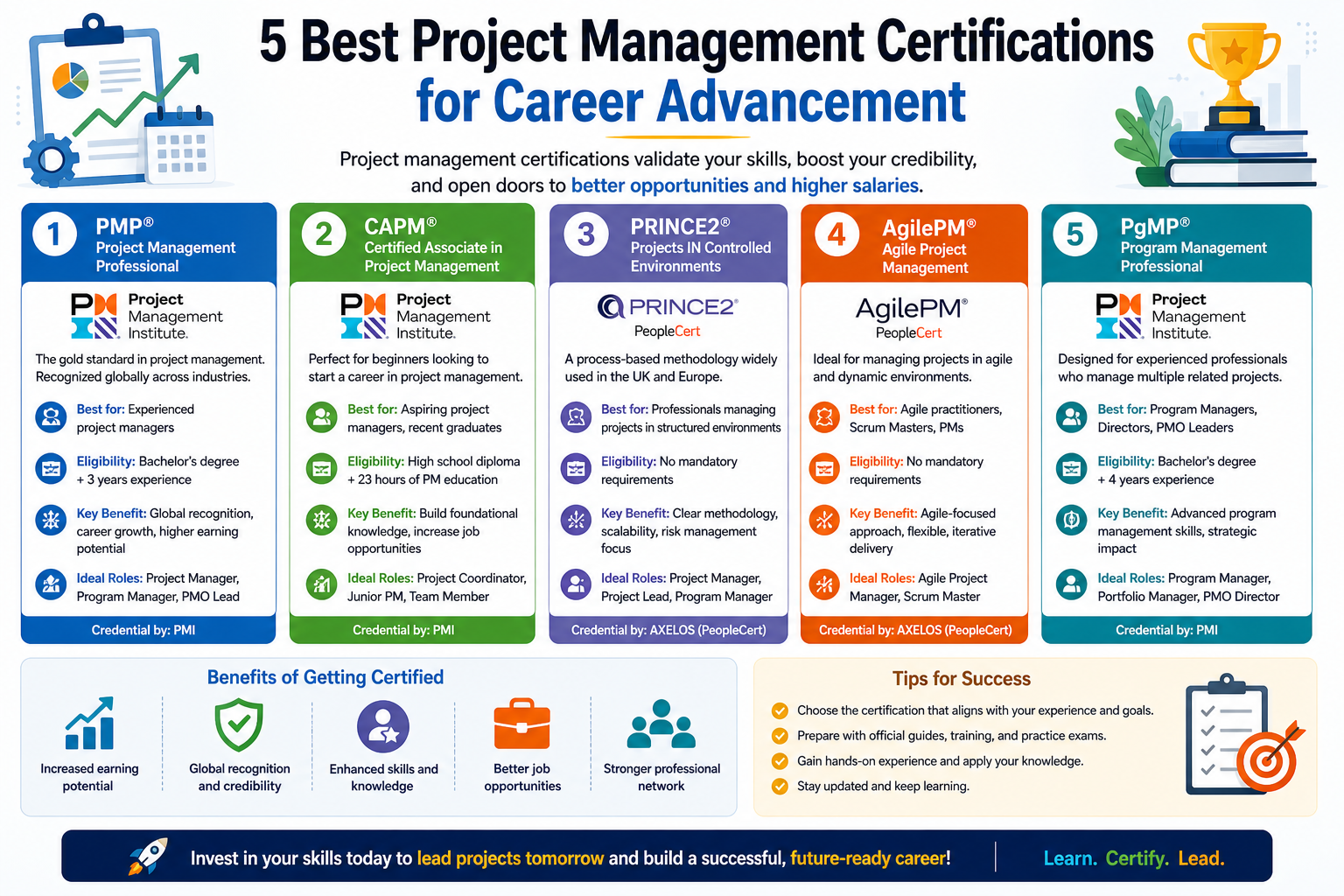
Project management has become one of the most widely applicable professional skill sets in the modern workplace. Whether in technology, healthcare, construction, finance, education, or government, the ability to plan, organise, and deliver outcomes within defined constraints is essential. At its core, project management is about coordination—bringing together people, resources, timelines, and expectations in a structured way so that work is completed effectively and goals are achieved.
However, project managers do not all arrive at the profession through the same path. Some begin their careers in highly structured environments where formal methodologies are deeply embedded in daily operations. Others grow into the role naturally by becoming the person who consistently takes ownership, solves problems, and ensures that work gets completed on time, even without formal training. This diversity in background is one reason why project management certifications exist in many forms and levels of complexity.
Certifications serve as a way to standardise knowledge, validate skills, and provide a shared language across industries. They can demonstrate that a professional understands recognised frameworks, can apply structured methodologies, and is capable of handling projects in a consistent and predictable way. Yet not all certifications are the same. Some are heavily focused on theoretical frameworks and formal processes, while others emphasise adaptability and practical problem-solving in real-world environments.
This range creates a spectrum of certifications that cater to different career stages and professional needs. Understanding where each certification fits within this spectrum is important for anyone looking to advance in project management or transition into the field.
Why Certifications Matter in Modern Project Management
In earlier decades, project management was often learned informally. Experienced professionals mentored newcomers, and knowledge was passed down through observation and practice. While this approach still exists in many organisations, the complexity of modern projects has increased significantly. Today’s projects often involve distributed teams, advanced technologies, strict compliance requirements, and rapidly changing business environments.
Because of this complexity, organisations increasingly rely on standardised practices to reduce uncertainty and improve outcomes. Certifications help create this standardisation by defining what a competent project manager should know and be able to do.
One of the key benefits of certifications is consistency. When a project manager holds a recognised credential, employers can reasonably expect that the individual understands certain core concepts such as project planning, risk management, stakeholder communication, scheduling, and scope control. This reduces ambiguity in hiring and helps organisations build teams with aligned expectations.
Another important factor is credibility. In competitive job markets, certifications can help demonstrate commitment to the profession. They signal that a candidate has invested time in learning structured methodologies rather than relying solely on experience. While experience remains critical, certifications often serve as proof that a professional has formalised their knowledge.
Certifications also provide a common framework for communication. Project management often involves coordinating with multiple departments or external stakeholders who may have different working styles and levels of understanding. Shared terminology and standardised processes help reduce miscommunication and ensure that everyone involved in a project is aligned.
Additionally, certifications can support career progression. Many organisations use them as benchmarks for promotion or role advancement. Entry-level certifications may be required for junior roles, while more advanced credentials are often associated with leadership positions. This structured progression helps professionals map out their long-term career development.
It is also important to recognise that certifications are not purely academic. While some emphasise theoretical knowledge, others are designed to reflect real-world application. This balance between theory and practice is what makes the project management certification landscape so diverse.
The Spectrum of Project Management Credentials
Project management certifications exist along a broad continuum. On one end are certifications that focus on flexible, practical skills that can be applied across industries and project types. On the other end are highly structured certifications built around specific methodologies and frameworks that define how projects should be executed in detail.
Broadly speaking, certifications can be grouped into three general categories:
The first category includes foundational certifications designed for individuals who are new to project management or who want to validate a basic understanding of core concepts. These certifications typically focus on terminology, basic processes, and general project lifecycle awareness. They are often accessible to professionals without extensive experience.
The second category consists of intermediate certifications that introduce more structured methodologies. These certifications often require a deeper understanding of project management principles and may involve some level of practical experience or formal training. They tend to emphasise standard processes, documentation practices, and controlled project environments.
The third category includes advanced certifications intended for experienced professionals who manage complex projects or lead project teams. These credentials typically require significant work experience and a strong understanding of established frameworks. They often focus on strategic planning, leadership, risk management at scale, and organisational alignment.
Within this spectrum, different certifications reflect different philosophies. Some prioritise adaptability and real-world flexibility, while others emphasise strict adherence to defined methodologies. Understanding this difference is essential when evaluating which certification aligns best with a professional’s career goals.
Project+ Certification and Its Practical Approach to Project Management
Among entry-level project management certifications, one of the most practical and broadly applicable is Project+. This certification is designed to provide a foundational understanding of project management without tying the learner to a specific methodology or framework. Instead, it focuses on universally applicable skills that can be used across a wide range of industries and project types.
A key feature of Project+ is its vendor-neutral approach. Rather than teaching a single prescribed methodology, it introduces learners to general principles of project management. This includes understanding how projects are initiated, planned, executed, monitored, and closed. The emphasis is on adaptability, making it suitable for professionals working in diverse environments.
One of the strengths of this certification is its focus on practical knowledge. It covers essential areas such as defining project scope, identifying constraints, managing resources, and communicating effectively with stakeholders. These are foundational skills that apply regardless of industry or project size.
Communication is a particularly important component. Project managers must act as a bridge between technical teams, business stakeholders, and leadership. Clear communication helps ensure that expectations are aligned and that potential issues are identified early. Project+ emphasises methods for maintaining transparency and managing communication throughout the lifecycle of a project.
Another important area covered is change management. Projects rarely proceed exactly as planned, and the ability to adapt to changing requirements is critical. Understanding how to manage changes in scope, timeline, or resources without derailing the entire project is a key skill that Project+ helps develop.
Risk management is also introduced at a foundational level. This includes identifying potential risks, assessing their impact, and developing mitigation strategies. While not as advanced as risk frameworks found in higher-level certifications, this introduction helps build awareness of how uncertainty can affect project outcomes.
Documentation is another core focus. Proper documentation ensures that project decisions, changes, and progress are recorded in a way that can be reviewed and understood by others. This is especially important in larger organisations where multiple teams may interact with the same project over time.
Project+ is particularly well-suited for individuals working in environments where technology plays a role but is not the sole focus. It is also valuable for professionals who support projects in business, operations, or administrative functions. Because it does not require adherence to a strict methodology, it allows professionals to apply what they learn in a flexible and adaptable way.
The certification also serves as a stepping stone for those who may later pursue more advanced credentials. By establishing a strong foundation in general project management principles, it prepares learners for more structured frameworks that build upon these basics.
CAPM Certification and Its Structured Approach to Project Management
At the next level of project management certification is the Certified Associate in Project Management, commonly known as CAPM. This certification is designed for individuals who want to develop a more formal and structured understanding of project management practices. Unlike more flexible certifications, CAPM is closely aligned with a well-defined body of knowledge that outlines standardised processes and terminology.
One of the defining characteristics of CAPM is its emphasis on a structured framework for managing projects. This framework provides detailed guidance on how projects should be initiated, planned, executed, monitored, and closed. It also defines specific knowledge areas such as integration, scope, time, cost, quality, human resources, communication, risk, procurement, and stakeholder management.
By organising project management into these distinct areas, CAPM provides a comprehensive view of how projects operate within an organisation. This structured approach helps ensure that all critical aspects of a project are considered and managed systematically.
A significant portion of CAPM focuses on terminology and conceptual understanding. This means that learners must become familiar with specific definitions, processes, and relationships between different components of project management. While this can be challenging for those new to the field, it helps create a standardised language that is widely recognised across industries.
CAPM is often viewed as an entry-level certification, but it is more formal and structured than general foundational certifications. It is particularly useful for individuals who want to build a strong theoretical understanding of project management before moving into more advanced roles.
One of the strengths of this certification is its global recognition. Because it is based on a widely accepted framework, it is understood by organisations around the world. This makes it valuable for professionals who may work in international environments or with cross-border teams.
CAPM also plays an important role in career development. It is often pursued by individuals who are early in their project management careers but want to demonstrate commitment to the profession. It can serve as a prerequisite or stepping stone for more advanced certifications and roles that require deeper experience.
In practical terms, CAPM helps professionals understand how structured project environments operate. This includes learning how different processes interact, how responsibilities are distributed among stakeholders, and how project performance is measured and controlled.
While it is more formal than flexible certifications like Project+, CAPM provides a strong foundation for understanding how large organizations manage complex projects. It introduces a disciplined way of thinking that is essential for roles involving coordination, planning, and execution at scale.
For individuals aiming to move into structured project environments or work within organisations that rely heavily on standardised methodologies, CAPM offers a clear and well-defined path into the profession.
PMP Certification and Its Role in Advanced Project Leadership
The Project Management Professional certification is widely regarded as one of the most influential credentials in the field of project management. It represents a significant step beyond entry-level and associate certifications, positioning professionals for leadership roles in complex, large-scale projects. Unlike foundational certifications that focus on introducing concepts or building basic familiarity, the PMP certification is designed for individuals who already have substantial project experience and are ready to operate at a higher level of responsibility.
At its core, PMP reflects the expectation that a project manager is not only familiar with processes and terminology but is also capable of applying them in dynamic, real-world environments. This includes managing competing priorities, leading cross-functional teams, handling uncertainty, and ensuring successful delivery under constraints such as time, cost, and scope.
The Experience-Based Nature of PMP
One of the defining characteristics of PMP is its strong emphasis on professional experience. Unlike entry-level certifications that are accessible to newcomers, PMP requires candidates to demonstrate that they have already led or directed projects in a meaningful capacity. This ensures that individuals earning the certification are not only theoretically knowledgeable but also practically experienced.
This experience requirement reflects the reality of advanced project management roles. Managing a project at a senior level involves far more than following predefined steps. It requires decision-making in ambiguous situations, resolving conflicts between stakeholders, adjusting plans based on changing conditions, and maintaining control over complex interdependencies.
The expectation is that candidates have already encountered real challenges such as shifting project scopes, resource limitations, stakeholder disagreements, and unforeseen risks. PMP builds on this foundation by formalising how experienced professionals structure their approach to these challenges.
The Structured Framework Behind PMP
While PMP is experience-based, it is also deeply rooted in a structured framework that defines how projects should be managed. This framework is comprehensive, covering the entire lifecycle of a project from initiation through closing. It organises project management into process groups and knowledge areas that ensure consistency and completeness in execution.
The process groups represent the stages of a project’s life cycle. These include initiating, planning, executing, monitoring, controlling, and closing. Each stage has specific objectives and activities that guide how work should progress.
The knowledge areas provide a detailed breakdown of the different aspects of project management that must be managed simultaneously. These include integration, scope, schedule, cost, quality, resource management, communication, risk, procurement, and stakeholder engagement. Each area represents a critical dimension of project success.
Together, these frameworks create a structured approach that helps project managers maintain control over complex initiatives. Rather than relying on intuition alone, PMP-certified professionals are trained to apply standardised processes that improve predictability and reduce uncertainty.
Planning as the Foundation of PMP Methodology
Planning is one of the most critical aspects of PMP-level project management. At this stage, project managers are responsible for defining the full scope of the project, establishing timelines, identifying required resources, and anticipating potential risks.
Unlike simpler planning processes used in smaller projects, PMP-level planning is highly detailed and structured. It involves breaking down the project into manageable components, defining dependencies between tasks, and establishing clear milestones. This ensures that all aspects of the project are accounted for before execution begins.
Resource planning is also a major focus. This includes identifying the human, financial, and material resources required to complete the project successfully. Project managers must ensure that resources are allocated efficiently and that potential shortages or constraints are identified early.
Risk planning is another essential component. At this level, risk management is not simply about identifying obvious issues but involves a systematic evaluation of potential uncertainties across all areas of the project. This includes assessing probability, impact, and mitigation strategies for each identified risk.
Communication planning is equally important. Large projects often involve multiple stakeholders with different expectations and levels of involvement. A structured communication plan ensures that information flows effectively between teams, leadership, and external stakeholders.
Execution and Leadership Responsibilities
Once planning is complete, the execution phase begins. At the PMP level, execution is not simply about completing tasks but about actively leading teams and ensuring that the project remains aligned with its objectives.
Leadership plays a central role during execution. Project managers must coordinate team members, assign responsibilities, and ensure that everyone understands their role in achieving project goals. This requires strong interpersonal skills as well as the ability to manage diverse personalities and working styles.
Another key aspect of execution is maintaining alignment between planned objectives and actual progress. Projects rarely proceed exactly as planned, so project managers must continuously monitor performance and make adjustments when necessary. This may involve reallocating resources, adjusting timelines, or modifying scope.
Quality management is also a major responsibility during execution. Ensuring that deliverables meet defined standards requires ongoing monitoring and evaluation. This includes implementing quality control processes and addressing any deviations from expected outcomes.
Conflict resolution is another important leadership function. In complex projects, disagreements between stakeholders or team members are common. Project managers must be able to resolve these conflicts in a way that maintains project momentum and preserves working relationships.
Monitoring and Controlling Complex Projects
Monitoring and controlling is a continuous process that runs alongside execution. It involves tracking project performance, comparing actual results to planned objectives, and implementing corrective actions when necessary.
At the PMP level, monitoring is highly data-driven. Project managers rely on performance metrics, progress reports, and analytical tools to assess how the project is performing. This allows for early detection of issues before they escalate into major problems.
Cost control is a critical aspect of this process. Projects must remain within budget, and any deviations must be identified and addressed quickly. This requires careful tracking of expenditures and ongoing financial analysis.
Schedule control is equally important. Delays in one area of the project can have cascading effects on other areas. Project managers must continuously evaluate timelines and make adjustments to keep the project on track.
Scope control ensures that the project does not expand beyond its original objectives without proper evaluation. Scope creep is a common challenge in project management, and controlling it is essential for maintaining focus and efficiency.
Risk monitoring is also an ongoing activity. New risks may emerge during execution, and previously identified risks may change in severity or likelihood. Project managers must continuously reassess the risk landscape and adjust mitigation strategies accordingly.
Stakeholder Management at a Strategic Level
At the PMP level, stakeholder management becomes significantly more complex. Projects often involve a wide range of stakeholders, including executives, clients, team members, suppliers, and regulatory bodies. Each group may have different expectations, priorities, and levels of influence.
Effective stakeholder management requires identifying all relevant stakeholders and understanding their interests and impact on the project. This includes analysing their level of influence and determining the best approach for engaging with them throughout the project lifecycle.
Communication is a key tool in stakeholder management. Project managers must ensure that stakeholders receive the right information at the right time and in the appropriate format. This helps maintain trust and alignment throughout the project.
Managing expectations is another critical responsibility. Stakeholders may have differing views on what constitutes success, and it is the project manager’s role to align these expectations with project realities.
In some cases, stakeholder management also involves negotiation and conflict resolution. Balancing competing interests requires diplomacy, strategic thinking, and the ability to make decisions that serve the overall objectives of the project.
PMP as a Career Milestone
PMP is often viewed as a milestone in a project manager’s career. It represents a transition from operational project management to strategic leadership. Professionals who hold this certification are typically expected to manage larger, more complex projects and take on greater responsibility within their organizations.
In many industries, PMP is associated with senior roles such as project manager, program manager, or project director. These roles involve overseeing multiple projects or managing initiatives that have significant organizational impact.
The certification also enhances professional credibility. It signals that an individual has not only gained experience but has also mastered a globally recognized framework for managing projects. This can be particularly valuable in competitive job markets where employers seek proven expertise.
CSM Certification and Agile Project Environments
While PMP represents a structured and process-driven approach to project management, the Certified Scrum Master certification represents a different philosophy entirely. It is rooted in Agile principles, which emphasise flexibility, collaboration, and iterative progress rather than rigid planning and documentation.
Agile project management emerged as a response to the limitations of traditional methodologies in fast-changing environments. In industries such as software development, marketing, and product design, requirements often evolve rapidly. Agile frameworks were designed to accommodate this uncertainty by allowing teams to adapt quickly and deliver incremental value.
The Core Philosophy Behind Scrum
Scrum is one of the most widely used Agile frameworks, and the Certified Scrum Master certification focuses on enabling professionals to understand and implement its principles effectively. At its core, Scrum is based on the idea that complex projects are best managed through iterative cycles of work rather than long, linear plans.
Work is divided into short cycles called sprints, during which teams focus on completing a specific set of tasks. At the end of each sprint, the team reviews progress and adjusts priorities based on feedback and changing requirements.
This iterative approach allows for continuous improvement and faster response to change. Instead of waiting until the end of a long project cycle to evaluate results, teams receive regular feedback and can make adjustments throughout the process.
The Role of the Scrum Master
The Scrum Master plays a unique role within Agile teams. Rather than acting as a traditional project manager who directs tasks and controls timelines, the Scrum Master serves as a facilitator and coach. Their primary responsibility is to ensure that the Scrum framework is followed effectively and that the team is able to work efficiently.
This includes removing obstacles that may hinder progress, facilitating communication between team members, and ensuring that Scrum ceremonies such as daily stand-ups, sprint planning, and retrospectives are conducted properly.
The Scrum Master also helps foster a culture of collaboration and continuous improvement. Instead of focusing on command-and-control management, they encourage self-organisation within the team. This allows team members to take ownership of their work and make decisions collaboratively.
Agile Collaboration and Team Dynamics
One of the defining features of Scrum is its emphasis on teamwork. Unlike traditional project management approaches where roles are clearly separated, Scrum encourages cross-functional collaboration. Team members work closely together and share responsibility for delivering outcomes.
Daily communication is a key component of this approach. Regular stand-up meetings ensure that everyone is aware of progress, challenges, and upcoming tasks. This transparency helps identify issues early and keeps the team aligned.
Feedback loops are another important aspect. At the end of each sprint, teams review what was accomplished and discuss ways to improve. This continuous feedback process helps teams refine their approach over time.
Adaptability in Changing Environments
Scrum is particularly effective in environments where requirements are uncertain or constantly changing. Instead of trying to define every detail upfront, Agile teams embrace change and adjust their work based on new information.
This adaptability is one of the main reasons Scrum has become so widely adopted in technology-driven industries. It allows teams to respond quickly to user feedback, market changes, and evolving business needs.
Unlike traditional project management approaches that prioritise detailed planning, Scrum prioritises flexibility and responsiveness. This shift in mindset is one of the key differences between Agile and traditional methodologies.
PRINCE2 Certification and Structured Governance
Another major approach to project management is PRINCE2, which stands for Projects IN Controlled Environments. This methodology is widely used in government and large organisations that require strict governance and control over project execution.
PRINCE2 is highly structured and process-oriented. It defines clear roles, responsibilities, and processes for managing projects from start to finish. Unlike Agile frameworks, which emphasise flexibility, PRINCE2 focuses on predictability, control, and documentation.
The Emphasis on Governance and Control
One of the key strengths of PRINCE2 is its emphasis on governance. Projects are divided into clearly defined stages, each with specific objectives and deliverables. At the end of each stage, progress is reviewed, and decisions are made about whether to continue, adjust, or stop the project.
This stage-based approach ensures that projects remain under control and aligned with organisational objectives. It also provides opportunities for regular evaluation and accountability.
Roles within PRINCE2 are also clearly defined. This includes project boards, project managers, and team members, each with specific responsibilities. This clarity helps ensure that decision-making authority is well understood and that accountability is maintained throughout the project.
Process-Driven Project Management
PRINCE2 is built around a set of defined processes that guide project execution. These processes cover everything from initiating a project to closing it. Each process includes specific inputs, outputs, and activities that must be completed.
This process-driven approach ensures consistency across projects and reduces the risk of deviation from established standards. It also makes it easier to manage large-scale projects that involve multiple teams or departments.
Documentation plays a central role in PRINCE2. Detailed records are maintained throughout the project lifecycle, ensuring that decisions, changes, and progress are fully documented. This level of documentation supports transparency and accountability.
Applicability Across Different Industries
PRINCE2 is widely used in industries where control and predictability are critical. This includes government projects, infrastructure development, and large corporate initiatives. Its structured approach makes it particularly suitable for environments where compliance and governance are important.
Unlike more flexible methodologies, PRINCE2 is less focused on adaptability and more focused on ensuring that projects are executed according to predefined plans. This makes it a strong choice for organisations that prioritise stability and control over rapid iteration.
PRINCE2 Certification and Its Controlled Environment Approach
PRINCE2, which stands for Projects IN Controlled Environments, represents one of the most structured and governance-driven approaches to project management. Unlike flexible methodologies that adapt continuously during execution, PRINCE2 is built on the idea that projects should operate within clearly defined boundaries, processes, and decision points. It is especially popular in large organisations and government environments where accountability, documentation, and control are essential for success.
At its foundation, PRINCE2 is not simply a set of tools or techniques. It is a complete project management methodology that defines how projects should be organised, managed, and delivered. It provides a universal language for project management that ensures consistency across different teams, departments, and even countries.
This structured approach makes PRINCE2 particularly valuable in environments where multiple stakeholders are involved and where projects must meet strict regulatory or organisational standards. Defining clear processes and responsibilities, it reduces ambiguity and ensures that every stage of a project is carefully monitored.
The Principle-Based Structure of PRINCE2
One of the defining features of PRINCE2 is its reliance on principles. These principles are universal guidelines that must be followed in every PRINCE2 project, regardless of size or complexity. They are designed to ensure that projects remain controlled, justified, and well-managed throughout their lifecycle.
These principles include continued business justification, learning from experience, defined roles and responsibilities, managing by stages, managing by exception, focusing on products, and tailoring to suit the project environment.
Each principle plays a critical role in shaping how projects are executed. For example, continued business justification ensures that a project remains viable and aligned with organisational goals at every stage. If a project no longer provides value, it should be reconsidered or stopped.
Learning from experience emphasises the importance of reviewing past projects and applying lessons learned to future work. This helps organisations continuously improve their project management practices.
Defined roles and responsibilities ensure that everyone involved in the project understands their duties. This clarity helps prevent confusion and improves accountability.
Managing by stages breaks the project into manageable sections, allowing for regular evaluation and decision-making. This staged approach ensures that projects remain under control and that progress can be assessed at key points.
Managing by exception allows senior management to stay informed without being involved in every detail. Instead, they are only notified when issues exceed predefined tolerances.
Focusing on products ensures that the project remains outcome-oriented rather than activity-oriented. This means the emphasis is on delivering defined outputs rather than simply completing tasks.
Tailoring ensures that PRINCE2 can be adapted to suit different types of projects and organisational environments. While the methodology is structured, it is not rigid, and can be adjusted based on specific needs.
PRINCE2 Processes and Lifecycle Management
PRINCE2 organises project management into a series of processes that cover the entire project lifecycle. These processes provide a step-by-step framework for managing projects from initiation through closure.
The lifecycle begins with starting up a project, where the idea is evaluated and initial planning begins. This stage ensures that the project is viable and worth pursuing.
Next is the initiation stage, where detailed planning takes place. This includes defining objectives, scope, timelines, resources, risks, and governance structures. A comprehensive project plan is developed to guide execution.
Once the project is approved, it moves into the stage of directing a project, where senior management provides oversight and makes key decisions. This ensures that the project remains aligned with strategic goals.
The controlling stage process focuses on day-to-day management. This includes assigning tasks, monitoring progress, managing risks, and ensuring that deliverables are completed as planned.
Managing product delivery is another key process, where teams focus on producing the required outputs. This ensures that the project delivers tangible results at each stage.
Managing stage boundaries involves reviewing progress at the end of each stage and deciding whether to continue, adjust, or terminate the project. This checkpoint ensures that projects remain viable and controlled.
Finally, closing a project ensures that all activities are completed, deliverables are finalised, and lessons learned are documented for future reference.
Roles and Responsibilities in PRINCE2 Projects
A key strength of PRINCE2 is its clear definition of roles and responsibilities. Unlike informal project management approaches, where responsibilities may overlap or be unclear, PRINCE2 establishes a structured hierarchy.
At the top is the project board, which includes executive stakeholders responsible for overall project direction and decision-making. They ensure that the project remains aligned with business objectives and provide approval at key stages.
The project manager is responsible for the day-to-day management of the project. This includes planning, coordination, monitoring progress, and ensuring that work is completed according to defined standards.
Team managers or team members are responsible for delivering specific products or outputs. They focus on executing assigned tasks and reporting progress to the project manager.
This clear separation of responsibilities helps ensure accountability and reduces confusion. Each role has defined authority and responsibility, making it easier to manage complex projects with multiple stakeholders.
Focus on Documentation and Control
PRINCE2 places a strong emphasis on documentation. Every aspect of the project is carefully recorded, including plans, decisions, risks, issues, and progress updates. This documentation serves several important purposes.
First, it ensures transparency. Stakeholders can review project information at any time and understand how decisions were made. This builds trust and accountability.
Second, it supports consistency. By documenting processes and decisions, organisations can ensure that similar projects are managed in a consistent way.
Third, it enables learning. Documentation provides a record of what worked well and what did not, allowing future projects to benefit from past experiences.
Control is another central theme in PRINCE2. Projects are managed through defined tolerances for time, cost, quality, scope, risk, and benefits. If a project exceeds these tolerances, it must be escalated to higher management for review.
This structured control mechanism ensures that projects do not deviate significantly from their intended goals without oversight.
PRINCE2 in Large Organisations and Government Environments
PRINCE2 is particularly well-suited for large organisations and government institutions where projects often involve significant budgets, multiple stakeholders, and strict regulatory requirements.
In these environments, accountability and transparency are critical. PRINCE2 provides a framework that ensures every decision is documented, every stage is reviewed, and every outcome is measurable.
Large organisations often manage multiple projects simultaneously, and PRINCE2 helps standardise project management practices across the organisation. This ensures consistency and makes it easier to manage portfolios of projects.
Government projects also benefit from PRINCE2’s structured approach. Public sector initiatives often require detailed documentation, compliance with regulations, and clear accountability for spending. PRINCE2’s emphasis on governance aligns well with these requirements.
Comparing PRINCE2 with Agile Approaches
While PRINCE2 is highly structured, Agile methodologies such as Scrum take a very different approach. Agile focuses on flexibility, collaboration, and iterative development, while PRINCE2 emphasises control, documentation, and predictability.
In Agile environments, requirements are expected to evolve. Teams work in short cycles and continuously adjust their approach based on feedback. This makes Agile highly adaptable but less structured.
In contrast, PRINCE2 requires detailed planning up front and follows a more linear progression. Changes are carefully controlled and must go through formal approval processes.
Despite these differences, many organisations combine elements of both approaches. This hybrid model allows for flexibility in execution while maintaining overall governance and control.
PRINCE2 Certification and Professional Development
For professionals, PRINCE2 certification represents a strong foundation in structured project management. It demonstrates the ability to manage projects within controlled environments and adhere to formal processes.
The certification is often pursued by individuals working in industries where governance and accountability are highly valued. It is also useful for professionals who want to work in international environments, as PRINCE2 is widely recognised across different regions.
Earning PRINCE2 certification also helps professionals develop strong organisational and planning skills. The methodology encourages disciplined thinking and careful consideration of every aspect of a project.
Comparing the Major Project Management Certifications
When viewed together, Project+, CAPM, PMP, CSM, and PRINCE2 represent different philosophies of project management.
Project+ focuses on broad, practical skills that can be applied across industries. It emphasises flexibility and foundational understanding.
CAPM introduces structured methodologies and formal processes, making it suitable for those entering more traditional project environments.
PMP represents advanced professional practice, focusing on leadership, experience, and complex project execution.
CSM introduces Agile principles, emphasising adaptability, collaboration, and iterative progress.
PRINCE2 focuses on governance, control, and structured processes in controlled environments.
Each certification serves a different purpose and reflects different ways of thinking about how projects should be managed.
The Evolving Nature of Project Management Careers
Project management continues to evolve as organisations face new challenges. Digital transformation, remote work, global collaboration, and rapidly changing markets have all influenced how projects are managed.
As a result, professionals are increasingly expected to understand multiple methodologies rather than relying on a single approach. The ability to adapt between structured frameworks and flexible Agile methods is becoming a valuable skill.
Certifications play an important role in this evolution by providing structured learning paths and recognised standards. However, real-world experience remains equally important. The most effective project managers are those who can combine formal knowledge with practical adaptability.
As industries continue to change, project management will remain a critical function that connects strategy with execution. The variety of certifications available reflects the diversity of approaches needed to manage modern projects effectively.
Conclusion
Project management certifications occupy a unique space in professional development because they do more than validate knowledge—they shape how professionals think, plan, and execute work in real-world environments. Across industries, projects have become increasingly complex, involving distributed teams, tight deadlines, evolving requirements, and significant financial and operational stakes. In this environment, having structured training is no longer just an advantage; it has become a practical necessity for those who want to grow into leadership roles.
What becomes clear when examining certifications such as Project+, CAPM, PMP, CSM, and PRINCE2 is that there is no single “best” path for every project manager. Instead, each certification represents a different philosophy of how projects should be managed. Some emphasise flexibility and adaptability, while others focus on strict governance and structured processes. Some are designed for beginners building foundational knowledge, while others are intended for experienced professionals leading large-scale initiatives.
This diversity is not a limitation—it is a reflection of how varied the project management profession has become. A project manager working in a fast-moving software environment may rely heavily on Agile principles, where responsiveness and iteration are essential. In contrast, someone managing infrastructure, government programs, or enterprise-level initiatives may need the structure, documentation, and control offered by traditional methodologies. Both approaches are valid, and both require different skill sets.
Certifications also play an important role in shaping career progression. Entry-level credentials help professionals establish a baseline understanding of key concepts such as scope, scheduling, communication, and risk. Intermediate certifications introduce more structured thinking and standardised frameworks that prepare individuals for larger responsibilities. Advanced certifications, particularly those requiring extensive experience, signal readiness for leadership roles where decision-making, strategic planning, and stakeholder management become central responsibilities.
However, it is equally important to recognise that certifications alone do not define a successful project manager. While they provide valuable frameworks and terminology, real expertise comes from applying these principles in dynamic and often unpredictable environments. No certification can fully replicate the complexity of real-world projects, where priorities shift, resources change, and unexpected challenges arise.
The most effective project managers are those who understand how to adapt knowledge to context. They are not rigidly tied to one methodology but instead draw from multiple approaches depending on the needs of the project. They may use structured planning techniques when clarity is essential, while also applying Agile principles when flexibility is required. This ability to blend approaches is becoming increasingly valuable in modern organisations.
Another important factor is communication. Regardless of the certification path, successful project management ultimately depends on the ability to communicate clearly with stakeholders, teams, and leadership. Miscommunication is often the root cause of project failure, and structured methodologies help reduce this risk by establishing clear processes, documentation standards, and reporting mechanisms.
As industries continue to evolve, the demand for skilled project managers is expected to grow. Organisations are placing greater emphasis on efficiency, accountability, and strategic alignment, all of which depend on effective project management. Certifications provide a structured way for professionals to enter and advance within this field, but they also serve as a foundation for continuous learning and improvement.
Ultimately, choosing a project management certification is less about selecting a single “correct” option and more about understanding where you are in your career and where you want to go. Each certification offers a different lens through which to view projects, and each contributes to building a more complete understanding of how work gets done in modern organisations.