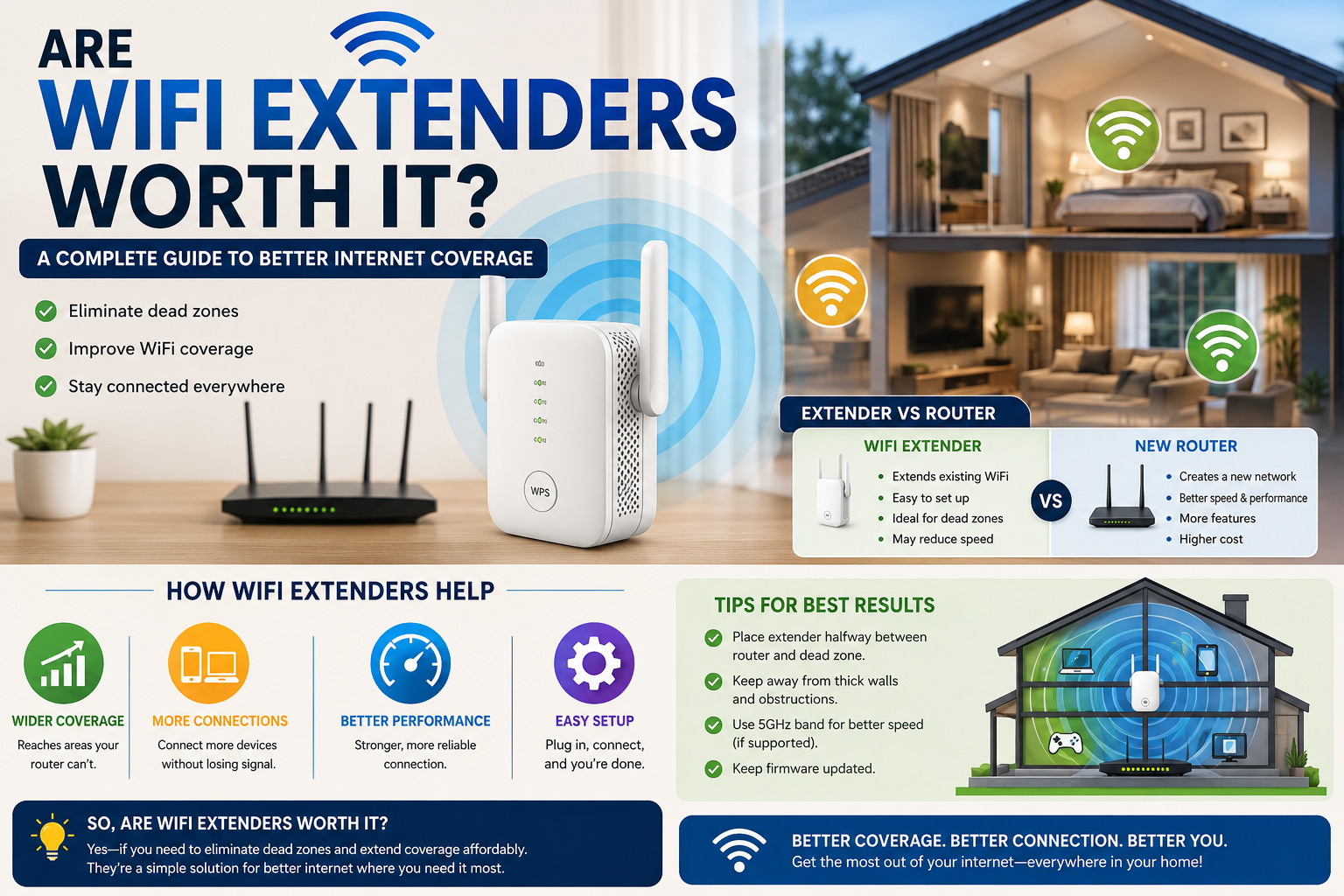
WiFi dead zones are one of the most frustrating issues in any home or office network. These are areas where the wireless signal becomes weak or completely unavailable, even though the internet connection itself is working fine. In practical terms, this means you might be able to stream smoothly in one room, but face constant buffering or disconnections just a few meters away. These inconsistencies are usually caused by a combination of physical obstacles, distance, and network limitations.
One of the main reasons dead zones exist is because WiFi signals are radio waves, and like all radio signals, they weaken as they travel. The farther you move from the router, the weaker the signal becomes. Walls, floors, and even furniture can further reduce signal strength. Materials like concrete, metal, and brick are especially problematic because they absorb or reflect signals instead of letting them pass through easily. This is why a router placed in one corner of a house often struggles to cover the entire building.
Another contributing factor is interference from other electronic devices. Microwaves, cordless phones, and even neighboring WiFi networks can compete for the same frequency bands, especially in densely populated areas. When multiple devices operate on overlapping channels, congestion increases, leading to slower speeds and unstable connections.
Network design also plays a role. Many users rely on a single router placed in a central location without considering optimal placement or additional hardware. In larger homes or multi-floor buildings, this setup is rarely sufficient. As a result, users experience inconsistent connectivity depending on where they are located.
Understanding these causes is essential because it helps determine whether a WiFi extender is a suitable solution or whether other networking improvements are needed instead.
How WiFi Extenders Actually Work
A WiFi extender is designed to improve coverage by receiving an existing wireless signal and rebroadcasting it to areas where the signal is weak. In simple terms, it acts as a middle point between your router and devices located in hard-to-reach areas. Instead of replacing your network, it extends its reach.
When a device connects through an extender, the data travels from the device to the extender, then to the main router, and finally to the internet. The return data follows the same path in reverse. While this process improves coverage, it also introduces additional steps in communication. Each extra step can slightly increase delay, also known as latency.
Most extenders operate in one of two ways. Single-band extenders use the same frequency channel to communicate with both the router and connected devices. This can reduce efficiency because the extender must alternate between receiving and sending data. Dual-band extenders improve this by using separate frequency bands for communication, allowing one band to handle the router connection while the other serves devices.
Despite these improvements, extenders still depend heavily on the quality of the original signal. If the extender is placed in an area where the signal from the router is already weak, it will simply repeat that weak signal. This is why placement is critical for effectiveness.
In essence, WiFi extenders do not create new internet speed or capacity. They simply redistribute existing coverage. This makes them useful in specific situations but not a universal fix for all network issues.
Types of WiFi Extenders and Alternative Solutions
WiFi extenders come in several forms, each with its own strengths and limitations. The most basic type is the single-band repeater, which operates on either the 2.4 GHz or 5 GHz band. These devices are usually affordable and easy to set up, but they often suffer from reduced performance because they use the same channel for receiving and transmitting data.
Dual-band extenders offer a more advanced option. By separating communication into two frequency bands, they can reduce congestion and improve stability. One band typically handles communication with the router, while the other serves connected devices. This setup helps minimize speed loss compared to single-band models, although it still cannot fully eliminate performance degradation.
Another category often confused with extenders is wireless access points. Unlike traditional extenders, access points require a wired connection to the main router. This allows them to create a completely new wireless network with strong and stable performance. While highly effective, this solution requires physical cabling, which is not always practical in every environment.
Powerline adapters provide an alternative approach by using electrical wiring to transmit network signals. One adapter connects to the router and plugs into a power outlet, while another device in a different room provides connectivity. Some models even include WiFi functionality, effectively extending wireless coverage through electrical circuits.
Mesh WiFi systems represent a more modern solution. Instead of relying on a single router, mesh systems use multiple interconnected nodes placed throughout a building. These nodes communicate with each other to provide seamless coverage. Unlike traditional extenders, mesh systems are designed to work as a unified network, reducing many of the performance issues associated with older extension methods.
Each of these solutions serves a different purpose, and choosing the right one depends on the size of the space, budget, and performance expectations.
When WiFi Extenders Make Sense and When They Don’t
WiFi extenders are not a universal solution, but they can be highly effective in the right conditions. They are best suited for situations where the main issue is limited coverage rather than insufficient internet speed. For example, if the router provides strong speeds in most areas of a building but struggles to reach a single room or upper floor, an extender can help bridge that gap.
They are also useful in environments where installing cables is not practical. Rental properties, temporary setups, or older buildings may not allow structural modifications. In these cases, a wireless extender provides a simple way to improve connectivity without physical installation work.
However, extenders are not ideal when the underlying problem is network congestion or insufficient bandwidth. If multiple devices are heavily using the network at the same time, an extender will not increase available capacity. Instead, it may add additional overhead that slightly reduces performance.
Similarly, if the original router signal is already weak at the location where the extender is placed, the results will be disappointing. Extenders cannot amplify a poor signal; they can only repeat what they receive. This means placement is critical, and poor positioning can make the situation worse rather than better.
In environments requiring high performance, such as video conferencing, online gaming, or large file transfers, more robust solutions like wired access points or mesh systems are often more appropriate. These alternatives provide more stable performance and reduce latency issues that can affect real-time applications.
Understanding these limitations is key to deciding whether a WiFi extender is truly the right choice.
Performance Tradeoffs and Real-World Expectations
While WiFi extenders can improve coverage, they come with noticeable tradeoffs that users should understand before relying on them. One of the most common issues is reduced speed. Because extenders must receive and retransmit data, available bandwidth is often divided between communication tasks. This can lead to slower speeds compared to a direct connection to the main router.
Latency is another factor to consider. Each additional step in the data path introduces slight delays. While these delays may not be noticeable during casual browsing, they can become more apparent during video calls or online gaming where real-time communication is important.
Interference can also become more complex in extended networks. Extenders operating on the same channel as the router may compete for bandwidth, especially in crowded wireless environments. This competition can result in fluctuating performance depending on network usage at any given time.
Despite these drawbacks, extenders still serve a valuable purpose when used correctly. They are particularly effective in improving signal reach in areas that are otherwise completely disconnected. For basic tasks such as web browsing, email, and video streaming at moderate quality, they can provide a satisfactory experience.
The key is managing expectations. A WiFi extender is not designed to enhance internet speed or replace a properly planned network infrastructure. Instead, it is a practical tool for extending existing coverage into areas where running cables or upgrading to more advanced systems is not feasible.
Conclusion
WiFi extenders can be a practical and cost-effective solution for improving wireless coverage in specific situations, but they are not a one-size-fits-all fix. Their effectiveness depends heavily on how they are used, where they are placed, and the quality of the existing network. In simple terms, they work best when the main problem is limited signal reach rather than insufficient internet speed or network congestion.
For homes or offices with small dead zones, a properly positioned extender can make a noticeable difference by bringing connectivity to areas that previously had weak or no signal. This can improve everyday activities such as browsing, streaming, and attending online meetings. However, they do introduce tradeoffs, including potential reductions in speed and slight increases in latency due to the way they retransmit data.
In more demanding environments, or in cases where consistent high performance is required, alternative solutions such as wired access points or mesh systems may provide better long-term results. These options are more stable but often require greater investment or installation effort.
Ultimately, WiFi extenders are worth it when used with realistic expectations and in the right conditions. They are best seen as a targeted solution for coverage gaps rather than a complete upgrade for an entire network.