The 802.11 standards form the foundation of modern wireless communication, enabling devices to connect to local networks without physical cables. These standards are developed and maintained by the Institute of Electrical and Electronics Engineers (IEEE), an organization responsible for defining many global networking and communication protocols. In simple terms, 802.11 refers to a family of specifications that govern how wireless local area networks (WLANs) operate, especially Wi-Fi connections used in homes, offices, schools, and public spaces.
Each version of the 802.11 standard represents an evolution in wireless technology. Over time, improvements have focused on increasing speed, expanding coverage, reducing interference, and enhancing overall network efficiency. These advancements have made Wi-Fi more reliable and capable of supporting modern digital demands such as streaming, online gaming, cloud computing, and smart devices.
To simplify understanding, the Wi-Fi Alliance introduced generational naming such as Wi-Fi 4, Wi-Fi 5, and Wi-Fi 6. These labels correspond to specific IEEE standards like 802.11n, 802.11ac, and 802.11ax. While these names make it easier for everyday users to understand general improvements, the underlying technical standards remain essential for network professionals who need to understand compatibility, performance limitations, and deployment scenarios.
Early Development of Wireless Networking Standards
The journey of 802.11 standards began in the late 1990s when wireless networking was still in its early stages. The original 802.11 standard introduced in 1997 laid the groundwork for wireless communication. However, it offered very limited speed and was quickly replaced by improved versions.
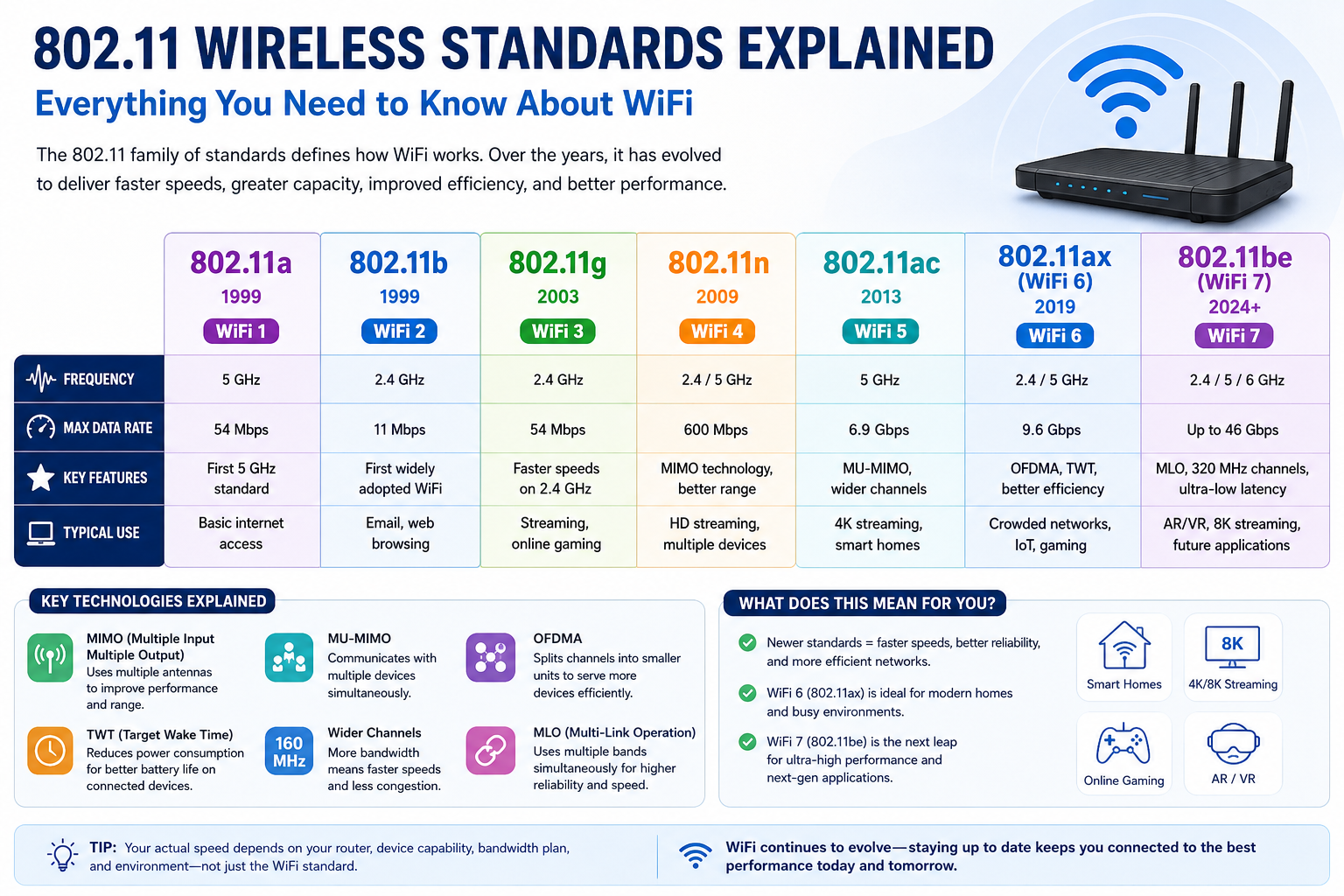
Early developments focused on increasing data rates and choosing the most efficient frequency bands. Two major paths emerged: one operating on the 2.4 GHz band and the other on the 5 GHz band. Each had its advantages and limitations. The 2.4 GHz band provided better range and penetration through walls, but it was more prone to interference. The 5 GHz band, on the other hand, offered higher speeds and less congestion but had a shorter range.
One of the first widely adopted improvements was 802.11b, which became popular due to its affordability and acceptable performance at the time. It operated in the 2.4 GHz band and significantly expanded Wi-Fi adoption in homes and businesses. Shortly after, 802.11a introduced higher speeds using the 5 GHz band, although it saw less widespread use due to higher costs and reduced range.
The introduction of 802.11g marked an important milestone by combining the strengths of earlier standards. It maintained compatibility with 802.11b while offering faster speeds, making it a widely accepted upgrade path for users. These early standards played a critical role in establishing Wi-Fi as a mainstream technology, setting the stage for more advanced generations.
Expansion and Improvements with 802.11n, 802.11ac, and 802.11ax
As digital technology evolved, the demand for faster and more reliable wireless connections increased dramatically. This led to the development of more advanced standards, beginning with 802.11n, also known as Wi-Fi 4. This version introduced significant improvements such as support for both 2.4 GHz and 5 GHz bands, multiple-input multiple-output (MIMO) technology, and higher data transfer rates. These enhancements allowed for better performance in environments with many connected devices.
Following this, 802.11ac, or Wi-Fi 5, brought even greater improvements. It focused primarily on the 5 GHz band and introduced wider channel bandwidths, more efficient data encoding, and improved beamforming technology. These features enabled faster speeds and better network efficiency, especially in environments with heavy data usage such as video streaming and online collaboration.
The next major advancement came with 802.11ax, commonly known as Wi-Fi 6. This standard was designed to handle dense network environments where many devices are connected simultaneously. It introduced technologies such as Orthogonal Frequency Division Multiple Access (OFDMA), which improves efficiency by allowing multiple devices to share the same channel. Wi-Fi 6 also supports 2.4 GHz, 5 GHz, and in extended versions, the 6 GHz band, offering greater flexibility and reduced congestion.
Each of these generations reflects a shift toward smarter, more efficient wireless communication designed to support modern digital lifestyles.
Performance, Compatibility, and Real-World Considerations
While theoretical speeds are often highlighted in discussions about 802.11 standards, real-world performance depends on many factors. These include physical obstacles, device capabilities, network congestion, and environmental interference. As a result, actual speeds are typically lower than the maximum values advertised for each standard.
Compatibility is another important factor in wireless networking. Most modern Wi-Fi systems are designed to be backward compatible, meaning newer routers can still support older devices. However, when older devices connect to newer networks, performance is often limited by the capabilities of the oldest standard in use. For example, a Wi-Fi 6 router will not provide full benefits if most connected devices only support Wi-Fi 4 or Wi-Fi 5.
Network design also plays a major role in performance. Factors such as access point placement, channel selection, and bandwidth configuration can significantly impact speed and stability. For instance, 2.4 GHz signals travel farther but are more susceptible to interference from household devices like microwaves and Bluetooth equipment. In contrast, 5 GHz and 6 GHz bands offer higher speeds but require closer proximity to access points.
Another important consideration is device density. Modern standards like Wi-Fi 6 are specifically designed to handle environments with many connected devices, such as smart homes, offices, and public venues. Without these improvements, networks would struggle to maintain consistent performance under heavy load.
The Future of 802.11 Standards
Wireless networking continues to evolve as technology demands grow. The development of newer standards beyond Wi-Fi 6 aims to further improve speed, efficiency, and responsiveness. Future generations are expected to focus heavily on reducing latency, increasing bandwidth efficiency, and improving performance in extremely dense environments.
One of the key directions of development is the expansion of frequency usage. With the introduction of the 6 GHz band in recent standards, there is now more room for data transmission with less interference. Future standards are likely to optimize how these frequency bands are used, ensuring smoother communication between devices.
Another area of improvement involves smarter network management. Future Wi-Fi technologies are expected to better allocate resources dynamically, allowing networks to adapt in real time to changing conditions. This will be particularly important as the number of connected devices continues to grow with the rise of smart homes, IoT systems, and automated environments.
Energy efficiency is also becoming increasingly important. As more portable and battery-powered devices rely on wireless connectivity, reducing power consumption without sacrificing performance will be a key priority.
Overall, the evolution of 802.11 standards reflects a continuous effort to meet the increasing demands of digital communication, ensuring that wireless networks remain fast, reliable, and scalable.
Wireless networking has become one of the most essential technologies in modern life, and the 802.11 standards continue to evolve to meet increasing demands. With every new generation, improvements are not only focused on raw speed but also on how efficiently networks manage multiple devices at the same time. This is especially important today, where smartphones, laptops, smart TVs, IoT devices, and home automation systems are all competing for bandwidth within the same environment.
Another important development in newer 802.11 standards is improved spectrum utilization. Instead of relying heavily on a single frequency band, modern Wi-Fi systems distribute traffic more intelligently across available bands such as 2.4 GHz, 5 GHz, and 6 GHz. This reduces congestion and improves stability, particularly in crowded urban areas where many networks overlap. Features like OFDMA and MU-MIMO have also transformed how data is transmitted, allowing multiple users to communicate with the router simultaneously without significant performance loss.
Security has also evolved alongside performance. Newer standards integrate stronger encryption methods and better authentication processes, helping protect users from unauthorized access and cyber threats. As digital dependency continues to grow, these enhancements play a critical role in ensuring safe and reliable communication.
Overall, the continuous improvement of 802.11 standards reflects the growing need for faster, smarter, and more secure wireless connectivity in an increasingly connected world.
Conclusion
The 802.11 standards represent the backbone of modern wireless communication, shaping how devices connect and interact in nearly every digital environment today. From the early days of limited-speed wireless connections to the high-performance networks of Wi-Fi 6 and beyond, each generation has introduced meaningful improvements in speed, range, efficiency, and reliability. These advancements have made it possible for wireless networks to support everything from basic web browsing to high-definition streaming, cloud services, and smart device ecosystems.
Understanding these standards is essential for recognizing how Wi-Fi technology has evolved and why different devices perform differently on the same network. While newer standards offer significant advantages, real-world performance always depends on a combination of device capability, network design, and environmental conditions. Backward compatibility ensures smooth transitions between generations, but also means that older devices can limit the full potential of modern networks.
As wireless technology continues to advance, future 802.11 standards will likely focus on even greater efficiency, lower latency, and improved handling of densely connected environments. This ongoing evolution ensures that Wi-Fi will remain a critical part of global communication infrastructure, adapting to the growing demands of an increasingly connected world.