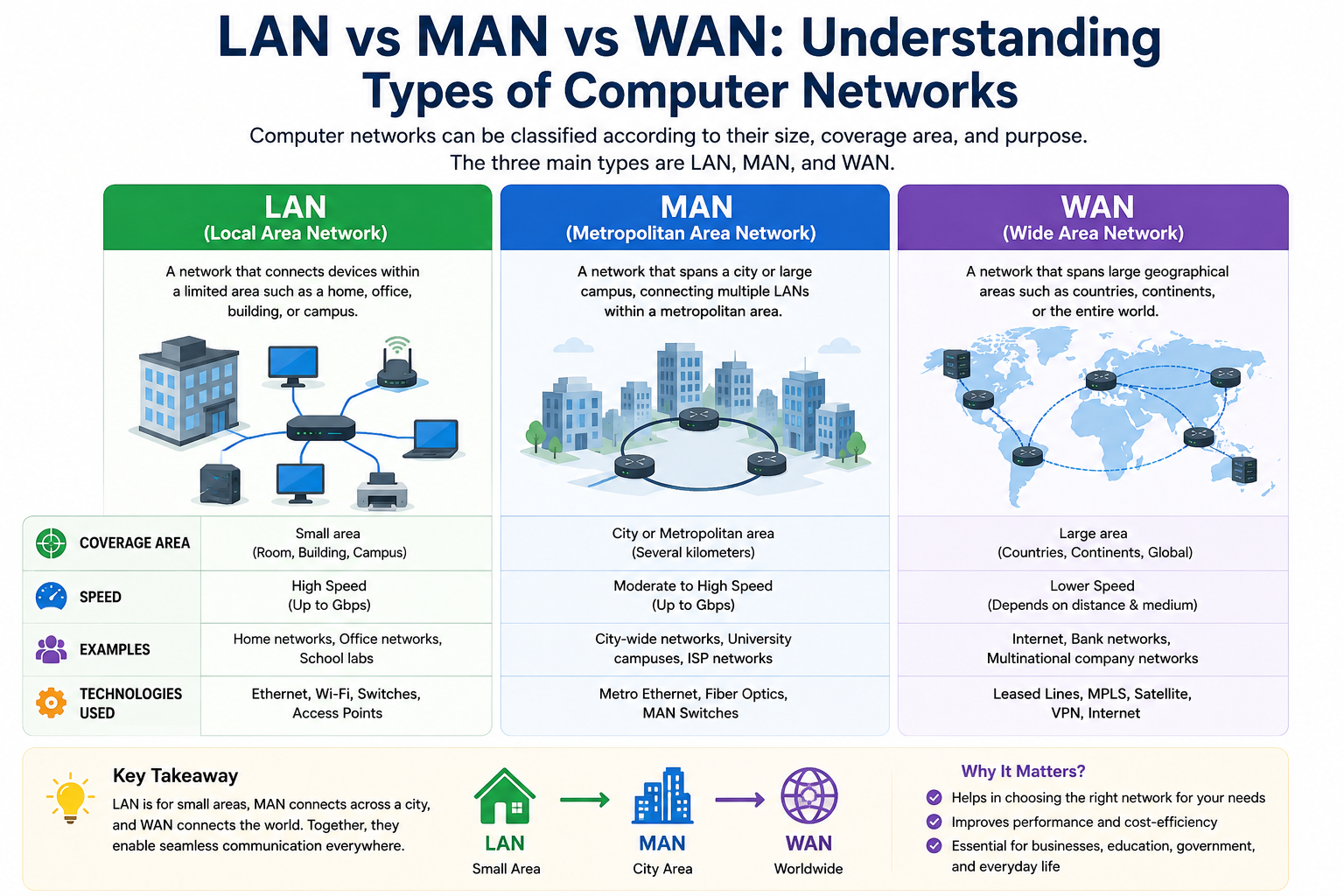
In today’s digitally connected world, communication between devices happens through structured networks that vary in size, purpose, and reach. Whether you are browsing the internet at home, accessing company files at work, or connecting to services across countries, you are relying on different types of networks working behind the scenes. These networks are generally categorized into three main types: WAN (Wide Area Network), LAN (Local Area Network), and MAN (Metropolitan Area Network).
Each of these network types serves a specific role in ensuring that data flows efficiently between devices. The differences between them are mainly based on geographic coverage, speed, ownership, and infrastructure. A LAN is typically confined to a small physical space like a home or office, while a WAN spans vast regions, connecting cities, countries, and even continents. Between these two lies the MAN, which bridges connectivity within a city or large metropolitan region.
Understanding these network types is essential for anyone interested in technology, as they form the foundation of how the internet and internal communication systems operate. From small home routers to global internet backbones, these networks work together seamlessly to deliver information in milliseconds.
What is WAN (Wide Area Network)?
A WAN, or Wide Area Network, is a type of network designed to cover large geographical distances. It connects multiple smaller networks, such as LANs, across cities, countries, or even continents. The most well-known example of a WAN is the internet itself, which links billions of devices worldwide into a single, interconnected system.
WANs rely on a combination of advanced communication technologies, including fiber-optic cables, satellite links, and undersea communication lines. These infrastructures allow data to travel long distances at high speeds. However, because of the vast areas they cover, WANs are generally slower in comparison to local networks due to factors like signal travel distance and routing complexity.
One of the defining characteristics of a WAN is that it is not owned by a single organization. Instead, WAN infrastructure is built and maintained by multiple service providers, often working together through agreements. Internet Service Providers (ISPs) play a crucial role in operating WANs by connecting users to global networks.
Security is also a major concern in WAN environments. Since data travels across public and shared infrastructure, encryption methods such as VPNs are commonly used to protect sensitive information from interception. Without these security measures, data transmitted over WANs could be vulnerable to unauthorized access.
WANs are essential for global communication. Businesses use them to connect offices in different countries, while individuals rely on them for browsing, streaming, and online communication. Without WANs, the modern internet would not exist in its current form.
What is LAN (Local Area Network)?
A LAN, or Local Area Network, is a network that operates within a limited geographic area, such as a home, office, school, or building. Unlike WANs, LANs are privately owned and managed by individuals or organizations, making them more controlled and secure environments.
LANs are designed for high-speed communication between devices located close to each other. They typically use Ethernet cables or Wi-Fi to connect devices like computers, printers, servers, and smartphones. Because the distance between devices is short, LANs offer extremely fast data transfer rates and low latency compared to larger networks.
One of the key technologies used in LANs is the network switch. Switches operate at a fundamental level to direct data between devices using MAC addresses. This ensures that data is delivered only to the intended device within the network, improving efficiency and reducing unnecessary traffic.
LANs also use private IP address ranges, which are not accessible from the internet. This adds an extra layer of security and allows multiple devices within the same network to communicate without external interference. A router is often used in a LAN setup to connect the internal network to the wider internet, acting as a gateway.
In homes, LANs allow multiple devices to share a single internet connection. In businesses, they enable employees to access shared resources, databases, and internal communication tools. Educational institutions also rely heavily on LANs for managing computer labs and administrative systems.
Despite technological advancements, the core principles of LANs have remained largely unchanged over time. Improvements in speed and wireless connectivity have enhanced performance, but the fundamental structure continues to rely on local connectivity and controlled environments.
What is MAN (Metropolitan Area Network)?
A MAN, or Metropolitan Area Network, is a network that covers a geographic area larger than a LAN but smaller than a WAN. It typically spans a city or a large urban region, connecting multiple LANs within that area into a unified network.
MANs were developed to solve the challenge of connecting multiple local networks within cities that required high-speed communication. Before the widespread availability of modern fiber-optic WAN connections, organizations such as universities, government institutions, and businesses needed a way to connect their separate LANs efficiently without relying on slower long-distance networks.
To achieve this, MANs often use high-speed fiber-optic infrastructure operated by service providers. These networks offer faster data transmission than traditional WAN connections and are optimized for regional connectivity. They act as an intermediate layer between LAN and WAN, ensuring smooth communication across a city.
One of the key advantages of MANs is their ability to reduce congestion by providing dedicated high-speed links between local networks. For example, multiple campuses of a university spread across a city can communicate seamlessly through a MAN.
However, with advancements in WAN technology, particularly the expansion of high-speed fiber internet, the need for separate MAN infrastructures has decreased in many regions. Modern WANs are now capable of providing similar or even better performance over long distances, reducing reliance on traditional metropolitan networks.
Even though MANs are less prominent today, their concept remains important in understanding how regional connectivity evolved and how networks were structured before global fiber expansion became widespread.
Evolution and Interconnection of WAN, LAN, and MAN
The development of WAN, LAN, and MAN technologies has been closely tied to the increasing demand for faster and more reliable communication. Early computer networks were limited in scope and speed, relying heavily on basic wired connections. As technology advanced, the need for larger and more efficient networks grew.
LANs evolved first, improving internal communication within buildings and organizations. Over time, faster Ethernet standards significantly increased data transfer speeds, making LANs highly efficient for local environments.
WANs evolved alongside telecommunications infrastructure. Initially dependent on copper wires and telephone systems, WANs gradually transitioned to fiber-optic technology. This shift enabled faster, more stable, and long-distance communication, ultimately supporting the global expansion of the internet.
MANs emerged as a temporary solution to bridge the gap between LANs and WANs in urban environments. They helped organizations connect multiple locations within a city without relying on slow or expensive long-distance connections. However, as WAN infrastructure improved, MANs became less necessary in many regions.
Today, all three network types still exist conceptually, but their roles often overlap due to technological advancements. The internet itself is a massive WAN that incorporates countless LANs, and in some cases, regional networks still function similarly to MANs within large cities.
Modern Relevance of Network Types
In the modern digital landscape, understanding WAN, LAN, and MAN is essential for grasping how data flows across systems. LANs continue to dominate personal and organizational environments, ensuring fast and secure communication within limited areas.
WANs remain the backbone of global connectivity, enabling everything from cloud computing to international communication. As internet infrastructure continues to improve, WAN performance is becoming faster and more reliable, even in remote regions.
MANs, although less common today, still play a role in specific scenarios where localized high-speed connectivity is required, especially in large institutions or specialized network environments.
Together, these network types form a layered structure that supports modern communication systems. From a single device in a home to massive data centers spanning continents, these networks work in harmony to ensure seamless digital interaction.
Expanding further, it is also important to recognize how these network types influence emerging technologies such as cloud computing, IoT (Internet of Things), and remote work systems. LANs provide the immediate environment where smart devices, printers, and local servers communicate efficiently. WANs enable these systems to extend beyond physical boundaries, allowing users to access applications, storage, and services from anywhere in the world.
Conclusion
WAN, LAN, and MAN represent three fundamental types of computer networks that differ primarily in their geographical coverage and purpose. LANs provide fast and efficient communication within small areas such as homes and offices, making them ideal for local connectivity. WANs
extend this communication across vast distances, connecting cities, countries, and even continents, forming the backbone of the global internet. MANs sit between these two, historically serving as a bridge for city-wide connectivity before advancements in WAN technology reduced their necessity.
Together, these networks illustrate the evolution of digital communication systems and how they have adapted to increasing demands for speed, scale, and reliability. While their roles may have shifted over time, their importance in understanding how modern networking works remains unchanged. From local file sharing to global data exchange, these network types continue to support the digital infrastructure that powers everyday life.