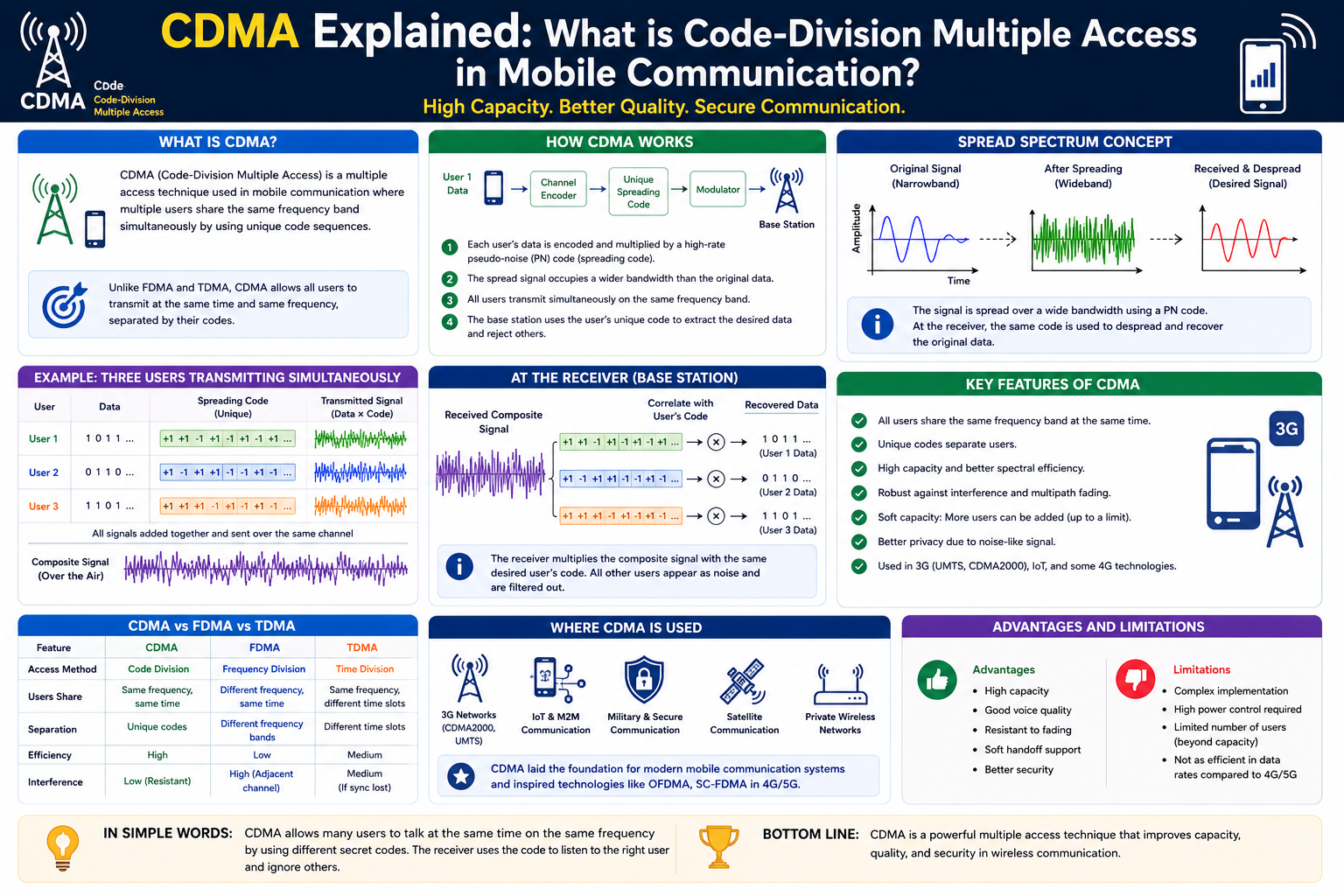
Code-Division Multiple Access, commonly known as CDMA, is a wireless communication method that changed how mobile networks handle multiple users at the same time. Instead of dividing communication by time slots or separate frequency channels, CDMA allows many users to share the same frequency band simultaneously. It achieves this by assigning a unique digital code to each user’s signal, ensuring that communications remain separated even though they occupy the same spectrum.
This approach made CDMA a major advancement in the evolution of mobile communication, especially during the era of second-generation (2G) and third-generation (3G) networks. It improved call quality, increased network capacity, and enhanced security compared to earlier technologies. CDMA also introduced more efficient use of limited radio spectrum, which is one of the most valuable resources in wireless communication systems.
To understand why CDMA was so influential, it is important to explore how it works at a technical level, how it compares with other communication methods, and why it played such a significant role in shaping modern mobile networks.
What is CDMA in Wireless Communication
CDMA is a multiplexing technique used in wireless systems to allow multiple signals to occupy the same transmission channel at the same time without interfering with each other. The core idea behind CDMA is the use of unique spreading codes assigned to each user or communication session.
When a device sends data over a CDMA network, the signal is combined with a specific code sequence. This process spreads the signal across a much wider frequency range than it would normally require. Even though all users transmit over the same frequency band, the receiver can distinguish each signal by using the corresponding code.
This method is fundamentally different from earlier systems that relied on dividing frequency bands or assigning time slots. Instead of separating users physically in time or frequency, CDMA separates them mathematically through coding techniques.
Because of this structure, CDMA networks can support a higher number of users within the same bandwidth. It also reduces the chances of dropped calls and improves signal reliability in crowded environments, such as cities with heavy mobile usage.
How CDMA Works Behind the Scenes
At the heart of CDMA lies spread spectrum technology. In this system, each user’s signal is multiplied by a high-speed code known only to the sender and receiver. This code spreads the signal across a wide frequency range, making it appear like background noise to anyone without the correct decoding sequence.
When the signal reaches the receiver, the same code is used to reconstruct the original message. Without the correct code, the signal remains unintelligible, which adds a natural layer of security.
One of the key strengths of CDMA is its use of power control. Since all users share the same frequency band, devices must adjust their transmission power carefully. If one device transmits too strongly, it could drown out weaker signals from other users. CDMA systems continuously balance these power levels to maintain overall network stability.
Another important mechanism is soft handoff. In CDMA networks, a mobile device can communicate with multiple base stations simultaneously during movement between coverage areas. This reduces the chance of call drops and ensures smoother transitions compared to older systems.
The combination of spreading codes, power control, and soft handoff allows CDMA to maintain efficient communication even in high-density environments where many users are active at the same time.
CDMA Compared to GSM and TDMA Systems
To understand the value of CDMA, it helps to compare it with other access methods like GSM and TDMA.
GSM (Global System for Mobile Communications) relies on a combination of time and frequency division. Each user is assigned a specific time slot within a frequency channel. While effective, this method limits how many users can communicate simultaneously because time slots are fixed and must be shared sequentially.
TDMA (Time Division Multiple Access) works in a similar way, dividing communication into time segments. Users take turns transmitting, which prevents interference but can reduce efficiency when demand is high.
CDMA, on the other hand, allows all users to transmit at the same time using the same frequency band. Instead of dividing time or frequency, it divides communication using unique codes. This makes CDMA more flexible and scalable in environments with heavy traffic.
In terms of performance, CDMA often provides better call quality and fewer dropped connections. It is also more resistant to interference because signals are spread across a wider bandwidth. However, it requires more complex technology and careful power management compared to simpler systems like TDMA.
Over time, GSM became more widely adopted globally, especially in 2G networks, but CDMA played a critical role in advancing mobile technology and influencing later generations of communication systems.
Applications of CDMA in Real-World Communication
CDMA has been widely used in various communication systems, especially during the rise of 3G mobile networks. One of its primary applications is in cellular voice communication, where it significantly improved call clarity and reduced interference compared to earlier technologies.
It was also heavily used in mobile data transmission. CDMA-based networks enabled early mobile internet access, allowing users to browse the web, send emails, and use data services on handheld devices. This was a major step forward in mobile connectivity and laid the foundation for modern smartphone usage.
In addition to consumer mobile networks, CDMA principles are used in military and satellite communications. The spread spectrum nature of CDMA makes it more resistant to jamming and interception, which is valuable in secure communication environments.
CDMA has also been used in telemetry systems, where data is transmitted from remote sensors to central systems. Its ability to handle multiple signals efficiently makes it suitable for environments where many devices need to communicate simultaneously.
Even though newer technologies like LTE and 5G have replaced CDMA in most mobile networks, its underlying principles still influence modern communication design.
Benefits and Strengths of CDMA Technology
CDMA introduced several important advantages that helped improve wireless communication systems. One of its biggest strengths is its ability to support a large number of users within the same frequency band. This makes it highly efficient in terms of spectrum usage.
Another key benefit is improved call quality. Because CDMA spreads signals across a wide bandwidth, it reduces the impact of interference and noise. This leads to clearer voice communication and fewer disruptions during calls.
CDMA also offers enhanced security. Since each signal is encoded with a unique key, it is difficult for unauthorized users to intercept or decode communications. This built-in layer of protection made CDMA more secure than earlier systems.
In addition, CDMA networks are known for their stability in dense environments. Whether in crowded cities or high-traffic areas, CDMA can maintain performance by dynamically managing power levels and distributing network load efficiently.
These advantages made CDMA a preferred choice for many mobile operators during its peak usage period and contributed significantly to the growth of mobile communication technology.
Challenges and Evolution of CDMA Technology
Despite its advantages, CDMA also has limitations. One of the main challenges is its complexity. Managing power levels, assigning codes, and maintaining synchronization between devices requires advanced infrastructure and careful network design.
Another limitation is compatibility. CDMA devices are not always easily transferable between networks, unlike GSM systems that use SIM cards for portability. This reduced flexibility for users and carriers.
As mobile communication evolved, newer technologies such as LTE and 5G began to replace CDMA. These systems offer even higher speeds, better efficiency, and more advanced features for modern data-heavy applications.
However, CDMA’s influence remains important. Many concepts introduced by CDMA, such as spread spectrum communication and advanced interference management, are still used in modern wireless systems. It served as a bridge between early mobile networks and today’s high-speed digital communication era.
CDMA Network Architecture and Core Components
To fully understand how CDMA operates in real-world mobile systems, it is important to look at its network structure. A CDMA network is built using several interconnected components that work together to manage communication between mobile devices and the core network.
At the center of this architecture is the Base Transceiver Station (BTS). The BTS is responsible for handling radio communication with mobile devices. It transmits and receives signals using antennas and ensures that user data is properly encoded and decoded using CDMA spreading codes.
Conclusion
CDMA, or Code-Division Multiple Access, represents a major milestone in the development of wireless communication technology. By allowing multiple users to share the same frequency band through unique coding techniques, it improved network efficiency, increased capacity, and enhanced call quality. Its use of spread spectrum technology provided both performance and security benefits, making it a powerful solution during the growth of 2G and 3G mobile networks.
Although CDMA has largely been replaced by newer technologies like LTE and 5G, its impact on the telecommunications industry remains significant. It introduced foundational concepts that continue to influence modern wireless design, particularly in areas such as signal processing, interference reduction, and secure communication methods.
CDMA helped shape the transition from basic mobile telephony to advanced digital communication systems. Its legacy can still be seen in the way modern networks manage large numbers of users efficiently while maintaining high-quality connections.