Modern networking depends on a remarkable collection of protocols working together quietly behind the scenes. Every time someone opens a website, streams a video, sends a message, or accesses a shared file on a local office network, several systems cooperate to move data from one point to another. Most people never think about these invisible operations because they happen almost instantly. Yet within that process, one protocol plays a particularly important role in helping devices locate each other inside a local network. That protocol is ARP, or Address Resolution Protocol.
ARP may not receive the same level of attention as technologies like Wi-Fi, cloud computing, or cybersecurity platforms, but it remains one of the essential building blocks of network communication. Without it, devices connected to the same network would struggle to identify where data should physically go. Understanding ARP is important for anyone learning networking because it explains how communication actually begins between devices sharing the same local environment.
To understand ARP properly, it helps to first understand the difference between logical addressing and physical addressing. Every device connected to a network typically has an IP address. This address works similarly to a postal address. It identifies where a device exists within a network structure and allows routers to send traffic toward the correct destination. IP addresses are designed to be flexible. They can change depending on the network a device joins, and they can be assigned automatically or configured manually.
At the same time, network devices also possess MAC addresses, which stands for Media Access Control addresses. Unlike IP addresses, MAC addresses are tied directly to the network hardware itself. They are usually assigned by manufacturers and embedded into network interface cards. A MAC address acts like a permanent identifier for a device’s networking hardware.
This creates an important challenge. Devices communicate across local networks using MAC addresses, but applications and operating systems generally think in terms of IP addresses. A computer might know the IP address of another device it wants to contact, but it still needs the corresponding MAC address before it can actually send data across the local network.
That is where ARP enters the picture.
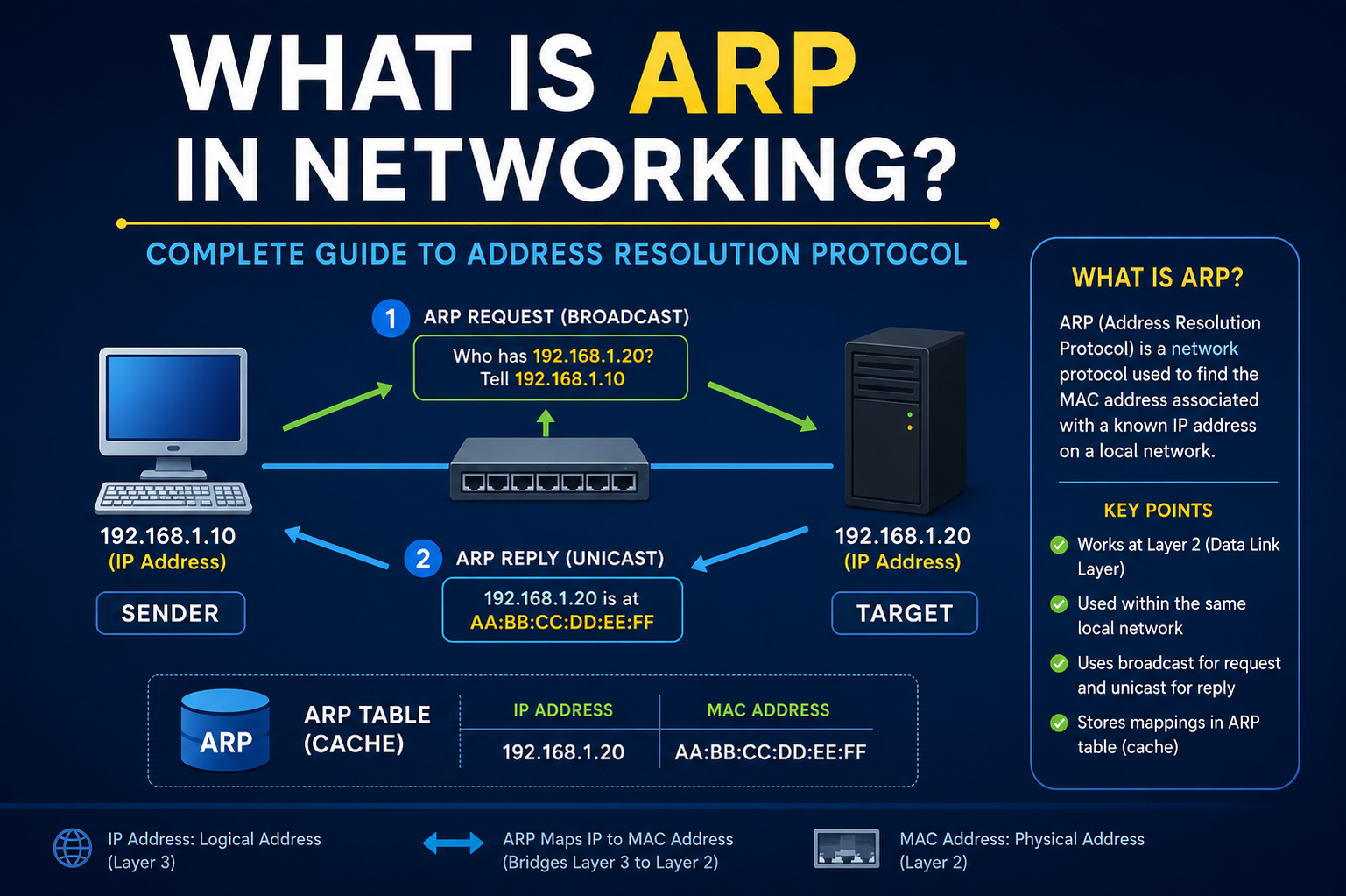
ARP acts as a translator between IP addresses and MAC addresses. Its primary purpose is to discover the physical MAC address associated with a known IP address on the same local network. Without this translation process, devices would know where they want to send information logically but would not know how to physically deliver the data frames to the correct hardware destination.
The importance of ARP becomes easier to understand when looking at a simple home or office network. Imagine a laptop connected to a wireless router. The laptop wants to print a document using a network printer located on the same subnet. The user selects the printer, presses print, and expects the job to complete instantly. Behind the scenes, however, the laptop first needs to identify the MAC address of the printer before communication can begin.
The laptop already knows the printer’s IP address because that information was either manually configured or discovered through another service. Yet the laptop cannot simply send the traffic directly using only the IP address. Ethernet communication within the local network depends on MAC addresses. The laptop therefore uses ARP to determine which MAC address belongs to the printer’s IP.
The process starts with an ARP request. The laptop sends a broadcast message across the network asking which device owns the target IP address. Because the request is broadcast, every device connected to the same local network segment receives it. Most devices quickly ignore the message because the IP address does not belong to them.
The printer, however, recognizes that the requested IP matches its own address. It then sends an ARP reply directly back to the laptop. This reply contains the printer’s MAC address. Once the laptop receives this information, it stores the mapping temporarily inside a local ARP cache.
The ARP cache serves as a memory table containing previously learned IP-to-MAC relationships. Instead of repeating the ARP request process every single time communication occurs, the device can simply consult its cache. This improves efficiency and reduces unnecessary broadcast traffic on the network.
ARP caching is extremely important in larger environments. Consider a corporate office with hundreds or even thousands of devices. If every communication required a fresh ARP request, the amount of broadcast traffic would increase dramatically. By storing mappings temporarily, devices reduce repeated network discovery activity.
However, ARP cache entries are not permanent. They eventually expire after a specific timeout period. Different operating systems use different expiration timers, but the goal remains the same: remove old entries so devices can refresh outdated information if network conditions change.
For example, a printer may be replaced with new hardware while keeping the same IP address. If devices never refreshed their ARP cache, they would continue sending traffic to the old MAC address, causing communication failures. Cache expiration ensures devices periodically rediscover accurate network mappings.
ARP primarily functions within local networks because MAC addresses are only meaningful inside the local broadcast domain. Routers separate broadcast domains and do not forward ARP broadcasts between networks. This detail is important because it explains why ARP is associated with local communication rather than internet-wide communication.
Suppose someone opens a website hosted on a server in another country. Their computer does not use ARP to discover the MAC address of that distant server. Instead, the computer uses ARP only to locate the MAC address of the local router, also known as the default gateway. Once the packet reaches the router, routing protocols handle the journey across external networks.
This distinction helps illustrate the relationship between switching and routing. Switching operates mainly at Layer 2 of the OSI model and depends on MAC addresses for local delivery. Routing operates at Layer 3 and uses IP addresses to move packets between separate networks. ARP effectively connects these two worlds by translating between logical Layer 3 addresses and physical Layer 2 identifiers.
Understanding the OSI model further clarifies ARP’s role in networking. Although ARP is often associated with Layer 2 because it works closely with Ethernet and MAC addresses, it also interacts with Layer 3 concepts through IP addressing. Because of this hybrid behavior, ARP does not fit neatly into a single layer category.
Networking students often encounter ARP early in their learning journey because it demonstrates how protocols cooperate rather than function independently. A single network action typically involves multiple protocols working together in sequence. For example, opening a website may involve DNS for name resolution, ARP for MAC discovery, TCP for reliable transport, and HTTP for web communication.
ARP therefore represents a perfect example of networking collaboration. It does one specific job, but that job is essential for enabling broader communication.
Another important aspect of ARP is its simplicity. The protocol itself is straightforward compared to more advanced networking technologies. It performs a focused task with relatively few steps. This simplicity helped ARP become widely adopted and remain relevant for decades.
Yet simplicity can also create limitations. ARP was designed during a time when network security concerns were far less advanced than they are today. Early network designers focused heavily on connectivity and interoperability rather than authentication and threat prevention. As a result, ARP does not include built-in verification mechanisms to confirm whether ARP replies are legitimate.
This weakness eventually became one of the protocol’s most significant security concerns. Attackers discovered they could send fake ARP replies and manipulate network traffic flows. Although security issues will be explored more deeply later, it is important to recognize that ARP’s openness was originally intended to make networking easier and more efficient.
The development of ARP also reflects the rapid evolution of networking technology over time. During the early years of computer networking, systems needed a reliable way to connect logical addressing schemes with physical hardware communication. ARP provided a practical solution that worked efficiently within Ethernet-based environments.
As Ethernet became the dominant local networking technology worldwide, ARP naturally became a standard part of everyday networking operations. Home routers, enterprise switches, wireless access points, printers, servers, and personal computers all continue to rely on ARP whenever they communicate within local networks.
Even though users rarely see ARP directly, administrators and engineers interact with it frequently when troubleshooting connectivity issues. One of the most common networking diagnostic commands allows administrators to view the ARP cache on a device. By examining ARP entries, technicians can verify whether devices are successfully resolving MAC addresses.
For example, if a computer cannot reach another device on the same network, checking the ARP table may reveal missing or incorrect mappings. This information can help narrow down whether the issue involves switching, addressing, hardware failure, or another network problem.
ARP troubleshooting is particularly useful because local connectivity problems often occur before higher-level communication even begins. If ARP fails, applications relying on the network will fail as well.
Wireless networking environments also depend heavily on ARP. Although wireless devices communicate differently at the physical level compared to wired Ethernet, they still rely on MAC addressing principles. A smartphone connected to a Wi-Fi network uses ARP just like a desktop computer connected through an Ethernet cable.
This widespread reliance highlights how deeply ARP is embedded into networking infrastructure. Despite newer technologies and protocols emerging over time, ARP remains one of the foundational components of IPv4 communication.
IPv6 networks, however, introduced a replacement mechanism called Neighbor Discovery Protocol, or NDP. IPv6 designers recognized some of ARP’s limitations and integrated address discovery into a more advanced framework. Even so, ARP remains extremely important because IPv4 is still heavily used throughout the world.
Many organizations continue operating mixed environments where both IPv4 and IPv6 coexist. In these networks, ARP still handles IPv4 local address resolution while IPv6 devices rely on NDP. Understanding ARP therefore remains valuable even as networking evolves.
The relationship between ARP and performance is another interesting area to consider. Under normal conditions, ARP traffic represents only a small fraction of overall network activity. However, excessive ARP broadcasts can create unnecessary overhead in poorly designed or overloaded networks.
Large broadcast domains may experience increased ARP traffic because every ARP request reaches all connected devices. Network engineers often reduce this impact by segmenting networks using VLANs and routers. Smaller broadcast domains improve efficiency and reduce the amount of unnecessary traffic devices must process.
ARP also interacts closely with switching infrastructure. Switches maintain MAC address tables that map MAC addresses to physical switch ports. When ARP replies occur, switches learn which devices are connected to specific interfaces. This learning process helps switches forward future traffic more efficiently.
In this sense, ARP indirectly contributes to overall switching intelligence within a network. By enabling devices to discover MAC addresses, it helps switches build accurate forwarding information.
Another fascinating aspect of ARP is how quickly it operates. Most users never notice the discovery process because it happens within milliseconds. The network performs countless ARP operations daily without interrupting normal activities.
This speed is crucial because modern users expect instant connectivity. Delays caused by repeated address resolution would negatively affect performance-sensitive applications such as voice calls, video conferencing, online gaming, and cloud-based services.
Network virtualization and cloud infrastructure have also expanded the importance of ARP management. Virtual machines and software-defined networks often generate significant ARP activity as virtual devices appear, disappear, or migrate between hosts. Administrators managing virtualized environments must understand ARP behavior to optimize performance and prevent broadcast-related issues.
Containerized applications and modern orchestration platforms similarly rely on efficient address resolution within virtual networks. Although these environments are far more advanced than traditional office LANs, the underlying need to map logical addresses to physical delivery mechanisms still exists.
ARP therefore represents more than just a basic networking concept. It demonstrates a core principle of communication systems: devices need both logical identity and physical reachability to exchange information successfully.
From home Wi-Fi networks to enterprise data centers, ARP continues playing a vital role in ensuring devices can discover and communicate with each other. It quietly bridges the gap between IP-based communication and hardware-level delivery, making modern networking possible in ways most users never notice.
How ARP Shapes Communication Across Local Networks
ARP becomes even more interesting when examined from the perspective of actual network communication. Many networking concepts appear simple in theory but reveal impressive complexity when viewed in action. ARP is one of those technologies. Although the protocol performs a narrow task, its influence spreads across nearly every stage of local network communication.
To understand ARP in greater depth, imagine a small business office where several computers, printers, servers, wireless devices, and security cameras share the same network. Employees arrive in the morning, connect their laptops, open applications, access shared files, and print documents without thinking about how devices locate each other. Underneath those routine activities, ARP constantly supports communication.
Suppose an employee opens a shared spreadsheet stored on a local file server. The employee’s computer already knows the server’s IP address because the operating system previously connected to it or retrieved the information through another service. However, before the computer can send traffic to the server, it must determine the server’s MAC address.
The operating system first checks the ARP cache. If a valid mapping already exists, the communication begins immediately. If no entry is present, the device sends an ARP request broadcast.
Broadcast traffic is unique because it is delivered to every device within the same broadcast domain. Unlike unicast communication, which targets a single recipient, broadcasts are intended for all devices listening on the network segment.
The ARP request essentially asks a simple question: which device owns this IP address?
Every connected system receives the broadcast frame. Network switches forward the frame throughout the local VLAN because broadcasts are designed to reach all devices in that domain. Most systems ignore the message after determining the requested IP address does not belong to them.
The correct device responds with an ARP reply containing its MAC address. This reply is usually unicast rather than broadcast because it only needs to reach the original requester.
Once the requester learns the MAC address, it can finally construct Ethernet frames targeting the destination device properly. At this point, real communication begins.
This entire process normally takes such a short amount of time that users never notice it occurring. Yet every local communication session depends on this exchange.
ARP also plays an important role when devices communicate with systems outside their local subnet. This is a point many beginners initially misunderstand. If a computer wants to access a website hosted on another network, it still uses ARP. However, it does not use ARP to locate the distant server.
Instead, the computer uses ARP to discover the MAC address of its default gateway, usually a local router. The router acts as the exit point from the local network toward external destinations.
For example, imagine a home computer accessing an online streaming platform. The computer determines that the destination IP address belongs to an external network. Because the destination is outside the local subnet, the computer forwards the traffic to the router.
Before it can do that, it needs the router’s MAC address.
The system checks its ARP cache. If the router’s MAC address is already stored, communication proceeds immediately. If not, the computer broadcasts an ARP request asking which device owns the router’s IP address.
The router responds with its MAC address, and the computer then sends the traffic toward the router for external routing.
This behavior demonstrates how ARP supports both internal communication and internet access. Even though ARP itself never crosses routers, it still helps devices reach the outside world by identifying the local gateway.
ARP’s interaction with switching technology is another major aspect of network behavior. Ethernet switches maintain MAC address tables that map MAC addresses to physical switch ports. These tables help switches forward traffic efficiently.
Whenever a switch receives a frame, it learns the source MAC address and associates it with the incoming interface. Over time, the switch builds a detailed understanding of which devices exist on each port.
ARP contributes heavily to this learning process because ARP broadcasts and replies generate frequent Layer 2 activity. As devices communicate, switches continuously update their MAC address tables.
This relationship between ARP and switching creates efficient local communication. Instead of flooding all traffic everywhere, switches learn exactly where devices are located and deliver frames only where needed.
Without accurate MAC learning, networks would become much less efficient.
ARP also highlights the importance of subnetting. Broadcast traffic only travels within the same subnet or VLAN. Routers block broadcasts from crossing into other networks.
This limitation is intentional because unrestricted broadcast traffic would create massive inefficiency on large networks. Imagine a global corporate network where every ARP request reached every device worldwide. The resulting traffic volume would overwhelm systems quickly.
Subnetting divides networks into smaller sections called broadcast domains. Each subnet contains its own ARP activity, reducing unnecessary traffic exposure.
For instance, a university may separate student devices, faculty systems, laboratory equipment, and administrative servers into different VLANs. Each VLAN becomes its own broadcast domain, containing ARP requests locally.
This improves both performance and security.
ARP tables themselves are interesting sources of network information. Operating systems maintain these tables automatically, recording IP-to-MAC mappings learned through communication.
Administrators frequently inspect ARP tables during troubleshooting sessions. A missing entry may indicate connectivity problems, while duplicate mappings may signal addressing conflicts or malicious activity.
Duplicate IP addresses represent one of the more frustrating local network issues. If two devices accidentally share the same IP address, ARP behavior becomes unstable because multiple systems respond to requests for the same IP.
This can cause intermittent connectivity problems that appear unpredictable to users. One moment communication works normally, and the next moment traffic reaches the wrong device.
ARP responses continually overwrite each other inside caches, creating confusion throughout the network.
Dynamic Host Configuration Protocol, commonly known as DHCP, helps reduce such conflicts by automatically assigning unique IP addresses to devices. Even so, improperly configured static addresses can still create duplication problems.
Wireless networks rely on ARP in much the same way as wired networks. A smartphone connected to a coffee shop Wi-Fi network still uses ARP to locate the gateway router or nearby devices.
The underlying transmission medium differs because communication occurs through radio frequencies rather than Ethernet cables, but MAC addressing remains fundamental.
Modern operating systems often optimize ARP behavior to improve performance and efficiency. Some systems perform gratuitous ARP operations, where devices announce their own IP-to-MAC mappings proactively.
Gratuitous ARP serves several purposes. It can help update neighboring devices after hardware changes, detect duplicate IP conflicts, or refresh stale ARP cache entries.
For example, high-availability server clusters frequently use gratuitous ARP during failover events. If a backup server takes over an IP address from a failed primary server, it sends gratuitous ARP announcements to inform neighboring devices of the new MAC association.
This helps minimize downtime by ensuring nearby systems update their caches quickly.
ARP scanning is another common networking practice. Administrators use network tools to send ARP requests across local subnets in order to identify active devices.
Because ARP operates at the local level, it provides a reliable way to discover systems connected to a network segment. Network inventory tools often use ARP scanning to map connected devices.
Attackers, however, also use ARP scanning for reconnaissance purposes. By identifying live hosts and associated MAC addresses, attackers can gather valuable information about the network environment.
This dual-use nature is common in networking technologies. The same mechanisms that help administrators manage infrastructure can also assist malicious actors.
ARP traffic patterns can reveal a surprising amount of operational information. Frequent ARP requests may indicate unstable devices, overloaded systems, or network loops. Excessive broadcast traffic may suggest poor segmentation design.
Network monitoring platforms therefore track ARP behavior alongside other metrics.
Cloud networking environments introduce additional complexity. In virtualized data centers, software-defined networking platforms must manage ARP activity among virtual machines that may move dynamically between physical hosts.
Virtual switches handle ARP resolution similarly to physical switches, but at a software level.
Large-scale virtualization can generate enormous amounts of ARP traffic if not optimized properly. Cloud providers often implement advanced ARP suppression techniques to reduce broadcast overhead.
These technologies maintain centralized mapping databases so devices do not need to broadcast requests constantly.
The evolution of ARP management reflects broader networking trends toward automation and scalability.
Industrial networks also depend on ARP. Manufacturing systems, smart sensors, industrial controllers, and monitoring devices frequently communicate across Ethernet-based environments.
In these scenarios, stable ARP behavior becomes critical because communication interruptions may affect operational processes.
Healthcare networks provide another example where ARP reliability matters significantly. Medical equipment connected to hospital networks depends on uninterrupted communication for monitoring and data exchange.
Although users may never notice ARP directly, failures in address resolution can disrupt critical services.
ARP behavior can even influence cybersecurity monitoring strategies. Security teams often analyze ARP traffic to identify suspicious behavior.
Unexpected changes in IP-to-MAC mappings may indicate unauthorized devices or ongoing attacks.
Some organizations configure static ARP entries for critical infrastructure such as gateways, servers, and security appliances. Static entries prevent devices from accepting potentially malicious updates for important systems.
However, maintaining static mappings across large environments can become difficult because network hardware changes periodically.
This balance between automation and security remains one of networking’s ongoing challenges.
The relationship between ARP and latency is also worth examining. Although ARP resolution occurs quickly, delays can still affect performance-sensitive applications.
Voice-over-IP systems, real-time gaming platforms, and financial trading applications all depend on low-latency communication.
Repeated ARP lookups or delayed replies may introduce small interruptions that become noticeable in highly sensitive environments.
For this reason, enterprise networks often tune ARP cache timers carefully to balance freshness with efficiency.
Short cache timers improve adaptability but increase broadcast frequency. Longer timers reduce broadcasts but risk outdated mappings.
Network engineers must select values appropriate for their environments.
ARP remains one of the clearest examples of how networking systems depend on cooperation between protocols. IP addressing alone is insufficient for local communication because Ethernet delivery still requires hardware-level identifiers.
ARP bridges that gap quietly and efficiently.
Despite its age, the protocol continues functioning at the heart of modern networks, supporting everything from home internet access to enterprise cloud infrastructure. Whether users are checking email, printing documents, joining video conferences, or accessing online services, ARP plays an invisible but essential role in making communication possible.
Security Challenges, ARP Spoofing, and the Future of Address Resolution
ARP was designed during a period when computer networks were far smaller and less hostile than modern environments. Early networking engineers focused primarily on enabling communication between systems rather than defending against sophisticated cyber threats. Networks were often limited to universities, research institutions, and trusted organizations where security concerns were relatively modest.
As networking expanded across businesses, governments, homes, and public internet infrastructure, attackers discovered weaknesses in protocols never intended to resist malicious behavior. ARP became one of the clearest examples of this problem.
The protocol’s greatest weakness is its trust-based design. ARP assumes devices on the local network are behaving honestly. When a device receives an ARP reply, it generally accepts the information without verifying whether the sender is legitimate.
This lack of authentication creates opportunities for attackers to manipulate traffic using a technique known as ARP spoofing or ARP cache poisoning.
ARP spoofing occurs when a malicious device sends false ARP messages across the network. The attacker tricks neighboring systems into associating the attacker’s MAC address with another device’s legitimate IP address.
Once successful, traffic intended for the legitimate destination is redirected to the attacker instead.
To understand how dangerous this can become, imagine an office network where employees communicate with a central gateway router for internet access. An attacker connected to the same network sends forged ARP replies claiming that the router’s IP address belongs to the attacker’s MAC address.
Nearby computers update their ARP caches because they trust the replies.
As a result, employee traffic intended for the router now flows toward the attacker first.
The attacker may then forward the traffic to the actual router so communication continues normally from the user’s perspective. Meanwhile, the attacker silently observes the intercepted data.
This type of attack is commonly called a man-in-the-middle attack because the attacker positions themselves between two communicating parties.
If the intercepted traffic contains unencrypted information, the consequences can be severe. Sensitive emails, login credentials, browsing activity, session cookies, and confidential files may all become visible to the attacker.
Even encrypted traffic can sometimes reveal useful metadata or become vulnerable if combined with additional attack techniques.
ARP spoofing does not always focus on espionage. Attackers can also use fake ARP replies to disrupt communication entirely.
For example, an attacker may associate a nonexistent MAC address with the gateway router’s IP address. Devices attempting internet access send traffic into a dead end because the destination hardware does not exist.
This creates a denial-of-service condition where users lose connectivity.
Such disruptions can affect businesses significantly. Employees may lose access to applications, communication tools, cloud platforms, and customer services.
Public Wi-Fi networks are especially vulnerable because many unrelated users share the same local broadcast domain. Attackers connected to the same wireless network can potentially perform ARP spoofing against nearby devices.
Coffee shops, airports, hotels, and conference venues have historically been attractive environments for such attacks.
The rise of encryption technologies such as HTTPS has reduced some risks associated with intercepted traffic, but ARP spoofing remains dangerous. Attackers may still redirect users toward fake websites, manipulate DNS traffic, or launch additional attacks once positioned within the communication path.
Network administrators therefore take ARP security seriously.
One common defensive strategy involves static ARP entries. Instead of learning MAC addresses dynamically, administrators manually configure trusted mappings for important systems such as routers, servers, and firewalls.
Because the mappings are fixed, devices ignore unauthorized ARP updates for those addresses.
Static ARP improves security but introduces management complexity. Large organizations may operate thousands of devices, making manual mapping maintenance impractical.
Hardware replacements and infrastructure upgrades also require administrators to update static entries carefully.
Another important defense mechanism is Dynamic ARP Inspection, often abbreviated as DAI. Many enterprise-grade switches support this security feature.
Dynamic ARP Inspection monitors ARP traffic and validates ARP replies against trusted information sources such as DHCP snooping databases.
If a device sends an ARP reply claiming ownership of an IP address that does not match approved records, the switch blocks the message.
This significantly reduces the risk of ARP spoofing within managed enterprise networks.
Port security features on switches can also help limit unauthorized devices. Administrators may restrict which MAC addresses are allowed on specific switch ports.
If an attacker attempts to connect an unknown system to the network, the switch can disable the port or generate alerts.
Segmentation further improves ARP security. Smaller broadcast domains reduce the number of systems exposed to ARP traffic.
For example, separating guest Wi-Fi users from internal corporate systems prevents attackers on public wireless networks from interacting directly with sensitive infrastructure.
Virtual LANs play a major role in this strategy.
Intrusion detection and monitoring tools also analyze ARP behavior continuously. Sudden changes in IP-to-MAC mappings, excessive ARP replies, or unusual broadcast activity may indicate malicious activity.
Security teams often configure alerts for suspicious ARP patterns.
Encryption technologies provide another layer of defense. Even if attackers intercept traffic through ARP spoofing, encrypted communication limits the usefulness of captured data.
Protocols such as HTTPS, SSH, VPN tunnels, and secure messaging platforms reduce exposure significantly.
However, encryption alone does not eliminate the threat entirely. Attackers positioned between devices may still attempt traffic manipulation, redirection, or credential theft using phishing techniques.
The persistence of ARP spoofing highlights a broader truth about cybersecurity: older protocols often remain active long after their original security assumptions become outdated.
Networking infrastructure evolves gradually because replacing foundational protocols across global systems is extremely difficult.
IPv6 attempted to address some of ARP’s weaknesses through the Neighbor Discovery Protocol.
Neighbor Discovery combines several functions into a more advanced framework that supports address resolution, router discovery, and network configuration.
Unlike ARP, Neighbor Discovery operates using Internet Control Message Protocol version 6 messages.
IPv6 also introduced optional security enhancements such as Secure Neighbor Discovery, designed to improve authentication.
Even so, IPv6 adoption has progressed slowly in many regions, meaning ARP remains deeply embedded in global networking.
Many businesses still rely heavily on IPv4 infrastructure because transitioning to IPv6 involves substantial planning, compatibility testing, and operational adjustments.
As a result, ARP continues supporting billions of devices worldwide.
Wireless networking trends have introduced additional ARP-related considerations.
Large Wi-Fi deployments with thousands of mobile devices can generate substantial ARP broadcast traffic. Smartphones, tablets, laptops, and Internet of Things devices constantly join and leave wireless networks.
This dynamic behavior increases address resolution activity.
To improve efficiency, some wireless controllers implement ARP optimization features that reduce unnecessary broadcasts.
Internet of Things environments create further challenges. Smart sensors, cameras, appliances, industrial controllers, and consumer devices often operate with limited security protections.
Compromised IoT devices may participate in ARP spoofing attacks or become vulnerable targets themselves.
Because many IoT systems prioritize low cost and simplicity over strong security, network segmentation becomes especially important.
Data centers and cloud providers also face large-scale ARP management challenges.
Massive virtualization environments may contain tens of thousands of virtual machines communicating dynamically across software-defined networks.
Traditional broadcast-based ARP mechanisms can become inefficient at such scale.
To address this issue, cloud networking platforms often use centralized control systems that maintain address mappings more intelligently.
Technologies such as EVPN and VXLAN help modern data centers scale address resolution while reducing broadcast traffic.
These innovations demonstrate how networking continues evolving beyond the limitations of older designs.
Despite these advancements, ARP remains highly relevant for troubleshooting.
Network engineers frequently inspect ARP tables when diagnosing connectivity issues.
Incorrect ARP entries can cause devices to lose communication unexpectedly.
For example, if a server’s network card fails and is replaced, neighboring systems may continue using the outdated MAC address stored in their caches.
Until the cache refreshes, communication problems may persist.
Clearing ARP caches manually often resolves such situations.
Administrators also use packet analyzers to examine ARP traffic directly.
By capturing network packets, engineers can observe requests, replies, duplicate IP conflicts, and suspicious spoofing attempts.
This visibility makes ARP analysis an important skill for troubleshooting and security investigations alike.
Educationally, ARP remains one of the best examples of networking fundamentals in action.
Students learning networking often experience a moment of clarity when they first understand how IP addresses and MAC addresses interact.
ARP reveals that communication involves multiple layers cooperating together rather than a single unified process.
Applications think in terms of names and IP addresses, but physical networks ultimately deliver frames based on hardware identifiers.
ARP bridges these layers seamlessly.
The protocol’s simplicity also makes it an excellent teaching tool.
Unlike more advanced routing protocols or encryption frameworks, ARP behavior can be observed directly in small lab environments.
Students can view ARP tables, generate ARP requests, and analyze broadcasts using basic networking tools.
These practical exercises help transform abstract concepts into visible network activity.
The future of networking will likely continue reducing dependence on broadcast-based discovery mechanisms.
Software-defined networking, automation, artificial intelligence, and centralized orchestration systems are gradually changing how networks manage addressing information.
Yet the core challenge ARP solved still exists.
Devices need efficient methods to map logical identities to reachable communication endpoints.
Whether through ARP, Neighbor Discovery, or future technologies, networks will always require mechanisms connecting higher-level addressing systems with physical or virtual delivery paths.
ARP therefore represents more than an aging protocol from the early days of Ethernet.
It symbolizes one of networking’s foundational principles: communication depends on accurate identification and delivery.
Every packet moving across a local network ultimately relies on systems knowing where data should physically go.
ARP has quietly performed that responsibility for decades, supporting everything from home Wi-Fi connections to enterprise infrastructure, industrial systems, cloud platforms, and global internet access.
Even as newer technologies emerge, the lessons ARP teaches about addressing, trust, efficiency, and security remain deeply relevant to the future of networking.
Rather than viewing networking as abstract theory, packet captures reveal actual conversations occurring between devices.
One of the most interesting aspects of ARP is how something so small can influence entire networks.
The protocol itself performs a very limited task: mapping IP addresses to MAC addresses.
Yet if that task fails, many higher-level services stop functioning immediately.
Web browsing, email, file sharing, printing, cloud applications, video conferencing, and authentication systems all depend on reliable local communication.
ARP also plays an important role in cybersecurity education.
Students learning ethical hacking techniques often study ARP spoofing to understand how trust-based protocols can be exploited.
By observing ARP manipulation in controlled laboratory environments, students gain insight into network vulnerabilities and defensive strategies.
This practical experience helps reinforce broader security concepts.
Packet analysis tools provide valuable visibility into ARP behavior.
Administrators can capture traffic and examine ARP requests, replies, duplicate conflicts, spoofing attempts, and gratuitous announcements directly.
Watching these exchanges in real time often helps learners understand networking much more clearly.
However, the core networking challenge remains unchanged.
Devices still need efficient ways to identify where data should physically or virtually travel.
ARP solved that challenge effectively for IPv4 networks and continues doing so decades after its introduction.
Conclusion
Address Resolution Protocol, commonly known as ARP, remains one of the most important foundations of modern computer networking. Even though most users never see it operating directly, the protocol quietly supports communication between devices every second of the day. From home Wi-Fi connections and office networks to enterprise data centers and cloud infrastructure, ARP helps systems identify where data should physically travel within a local network. Without this process, devices would struggle to communicate efficiently, and many everyday online activities would fail before they even begin.
One of the most important lessons from understanding ARP is recognizing how networking depends on cooperation between multiple technologies. IP addresses provide logical identification, but MAC addresses enable actual delivery across local connections. ARP acts as the bridge between these two systems, translating network-layer information into physical hardware destinations. This simple yet critical function demonstrates how different layers of networking work together to create seamless communication experiences for users around the world.
ARP also highlights how much activity occurs behind the scenes whenever devices connect to each other. Opening a website, printing a document, accessing a file server, or streaming a video may appear instant to users, but each action involves several networking processes working together rapidly. ARP plays a major role in this communication flow by helping devices discover the correct hardware addresses needed for local packet delivery. Its efficiency and simplicity are part of the reason modern networking feels so fast and reliable in everyday life.
At the same time, ARP serves as an important reminder that older networking protocols were not originally designed with today’s cybersecurity challenges in mind. Because ARP trusts replies without authentication, attackers can exploit the protocol through techniques such as ARP spoofing and ARP cache poisoning. These attacks can redirect traffic, intercept sensitive information, or disrupt communication across networks. For this reason, network administrators must combine ARP knowledge with modern security practices such as segmentation, encryption, monitoring tools, and switch security features to protect network environments effectively.
Despite the rise of newer technologies and the gradual transition toward IPv6 networking, ARP continues to play a central role in IPv4 communication worldwide. Businesses, educational institutions, healthcare systems, industrial facilities, and cloud platforms still rely heavily on it every day. Understanding ARP therefore remains valuable not only for networking students and certification candidates but also for real-world administrators, engineers, and cybersecurity professionals responsible for maintaining reliable communication systems.
As networks continue evolving through virtualization, automation, software-defined infrastructure, and cloud computing, the need for efficient address resolution will always remain essential. ARP may seem like a small part of networking on the surface, but its role in enabling communication makes it one of the most important protocols in the history of computer networking.