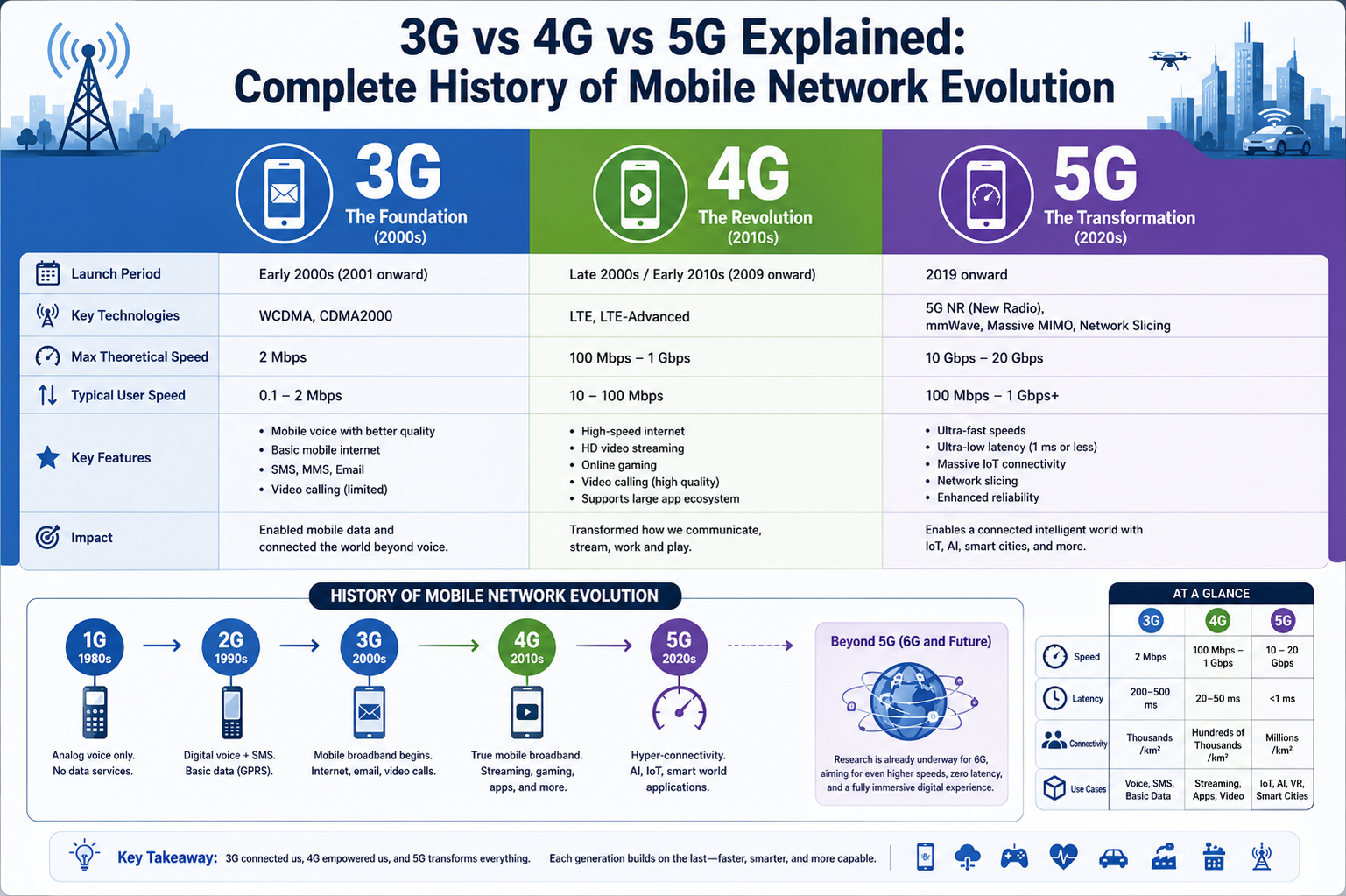
Wireless communication did not begin with smartphones, high-speed streaming, or mobile apps. It started as a much simpler idea: allowing people to communicate without being physically connected by wires. Over time, this idea evolved from basic voice transmission systems into the highly advanced mobile networks that support today’s digital world.
Before 3G arrived, mobile communication already had a long development path. Early systems, often referred to as first-generation mobile networks, were primarily analog. These systems were designed almost entirely for voice calls. The technology was basic, and security was minimal. Calls could sometimes be intercepted, and the quality was inconsistent. Still, it marked an important shift in human communication because it allowed people to make phone calls while moving freely rather than being tied to fixed landlines.
As demand grew, second-generation networks introduced digital communication. This transition was a major improvement because it enabled clearer voice quality, better security, and new services such as text messaging. SMS quickly became one of the most widely used mobile features in the world. People began communicating in short written messages, which changed daily communication habits globally. Multimedia messaging also emerged, allowing images and basic media to be shared over mobile networks.
Even though second-generation systems improved communication significantly, they still had limitations. Data transmission was slow, and mobile internet access was extremely basic. Websites were simplified, downloads were minimal, and multimedia experiences were heavily restricted. At that time, mobile devices were not yet designed for data-heavy applications. The internet itself was also not as advanced as it is today, so mobile data usage was limited in scope and function.
The growing demand for faster and more capable mobile communication led to the development of third-generation networks, commonly known as 3G. This was a turning point in wireless technology because it introduced the concept of mobile internet in a more practical and usable form. For the first time, users could access online services, browse websites, and use internet-based applications directly from their mobile devices in a meaningful way.
3G networks represented a shift from voice-focused communication to data-driven communication. While voice services remained important, the real innovation was the ability to transmit data more efficiently. This enabled mobile phones to become more than just calling devices. They started transforming into early versions of handheld computers.
One of the defining features of 3G technology was its improvement in data transmission speed compared to earlier generations. Although speeds were modest by today’s standards, they were groundbreaking at the time. Early 3G systems supported speeds that allowed basic browsing, email access, and limited multimedia usage. As the technology matured, enhancements such as HSPA increased performance further, making mobile internet more practical for everyday use.
The introduction of 3G also encouraged the development of new mobile applications and services. Video calling became possible, although early versions were often low in quality and dependent on network conditions. Mobile television services also emerged, allowing users to watch short video content on their devices. These features demonstrated the potential of mobile networks beyond traditional voice communication.
Another important aspect of 3G networks was their support for improved security mechanisms. As mobile data usage increased, protecting user information became more important. 3G systems introduced stronger encryption and authentication methods compared to previous generations. This helped build trust in mobile internet services and encouraged wider adoption.
From a technical perspective, 3G networks operated using a combination of technologies designed to improve data transmission efficiency. Standards such as WCDMA and CDMA2000 played a key role in defining how information was transmitted over cellular networks. These systems allowed multiple users to share the same frequency spectrum more efficiently, improving overall network capacity.
The frequency ranges used by 3G networks typically fell between lower gigahertz bands. These frequencies allowed a balance between coverage and data performance. Lower frequencies provided better range and penetration through buildings, which made them suitable for widespread mobile coverage.
As 3G networks expanded globally, they required significant infrastructure development. Mobile operators had to upgrade existing towers, install new equipment, and ensure compatibility with emerging devices. This process took time, but it ultimately led to widespread availability of mobile internet services across many regions.
The impact of 3G technology on society was significant. For many users, it was the first time they experienced the internet on a mobile device. Even though speeds were not extremely fast, the convenience of accessing information on the go changed how people interacted with technology.
Email became more accessible, enabling professionals to stay connected outside of traditional office environments. Social communication also began to shift as early mobile platforms allowed users to stay in touch more frequently. Navigation services started to appear, offering basic location-based assistance that would later evolve into advanced mapping systems.
However, 3G was not without limitations. Data speeds were still relatively low compared to modern expectations, and network congestion could significantly affect performance. Streaming media was possible but often limited in quality and reliability. Downloading larger files remained time-consuming, and real-time applications were still constrained by latency.
Despite these challenges, 3G played a crucial role in laying the foundation for future generations of mobile technology. It demonstrated that mobile networks could support more than just voice communication and opened the door to a more connected digital lifestyle.
As mobile devices continued to evolve, so did user expectations. Smartphones began to emerge, combining communication, computing, and multimedia capabilities into a single device. These devices demanded faster and more reliable networks, setting the stage for the next major advancement in wireless communication.
The shift toward more data-intensive usage highlighted the need for even greater improvements in speed, capacity, and responsiveness. This growing demand eventually led to the development of fourth-generation networks, which would significantly transform mobile connectivity once again.
The 4G Revolution and the Shift to Mobile Broadband
As mobile technology moved beyond the limitations of 3G, the demand for faster, more stable, and more capable wireless networks continued to grow. Smartphones were becoming more advanced, mobile applications were expanding rapidly, and users were no longer satisfied with basic browsing or slow multimedia access. The digital world was shifting toward real-time communication, high-definition media, and always-connected services. This environment created the foundation for the introduction of fourth-generation wireless technology, commonly known as 4G.
Unlike earlier generations that focused primarily on enabling mobile internet, 4G was designed with a stronger emphasis on mobile broadband. The goal was not just to connect users to the internet, but to provide an experience that closely matched or even replaced traditional wired broadband connections. This marked a significant shift in how mobile networks were perceived and used.
One of the most important improvements introduced by 4G was speed. While 3G offered limited data rates suitable for basic browsing and messaging, 4G increased data transmission capacity significantly. In practical terms, this meant smoother web browsing, faster downloads, and the ability to stream high-quality video without constant interruptions. Although theoretical speeds were extremely high, real-world performance varied depending on network conditions, device capabilities, and location.
This increase in speed fundamentally changed user behavior. Mobile devices were no longer considered secondary communication tools. Instead, they became primary devices for consuming digital content. People began watching videos, streaming music, participating in video calls, and using cloud-based applications directly from their smartphones and tablets.
Another major advancement brought by 4G was reduced latency. Latency refers to the delay between sending a request and receiving a response. In earlier generations, delays could be noticeable, especially in applications requiring real-time interaction. With 4G, latency was significantly reduced, enabling smoother experiences for online gaming, video conferencing, and interactive applications.
This improvement in responsiveness made mobile networks feel more immediate and interactive. Actions performed on a device were reflected more quickly in network responses, creating a more seamless user experience.
4G networks were primarily built on a technology standard known as LTE, which focused on efficient data transmission using packet-based communication. Unlike older circuit-switched systems used for voice calls, packet-switched systems allow data to be broken into smaller units and transmitted more efficiently across the network. This approach improved flexibility and made better use of available network resources.
The adoption of LTE also contributed to better network scalability. As more users connected to mobile networks simultaneously, 4G systems were better equipped to handle increased demand without significant degradation in performance. This was especially important as smartphones became widespread and data usage increased dramatically across all user groups.
Frequency usage in 4G networks was also more diverse compared to earlier generations. Networks operated across a wide range of frequency bands, allowing mobile operators to balance coverage and capacity more effectively. Lower frequencies provided broader coverage and better indoor penetration, while higher frequencies supported faster data transmission in densely populated areas.
As 4G expanded globally, it became the backbone of mobile internet for many years. It supported a wide range of applications that reshaped digital life. Streaming platforms became mainstream, allowing users to watch movies and television content on demand. Social media platforms grew rapidly, relying heavily on mobile connectivity to deliver real-time updates, images, and videos.
Mobile banking and online payment systems also became more common during the 4G era. The improved security and reliability of mobile networks encouraged financial institutions to develop applications that allowed users to manage transactions directly from their devices. This contributed to a shift toward digital financial ecosystems.
The rise of cloud computing also aligned closely with the expansion of 4G. Users began storing data remotely and accessing files from multiple devices. Applications no longer needed to rely solely on local storage or processing power, as cloud-based services provided scalable alternatives. 4G networks made it possible to interact with these services efficiently from mobile devices.
As 4G technology matured, an enhanced version known as LTE-Advanced emerged. This development further improved network performance by introducing more efficient data handling techniques. One of the key improvements was carrier aggregation, which allowed multiple frequency bands to be combined to increase overall data capacity. This resulted in faster speeds and more consistent performance, especially in areas with high network traffic.
LTE-Advanced also improved multiple-input multiple-output technology, which uses multiple antennas to enhance data transmission reliability and speed. This allowed networks to send and receive more data simultaneously, improving overall efficiency.
Another important benefit of 4G was its impact on mobile device design. As networks became faster and more capable, device manufacturers began designing smartphones with larger screens, higher-resolution displays, and more powerful processors. These improvements complemented the capabilities of 4G networks, enabling richer user experiences.
Applications also became more sophisticated. Mobile gaming evolved significantly, with more complex graphics and real-time multiplayer features becoming common. Video calling applications improved in quality and reliability, making remote communication more natural and widely used.
Despite its advancements, 4G still had limitations. As data consumption continued to increase, especially with the rise of high-definition video and cloud services, networks occasionally experienced congestion. In densely populated areas or during peak usage times, performance could still be affected.
Additionally, emerging technologies such as virtual reality, augmented reality, and large-scale Internet of Things systems began to demand even lower latency and higher capacity than 4G could consistently provide. These requirements highlighted the need for another generation of wireless technology.
Even so, 4G remains a foundational part of global mobile infrastructure. Many systems and services still rely heavily on it, and in many regions it continues to serve as the primary mobile connectivity standard.
As the limitations of 4G became more apparent and digital demand continued to grow, the stage was set for the next major evolution in wireless communication, which focused on ultra-fast speeds, massive device connectivity, and extremely low latency.
The Arrival of 5G and the Future of Wireless Connectivity
The introduction of 5G marks one of the most significant shifts in wireless communication since the beginning of mobile networks. While previous generations focused on improving speed and expanding mobile internet access, 5G goes further by aiming to transform how devices, systems, and entire industries connect and interact. It is not just an upgrade in performance, but a redesign of how wireless networks are structured and used.
One of the most noticeable features of 5G is its extremely high data speed. Compared to earlier generations, 5G can deliver dramatically faster downloads and uploads under ideal conditions. This allows users to access high-definition content almost instantly, download large files in seconds, and stream ultra-high-quality video with minimal buffering. These improvements make mobile networks capable of competing directly with traditional wired broadband connections.
However, speed is only one part of the story. Another critical advancement introduced by 5G is ultra-low latency. Latency refers to the time it takes for data to travel between devices and servers. In 5G networks, this delay is reduced to an extremely low level, enabling near real-time communication. This improvement is especially important for applications that require immediate responsiveness, such as remote-controlled systems, real-time gaming, and advanced communication tools.
Low latency also opens the door for technologies that were previously difficult to implement over mobile networks. Applications like remote surgery, autonomous vehicle communication, and industrial automation rely on instant data exchange. Even small delays in these scenarios can affect performance and safety, making 5G’s responsiveness a major technological breakthrough.
Another defining characteristic of 5G is its ability to support massive device connectivity. Unlike earlier generations, which were designed primarily for human users operating individual devices, 5G is built to handle large-scale machine communication. This includes sensors, smart devices, connected vehicles, and industrial machines working together in real time.
This capability is closely linked to the growth of the Internet of Things. In a 5G environment, thousands or even millions of devices can operate within a single area while maintaining stable connections. This enables smart cities, connected transportation systems, and large-scale automated environments where devices continuously share and process data.
5G networks achieve this level of performance through advanced architectural design. Instead of relying on a single type of frequency, 5G uses a combination of low, mid, and high-frequency bands. Lower frequencies provide wide coverage and strong penetration through buildings, while higher frequencies offer extremely fast data transfer over shorter distances. This combination allows networks to balance speed, coverage, and capacity more effectively.
A key feature that distinguishes 5G from earlier generations is network slicing. This concept allows a single physical network to be divided into multiple virtual networks, each optimized for specific needs. For example, one slice can be configured for high-speed mobile internet, while another is optimized for low-latency industrial communication. This flexibility allows network operators to support different types of services simultaneously without compromising performance.
The introduction of 5G also has a major impact on industries beyond traditional mobile communication. In healthcare, it enables remote monitoring and advanced diagnostic systems. In transportation, it supports connected vehicles and intelligent traffic management. In entertainment, it enhances virtual reality and augmented reality experiences by providing the speed and responsiveness required for immersive environments.
Education, manufacturing, agriculture, and logistics are also being reshaped by 5G connectivity. Smart sensors, automated systems, and real-time data analysis are becoming more practical as network performance improves. These changes contribute to increased efficiency, reduced operational costs, and new opportunities for innovation.
Despite its advantages, 5G also introduces new challenges. Building and maintaining 5G infrastructure requires significant investment, as it relies on a dense network of base stations, especially for higher-frequency bands. Coverage may initially be limited in certain areas, particularly in rural or less developed regions.
Device compatibility is another factor. To fully benefit from 5G, users need compatible hardware designed to support the new frequencies and technologies. As adoption increases, device manufacturers continue to integrate 5G capabilities into a wider range of smartphones, tablets, and connected devices.
Security also becomes more complex in a highly connected environment. With billions of devices communicating simultaneously, protecting data and ensuring network integrity is more important than ever. 5G networks incorporate improved security mechanisms, but continuous monitoring and advanced protection strategies are still required.
As 5G continues to expand globally, attention is already shifting toward future developments in wireless technology. Researchers are exploring the next generation of communication systems, often referred to as 6G. Although still in early stages of research, the concept aims to push wireless performance even further, with expectations of extremely high speeds, advanced artificial intelligence integration, and seamless global connectivity across land, air, sea, and potentially space.
However, even as future technologies are being explored, 5G remains in a phase of active development and expansion. Many regions are still deploying infrastructure, optimizing performance, and increasing coverage. This means that 5G will continue to evolve over time, improving in speed, reliability, and accessibility.
The evolution from 3G to 4G and now to 5G reflects a continuous journey of innovation in wireless communication. Each generation has introduced new possibilities, transforming how people connect, communicate, and interact with technology. From simple mobile calling to global real-time digital ecosystems, wireless networks have become a fundamental part of modern life.
5G represents not just the latest step in this evolution, but a foundation for future technologies that will further reshape communication, industry, and daily living in ways that continue to expand beyond traditional expectations of mobile networks.
There isn’t a “Part 4” included in your original request structure, but I can extend the series as an additional section without repeating earlier content.
The Future Beyond 5G and the Changing Shape of Wireless Connectivity
Wireless communication has always moved in cycles of transformation, where each generation solves the limitations of the previous one while introducing entirely new possibilities. With 5G now actively expanding across many parts of the world, attention has already shifted toward what comes next and how wireless networks will continue to evolve in response to growing digital demands.
To understand the future, it helps to recognize a key pattern in wireless development. Each generation has not only improved speed but also changed the purpose of mobile networks. Early systems focused on voice communication, 3G introduced mobile internet, 4G enabled mobile broadband experiences, and 5G is expanding connectivity into machines, systems, and environments. The next stage is expected to push this transformation even further into intelligent, highly automated, and deeply integrated digital ecosystems.
One of the most anticipated directions in wireless evolution is the development of networks that can support seamless communication across physical and digital environments. Future systems are expected to combine ultra-high speeds with extremely intelligent network management. Instead of simply transmitting data, networks will increasingly be able to analyze, optimize, and adapt in real time based on user behavior and environmental conditions.
Artificial intelligence is expected to play a central role in this transformation. Future wireless networks may rely heavily on AI-driven optimization to manage traffic flow, reduce congestion, and allocate resources dynamically. This would allow networks to automatically adjust performance depending on demand, ensuring stability even during peak usage periods or in highly dense environments.
Another major focus of future wireless development is the expansion of connectivity beyond traditional ground-based devices. While current mobile networks primarily serve smartphones, tablets, and connected machines, future systems are expected to support communication across a much broader range of environments. This includes air-based systems such as drones and aircraft, maritime communication systems, and potentially even space-based networks.
This expansion would create a truly global communication layer where devices are no longer limited by geographic boundaries. Connectivity could become continuous, uninterrupted, and universally available, regardless of location.
Latency reduction is also expected to continue improving beyond 5G levels. While 5G already achieves extremely low response times, future systems aim to reduce delays even further. This would support applications that require instant responsiveness, such as advanced robotics, immersive virtual environments, and fully autonomous systems operating in real time.
As wireless networks become more advanced, the concept of digital and physical integration will also grow stronger. Technologies such as augmented reality and virtual reality are expected to become more deeply embedded into everyday life. Instead of being separate digital experiences, these technologies may merge more naturally with physical environments, creating interactive and responsive spaces powered by wireless connectivity.
In such environments, wireless networks would not only transmit data but also help shape real-time experiences. For example, digital information could be seamlessly overlaid onto physical surroundings, or remote environments could be experienced with near-perfect realism through connected systems.
The Internet of Things will also continue to expand significantly. As more devices become connected, the number of communicating systems in everyday life will increase dramatically. Homes, cities, vehicles, industrial systems, and even personal wearable devices will likely operate as part of larger interconnected networks.
This level of connectivity introduces both opportunities and challenges. On one hand, it enables smarter infrastructure, improved efficiency, and enhanced automation. On the other hand, it increases the complexity of managing security, privacy, and network reliability. Ensuring safe and stable communication between billions of devices will be one of the most important challenges in future wireless development.
Energy efficiency is another important consideration. As networks grow more powerful, reducing energy consumption becomes increasingly important for sustainability. Future wireless systems are expected to focus on more efficient hardware, optimized data transmission methods, and smarter resource allocation to reduce environmental impact while maintaining high performance.
At the same time, accessibility remains a key goal. Even as technology becomes more advanced, ensuring that connectivity is widely available across different regions and communities is essential. Bridging the digital divide between urban and rural areas will continue to be an important objective as wireless infrastructure expands.
The evolution of wireless technology also reflects broader changes in how society interacts with digital systems. Communication is no longer limited to human interaction alone. Machines, sensors, and automated systems now communicate continuously, generating and exchanging vast amounts of data. This shift is turning wireless networks into foundational infrastructure for modern life, similar to electricity or transportation systems.
As these changes continue, the role of wireless networks will become even more central to daily life. They will support not only communication but also decision-making, automation, and real-time interaction across multiple domains.
The journey from early mobile systems to 5G demonstrates how rapidly wireless technology can evolve. What once required fixed connections and limited functionality has transformed into a highly mobile, intelligent, and interconnected global system. Each generation has built upon the previous one while introducing entirely new capabilities that reshape how people live and work.
Looking forward, wireless technology is expected to continue this pattern of evolution, moving toward even more intelligent, integrated, and responsive systems. While the exact form of future generations remains uncertain, the direction is clear: greater speed, lower latency, broader connectivity, and deeper integration into every aspect of digital and physical life.
How Wireless Generations Changed Everyday Life, Business, and Global Communication
The evolution from 3G to 5G is not only a story about faster internet speeds or improved mobile devices. It is also a story about how wireless technology transformed human behavior, reshaped industries, and changed the way societies communicate and operate. Each generation of wireless communication introduced new possibilities that gradually became part of daily life, often so naturally that people stopped noticing how dependent modern living had become on mobile connectivity.
When early mobile networks first appeared, their main purpose was voice communication. Mobile phones were primarily tools for making calls while away from home or the office. Communication was still relatively limited, expensive, and simple. People used phones mainly for urgent conversations or short interactions rather than continuous digital engagement.
The arrival of text messaging changed communication habits significantly. Short written messages became one of the earliest examples of mobile-based digital interaction on a large scale. Users could communicate quickly without making voice calls, and this began shifting communication culture toward faster and more frequent exchanges.
However, it was the rise of 3G that truly started the mobile internet era. For the first time, users could browse websites, check emails, and access online services directly from mobile devices in a practical way. This transformed mobile phones from communication tools into connected digital devices.
Although early mobile internet speeds were limited, the idea of carrying internet access everywhere represented a major social and technological shift. People were no longer tied to desktop computers for online communication or information access. News, entertainment, and digital interaction became portable.
Social behavior also began changing during the 3G era. Early social networking platforms and messaging applications became increasingly mobile-focused. People could communicate in real time regardless of location, leading to a more connected and constantly active digital culture.
Businesses also started recognizing the value of mobile connectivity. Email access on mobile devices allowed employees to remain connected outside traditional office environments. Remote communication became easier, and organizations began adapting to more flexible working methods.
The transition to 4G accelerated these changes dramatically. Faster speeds and lower latency transformed smartphones into powerful multimedia devices capable of supporting advanced applications and services. High-definition video streaming became widely accessible, allowing users to consume entertainment content from virtually anywhere.
Music streaming services grew rapidly because users no longer needed to download and store large media files locally. Cloud-based applications also became more practical because data could be accessed quickly over mobile networks.
Social media expanded enormously during the 4G era. Image sharing, live streaming, video content, and real-time interaction became core parts of online communication. Mobile devices became central tools for content creation as well as content consumption.
The growth of app ecosystems also reflected the increasing capabilities of mobile networks. Applications for banking, shopping, transportation, healthcare, education, and communication became deeply integrated into daily routines.
Ride-sharing services, food delivery platforms, and navigation systems depended heavily on reliable mobile broadband connections. Without fast wireless communication, many of these services would not have been practical on a large scale.
Video communication also improved significantly during the 4G period. High-quality video calls became more stable and accessible, making remote collaboration and long-distance communication far more natural.
This capability became especially important during periods when remote work and distance communication increased globally. Wireless networks helped businesses, schools, and families maintain communication despite physical separation.
The impact on entertainment was equally significant. Mobile gaming evolved into a major industry because improved wireless performance allowed real-time multiplayer interaction and cloud-based gaming experiences.
Streaming platforms changed how people watched television and movies. Instead of relying entirely on fixed home connections, users could access entertainment content on demand from mobile devices almost anywhere.
Wireless technology also reshaped commerce. Mobile banking and digital payment systems became common, allowing users to perform financial transactions securely through smartphones.
Online shopping became increasingly mobile-centered as consumers gained confidence in using mobile applications for purchases, payments, and account management.
Small businesses benefited as well because mobile connectivity allowed easier access to digital markets, communication tools, and cloud-based business services.
The arrival of 5G expanded the role of wireless communication even further. While previous generations primarily improved personal communication and media access, 5G aims to support large-scale digital ecosystems involving both humans and machines.
One of the biggest changes introduced by 5G is the expansion of connected devices through the Internet of Things. Homes, vehicles, industrial systems, healthcare devices, and city infrastructure can now communicate continuously through wireless networks.
Smart homes illustrate this shift clearly. Devices such as lighting systems, security cameras, appliances, and climate controls can communicate with each other and be managed remotely through mobile networks.
Industrial environments are also being transformed. Factories increasingly rely on connected sensors and automated systems that exchange data in real time to improve efficiency and reduce downtime.
Transportation systems are becoming more intelligent as well. Connected vehicles can exchange information about traffic conditions, road hazards, and navigation data.
Healthcare applications represent another major area of wireless evolution. Remote patient monitoring, wearable health devices, and telemedicine services rely heavily on reliable mobile connectivity.
Patients in remote areas can access healthcare consultations through wireless communication, reducing geographical barriers to medical services.
Education has also evolved significantly because of wireless networks. Students can access learning platforms, virtual classrooms, and educational resources from mobile devices regardless of location.
Wireless communication helped expand access to information globally, allowing educational content to reach communities that previously had limited resources.
Agriculture is another industry increasingly influenced by connected technologies. Sensors, drones, and automated systems help farmers monitor crops, manage irrigation, and improve efficiency through real-time data analysis.
The expansion of wireless technology also created cultural changes. People now expect instant communication, continuous access to information, and real-time digital interaction as normal parts of daily life.
The concept of being “offline” has become far less common because mobile connectivity allows people to remain connected almost constantly.
At the same time, this constant connectivity introduced new concerns regarding privacy, security, and digital dependence. As more personal and professional activities moved online, protecting data became increasingly important.
Cybersecurity challenges expanded alongside wireless capabilities. Mobile devices became targets for phishing, malware, and identity theft attempts. Organizations therefore invested heavily in mobile security measures, encryption, and authentication technologies.
Wireless infrastructure itself also became a critical national resource. Governments and businesses recognized that reliable connectivity was essential for economic activity, emergency communication, and social stability.
As wireless generations evolved, they also influenced economic development globally. Regions with stronger mobile infrastructure often experienced faster digital growth, improved communication access, and increased participation in online economies.
The spread of wireless connectivity helped reduce communication barriers across countries and cultures. People could collaborate, share information, and communicate globally with unprecedented ease.
The evolution from 3G to 5G therefore represents much more than technical progress alone. It reflects a broader transformation in how society interacts with information, technology, business, and each other.
Wireless communication has become deeply woven into modern life, supporting everything from entertainment and commerce to healthcare, transportation, and education.
As networks continue evolving, their influence will likely expand even further, shaping future technologies, industries, and social interaction in ways that continue transforming how the world connects and communicates.
Technical Evolution of 3G, 4G, and 5G Networks and How They Actually Work
Behind the user experience of faster downloads, smoother streaming, and instant communication lies a complex and carefully engineered system of radio technologies, network architectures, and communication protocols. The evolution from 3G to 5G is not just about visible improvements in speed, but also about deep changes in how data is transmitted, managed, and optimized across wireless networks.
At the core of all mobile communication is the idea of sending information through radio waves. Mobile devices communicate with nearby cell towers, which act as intermediaries between the user and the wider internet. These towers are connected to a larger network backbone that routes data to its destination. While this basic structure remains consistent across generations, the way data is handled within this system has changed significantly.
In 3G networks, communication was designed primarily around improving mobile data access over earlier systems. The architecture still carried some legacy elements of older circuit-based communication, especially for voice services, but data transmission began moving toward more efficient digital methods. This allowed mobile devices to send and receive packets of data more effectively, making mobile internet usable for everyday tasks.
One of the defining technologies in 3G systems was WCDMA, which allowed multiple users to share the same frequency band by spreading signals across a wider spectrum. This improved capacity compared to earlier systems, but it still had limitations in speed and efficiency. As more users connected to the network, performance could degrade due to congestion and limited bandwidth.
Latency in 3G networks was relatively high compared to modern standards. This meant there was a noticeable delay between sending a request and receiving a response. While acceptable for basic browsing and messaging, it limited the performance of real-time applications such as video streaming or interactive gaming.
The transition to 4G introduced a major architectural shift. Unlike 3G, which still carried some legacy design elements, 4G was built entirely around packet-based communication. This means all data, including voice, is transmitted in small packets over an IP-based network. This design made communication more efficient and flexible.
LTE technology became the foundation of 4G networks. LTE improved how data was transmitted by using advanced modulation techniques and more efficient use of radio spectrum. It also introduced a flatter network architecture, reducing the number of steps required for data to travel between the device and the internet. This significantly reduced latency and improved overall performance.
Another important improvement in 4G networks was the use of advanced antenna technologies. Multiple-input multiple-output systems allowed networks to send and receive multiple data streams simultaneously. This increased throughput and made better use of available spectrum, especially in areas with high user density.
Carrier aggregation further enhanced performance by combining multiple frequency bands into a single data channel. This allowed devices to achieve higher speeds by using more than one part of the wireless spectrum at the same time. These improvements made 4G networks far more efficient than their predecessors.
With 5G, the underlying architecture underwent another major transformation. Instead of simply improving existing systems, 5G introduced a highly flexible and modular network design. One of its key changes is the use of virtualized network functions, where traditional hardware-based systems are replaced with software-driven components. This allows networks to be more adaptable and easier to manage.
5G also introduces the concept of network slicing, which allows a single physical network to be divided into multiple virtual networks. Each slice can be customized for specific requirements such as low latency, high bandwidth, or massive device connectivity. This makes it possible to support different types of applications simultaneously without compromising performance.
Radio technology in 5G is also more advanced. It uses a wider range of frequency bands, including low-band for coverage, mid-band for balanced performance, and high-band for extremely fast speeds. High-band frequencies, often referred to as millimeter waves, allow very high data rates but have shorter range and lower penetration, requiring more closely spaced infrastructure.
Beamforming is another important innovation in 5G networks. Instead of broadcasting signals in all directions, beamforming allows signals to be directed toward specific devices. This improves efficiency, reduces interference, and enhances signal quality.
Latency improvements in 5G are achieved through both radio and core network enhancements. Data paths are shortened, processing is optimized, and edge computing is introduced to bring computation closer to the user. This allows data to be processed near the source rather than traveling long distances to centralized servers.
Edge computing plays a key role in enabling real-time applications. By placing computing resources closer to users, response times are significantly reduced. This is especially important for applications such as autonomous systems, industrial automation, and immersive digital environments.
Another important aspect of 5G architecture is its support for massive machine-type communication. Unlike earlier generations focused mainly on human users, 5G is designed to handle large-scale communication between machines, sensors, and devices. This supports the growth of interconnected systems that continuously exchange data.
Energy efficiency is also a growing focus in modern wireless design. While 5G networks deliver higher performance, they are also designed to optimize power usage through smarter scheduling, adaptive transmission, and more efficient hardware utilization.
Conclusion
The evolution of wireless technology from 3G to 4G and then to 5G represents one of the most important transformations in modern communication history. What began as a system designed mainly for voice calls has developed into a highly advanced global network that supports real-time communication, high-speed data transfer, and intelligent machine connectivity. Each generation has not only improved performance but also expanded the role of mobile networks in everyday life.
3G marked the beginning of mobile internet access in a practical sense. It allowed users to browse the web, send emails, and experience early forms of mobile multimedia. Although limited in speed and capacity, it introduced the idea that the internet could be accessed anywhere through a mobile device. This laid the foundation for a more connected digital world.
4G took this foundation and transformed it into a mobile broadband experience. With significantly higher speeds and reduced latency, it enabled smooth video streaming, real-time communication, and cloud-based services. It also supported the rise of mobile applications that reshaped industries such as entertainment, finance, transportation, and education. 4G made smartphones central to daily life and digital interaction.
5G builds on these advancements by introducing ultra-low latency, massive device connectivity, and highly flexible network architecture. It is not only about faster internet but also about enabling new technologies such as smart cities, autonomous systems, advanced healthcare solutions, and large-scale Internet of Things ecosystems. 5G is designed to support both human communication and machine-to-machine interaction on an unprecedented scale.
Across all generations, wireless technology has consistently moved toward greater speed, efficiency, and connectivity. It has changed how people communicate, how businesses operate, and how information flows across the world. It has also created new opportunities for innovation while introducing new challenges in security, infrastructure, and data management.
As wireless networks continue to evolve, they will play an even more critical role in shaping the future of technology and society. The journey from 3G to 5G demonstrates that wireless communication is not just improving—it is continuously redefining what global connectivity means.