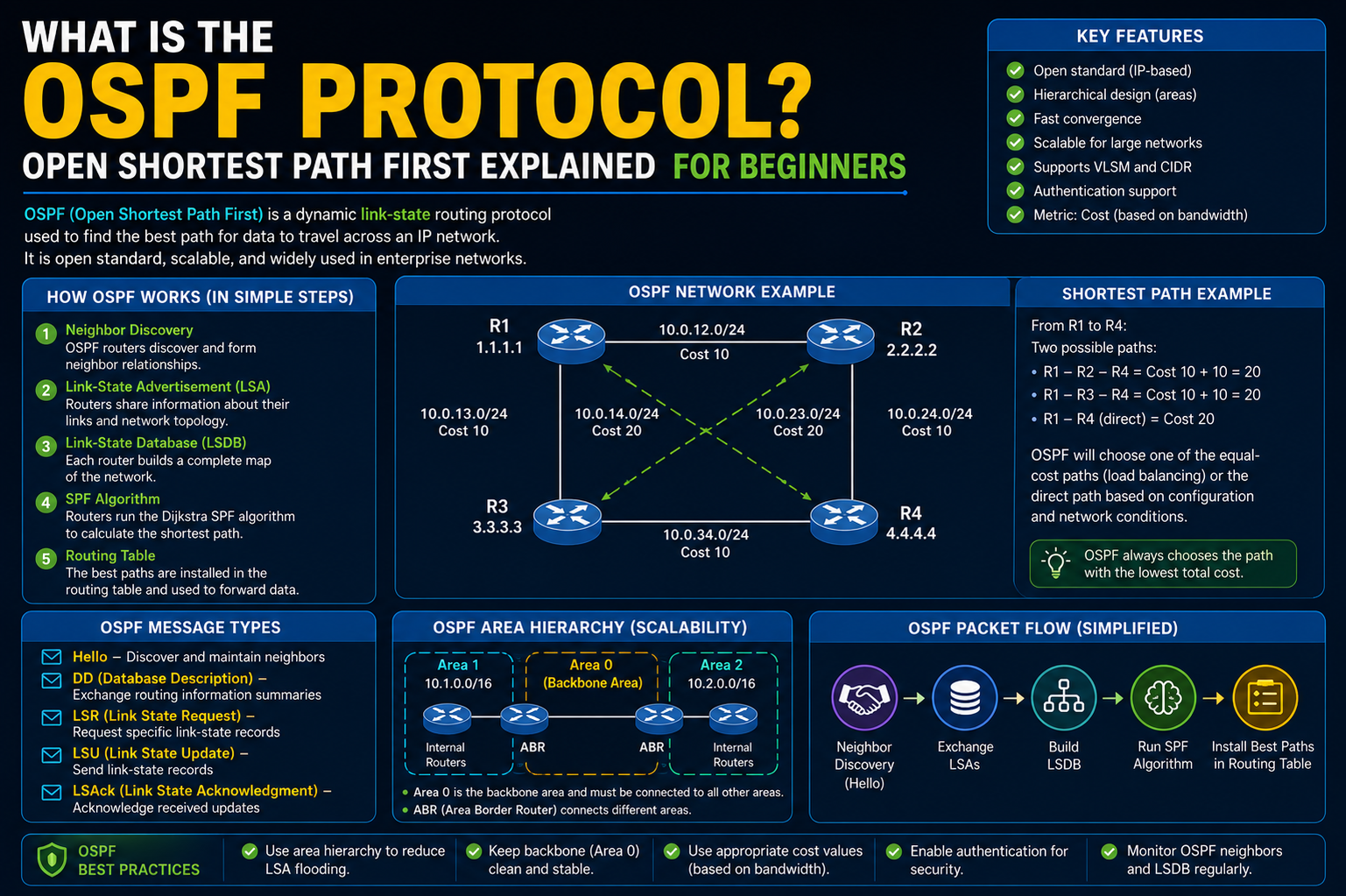
In modern computer networking, efficient routing is one of the most important requirements for maintaining performance, stability, and scalability. As networks grow larger and more complex, simple routing methods are no longer sufficient to handle dynamic changes in topology or increasing traffic loads. This is where dynamic routing protocols become essential, and among them, OSPF (Open Shortest Path First) stands out as one of the most widely used and powerful protocols in enterprise environments.
OSPF is a dynamic link-state routing protocol designed to help routers exchange information about network topology and calculate the most efficient path for data transmission. Unlike simpler routing methods that rely on static configurations or basic distance calculations, OSPF builds a complete and updated map of the network, allowing routers to make intelligent decisions about where to send data packets. This makes it highly suitable for large-scale and rapidly changing networks.
At its core, OSPF operates at Layer 3 of the OSI model, which is responsible for logical addressing and routing. This means OSPF deals directly with IP addresses and network paths rather than physical hardware connections. It is designed specifically for use within an Autonomous System, which is a collection of networks managed under a single administrative domain. This makes it particularly common in enterprise networks, service provider environments, and large organizational infrastructures.
The defining characteristic of OSPF is that it belongs to the link-state category of routing protocols. In a link-state system, each router does not simply rely on neighboring routers for routing decisions. Instead, every router builds and maintains a detailed map of the entire network, known as the link-state database. This database contains information about all routers, links, and available paths within the network. By maintaining this comprehensive view, each router is capable of independently calculating the best possible route to any destination.
To achieve this, OSPF uses a specialized algorithm known as the Shortest Path First algorithm, also called Dijkstra’s algorithm. This algorithm evaluates all possible paths in the network and assigns a cost to each path based on factors such as bandwidth. The path with the lowest total cost is selected as the most efficient route for data transmission. This ensures that traffic is always directed through the optimal route rather than relying on random or fixed paths.
One of the most important advantages of OSPF is its ability to react quickly to network changes. When a link goes down or a new router is added, OSPF immediately updates its link-state database and recalculates routes. This process, known as convergence, is significantly faster compared to older routing protocols. Fast convergence is critical in modern networks where downtime or delays can have a direct impact on business operations and user experience.
Another important concept in OSPF is the idea of areas. Instead of treating the entire network as a single large system, OSPF divides it into smaller, more manageable sections called areas. Each area contains a group of routers that share routing information internally. These areas are connected through a central backbone area, which is typically referred to as Area 0. This hierarchical design improves efficiency by reducing the amount of routing information that needs to be processed and shared across the entire network.
By organizing networks into areas, OSPF reduces overhead and improves scalability. Routers within an area only need to maintain detailed information about their local environment, while summarized information is shared between areas. This approach allows OSPF to support extremely large networks without overwhelming routers with excessive routing data.
OSPF also supports advanced IP addressing techniques such as Variable Length Subnet Masking, which allows networks to use IP address space more efficiently. This flexibility is essential in modern networking, where efficient allocation of IP addresses is a key concern.
Because OSPF is an open standard protocol, it is not owned by any single company. This makes it widely compatible across different hardware and software platforms. It has become a foundational protocol in networking education and certification programs, as well as in real-world enterprise deployments.
OSPF Operation, Neighbor Relationships, States, and Internal Routing Mechanics
To understand how OSPF functions in real-world environments, it is important to explore how routers communicate with each other and establish relationships within a network. Unlike simpler routing protocols that exchange basic routing tables, OSPF uses a more structured and intelligent process based on neighbor discovery, database synchronization, and state progression.
The first step in OSPF operation is the discovery of neighboring routers. When OSPF is enabled on a router, it begins sending special messages known as Hello packets. These packets are used to identify other OSPF-enabled devices on directly connected networks. When two routers receive each other’s Hello packets and confirm compatibility, they begin forming a neighbor relationship. This process is essential because OSPF relies on cooperation between routers to build an accurate network map.
Once routers establish initial communication, they progress through a series of defined states. These states represent the stages of relationship building and database synchronization. The first state is Down, which indicates that no OSPF communication is occurring. When a router begins sending Hello packets but has not yet received a response, it enters the Init state. This means the router is aware of a potential neighbor but has not yet established a confirmed relationship.
When both routers begin exchanging Hello packets successfully, they move into the Two-Way state. At this point, bidirectional communication has been established, meaning each router recognizes the other as a valid neighbor. This is a critical milestone because it confirms that both devices are ready to exchange routing information.
The next stage involves more detailed synchronization. Routers enter the ExStart state, where they determine which device will act as the primary sender of database information. This is followed by the Exchange state, where routers share summaries of their link-state databases. These summaries help each router understand what information the other possesses without sending full details immediately.
After this, routers move into the Loading state, where they request any missing information from their neighbors. This ensures that both routers have a complete and accurate view of the network. Finally, when all information has been successfully exchanged and synchronized, routers enter the Full state. At this point, they have a complete understanding of the network topology and are fully capable of performing routing decisions.
A key concept within OSPF operation is the link-state advertisement. These are small packets that contain information about network changes, such as new routes, failed links, or updated metrics. When a change occurs, routers immediately propagate this information throughout the network. This ensures that all routers maintain an updated view of the network at all times.
Another important component of OSPF is the Designated Router concept. In multi-access networks, such as Ethernet segments, multiple routers may be connected to the same network. To reduce unnecessary communication, OSPF elects a Designated Router and a Backup Designated Router. These routers act as central points for exchanging routing information, reducing network overhead and improving efficiency.
OSPF also uses a structured database system to store all routing information. This database is continuously updated as changes occur in the network. Because every router maintains its own copy of this database, routing decisions can be made independently without relying on a central controller. This distributed design increases reliability and reduces the risk of single points of failure.
Through these mechanisms, OSPF ensures that routers are always synchronized, aware of network changes, and capable of selecting the best possible routing paths.
OSPF Path Selection, Metrics, Configuration, and Real-World Network Optimization
Once OSPF routers have established neighbor relationships and synchronized their databases, the next critical function is route calculation. This is where OSPF determines the most efficient path for data to travel across the network. Unlike simpler protocols that rely on hop counts or static values, OSPF uses a more advanced metric system based on cost.
The OSPF cost metric is calculated using a formula that considers interface bandwidth. In simple terms, higher bandwidth links are assigned lower cost values, while lower bandwidth links receive higher cost values. This ensures that OSPF naturally prefers faster and more efficient paths when routing data. The cost calculation is typically based on a reference bandwidth divided by the actual interface bandwidth, allowing routers to compare different paths objectively.
Once costs are assigned to all available links, OSPF uses Dijkstra’s algorithm to compute the shortest path tree. This algorithm evaluates all possible routes from a source router to all other destinations and selects the path with the lowest total cost. This ensures that data always follows the most efficient route available within the network.
In situations where multiple paths have the same cost, OSPF can use additional criteria to select a preferred route. This may include factors such as router priority or interface characteristics. In some cases, multiple equal-cost paths may be used simultaneously to balance traffic load across the network, improving overall performance.
Configuring OSPF in real-world environments involves defining routing processes, assigning network interfaces, and organizing routers into areas. Administrators begin by enabling OSPF on a router and assigning it a process identifier. This identifier is locally significant and allows multiple OSPF processes to exist on the same device if needed.
Next, network interfaces are assigned to OSPF. This step determines which parts of the network will participate in OSPF routing. After this, networks are associated with specific OSPF areas. Area configuration is critical because it determines how routing information is shared and summarized across the network. The backbone area, known as Area 0, plays a central role in connecting all other areas together.
In large-scale networks, proper area design is essential for performance optimization. Poorly designed areas can lead to excessive routing updates, increased processing load, and inefficient path selection. Well-structured area design ensures that routers only process relevant information, reducing overhead and improving scalability.
Troubleshooting OSPF often involves checking neighbor relationships, verifying database synchronization, and analyzing routing tables. If routers fail to form adjacency, it may indicate configuration mismatches, network issues, or authentication problems. Ensuring consistency in area configuration and interface settings is critical for maintaining stable OSPF operation.
In real-world applications, OSPF is widely used in enterprise networks, data centers, and service provider infrastructures. Its ability to quickly adapt to changes, support large-scale topologies, and calculate efficient routes makes it a preferred choice for dynamic routing environments.
Through its combination of link-state intelligence, hierarchical design, and advanced path calculation, OSPF remains one of the most important routing protocols in modern networking systems.
OSPF Network Design Principles, Area Hierarchy, and Scalable Architecture in Real-World Networks
In large and complex networking environments, routing is not just about finding the shortest path between two devices. It is about designing a structured system that can scale efficiently, adapt to changes quickly, and maintain stability even under heavy traffic conditions. OSPF plays a central role in achieving these goals through its hierarchical design, area-based segmentation, and intelligent distribution of routing information. Understanding how OSPF is structured at a design level is essential for building networks that can grow without becoming unstable or inefficient.
One of the most important concepts in OSPF is hierarchical network design. Instead of treating the entire network as a single flat system where every router knows everything about every other router, OSPF divides the network into smaller sections called areas. Each area operates as a semi-independent unit, maintaining detailed routing information only about its own internal structure. This approach significantly reduces the amount of routing data that each router must process and store, which improves both performance and scalability.
At the center of this hierarchical design is the backbone area, known as Area 0. This area serves as the primary hub through which all other areas must connect. In a properly designed OSPF network, all non-backbone areas communicate with each other through Area 0. This ensures that routing information flows in a controlled and predictable manner, preventing routing loops and unnecessary complexity. The backbone area essentially acts as the core of the entire OSPF system, maintaining connectivity between all other segments.
The concept of areas is not just about organization; it is also about efficiency. When routers are grouped into areas, they do not need to maintain full knowledge of the entire network topology. Instead, they focus on their local area and only receive summarized information about other areas. This reduces the size of the link-state database on each router and minimizes the processing required to calculate routes. As a result, OSPF can scale to support very large networks without overwhelming individual devices.
Different types of OSPF areas are used to further optimize routing behavior. A standard area allows full OSPF functionality, where routers maintain complete routing information for that section of the network. In contrast, a stub area is designed to reduce complexity by limiting the types of external routing information that can enter the area. Instead of receiving detailed external routes, routers in a stub area rely on a default route to reach destinations outside their area. This reduces the size of routing tables and simplifies decision-making.
There are also more specialized area types designed for specific scenarios. For example, certain restricted areas are used to further limit external routing information while still maintaining connectivity with the rest of the network. These specialized designs are particularly useful in environments where simplicity and efficiency are more important than full routing visibility.
Another important aspect of OSPF design is route summarization. Route summarization allows multiple specific routes to be represented as a single broader route when communicated between areas. This reduces the amount of routing information that needs to be exchanged across the network and helps prevent routing table bloat. By summarizing routes at area boundaries, OSPF ensures that routers outside an area do not need to know every internal detail of that area’s topology.
This summarization process plays a key role in maintaining scalability. Without it, large networks would quickly become overwhelmed with routing information, making it difficult for routers to process updates efficiently. By reducing the amount of information shared between areas, OSPF ensures that network growth does not lead to exponential increases in complexity.
Another important design consideration is how OSPF handles inter-area communication. When a packet needs to travel from one area to another, it must pass through the backbone area. This structured flow ensures that routing remains predictable and prevents chaotic routing behavior. It also allows network administrators to control traffic patterns more effectively, ensuring that critical paths remain optimized.
In addition to areas, OSPF design also considers the role of different router types within the network. Internal routers operate entirely within a single area and maintain full knowledge of that area’s topology. Area Border Routers (ABRs) connect multiple areas together and are responsible for summarizing and distributing routing information between them. Backbone routers operate within Area 0 and form the core of the OSPF infrastructure. Autonomous System Boundary Routers (ASBRs) connect OSPF networks to external routing domains, allowing communication between different routing systems.
These roles create a structured hierarchy that ensures routing information flows efficiently throughout the network. Each router type has a specific responsibility, which prevents unnecessary duplication of routing information and improves overall system performance.
OSPF network design also emphasizes stability during changes. In dynamic environments, network links may go up or down frequently due to hardware changes, failures, or configuration updates. OSPF is designed to handle these changes without disrupting the entire network. When a change occurs, only the affected area recalculates its routing information, while other areas remain unaffected. This localized response reduces instability and ensures faster recovery.
Another key principle in OSPF design is minimizing routing overhead. Routing overhead refers to the amount of processing power, memory, and bandwidth required to maintain routing information. By dividing networks into areas, summarizing routes, and controlling update distribution, OSPF significantly reduces overhead compared to flat routing designs. This makes it particularly well-suited for large enterprise networks and service provider environments.
Security and control are also important considerations in OSPF design. Because routing information is exchanged dynamically between routers, it is important to ensure that only trusted devices participate in the OSPF process. Authentication mechanisms can be used to verify routing updates and prevent unauthorized devices from injecting false routing information into the network.
Overall, OSPF network design is built around the principles of hierarchy, efficiency, scalability, and stability. By dividing networks into structured areas, controlling routing information flow, and optimizing path selection, OSPF provides a powerful framework for managing complex network environments. Its design allows it to support everything from small enterprise networks to large global infrastructures without losing performance or reliability.
Advanced OSPF Behavior, DR/BDR Elections, Timers, Convergence, Load Handling, and Real-World Performance Optimization
As OSPF operates in increasingly complex network environments, its internal mechanisms become far more important than basic configuration. While initial OSPF concepts focus on forming neighbor relationships and calculating routes, real-world performance depends heavily on how OSPF manages shared networks, handles timing, responds to failures, and distributes routing information efficiently. These advanced behaviors ensure that OSPF remains stable even in large-scale infrastructures with high traffic loads and frequent topology changes.
One of the most critical advanced mechanisms in OSPF is the Designated Router (DR) and Backup Designated Router (BDR) election process. In multi-access networks, such as Ethernet LAN segments where multiple routers share the same broadcast domain, full mesh communication between every router would be highly inefficient. If every router formed a direct adjacency with every other router, the number of relationships would grow rapidly as more devices were added, leading to unnecessary overhead and resource consumption.
To solve this, OSPF introduces the concept of a Designated Router. The DR acts as a central coordination point for exchanging routing information on a shared network segment. Instead of every router communicating with all others, they communicate primarily with the DR, which then distributes updates efficiently. This significantly reduces the number of required OSPF adjacencies and improves scalability.
Alongside the DR, a Backup Designated Router is elected. The BDR continuously monitors the DR and remains in a standby state. If the DR fails or becomes unreachable, the BDR immediately takes over its role without requiring a full re-election process. This ensures network continuity and prevents disruption in routing operations.
The election process itself is based on router priority values and router IDs. Routers with higher priority values are more likely to become DR or BDR. If all priorities are equal, the router with the highest router ID is selected. This deterministic selection process ensures predictability in network design, which is essential for maintaining stability in large environments.
Another major component of OSPF behavior is its timer system. Timers control how frequently routers send Hello packets and how quickly they detect failures in neighboring routers. Hello packets are used to maintain active neighbor relationships, ensuring that routers know which devices are still reachable.
Two key timers define this behavior: the Hello interval and the Dead interval. The Hello interval determines how often Hello packets are transmitted, while the Dead interval defines how long a router waits without receiving Hello packets before declaring a neighbor down. These timers must match exactly between neighboring routers. If they do not, adjacency will fail even if all other configurations are correct.
In high-performance networks, administrators sometimes adjust these timers to improve convergence speed. Lowering the Hello and Dead intervals can allow faster failure detection, but it also increases processing overhead and the risk of false failure detection due to temporary network delays. Therefore, tuning these values requires careful balance between responsiveness and stability.
Convergence is another essential concept in OSPF performance. Convergence refers to the process by which all routers in a network update their routing tables to reflect a change in topology. This could be triggered by a link failure, a new router being added, or a change in cost metrics.
OSPF is designed for fast convergence compared to older routing protocols. When a change occurs, routers immediately generate Link-State Advertisements and flood them throughout their area. Each router updates its Link-State Database and recalculates the shortest path tree using Dijkstra’s algorithm. This ensures that all routers eventually agree on the best paths to each destination.
However, convergence speed is influenced by several factors. Large networks with many routers and routes take longer to process updates. Poorly designed areas or excessive route redistribution can also slow down convergence. Additionally, hardware limitations such as CPU and memory constraints can impact how quickly routers process SPF recalculations.
To improve convergence performance, OSPF implementations often use optimization techniques such as incremental SPF calculation. Instead of recalculating the entire routing table from scratch, routers only recalculate affected portions of the network. This reduces processing load and improves response times during network changes.
Another important performance feature of OSPF is its use of event-driven updates. Unlike older routing protocols that periodically send full routing tables, OSPF only sends updates when changes occur. This reduces unnecessary bandwidth usage and ensures that routing updates are efficient and timely.
OSPF also supports load balancing across equal-cost paths. If multiple routes to a destination have the same cost, OSPF can distribute traffic across them simultaneously. This improves network efficiency by preventing any single link from becoming overloaded while others remain underutilized. Load balancing enhances both performance and redundancy, ensuring that traffic can continue flowing even if one path becomes unavailable.
In real-world deployments, OSPF behavior is often fine-tuned to match specific network requirements. For example, in enterprise environments, administrators may adjust interface costs to influence path selection. By increasing or decreasing cost values, traffic can be directed through preferred routes, optimizing bandwidth usage across the network.
In large service provider networks, OSPF must handle thousands of routes and frequent topology changes. To manage this complexity, careful area design is used to isolate changes and reduce the scope of routing updates. This prevents instability in one part of the network from affecting the entire system.
Another important aspect of OSPF performance is its interaction with network stability. While fast convergence is desirable, overly aggressive tuning can lead to instability. For example, setting timers too low may cause routers to incorrectly detect failures during brief delays, leading to unnecessary recalculations and route flapping. Route flapping can destabilize the network and reduce overall performance.
OSPF also interacts with route summarization, which plays a major role in performance optimization. By summarizing multiple routes into a single advertisement, OSPF reduces the size of routing tables and decreases the amount of information that must be processed during convergence events. This is especially important in large networks where thousands of routes may exist.
Another advanced behavior is the handling of network types. OSPF treats different types of network links differently, such as broadcast, point-to-point, and non-broadcast multi-access networks. Each type influences how neighbors are discovered and how DR/BDR elections are performed. Understanding these behaviors is important for ensuring optimal performance in mixed network environments.
Security considerations also play a role in OSPF behavior. Authentication mechanisms ensure that only trusted routers participate in the routing process. This prevents unauthorized devices from injecting false routing information, which could disrupt network performance or create security vulnerabilities.
The Hello interval determines how often Hello packets are sent, while the Dead interval determines how long a router waits before declaring a neighbor down. These timers must be consistent between neighboring routers; otherwise, adjacency will not form. In high-performance networks, adjusting these timers can help improve convergence speed, but reducing them too aggressively can lead to instability due to false failure detection.
Convergence is another critical concept in OSPF. Convergence refers to the process by which all routers in the network reach a consistent view of the topology after a change occurs. When a link fails or a new route is added, OSPF must propagate this information throughout the network and recalculate routing paths. The speed at which this process occurs is known as convergence time.
OSPF is designed for fast convergence compared to many older routing protocols. When a change is detected, routers immediately generate Link-State Advertisements and flood them throughout the network. Each router updates its link-state database and recalculates the shortest path tree using Dijkstra’s algorithm. This ensures that new routes are quickly identified and traffic is redirected efficiently.
However, convergence speed can still be influenced by network size, design quality, and configuration settings. Poorly designed networks with excessive routing complexity may experience slower convergence times. Similarly, inefficient area design or excessive route redistribution can increase processing overhead and delay updates.
Overall, OSPF’s advanced behavior is what allows it to function effectively in complex, high-performance environments. From DR/BDR elections and timer management to convergence optimization and load balancing, every mechanism is designed to improve efficiency, stability, and scalability.
These features make OSPF one of the most powerful interior routing protocols in modern networking, capable of supporting everything from small enterprise setups to massive global infrastructures with consistent reliability and performance.
OSPF Troubleshooting, Deep Network Behavior, Real-World Deployment, Protocol Comparisons, and Modern Networking Evolution
In large-scale networking environments, OSPF is often considered one of the most stable and efficient routing protocols, but even the most well-designed OSPF network can develop issues over time. These issues are not always caused by outright failures; instead, they often emerge from subtle misconfigurations, inconsistent design choices, hardware limitations, or environmental changes within the network. Understanding OSPF troubleshooting at a deeper level requires not just knowledge of commands or states, but also a clear mental model of how OSPF behaves internally when everything is functioning correctly.
At its core, OSPF is extremely sensitive to consistency. Neighbor relationships, area configurations, interface settings, and timing parameters must all align perfectly between routers. Even a small mismatch can prevent the formation of adjacency or disrupt routing updates. Because OSPF relies on building a complete and synchronized view of the network topology, any inconsistency in data exchange can lead to incomplete or incorrect routing tables.
One of the most common and foundational issues in OSPF networks is the failure of neighbor adjacency formation. This is often the first sign that something is wrong. When two routers are connected but fail to become OSPF neighbors, the problem usually lies in configuration mismatches or communication barriers. The routers may physically see each other on the network, but OSPF requires more than simple connectivity—it requires agreement on parameters such as area ID, hello intervals, dead intervals, authentication settings, and network types.
If any of these parameters differ, the routers will fail to progress beyond early OSPF states. For example, if one router is configured with a hello interval of 10 seconds while the other uses 5 seconds, they will not form a stable adjacency. Similarly, mismatched area assignments will immediately prevent communication, because OSPF requires routers on the same link to belong to the same logical area.
Authentication mismatches are another frequent cause of failure. In secure OSPF environments, routers may be configured to verify routing updates using passwords or cryptographic keys. If one router has authentication enabled but the other does not, or if the credentials do not match exactly, the routers will reject each other’s messages. This results in silent failure, where connectivity appears normal but routing information is never exchanged.
Beyond adjacency issues, OSPF troubleshooting often involves examining the different neighbor states. OSPF does not immediately form full relationships; instead, it progresses through a sequence of states such as INIT, TWO-WAY, EXSTART, EXCHANGE, LOADING, and FULL. Each state represents a specific stage of synchronization between routers. When a router becomes stuck in one of these states, it provides a strong clue about the underlying issue.
For example, if routers remain stuck in the INIT state, it typically indicates that hello packets are being sent but not properly received or acknowledged. This could be due to unidirectional communication, filtering, or interface problems. If routers are stuck in the EXSTART or EXCHANGE states, it often points to issues with database description packet negotiation or mismatched MTU settings. These deeper states are where OSPF begins exchanging full topology information, so inconsistencies here can severely disrupt routing convergence.
Another critical troubleshooting area is the Link-State Database, often referred to as the LSDB. This database represents the complete map of the network as understood by a router. Every OSPF router maintains its own LSDB, and these databases must be synchronized across all routers in the same area. If discrepancies exist between LSDBs, routing loops or black holes can occur, where traffic is sent along incorrect or incomplete paths.
Examining LSDB contents allows network engineers to verify whether all expected routers and links are being advertised correctly. Missing entries may indicate flooding issues, area misconfiguration, or failed adjacency relationships. Excess or unexpected entries may indicate redistribution problems or incorrect route injection from external sources.
Another important aspect of troubleshooting involves route selection behavior. OSPF calculates the best path using cost metrics, which are based on interface bandwidth. However, if interface bandwidth values are manually configured incorrectly or left at default values that do not reflect actual network conditions, OSPF may choose suboptimal or unexpected routes. This can lead to uneven traffic distribution or inefficient use of network resources.
In some cases, OSPF may appear to function correctly but still route traffic inefficiently. This is often due to incorrect cost assignments or lack of proper summarization between areas. Adjusting interface costs or refining area boundaries can significantly improve routing performance.
Beyond troubleshooting, OSPF is widely used in real-world enterprise and service provider environments due to its scalability and reliability. Large organizations depend on OSPF to manage internal routing across thousands of devices. Its hierarchical structure allows networks to grow without overwhelming routers with excessive routing information. By dividing networks into areas, OSPF ensures that changes in one part of the network do not unnecessarily impact the entire system.
In internet service provider environments, OSPF is often used as the internal routing backbone. It provides fast convergence and stable routing behavior, which is essential for maintaining service availability. In these environments, even minor routing delays can affect thousands or millions of users, making OSPF’s rapid convergence capabilities extremely valuable.
In data center environments, OSPF plays an important role in maintaining connectivity between servers, storage systems, and virtual machines. Modern data centers are highly dynamic, with resources being moved, scaled, or reallocated frequently. OSPF’s ability to quickly adapt to topology changes ensures that traffic continues to flow efficiently even as the underlying infrastructure changes.
When compared to other routing protocols, OSPF stands out due to its balance between complexity and capability. Distance-vector protocols, while simpler, do not maintain a complete view of the network and rely on periodic updates, which can lead to slower convergence and routing inefficiencies. OSPF, on the other hand, uses a complete topology map, allowing it to calculate optimal paths with precision.
Another commonly compared protocol is EIGRP, which is known for fast convergence and ease of configuration. However, EIGRP is more closely associated with specific vendor ecosystems, whereas OSPF is an open standard supported across virtually all networking equipment. This makes OSPF more suitable for heterogeneous environments where multiple vendors are involved.
Despite its strengths, OSPF is not without complexity. Designing a scalable OSPF network requires careful planning of areas, careful control of route summarization, and consistent configuration across all devices. Poor design decisions can lead to unnecessary complexity and troubleshooting challenges.
In modern networking environments, OSPF continues to evolve alongside emerging technologies such as cloud computing, virtualization, and software-defined networking. In these environments, network topologies are no longer static. Instead, they are dynamic and constantly changing based on workload demands. OSPF must operate alongside automation systems that manage routing updates at scale.
In cloud environments, OSPF is often used within private network segments to maintain internal connectivity between virtual machines and physical infrastructure. It may also be integrated with overlay networks that abstract physical topology from virtualized services. This allows organizations to maintain consistent routing behavior regardless of underlying hardware changes.
Automation has become increasingly important in managing OSPF at scale. Instead of manually configuring each router, modern systems can automatically deploy OSPF configurations across entire networks. This reduces human error, ensures consistency, and allows for rapid scaling.
Despite these advancements, the fundamental principles of OSPF remain unchanged. It still relies on link-state advertisements, shortest path calculations, and hierarchical area design. These core principles are what allow OSPF to remain relevant even as networking technologies continue to evolve.
Ultimately, OSPF’s long-term success comes from its ability to balance efficiency, scalability, and adaptability. Whether used in small enterprise networks or massive global infrastructures, it continues to provide a stable and intelligent routing framework capable of handling modern networking demands.
Another common issue involves authentication mismatches. If OSPF authentication is enabled on one router but not correctly configured on its neighbor, the routers will reject each other’s updates. This results in a failure to form adjacency even though basic connectivity appears to be functioning correctly. When troubleshooting OSPF, examining the state of neighbors provides valuable insight.
OSPF neighbors progress through several states before reaching full adjacency. If routers are stuck in intermediate states such as INIT or EXSTART, it indicates a communication or configuration issue that must be resolved. A fully functional OSPF relationship should reach the FULL state.
Conclusion
OSPF (Open Shortest Path First) stands as one of the most important and widely used interior gateway routing protocols in modern networking. Its strength lies not only in its ability to determine the most efficient paths for data transmission but also in its structured, scalable, and adaptive design. Across all layers of discussion—from basic functionality to advanced behaviors—OSPF consistently demonstrates why it remains a foundational technology in enterprise and service provider networks.
At its core, OSPF operates using a link-state approach, meaning each router builds and maintains a detailed map of the network. This complete awareness allows routers to make highly accurate routing decisions using the shortest path first algorithm. Unlike simpler protocols that rely on incremental or distance-based updates, OSPF ensures that every router has a synchronized and consistent view of the network topology. This significantly reduces routing errors and improves overall efficiency.
One of the most powerful aspects of OSPF is its hierarchical area design. By dividing large networks into smaller, manageable sections, OSPF reduces complexity and improves scalability. The backbone area, known as Area 0, acts as the central hub connecting all other areas, ensuring structured communication and controlled routing updates. This design prevents unnecessary flooding of routing information and helps maintain performance even in very large networks.
Advanced mechanisms such as Designated Router and Backup Designated Router elections further enhance OSPF efficiency by reducing redundant communication on shared networks. Instead of every router forming full relationships with every other router, OSPF intelligently centralizes communication through elected routers. This minimizes overhead while maintaining reliability and redundancy.
OSPF’s timer-based system and fast convergence behavior also contribute to its robustness. By quickly detecting network changes and recalculating routes using Dijkstra’s algorithm, OSPF ensures minimal downtime and rapid adaptation to failures. This makes it especially suitable for environments where uptime and reliability are critical.
When compared to other routing protocols, OSPF strikes a strong balance between complexity and capability. While it may require more careful planning than simpler protocols, its scalability, open standard nature, and vendor neutrality make it highly adaptable across diverse network environments. From enterprise infrastructures to large-scale service provider backbones, OSPF continues to serve as a reliable routing solution.
In modern networking landscapes, OSPF has also evolved alongside technologies such as virtualization, cloud computing, and software-defined networking. Although newer technologies introduce more automation and abstraction, the core principles of OSPF remain relevant. Its structured approach to routing and proven stability ensure that it continues to play a vital role in hybrid and traditional network architectures alike.
Ultimately, understanding OSPF is not just about learning a protocol—it is about understanding how large-scale networks maintain order, efficiency, and resilience. Its combination of intelligent path selection, hierarchical design, and adaptive behavior makes it a cornerstone of network engineering. For anyone involved in designing, managing, or troubleshooting networks, a strong grasp of OSPF provides both practical value and deeper insight into how modern communication systems function at scale.