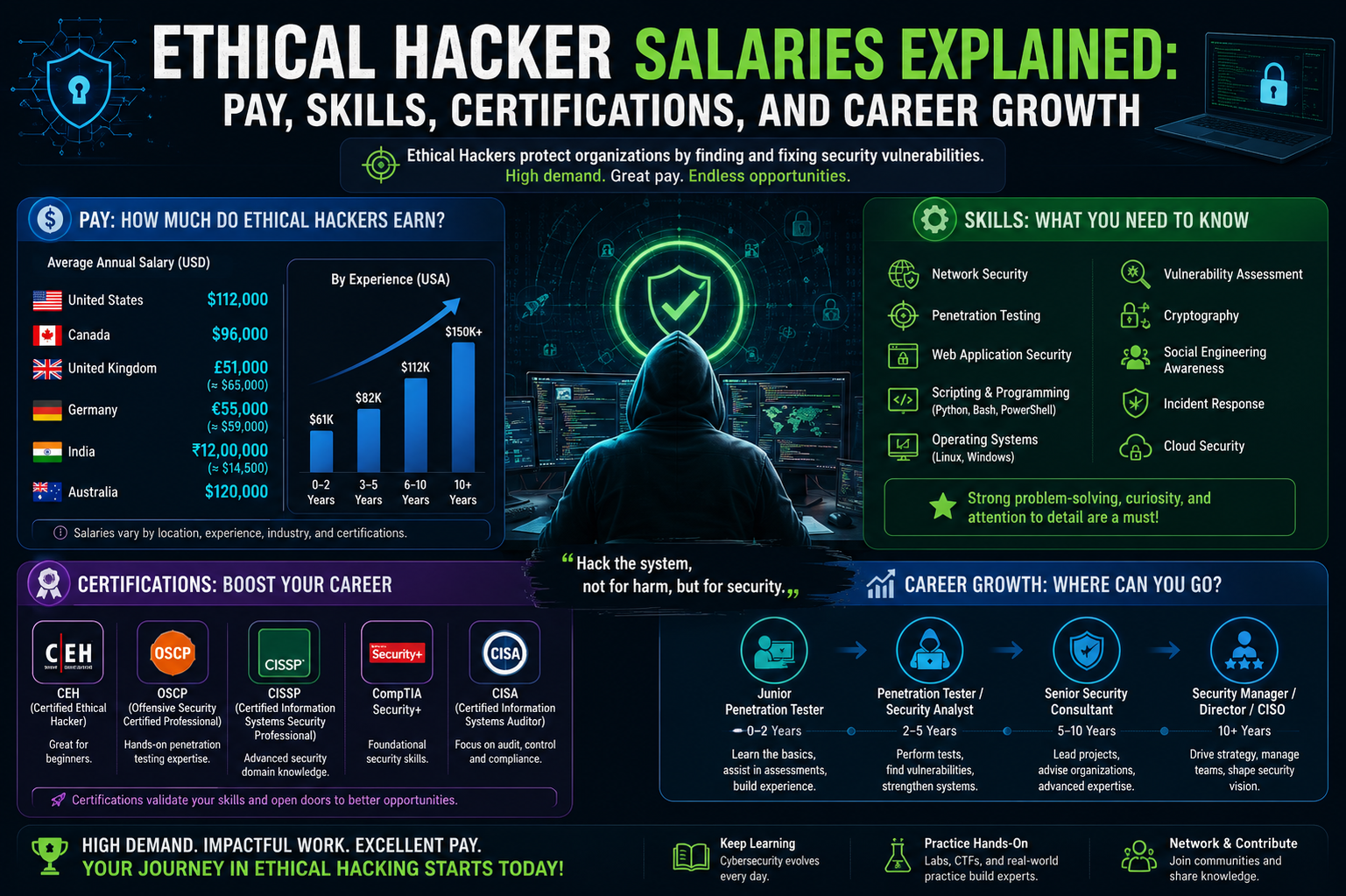
Cybersecurity has become one of the most important industries in the modern digital world. Businesses, governments, hospitals, financial institutions, and even small organizations depend heavily on technology every single day. As more systems move online and more sensitive information becomes digitally stored, cybercriminals continue searching for new ways to exploit weaknesses. This constant threat has created enormous demand for professionals capable of defending networks, applications, and infrastructure from attacks.
Among the most valuable professionals in this field are ethical hackers. These specialists use the same methods and mindset as malicious hackers, but instead of causing damage, they work to strengthen security. Ethical hackers intentionally search for vulnerabilities before cybercriminals can exploit them. Their work helps organizations reduce risks, improve security practices, and protect sensitive information from data breaches and ransomware attacks.
Because cyber threats continue growing in both sophistication and frequency, ethical hackers have become some of the highest-paid professionals in cybersecurity. Companies are willing to invest heavily in talent that can prevent devastating financial losses, reputation damage, and operational disruption. As a result, ethical hacker salaries have increased steadily across many industries and geographic locations.
Understanding why ethical hackers earn strong salaries requires looking beyond simple job titles. Ethical hacking is not just about breaking into systems for fun or testing passwords. It involves deep technical expertise, strategic thinking, advanced problem-solving skills, and the ability to understand how attackers operate in real-world environments.
An ethical hacker typically performs penetration testing, vulnerability assessments, security audits, and simulated attacks against networks or applications. The goal is to identify weaknesses before criminals discover them. Ethical hackers often work closely with system administrators, developers, compliance teams, and executives to improve organizational security.
The role requires an unusual combination of technical knowledge and creativity. Many cybersecurity jobs focus primarily on defense and monitoring, but ethical hackers must think offensively. They must anticipate attacker behavior, discover overlooked vulnerabilities, and understand how seemingly small weaknesses can be chained together into larger attacks.
This unique skill set is one of the reasons ethical hacking salaries continue to climb.
Another major factor influencing salary growth is the increasing financial impact of cybercrime. Modern cyberattacks can cost organizations millions of dollars through ransomware payments, downtime, regulatory fines, legal consequences, and reputational harm.
For example, a successful attack against a healthcare provider may disrupt patient services and expose sensitive medical records. An attack against a financial institution could compromise customer accounts or interrupt critical operations. Manufacturing companies may face production shutdowns if operational technology systems become infected.
Organizations understand that prevention is often far less expensive than recovery. Hiring experienced ethical hackers therefore becomes a strategic investment rather than just another IT expense.
Ethical hackers are also valuable because they help organizations meet compliance and regulatory requirements. Many industries must follow strict cybersecurity standards designed to protect sensitive information.
Financial institutions, healthcare organizations, government contractors, and cloud service providers frequently conduct penetration testing to demonstrate security readiness. Ethical hackers play a central role in these assessments.
As regulations become stricter worldwide, demand for offensive security professionals continues growing.
The rise of remote work has created another major reason for increased salaries.
When businesses rapidly expanded remote access infrastructure, attackers gained new opportunities to target organizations through weak home networks, misconfigured systems, phishing campaigns, and cloud vulnerabilities.
Companies realized they needed stronger security testing across distributed environments. Ethical hackers capable of identifying weaknesses in remote access systems became especially valuable.
Cloud computing has further expanded the need for ethical hacking expertise.
Modern businesses rely heavily on cloud platforms, virtual infrastructure, and software-as-a-service applications. While these technologies improve flexibility and scalability, they also introduce new security challenges.
Ethical hackers must now understand cloud environments, container security, identity management, API vulnerabilities, and hybrid infrastructure.
Professionals who specialize in cloud penetration testing often command higher salaries because their skills are in particularly high demand.
Application security has become another rapidly growing specialization.
Organizations increasingly depend on web applications and mobile platforms to deliver services to customers. Attackers frequently target these applications through vulnerabilities such as SQL injection, broken authentication, insecure APIs, and cross-site scripting.
Ethical hackers who specialize in web application security testing are highly sought after because application breaches can expose enormous amounts of customer data.
The growing importance of offensive security teams has also influenced salary trends.
In many organizations, ethical hackers no longer operate only as external consultants performing occasional assessments. Businesses now maintain dedicated internal red teams that continuously simulate attacks against company systems.
These red teams test incident response capabilities, employee awareness, detection systems, and infrastructure resilience.
Red team operations require advanced technical skills and strategic planning. Professionals working in these roles often earn significantly higher salaries than general cybersecurity analysts.
Location remains one of the biggest influences on ethical hacker compensation.
Major technology hubs typically offer the highest salaries because they compete aggressively for skilled cybersecurity professionals. Cities with large technology sectors, financial institutions, defense contractors, and cloud companies tend to pay premium salaries.
However, the rise of remote work has changed salary dynamics considerably.
In the past, professionals often needed to relocate to major cities to access high-paying cybersecurity jobs. Today, many companies hire remote ethical hackers from across the country or even internationally.
This shift has increased opportunities for skilled professionals living outside traditional technology hubs.
Remote work also allows companies to recruit from a larger talent pool. Because offensive security expertise remains relatively rare, employers are often willing to offer strong compensation packages regardless of location.
Experience level plays a major role in salary progression as well.
Entry-level ethical hackers usually begin by supporting senior penetration testers, performing vulnerability scans, documenting findings, and learning offensive tools.
These roles provide foundational experience with networking, operating systems, scripting, and security assessment methodologies.
As professionals gain hands-on experience, their responsibilities expand significantly.
Mid-level ethical hackers typically conduct full penetration tests independently, communicate findings to stakeholders, and recommend remediation strategies.
Senior professionals often lead complex red team operations, mentor junior staff, develop custom attack techniques, and advise executives on enterprise-wide security risks.
The jump in compensation between junior and senior levels can be substantial because experienced ethical hackers are difficult to replace.
Certifications also influence salary potential.
Many employers use certifications to evaluate technical competency, especially during hiring processes. Certifications demonstrate commitment to the field and validate knowledge in offensive security techniques.
Some certifications focus on foundational knowledge, while others require practical exploitation skills in controlled environments.
Hands-on certifications tend to carry particular weight because they demonstrate real-world problem-solving ability.
However, certifications alone rarely guarantee high salaries.
Employers generally prioritize practical experience, communication skills, and the ability to perform effectively during real assessments. Ethical hackers must often explain technical findings clearly to non-technical audiences.
A penetration test report may eventually reach executives, compliance officers, developers, and legal teams. Strong communication therefore becomes just as important as technical skill.
Another reason ethical hackers earn high salaries is the demanding nature of the work.
Offensive security requires continuous learning because threats evolve constantly. Attackers regularly develop new exploitation techniques, malware variants, phishing strategies, and bypass methods.
Ethical hackers must stay current with emerging vulnerabilities, security research, and evolving technologies.
This constant learning curve creates a barrier to entry that limits the number of truly skilled professionals.
Burnout can also affect offensive security careers.
Penetration testing and red team engagements often involve intense workloads, tight deadlines, and significant pressure. Ethical hackers may spend long hours researching vulnerabilities, writing reports, or troubleshooting complex exploitation chains.
Organizations therefore compete heavily to retain experienced talent.
Freelancing and consulting opportunities provide additional earning potential.
Some ethical hackers work independently, performing security assessments for multiple clients rather than joining a single employer. Experienced consultants may charge substantial fees for specialized testing services.
Bug bounty programs have also created alternative income streams.
Many organizations offer financial rewards to researchers who responsibly disclose vulnerabilities. Highly skilled ethical hackers sometimes earn significant income by discovering security flaws in applications and platforms.
However, consistent success in bug bounty programs requires advanced expertise and persistence.
The ethical hacking field continues expanding into new areas as technology evolves.
Internet of Things devices, industrial control systems, automotive platforms, smart infrastructure, and artificial intelligence applications all introduce new security challenges.
Organizations increasingly seek specialists capable of testing these emerging technologies.
As digital transformation accelerates worldwide, ethical hackers will likely remain in high demand for years to come.
Another interesting aspect of ethical hacking salaries is the diversity of job titles.
Professionals performing offensive security work may hold titles such as penetration tester, red team operator, offensive security engineer, security consultant, adversary emulation specialist, or application security engineer.
Although responsibilities vary, these roles often overlap significantly.
Salary differences may depend on specialization, industry, and organizational structure.
Government and defense sectors frequently offer high salaries for ethical hackers with security clearances.
Clearance requirements limit the available talent pool, making qualified professionals especially valuable.
Cleared offensive security specialists often support national security operations, critical infrastructure protection, and advanced threat simulation programs.
Financial institutions also pay premium salaries because they face constant targeting from cybercriminals.
Banks, payment processors, investment firms, and insurance companies rely heavily on ethical hackers to protect customer data and transaction systems.
Healthcare organizations increasingly invest in offensive security as well.
Medical records represent valuable targets for attackers, and hospitals depend on secure infrastructure for patient care systems.
Ethical hackers help identify weaknesses before attackers can disrupt operations or compromise sensitive data.
Technology companies remain among the largest employers of offensive security professionals.
Cloud providers, software vendors, e-commerce platforms, and social media companies continuously test their infrastructure against evolving threats.
These organizations often maintain advanced internal red teams and application security divisions.
One of the most appealing aspects of ethical hacking is the career flexibility it provides.
Professionals may move between consulting, enterprise security, cloud security, application testing, threat intelligence, and leadership roles throughout their careers.
The technical foundation built through offensive security work transfers effectively across many areas of cybersecurity.
For people considering cybersecurity careers, ethical hacking often represents an exciting path because it combines technical challenge, creative thinking, continuous learning, and strong earning potential.
The field rewards curiosity and persistence. Ethical hackers constantly investigate how systems work, how vulnerabilities emerge, and how attackers think.
This mindset makes the profession intellectually engaging while also financially rewarding.
As organizations continue facing growing cyber threats, the value of ethical hackers will likely keep increasing. Businesses understand that proactive security testing is essential for survival in a world where digital attacks can happen at any moment.
That reality is one of the biggest reasons ethical hacking has become one of the most respected and well-paid specialties in modern cybersecurity.
Ethical Hacker Salary Trends, Industries, and Career Growth
Ethical hacker salaries vary widely depending on several important factors. While technical skill remains the foundation of earning potential, compensation is also shaped by industry demand, geographic location, specialization, experience level, and the complexity of the work performed.
Cybersecurity has become a business-critical function rather than simply an IT responsibility. Organizations understand that a serious security breach can damage finances, reputation, customer trust, and operational stability. Because of this, companies increasingly compete for professionals capable of identifying vulnerabilities before attackers do.
This growing competition directly influences salary trends.
One of the strongest patterns in ethical hacker compensation is the relationship between location and pay.
Large technology hubs typically offer the highest salaries because they host major software companies, cloud providers, financial institutions, defense contractors, and startups.
These organizations compete aggressively for cybersecurity talent, driving compensation upward.
Cities with dense technology sectors usually provide both higher average salaries and higher salary ceilings.
However, higher compensation often reflects increased living costs as well.
A professional earning a large salary in a major metropolitan area may still face expensive housing, transportation, and daily expenses.
By comparison, ethical hackers working in smaller cities or lower-cost regions may enjoy greater purchasing power even with slightly lower salaries.
Remote work has changed this equation significantly.
Many organizations now hire ethical hackers remotely because offensive security work can often be performed from anywhere with secure access.
This shift has allowed skilled professionals living outside major tech centers to compete for higher-paying roles previously limited to large cities.
Some companies continue adjusting salaries based on employee location, while others offer standardized compensation regardless of geography.
The growing acceptance of remote cybersecurity teams has expanded career opportunities dramatically.
Industry choice also affects salary potential.
Financial services companies often pay some of the highest salaries in ethical hacking because they face constant attacks from cybercriminal groups.
Banks, payment platforms, trading firms, and insurance companies manage enormous amounts of sensitive financial information.
A successful attack against these systems can create devastating consequences.
As a result, financial organizations invest heavily in penetration testing, application security, and red team operations.
Healthcare is another rapidly growing sector for ethical hackers.
Hospitals, clinics, pharmaceutical companies, and healthcare technology providers store valuable medical data and depend heavily on reliable digital systems.
Cyberattacks targeting healthcare organizations have increased significantly in recent years.
Ransomware attacks against hospitals can interrupt patient care and create life-threatening situations.
Because of these risks, healthcare organizations increasingly hire offensive security specialists to identify vulnerabilities proactively.
Government agencies and defense contractors also represent major employers.
National security operations, military infrastructure, intelligence systems, and critical public services all require advanced cybersecurity protection.
Many government-related roles require security clearances, which often increase salary levels because relatively few professionals possess both offensive security expertise and clearance eligibility.
Technology companies remain central to the ethical hacking job market.
Cloud providers, software developers, e-commerce companies, and telecommunications firms continuously test their infrastructure for weaknesses.
Many large technology companies maintain dedicated internal red teams that perform simulated attacks against corporate systems.
These roles often involve sophisticated testing environments, advanced tooling, and large-scale infrastructure.
Because the work can be highly specialized, salaries tend to be strong.
Consulting firms offer another major career path.
Security consulting companies perform penetration testing and assessments for multiple clients across different industries.
Consultants may work on web application testing one week and internal network assessments the next.
This variety provides broad technical exposure and rapid skill development.
Consulting work can also involve travel, client communication, and tight reporting deadlines.
Experienced consultants often command excellent compensation because of their versatility.
Specialization increasingly affects salary growth within ethical hacking.
General penetration testing skills remain valuable, but specialists in high-demand areas often earn more.
Application security specialists, for example, focus heavily on testing web applications, APIs, and mobile platforms.
As businesses rely more on digital services, application vulnerabilities become especially dangerous.
Professionals skilled in identifying insecure authentication, injection flaws, business logic weaknesses, and cloud application misconfigurations are highly sought after.
Cloud penetration testing has emerged as another major specialization.
Modern infrastructure increasingly relies on cloud environments rather than traditional on-premises systems.
Cloud platforms introduce unique security challenges involving identity management, storage exposure, container security, and configuration errors.
Ethical hackers who understand cloud infrastructure deeply often receive premium compensation because demand exceeds available talent.
Industrial control systems and operational technology security represent another growing niche.
Manufacturing plants, energy facilities, transportation systems, and utilities rely on operational technology environments that historically lacked strong cybersecurity protections.
Testing these environments safely requires specialized expertise.
Professionals capable of assessing industrial systems often earn strong salaries because relatively few ethical hackers possess this knowledge.
Red team operations typically represent one of the highest-paying branches of offensive security.
Unlike standard penetration testing, which often focuses on identifying technical vulnerabilities, red team engagements simulate realistic adversary behavior.
Red teamers may combine phishing, social engineering, privilege escalation, persistence techniques, and physical security testing to evaluate organizational defenses comprehensively.
These engagements require creativity, advanced technical ability, and strategic planning.
Because of the complexity involved, experienced red team operators frequently earn top-tier salaries.
Experience level remains one of the biggest drivers of compensation growth.
Entry-level ethical hackers generally begin with supporting responsibilities. They may assist with vulnerability scanning, reconnaissance, documentation, and basic testing tasks.
During this stage, professionals build foundational knowledge of networking, Linux systems, Windows administration, scripting, and security methodologies.
Although salaries at this level are lower than senior roles, compensation is often still strong compared to many other technology careers.
Mid-level professionals usually gain independence quickly.
They conduct full penetration tests, communicate findings directly to clients or internal stakeholders, and recommend remediation strategies.
Many begin specializing in particular technologies or industries.
Salary increases during this phase can be substantial because hands-on experience dramatically improves practical effectiveness.
Senior ethical hackers often lead engagements, mentor junior team members, and design offensive testing strategies.
They may develop custom tools, discover advanced exploitation chains, or simulate sophisticated threat actor behavior.
Strong communication becomes especially important at this level because senior professionals frequently interact with executives, compliance teams, and leadership groups.
The combination of technical expertise and strategic thinking makes senior ethical hackers extremely valuable.
Management and leadership roles provide additional earning opportunities.
Some experienced professionals transition into offensive security leadership positions where they oversee red teams, penetration testing programs, or enterprise security strategy.
Although these roles may involve less hands-on hacking, they often offer higher compensation because of broader organizational responsibility.
Certifications influence salary discussions as well.
Employers frequently use certifications to evaluate candidates during hiring processes. Entry-level certifications demonstrate foundational knowledge, while advanced certifications validate hands-on offensive security skills.
Performance-based certifications tend to carry particular respect because they require practical exploitation ability rather than only theoretical knowledge.
However, certifications rarely replace real-world experience.
Employers generally prioritize candidates who can demonstrate practical success during technical interviews, labs, or previous engagements.
Hands-on ability matters significantly in offensive security.
Programming and automation skills increasingly affect compensation too.
Ethical hackers who can write scripts, automate testing tasks, and develop custom tools often stand out from competitors.
Python remains especially valuable because it is widely used for automation, exploit development, and security tooling.
PowerShell and Bash scripting are also important for interacting with Windows and Linux systems.
Automation helps ethical hackers scale their effectiveness across large environments.
Communication skills may seem less technical, but they strongly influence career growth.
A penetration test is only valuable if findings are clearly explained and actionable.
Ethical hackers must often present vulnerabilities to audiences with varying technical backgrounds.
Executives may care primarily about business risk, while developers focus on remediation details.
Professionals capable of translating technical issues into understandable business impact often advance more quickly.
Reputation within the cybersecurity community can also influence opportunities.
Some ethical hackers publish research, contribute to open-source tools, participate in security conferences, or discover vulnerabilities publicly.
These activities help build professional credibility and visibility.
A strong reputation can attract recruiters, consulting opportunities, and leadership roles.
Freelance penetration testing provides another income path.
Independent consultants may perform security assessments for multiple clients simultaneously. Experienced freelancers sometimes earn substantial income because organizations frequently require external testing for compliance or security validation.
However, freelancing also involves business development, client management, and inconsistent workloads.
Bug bounty programs represent a unique area within ethical hacking.
Organizations offer financial rewards to researchers who identify and responsibly disclose vulnerabilities.
Some researchers earn impressive income through bug bounty participation, particularly when discovering critical vulnerabilities.
However, bug bounty success requires persistence, deep technical skill, and significant time investment.
Not every researcher achieves consistent earnings.
Another factor influencing salaries is the global cybersecurity talent shortage.
Many organizations struggle to find experienced offensive security professionals. The learning curve for ethical hacking is steep, and practical expertise takes years to develop.
This shortage increases competition among employers.
Retention becomes a major challenge as well.
Organizations often offer salary increases, flexible schedules, remote work options, and professional development opportunities to keep experienced talent.
Cybersecurity burnout remains a concern across the industry.
Ethical hackers may work under pressure during high-priority assessments, incident response situations, or tight project deadlines.
Maintaining work-life balance becomes important for long-term career sustainability.
Despite the challenges, ethical hacking continues attracting professionals because it combines technical complexity, continuous learning, intellectual curiosity, and strong financial opportunity.
The field rewards persistence and adaptability.
As cyber threats continue evolving, ethical hackers will remain essential for protecting digital infrastructure across nearly every industry.
Organizations understand that proactive security testing is no longer optional. It is a necessary part of operating safely in a connected world.
That reality ensures ethical hacking will likely remain one of the most respected and financially rewarding areas within cybersecurity for years to come.
Skills, Tools, Certifications, and Long-Term Success in Ethical Hacking
Becoming a successful ethical hacker requires much more than simply learning how to use hacking tools. Offensive security professionals must build a strong foundation across networking, operating systems, scripting, security concepts, and problem-solving techniques. The field rewards curiosity, persistence, adaptability, and continuous learning.
Because cyber threats evolve constantly, ethical hackers must continually improve their skills to remain effective.
One of the first areas aspiring ethical hackers need to understand is networking.
Networks form the backbone of nearly every digital environment. Ethical hackers must understand how devices communicate, how protocols function, and how attackers exploit weaknesses in network infrastructure.
Knowledge of IP addressing, routing, switching, DNS, VPNs, wireless communication, firewalls, and network segmentation is essential.
Without strong networking fundamentals, offensive security work becomes much more difficult.
Operating systems represent another critical area.
Ethical hackers regularly interact with both Windows and Linux environments because most enterprise systems rely heavily on these platforms.
Linux knowledge is especially important because many security tools operate within Linux environments.
Understanding file permissions, system processes, services, scripting, and command-line operations helps ethical hackers navigate systems efficiently.
Windows expertise is equally valuable because many organizations depend on Active Directory environments for identity management and authentication.
Attackers frequently target Active Directory because compromising it can provide broad control across enterprise networks.
Ethical hackers therefore spend considerable time learning privilege escalation, credential attacks, misconfiguration exploitation, and lateral movement techniques within Windows infrastructure.
Programming and scripting skills greatly improve effectiveness.
While not every ethical hacker becomes a full-time software developer, the ability to write scripts and automate tasks provides major advantages.
Python remains one of the most widely used languages in offensive security because it is flexible and relatively easy to learn.
Ethical hackers use Python for automation, vulnerability scanning, exploit development, reconnaissance, and custom tooling.
Bash scripting helps automate tasks within Linux environments, while PowerShell is extremely valuable for Windows administration and post-exploitation activity.
Automation allows ethical hackers to handle repetitive tasks more efficiently and focus on deeper analysis.
Web application security has become one of the most important specialties within ethical hacking.
Modern businesses depend heavily on web-based platforms and cloud applications. Attackers frequently target web applications because vulnerabilities can expose customer data, authentication systems, and financial information.
Ethical hackers studying application security learn concepts such as session management, authentication flaws, insecure APIs, SQL injection, cross-site scripting, server-side request forgery, and access control weaknesses.
Testing web applications requires both technical skill and creative thinking because vulnerabilities often emerge through unexpected combinations of behavior.
Cloud security knowledge continues growing in importance.
Many organizations now operate hybrid or fully cloud-based infrastructure. Ethical hackers therefore need to understand identity management, storage permissions, virtual networking, container security, and cloud service configurations.
Misconfigured cloud environments have caused numerous major data breaches in recent years.
Professionals capable of identifying cloud vulnerabilities are highly valued because cloud infrastructure can become extremely complex.
Mobile security represents another growing area.
Smartphones and mobile applications now store enormous amounts of sensitive information. Ethical hackers performing mobile testing analyze application permissions, authentication systems, encryption behavior, and communication patterns.
Both Android and iOS environments present unique security considerations.
Wireless security skills remain relevant as well.
Wi-Fi networks continue serving as common attack targets in homes, businesses, and public spaces. Ethical hackers may test wireless encryption, rogue access points, client isolation weaknesses, and network segmentation.
Understanding wireless protocols and attack techniques helps organizations secure their environments more effectively.
Social engineering awareness is another important component of ethical hacking.
Many successful cyberattacks rely more on manipulating people than exploiting technology.
Phishing emails, fake login pages, impersonation attempts, and deceptive phone calls remain extremely effective attack methods.
Ethical hackers participating in red team operations may simulate phishing campaigns to test employee awareness and organizational defenses.
Understanding human behavior therefore becomes surprisingly valuable.
The tools used by ethical hackers vary depending on the engagement.
One of the most widely recognized offensive security platforms is Kali Linux, a specialized operating system containing numerous penetration testing tools.
Kali Linux includes utilities for reconnaissance, exploitation, password attacks, wireless testing, reverse engineering, and digital forensics.
Many professionals use Kali as their primary testing environment.
Metasploit remains one of the most popular exploitation frameworks.
It allows ethical hackers to test vulnerabilities, develop payloads, and simulate attacks within controlled environments.
Although real-world penetration testing involves far more than automated exploitation, Metasploit remains an important tool for demonstrating impact.
Nmap is another essential utility.
Ethical hackers use Nmap to scan networks, identify active devices, detect open ports, and gather service information.
Reconnaissance forms the foundation of many assessments because understanding the target environment helps guide further testing.
Burp Suite has become especially important for web application security testing.
It allows ethical hackers to intercept traffic, manipulate requests, analyze sessions, and identify vulnerabilities in web applications.
Application security professionals often spend significant time working with tools like Burp during assessments.
Password security testing tools also play major roles.
Ethical hackers may analyze password policies, authentication weaknesses, and credential exposure risks using specialized utilities.
Organizations rely heavily on passwords and identity systems, making credential security a common attack target.
Packet analysis tools help ethical hackers understand network traffic.
By examining packets directly, professionals can identify insecure communication, authentication weaknesses, exposed data, and protocol misconfigurations.
Traffic analysis remains an important skill across many types of security assessments.
Custom tooling increasingly distinguishes advanced professionals.
Experienced ethical hackers often develop their own scripts, scanners, and automation frameworks tailored to specific testing scenarios.
This ability demonstrates deeper technical understanding and improves efficiency during complex engagements.
Certifications remain important within ethical hacking careers because they help validate knowledge and practical ability.
Entry-level certifications usually focus on foundational cybersecurity concepts and basic offensive techniques.
These certifications help newcomers understand terminology, methodologies, and common attack patterns.
Intermediate certifications typically emphasize practical penetration testing skills.
Professionals may need to perform reconnaissance, exploit vulnerabilities, escalate privileges, and document findings within controlled environments.
Hands-on testing environments provide more realistic demonstrations of ability than multiple-choice examinations alone.
Advanced certifications often focus on specialized areas such as red teaming, cloud security, web application testing, or Active Directory exploitation.
These certifications can help professionals move into higher-paying and more specialized roles.
However, real-world experience remains critical.
Many employers value practical problem-solving ability more than certification counts. Ethical hacking involves creativity and adaptability because no two environments are exactly alike.
Professionals therefore build expertise through hands-on practice, lab environments, capture-the-flag competitions, and real assessments.
Continuous learning is essential because cybersecurity changes rapidly.
New vulnerabilities, attack techniques, malware families, and defensive technologies emerge constantly.
Ethical hackers regularly study security research, vulnerability disclosures, and industry developments to remain effective.
Many professionals spend personal time experimenting with labs, researching attack methods, or analyzing real-world incidents.
The learning process never truly ends.
Communication skills strongly influence long-term success.
Ethical hackers must explain technical findings clearly and responsibly.
A poorly written penetration test report may confuse stakeholders or fail to communicate business risk properly.
Professionals capable of producing clear documentation and presenting findings effectively often advance more quickly.
Teamwork also matters.
Ethical hackers frequently collaborate with developers, administrators, compliance teams, and executives.
Strong interpersonal skills help build trust and improve remediation outcomes.
Organizations value professionals who can identify problems while also helping teams improve security practices constructively.
Time management becomes important as careers progress.
Penetration tests often involve deadlines, reporting requirements, and simultaneous projects.
Experienced ethical hackers learn how to prioritize findings, organize workflows, and balance deep technical analysis with project expectations.
Career growth within ethical hacking can follow many different paths.
Some professionals remain highly technical specialists focused on advanced offensive operations. Others transition into leadership roles managing red teams or enterprise security programs.
Some move into application security engineering, threat intelligence, cloud architecture, or incident response.
The skills developed through ethical hacking provide strong foundations across cybersecurity.
Freelance consulting offers another path.
Independent consultants may perform penetration testing, security reviews, or adversary simulation work for multiple clients.
Consulting can provide strong earning potential and project variety, though it also involves client acquisition and business management responsibilities.
Bug bounty research attracts many ethical hackers as well.
Researchers identify vulnerabilities in applications or infrastructure and report them responsibly in exchange for financial rewards.
Some researchers specialize heavily in bug bounty hunting and develop strong reputations within the security community.
Reputation can significantly affect career opportunities.
Professionals who publish research, contribute to security tools, discover vulnerabilities, or speak publicly about cybersecurity topics often gain visibility within the industry.
A respected reputation can lead to consulting invitations, leadership roles, and specialized opportunities.
Despite the strong salaries and exciting technical challenges, ethical hacking can also be demanding.
The constant learning curve, high expectations, and fast-changing threat landscape require persistence and adaptability.
Burnout can occur if professionals fail to maintain healthy balance.
Successful ethical hackers therefore focus not only on technical growth but also on sustainable career development.
The future of ethical hacking remains extremely promising.
Artificial intelligence, cloud computing, Internet of Things devices, industrial systems, and smart infrastructure continue expanding the digital attack surface.
Organizations will increasingly need skilled professionals capable of thinking like attackers while protecting critical systems.
As technology evolves, ethical hackers will continue playing a central role in modern cybersecurity.
Their work helps organizations identify weaknesses, strengthen defenses, and reduce risk before attackers strike.
That combination of technical challenge, strategic importance, and strong career opportunity is one of the reasons ethical hacking continues attracting so much attention worldwide.
Future Trends and Opportunities in Ethical Hacking Careers
The world of ethical hacking is evolving rapidly as technology becomes more advanced and cyber threats grow increasingly sophisticated. Organizations today face constant pressure to secure their systems, protect customer information, and defend critical infrastructure from attackers who continuously develop new tactics. Because of this changing landscape, ethical hackers are no longer viewed as optional security specialists. They are becoming essential members of modern cybersecurity teams across nearly every industry.
One of the biggest trends shaping the future of ethical hacking is the expansion of cloud computing. Businesses are moving applications, databases, and entire infrastructures into cloud environments at an incredible pace. While cloud platforms offer flexibility and scalability, they also introduce new security risks related to identity management, storage exposure, misconfigured permissions, and insecure APIs. Ethical hackers who understand cloud technologies are becoming extremely valuable because organizations need experts capable of testing these environments before attackers exploit weaknesses.
Cloud-focused ethical hackers often work with complex hybrid systems that combine traditional on-premises infrastructure with public and private cloud services. This requires a broad understanding of networking, virtualization, containers, and access control systems. Professionals with strong cloud penetration testing skills are expected to remain in high demand for many years, especially as more companies continue migrating critical operations online.
Artificial intelligence is another major factor transforming ethical hacking careers. AI-powered security systems are becoming more common in threat detection and automated defense. At the same time, cybercriminals are also beginning to use artificial intelligence to automate attacks, improve phishing campaigns, and identify vulnerabilities more quickly.
As offensive and defensive technologies become smarter, ethical hackers must adapt by learning how AI impacts cybersecurity operations. Some professionals already use machine learning tools to analyze attack patterns, automate reconnaissance tasks, and improve vulnerability discovery processes. Ethical hackers who understand both cybersecurity and AI technologies may gain a significant advantage in the future job market.
The growth of Internet of Things devices has also created enormous opportunities in offensive security. Smart devices now exist everywhere, including homes, hospitals, factories, transportation systems, and city infrastructure. Security cameras, industrial sensors, smart appliances, and connected medical devices all create additional attack surfaces for cybercriminals.
Unfortunately, many IoT devices are released with weak security protections. Some contain default passwords, outdated firmware, or insecure communication protocols. Ethical hackers help organizations identify these weaknesses before attackers can exploit them. As smart technology continues expanding worldwide, specialists in IoT security testing are expected to become increasingly important.
Critical infrastructure protection is another rapidly growing area for ethical hackers. Power grids, transportation systems, water treatment facilities, and manufacturing plants all rely heavily on digital systems to operate safely. Attacks against these systems could cause serious economic disruption or even threaten public safety.
Governments and private organizations are therefore investing heavily in cybersecurity defenses for industrial environments. Ethical hackers capable of testing operational technology systems are in especially high demand because these environments require specialized knowledge. Unlike traditional office networks, industrial systems often involve legacy equipment, safety considerations, and real-time operational constraints.
Remote work has permanently changed cybersecurity hiring trends as well. Many organizations now operate with distributed teams and remote infrastructure, creating additional security challenges involving VPNs, cloud collaboration tools, endpoint security, and identity management. Ethical hackers increasingly test remote work environments to identify weaknesses that attackers could exploit.
At the same time, remote work has expanded career opportunities for ethical hackers themselves. Professionals are no longer limited to jobs in major technology cities. Many companies now hire remote penetration testers, red team operators, and offensive security consultants from anywhere in the world. This flexibility allows skilled professionals to access higher-paying opportunities without relocating.
Specialization is becoming increasingly important in ethical hacking careers. In the past, general penetration testing skills may have been enough to stand out. Today, many organizations seek professionals with expertise in areas such as cloud security, web application testing, mobile security, malware analysis, digital forensics, or adversary emulation.
Ethical hackers who develop niche expertise often command higher salaries because their skills are harder to replace. For example, professionals specializing in Active Directory exploitation or cloud identity security are particularly valuable in enterprise environments where attackers frequently target authentication systems.
Soft skills are also becoming more important as cybersecurity teams collaborate more closely with business leadership. Ethical hackers are expected not only to identify vulnerabilities but also to explain business risks clearly and help organizations improve their overall security posture. Communication, reporting, and strategic thinking therefore play a major role in long-term career advancement.
Many experienced ethical hackers eventually move into leadership positions, security architecture roles, or consulting careers. Others continue focusing on highly technical research and offensive operations. The flexibility of the field allows professionals to shape careers around their interests and strengths.
Conclusion
Ethical hacking has become one of the most important and respected areas within modern cybersecurity. As organizations continue expanding their digital operations, the need for skilled professionals who can identify vulnerabilities before cybercriminals exploit them has grown dramatically. Ethical hackers play a critical role in protecting businesses, governments, healthcare systems, financial institutions, and individuals from increasingly sophisticated cyber threats.
One of the biggest reasons ethical hacking careers continue attracting attention is the strong combination of technical challenge and financial opportunity. Ethical hackers are trusted to think like attackers while working to strengthen defenses and reduce security risks. This unique responsibility makes their skills highly valuable across many industries. Companies understand that proactive security testing can prevent costly data breaches, operational disruptions, and reputational damage, which is why experienced ethical hackers often earn impressive salaries.
The field also offers exceptional career flexibility. Professionals can specialize in areas such as cloud security, application testing, wireless security, red teaming, industrial systems, or mobile security depending on their interests and strengths. As technology continues evolving, new opportunities constantly emerge for ethical hackers willing to learn and adapt. The rapid growth of cloud computing, artificial intelligence, Internet of Things devices, and remote infrastructure ensures that offensive security expertise will remain in high demand for years to come.
However, success in ethical hacking requires more than simply learning a few tools or earning certifications. The profession demands continuous learning, persistence, creativity, and strong problem-solving skills. Ethical hackers must understand networking, operating systems, scripting, security architecture, and attacker behavior while also developing communication and reporting abilities. Organizations value professionals who can explain complex technical findings clearly and help improve security strategies effectively.
Another major advantage of ethical hacking is the opportunity for long-term career growth. Entry-level professionals can gradually advance into senior penetration testing roles, red team leadership, consulting, security research, or enterprise security management. The knowledge gained through offensive security work also creates pathways into many other cybersecurity specialties.
As cyber threats continue growing in scale and complexity, ethical hackers will remain essential to modern digital security. Their ability to uncover weaknesses before attackers strike helps organizations operate more safely in an increasingly connected world. For people interested in technology, cybersecurity, and continuous learning, ethical hacking offers a career path that combines intellectual challenge, strong earning potential, and meaningful real-world impact.