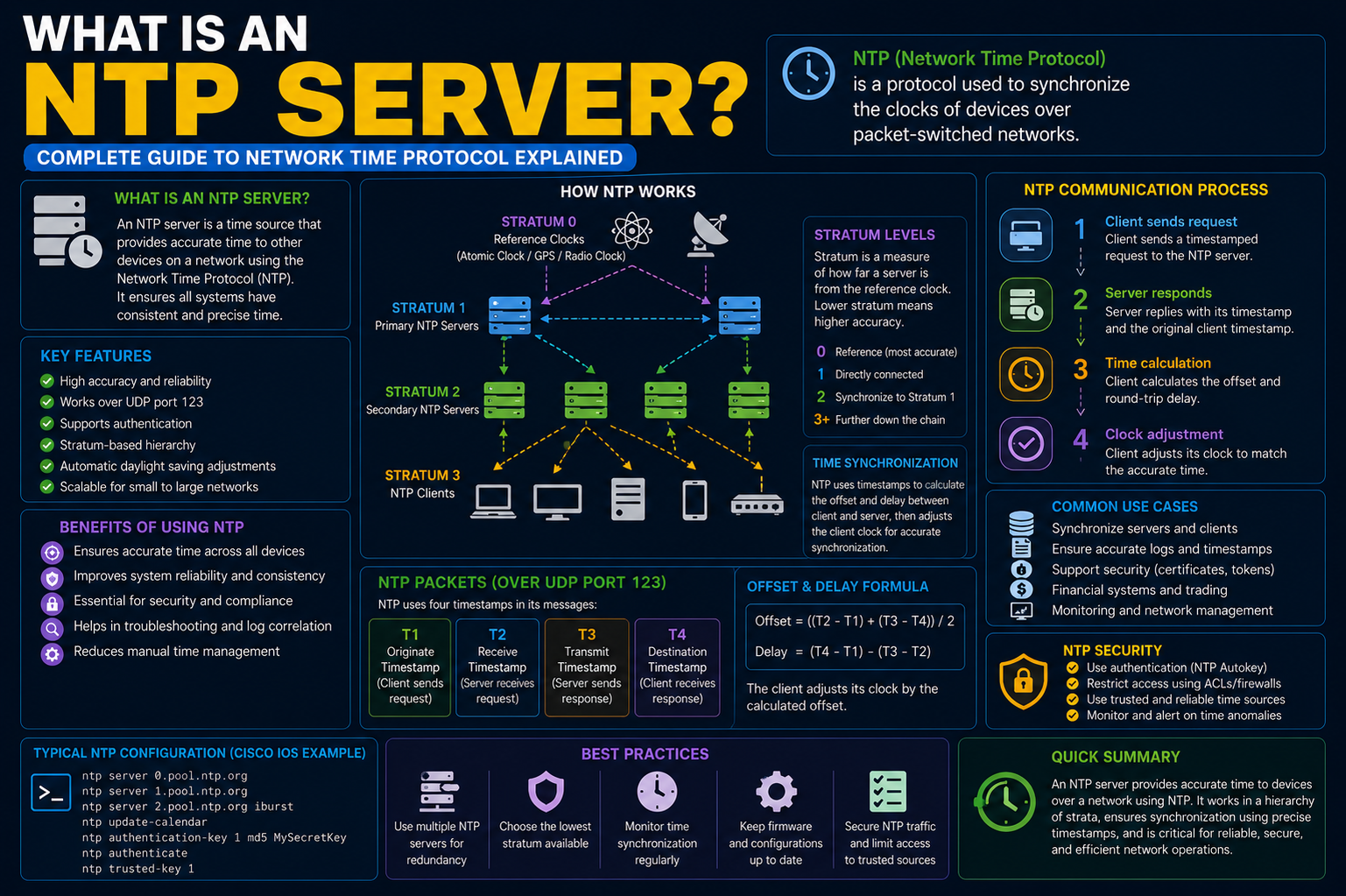
In modern computing environments, time is far more important than it may appear at first glance. Every digital activity, from sending an email to processing financial transactions, depends on accurate and synchronized timekeeping. Without consistent time across systems, networks would quickly become unreliable, logs would lose meaning, and critical processes would fail to coordinate properly. This is where the concept of an NTP (Network Time Protocol) server becomes essential.
An NTP server is a specialized system designed to provide accurate time to devices across a network. Instead of each device relying on its own internal clock—which can drift and become inaccurate over time—systems synchronize their time with a trusted external source. This ensures that every device within a network operates using the same reference time, creating consistency across all operations.
The importance of this synchronization becomes clearer when considering how computers function. Every action performed on a system is timestamped. These timestamps are used for logging events, tracking changes, coordinating distributed systems, and ensuring security protocols function correctly. If even small differences in system time occur across devices, it can lead to confusion, errors, and inconsistencies in data interpretation.
NTP servers solve this problem by acting as authoritative time sources. They obtain highly accurate time information from reliable references, often linked to atomic clocks or GPS-based timing systems. Once they receive this precise time, they distribute it to other devices within the network. This process ensures that all connected systems remain aligned, regardless of their individual internal clock variations.
The concept of synchronization is not limited to large enterprises or complex infrastructures. Even simple home networks benefit from consistent timekeeping. Devices such as computers, smartphones, routers, and smart appliances rely on accurate time for scheduling updates, maintaining security certificates, and managing communication between systems.
Without an NTP server or equivalent time synchronization system, devices would gradually drift apart in terms of time accuracy. Each system’s internal clock naturally deviates slightly over time due to hardware limitations. While these differences may seem minor at first, they can accumulate and eventually cause noticeable discrepancies between devices.
NTP servers act as stabilizing points in this environment. They continuously correct these small differences by sending updated time information to connected devices. This constant adjustment ensures that all systems remain aligned within a very small margin of error.
The architecture of NTP is built around reliability and scalability. It is designed to function in both small and extremely large networks. Whether synchronizing a handful of devices or millions of systems across global infrastructures, NTP maintains consistent performance. This adaptability is one of the reasons it has remained a core part of networking systems for decades.
Another important aspect of NTP servers is their ability to operate in hierarchical structures. Not all time sources are equal in terms of accuracy. Some servers are closer to the original time reference, while others rely on intermediate layers. This layered structure allows time to be distributed efficiently without overwhelming primary sources.
In practical terms, an NTP server does more than simply provide the current time. It ensures that time is meaningful within a system. When all devices share the same reference, events can be accurately ordered, logs can be properly analyzed, and system behavior can be reliably understood.
This becomes especially important in environments where multiple systems interact continuously. For example, distributed applications, database systems, and cloud services all rely heavily on synchronized time to function correctly. Even a small mismatch in system clocks can lead to data conflicts or operational errors.
The role of an NTP server is therefore foundational rather than optional in modern networking. It quietly ensures that time remains consistent across all devices, allowing complex systems to function smoothly without visible disruption to users.
The Evolution of Network Time Protocol and the Development of Time Synchronization Systems
The need for accurate timekeeping in computer networks did not emerge overnight. It developed gradually as digital systems became more interconnected and complex. In the early stages of computing, individual machines operated mostly in isolation. Each system maintained its own internal clock, and minor differences in time were rarely considered a problem. However, as networks expanded and communication between systems became more frequent, the importance of synchronized time became increasingly clear.
The early internet era highlighted the limitations of unsynchronized systems. As more devices began exchanging data, inconsistencies in system time started to cause confusion in logging, data processing, and communication tracking. Events recorded on different machines could appear out of order, making it difficult to understand what actually happened in a sequence of operations. This issue became especially problematic in environments where precision mattered, such as scientific computing and financial systems.
To address these challenges, the Network Time Protocol began to take shape in the mid-1980s. Its initial purpose was relatively simple: provide a way for computers to agree on a common time reference over a network. Early versions of the protocol focused on basic synchronization between systems, but they lacked the advanced precision and scalability required for growing global networks.
As internet usage expanded rapidly in the 1990s, the limitations of early time synchronization methods became more apparent. Networks were no longer small or isolated. Instead, they spanned organizations, countries, and eventually continents. In this environment, even small time discrepancies could lead to significant operational problems.
This led to the evolution of more advanced versions of NTP, designed to handle large-scale distributed systems. One of the key developments during this period was the introduction of a hierarchical structure known as stratum levels. This system helped organize time sources based on their accuracy and distance from the original reference clock.
At the top of this hierarchy are highly precise time sources that are directly connected to atomic clocks or GPS-based systems. These are considered the most accurate references available. As time information moves down through the hierarchy, it passes through multiple layers of servers, each slightly less precise than the one above it but still synchronized within acceptable limits.
This structured approach allowed NTP to scale efficiently while maintaining accuracy. Instead of relying on a single central time server for the entire internet, the system distributes time across multiple levels. This reduces load, improves reliability, and ensures that time synchronization can be maintained even if individual servers become unavailable.
Another major advancement in the evolution of NTP was the improvement of error correction techniques. Network communication is not instantaneous, and delays can affect the accuracy of time measurements. To address this, NTP began incorporating algorithms that account for network latency. These algorithms estimate the delay between sending and receiving time information, allowing the system to adjust calculations and improve precision.
Over time, NTP became more than just a simple synchronization tool. It evolved into a highly sophisticated protocol capable of supporting complex global infrastructures. Modern versions of NTP are designed to operate in environments where milliseconds—or even microseconds—of accuracy can be critical.
The development of NTP also reflects a broader trend in computing: the shift from isolated systems to interconnected ecosystems. As digital systems became more dependent on each other, the need for coordination increased. Time synchronization became a foundational requirement rather than an optional feature.
Today, NTP continues to evolve alongside modern technology. While the core principles remain the same, improvements in network speed, processing power, and infrastructure design have allowed for even more precise and reliable synchronization. Despite these advancements, the fundamental challenge remains unchanged: ensuring that all systems in a network agree on a single, consistent sense of time.
This ongoing evolution demonstrates how essential time synchronization has become in digital environments. What began as a simple solution for small networks has grown into a global system that supports everything from cloud computing to critical infrastructure operations.
How NTP Servers Work and How Time is Distributed Across Networks
At the core of every NTP system is a structured method of distributing accurate time from reliable sources to ordinary network devices. Although the process appears seamless to users, behind the scenes it involves carefully coordinated communication between servers and clients to ensure that every system remains synchronized within a very small margin of error.
An NTP server begins its role by obtaining time from highly accurate reference sources. These sources are typically extremely precise systems such as atomic clocks or GPS-based timing receivers. These reference systems are considered the foundation of global timekeeping because they are stable, consistent, and not influenced by local system variations.
Once the NTP server receives this precise time, it does not simply broadcast it without control. Instead, it participates in a structured hierarchy where time is distributed gradually through multiple levels. This hierarchy is essential for scalability because it prevents a single source from being overwhelmed by millions of requests at once.
In this structure, time sources are organized into what is known as stratum levels. The lowest stratum level represents the most accurate time sources, while higher levels represent servers that receive time from other servers. As time moves down the hierarchy, it is continuously refined and adjusted to maintain accuracy.
When a device, known as an NTP client, needs to synchronize its clock, it sends a request to an NTP server. The server responds by providing time information along with additional data that helps the client calculate differences between its own clock and the reference time. This exchange is not a simple one-way transfer. It involves multiple measurements to account for delays caused by network transmission.
One of the key challenges in time synchronization is network latency. Data does not travel instantly between devices, and even small delays can affect accuracy. To overcome this, NTP uses a process that measures round-trip time. The client records when a request is sent and when a response is received, allowing it to estimate the delay and adjust its internal clock accordingly.
This correction process ensures that the final synchronized time is as accurate as possible, even when network conditions are not perfect. Over time, repeated synchronization events help keep the client’s clock closely aligned with the server’s reference time.
NTP servers do not continuously push time updates to clients in most cases. Instead, clients periodically request updates based on configured intervals. These intervals can vary depending on system requirements, network conditions, and desired accuracy levels. Shorter intervals provide higher precision but generate more network traffic, while longer intervals reduce traffic but may slightly reduce accuracy.
As multiple clients connect to NTP servers, the system distributes load efficiently. Instead of relying on a single central server, networks often use multiple NTP servers to provide redundancy and balance traffic. This ensures that even if one server becomes unavailable, clients can still obtain accurate time from alternative sources.
Another important aspect of NTP operation is its ability to gradually adjust time rather than making sudden changes. If a device’s clock is significantly out of sync, NTP does not immediately reset it to the correct time. Instead, it slowly corrects the difference over a period of time. This prevents disruptions in applications that rely on continuous timing, such as logging systems or transactional processes.
In complex networks, multiple layers of NTP servers may exist. Local servers may synchronize with regional servers, which in turn synchronize with higher-level sources. This layered approach helps reduce network congestion and improves overall efficiency while maintaining accuracy across all connected systems.
Security also plays an important role in how NTP servers operate. Since time data is critical for system operations, ensuring that it comes from trusted sources is essential. Many systems implement validation mechanisms to verify that time information has not been tampered with during transmission.
The entire NTP process is designed to be continuous and self-correcting. Devices constantly adjust their clocks based on updated information, ensuring that time remains consistent even as network conditions change. This ongoing synchronization process is what allows modern distributed systems to function reliably across different locations and environments.
In essence, NTP servers act as intermediaries between highly accurate time sources and everyday computing devices, ensuring that time flows consistently and accurately throughout the entire network structure.
NTP Client Behavior, Synchronization Modes, and Network Communication Patterns
In a Network Time Protocol system, the NTP server is only one side of the equation. The other essential component is the NTP client, which is responsible for receiving time information and adjusting its own system clock accordingly. Understanding how clients behave in a networked environment helps explain why time synchronization remains stable even in large and complex systems.
An NTP client is any device that requests time updates from an NTP server. This can include computers, routers, servers, virtual machines, and even embedded systems. Each client operates independently, but follows a consistent process when communicating with time servers.
When an NTP client starts, it does not immediately assume that its internal clock is correct. Instead, it initiates communication with one or more NTP servers to obtain reference time. This communication is typically done through a structured exchange of messages that allow both sides to measure timing differences and network delays.
Unlike simple data requests, NTP communication is designed to be precise. The client records the exact time a request is sent, and the server responds with time information along with its own timestamp. When the response is received, the client calculates the difference between its local clock and the server’s reference time. This calculation also accounts for the time it took for the message to travel across the network.
This process is important because network delays are never perfectly consistent. Even small variations in transmission time can affect accuracy. By analyzing multiple timestamps, the client is able to estimate the true time offset and correct its clock with high precision.
NTP clients can operate in different communication modes depending on the network environment and configuration. One common mode is direct communication with a single server, where the client sends requests to a specific time source. This approach provides clear and controlled synchronization and is often used in secure or sensitive environments.
In larger networks, clients may communicate with multiple servers at the same time. This allows them to compare responses and choose the most accurate or reliable time source. By using multiple references, clients reduce the risk of relying on a single incorrect or delayed response.
Another behavior of NTP clients is their adaptive polling mechanism. Instead of requesting time updates at fixed intervals regardless of conditions, many clients adjust their request frequency based on network stability and clock accuracy. If the system clock is stable and closely aligned with the server, the client reduces the frequency of updates. If greater deviation is detected, the client increases synchronization activity.
This adaptive behavior helps balance accuracy with network efficiency. It prevents unnecessary traffic while ensuring that time remains accurate enough for system requirements.
NTP clients also handle gradual clock correction. If a system clock is slightly fast or slow, the client does not abruptly change it. Instead, it makes small incremental adjustments over time. This prevents sudden jumps in system time, which could disrupt applications that depend on continuous timing sequences.
In environments where multiple systems depend on each other, this gradual adjustment is especially important. Sudden changes in time could cause inconsistencies in logs, data processing errors, or synchronization failures between distributed services.
Communication patterns between NTP clients and servers are designed to be lightweight. Messages are small and efficient, allowing thousands of devices to synchronize time without overwhelming network resources. This efficiency is one of the reasons NTP has remained widely used in both small and large-scale systems.
Security considerations also influence client behavior. Since time accuracy is critical for authentication systems, encryption protocols, and system logging, NTP clients must ensure that they are communicating with trusted servers. Some systems implement verification mechanisms to confirm that time responses are legitimate and have not been altered during transmission.
In distributed environments, NTP clients often rely on redundancy. Instead of connecting to a single server, they are configured with multiple time sources. This ensures that if one server becomes unavailable or unreliable, the client can continue synchronizing with alternative sources without interruption.
Another important aspect of client behavior is stability during network disruptions. If a client temporarily loses connection to NTP servers, it does not immediately lose time accuracy. Instead, it continues using its last known synchronization state while attempting to reconnect. Once communication is restored, it gradually corrects any drift that occurred during the interruption.
This resilience is critical in maintaining system stability, especially in environments where continuous operation is required. It ensures that short-term network issues do not immediately affect system-wide time consistency.
Overall, NTP clients play an active and intelligent role in time synchronization. They do not simply receive time data; they analyze, compare, adjust, and continuously refine their internal clocks based on multiple inputs and changing network conditions.
Accuracy, Time Correction Mechanisms, and the Algorithms Behind NTP
Precise timekeeping across computer networks requires more than simply requesting the current time from a server. Even if a server provides extremely accurate time, network delays, clock drift, and processing latency can introduce errors. To overcome these challenges, the Network Time Protocol relies on a series of sophisticated mechanisms and algorithms designed to measure, calculate, and correct time differences with remarkable precision.
Every computer system contains an internal clock that measures time based on hardware oscillators. These oscillators generate a consistent signal that the system interprets as seconds, milliseconds, and smaller units of time. Although they are generally reliable, they are not perfect. Environmental factors such as temperature changes, electrical variations, and hardware limitations can cause clocks to run slightly faster or slower than the actual reference time.
Over time, these small deviations accumulate and cause clock drift. A system that drifts even a few milliseconds every hour can eventually become seconds or minutes out of sync with the correct time. In isolated systems this might not be a major problem, but in networked environments such inaccuracies can cause serious issues.
This is where NTP plays a critical role. The protocol is designed not only to distribute time but also to correct clock drift gradually and maintain long-term synchronization. To accomplish this, NTP measures the relationship between a client clock and a reference clock using carefully timed message exchanges.
When a client contacts an NTP server, several timestamps are recorded during the communication process. These timestamps represent the moment the client sends a request, the time the server receives the request, the time the server sends its response, and the moment the client receives the reply. By comparing these values, the client can calculate two important metrics: the round-trip delay and the clock offset.
Round-trip delay measures how long it took for the request and response messages to travel between the client and the server. Clock offset represents the estimated difference between the client’s local time and the server’s reference time. By combining these measurements, the client can estimate the correct adjustment required to align its clock with the server.
However, not all time measurements are equally reliable. Network conditions can fluctuate, introducing temporary delays or irregularities in message delivery. If the client relied on a single measurement, it could produce inaccurate adjustments. To avoid this, NTP collects multiple samples over time and evaluates them using statistical filtering methods.
These filtering mechanisms help identify the most reliable time measurements while discarding those affected by network congestion or temporary anomalies. The client then selects the most accurate estimate from the collected data and uses it to correct its clock.
Another key component of NTP accuracy is the clock discipline algorithm. This algorithm determines how the system clock should be adjusted to match the reference time. Instead of immediately jumping to the new time value, the algorithm typically modifies the clock frequency slightly so that the system gradually converges toward the correct time.
This process is often referred to as clock slewing. During slewing, the system clock continues moving forward but at a slightly faster or slower rate until the correct time alignment is achieved. This method avoids abrupt time jumps that could disrupt time-sensitive applications.
In situations where the clock offset is extremely large, a direct adjustment may be required. However, most modern NTP implementations attempt to avoid sudden time corrections unless absolutely necessary. Maintaining continuity in time progression is important for software processes, databases, and distributed computing systems.
Another important algorithm used in NTP systems is the selection algorithm. When a client communicates with multiple NTP servers, it must determine which servers are providing trustworthy and accurate time information. Not all servers will necessarily agree on the exact time, and some responses may contain errors due to network delays or misconfigured systems.
The selection algorithm compares responses from multiple servers and eliminates those that appear inconsistent with the majority. This helps protect the client from relying on faulty or malicious time sources. By narrowing the selection to the most consistent servers, the client increases its confidence in the final time calculation.
Once reliable sources are identified, the clustering algorithm refines the selection further. It evaluates the remaining servers based on accuracy, stability, and network delay. The goal is to choose the most dependable combination of time sources for synchronization.
These algorithms work together to create a highly resilient system for time correction. Even when individual servers experience temporary delays or inconsistencies, the client can continue maintaining accurate time by relying on the most reliable measurements available.
The precision achieved by NTP is impressive considering the unpredictability of network communication. Under typical conditions, synchronization accuracy on a local network can reach within a few milliseconds. In optimized environments with stable connections, accuracy may improve even further.
Across larger networks such as the public internet, accuracy may vary slightly due to longer transmission paths and fluctuating latency. However, the protocol’s filtering and correction algorithms ensure that time remains sufficiently precise for most computing applications.
The ability to maintain accurate time across distributed systems has enormous practical importance. Logging systems rely on consistent timestamps to track events in the correct order. Authentication systems depend on synchronized clocks to validate security tokens. Databases and financial systems require precise timing to prevent data inconsistencies.
Without reliable time synchronization, even simple tasks such as file transfers, automated scheduling, and system monitoring could become unreliable. NTP ensures that these processes operate smoothly by providing a common time reference across the entire network.
As networks continue to expand in scale and complexity, the demand for accurate and stable timekeeping will only increase. The algorithms behind NTP demonstrate how careful engineering and mathematical analysis can solve one of the most fundamental challenges in distributed computing: keeping time consistent everywhere at once.
In the next section, the discussion will move toward operational practices, reliability strategies, and long-term maintenance considerations that ensure NTP systems remain dependable in modern network infrastructures.
Maintaining Reliable Time Infrastructure and Long-Term Stability in NTP Systems
Reliable time synchronization is not achieved simply by installing an NTP service and connecting devices to a time server. In real-world networks, maintaining accurate and consistent time requires careful planning, monitoring, and ongoing maintenance. As networks grow larger and more complex, the stability of the time infrastructure becomes increasingly important. Organizations depend on synchronized clocks for security systems, application coordination, transaction processing, logging, and system diagnostics. Because of this, maintaining a dependable NTP environment is an essential responsibility for network administrators.
A well-designed time infrastructure begins with selecting appropriate time sources. These sources serve as the foundation for the entire synchronization system. High-quality reference clocks, such as GPS receivers or atomic clock sources, provide the most accurate time signals. In many organizations, dedicated time servers connected to these reference clocks act as the primary sources for the internal network. These servers distribute time updates to secondary servers and client devices throughout the organization.
This layered structure allows the network to maintain accurate time while preventing excessive load on the primary reference sources. Instead of every device directly contacting a high-precision clock, a small number of trusted servers handle the distribution of time information. This approach reduces network congestion and improves reliability by spreading synchronization responsibilities across multiple systems.
Redundancy is another important factor in maintaining a stable time environment. Relying on a single time server creates a point of failure. If that server becomes unavailable due to hardware issues, network outages, or configuration errors, client devices may lose synchronization. Over time, their clocks will begin drifting away from the correct time reference.
To avoid this situation, networks typically deploy multiple NTP servers. Clients are configured to communicate with several servers simultaneously. When multiple sources are available, the client software can compare responses and select the most reliable time information. If one server fails or becomes unreachable, the client continues synchronizing with the remaining servers without disruption.
Geographic distribution of time servers also improves resilience. In large organizations with multiple locations, placing time servers in different regions helps reduce latency and network dependency. Local clients can synchronize with nearby servers, minimizing communication delays while still maintaining consistency with the global reference time.
Monitoring the health of the NTP infrastructure is equally important. Time synchronization may appear stable for long periods, but small problems can gradually develop if systems are not regularly checked. Network administrators often monitor synchronization status using system logs, diagnostic tools, or centralized monitoring platforms.
These monitoring systems track metrics such as time offset, synchronization status, server reachability, and network delay. When unusual patterns appear—such as large time differences or failed synchronization attempts—administrators can investigate the underlying cause before it affects network operations.
Clock drift is a natural phenomenon that affects every computer system. Even when devices are synchronized regularly, internal oscillators may slowly drift away from the correct time between updates. Continuous monitoring ensures that drift remains within acceptable limits and that synchronization mechanisms continue working as expected.
Another critical aspect of maintaining a reliable time infrastructure is consistent configuration across devices. When different systems use inconsistent settings, synchronization behavior may vary from one device to another. Some systems might poll servers too frequently, generating unnecessary network traffic, while others may update too rarely, allowing significant clock drift.
Standardizing NTP configurations across all devices helps maintain uniform behavior throughout the network. Consistent polling intervals, trusted server lists, and synchronization parameters ensure that every device participates in the timing system in the same predictable way.
Security considerations also play a role in maintaining long-term stability. Because accurate time is essential for authentication systems and encrypted communications, attackers may attempt to manipulate time synchronization processes. A compromised time source could potentially disrupt security mechanisms or create inconsistencies in event logs.
To reduce these risks, administrators often restrict which systems are allowed to serve time within the network. Only trusted servers are authorized to provide synchronization data, while client devices are configured to ignore unknown sources. Some environments also implement authentication mechanisms to verify that time updates originate from legitimate servers.
Another maintenance practice involves keeping NTP software updated. Like any network protocol implementation, NTP software evolves over time to improve performance, fix vulnerabilities, and enhance compatibility with modern systems. Applying updates ensures that the synchronization system remains secure and efficient.
In addition to routine maintenance, administrators sometimes perform periodic audits of the time infrastructure. During these audits, synchronization accuracy is measured across multiple devices to confirm that clocks remain aligned with the expected reference time. These checks help identify subtle configuration problems that may not be immediately obvious during normal operation.
As computing environments expand to include cloud systems, virtual machines, and distributed services, time synchronization becomes even more important. Virtualized systems may experience unique timing challenges because their clocks depend on both hardware and software layers. Proper integration between virtualization platforms and NTP services ensures that these systems remain synchronized with the broader network.
Distributed applications also rely heavily on synchronized time. In large-scale systems where tasks are executed across multiple servers, consistent timestamps allow processes to coordinate effectively. Without synchronized clocks, events might appear to occur out of order, making debugging and performance analysis far more difficult.
Time synchronization also supports reliable data management. Backup systems, replication services, and database transactions depend on consistent timestamps to maintain accurate records. When clocks differ across systems, determining the sequence of events becomes complicated, potentially leading to data inconsistencies.
Because of these dependencies, the NTP infrastructure often operates quietly in the background while supporting countless critical processes. Users rarely notice its presence, yet nearly every aspect of network operation depends on its accuracy.
The long-term reliability of NTP systems comes from careful design, redundancy, monitoring, and consistent management. By establishing trusted time sources, maintaining multiple synchronization paths, and regularly verifying system performance, organizations ensure that their networks remain synchronized regardless of scale or complexity.
As technology continues evolving, the need for precise and dependable timekeeping will remain fundamental. From simple personal devices to massive distributed infrastructures, synchronized clocks enable digital systems to operate in harmony. Through thoughtful implementation and diligent maintenance, NTP continues to provide the stable time foundation thatBelow is your additional Part 6 content with clear topic-style headings added, while keeping the paragraph structure and blog style you requested.
Diverse Devices and Time Synchronization in Modern Networks
In addition to monitoring synchronization status and maintaining redundancy, organizations must also consider how time synchronization interacts with different types of devices connected to modern networks. Today’s infrastructure rarely consists of only desktop computers and servers. Instead, networks include mobile devices, virtual machines, embedded systems, industrial controllers, and a wide range of smart devices. Each of these systems may handle time synchronization slightly differently, which means administrators must ensure that all devices are compatible with the organization’s time infrastructure.
Mobile devices and laptops, for example, frequently move between different networks. When these devices disconnect from a network and reconnect later, their internal clocks may drift from the correct time reference. Once the device reconnects to the network, the NTP client automatically attempts to synchronize with a configured server to restore accuracy. This automatic adjustment ensures that devices remain aligned with network time even after extended periods offline.
Synchronization Challenges in Embedded Systems
Embedded systems present a different challenge. Many embedded devices used in industrial environments, monitoring equipment, or security systems rely on accurate time to record events and perform scheduled operations. However, some of these devices may have limited processing power or simplified operating systems. Because of these limitations, their NTP implementations may be less sophisticated than those found in full operating systems. Careful configuration and testing are necessary to ensure that these systems synchronize correctly and consistently.
Time Management in Virtualized Environments
Virtualization technology introduces additional considerations for time synchronization. Virtual machines operate on top of physical hardware but rely on a hypervisor to manage system resources. This abstraction layer can sometimes affect how system clocks behave. If a virtual machine depends solely on its virtual hardware clock, timing inconsistencies may occur when system resources are heavily utilized or when the host machine experiences changes in workload.
To maintain accuracy in these environments, many administrators configure virtual machines to synchronize time through NTP while also coordinating with the host system. This dual approach helps prevent time drift and ensures that virtual environments remain consistent with the broader network time reference.
Time Synchronization in Cloud Infrastructure
Cloud computing environments further expand the complexity of time synchronization. Large cloud infrastructures consist of thousands of servers distributed across multiple geographic regions. Even minor timing inconsistencies can cause issues when systems coordinate tasks or process transactions across different locations. NTP helps ensure that these distributed systems maintain a consistent understanding of time regardless of physical distance.
Impact of Network Conditions on Time Accuracy
Another aspect of maintaining reliable time synchronization involves understanding how network conditions influence timing accuracy. Because NTP relies on network communication, factors such as latency, packet loss, and congestion can affect the precision of time updates. Although the protocol includes mechanisms to compensate for these conditions, extremely unstable network connections may still introduce timing variations.
To address this challenge, administrators often select time servers that are geographically close to the client devices or located within the same network infrastructure. Shorter communication paths reduce the potential for delay and improve synchronization accuracy. When multiple servers are available, NTP clients evaluate the responses they receive and select the most stable and reliable time source.
Energy Efficiency and Clock Adjustments
Energy-efficient computing practices also interact with time synchronization. Many modern systems use power-saving features that temporarily suspend certain system processes when devices are idle. When a system wakes from a low-power state, its internal clock may require adjustment. NTP clients automatically resynchronize with their servers after these transitions, ensuring that the device quickly returns to accurate timekeeping.
System Updates and Configuration Consistency
Network administrators must also consider how software updates and system changes affect synchronization. Operating system upgrades, configuration modifications, or hardware replacements can sometimes alter time-related settings. After any major system change, it is important to verify that the NTP client remains correctly configured and continues communicating with the appropriate servers.
Importance of Documentation in Time Infrastructure
Documentation plays an important role in long-term NTP management. Clear documentation of time server locations, configuration parameters, synchronization policies, and maintenance procedures ensures that the system can be maintained effectively even as staff members change or network environments evolve. Well-documented configurations also simplify troubleshooting when synchronization issues arise.
Building Administrator Awareness and Expertise
Training and awareness are equally valuable in maintaining reliable time infrastructure. Many network problems that appear unrelated to time synchronization may actually originate from clock discrepancies. Administrators who understand how NTP operates are better equipped to recognize these issues and resolve them quickly.
Supporting Compliance and Accurate Event Logging
Another important consideration is how time synchronization supports compliance and auditing requirements. Many industries require precise event logging to meet regulatory standards. Accurate timestamps allow organizations to reconstruct events, verify transactions, and demonstrate compliance with operational policies. Without synchronized time, these records may become unreliable or difficult to interpret.
Conclusion
Accurate timekeeping is a fundamental requirement for modern computer networks, and the Network Time Protocol plays a critical role in maintaining that accuracy across countless devices. From small home networks to vast enterprise infrastructures, synchronized time ensures that systems operate smoothly and data remains consistent. Without a reliable mechanism for keeping clocks aligned, even simple digital activities could become complicated, leading to errors in communication, logging, and system coordination.
NTP servers act as trusted time sources that distribute precise timing information to client devices throughout a network. By obtaining their time from highly accurate references such as atomic clocks or satellite-based systems, these servers provide a dependable standard that other devices can follow. Through a hierarchical structure of time sources and servers, NTP allows networks of any size to maintain consistent time without overwhelming a single system. This structured design ensures that accurate time can be delivered efficiently and reliably across both local and global networks.
Another important strength of NTP lies in its ability to adjust for network delays and variations in communication. Since data traveling across a network may experience slight delays, NTP uses intelligent algorithms to measure these delays and calculate the most accurate possible time adjustment. This process allows devices to gradually correct their clocks instead of making sudden changes that could disrupt system processes. As a result, synchronization remains stable and dependable even when networks experience fluctuations in latency.
Time synchronization also plays an essential role in maintaining security and operational integrity. Many authentication systems, encryption protocols, and security logs rely heavily on accurate timestamps. When systems share the same time reference, administrators can trace events, detect suspicious activity, and maintain reliable records of network operations. Accurate time also supports the proper functioning of distributed systems where multiple machines must coordinate tasks or share resources.
Beyond security and system coordination, synchronized time improves the reliability of many everyday computing tasks. Log files, backups, scheduled jobs, and automated services all depend on precise timestamps to operate correctly. Without synchronized clocks, troubleshooting problems or analyzing system behavior would become far more difficult.
Ultimately, the Network Time Protocol serves as an invisible yet essential component of digital infrastructure. By ensuring that devices across a network maintain a consistent and reliable sense of time, NTP helps create a stable foundation for communication, security, and efficient system management in the connected world.