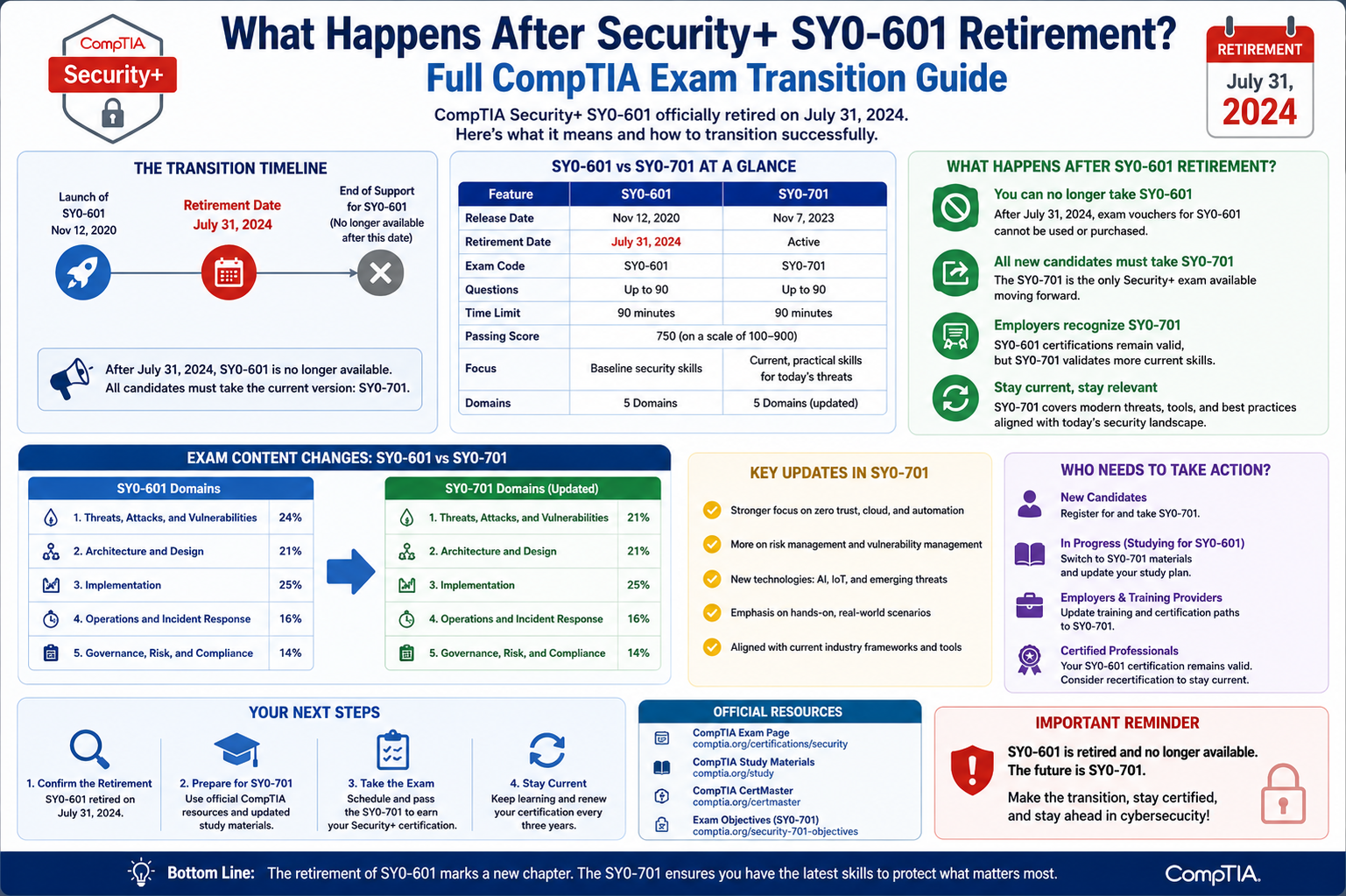
The world of cybersecurity certifications is constantly evolving, and few credentials reflect that evolution as clearly as CompTIA’s Security+ certification. For more than two decades, this certification has been one of the most recognized entry points into cybersecurity careers. It has earned this reputation not because it is easy, but because it consistently adapts to match real-world security demands.
Security+ is designed to validate foundational cybersecurity knowledge in a way that is both vendor-neutral and industry-relevant. That means it does not focus on a single technology provider or platform. Instead, it covers broad concepts that apply across different environments, tools, and security systems. This makes it especially valuable for professionals who want flexibility in their career paths.
Over time, however, cybersecurity itself has changed dramatically. Threats have become more advanced, infrastructure has become more complex, and organizations now rely heavily on cloud computing, remote access, and hybrid environments. Because of these changes, certification exams cannot remain static. They must evolve to stay relevant.
This is where exam version updates come into the picture. Security+ is periodically revised to reflect new skills, technologies, and security practices. Older versions are eventually retired, and new versions take their place. This cycle ensures that certified professionals are always aligned with current industry expectations rather than outdated knowledge.
The transition from one version of the Security+ exam to another is not just a minor update. It is a structured shift in how cybersecurity knowledge is defined and measured. When a version like SY0-601 reaches the end of its lifecycle, it signals that the industry has moved forward enough to justify a new standard.
The retirement of SY0-601 is part of this ongoing evolution. It represents the end of one phase of certification and the beginning of another, where updated concepts and modern security challenges take priority. Understanding this transition requires looking at both the purpose of the certification and the environment it is designed to reflect.
The Role of Security+ in Cybersecurity Careers
Security+ has long been considered a foundational certification in cybersecurity. It is often one of the first major credentials pursued by individuals entering the field. The reason for this is simple: it covers a wide range of essential security concepts without requiring prior specialization.
The certification validates knowledge in areas such as network security, threat management, risk concepts, identity and access management, and incident response. These topics form the backbone of most cybersecurity roles, regardless of industry or job title.
Unlike advanced certifications that focus on specific tools or deep technical expertise, Security+ is designed to ensure that professionals understand how different parts of a security ecosystem work together. This includes understanding how attacks occur, how systems are protected, and how organizations respond when incidents happen.
Because of this broad scope, Security+ has become a common requirement for entry-level cybersecurity positions. Employers often use it as a benchmark to evaluate whether candidates have the baseline knowledge needed to work in security-related roles.
Why Certification Exams Have Lifecycles
Every professional certification operates within a lifecycle. This lifecycle includes development, release, adoption, maintenance, and eventual retirement. The reason for this cycle is simple: technology does not stand still.
When a certification exam is first created, it reflects the state of the industry at that time. However, as years pass, new technologies emerge, new threats are discovered, and new practices become standard. If the exam does not change, it quickly becomes outdated.
To prevent this, certification bodies regularly review and update exam objectives. This ensures that the skills being tested match what professionals actually need in real-world environments. When updates become significant enough, a new version of the exam is released.
Older versions are not immediately removed. Instead, they are kept available for a limited time to allow candidates who are already preparing to complete their certification. Eventually, however, they are retired completely to make way for the updated version.
This structured retirement process ensures fairness while maintaining relevance. It gives learners time to adjust while also ensuring that the certification remains aligned with modern industry standards.
The Transition From SY0-601 to SY0-701
The transition from SY0-601 to SY0-701 reflects a broader shift in cybersecurity priorities. While both versions cover foundational security knowledge, the newer version places greater emphasis on modern infrastructure, evolving threats, and dynamic security environments.
SY0-601 was developed during a period when traditional network security models were still widely dominant. At that time, many organizations relied heavily on on-premises infrastructure, with clearly defined internal and external boundaries. Security strategies were often centered around protecting a fixed perimeter.
However, this model has changed significantly. Organizations now operate in hybrid environments that combine on-premises systems with cloud platforms and remote access technologies. This shift has blurred traditional security boundaries and introduced new challenges.
SY0-701 reflects this reality by placing greater emphasis on securing distributed environments. Instead of focusing primarily on static network protection, it incorporates concepts that address mobility, cloud integration, and continuous monitoring.
This does not mean that older concepts are no longer relevant. Traditional security principles still form the foundation of cybersecurity knowledge. However, they are now applied in more complex and dynamic environments.
Why Updates to Security+ Matter for Professionals
For individuals pursuing cybersecurity careers, updates to certifications like Security+ are more than just administrative changes. They directly impact how knowledge is evaluated and what skills are considered essential.
When a new version is released, it often introduces updated terminology, revised topic priorities, and new areas of focus. This means that professionals preparing for the exam must adjust their study approach to align with the updated expectations.
At the same time, these updates also reflect real-world changes in job requirements. Employers are increasingly looking for candidates who understand modern security challenges, including cloud environments, automation, and evolving threat landscapes.
As a result, updated certifications often provide better alignment with job market demands. They help ensure that certified professionals are not only knowledgeable but also relevant in current security roles.
The Expanding Scope of Cybersecurity Knowledge
One of the most noticeable trends in cybersecurity certification updates is the expanding scope of required knowledge. In earlier versions of Security+, the focus was primarily on traditional network security concepts. Over time, however, the scope has broadened significantly.
Modern cybersecurity professionals are expected to understand a wide range of topics, including cloud security, identity management, threat intelligence, and regulatory compliance. They must also be familiar with how different systems interact across hybrid environments.
This expansion reflects the reality of modern IT infrastructure. Systems are no longer isolated or contained within a single network. Instead, they are distributed across multiple platforms, often spanning on-premises infrastructure, cloud services, and remote endpoints.
Security+ updates are designed to reflect this complexity. Each new version incorporates additional concepts that align with how organizations actually operate today.
The Importance of Staying Current in Cybersecurity
Cybersecurity is one of the few fields where staying current is not optional. Threats evolve continuously, and defensive strategies must evolve alongside them. This makes ongoing learning and certification updates a critical part of professional development.
When certifications like Security+ are updated, they provide a structured way to ensure that professionals remain aligned with industry expectations. They serve as a benchmark for current knowledge rather than static historical understanding.
The retirement of older exam versions is part of this process. It ensures that the certification continues to represent current skills rather than outdated practices. While this may require additional effort from candidates, it ultimately strengthens the value of the certification itself.
Setting the Stage for the Transition
The retirement of SY0-601 marks an important transition point in the evolution of Security+. It signals a shift toward more modern cybersecurity concepts and a greater emphasis on dynamic, real-world environments.
Understanding this transition is essential for anyone involved in cybersecurity training or certification planning. It is not simply about choosing between two exam versions. It is about understanding how the field itself is changing and how professional standards evolve to reflect those changes.
As the cybersecurity landscape continues to expand, certifications like Security+ will continue to adapt. Each new version builds on the foundation of the previous one while introducing updates that reflect current realities in technology and security practice.
Breaking Down SY0-601 vs SY0-701 and the Shift in Exam Focus
The transition from SY0-601 to SY0-701 represents more than a routine update in exam numbering. It reflects a meaningful shift in how cybersecurity knowledge is structured, prioritized, and applied in real-world environments. While both versions of Security+ are built on the same foundational purpose—validating core cybersecurity skills—the way those skills are organized and emphasized has changed significantly.
To understand this shift properly, it is important to look beyond surface-level differences and examine how the exam framework itself has been redesigned. The change is not just about new topics being added; it is about rethinking what modern cybersecurity professionals need to know in order to operate effectively in today’s environments.
A Change in Structural Philosophy
One of the most noticeable differences between SY0-601 and SY0-701 is the structure of the exam domains. SY0-601 was organized around a more traditional cybersecurity model that closely followed established security functions such as architecture, implementation, operations, and governance.
This structure reflected a time when cybersecurity roles were more compartmentalized. Responsibilities were often divided into clear technical areas, and systems were generally more predictable in how they operated.
SY0-701 introduces a more integrated approach. Instead of separating topics strictly by function, it organizes knowledge around broader operational and strategic themes. This reflects the reality that modern cybersecurity roles often require professionals to move fluidly between technical tasks, risk evaluation, and incident response.
The shift in structure signals a change in mindset. Rather than viewing cybersecurity as a set of isolated domains, SY0-701 treats it as a connected ecosystem where decisions in one area directly influence outcomes in another.
Evolution of Domain Emphasis
In SY0-601, the exam domains were distributed in a way that heavily emphasized implementation and architecture. These areas focused on how systems are built and secured at a technical level. While these skills remain important, their relative weight has been adjusted in SY0-701.
The newer exam places increased emphasis on security operations and ongoing management. This reflects the reality that cybersecurity is no longer just about building secure systems—it is also about continuously monitoring, responding, and adapting to threats.
Security operations now take a central role in SY0-701. This includes incident detection, response workflows, monitoring systems, and continuous improvement of security posture. The increased weighting of this area reflects how critical real-time response has become in modern security environments.
Another notable shift is the increased focus on security program management and oversight. This area emphasizes governance, compliance, and strategic alignment of security practices with organizational goals. It shows that cybersecurity professionals are expected not only to understand technical controls but also to contribute to broader organizational security planning.
The Growing Importance of Threats and Mitigations
Both SY0-601 and SY0-701 cover threats, vulnerabilities, and attacks, but the depth and framing of this topic have evolved. In SY0-601, threats were primarily categorized and studied as individual concepts, often focusing on recognition and basic response strategies.
SY0-701 expands this area by emphasizing mitigation strategies and contextual understanding. Instead of simply identifying threats, candidates are expected to understand how threats evolve, how they are mitigated in real environments, and how different defensive layers interact.
This shift reflects the increasing complexity of cyber threats. Modern attacks are rarely isolated events. They often involve multiple stages, including reconnaissance, exploitation, persistence, and data exfiltration. Understanding this lifecycle is essential for effective defense.
As a result, SY0-701 places greater emphasis on how security controls work together to prevent, detect, and respond to threats across their entire lifecycle.
Increased Focus on Security Architecture in Modern Environments
Security architecture remains an important part of both exam versions, but SY0-701 expands its relevance by incorporating modern infrastructure models. In SY0-601, architecture concepts were largely centered around traditional network environments with clear internal and external boundaries.
SY0-701 reflects a more modern reality where systems are distributed across cloud platforms, on-premises infrastructure, and hybrid environments. This requires a broader understanding of how security controls are applied across different layers of infrastructure.
The updated focus includes how systems are designed to remain secure even when they are no longer confined to a single physical network. This includes understanding identity-based security, segmentation strategies, and the role of continuous verification in distributed systems.
This architectural shift highlights the move away from perimeter-based security models toward more dynamic and adaptive security frameworks.
The Rise of Operational Security as a Core Skill
One of the most significant changes in SY0-701 is the elevation of operational security as a central domain. While SY0-601 included operations and incident response, SY0-701 integrates these concepts more deeply into the overall structure of the exam.
Operational security now includes continuous monitoring, threat detection, response coordination, and system hardening practices. It reflects the reality that cybersecurity is not a one-time setup process but an ongoing cycle of observation, analysis, and adjustment.
This change emphasizes the importance of real-time awareness. Security professionals are expected to understand how to interpret alerts, respond to incidents, and adjust defenses based on evolving conditions.
It also highlights the importance of automation and efficiency in modern security operations. As environments become more complex, manual processes alone are no longer sufficient to manage security at scale.
Governance and Compliance as Strategic Priorities
Another major shift in SY0-701 is the increased emphasis on governance, risk, and compliance. While these topics were present in SY0-601, they now play a more integrated role in the overall exam structure.
This reflects a broader industry trend where cybersecurity is closely tied to regulatory requirements, organizational policies, and risk management frameworks. Security decisions are no longer purely technical; they must also align with legal and organizational standards.
SY0-701 places greater importance on understanding how policies are created, how risk is assessed, and how compliance requirements influence security decisions. This includes understanding documentation, reporting structures, and the relationship between security controls and business objectives.
This shift acknowledges that cybersecurity professionals are increasingly expected to operate at the intersection of technical implementation and organizational governance.
The Impact of Modern Threat Landscapes on Exam Design
The evolution from SY0-601 to SY0-701 is also driven by changes in the global threat landscape. Cyberattacks have become more sophisticated, more automated, and more targeted. Attackers now use advanced techniques that combine multiple methods to bypass traditional defenses.
As a result, certification exams must reflect these changes. SY0-701 incorporates updated knowledge areas that address modern attack techniques, including cloud-based threats, identity-based attacks, and automated exploitation methods.
It also places greater emphasis on understanding how threats operate in hybrid environments, where systems are distributed across multiple platforms and networks. This requires a more holistic understanding of security rather than a purely technical one.
Shifts in Skill Expectations for Entry-Level Professionals
One of the subtle but important changes in SY0-701 is the increased baseline expectation for entry-level professionals. While Security+ has always been considered an entry-level certification, the scope of knowledge required has gradually expanded.
SY0-701 assumes a stronger foundational understanding of networking, system behavior, and security concepts. This does not mean the exam is inaccessible, but it does mean that candidates are expected to be more prepared before attempting it.
This shift reflects industry demand. Employers now expect even entry-level cybersecurity professionals to understand complex environments and respond to evolving threats with greater confidence.
A More Integrated View of Cybersecurity Knowledge
Perhaps the most important difference between SY0-601 and SY0-701 is the shift toward integration. Instead of treating cybersecurity topics as separate categories, SY0-701 presents them as interconnected components of a unified system.
Threats, architecture, operations, and governance are no longer isolated areas of study. They are interconnected parts of a continuous security process. Decisions in one area influence outcomes in another, and professionals are expected to understand these relationships.
This integrated approach better reflects how cybersecurity works in practice. Security is not a checklist of tasks but an ongoing balance of risk, control, and response.
Setting the Context for Certification Decisions
Understanding the differences between SY0-601 and SY0-701 is essential for anyone deciding which version of the exam to pursue. The transition is not simply about timing but about aligning with the direction in which the cybersecurity industry is moving.
SY0-601 represents an earlier framework that is still relevant but increasingly aligned with traditional infrastructure models. SY0-701 represents a more modern approach that reflects current technologies, threats, and operational realities.
As the industry continues to evolve, these updates ensure that the certification remains meaningful and aligned with real-world expectations.
SY0-601 Retirement Timeline and How It Shapes Your Certification Strategy
When a certification exam is scheduled for retirement, it creates a very practical concern for learners: timing. In the case of SY0-601, the retirement date is not just a technical detail—it directly affects how candidates plan their study path, allocate their preparation time, and decide which version of the Security+ exam they should attempt.
Understanding this timeline is important because certification preparation is not only about learning content. It is also about aligning your study progress with the availability of the exam itself. Once an exam version is retired, it is no longer available, and any preparation for it becomes unusable in a formal certification context.
What Exam Retirement Actually Means
Exam retirement does not happen suddenly without warning. Instead, it is part of a structured lifecycle that ensures fairness for candidates already preparing. When an exam like SY0-601 reaches its retirement phase, it remains available for a defined period before being fully discontinued.
During this window, candidates can still register for and take the exam as usual. However, once the final date passes, the exam is permanently removed and replaced by the newer version, in this case SY0-701.
This transition period is designed to prevent disruption for learners who have already invested time in studying. It ensures that preparation efforts are not wasted, while still allowing the certification body to move forward with updated content.
However, this overlap period also creates a decision point. Candidates must choose whether to continue with the older exam or shift focus to the newer version.
The Importance of Timing in Exam Preparation
Timing plays a critical role in certification success. Unlike casual learning, exam preparation is structured around specific objectives and deadlines. If a candidate starts preparing too late for a retiring exam, they may not have enough time to study, practice, and schedule the test before it is removed.
On the other hand, starting too early without considering the transition can lead to another issue: studying outdated material. If a learner begins preparing for SY0-601 too close to its retirement, they may find themselves forced to switch to SY0-701 mid-preparation, which can disrupt learning continuity.
This is why timing decisions are not just administrative—they directly affect learning efficiency and exam readiness.
Choosing Between SY0-601 and SY0-701 During Transition
During any certification transition, candidates typically fall into one of two categories. The first group includes those who are already deep into their SY0-601 preparation. The second group includes those who are just beginning their cybersecurity journey.
For candidates already well into their study process, continuing with SY0-601 may still be practical if there is enough time before the retirement deadline. However, this depends heavily on how far along they are and how confident they feel in completing the exam requirements within the remaining timeframe.
For new learners, the situation is different. Starting with a retiring exam often introduces unnecessary risk. New candidates must learn all required material and reach exam readiness before the cutoff date, which may not always be realistic depending on their schedule and experience level.
Because of this, many learners find it more practical to focus directly on the newer exam version, SY0-701, especially if they are at the beginning of their preparation journey.
Study Duration and Realistic Preparation Windows
One of the most important factors in deciding between exam versions is the amount of time required for preparation. Security+ is not a lightweight certification. It covers a wide range of cybersecurity topics, and most candidates require structured study over an extended period.
Preparation time varies significantly depending on prior experience, study consistency, and familiarity with networking and security concepts. Some learners may be able to prepare in a shorter timeframe, while others may need several months to feel confident.
This variability becomes especially important during an exam transition period. If a candidate underestimates the time required, they may find themselves unable to complete SY0-601 before its retirement, forcing them to shift to SY0-701 unexpectedly.
A more stable approach is to choose a preparation path that aligns with realistic time expectations rather than optimistic assumptions. This helps reduce pressure and avoids the risk of having to restart preparation under a different exam structure.
The Risk of Switching Exams Mid-Preparation
One of the most challenging situations for learners is switching from one exam version to another midway through preparation. While SY0-601 and SY0-701 share foundational cybersecurity concepts, their structure, emphasis, and updated topics differ enough to create confusion if switching occurs too late.
When candidates transition mid-study, they may need to adjust their learning materials, reorganize their study plan, and reorient their understanding of topic priorities. This can slow down progress and reduce confidence.
For this reason, stability in exam selection is often more valuable than trying to maximize speed. Committing early to one version helps maintain consistency in learning and reduces cognitive disruption.
How Retirement Dates Influence Study Planning
The retirement date of an exam serves as a fixed point around which preparation must be structured. It creates a clear boundary that defines how much time is available for completing the certification.
Candidates who choose SY0-601 must carefully map their study schedule backward from the retirement date. This includes accounting for revision time, practice assessments, and potential rescheduling delays.
Without this structured planning, it becomes easy to underestimate how much time is actually required to reach exam readiness.
For those choosing SY0-701, the timeline is less constrained in the short term, but the planning process remains just as important. Instead of racing against a retirement deadline, candidates focus on building a sustainable study rhythm aligned with the newer exam structure.
Psychological Pressure and Decision Fatigue
Exam transitions often introduce psychological pressure. Candidates may feel uncertain about whether they are making the “right” choice between two versions of an exam. This can lead to hesitation, delayed decision-making, or frequent changes in study direction.
This uncertainty is natural, but it can also be counterproductive. Constantly shifting focus between exam versions reduces learning efficiency and creates fragmented knowledge retention.
A more effective approach is to make a clear decision early and commit to it. Once a path is chosen, consistency becomes more important than perfection in timing. Progress is built through steady learning rather than frequent adjustments.
Why SY0-601 Still Attracts Attention Near Retirement
Even as SY0-601 approaches retirement, it continues to attract interest from candidates. This is often because learners perceive it as a more familiar or slightly simpler version due to its established structure.
However, availability alone does not necessarily make it the better choice. As retirement approaches, the effective study window becomes shorter, and pressure increases. Candidates must complete preparation within a limited timeframe, which may not align with their personal learning pace.
This is why timing and readiness must be evaluated together rather than independently. An exam that appears familiar may not be practical if the remaining preparation time is insufficient.
Transition Periods as a Natural Part of Certification Cycles
Exam transitions are not unusual in professional certifications. They are a natural part of how industries ensure that credentials remain relevant. Each transition reflects changes in technology, job roles, and security practices.
The shift from SY0-601 to SY0-701 is part of this ongoing cycle. It represents not only the retirement of an older exam but also the introduction of updated expectations for cybersecurity professionals.
Understanding this cycle helps candidates approach certification planning with a long-term perspective rather than focusing only on immediate deadlines.
Preparing for Stability in an Evolving Framework
Ultimately, the retirement of SY0-601 highlights the importance of adaptability in certification planning. While exams may change, the underlying goal remains consistent: validating real-world cybersecurity skills.
Candidates who approach this transition with a clear strategy—balancing timing, preparation needs, and exam selection—are better positioned to succeed without unnecessary disruption.
SY0-701 Exam Structure and the New Priorities in Cybersecurity Knowledge
The SY0-701 version of Security+ represents a noticeable shift in how cybersecurity knowledge is organized and evaluated. Rather than simply updating older topics, the exam reorders priorities to better match how security work is performed in modern environments. This includes a stronger focus on ongoing operations, real-time decision-making, and the practical application of security concepts in hybrid and distributed systems.
At a structural level, SY0-701 is built around five main domains. While these domains still cover the traditional pillars of cybersecurity, they reflect a more integrated and operational approach compared to earlier versions. Each domain is weighted differently, signaling what CompTIA considers most important for today’s security professionals.
General Security Concepts as a Foundational Layer
The first domain in SY0-701 focuses on general security concepts. This section is designed to establish a baseline understanding of core principles that apply across all areas of cybersecurity.
Rather than treating these concepts as isolated theory, the exam frames them as building blocks that support all other security activities. This includes understanding confidentiality, integrity, and availability, as well as how these principles apply in real environments where systems are constantly changing.
This domain also emphasizes foundational awareness of cryptography, authentication methods, and basic security controls. However, the focus is not on deep technical implementation. Instead, it is about understanding how these concepts support broader security goals.
The role of this domain is to ensure that candidates have a shared conceptual foundation before moving into more operational and technical areas of the exam.
Threats, Vulnerabilities, and Mitigation Strategies
One of the most significant domains in SY0-701 is centered around threats, vulnerabilities, and mitigation. This area reflects the growing complexity of modern attack methods and the need for professionals to understand not just what threats are, but how they evolve and interact with systems.
Instead of focusing only on identifying attack types, this domain places stronger emphasis on understanding how threats are mitigated in real environments. This includes recognizing how different security controls work together to reduce risk and how vulnerabilities can be addressed through layered defenses.
The emphasis on mitigation reflects a shift in cybersecurity thinking. Rather than reacting to threats after they occur, modern security practices aim to reduce exposure before attacks succeed. This includes proactive strategies such as system hardening, continuous monitoring, and risk-based decision-making.
This domain also reflects the increasing diversity of threats. Modern cybersecurity professionals must understand a wide range of attack vectors, including social engineering, network-based attacks, application vulnerabilities, and identity-based compromises.
Security Architecture in Modern Infrastructure
The security architecture domain in SY0-701 focuses on how systems are designed and protected across different environments. This includes traditional infrastructure as well as cloud-based and hybrid systems.
Unlike earlier approaches that focused heavily on static network boundaries, this domain reflects the reality that systems today are distributed across multiple platforms. Security architecture must therefore account for connectivity between on-premises systems, cloud environments, and remote users.
This requires an understanding of how security controls are applied across different layers of infrastructure. Instead of relying on a single protective boundary, modern architecture uses multiple interconnected controls that work together to enforce security policies.
Identity-based security also plays a more important role in this domain. As traditional network boundaries become less defined, identity and access controls become central to determining who can access what resources and under what conditions.
The architecture domain emphasizes design thinking rather than just implementation. Candidates are expected to understand how security decisions impact system behavior across complex environments.
Security Operations as the Core of the Exam
Security operations is the largest and most heavily weighted domain in SY0-701. This reflects a major shift in how cybersecurity work is performed in practice. Rather than focusing primarily on system setup, modern security roles are heavily centered on continuous monitoring and response.
This domain covers activities such as detecting security events, analyzing alerts, responding to incidents, and maintaining ongoing system security. It represents the day-to-day reality of cybersecurity work, where professionals must constantly interpret system behavior and respond to potential threats.
A key aspect of this domain is the emphasis on real-time awareness. Security professionals are expected to understand how monitoring tools function, how logs are analyzed, and how incidents are escalated and resolved.
Automation also plays a growing role in this area. As environments become more complex, manual monitoring alone is no longer sufficient. Security operations increasingly rely on automated tools to detect anomalies and trigger responses.
This domain reflects the operational heartbeat of modern cybersecurity, where continuous vigilance is essential.
Security Program Management and Oversight
The final domain in SY0-701 focuses on security program management and oversight. This area represents the strategic and organizational side of cybersecurity.
Instead of focusing purely on technical controls, this domain emphasizes governance, policy development, risk management, and compliance. It reflects the reality that cybersecurity decisions are not made in isolation but must align with organizational objectives and regulatory requirements.
Candidates are expected to understand how security programs are structured, how risk is assessed, and how policies are enforced across an organization. This includes understanding documentation practices, audit processes, and compliance frameworks.
This domain highlights the fact that cybersecurity is not only a technical discipline but also an organizational function. Security professionals must be able to connect technical controls with business requirements and regulatory obligations.
A Shift Toward Operational Reality
One of the most important themes in SY0-701 is its shift toward operational realism. Rather than focusing heavily on theoretical knowledge or isolated technical tasks, the exam emphasizes how cybersecurity is practiced in real environments.
This includes continuous monitoring, incident response, risk management, and system design across distributed infrastructures. It reflects the fact that cybersecurity is no longer a static discipline but an ongoing process that requires constant attention and adaptation.
This operational focus ensures that candidates are not only familiar with concepts but also prepared to apply them in dynamic environments where conditions change rapidly.
Increased Relevance of Hybrid Environments
Modern organizations rarely operate in purely on-premises or purely cloud-based environments. Instead, they use a combination of both, often referred to as hybrid environments. SY0-701 reflects this reality by incorporating scenarios that span multiple infrastructure types.
This includes understanding how security controls operate across different environments, how data flows between systems, and how identity and access management is maintained across distributed platforms.
The emphasis on hybrid environments reflects one of the most significant changes in modern IT infrastructure. Security professionals must now understand how systems interact across boundaries that are no longer strictly defined.
Integration of Security Disciplines
Another important characteristic of SY0-701 is the integration of different security disciplines. Instead of treating topics such as architecture, operations, and governance as separate areas, the exam presents them as interconnected components of a unified security strategy.
This integration reflects how cybersecurity actually functions in practice. Decisions made in one area often affect outcomes in another. For example, architectural choices influence operational monitoring, while governance policies shape how incidents are handled.
By emphasizing these connections, SY0-701 encourages a more holistic understanding of cybersecurity rather than a compartmentalized one.
Reflecting Modern Industry Expectations
The structure and content of SY0-701 are closely aligned with current industry expectations for entry-level cybersecurity professionals. Employers are increasingly looking for candidates who can operate in complex environments, respond to incidents, and understand both technical and organizational aspects of security.
This alignment ensures that the certification remains relevant not only as a learning tool but also as a professional benchmark.
SY0-701 therefore represents more than an updated exam structure. It reflects a broader shift in how cybersecurity skills are defined, measured, and applied in real-world environments.
Strengthening Core Networking and System Understanding
A strong understanding of networking and system behavior is essential before diving deeply into SY0-701 topics. Many of the exam concepts assume that candidates are already comfortable with how data moves across networks, how devices communicate, and how systems process requests.
Without this foundation, more advanced topics such as threat mitigation, security operations, and architecture design can become difficult to interpret. For example, understanding how traffic flows between systems helps explain why certain security controls are placed at specific points in a network.
System-level knowledge is equally important. Candidates should be familiar with how operating systems handle processes, permissions, and basic security configurations. These concepts form the background against which many security decisions are made.
This foundational layer is not tested in isolation but appears throughout the exam in applied scenarios. That is why strengthening it early in the preparation process is critical.
Developing a Security Mindset Instead of Memorization
One of the most common challenges for candidates preparing for SY0-701 is the temptation to rely on memorization. While memorizing terms and definitions can be helpful at the beginning, it is not sufficient for understanding how security works in practice.
The exam increasingly focuses on scenario-based thinking. This means candidates are expected to interpret situations, identify risks, and choose appropriate responses based on context rather than recall.
Developing a security mindset involves thinking in terms of cause and effect. Instead of simply knowing what a threat is, candidates should understand how it behaves, what impact it has, and how it can be mitigated.
This shift in thinking is what separates theoretical knowledge from practical cybersecurity understanding. It also helps candidates adapt more easily to unfamiliar scenarios during the exam
Conclusion
The retirement of SY0-601 and the transition toward SY0-701 marks an important moment in the ongoing evolution of cybersecurity certification. It is not simply an administrative update or a routine exam refresh; it reflects a deeper shift in how the cybersecurity industry defines essential skills and evaluates professional readiness. As technology environments become more complex and distributed, certifications like Security+ must evolve to remain relevant, and SY0-701 is designed specifically to align with these modern demands.
Across its updated structure, SY0-701 places greater emphasis on operational security, continuous monitoring, and real-world incident response. These changes highlight a clear message: cybersecurity is no longer a static discipline focused only on theoretical knowledge or isolated technical tasks. Instead, it is a dynamic field where professionals must understand how systems behave in real time, how threats evolve, and how security controls interact across hybrid environments.
The shift also reflects the growing importance of integrated thinking in cybersecurity roles. Rather than treating topics such as architecture, governance, and operations as separate areas, SY0-701 brings them together into a unified framework. This mirrors how security is practiced in real organizations, where decisions in one area often influence outcomes in another. Professionals are expected to understand not only how individual security components work, but also how they connect within larger systems.
Another key takeaway is the increasing expectation placed on entry-level professionals. The cybersecurity industry is expanding rapidly, and employers now expect foundational knowledge that extends beyond basic awareness. Even early-career roles involve engagement with cloud environments, risk assessment, and incident response activities. SY0-701 reflects this reality by setting a higher baseline of practical understanding while still maintaining accessibility for new learners.
At the same time, the certification transition reinforces the importance of adaptability in professional development. As older exam versions are retired and new ones introduced, learners must be willing to adjust their approach and stay aligned with current industry standards. This ongoing change is not a challenge to avoid, but a natural part of working in a field that evolves as quickly as cybersecurity.
Ultimately, the move from SY0-601 to SY0-701 underscores a broader truth about the profession itself. Cybersecurity is continuously advancing, and success in this field depends on staying current, thinking critically, and understanding how technology and risk interact in modern environments. SY0-701 is not just an updated exam—it is a reflection of the skills, mindset, and adaptability required to operate effectively in today’s security landscape.