IPv4 addressing is the foundation of how devices identify and communicate with each other across networks. Every device connected to a network, whether it is a computer, printer, server, or router, requires a unique address to send and receive data correctly. This address is known as an Internet Protocol version 4 (IPv4) address.
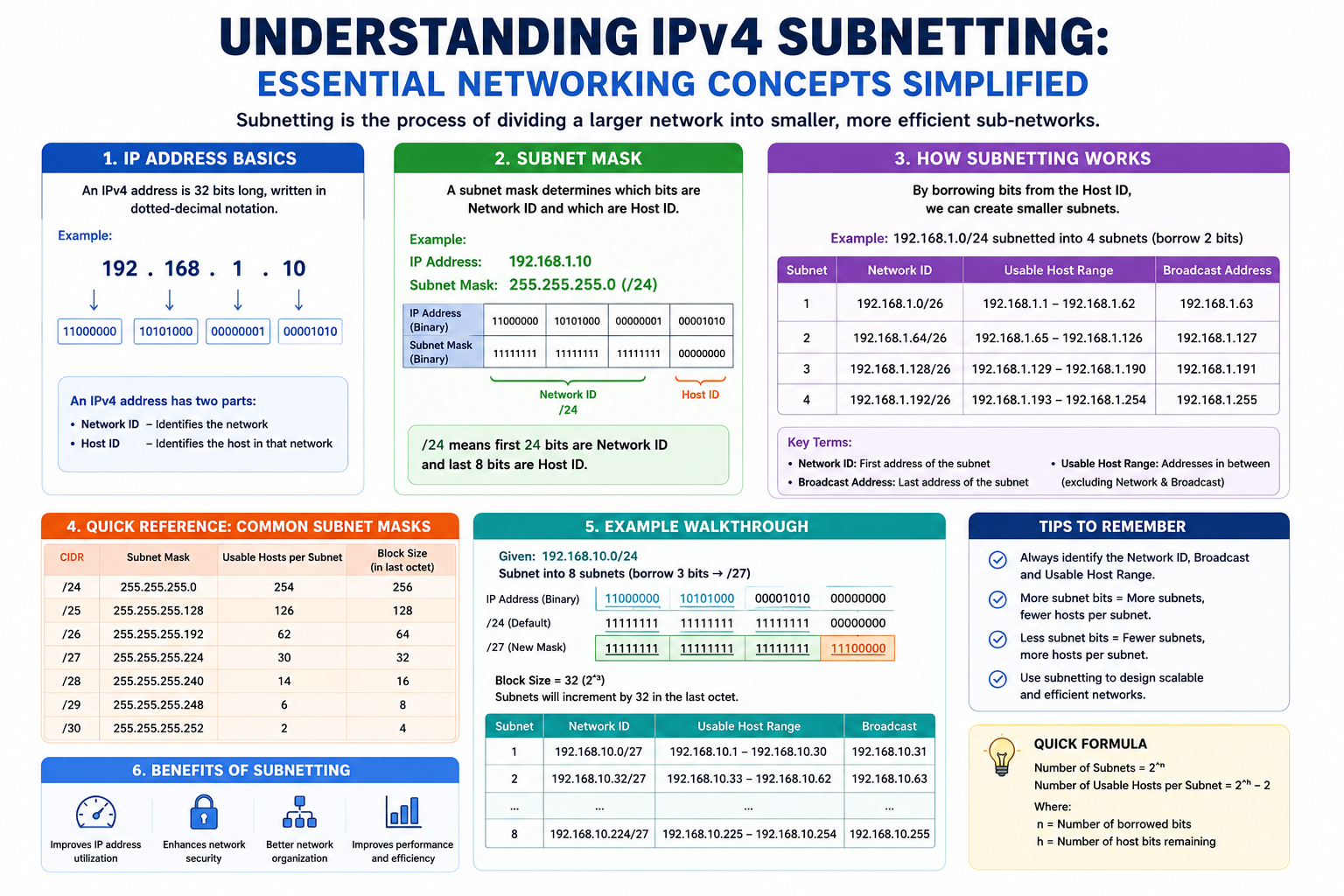
An IPv4 address is made up of 32 bits, which are divided into four sections for easier readability. Each section contains eight bits and is commonly represented in decimal form to make it more user-friendly. These decimal sections are separated by dots, creating a format that is easy to recognize and work with in networking environments.
Behind the scenes, however, the computer does not see these numbers as we do. Instead, it processes everything in binary form. This binary foundation is what allows networks to efficiently manage large amounts of communication. Each IPv4 address represents both a network identity and a device identity, allowing data to travel across complex systems without confusion.
As the number of internet-connected devices increased over time, managing IPv4 addresses became more challenging. Without an efficient system to organize and divide networks, address exhaustion would have occurred much faster. This is where subnetting becomes essential, allowing large networks to be broken into smaller, more manageable sections.
The Role of Binary in IP Communication
Binary is the language of computers, and it plays a crucial role in how IPv4 addresses function. While humans see IP addresses as decimal numbers, machines interpret them as sequences of 0s and 1s. Each bit in an IPv4 address carries a specific weight, and together they form meaningful numerical values.
When converting binary to decimal, each position in an 8-bit segment represents a value starting from 1 and doubling up to 128. By turning specific bits on or off, a wide range of numbers can be represented between 0 and 255 in each section of an IP address.
This binary structure is essential for understanding subnetting because subnetting itself depends on manipulating bits within the address. When network engineers design subnets, they are essentially deciding how many bits belong to the network portion and how many belong to the host portion.
This bit-level control gives networks flexibility. It allows administrators to allocate IP addresses more efficiently, ensuring that large organizations do not waste address space while smaller networks still have enough capacity to operate smoothly.
Without binary understanding, subnetting would appear confusing and abstract. However, once the relationship between binary and decimal becomes clear, the logic behind IP addressing becomes far more structured and predictable.
Why Subnetting Became Essential in Networking
In the early development of the internet, IP addresses were distributed in large blocks without efficient planning. Organizations were given more addresses than they actually needed, leading to rapid depletion of available IPv4 space.
Subnetting emerged as a solution to this inefficiency. By dividing a large network into smaller segments, administrators could allocate IP addresses based on actual requirements instead of excess capacity. This significantly reduced waste and extended the usability of IPv4 addressing.
Another major reason subnetting became essential is network performance. Large, unsegmented networks tend to experience high levels of broadcast traffic. Every device receives unnecessary data, which can slow down communication and reduce efficiency. By splitting a network into smaller subnets, broadcast traffic is limited to specific segments, improving overall performance.
Subnetting also improves security. When networks are divided into smaller sections, it becomes more difficult for unauthorized users to access the entire system. Each subnet can be controlled independently, allowing better monitoring and isolation of sensitive areas.
Over time, subnetting has become a core skill in networking because it supports scalability. As organizations grow, their networks must grow with them, and subnetting provides the flexibility to expand without rebuilding the entire infrastructure.
How Subnet Masks Define Network Boundaries
A subnet mask is a critical component in determining how an IP address is divided between network and host portions. It acts like a filter that tells devices which part of an address belongs to the network and which part identifies the specific device.
When a subnet mask is applied, it separates the 32-bit IP address into two distinct sections. The network portion remains fixed across all devices within the same subnet, while the host portion varies for each device. This distinction allows systems to communicate efficiently within and across networks.
Subnet masks also determine the size of a network. A larger network portion means more subnets but fewer hosts per subnet. Conversely, a smaller network portion allows more devices but fewer subdivisions. This trade-off is a key consideration in network design.
In practical terms, subnet masks ensure that data packets are delivered to the correct destination. When a device sends data, it uses the subnet mask to determine whether the recipient is within the same network or outside it. If the destination is outside, the data is sent to a router for further forwarding.
This mechanism ensures that communication remains organized and efficient, preventing unnecessary traffic from overwhelming local networks.
CIDR Notation and Its Importance in Efficient Addressing
Classless Inter-Domain Routing (CIDR) notation was introduced to make IP addressing more flexible and efficient. Instead of relying on traditional network classes, CIDR allows networks to define subnet sizes with greater precision.
CIDR notation uses a slash followed by a number to indicate how many bits are used for the network portion of an address. This method eliminates the rigid structure of older class-based systems and allows for more customized network design.
With CIDR, network administrators can allocate IP addresses based on actual need rather than fixed categories. This reduces waste and improves scalability, especially in large and dynamic environments.
CIDR also simplifies routing. Instead of managing multiple rigid network classes, routers can process more flexible address ranges. This improves performance and reduces the complexity of routing tables across the internet.
The introduction of CIDR played a major role in slowing down IPv4 exhaustion. By enabling more efficient allocation of address space, it allowed the internet to continue expanding despite limited address availability.
The Concept of Network and Host Separation
Every IPv4 address is divided into two logical parts: the network portion and the host portion. This separation is fundamental to how subnetting works and how devices communicate within a network.
The network portion identifies the broader network to which a device belongs. It acts as a common identifier shared by all devices within the same subnet. The host portion, on the other hand, identifies individual devices within that network.
This structure allows routers and switches to efficiently direct traffic. When data is sent across networks, routers first look at the network portion to determine the correct destination path. Once the data reaches the correct subnet, the host portion ensures it is delivered to the exact device.
This separation also improves scalability. Large networks can be divided into smaller segments without changing the overall structure of IP addressing. Each subnet operates independently while still being part of a larger system.
Understanding this separation is key to mastering subnetting because it forms the basis for all calculations and network design decisions.
Practical Thinking Behind Subnet Design
Designing subnets requires careful planning to balance efficiency, performance, and future growth. Network designers must consider how many devices will be connected, how much traffic will flow, and how the network may expand over time.
One of the main goals of subnet design is to minimize wasted IP addresses. Assigning overly large subnets can lead to inefficient use of address space, while overly small subnets may limit growth and cause connectivity issues.
Subnet design also takes into account organizational structure. Different departments or locations may require separate subnets to improve security and manageability. This allows administrators to control traffic flow and apply policies more effectively.
Another important factor is performance optimization. Smaller subnets reduce broadcast traffic, which improves speed and reduces network congestion. This is especially important in large enterprise environments where thousands of devices may be connected simultaneously.
Effective subnet design is both a technical and strategic process. It requires understanding current requirements while anticipating future changes in network demand.
Future Relevance of IPv4 Subnetting in a Growing Internet
Even with the rise of newer addressing systems, IPv4 subnetting remains highly relevant in modern networking. Many systems across the world still rely on IPv4, making subnetting a necessary skill for network management.
As the number of connected devices continues to grow, efficient use of IPv4 space becomes even more important. Subnetting helps extend the life of IPv4 by ensuring that address space is used responsibly.
Conclusion
IPv4 subnetting is a fundamental concept that allows modern networks to function efficiently and securely. By dividing large networks into smaller, manageable segments, subnetting helps optimize IP address usage, reduce network congestion, and improve overall performance. It also enhances security by isolating different parts of a network and limiting unnecessary access between systems. The use of binary, subnet masks, and CIDR notation all work together to create a structured approach to network design that is both flexible and scalable. Even as technology continues to evolve, the principles of subnetting remain essential in managing existing IPv4-based systems around the world. Understanding subnetting not only strengthens technical knowledge but also builds a strong foundation for more advanced networking concepts.