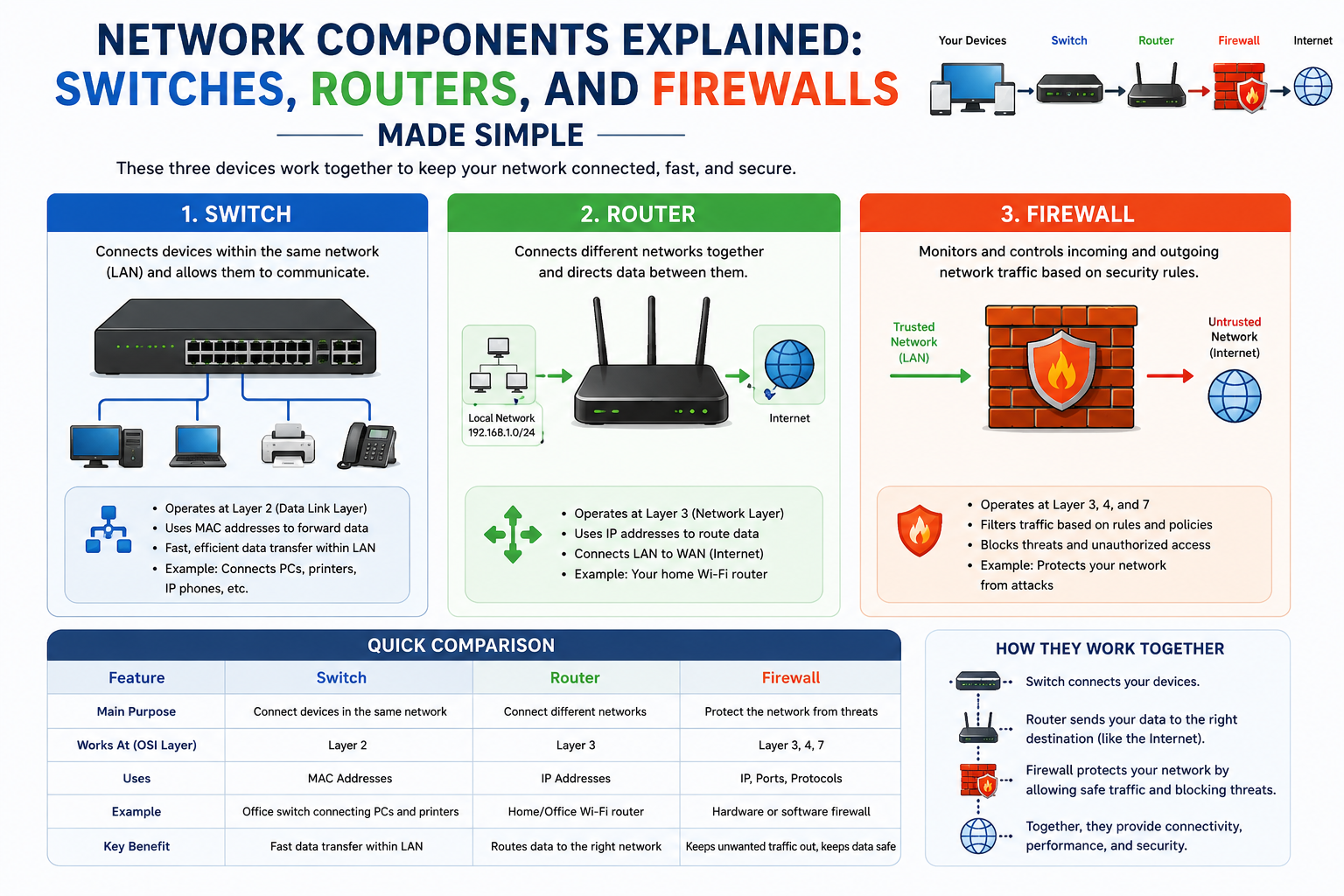
Modern computer networks rely on a small set of essential devices that work together to move data, connect systems, and protect information. Among these, switches, routers, and firewalls form the foundation of nearly every network you interact with—whether at home, in a school, or inside a large enterprise environment.
Although these devices often sit quietly in server rooms or network cabinets, they are responsible for every message sent, every website loaded, and every secure connection established. Understanding how they function is not just useful for technical professionals but also for anyone trying to grasp how digital communication actually works.
The Role of Switches in a Network
A switch is one of the most fundamental building blocks of a local network. Its primary role is to connect multiple devices within the same network and ensure that data reaches the correct destination efficiently.
Unlike older networking methods where data was broadcast to every device, switches operate in a more intelligent way. When a device sends data, the switch learns which device is connected to which port by identifying its unique hardware address. This allows it to forward information only where it needs to go, reducing unnecessary traffic and improving performance.
At the core of a switch’s operation is the idea of local communication. Devices such as computers, printers, cameras, and phones are typically connected to a switch within a building or office. Once connected, these devices can communicate with each other quickly without involving external networks.
Switches operate primarily at the data link layer of network communication. This means they focus on identifying devices using hardware-level addressing and managing traffic within the same network segment. Some advanced switches can also perform additional tasks related to routing, but their main purpose remains local data delivery.
One of the key advantages of switches is efficiency. By directing traffic only where it is needed, they reduce congestion and improve network speed. This becomes especially important in environments where many devices are communicating simultaneously.
Switches can also vary in complexity. Simple versions are designed to work immediately without configuration, making them suitable for basic home or small office setups. More advanced switches offer configuration options that allow administrators to monitor traffic, prioritize certain types of data, and manage network behavior in detail.
In larger networks, switches can also be interconnected to create extended systems. This allows organizations to scale their internal communication without losing performance or control.
Understanding Routers and Their Function
While switches manage communication within a network, routers are responsible for connecting different networks together. Their primary job is to direct data between local systems and external destinations, such as the internet or other private networks.
A router works by analyzing network addresses and determining the most efficient path for data to travel. This process is known as routing, and it allows information to move across multiple interconnected networks without confusion or duplication.
In a typical home setup, the router serves as the gateway between internal devices and the internet. It receives requests from devices like phones or computers and forwards them to external servers. Once the response is received, it sends the data back to the correct device inside the local network.
Routers also play an important role in assigning internal addresses to devices. This ensures that each device on a network has a unique identity, allowing communication to remain organized and structured.
One of the most important functions of a router is address translation. Since internal network addresses are not directly usable on the internet, routers modify outgoing data so that it appears to come from a valid external address. This process helps maintain security and allows many devices to share a single public connection.
Routers also control traffic flow using rules that determine which data is allowed in or out of a network. These rules help prevent unauthorized access and can be configured to prioritize certain types of traffic, such as video calls or business applications.
In more complex environments, routers may also handle multiple paths between networks. This allows them to choose the most efficient route for data based on current conditions, improving speed and reliability.
Overall, routers serve as the communication bridge between internal systems and the wider digital world, making them essential for internet connectivity and inter-network communication.
Firewalls and Network Security
Firewalls are the protective layer of a network, designed to control and monitor incoming and outgoing traffic based on predefined security rules. Their primary purpose is to prevent unauthorized access while allowing legitimate communication to pass through.
Unlike switches and routers, which focus on connectivity, firewalls focus on security. They act as a barrier between trusted internal networks and potentially unsafe external networks.
A firewall examines data packets as they attempt to enter or leave a network. It evaluates each packet based on factors such as source, destination, type of traffic, and behavior patterns. If the data does not meet security requirements, it is blocked.
Modern firewalls are far more advanced than simple filtering systems. They can analyze traffic in real time and detect suspicious behavior such as repeated connection attempts or unusual data patterns. This makes them effective against threats like unauthorized access attempts or network attacks.
Firewalls can also enforce strict communication rules. For example, they can allow certain types of traffic such as secure web browsing while blocking others that are considered unsafe or unnecessary. This level of control helps organizations maintain strong security policies.
Another important feature of firewalls is their ability to track active connections. This means they understand whether a data session is legitimate or part of an ongoing communication process. As a result, they can make smarter decisions about what traffic should be allowed.
In many networks, firewalls are placed at the boundary between internal systems and external networks. This positioning ensures that all incoming and outgoing data is inspected before it reaches critical systems.
Firewalls are essential in protecting sensitive information, preventing cyber threats, and maintaining overall network integrity.
How Switches, Routers, and Firewalls Work Together
Although each of these devices serves a different purpose, they are most powerful when working together as a system.
Inside a typical network, switches form the internal communication layer. They connect all local devices and allow them to share data efficiently. When a device needs to communicate outside the local network, the data is passed to a router.
The router then determines where the data needs to go and sends it toward its destination, whether that is another network or the internet. Before this data is fully transmitted, it may pass through a firewall, which inspects it for security risks.
The reverse process happens when data comes from external sources. The firewall first checks the incoming information. If it is safe, it is passed to the router, which directs it to the correct internal device through the switch.
This layered approach ensures both efficiency and security. Switches handle speed within the network, routers manage communication between networks, and firewalls protect against threats.
In large organizations, this system becomes even more important. Thousands of devices may be connected simultaneously, generating a constant flow of data. Without clear separation of roles between these components, the network would become slow, disorganized, and vulnerable.
By dividing responsibilities, networks can scale effectively while maintaining performance and security.
Network Behavior in Real-World Environments
In practical environments, network components must handle far more than simple data transfer. They must adapt to changing conditions, manage heavy traffic loads, and maintain consistent performance under pressure.
Switches, for example, must quickly learn and update device connections as systems join or leave the network. This requires constant monitoring of data flow and efficient memory management.
Routers must handle dynamic paths, especially when networks grow or when connections fail. They must continuously determine the best available route for data, ensuring that communication remains uninterrupted.
Firewalls must stay updated against evolving security threats. As new types of cyber risks emerge, firewall rules and detection systems must adapt to recognize and block them.
Together, these devices create a dynamic environment that constantly responds to both internal and external changes. This adaptability is what makes modern networks reliable even under complex conditions.
Conclusion
Switches, routers, and firewalls form the essential foundation of all modern networks. Each device plays a distinct role that contributes to the overall structure, performance, and security of digital communication systems.
Switches ensure fast and efficient communication between devices within a local network by directing data precisely where it needs to go. Routers extend this communication beyond local boundaries, connecting networks and enabling access to the internet while managing the flow of data between different systems. Firewalls add a critical layer of protection by monitoring traffic, enforcing security rules, and blocking unauthorized or suspicious activity.
When combined, these three components create a balanced network architecture that supports both functionality and safety. Without switches, internal communication would be slow and inefficient. Without routers, networks would remain isolated. Without firewalls, systems would be exposed to significant security risks.
Understanding how these devices work together provides valuable insight into how digital communication operates in everyday life. From simple home internet connections to complex global infrastructures, the same principles apply. Data must be transmitted efficiently, directed correctly, and protected at all times.
As technology continues to evolve, these core components remain central to network design, forming the backbone of the connected world we rely on every day.