Power over Ethernet (PoE) is a networking technology that allows electrical power and data to travel through the same Ethernet cable. Instead of relying on separate power adapters and electrical outlets for each network device, PoE simplifies infrastructure by combining both functions into a single connection. This concept may seem simple today, but it has significantly transformed how modern networks are designed and deployed.
In traditional networking setups, every device such as IP cameras, wireless access points, or VoIP phones required a dedicated power source. This often led to cluttered installations, increased wiring costs, and limited placement flexibility. PoE addressed these challenges by enabling network switches and injectors to deliver power directly through Ethernet cables, reducing dependency on wall sockets.
The early use of PoE focused on low-power devices, especially voice over IP phones. These devices required minimal energy and benefited greatly from centralized power delivery. As networking demands evolved, PoE expanded into more advanced applications such as surveillance systems, wireless networking, and smart building technologies.
Today, PoE is a foundational technology in enterprise and industrial environments. It supports flexible device placement, reduces installation complexity, and enables remote power management. However, to understand how PoE works in different scenarios, it is essential to explore its two most widely used standards: IEEE 802.3af and IEEE 802.3at.
Understanding IEEE 802.3af (Standard PoE)
The IEEE 802.3af standard, commonly referred to simply as PoE, was the first official version of Power over Ethernet. It laid the foundation for delivering power over standard Ethernet cabling while maintaining data transmission integrity. This standard was designed to support low-power devices that require stable but limited electrical input.
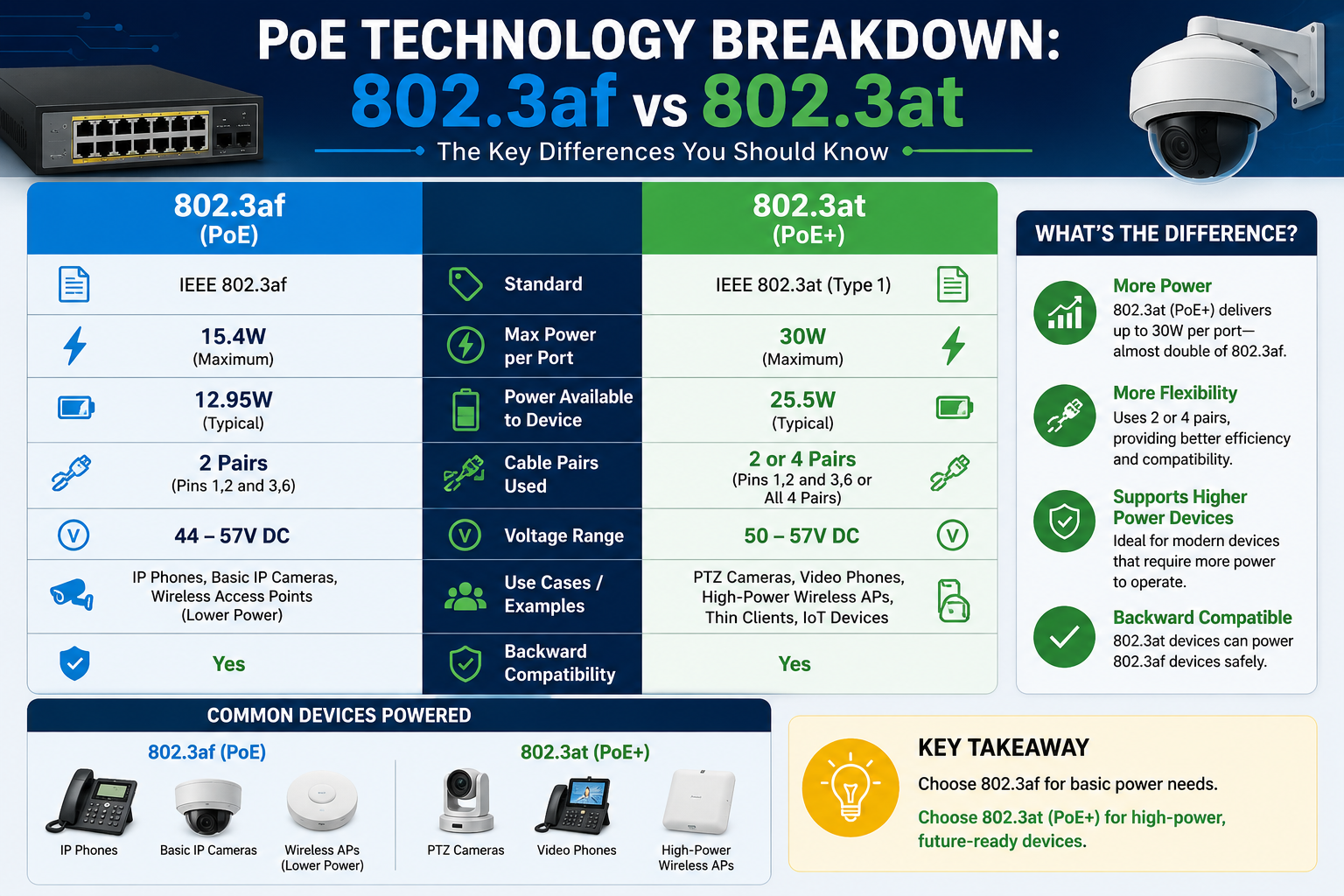
Under the 802.3af specification, a powered device can receive up to 15.4 watts of power from the source. However, due to power loss across the cable, the actual usable power at the device is typically around 12.95 watts. Devices that operate within this power range are classified as Type 1 devices.
The introduction of 802.3af was a significant advancement in networking infrastructure. It allowed organizations to deploy devices in locations where electrical wiring was difficult or expensive to install. For example, IP phones in office cubicles, small security cameras mounted on walls, and basic wireless access points became much easier to deploy.
One of the key advantages of 802.3af is its efficiency. Since it delivers relatively low power, it places minimal demand on network switches and power supplies. This results in lower operational costs and simplified electrical planning. Additionally, 802.3af is designed with safety mechanisms that ensure power is only delivered after detecting a compatible device, preventing accidental damage to non-PoE equipment.
However, the limitation of this standard lies in its power capacity. As networking devices became more advanced, many began requiring more energy than 802.3af could provide. Devices with features such as video displays, motorized components, or enhanced processing capabilities often exceed its limits. This gap in power delivery eventually led to the development of a more powerful standard.
Understanding IEEE 802.3at (PoE+ Standard)
The IEEE 802.3at standard, commonly known as PoE+, was introduced to overcome the limitations of the original PoE specification. It significantly increased the available power, allowing a broader range of devices to operate efficiently over Ethernet cables.
With 802.3at, a powered device can receive up to 30 watts from the power source, while the usable power at the device is typically around 25.5 watts. Devices that fall within this category are known as Type 2 devices. This increased power capacity opened the door for more demanding applications in networking environments.
PoE+ supports devices that require higher energy consumption, such as advanced wireless access points, pan-tilt-zoom security cameras, and VoIP phones with color displays or video capabilities. These devices often include additional processing components or mechanical functions that require more power than the original PoE standard can provide.
Another important feature of 802.3at is backward compatibility. PoE+ switches are designed to support both Type 1 and Type 2 devices. This means they can automatically adjust power delivery based on the requirements of the connected device. If a lower-power device is connected, the switch will supply only the necessary amount of energy, ensuring efficiency and safety.
Despite its advantages, PoE+ introduces higher demands on network infrastructure. Switches supporting 802.3at require more robust power supplies, and network designs must account for increased electrical load. In larger deployments, this can lead to higher infrastructure costs and more complex power management requirements. However, the trade-off is greater flexibility and support for modern high-performance devices.
Key Differences and Technical Considerations
The differences between 802.3af and 802.3at are primarily related to power capacity, device compatibility, and infrastructure requirements. While both standards use the same Ethernet cabling and operate under similar principles, their performance capabilities vary significantly.
One of the most important distinctions is power output. 802.3af delivers up to 15.4 watts, while 802.3at doubles that capacity to 30 watts. This increase enables support for more advanced devices but also requires more energy from the power source.
Another key difference is device classification. 802.3af supports Type 1 devices, which are generally low-power and basic in functionality. In contrast, 802.3at supports Type 2 devices, which are more complex and power-intensive. This classification helps network administrators determine compatibility and plan infrastructure accordingly.
From a compatibility standpoint, 802.3at is fully backward compatible with 802.3af devices. However, the reverse is not true. An 802.3af-only switch cannot power a device that requires PoE+, as it lacks sufficient power capacity. This makes 802.3at a more future-ready solution for expanding networks.
Power negotiation is another important technical feature shared by both standards. Before delivering full power, the switch performs a detection process to ensure that the connected device is PoE-compatible. This prevents damage to non-PoE devices and ensures safe operation across the network.
Cable distance is another shared limitation. Both standards support a maximum Ethernet cable length of 100 meters for reliable power and data transmission. Beyond this range, signal degradation can occur unless additional equipment such as extenders is used.
Practical Applications and Real-World Use Cases
PoE technology is widely used across multiple industries, and both 802.3af and 802.3at play important roles depending on device requirements. In many environments, a combination of both standards is used to optimize performance and cost efficiency.
In office environments, 802.3af is commonly used for VoIP phones, simple wireless access points, and basic network sensors. These devices do not require high power and benefit from the cost-effectiveness of the standard.
In contrast, 802.3at is typically used in more demanding applications. Modern wireless access points that support high-speed connectivity, advanced security cameras with motorized features, and smart building systems often rely on PoE+ for stable operation.
Security systems are one of the largest adopters of PoE technology. Basic surveillance cameras can operate efficiently on 802.3af, while advanced cameras with infrared capabilities, zoom functions, or heating elements require 802.3at. This flexibility allows organizations to design scalable surveillance networks.
In smart building environments, PoE is used for lighting control, environmental sensors, and automated systems. Lower-power sensors typically run on 802.3af, while more complex control systems depend on 802.3at to handle additional processing and communication tasks.
Wireless networking has also evolved alongside PoE standards. As Wi-Fi technology advanced from Wi-Fi 4 to Wi-Fi 6 and beyond, access points began requiring more power to support higher speeds and greater user capacity. This shift has made 802.3at increasingly important in modern network deployments.
Power Planning, Limitations, and Network Design Considerations
Designing a network with PoE requires careful planning to ensure that power demands do not exceed switch capacity. Each PoE switch has a total power budget, which must be distributed across all connected devices. Understanding device requirements is essential to avoid overload or performance issues.
One important consideration is power distribution. Even if a switch supports multiple PoE ports, the total available power is shared among all connected devices. If too many high-power devices are connected, the switch may disable some ports or reduce power delivery to maintain stability.
Another factor is infrastructure scalability. While 802.3af is cost-effective for basic deployments, it may not support future device upgrades. On the other hand, 802.3at provides greater flexibility but requires higher initial investment in power infrastructure.
Conclusion
Power over Ethernet has fundamentally changed how modern networks are built and maintained. By combining data and power delivery into a single cable, it simplifies installations and enables flexible device placement across a wide range of environments. The two main standards, 802.3af and 802.3at, represent different stages of this technology’s evolution.
While 802.3af remains suitable for low-power devices such as basic phones and sensors, 802.3at extends capabilities to more advanced equipment that requires higher energy consumption. Together, these standards provide a scalable foundation for both small and enterprise-level networks.
Choosing between them depends on device requirements, network size, and future expansion plans. As technology continues to evolve, PoE will remain a critical component in powering connected systems efficiently and reliably across industries.