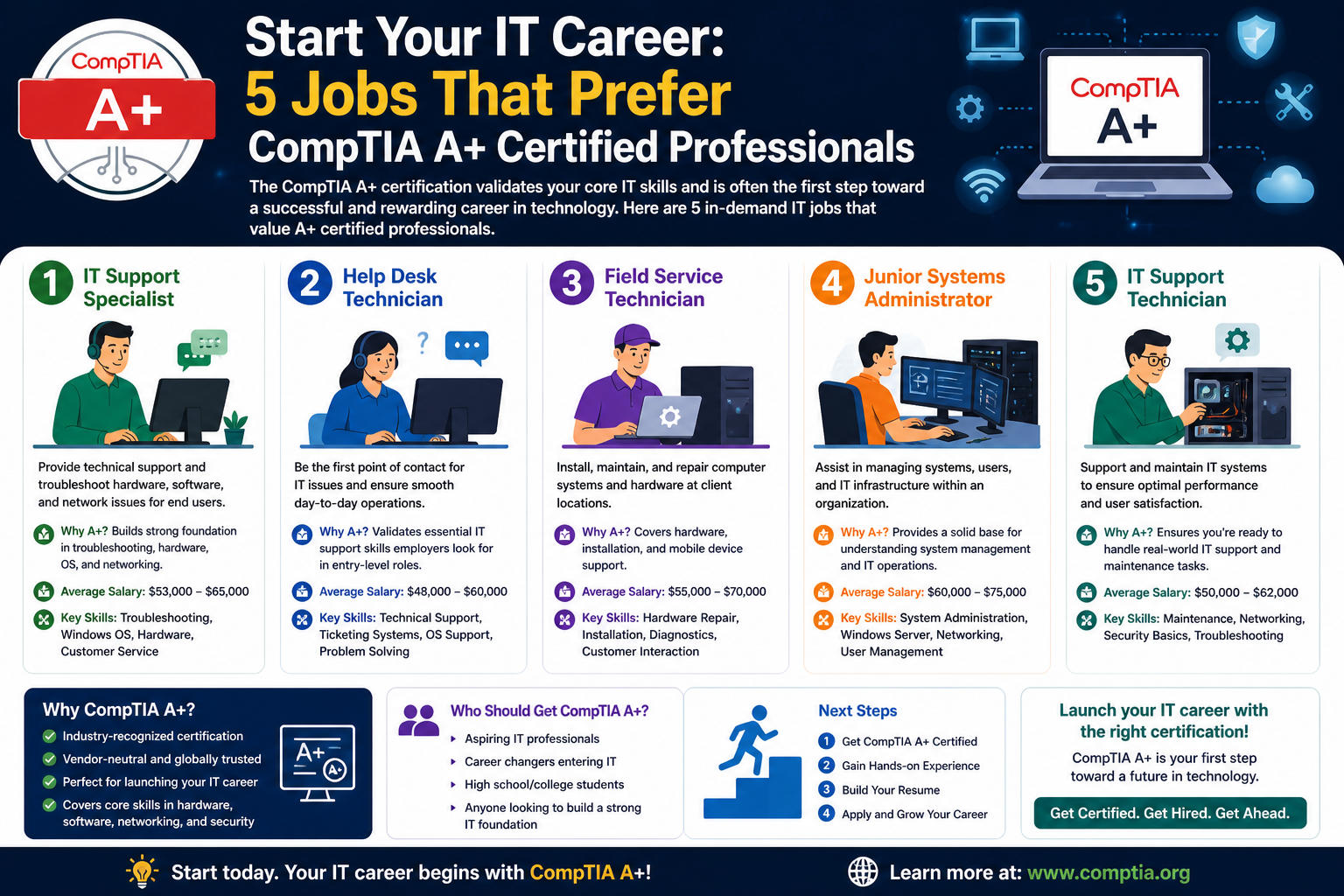
In the rapidly changing world of information technology, new tools, platforms, and specializations appear constantly. Cloud computing, automation, cybersecurity frameworks, and artificial intelligence-driven systems have all reshaped how organizations operate. Despite all these advancements, foundational technical knowledge remains essential. This is where entry-level certifications like CompTIA A+ continue to hold strong relevance.
CompTIA A+ is often considered the starting point for individuals entering the IT field. It is not designed to specialize in a single advanced domain but instead to build a broad technical foundation. This foundation is what allows new professionals to understand how different parts of IT infrastructure connect and function together. Whether it is troubleshooting a malfunctioning laptop, configuring a small office network, or supporting users experiencing software issues, the principles covered in A+ training frequently apply.
For employers, this certification serves as a signal. It indicates that a candidate has been exposed to core IT concepts such as operating systems, hardware components, basic networking, security fundamentals, and troubleshooting methodology. While hands-on experience is always valuable, many hiring managers view A+ as a structured validation of baseline competence. This is particularly important in entry-level roles where candidates may not yet have extensive professional experience.
Another important aspect of A+ is its role in standardizing knowledge. People entering IT often come from diverse educational backgrounds. Some may have degrees in computer science, while others are self-taught or transitioning from unrelated careers. The certification helps bridge this gap by establishing a shared technical baseline. This makes communication within teams more efficient and ensures that new professionals can integrate more smoothly into workplace environments.
It is also important to understand that A+ is not an endpoint. Instead, it functions as a gateway into more specialized areas of IT. Many professionals use it as a stepping stone toward networking, cybersecurity, systems administration, or cloud computing. The value lies in how it builds confidence and technical awareness that can be expanded through experience and further learning.
As organizations increasingly rely on complex digital systems, the demand for skilled support professionals continues to grow. Even highly automated environments still require human oversight, especially when systems fail or behave unpredictably. This is why entry-level IT roles remain essential and why certifications that prepare individuals for those roles continue to be relevant.
Understanding the career pathways that emerge from A+ certification helps clarify its long-term value. Rather than viewing it as a simple credential, it is more accurate to see it as the foundation for multiple IT career directions. The following sections explore how this certification connects directly to real job roles and how it influences career progression.
Understanding What CompTIA A+ Actually Validates
CompTIA A+ is structured to assess a wide range of foundational IT skills rather than deep specialization. This makes it unique compared to advanced certifications that focus on specific technologies or systems. At its core, A+ validates whether an individual can perform essential IT support tasks in real-world environments.
One of the primary areas covered is hardware knowledge. This includes understanding computer components such as processors, memory modules, storage devices, motherboards, and power supplies. It also involves knowing how these components interact within a system. In practical terms, this means an A+ certified individual should be able to identify hardware failures, replace components, and ensure systems are functioning correctly after repairs.
Another major area is operating systems. Candidates are expected to understand the basics of installing, configuring, and maintaining different operating systems, including Windows, macOS, and Linux. While deep administration is not required at this level, familiarity with system settings, file structures, and user management is essential. This knowledge becomes especially important in support roles where users frequently encounter software-related issues.
Networking fundamentals also form a key part of the certification. This includes understanding how devices connect within local networks, how IP addressing works, and how basic network troubleshooting is performed. Although A+ does not dive deeply into advanced networking concepts, it provides enough knowledge for entry-level professionals to support connectivity issues and understand network-related problems.
Security fundamentals are also included. In today’s environment, even basic IT roles require awareness of cybersecurity risks. A+ introduces concepts such as malware, phishing, authentication methods, and secure configuration practices. This ensures that even entry-level technicians understand how to protect systems and data from common threats.
Troubleshooting methodology is another critical component. Rather than simply memorizing technical facts, candidates are encouraged to follow structured problem-solving approaches. This includes identifying symptoms, isolating potential causes, testing solutions, and verifying results. This logical approach is highly valued in real IT environments where problems are often unpredictable.
In addition to technical skills, A+ also emphasizes communication and professionalism. IT professionals frequently interact with non-technical users, and the ability to explain technical issues in simple terms is essential. Understanding customer service principles and maintaining professionalism under pressure are part of what makes entry-level IT support effective.
Overall, the certification does not aim to create experts in any single domain. Instead, it builds versatile professionals who can adapt to different technical environments. This adaptability is one of the reasons A+ continues to be widely recognized across the industry.
How Employers Interpret CompTIA A+ in Hiring Decisions
From an employer’s perspective, CompTIA A+ serves as an initial filter in the hiring process. Entry-level IT positions often attract a large number of applicants, many of whom may not have formal technical training. In such cases, certifications help hiring managers quickly identify candidates who have demonstrated a commitment to learning foundational IT skills.
One of the most important signals A+ provides is consistency. Employers know that individuals who pass the certification exam have studied a standardized body of knowledge. This reduces uncertainty when evaluating candidates who may have different educational or experiential backgrounds. It ensures that all applicants meet a minimum technical threshold.
In many organizations, A+ is particularly valued for help desk and technical support roles. These positions require individuals to handle a wide variety of user issues, often under time pressure. Employers want assurance that candidates understand basic troubleshooting principles and can navigate common technical problems without extensive supervision.
Another way employers interpret A+ is as a sign of initiative. Since the certification is not always mandatory for entry-level roles, candidates who obtain it demonstrate a proactive approach to career development. This can be especially important in competitive job markets where small differences in qualifications can influence hiring decisions.
However, it is important to note that employers do not view A+ as a substitute for experience. Instead, it complements hands-on exposure. Candidates who combine certification with internships, lab practice, or personal technical projects tend to stand out more strongly. The certification alone does not guarantee employment, but it strengthens the overall profile of an applicant.
In larger organizations, A+ may also influence internal training decisions. New hires with certification often require less initial onboarding in basic technical concepts. This allows training programs to focus more quickly on company-specific systems and workflows rather than foundational IT knowledge.
For staffing teams, certifications like A+ also help streamline recruitment. They provide a measurable benchmark that can be used to filter candidates efficiently. This is particularly useful in high-volume hiring environments such as IT support centers or managed service providers.
Overall, employers see A+ as a reliability indicator. It does not define expertise, but it reduces uncertainty about a candidate’s readiness for entry-level technical responsibilities.
Career Pathway 1: Help Desk Technician and IT Support Roles
The help desk technician role is widely recognized as the most common starting point for individuals entering the IT industry. It is also the career path most directly associated with CompTIA A+ certification. In many organizations, this role serves as the first line of technical support for employees and customers experiencing IT issues.
Help desk technicians handle a broad range of responsibilities. These include responding to support tickets, troubleshooting hardware and software problems, assisting with password resets, and guiding users through basic technical processes. The work environment can vary from small internal IT teams to large outsourced support centers that handle requests from multiple clients.
One of the key challenges in this role is variety. Unlike specialized positions, help desk technicians rarely deal with the same problem repeatedly. One moment they may be assisting a user with a printer malfunction, and the next they may be troubleshooting a software installation issue. This diversity requires strong foundational knowledge, which is exactly what A+ certification helps provide.
Communication is also a critical aspect of the job. Many users seeking help do not have technical backgrounds, so the ability to translate complex issues into simple explanations is essential. A technician might need to guide a user step-by-step through a solution while remaining patient and clear. This soft skill is just as important as technical ability.
Help desk technicians also play an important role in escalation. When a problem cannot be resolved at the first level of support, it is passed to more advanced technical teams such as system administrators or network engineers. Understanding when and how to escalate issues is part of efficient IT service management.
From a technical perspective, help desk professionals rely heavily on troubleshooting skills. They must be able to identify whether an issue is related to hardware failure, software misconfiguration, network connectivity, or user error. The structured troubleshooting approach taught in A+ certification is directly applicable here.
Daily tasks often involve using ticketing systems to track user issues, documenting solutions, and ensuring that problems are resolved within defined timeframes. This documentation is important because it helps organizations identify recurring issues and improve their systems over time.
The help desk role also provides exposure to real-world IT environments. For many professionals, it serves as a training ground where theoretical knowledge is applied in practical situations. Over time, technicians develop deeper understanding of systems and begin to specialize in specific areas.
Career growth from help desk positions is common. Many professionals transition into roles such as systems administrator, network technician, or cybersecurity analyst after gaining experience. The foundational knowledge gained during this stage often becomes the basis for more advanced career development.
Career Pathway 2: Systems and Network Administration Roles
Systems and network administration roles represent the next stage in IT career development after help desk experience. These positions involve managing and maintaining the infrastructure that supports organizational technology systems. While help desk technicians focus on user-level issues, administrators focus on system-wide stability and performance.
System administrators are responsible for managing servers, operating systems, software deployments, and user accounts. They ensure that organizational systems run efficiently and securely. This includes tasks such as installing updates, monitoring system performance, managing backups, and configuring user permissions.
Network administrators, on the other hand, focus on connectivity. They manage routers, switches, firewalls, and network configurations. Their primary goal is to ensure that data flows smoothly between devices and systems within an organization. They also troubleshoot network outages and optimize performance.
Although these roles are more advanced, the foundational knowledge gained through A+ certification remains relevant. Understanding hardware components, operating systems, and basic networking concepts is essential when working with complex IT environments.
One of the key responsibilities in these roles is troubleshooting at a deeper level. Unlike help desk technicians who deal with user-facing issues, administrators often deal with system-level problems that can affect entire departments or organizations. This requires a more analytical and structured approach to problem-solving.
System administrators also need to understand virtualization technologies, which allow multiple operating systems to run on a single physical machine. This is commonly used in modern IT environments to improve efficiency and reduce costs. Familiarity with how systems interact at a hardware level is essential for managing these environments effectively.
Network administrators must also understand concepts such as IP routing, subnetting, and network security protocols. While these topics go beyond A+ certification, the foundational networking knowledge it provides helps professionals build toward these advanced skills.
Transitioning from help desk to administration roles typically involves gaining hands-on experience and additional specialized learning. Many professionals develop their skills gradually by working closely with senior technicians and taking on more complex responsibilities over time.
These roles are highly valued in the IT industry because they directly impact system reliability and organizational productivity. Without effective system and network administration, even well-designed IT environments can experience performance issues and downtime.
The career progression from help desk to administration represents a natural evolution in technical responsibility. It reflects a shift from reactive support to proactive system management, marking a significant step forward in an IT professional’s career journey.
Deepening IT Careers Beyond Foundational Support Roles
As professionals gain experience in entry-level IT positions, their responsibilities naturally begin to shift from basic troubleshooting toward more specialized technical domains. This transition is where foundational knowledge from CompTIA A+ becomes increasingly valuable, even if the work no longer directly mirrors help desk tasks. At this stage, IT careers begin to branch into distinct technical disciplines that require deeper systems understanding, stronger analytical thinking, and greater accountability for organizational infrastructure.
Rather than simply responding to user issues, professionals in these advanced roles are expected to design, maintain, and optimize the systems that keep businesses running. This shift represents a move from reactive support to proactive management. It also marks the point where career growth becomes more dependent on specialization, experience, and technical depth.
Among the most prominent pathways that emerge at this stage are database administration and server administration. These roles form the backbone of enterprise IT operations and are critical to data-driven decision-making, system reliability, and overall business continuity.
Career Pathway 3: Database Administrator and Data Management Specialist Roles
Database administration is one of the most technically demanding and strategically important roles in the IT ecosystem. Organizations rely heavily on data to drive decisions, analyze performance, and support operations. Without properly managed databases, even the most advanced applications and systems lose their effectiveness.
A database administrator (DBA) is responsible for ensuring that data is stored securely, efficiently, and in a way that allows fast and reliable access. This involves managing database structures, optimizing performance, handling backups, and ensuring data integrity across systems.
While CompTIA A+ does not directly focus on database technologies, it provides essential foundational knowledge that supports entry into this field. Understanding operating systems, storage devices, hardware performance, and basic networking is critical when working with databases, especially in environments where systems are tightly integrated.
Understanding the Role of Data in Modern IT Systems
In modern organizations, data is not just a byproduct of operations—it is a core asset. Everything from customer records to financial transactions and application logs is stored in databases. These databases must remain available at all times, often supporting multiple applications simultaneously.
A DBA ensures that these systems remain stable under heavy usage. This includes monitoring database performance, identifying bottlenecks, and making adjustments to improve efficiency. Even small performance issues can have significant impacts when scaled across thousands of users.
One of the key responsibilities in this role is designing database structures that align with business needs. This requires an understanding of how data is used across different departments and how it flows through various systems. Poor database design can lead to inefficiencies, redundant data, and slow application performance.
Core Responsibilities in Database Administration
Database administrators perform a wide range of tasks that require both technical expertise and strategic thinking. One of their primary responsibilities is maintaining data integrity. This ensures that information remains accurate, consistent, and reliable across all systems.
Backups and recovery processes are another critical aspect of the role. Data loss can have severe consequences for any organization, so DBAs must ensure that backup systems are properly configured and regularly tested. In the event of system failure, they are responsible for restoring data quickly and minimizing downtime.
Performance tuning is also a major part of the job. As databases grow in size and complexity, performance can degrade if not properly managed. DBAs analyze query performance, optimize indexing strategies, and adjust configurations to maintain efficiency.
Security is another essential responsibility. Databases often contain sensitive information, including personal customer data and financial records. DBAs must implement access controls, encryption methods, and monitoring systems to protect this information from unauthorized access.
How Foundational IT Knowledge Supports Database Careers
Although database administration is a specialized field, many of its core requirements are built on general IT knowledge. Understanding how operating systems manage resources is important when configuring database servers. Knowledge of hardware performance helps in optimizing storage systems and memory usage.
Networking knowledge is also important because databases often interact with multiple applications across different systems. Ensuring secure and efficient communication between these systems requires a solid understanding of network principles.
Troubleshooting skills developed during earlier IT roles are also highly valuable. When database issues arise, they often require systematic analysis to identify root causes. This mirrors the troubleshooting methodology emphasized in CompTIA A+ training, where problems are broken down into logical steps.
Career Progression Within Database Administration
Database administration offers strong long-term career growth opportunities. Entry-level positions often begin with support roles focused on monitoring and basic maintenance. Over time, professionals can advance into more specialized roles such as database architect, data engineer, or performance analyst.
As organizations increasingly rely on data-driven systems, the demand for skilled database professionals continues to grow. This makes it a highly stable and rewarding career path for individuals who enjoy structured problem-solving and working with complex systems.
Career Pathway 4: Server Technician and Systems Infrastructure Roles
Server administration represents another critical advancement in IT careers. Servers form the foundation of modern computing environments, hosting applications, managing network services, and storing essential organizational data. Without properly maintained servers, most business operations would come to a halt.
Server technicians and administrators are responsible for ensuring that these systems remain operational, secure, and efficient. Their work involves both physical hardware management and software configuration, making it a highly technical and hands-on role.
The Role of Servers in Modern IT Environments
Servers are specialized computers designed to handle large volumes of requests from multiple users or systems. They can run a variety of services, including file storage, web hosting, application delivery, and authentication management.
In enterprise environments, servers are often grouped into clusters or data centers to ensure reliability and scalability. This means that server administrators must manage not just individual machines but entire systems of interconnected infrastructure.
CompTIA A+ provides foundational knowledge that supports this work by introducing hardware concepts, operating system fundamentals, and basic troubleshooting techniques. Understanding how components interact at a hardware level is essential when diagnosing server issues.
Core Responsibilities of Server Administrators
Server administrators are responsible for installing, configuring, and maintaining server systems. This includes setting up operating systems, applying updates, and ensuring that services are running correctly.
One of the most important aspects of this role is system monitoring. Servers must be continuously monitored for performance issues, hardware failures, and security vulnerabilities. Administrators use specialized tools to track system health and respond quickly to any anomalies.
Backup management is also a critical responsibility. Servers often store mission-critical data, so ensuring regular backups and recovery procedures is essential. In the event of hardware failure or system corruption, administrators must be able to restore services with minimal disruption.
Virtualization is another key component of modern server environments. Instead of relying on a single physical machine for each service, virtualization allows multiple virtual servers to run on a single physical host. This improves efficiency and reduces hardware costs. Server administrators must understand how to configure and manage virtual environments effectively.
Hardware and Infrastructure Knowledge in Server Roles
Unlike many other IT roles, server administration often involves direct interaction with physical hardware. This includes installing processors, memory modules, storage arrays, and network interfaces. A strong understanding of hardware components is essential for diagnosing performance issues and replacing faulty parts.
Cooling systems and power management are also important considerations. Servers generate significant heat and require specialized cooling systems to operate reliably. Administrators must ensure that data center environments are properly maintained to prevent overheating and system failure.
Storage systems are another key area of focus. Servers often rely on complex storage configurations such as RAID arrays to ensure redundancy and performance. Understanding how these systems work is critical for maintaining data integrity.
Operational Challenges in Server Management
Server environments are often highly complex, with multiple systems interacting simultaneously. This creates challenges in terms of coordination, monitoring, and troubleshooting.
One common challenge is ensuring system uptime. Many organizations require servers to operate continuously with minimal downtime. This places pressure on administrators to resolve issues quickly and efficiently.
Security is another major concern. Servers are frequent targets for cyberattacks due to the valuable data they contain. Administrators must implement firewalls, access controls, and monitoring systems to protect against threats.
Scalability is also an important consideration. As organizations grow, their server infrastructure must be able to handle increased demand. This requires careful planning and optimization to avoid performance bottlenecks.
Career Growth in Server Administration
Server administration offers multiple pathways for advancement. Professionals may move into roles such as systems engineer, infrastructure architect, or cloud systems specialist.
With the increasing adoption of cloud technologies, many traditional server roles are evolving into hybrid environments where physical and virtual systems coexist. This creates new opportunities for professionals who understand both traditional infrastructure and modern cloud platforms.
Emerging Hybrid Infrastructure Roles and Expanding IT Responsibilities
As IT environments become more complex, traditional role boundaries are beginning to blur. Professionals are increasingly expected to understand multiple systems rather than focusing on a single specialization. This has led to the emergence of hybrid roles that combine elements of networking, systems administration, and infrastructure management.
One example is the network operations center (NOC) technician. These professionals monitor large-scale IT environments, identifying and responding to system alerts in real time. Their work requires a strong understanding of both networking and system performance.
Another emerging role is cloud support associate. As organizations migrate services to cloud platforms, professionals are needed to manage virtual infrastructure, monitor performance, and ensure system availability. While this represents a shift from traditional on-premises systems, many foundational IT principles remain the same.
Virtualization specialists also play an increasingly important role. They manage virtual machines, allocate resources, and ensure that virtual environments operate efficiently. This requires a strong understanding of both hardware and software interactions.
These hybrid roles reflect the evolving nature of IT careers. Rather than focusing on narrow technical areas, professionals are now expected to adapt to multiple technologies and understand how different systems interact within larger ecosystems.
Expanding Technical Depth Toward Security-Oriented IT Roles
As IT systems become more interconnected, security considerations become increasingly important across all technical roles. Even professionals in database administration or server management must now consider security implications in their daily work.
Security-related responsibilities often include monitoring system logs, identifying suspicious activity, and implementing access controls. While dedicated security roles will be explored further in the next section, it is important to recognize that security awareness is now embedded across all IT disciplines.
Foundational knowledge from CompTIA A+ plays a role here by introducing basic security concepts such as authentication, encryption, and threat recognition. These concepts serve as the starting point for more advanced security careers, where professionals are responsible for protecting entire organizational infrastructures.
As IT environments continue to evolve, the boundaries between infrastructure, administration, and security will likely become even more integrated.
The Growing Importance of Security in Entry-Level IT Foundations
In modern IT environments, security is no longer treated as a separate discipline that only specialized professionals handle. Instead, it has become a core requirement embedded across nearly every technical role. From help desk technicians to system administrators and cloud engineers, everyone is expected to understand basic security principles and apply them in daily operations.
This shift has significantly increased the importance of foundational certifications like CompTIA A+. While it is often introduced as an entry-level IT certification, its coverage of security fundamentals makes it surprisingly relevant for cybersecurity-oriented career paths as well. Concepts such as authentication, malware awareness, secure configuration, and troubleshooting suspicious system behavior form the groundwork for more advanced security responsibilities.
Organizations today face constant exposure to digital threats. These threats range from phishing attacks and ransomware to insider risks and system misconfigurations. Because of this, even entry-level IT staff must be capable of recognizing early signs of security issues and responding appropriately.
Security is no longer limited to firewalls and antivirus tools. It is a mindset that influences how systems are configured, how users are supported, and how incidents are handled. This mindset begins with understanding how systems behave under normal conditions and identifying when something deviates from that baseline. That is exactly where foundational IT knowledge becomes essential.
CompTIA A+ introduces learners to this way of thinking by encouraging structured troubleshooting and awareness of system vulnerabilities. Although it does not turn candidates into security experts, it builds the awareness required to recognize risks in real-world environments. This awareness becomes the foundation for transitioning into dedicated cybersecurity roles later in one’s career.
Career Pathway 5: IT Security Specialist and Entry-Level Cybersecurity Roles
Among the career pathways influenced by CompTIA A+, cybersecurity stands out as one of the most dynamic and rapidly evolving fields. IT security specialists are responsible for protecting systems, networks, and data from unauthorized access, damage, or disruption.
At the entry level, security-focused roles often involve monitoring systems, identifying potential threats, and assisting with the implementation of security policies. These responsibilities require a strong understanding of how IT systems operate, which is why foundational knowledge plays such an important role.
An IT security specialist may work in various environments, including corporate IT departments, managed security service providers, or government-related organizations. Their work often involves collaboration with other IT teams, especially system administrators and network engineers, to ensure that security measures are properly implemented across infrastructure.
Core Responsibilities in Entry-Level Security Roles
Entry-level security professionals typically focus on monitoring and maintaining the security posture of IT systems. This includes analyzing system logs, identifying unusual activity, and responding to alerts generated by security tools.
One of the key responsibilities is vulnerability awareness. Security specialists must understand common system weaknesses and ensure that patches and updates are applied regularly. Outdated systems are one of the most common entry points for attackers, making patch management a critical task.
Another important responsibility is user access control. Security specialists help ensure that employees only have access to the systems and data necessary for their roles. This principle, often referred to as least privilege access, reduces the risk of internal misuse or accidental data exposure.
Security documentation is also an essential part of the job. Specialists must record incidents, track security events, and maintain logs that can be used for analysis and compliance purposes. This documentation helps organizations understand patterns of behavior and improve their overall security posture.
How Foundational IT Knowledge Supports Security Work
CompTIA A+ provides a strong foundation for understanding the technical environment in which security operations take place. Without knowledge of operating systems, hardware components, and networking basics, it becomes difficult to identify abnormal system behavior.
For example, understanding how a computer normally boots and runs allows a security professional to recognize when malicious software is interfering with system processes. Similarly, knowledge of networking helps identify unusual traffic patterns that may indicate unauthorized access attempts.
Troubleshooting skills are also critical in security roles. When a potential threat is detected, security professionals must quickly determine whether it is a false alarm or a genuine incident. This requires a structured approach to problem-solving, which is heavily emphasized in A+ training.
Security work also requires attention to detail. Small anomalies in system behavior can often indicate larger underlying issues. Recognizing these patterns requires both technical knowledge and experience, which is often developed over time in entry-level IT roles.
From Technical Support to Security Operations Centers (SOC)
One of the most common career transitions for individuals with IT support backgrounds is moving into a Security Operations Center, commonly known as a SOC. These environments serve as centralized hubs where security professionals monitor and respond to cybersecurity incidents in real time.
SOC teams are typically structured into multiple levels, with entry-level analysts handling initial alerts and more experienced professionals managing complex incidents. This structure allows newcomers to gradually build their skills while contributing to organizational security.
The Role of SOC Analysts in Cybersecurity
SOC analysts are responsible for monitoring security tools and systems that generate alerts when suspicious activity occurs. These tools may include intrusion detection systems, firewalls, antivirus platforms, and security information and event management systems.
When an alert is triggered, analysts must evaluate its severity and determine whether it represents a real threat. This process often involves reviewing logs, analyzing network traffic, and correlating data from multiple sources.
One of the key challenges in SOC environments is managing alert volume. Security systems can generate thousands of alerts daily, many of which are false positives. Analysts must be able to quickly filter out irrelevant data and focus on genuine threats.
This requires strong analytical skills and a deep understanding of normal system behavior. Without this baseline knowledge, it becomes difficult to distinguish between routine activity and malicious behavior.
The Importance of Structured Thinking in SOC Environments
SOC work relies heavily on structured processes. When an incident is detected, analysts follow predefined procedures to investigate, contain, and resolve the issue. This ensures consistency and reduces the risk of human error during high-pressure situations.
CompTIA A+ contributes to this structured thinking by teaching systematic troubleshooting methods. Although originally designed for general IT support, these methods translate effectively into security operations.
For example, identifying the root cause of a system issue in IT support is similar to tracing the origin of a security breach. Both require breaking down complex problems into smaller components and analyzing each step logically.
Real-Time Decision Making in Security Operations
SOC environments often operate under time-sensitive conditions. When a potential threat is detected, rapid response is essential to prevent escalation. Analysts must make informed decisions quickly based on available data.
This requires not only technical knowledge but also situational awareness. Understanding how different systems interact helps analysts predict potential impacts and prioritize response actions accordingly.
Over time, SOC analysts develop experience that allows them to recognize attack patterns and respond more efficiently. Many senior cybersecurity professionals begin their careers in SOC environments before transitioning into specialized roles.
How CompTIA A+ Prepares You for Cybersecurity Thinking
Although CompTIA A+ is not a cybersecurity certification, it introduces several foundational concepts that are directly applicable to security careers. One of the most important of these is structured troubleshooting.
Cybersecurity professionals must constantly analyze systems to identify vulnerabilities and respond to threats. This requires a logical and methodical approach to problem-solving, which is embedded in A+ training.
Another important concept is system awareness. Security professionals must understand how operating systems, hardware, and networks function under normal conditions. Without this baseline knowledge, it becomes difficult to detect anomalies.
A+ also introduces basic security principles such as authentication methods, password policies, encryption basics, and malware types. While these topics are covered at an introductory level, they provide essential vocabulary and conceptual understanding for more advanced studies.
In addition, A+ emphasizes the importance of user behavior in security. Many security incidents are caused by human error rather than technical failures. Understanding how users interact with systems helps security professionals design better protections and training programs.
Incident Response and Early Threat Handling Roles
Incident response is a critical area within cybersecurity that focuses on managing and mitigating security breaches. Entry-level professionals in this area assist with detecting, analyzing, and responding to security incidents.
When a security event occurs, incident response teams follow a structured process that includes identification, containment, eradication, recovery, and post-incident analysis. Each stage requires careful coordination and technical understanding.
Entry-level roles often involve monitoring alerts, gathering evidence, and assisting senior analysts with investigations. These tasks require attention to detail and the ability to work under pressure.
CompTIA A+ supports this work by providing foundational knowledge of system behavior. Understanding how systems are supposed to function allows incident response professionals to identify deviations that may indicate compromise.
Incident response also involves communication. Professionals must document findings and communicate with stakeholders who may not have technical backgrounds. Clear and accurate reporting is essential for effective incident management.
Identity and Access Management (IAM) Support Careers
Identity and Access Management is another important area within cybersecurity. IAM focuses on ensuring that the right individuals have appropriate access to systems and data while preventing unauthorized access.
IAM professionals manage user accounts, authentication systems, and access policies. They play a key role in enforcing security controls across organizations.
Entry-level IAM roles often involve user provisioning, password management, and access reviews. These tasks require a strong understanding of system permissions and user authentication methods.
CompTIA A+ supports IAM careers by introducing concepts related to user accounts, operating system permissions, and basic security configurations. Understanding how users interact with systems is essential for managing access effectively.
IAM also requires strong attention to detail. Small configuration errors can lead to significant security vulnerabilities. Professionals in this field must be precise and methodical in their work.
Endpoint Security and Device Protection Roles
Endpoint security focuses on protecting individual devices such as computers, laptops, and mobile devices. These endpoints are often the first target of cyberattacks, making their protection a critical aspect of overall security strategy.
Professionals working in endpoint security manage antivirus systems, device encryption, patch management, and configuration policies. Their goal is to ensure that all devices connected to the network are secure and compliant with organizational standards.
CompTIA A+ provides foundational knowledge of hardware and operating systems that is directly relevant to endpoint security. Understanding how devices function helps professionals identify vulnerabilities and implement appropriate protections.
Endpoint security roles often involve monitoring device health, responding to security alerts, and ensuring compliance with security policies. These responsibilities require both technical knowledge and organizational awareness.
Expanding into Advanced Security Career Tracks
As professionals gain experience in entry-level security roles, they often transition into more advanced positions. These may include penetration testing, security engineering, threat intelligence analysis, or cloud security specialization.
Each of these paths builds on foundational IT knowledge while introducing more complex technical concepts. For example, penetration testers must understand system vulnerabilities in depth, while security engineers design and implement large-scale protection systems.
Threat intelligence analysts focus on identifying and analyzing emerging cyber threats. This requires understanding attack patterns, malware behavior, and global threat landscapes.
Cloud security specialists manage security in cloud-based environments, ensuring that virtual systems and data remain protected. This is increasingly important as organizations continue migrating to cloud platforms.
How Foundational IT Skills Continue to Shape Security Success
Even as security professionals advance into specialized roles, foundational IT knowledge remains essential. Understanding how systems operate at a basic level allows professionals to make informed decisions in complex environments.
Hardware knowledge helps in identifying physical vulnerabilities. Networking knowledge supports analysis of traffic patterns and communication flows. Operating system knowledge is critical for understanding how attacks exploit system behavior.
Troubleshooting skills remain relevant throughout a cybersecurity career. Whether investigating incidents or designing security systems, the ability to break down problems logically is invaluable.
CompTIA A+ continues to serve as the starting point for this journey. It does not define the entire career path, but it establishes the technical foundation upon which all advanced security knowledge is built.
Conclusion
CompTIA A+ certification continues to play an important role in shaping early IT careers, even as technology environments become more complex and specialized. Its value does not lie in advanced expertise, but in the strength of its foundation. By covering essential topics such as hardware, operating systems, networking basics, troubleshooting methods, and introductory security concepts, it equips individuals with the core understanding needed to function effectively in real-world IT environments.
Across the career pathways discussed—help desk support, system and network administration, database and server management, and cybersecurity roles—the certification consistently acts as a bridge. It helps individuals move from theoretical knowledge to practical application, enabling smoother transitions into professional roles. For many, it represents the first structured step into a long-term IT career.
What makes A+ particularly relevant is its adaptability. The skills it validates are not limited to one job function. Instead, they are applied across multiple domains, from resolving user issues to maintaining enterprise infrastructure and supporting security operations. This versatility allows professionals to explore different directions within IT before committing to a specialization.
As organizations continue to evolve with cloud computing, automation, and increased cybersecurity demands, the need for strong foundational knowledge remains unchanged. Technologies may shift, but the underlying principles of how systems operate and interact stay consistent.
Ultimately, CompTIA A+ serves as a starting point rather than a destination. It prepares individuals to enter the industry with confidence and provides the technical grounding necessary for long-term growth in a wide range of IT careers.