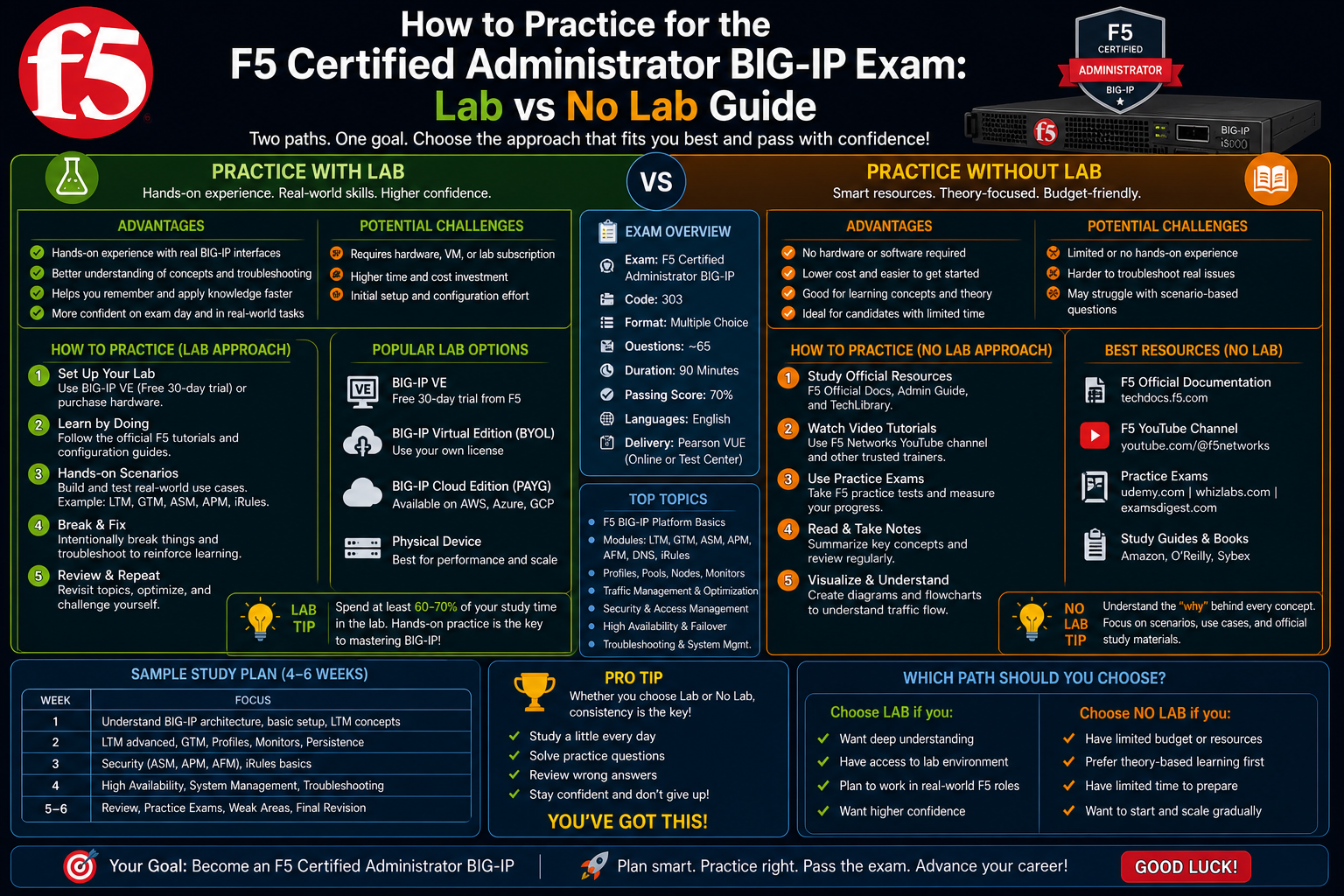
The F5 Certified Administrator focused on BIG-IP is designed to validate foundational knowledge of traffic management, application delivery, and network services in enterprise environments. At its core, this role is not just about memorizing features or understanding terminology. It is about understanding how application traffic flows through a controlled system and how that system can be adjusted to ensure reliability, performance, and security.
BIG-IP itself is widely used in organizations that manage high volumes of web traffic or need advanced control over application delivery. This includes load balancing, SSL management, traffic inspection, and failover mechanisms. As an administrator, the expectation is that you can understand how these components interact rather than simply knowing their definitions.
What makes this certification unique is its emphasis on real-world thinking. Even though the exams are structured in a theoretical format, the questions are framed around actual operational scenarios. This means that success depends heavily on conceptual clarity rather than rote memorization. Understanding how and why BIG-IP behaves in certain ways becomes more important than simply recalling configuration steps.
Many learners initially assume that they must master every configuration detail before attempting the exam. However, the actual expectation is more aligned with decision-making and troubleshooting logic. You are expected to interpret network behavior, recognize misconfigurations, and choose appropriate solutions based on system output or scenario descriptions.
How BIG-IP Fits in Modern Networks
Modern enterprise networks are no longer simple client-server architectures. They are distributed, layered, and often hybrid, combining on-premises infrastructure with cloud-based services. In this environment, BIG-IP plays a central role as a traffic management and application delivery controller.
One of its primary functions is load balancing. When multiple servers host the same application, BIG-IP distributes incoming traffic across them to ensure performance and prevent overload. This is essential for high-traffic applications where downtime or lag can significantly impact users.
Another critical function is SSL offloading. Instead of burdening backend servers with encryption and decryption tasks, BIG-IP handles SSL processing itself. This improves performance and allows centralized management of certificates and encryption policies.
In addition, BIG-IP supports advanced traffic routing decisions. It can inspect incoming requests and make decisions based on application layer data, not just IP addresses or ports. This level of intelligence allows organizations to build highly efficient and secure application delivery architectures.
Understanding these roles is important because exam questions often revolve around how traffic behaves under different configurations. Even if you have never touched a physical system, you must be able to visualize how requests move through a BIG-IP environment.
Exam Structure and Knowledge Expectations (F5CAB1–F5CAB5)
The F5 Certified Administrator BIG-IP path is divided into multiple smaller exams, each focusing on a specific domain of knowledge. This modular approach ensures that learners build understanding progressively rather than attempting to master everything at once.
Each module focuses on a different aspect of BIG-IP administration. The early sections typically cover installation, initial configuration, and system setup. These topics include understanding system interfaces, network connectivity, and basic deployment concepts.
Later modules shift toward more operational topics such as traffic management, load balancing methods, and monitoring system health. These areas require a deeper understanding of how BIG-IP processes requests and distributes traffic.
Advanced sections may introduce concepts like high availability, failover behavior, and traffic optimization strategies. These topics require learners to understand system redundancy and resilience mechanisms.
What is important to recognize is that none of these exams require direct interaction with a live system during testing. Instead, they evaluate your ability to reason through scenarios. You may be asked how a system behaves under certain conditions or what configuration would resolve a given issue.
This structure is what leads many learners to question whether a lab is necessary. Since the exam is not hands-on, it may appear that theoretical study alone is sufficient. However, the complexity of scenario-based questions often reveals gaps in understanding that hands-on practice naturally fills.
Scenario-Based Learning vs Practical Configuration
One of the most important aspects of BIG-IP preparation is understanding the difference between scenario-based learning and practical configuration experience.
Scenario-based learning focuses on describing system behavior. For example, you might be given a situation where users are experiencing inconsistent access to an application. You are then asked to identify the most likely cause or choose the best solution.
In contrast, practical configuration involves actually setting up systems, adjusting settings, and observing outcomes in real time. This might include creating virtual servers, configuring pools, or adjusting load balancing algorithms.
While both approaches teach the same concepts, they do so in different ways. Scenario-based learning develops analytical thinking, while hands-on practice builds intuition. Intuition is especially important in BIG-IP environments because many behaviors are not immediately obvious from documentation alone.
For example, understanding how persistence profiles affect session behavior is much easier when you have seen it in action. Similarly, troubleshooting SSL handshake issues becomes more intuitive when you have observed certificate misconfigurations in a controlled environment.
This is why many learners find that even though they can memorize concepts, they struggle with application-based questions without some form of practical exposure.
Why Lab Debate Exists in BIG-IP Preparation
The debate around whether a lab is necessary comes from the gap between theoretical exams and real-world systems. Since the F5 Certified Administrator exams do not require direct system interaction, some learners assume that a lab environment is optional.
However, the complexity of BIG-IP systems introduces subtle behaviors that are difficult to fully understand through reading alone. Traffic distribution, health monitoring, and failover mechanisms often behave differently depending on configuration combinations.
For instance, a load balancing method may seem straightforward in theory, but in practice, it can produce different outcomes depending on session persistence settings or node health conditions. These interactions are not always obvious in documentation.
The lab debate is also influenced by different learning styles. Some individuals can visualize systems easily and understand abstract concepts without hands-on practice. Others require physical interaction with systems to fully grasp how they behave.
Another factor is accessibility. Not all learners have access to enterprise-grade equipment or cloud resources. This leads to the assumption that labs are optional, even though they can significantly improve comprehension.
Ultimately, the debate is not about necessity but about efficiency. It is possible to pass without a lab, but the learning curve is often steeper.
Core BIG-IP Components Beginners Must Understand
Before diving into configuration or scenario analysis, it is essential to understand the core components that make up a BIG-IP system. These components form the foundation of almost every exam question.
The first key component is the virtual server. This is the entry point for client traffic. It defines how incoming requests are processed and routed to backend resources.
Next are pools and pool members. Pools are groups of servers that provide the same service, while pool members are individual servers within those groups. Load balancing decisions are made at this level.
Health monitors are another critical element. They continuously check whether backend servers are available and functioning correctly. If a server fails a health check, it is removed from the pool until it recovers.
Profiles define how traffic is processed. These can include SSL profiles for encryption, HTTP profiles for web traffic behavior, and persistence profiles for session management.
Finally, there are nodes and interfaces, which represent the underlying network elements that connect BIG-IP to external systems.
Understanding these components conceptually is essential because exam questions often describe scenarios involving multiple components interacting simultaneously. Without a clear mental model, it becomes difficult to interpret what is happening in a given situation.
Virtualization Concept of BIG-IP VE
One of the most important developments in BIG-IP learning is the availability of virtual editions. Instead of requiring physical hardware, BIG-IP can now be deployed as a virtual machine in a controlled environment.
This virtualization concept allows learners to simulate real-world environments without needing dedicated infrastructure. The virtual edition behaves almost identically to physical appliances, providing a realistic representation of system behavior.
From a learning perspective, this is significant because it bridges the gap between theory and practice. Even minimal exposure to a virtual environment can help learners understand how configurations affect traffic flow.
However, it is important to understand that virtualization is still an abstraction. While it replicates behavior, it may not fully replicate performance characteristics seen in large-scale production environments. This is why conceptual understanding remains important even when using virtual systems.
Virtual environments also introduce flexibility. Learners can experiment freely without fear of damaging real systems. Configurations can be reset, modified, or rebuilt quickly, allowing for iterative learning.
Even though a virtual lab is not strictly required for exam success, it provides a structured way to observe system behavior, which reinforces theoretical learning.
Theory-First Learning Approach
A theory-first approach to BIG-IP preparation focuses on understanding concepts before attempting practical application. This method is often used by learners who do not have access to lab environments.
In this approach, learners begin by studying how traffic flows through BIG-IP systems, how load balancing decisions are made, and how health monitoring affects system behavior. They then move on to analyzing scenarios and understanding expected outcomes.
This method relies heavily on visualization. Learners mentally simulate how requests move through virtual servers, pools, and nodes. Over time, this builds a conceptual model of system behavior.
One advantage of this approach is that it aligns closely with the format of the exam. Since questions are scenario-based, being able to mentally simulate system behavior is highly effective.
However, the limitation of theory-first learning is that it can sometimes create gaps in practical intuition. Without seeing real configurations, some behaviors may remain abstract or unclear.
Despite this limitation, many learners successfully pass the certification using this method, especially when they focus on deep conceptual understanding rather than surface-level memorization.
Common Misconceptions About Lab Requirements
One of the most common misconceptions is that a lab is mandatory for passing the F5 Certified Administrator exam. This belief often comes from comparisons with other technical certifications that require hands-on testing environments.
In reality, the BIG-IP certification exam is designed to test understanding rather than execution. You are not required to perform configuration tasks during the exam. Instead, you are evaluated on your ability to interpret system behavior.
Another misconception is that memorizing configuration steps is enough. While memorization can help with terminology, it does not prepare you for scenario-based reasoning. Understanding why configurations are used is far more important than knowing how to click through menus.
Some learners also believe that without a lab, it is impossible to understand traffic flow. While labs do help visualize this, diagrams, documentation, and scenario analysis can also build strong mental models.
These misconceptions often lead to over-reliance on either theory or practice alone. In reality, the most effective preparation combines both understanding and visualization, regardless of whether a physical lab is available.
Building Conceptual Foundation Before Hands-On Practice
A strong conceptual foundation is essential for mastering BIG-IP systems. Before attempting any form of practical configuration, it is important to understand how the system is structured and how its components interact.
This includes understanding how traffic enters the system, how it is evaluated, and how routing decisions are made. It also includes understanding failure scenarios and how the system responds to errors or outages.
Once these concepts are clear, practical learning becomes significantly easier. Even if a lab is introduced later, the learner is already able to interpret what they are observing.
Without this foundation, hands-on practice can become confusing. Users may change settings without understanding their impact, leading to fragmented knowledge.
By focusing first on conceptual clarity, learners create a mental framework that supports both theoretical and practical understanding.
How Production Environments Influence Exam Questions
Many of the scenarios presented in BIG-IP certification exams are inspired by real production environments. These environments are complex, dynamic, and often involve multiple interacting systems.
For example, a production issue might involve intermittent traffic failures caused by misconfigured persistence settings combined with health monitor delays. While simplified in exam form, the underlying logic remains the same.
This is why understanding real-world behavior is important. Even if you have never worked in a production environment, being able to visualize how systems behave under load or failure conditions is essential.
Exam questions often test indirect understanding. Instead of asking what a setting does, they may ask how a system behaves when multiple settings interact in unexpected ways.
This reflects real-world administration, where issues are rarely isolated and often involve multiple contributing factors.
Why Hands-On Experience Still Shapes BIG-IP Understanding
Even though the F5 Certified Administrator BIG-IP exams do not require you to perform live configuration tasks, hands-on experience continues to play a powerful role in how well candidates understand the system. The reason is simple: BIG-IP is a behavior-driven platform. Its features do not exist in isolation; they interact dynamically depending on traffic patterns, configuration choices, and system health.
When learners interact with BIG-IP in a real or virtual environment, they begin to notice patterns that are difficult to fully grasp through reading alone. For example, load balancing is not just a theoretical selection of algorithms. It is something that changes based on server health, session persistence, and connection load. Seeing this behavior firsthand creates a deeper cognitive connection.
Another important aspect is troubleshooting. In theory, troubleshooting seems straightforward. You read a symptom, identify a cause, and apply a fix. In practice, however, BIG-IP environments can present overlapping symptoms that require careful observation. A simple misconfiguration in a health monitor can appear similar to a network routing issue. Without hands-on exposure, these distinctions remain abstract.
This is why even minimal interaction with BIG-IP systems—whether virtual or simulated—can significantly improve comprehension. It is not about memorizing steps but about understanding system behavior in motion.
The Role of BIG-IP Virtual Edition in Skill Development
The BIG-IP Virtual Edition plays a crucial role in modern learning because it allows learners to experience real system behavior without requiring physical hardware. This virtualization has changed how many professionals approach certification preparation.
At its core, the Virtual Edition replicates the same software logic as physical BIG-IP appliances. This means that when you configure a virtual server, create a pool, or apply a profile, the system behaves in the same way it would in a production environment.
This creates a powerful learning opportunity. Instead of reading about how traffic flows through a system, learners can observe it directly. They can create test environments, simulate traffic, and see how configuration changes affect behavior in real time.
One of the most valuable aspects of using a virtual environment is experimentation. Learners can intentionally misconfigure settings to observe what goes wrong. This kind of exploratory learning builds intuition that is difficult to achieve through documentation alone.
However, virtualization also introduces limitations. Performance behavior, large-scale traffic patterns, and enterprise-level complexity are difficult to fully replicate. This means that while Virtual Edition is extremely useful for learning, it is still an approximation of real-world conditions.
Despite these limitations, it remains one of the most effective ways to bridge the gap between theory and practice.
Understanding Traffic Flow in BIG-IP Systems
To truly understand BIG-IP, it is essential to visualize how traffic flows through the system. Every request that enters a BIG-IP environment follows a structured path that involves multiple decision points.
When a client sends a request, it first reaches a virtual server. This virtual server acts as the entry point and determines how the request should be processed. It does not serve content directly but instead routes traffic to backend resources.
Once the request reaches the virtual server, BIG-IP evaluates associated rules and profiles. These may include SSL profiles for encrypted traffic, HTTP profiles for web optimization, and persistence profiles that determine session continuity.
After this evaluation, the system selects a pool based on configured load balancing methods. Each pool contains multiple backend servers that provide the same application or service.
The selected pool member then receives the request, processes it, and sends a response back through BIG-IP to the client. This entire process happens in milliseconds, but each step is critical in determining system behavior.
Understanding this flow is essential because many exam questions are built around it. You may be asked what happens when a pool member fails or how traffic is affected when persistence is enabled.
Without a clear mental model of this flow, these questions can become confusing.
Load Balancing Behavior and Real-World Interpretation
Load balancing is one of the most important concepts in BIG-IP administration. It determines how traffic is distributed across multiple servers to ensure efficiency and reliability.
There are several load balancing methods, each with its own behavior. Round robin distributes traffic evenly across all available servers. Least connections directs traffic to the server with the fewest active connections. Ratio-based balancing assigns traffic based on predefined weights.
In theory, these methods seem straightforward. However, in real-world environments, their behavior can be influenced by additional factors such as session persistence, server health, and network latency.
For example, a round robin configuration may not result in perfectly even distribution if some servers become temporarily unavailable. Similarly, least connections may favor certain servers under specific traffic conditions, even if they are not the most efficient choice.
This dynamic behavior is what makes BIG-IP both powerful and complex. It adapts to changing conditions, but this adaptability also introduces variability.
Exam questions often test this understanding by presenting scenarios where traffic does not behave as expected. The correct answer usually depends on understanding how multiple configuration elements interact rather than focusing on a single setting.
Health Monitoring and System Awareness
Health monitoring is a critical function in BIG-IP systems. It ensures that only healthy servers receive traffic and that failed nodes are automatically removed from active pools.
A health monitor continuously checks backend servers using predefined methods such as HTTP requests, TCP connections, or custom scripts. If a server fails these checks, it is marked as unavailable.
This process is essential for maintaining application reliability. Without health monitoring, users could be directed to non-functional servers, resulting in failed requests and poor user experience.
However, health monitoring behavior is not always immediate. There is often a delay between failure detection and system response. This delay can create temporary inconsistencies in traffic distribution.
Understanding these nuances is important because exam questions often describe scenarios involving partial failures or intermittent connectivity issues. Recognizing the role of health monitors in these situations is key to selecting the correct answer.
In practical environments, administrators often fine-tune health monitor settings to balance sensitivity and stability. Overly aggressive monitoring can result in false positives, while overly lenient monitoring can delay failure detection.
SSL Offloading and Security Processing
SSL offloading is another important concept within BIG-IP systems. It refers to the process of handling encryption and decryption tasks at the BIG-IP level instead of backend servers.
When SSL offloading is enabled, BIG-IP decrypts incoming encrypted traffic before forwarding it to backend servers. This reduces the computational load on application servers and improves overall performance.
It also centralizes certificate management, making it easier to maintain security policies across multiple applications.
However, SSL offloading introduces additional configuration considerations. Administrators must ensure that traffic remains secure between BIG-IP and backend systems if encryption is not maintained end-to-end.
Understanding SSL behavior is important for exam preparation because questions often involve scenarios where encrypted and unencrypted traffic behave differently depending on configuration.
For example, certain application issues may arise if SSL termination occurs at an unexpected point in the traffic flow. Recognizing where encryption is applied is essential for troubleshooting these scenarios.
Persistence and Session Continuity
Persistence, also known as session affinity, is a mechanism that ensures a user continues to be directed to the same backend server during a session.
This is important for applications that store session data locally on servers. Without persistence, a user’s session could be interrupted if requests are routed to different servers.
There are several types of persistence methods, including cookie-based persistence, source IP persistence, and SSL session persistence.
Each method has advantages and limitations. Cookie-based persistence is highly accurate but requires client support. Source IP persistence is simpler but can be unreliable in environments where multiple users share the same IP address.
Understanding persistence is important because it directly affects user experience. Inconsistent session behavior can lead to application errors, lost data, or repeated authentication requests.
Exam questions often test persistence in combination with load balancing methods, requiring learners to understand how both systems interact.
High Availability and Failover Behavior
High availability is a key feature of BIG-IP systems designed to ensure continuous service even in the event of hardware or software failure.
In a high availability configuration, multiple BIG-IP devices are paired together. One device acts as the active unit, while the other remains in standby mode.
If the active device fails, the standby device takes over traffic processing. This process is known as failover.
Failover behavior depends on synchronization between devices. Configuration data, session information, and system states must be properly synchronized to ensure smooth transitions.
Understanding failover is important because it is often tested in exam scenarios involving system outages or unexpected failures.
For example, you may be asked how traffic is affected when an active node becomes unavailable or how configuration changes are replicated across devices.
In real environments, high availability systems are critical for minimizing downtime and ensuring consistent application delivery.
Why Scenario Thinking Matters More Than Memorization
One of the most important aspects of BIG-IP preparation is developing scenario-based thinking. This means focusing on how systems behave rather than memorizing individual configuration steps.
Scenario-based thinking allows learners to interpret system behavior under different conditions. Instead of asking “what does this setting do,” you begin asking “what happens if this setting is applied in this situation.”
This shift in thinking is essential for success because exam questions are designed to test understanding of relationships between components.
For example, a question might describe a situation where traffic is unevenly distributed despite correct load balancing configuration. The correct answer may depend on understanding persistence or health monitoring behavior rather than load balancing itself.
Developing this level of understanding requires mental simulation of system behavior. Even without a lab, learners can practice by visualizing how requests move through different components.
This approach builds flexibility in thinking, which is essential for both exam success and real-world administration.
Limitations of Theory-Only Preparation
While theoretical study is sufficient to pass the F5 Certified Administrator exams, it does have limitations. The biggest limitation is the lack of experiential learning.
Without hands-on exposure, certain behaviors remain abstract. For example, understanding how traffic fails over during high availability events is easier when observed in real time.
Another limitation is reduced troubleshooting intuition. In real environments, problems rarely present themselves clearly. Instead, multiple symptoms may appear simultaneously, requiring careful analysis.
Theory-only learners may also struggle with spatial understanding of system architecture. While diagrams help, they cannot fully replicate the experience of interacting with a live system.
Despite these limitations, theory-only preparation can still be effective when combined with strong conceptual visualization. Many successful candidates rely heavily on structured reading and scenario analysis.
However, they often compensate for lack of hands-on experience by spending more time understanding how systems behave under different conditions.
Bridging Conceptual Knowledge with Real-World BIG-IP Thinking
By the time learners reach an advanced stage of F5 Certified Administrator BIG-IP preparation, the challenge is no longer about understanding individual features. It becomes about connecting those features into a coherent mental model of how the system behaves as a whole. This is where many candidates either gain confidence or start to feel uncertain.
BIG-IP is not a linear system where one setting produces one predictable outcome. Instead, it behaves like an adaptive traffic control layer that constantly evaluates conditions in real time. Every configuration decision—whether it involves load balancing, persistence, SSL processing, or health monitoring—feeds into a larger decision-making chain.
The key shift in thinking is moving from “what does this feature do” to “how does this feature influence everything else.” For example, enabling persistence does not just affect session behavior; it can override load balancing decisions, change perceived server load distribution, and even mask underlying server failures.
Without seeing these interactions in practice, learners may understand each feature individually but struggle to understand how they combine. This is where conceptual mapping becomes critical. It allows candidates to mentally simulate system behavior even without direct access to a lab environment.
A strong mental model typically includes visualizing traffic entering a system, passing through decision layers, and being influenced by multiple overlapping rules. When this model is clear, scenario-based exam questions become significantly easier to interpret.
Interpreting Complex Exam Scenarios Without Hands-On Access
One of the defining characteristics of the F5 Certified Administrator BIG-IP exams is the way questions are structured. They rarely ask direct factual questions. Instead, they present situations that require interpretation.
These scenarios often describe partial system behavior rather than complete configurations. For example, a question might mention that users are experiencing inconsistent application responses even though servers appear healthy. The challenge is to determine what configuration or system behavior is causing the issue.
Without hands-on experience, these questions can feel abstract. However, they are designed to test reasoning rather than memory. The ability to break down a scenario into components—traffic flow, load balancing behavior, persistence effects, and health monitoring—is what leads to correct answers.
In many cases, the correct answer is not obvious unless you understand how multiple features interact. For example, a persistence configuration might override expected load balancing behavior, causing traffic to appear uneven even though the system is functioning correctly.
This is why scenario interpretation becomes a skill in itself. It requires understanding not just what each feature does, but how they influence one another under specific conditions.
Even without a lab, learners can develop this skill by mentally simulating scenarios. Visualizing how requests move through virtual servers, pools, and backend nodes helps reinforce this type of thinking.
Why System Behavior Matters More Than Configuration Steps
A common misunderstanding among learners is focusing too heavily on configuration steps. While configuration knowledge is useful, it is not the primary focus of the exam.
BIG-IP certification is more concerned with system behavior. This means understanding what happens after a configuration is applied, rather than just how to apply it.
For example, knowing how to create a virtual server is less important than understanding how that virtual server influences traffic routing decisions. Similarly, knowing how to enable SSL profiles is less important than understanding how SSL termination affects backend communication.
This shift in focus is important because real-world BIG-IP environments are dynamic. A single configuration change can have multiple downstream effects that are not immediately visible.
System behavior thinking requires understanding cause and effect relationships. When a setting is changed, what else changes in the system? When traffic is redirected, what impact does that have on session continuity? When a server fails, how does the system compensate?
These questions form the foundation of exam scenarios. They also reflect real-world administrative challenges, where changes often have unintended consequences.
The Interconnected Nature of BIG-IP Components
BIG-IP is built on a highly interconnected architecture. Every component influences others in subtle but important ways. Understanding these relationships is essential for mastering the system.
Virtual servers act as entry points, but they do not operate independently. Their behavior is influenced by profiles, rules, and pool configurations.
Pools determine backend distribution, but their effectiveness depends on health monitors and persistence settings. A pool with correctly configured load balancing can still produce uneven traffic if persistence is enabled.
Profiles define how traffic is processed, but they can override or modify behavior at multiple stages in the traffic flow.
Even nodes, which represent backend servers, are not isolated. Their availability status is constantly evaluated, and this status directly impacts routing decisions.
This interconnected structure means that no single component can be understood in isolation. Each part must be viewed as part of a larger system.
In exam scenarios, this often appears as layered problems. A single issue may involve multiple contributing factors, and the correct solution requires identifying all of them rather than focusing on just one.
Mental Simulation as a Substitute for Physical Labs
In the absence of a physical or virtual lab, mental simulation becomes one of the most powerful learning tools. This involves imagining how the system behaves step by step under different conditions.
For example, consider a simple web request entering a BIG-IP system. In mental simulation, you would visualize the request arriving at a virtual server, being evaluated by assigned profiles, routed to a pool, and then forwarded to a backend server.
Now imagine introducing a failure scenario. One backend server becomes unavailable. In your mental model, you would adjust the pool behavior, remove the failed node from selection, and observe how traffic is redistributed.
Next, consider adding persistence. Now, instead of evenly distributing traffic, the system begins directing repeat requests to the same server. This changes the flow again.
By mentally adjusting one variable at a time, learners can simulate complex interactions without needing a physical system.
This approach is particularly effective for BIG-IP because the system behavior is highly logical. Once the rules are understood, outcomes become predictable even without hands-on confirmation.
The Role of Pattern Recognition in Exam Success
As learners progress in BIG-IP preparation, they begin to notice recurring patterns in system behavior. These patterns become extremely valuable during the exam.
For example, certain symptoms consistently point to specific types of misconfigurations. Uneven traffic distribution often relates to persistence or load balancing settings. Intermittent failures may indicate health monitor issues or network instability.
Pattern recognition allows learners to quickly narrow down possible causes in scenario-based questions. Instead of analyzing every detail from scratch, they can match the scenario to previously understood behavior patterns.
This skill develops over time and is strengthened by both theoretical study and practical exposure. Even without a lab, it can be developed by reviewing scenarios and mentally categorizing them.
One effective approach is to repeatedly analyze similar types of problems and identify their underlying causes. Over time, these patterns become automatic, reducing cognitive load during the exam.
Understanding Failure Scenarios in BIG-IP Environments
Failure scenarios are a critical part of BIG-IP administration and a frequent topic in certification exams. These scenarios test how well learners understand system resilience and recovery behavior.
Failures can occur at multiple levels. A backend server might become unavailable, a network connection might drop, or a configuration error might disrupt traffic flow.
BIG-IP is designed to handle many of these failures automatically through mechanisms such as health monitoring and high availability failover. However, the effectiveness of these mechanisms depends on correct configuration.
For example, if health monitors are too slow or too lenient, failed servers may continue receiving traffic longer than expected. If high availability synchronization is incomplete, failover events may cause temporary inconsistencies.
Understanding these behaviors is essential because exam questions often describe partial failures rather than complete system outages. The challenge is identifying how the system responds under imperfect conditions.
In real-world environments, failure scenarios are even more complex, often involving multiple overlapping issues. This makes conceptual understanding even more important than memorizing individual features.
The Importance of Traffic Inspection and Debug Thinking
Traffic inspection is another important aspect of BIG-IP understanding. It involves analyzing how requests move through the system and identifying where issues may occur.
Although the exam does not require actual debugging, it often tests debugging logic. Learners may be asked to identify where in the traffic flow a problem is likely occurring.
This requires understanding each stage of request processing. If traffic reaches the virtual server but does not reach backend pools, the issue may lie in routing or pool configuration. If traffic reaches backend servers but responses fail, the issue may relate to application behavior or SSL settings.
Debug thinking is about narrowing down possibilities logically. Instead of guessing, learners eliminate unlikely causes based on system behavior.
This skill is especially useful in scenario-based questions where multiple symptoms are presented. The correct answer usually depends on identifying the most likely point of failure in the traffic flow.
How Administrative Thinking Differs from Technical Memorization
BIG-IP certification is not designed to test memorization skills. Instead, it focuses on administrative thinking. This means understanding how to manage systems under real-world conditions.
Administrative thinking involves decision-making. When multiple solutions are possible, which one is most appropriate? When a system behaves unexpectedly, what is the most likely cause?
This type of thinking is more aligned with real job roles than simple technical recall. Administrators must constantly interpret system behavior and make adjustments based on observed outcomes.
For example, choosing between different load balancing methods is not just a technical decision. It depends on traffic patterns, server capacity, and application requirements.
Similarly, configuring persistence is not just about enabling a feature. It involves understanding user behavior, session requirements, and backend system limitations.
The exam reflects this mindset by focusing on reasoning rather than step-by-step configuration knowledge.
Building Confidence Without Physical Confirmation
One of the biggest challenges for learners without lab access is building confidence in their understanding. Without seeing systems in action, it can be difficult to confirm whether mental models are accurate.
However, confidence in BIG-IP preparation comes from consistency in reasoning rather than physical validation. If a learner can consistently predict system behavior correctly in different scenarios, that is a strong indicator of understanding.
This confidence is built through repeated exposure to scenario analysis. Over time, learners begin to trust their ability to interpret system behavior without needing to verify it physically.
It is also reinforced by comparing different scenarios and observing how small changes in configuration lead to different outcomes. Even without a lab, this can be achieved through structured problem analysis.
Confidence in BIG-IP systems is less about seeing and more about understanding patterns. Once patterns are clear, predictions become reliable.
Preparing for Real-World BIG-IP Administration Beyond Exams
Although the certification exam is an important milestone, the underlying goal of BIG-IP preparation is real-world administrative capability. In production environments, administrators are responsible for maintaining application availability, performance, and security.
This requires continuous monitoring of system behavior, quick troubleshooting of issues, and careful planning of configuration changes.
Unlike exam scenarios, real-world environments are unpredictable. Traffic patterns change, servers fail unexpectedly, and application requirements evolve over time.
This is why conceptual understanding is so important. Administrators must be able to adapt their knowledge to new situations rather than rely on memorized procedures.
Even without formal lab experience, strong conceptual preparation can provide a solid foundation for real-world tasks. The ability to reason through system behavior is often more valuable than memorized configuration steps.
BIG-IP environments reward adaptability, logical thinking, and structured problem-solving. These skills are developed through both study and experience, but strong theoretical understanding can significantly accelerate readiness for real-world responsibilities.
Conclusion
The question of whether a lab is required for the F5 Certified Administrator BIG-IP exams ultimately comes down to how deeply you want to understand the system rather than whether you can pass the exam itself. Since the exam is scenario-based and does not require live configuration, it is technically possible to succeed without ever touching a BIG-IP environment. Strong theoretical understanding, clear mental models of traffic flow, and familiarity with core concepts such as load balancing, persistence, SSL handling, and health monitoring can be enough to answer most questions accurately.
However, BIG-IP is fundamentally a behavior-driven platform, and its real strength lies in how its components interact under real conditions. This is where hands-on exposure—even in a virtual environment—adds meaningful value. Seeing how traffic actually behaves when configurations change helps reinforce concepts that might otherwise feel abstract. It also builds intuition, which becomes especially useful when interpreting complex scenario-based questions.
Still, lack of a lab does not have to be a barrier. Structured study, scenario analysis, and mental simulation of system behavior can effectively bridge the gap. What matters most is not the tool itself, but the ability to understand cause-and-effect relationships within the system.
In the end, success depends on how well you can think like a BIG-IP administrator—whether or not you have ever configured a real one.