In modern digital communication, the idea of sending information from one device to another without protection is no longer acceptable. Data travels across networks constantly—through homes, offices, public spaces, and large enterprise systems. This information can include personal messages, financial details, business records, and even sensitive login credentials. Because of this, protecting data during transmission has become one of the most important aspects of cybersecurity.
Encryption standards exist to solve this exact problem. They define the rules and methods used to transform readable information into an unreadable format so that only authorized users can access it. Without encryption, data sent across a network would be exposed and vulnerable to interception. Anyone with the right tools could potentially read, modify, or steal it.
Wireless networks make this challenge even more important. Unlike wired connections, which require physical access to a cable, wireless signals travel through the air. This means that anyone within range can potentially detect and capture these signals. This natural exposure is what makes Wi-Fi security a critical field in networking.
Encryption standards in wireless communication are designed to ensure three essential principles. The first is confidentiality, which ensures that only intended recipients can read the information being transmitted. The second is integrity, which ensures that data is not altered during transmission. The third is authentication, which verifies that both the sender and receiver are legitimate participants in the communication process. These principles form the foundation of secure networking.
Over time, several encryption systems have been developed to protect wireless communication. Early wireless security methods were relatively weak and quickly became vulnerable as technology advanced. As hackers developed more sophisticated tools, older systems were no longer sufficient. This led to the creation of improved encryption protocols designed specifically for Wi-Fi networks.
Wireless security became especially important as Wi-Fi became widely adopted in homes and businesses. The convenience of wireless internet access came with the trade-off of increased exposure. Unlike a wired connection, where data is confined to physical cables, wireless signals extend beyond walls and buildings. This makes them accessible to unintended users if proper protection is not in place.
To address this challenge, industry organizations developed standardized encryption protocols. These protocols are designed to be universally adopted across different devices and manufacturers, ensuring consistent protection regardless of the hardware being used. Among these standards, WPA and its successors have played a central role in securing wireless communication.
Before WPA became widely used, earlier wireless security systems had significant weaknesses. These systems relied on outdated encryption methods that could be broken with relatively simple techniques. As a result, attackers were able to exploit vulnerabilities and gain unauthorized access to networks. This highlighted the urgent need for stronger security measures.
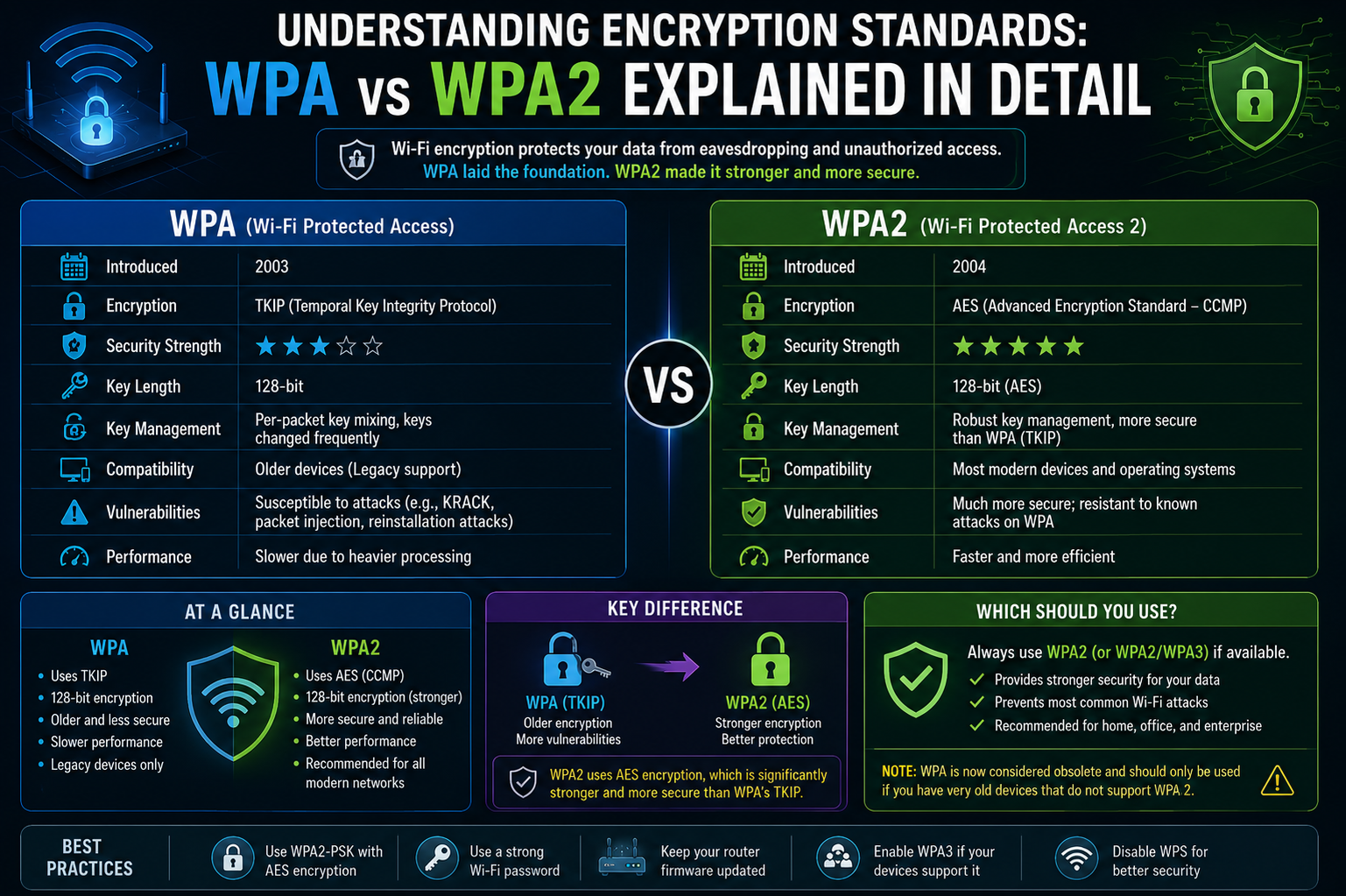
WPA, which stands for Wireless Protected Access, was introduced as an improvement over previous systems. It was designed to strengthen wireless security without requiring major changes to existing hardware. This made it easier for organizations and individuals to adopt improved protection without replacing their entire network infrastructure.
The introduction of WPA marked a turning point in wireless security. It addressed many of the weaknesses found in earlier systems by introducing more advanced encryption techniques and better authentication methods. One of its key improvements was the dynamic generation of encryption keys. Instead of using a single static key, WPA systems generate keys that change over time, making it significantly harder for attackers to break the encryption.
However, technology continues to evolve, and so do security threats. As attackers discovered new ways to exploit weaknesses in WPA, improvements were necessary. This led to the development of WPA2, a more advanced version of the original protocol. WPA2 introduced stronger encryption methods and became the standard for wireless security for many years.
At the core of WPA2 is a powerful encryption system that replaced older, weaker algorithms. This new system provides a much higher level of security and is capable of protecting sensitive data even in environments where attacks are common. It also introduced better support for enterprise-level authentication, making it suitable for both small networks and large organizations.
Encryption standards like WPA and WPA2 are not just technical concepts used by engineers. They are essential components of everyday digital life. Whenever a device connects to a Wi-Fi network, these standards determine how securely the connection is established. Whether someone is browsing the internet, sending emails, or accessing online services, encryption is working silently in the background to protect the data.
One of the key challenges in wireless security is balancing usability and protection. While strong encryption is necessary, it must also be practical for everyday users. If security systems are too complicated, users may avoid using them or configure them incorrectly. This is why WPA and WPA2 were designed to be both secure and relatively easy to implement.
Another important aspect of encryption standards is compatibility. Wireless devices come from many different manufacturers, and they must be able to communicate securely with each other. Standardized encryption protocols ensure that a smartphone, laptop, or router can all work together without compatibility issues while still maintaining strong security.
As wireless networks continue to expand, the importance of encryption standards becomes even more significant. Public Wi-Fi networks, in particular, present unique risks because they are open to many users at once. Without proper encryption, sensitive information transmitted over these networks could be exposed to malicious actors.
This is why encryption standards are continuously reviewed and improved. Security experts analyze potential weaknesses and develop updates to address emerging threats. The evolution from early wireless security systems to WPA and WPA2 demonstrates how cybersecurity is an ongoing process rather than a one-time solution.
Understanding encryption standards is essential for anyone working with or using wireless networks. Even though most users do not interact directly with encryption settings, these systems play a critical role in protecting digital communication. Every secure Wi-Fi connection relies on these underlying technologies to ensure safe and reliable data transfer.
As wireless technology becomes more deeply integrated into daily life, from smartphones and smart home devices to industrial systems and critical infrastructure, the role of encryption standards becomes even more important. Without them, modern digital communication would be far more vulnerable to interception and misuse.
The development of WPA and WPA2 represents a major milestone in the evolution of network security. These standards laid the foundation for more advanced systems that continue to improve wireless protection. Their introduction helped establish a safer digital environment where users can communicate and share data with greater confidence.
In the following sections, the focus will shift toward how WPA operates in practical environments, how it secures wireless communication at a technical level, and how it fits into real-world network setups used in homes and organizations.
How WPA Works in Wireless Network Security
Wireless networks operate by transmitting data through radio waves, which makes them fundamentally different from wired systems. While this flexibility allows devices to connect without physical cables, it also introduces security challenges. Anyone within range of a wireless signal can potentially intercept the communication if it is not properly protected. WPA, or Wireless Protected Access, was developed to address this exact vulnerability by securing data as it travels through the air.
At its core, WPA is not just a single feature but a combination of security mechanisms that work together. It focuses on encrypting data, verifying user identity, and ensuring that transmitted information remains unchanged. These functions are essential in preventing unauthorized access and maintaining trust between connected devices.
When a device attempts to connect to a WPA-protected network, a structured authentication process begins. The device must first prove that it is allowed to join the network. This is typically done using a password or passphrase. However, the process behind the scenes is more complex than simply entering a password. The system uses that input to generate encryption keys that will be used during the session.
One of the key innovations introduced with WPA was dynamic key generation. Instead of using a single fixed encryption key for all communications, WPA creates unique session keys. These keys are frequently refreshed, which reduces the risk of long-term exposure. Even if an attacker manages to capture some encrypted data, the constantly changing keys make it extremely difficult to decrypt the entire communication stream.
WPA also introduced improved encryption techniques compared to earlier wireless security systems. It initially used a protocol called Temporal Key Integrity Protocol, which was designed to strengthen encryption without requiring entirely new hardware. This allowed older devices to adopt better security without major upgrades. However, as time passed, limitations in this method became apparent, leading to the development of more secure alternatives in later standards.
Another important function of WPA is data integrity verification. When data is transmitted across a network, there is always a risk that it could be altered during transit. This could happen due to malicious interference or accidental corruption. WPA includes mechanisms that detect whether data has been tampered with. If any unauthorized modification is detected, the data is rejected, ensuring that only authentic information reaches its destination.
Authentication is another critical component of WPA’s operation. Before granting access, the system verifies that both the user and the device are legitimate. In simpler home networks, this may involve a shared password. In more advanced environments, additional authentication layers may be used to strengthen security.
The strength of WPA lies in its ability to combine these functions into a seamless user experience. From the perspective of the user, connecting to a WPA-secured network feels simple—enter a password and connect. However, behind the scenes, multiple cryptographic processes are taking place to ensure that the connection is secure.
WPA also introduced protection against certain types of attacks that were common in earlier wireless systems. One such attack involves capturing network traffic and attempting to analyze it over time to discover encryption keys. By frequently changing keys and improving encryption structure, WPA significantly reduces the effectiveness of these methods.
Another important feature of WPA is its support for message integrity checks. These checks ensure that any data received has not been altered during transmission. If even a small change is detected, the system recognizes the data as invalid. This prevents attackers from injecting malicious content into network communication without detection.
In practical terms, WPA operates at the network level, meaning it works automatically whenever a device connects to a secured Wi-Fi network. Users do not need to manually configure encryption settings for each connection. Instead, the router and the device negotiate security settings in the background before data exchange begins.
The introduction of WPA was also important from a compatibility perspective. At the time of its release, many devices were already in use that could not support completely new security systems. WPA was designed to be a transitional solution, improving security while maintaining support for existing hardware. This allowed widespread adoption without disrupting users or requiring immediate infrastructure replacement.
Despite its improvements over earlier systems, WPA was not perfect. Over time, researchers identified vulnerabilities that could potentially be exploited under certain conditions. These weaknesses were not always easy to exploit, but they demonstrated the need for further advancement in wireless security. This led to the development of WPA2, which introduced stronger encryption standards and more robust security architecture.
Understanding how WPA works also requires recognizing its role in everyday environments. In homes, WPA protects personal internet usage, including browsing, streaming, and online communication. In business environments, it helps safeguard sensitive corporate data and internal systems. Without WPA or similar encryption, wireless networks would be highly exposed to interception and unauthorized access.
Another important aspect of WPA is its role in establishing trust between devices. When multiple devices connect to the same network, they must be able to communicate securely without interfering with each other’s data. WPA ensures that each connection is encrypted individually, preventing one device from accessing another device’s traffic.
The design of WPA also reflects a balance between security and performance. Encryption processes require computational resources, which can affect network speed if not optimized properly. WPA was engineered to provide strong security while minimizing performance impact, allowing users to maintain fast and reliable wireless connections.
As wireless usage expanded globally, WPA became a widely adopted standard. Its influence can still be seen in modern networking systems, even though newer protocols have replaced it in many environments. The foundational concepts introduced by WPA continue to shape how wireless security is designed today.
In addition to protecting data, WPA also plays a role in managing network access. Administrators can configure networks to allow or restrict access based on security settings. This helps control who can connect and ensures that only authorized users are able to access network resources.
WPA’s importance becomes even more evident in environments where multiple users share a single network. In such cases, security must be strong enough to protect individual users while still allowing smooth communication across the network. WPA achieves this through its encryption and authentication structure.
While WPA significantly improved wireless security, it also highlighted the importance of ongoing development in cybersecurity. As threats evolve, security standards must evolve as well. WPA served as a stepping stone toward more advanced systems that continue to protect modern wireless communication.
The next stage in this evolution introduced WPA2, which built upon the foundation of WPA and introduced even stronger encryption methods and improved security protocols. Understanding WPA is essential before moving on to WPA2, as it provides the historical and technical context needed to appreciate the advancements that followed.
WPA2 and the Shift to Stronger Wireless Encryption
As wireless networks became more common in homes, businesses, and public environments, the limitations of earlier security systems became increasingly clear. WPA improved security significantly compared to previous standards, but it was still built partly on transitional technologies that were not designed to withstand long-term, evolving cyber threats. This led to the introduction of WPA2, a more advanced and more secure encryption standard that became the foundation of modern Wi-Fi security for many years.
WPA2 was designed to address weaknesses found in WPA while maintaining compatibility with existing wireless devices. The most important improvement introduced by WPA2 was the adoption of a stronger encryption system known as the Advanced Encryption Standard. This change alone marked a major shift in how wireless communication was protected, moving away from older, weaker encryption methods and toward a system considered highly secure even by modern cybersecurity standards.
Unlike earlier approaches, WPA2 relies on a more robust cryptographic structure that makes it significantly harder for attackers to decipher intercepted data. This encryption system works by transforming readable information into complex encoded data that cannot be understood without the correct encryption key. Even if someone captures the transmitted data, it remains useless without access to the proper decryption process.
One of the key strengths of WPA2 is its ability to securely manage encryption keys. In wireless communication, encryption keys act like digital locks and keys that control access to information. WPA2 improves how these keys are generated, exchanged, and protected during communication sessions. This reduces the chances of interception or unauthorized duplication of security credentials.
WPA2 also strengthened the authentication process. Authentication is the method used to verify that a device or user is allowed to access the network. In simpler systems, this process relied heavily on shared passwords, which could be vulnerable if exposed. WPA2 improved this by introducing more advanced authentication frameworks, especially in enterprise environments where stronger identity verification is required.
In addition to encryption and authentication improvements, WPA2 enhanced data integrity protection. This ensures that any information transmitted across the network cannot be altered without detection. If data is modified during transmission, WPA2 is designed to identify the change and reject the corrupted information. This helps prevent malicious tampering and ensures that communication remains reliable and trustworthy.
Another important advancement in WPA2 is its support for more secure communication between multiple devices on the same network. In a typical wireless environment, many devices may be connected at the same time, including smartphones, laptops, printers, and smart devices. WPA2 ensures that each connection is independently secured, preventing one device from accessing or interfering with another device’s data stream.
WPA2 also improved resistance to common wireless attacks that were more effective against earlier protocols. Attackers often attempt to capture network traffic and analyze it to discover patterns or encryption weaknesses. WPA2 makes this significantly more difficult by using stronger encryption methods and more secure key management techniques. This reduces the likelihood that intercepted data can be used to compromise the network.
A major advantage of WPA2 is its adaptability to different types of environments. It is designed to work in both simple home networks and complex enterprise systems. In home environments, WPA2 typically operates using a shared password system that is easy to set up and use. In enterprise environments, however, it supports more advanced authentication methods that involve centralized verification systems.
This flexibility made WPA2 widely adopted across the world. It became the default security standard for most Wi-Fi networks, replacing older protocols that were no longer considered secure. Its widespread use helped establish a more consistent baseline of wireless security across different devices and industries.
Despite its strengths, WPA2 is not entirely immune to vulnerabilities. Over time, researchers discovered certain weaknesses that could potentially be exploited under specific conditions. These issues were not trivial, but they highlighted the reality that no security system is permanently invulnerable. Cybersecurity is an ongoing process that requires continuous improvement and adaptation.
One of the reasons WPA2 remained widely used despite these vulnerabilities is its strong overall design. Even with certain weaknesses identified, it still provided a high level of protection compared to previous standards. For many years, it was considered secure enough for most practical applications, especially when combined with good security practices.
WPA2 also plays an important role in modern digital life because of its integration into a wide range of devices. From routers and smartphones to laptops and IoT devices, WPA2 became a universal standard for wireless communication. This widespread compatibility ensured that users could connect devices easily without sacrificing security.
Another important aspect of WPA2 is how it handles encryption in real time. When data is transmitted over a wireless network, it is continuously encrypted and decrypted as it moves between devices. This process happens almost instantly, allowing users to browse the internet, stream media, and communicate without noticeable delays. The efficiency of WPA2 encryption helps maintain a balance between security and performance.
WPA2 also improved the way wireless networks handle session security. Each time a device connects to a network, a unique session is established. This session includes its own encryption keys and security parameters. If the connection is interrupted and later reestablished, new security keys are generated. This prevents attackers from reusing old session data to gain unauthorized access.
In enterprise environments, WPA2 plays an even more critical role. Organizations often rely on centralized authentication systems that verify user identities before granting access to network resources. This ensures that only authorized personnel can connect to sensitive internal systems. It also allows administrators to manage access permissions more effectively across large networks.
The introduction of WPA2 represented a significant step forward in wireless security architecture. It not only improved encryption strength but also enhanced the overall structure of how devices communicate securely over wireless networks. This made it suitable for a wide range of applications, from personal internet usage to large-scale corporate networks.
WPA2 also contributed to shaping user expectations around wireless security. Over time, users became accustomed to the idea that Wi-Fi networks should be protected by strong encryption by default. This shift in expectation helped drive further improvements in security standards and encouraged manufacturers to prioritize secure configurations in their devices.
Another important feature of WPA2 is its ability to support multiple encryption modes depending on network requirements. This allows administrators to configure security settings based on the level of protection needed. For example, more secure configurations may be used in environments handling sensitive data, while simpler configurations may be used in less critical settings.
WPA2’s design also reflects a focus on long-term stability. Unlike earlier protocols that were quickly replaced due to security flaws, WPA2 remained in use for many years because of its strong foundation. Even as newer standards emerged, WPA2 continued to serve as a reliable option for millions of networks worldwide.
The continued relevance of WPA2 demonstrates the importance of strong cryptographic design in cybersecurity. While no system is perfect, a well-designed standard can remain effective for a long time if it is built on solid principles. WPA2 achieved this by combining strong encryption, reliable authentication, and effective integrity protection.
As wireless communication continues to evolve, WPA2 serves as a bridge between earlier insecure systems and newer, more advanced security protocols. Understanding how it works provides essential context for exploring the next generation of Wi-Fi security and how modern networks continue to protect data in an increasingly connected world.
WPA2 in Real-World Networks and Everyday Usage
WPA2 is often discussed as a technical standard, but its real value becomes clearer when it is seen in action across everyday environments. From homes and schools to offices and public spaces, WPA2 quietly operates in the background of nearly every wireless connection. It is responsible for securing the invisible flow of data that powers modern digital life, ensuring that information remains protected even when transmitted through open air.
In a typical home network, WPA2 is the default security layer used by most routers. When a user connects a phone, laptop, or smart device to Wi-Fi, WPA2 immediately begins the process of securing that connection. The user usually only sees a simple password prompt, but behind that simple step, multiple cryptographic processes are being executed. The router and device exchange encrypted information, verify credentials, and establish a secure communication channel before any actual data transfer begins.
This process is designed to be seamless so that users do not need to understand the technical complexity behind it. The goal is to make security automatic while still maintaining strong protection. Once the connection is established, all internet activity—such as browsing websites, streaming videos, or sending messages—is encrypted using WPA2 mechanisms.
In home environments, WPA2 typically operates in a mode that relies on a shared password. This means that all authorized users on the network use the same passphrase to gain access. While this is simple and convenient, it also means that the strength of the network’s security depends heavily on the quality of that password. A weak or easily guessed password can compromise the entire network, even if WPA2 itself is strong.
In contrast, public networks such as those in cafés, airports, or hotels often use WPA2 in a more open configuration or sometimes without proper encryption at all. When WPA2 is not properly configured in these environments, users may unknowingly expose their data to interception. Even though WPA2 is capable of strong security, it must be correctly implemented to be effective.
In business environments, WPA2 plays a much more structured and controlled role. Organizations often rely on centralized systems to manage network access. Instead of a single shared password, each user may have individual credentials. This allows administrators to control who can access the network and track usage more effectively. It also reduces the risk of unauthorized access if one set of credentials is compromised.
Enterprise networks using WPA2 are designed with additional layers of security beyond simple encryption. These systems often include authentication servers that verify user identities before granting access. This ensures that only approved devices and users can connect to sensitive internal resources. In such environments, WPA2 becomes part of a larger security framework rather than a standalone protection mechanism.
Another important aspect of WPA2 in real-world usage is how it handles multiple devices simultaneously. Modern networks often support dozens or even hundreds of connected devices at the same time. Each device requires its own secure communication channel. WPA2 manages this by creating unique encryption sessions for each connection, ensuring that data from one device cannot be accessed by another.
This separation of communication is essential in environments like offices or schools, where many users share the same network infrastructure. Without this isolation, data privacy would be extremely difficult to maintain. WPA2 ensures that even though devices share the same physical network, their data remains logically separated and protected.
WPA2 also plays a significant role in securing mobile computing. As laptops and smartphones move between different networks, they must continuously establish new secure connections. Each time a device connects to a new WPA2 network, a fresh encryption session is created. This dynamic process helps maintain security even as users move between different locations throughout the day.
In addition to protecting data in transit, WPA2 also helps prevent unauthorized network access. Without proper authentication, devices cannot join the network or communicate with other connected systems. This acts as a barrier against intrusion attempts, ensuring that only trusted devices can participate in network activity.
However, the effectiveness of WPA2 in real-world environments depends heavily on proper configuration. Even though the standard itself is strong, incorrect setup can create vulnerabilities. For example, using weak passwords, outdated firmware, or improper network settings can reduce overall security. This is why configuration practices are just as important as the encryption standard itself.
Another real-world challenge is user behavior. Many security issues arise not from weaknesses in WPA2, but from human factors. Users may share passwords too freely, reuse weak credentials, or connect to unsecured networks without understanding the risks. These behaviors can undermine even the strongest encryption systems.
In large organizations, managing WPA2 networks requires careful planning. Network administrators must ensure that security policies are consistently applied across all access points. This includes controlling who can connect, monitoring network activity, and updating systems regularly to address potential vulnerabilities.
WPA2 also interacts with other network technologies that support modern connectivity. For example, it works alongside routing systems, firewalls, and intrusion detection tools to create a layered security environment. While WPA2 protects the wireless connection itself, other systems handle traffic filtering and threat detection once data enters the internal network.
In industrial and critical infrastructure environments, WPA2 is often part of more complex security architectures. These environments require extremely high levels of reliability and protection. Wireless networks in such settings may be carefully segmented, with WPA2 serving as one component in a broader security strategy that includes physical security, network monitoring, and strict access control policies.
Another important real-world application of WPA2 is in the Internet of Things ecosystem. Smart devices such as cameras, thermostats, and sensors rely heavily on wireless connectivity. WPA2 provides the encryption needed to protect communication between these devices and central systems. Without it, sensitive data from smart environments could be exposed to unauthorized access.
Despite its widespread use, WPA2 has limitations that become more apparent in modern networking environments. As the number of connected devices increases and cyber threats become more advanced, the need for stronger and more flexible security systems grows. These limitations have encouraged the development of newer standards, but WPA2 remains widely deployed due to its reliability and compatibility.
One of the key reasons WPA2 continues to be used is its balance between security and performance. It provides strong encryption without placing excessive strain on devices or networks. This makes it suitable for both older hardware and modern systems, allowing for broad adoption across different technologies.
In real-world terms, WPA2 serves as a foundation for trust in wireless communication. Users may not see it working directly, but it is constantly active whenever a device is connected to a Wi-Fi network. It ensures that sensitive information such as passwords, personal messages, and financial data are protected as they move across the network.
The continued reliance on WPA2 across many environments highlights its importance in the evolution of wireless security. Even as newer technologies emerge, WPA2 remains a critical part of global networking infrastructure. Its role in everyday connectivity demonstrates how deeply embedded encryption standards have become in modern life, operating silently but effectively to protect digital communication.
WPA2 Security Mechanisms and How Data Protection Really Works
Behind every Wi-Fi connection protected by WPA2, there is a carefully structured system of cryptography and verification working continuously. While users only experience a simple “connected” status, the actual process involves multiple layers of security designed to protect data from interception, tampering, and unauthorized access. Understanding how these mechanisms function helps clarify why WPA2 became such an important standard in wireless networking.
At the heart of WPA2 is encryption, which transforms readable data into an unreadable format before it is transmitted. This process ensures that even if someone captures the wireless signal, they cannot interpret its contents without the correct cryptographic key. The encryption system used in WPA2 is based on a strong mathematical algorithm that is widely trusted in cybersecurity due to its resistance to brute-force attacks and cryptographic analysis.
When a device connects to a WPA2 network, a secure handshake process begins. This handshake is a negotiation between the device and the wireless access point. During this exchange, both sides confirm each other’s identity and agree on encryption keys that will be used for the session. These keys are not static; they are generated dynamically for each connection, which significantly reduces the risk of long-term exposure.
The handshake process is one of the most critical parts of WPA2 security. It ensures that both the client device and the network are legitimate before any actual data transfer begins. If an attacker tries to interfere or impersonate either side, the handshake process will fail, preventing unauthorized access. This mechanism is essential for maintaining trust in wireless communication.
Once the handshake is complete, WPA2 establishes what is known as a session key. This key is used to encrypt all data transmitted between the device and the network. Even if the same device reconnects later, a new session key is generated. This constant renewal of encryption keys ensures that previous sessions cannot be reused or exploited by attackers.
Another important component of WPA2 is message integrity protection. This ensures that data is not altered while in transit. When information is sent across a wireless network, it can potentially be intercepted and modified by malicious actors. WPA2 includes cryptographic checks that verify whether the data has been changed. If any modification is detected, the data is rejected before it reaches its destination.
This integrity mechanism is essential because encryption alone is not enough to guarantee security. Without integrity checks, attackers could potentially alter encrypted messages without fully decrypting them. WPA2 prevents this by attaching verification data to each transmitted packet, allowing the receiving device to confirm that the data is authentic and unchanged.
WPA2 also protects against replay attacks, which occur when an attacker captures valid data packets and attempts to resend them later to gain unauthorized access or disrupt communication. To prevent this, WPA2 uses sequence tracking and time-based validation techniques. These methods ensure that old or duplicated packets are rejected by the network.
In addition to encryption and integrity, WPA2 includes strong authentication mechanisms. Authentication ensures that only authorized users or devices can access the network. In home environments, this typically involves a shared password, but the underlying system still performs complex verification processes to ensure that the password is valid and has not been tampered with.
In more advanced environments, authentication becomes significantly more complex. Instead of relying on a single shared password, WPA2 can integrate with centralized authentication systems that verify each user individually. This approach allows organizations to manage access more precisely and revoke permissions when necessary without affecting the entire network.
A key strength of WPA2 is its ability to isolate communication between devices. Even though multiple devices may be connected to the same wireless network, WPA2 ensures that each device’s traffic remains encrypted separately. This prevents one user from accessing another user’s data, even if they are on the same network.
WPA2 also incorporates protection against common wireless attacks that attempt to exploit weaknesses in network communication. One such threat involves capturing encrypted data and attempting to analyze patterns over time. WPA2 reduces the effectiveness of these attacks by frequently changing encryption keys and using strong cryptographic randomness in key generation.
Another important feature is forward secrecy in certain configurations. This concept ensures that even if a long-term key is compromised, past communication sessions remain secure. Each session is independently encrypted, so breaking one key does not automatically expose previous data transmissions.
The strength of WPA2 also comes from its layered design. It does not rely on a single mechanism for security. Instead, it combines encryption, authentication, integrity verification, and session management into a unified system. This layered approach makes it significantly more difficult for attackers to find a single point of failure.
WPA2 is also designed to operate efficiently across a wide range of devices. Wireless communication must balance security with performance, especially in environments where speed and responsiveness are important. WPA2 achieves this by optimizing cryptographic processes so that they run quickly without noticeably affecting user experience.
Another important aspect of WPA2 security is its compatibility with hardware acceleration. Many modern devices include built-in support for encryption operations, allowing WPA2 to perform complex calculations more efficiently. This reduces processing load and ensures smooth network performance even under heavy usage.
Despite its strength, WPA2 is not immune to vulnerabilities. Over time, researchers have discovered certain edge-case weaknesses that could be exploited under specific conditions. However, these issues typically require advanced technical knowledge and specific circumstances to be effective. In most real-world scenarios, WPA2 remains a strong and reliable security standard.
One of the reasons WPA2 has remained widely used is its adaptability. It can function effectively in both simple and complex network environments without requiring major changes to existing infrastructure. This flexibility has contributed to its long-term adoption across homes, businesses, and public networks.
WPA2 also plays a crucial role in securing modern digital ecosystems that rely heavily on wireless communication. As more devices become connected, the importance of secure data transmission continues to grow. WPA2 ensures that this communication remains protected even in highly active network environments.
In enterprise environments, WPA2 security mechanisms are often combined with additional monitoring and control systems. These systems analyze network traffic for unusual behavior and help detect potential threats. While WPA2 protects the transmission itself, these supplementary tools provide broader visibility and control over network activity.
Conclusion
Wireless networking has transformed the way people communicate, work, and access information, but this convenience also introduces serious security challenges. Because Wi-Fi signals travel openly through the air, they are naturally vulnerable to interception and unauthorized access. Encryption standards such as WPA and WPA2 were developed to solve these problems by protecting wireless communication and ensuring that data remains secure during transmission.
WPA marked a major improvement in wireless security by introducing stronger encryption methods and better authentication processes than earlier standards. It helped reduce many of the weaknesses that previously exposed wireless networks to attackers. However, as technology evolved and cyber threats became more advanced, WPA2 emerged as a stronger and more reliable solution. By introducing advanced encryption techniques, improved integrity protection, and more secure authentication systems, WPA2 became the foundation of modern Wi-Fi security for homes, businesses, and enterprise environments.
The widespread adoption of WPA2 significantly improved the safety of wireless communication around the world. It allowed users to browse the internet, exchange sensitive information, and connect multiple devices with greater confidence. At the same time, WPA2 demonstrated that cybersecurity is not a fixed achievement but an ongoing process that must continuously adapt to new threats and technological changes.
Even though newer security standards are now being introduced, WPA2 remains an important part of wireless networking history and infrastructure. Its influence continues to shape modern security practices and encryption technologies. Understanding how WPA and WPA2 work provides valuable insight into the importance of network security and highlights why protecting wireless communication remains essential in an increasingly connected digital world.