Modern computing systems are constantly exchanging data with other systems, often without any visible indication to the user. Every time a page loads, a file syncs, a message sends, or an application updates in the background, small streams of network traffic move across local devices, corporate systems, and global infrastructure. This constant exchange is what makes modern digital life possible, but it is also what creates exposure. Not every incoming or outgoing connection is harmless, and not every device on a network behaves predictably. That reality is where firewall technology begins to matter.
Before any distinction between hardware and software firewalls can make sense, it is important to understand what firewalls were designed to solve in the first place. Early computer networks were built around trust. Systems were connected in controlled environments, and most communication happened between known devices. As the internet expanded, that trust model collapsed. Suddenly, any system connected to a network could be reached from almost anywhere in the world. This openness created enormous opportunity, but it also introduced constant exposure to unwanted or malicious traffic.
A firewall emerged as a control mechanism placed between trusted systems and untrusted networks. Its role is not to judge intent in a human sense, but to enforce rules about what is allowed to pass and what must be stopped. In the simplest form, a firewall examines traffic and compares it against predefined conditions such as addresses, ports, or protocols. If the traffic matches acceptable conditions, it is permitted through. If it does not, it is blocked before reaching its destination.
This basic idea may sound straightforward, but it represents a major shift in how networks are protected. Instead of relying on isolated systems to defend themselves individually, firewalls introduce a shared boundary of enforcement. That boundary becomes the first checkpoint for all data entering or leaving a network.
The Early Logic Behind Filtering Network Traffic
In the earliest implementations, firewall logic was relatively simple. Networks operated using clearly defined communication channels. Devices used specific ports to send and receive data, and administrators could define rules around those ports. For example, a web server might allow incoming traffic only through a secure web communication channel, while blocking everything else by default.
This approach reduced risk significantly. If a service did not need to be publicly accessible, it could simply be blocked at the firewall level. That prevented attackers from even attempting to interact with unnecessary services. Over time, this model evolved from basic allow-and-block rules into more intelligent systems capable of inspecting deeper layers of traffic behavior.
As network threats became more sophisticated, firewalls began to adopt deeper inspection capabilities. Instead of only looking at surface-level information such as ports and addresses, they started analyzing the contents of data packets. This allowed them to detect patterns associated with malicious activity, unauthorized access attempts, or unusual communication behavior. The concept of deep inspection became a turning point, because it shifted firewalls from passive filters into active security tools.
Modern firewalls now include features such as intrusion detection, intrusion prevention, and application-level filtering. These enhancements allow them to recognize complex attack patterns, rather than just blocking obvious or simplistic threats. However, even with these advancements, the core function remains the same: controlling traffic based on rules and behavior analysis.
How Firewalls Became Layered Security Systems
As digital environments expanded, so did the need for layered protection. Organizations began to realize that no single security tool could address every type of threat. Firewalls became one part of a larger ecosystem of defenses, working alongside antivirus tools, endpoint protection systems, encryption mechanisms, and monitoring platforms.
Within this ecosystem, firewalls serve as the first major barrier. They reduce unnecessary exposure by limiting what can enter or leave a network in the first place. This is important because many cyber threats rely on access rather than complexity. If access is denied early, the threat never reaches deeper systems.
Over time, firewall technology diversified into different categories based on where and how protection is applied. This is where the distinction between hardware and software firewalls begins to take shape. Before comparing them, however, it is important to understand how modern firewalls are deployed within real-world environments.
The Shift Toward Specialized Firewall Hardware
As network traffic volumes increased, general-purpose computing systems struggled to keep up with the demands of real-time traffic inspection. Firewalls needed to analyze large amounts of data without slowing down network performance. This led to the development of dedicated hardware appliances designed specifically for firewall operations.
These devices are built with optimized processors and architectures designed to handle continuous traffic flow at high speeds. Instead of sharing resources with general applications, they are focused entirely on filtering and inspecting network data. This specialization allows them to operate efficiently even in environments where thousands or millions of connections occur simultaneously.
In enterprise environments, dedicated firewall hardware became a standard component of network architecture. These devices are typically placed at network entry points, where they act as gatekeepers between internal systems and external networks. Every connection must pass through them before reaching internal devices.
Several well-known firewall platforms emerged in this category. For example, Cisco Systems developed enterprise-grade firewall solutions such as the Cisco ASA series, which became widely used in corporate environments for its stability and scalability. Similarly, Fortinet offers the FortiGate platform, known for integrating security functions into a unified system. Other major players include Palo Alto Networks with its PA series firewalls, and Juniper Networks with its Juniper SRX series.
These systems reflect a broader shift in security design. Instead of treating firewall functionality as a simple filtering tool, they position it as a centralized intelligence layer that can enforce complex security policies across entire networks.
Why Software-Based Protection Also Emerged
While hardware firewalls are designed for network-level protection, another category evolved to address a different need: device-level security. Not all systems operate within a controlled network environment. Laptops, personal devices, and remote systems frequently connect to networks outside organizational control. In such environments, relying solely on centralized protection is not enough.
Software firewalls address this gap by running directly on individual devices. Instead of controlling traffic for an entire network, they focus on protecting a single system. This allows them to enforce rules based on the behavior of applications installed on that device, as well as the connections it initiates or receives.
This type of firewall became especially important as remote work and mobile computing became more common. Devices that move between different networks cannot always rely on a fixed perimeter of protection. A software-based approach ensures that security follows the device rather than the network.
Unlike hardware systems, software firewalls are constrained by the resources of the device they run on. They share processing power, memory, and system resources with other applications. However, because they are only responsible for one device, they do not need to handle large-scale traffic loads.
The Growing Complexity of Network Boundaries
One of the most important developments in modern networking is the disappearance of a clear boundary between internal and external systems. In earlier models, networks were relatively contained. Devices stayed within defined environments, and security could be enforced at a single entry point.
Today, that model no longer holds. Cloud systems, mobile devices, remote work environments, and distributed applications have blurred the lines between internal and external traffic. A single user might connect to corporate systems from multiple locations in a single day, each with different security conditions.
This shift has forced firewall technology to evolve beyond static placement. Security can no longer rely on a single protective barrier. Instead, it must exist at multiple levels simultaneously. Hardware firewalls provide centralized control at the network edge, while software firewalls extend protection to individual endpoints.
Together, they form a layered approach to security that adapts to modern usage patterns. Each layer compensates for the limitations of the other. Hardware systems provide strength and scale, while software systems provide flexibility and mobility.
The Transition Toward Intelligent Filtering
As threats continue to evolve, firewalls are no longer just passive gatekeepers. They increasingly rely on behavioral analysis, contextual awareness, and real-time decision-making. Instead of only checking whether a connection matches a rule, they can evaluate whether the behavior of that connection appears normal or suspicious.
This transition has been gradual but significant. It reflects a broader trend in cybersecurity, where systems are expected to adapt dynamically rather than rely on static configurations. Firewalls now operate in environments where threats may disguise themselves as legitimate traffic, making simple rule-based filtering insufficient.
The result is a security landscape where firewalls function as intelligent control systems rather than simple barriers. This intelligence is distributed differently depending on whether the firewall is hardware-based or software-based, which becomes increasingly important when deciding how each should be used.
Hardware Firewalls and the Architecture of Network-Level Protection
As networks expanded beyond small office setups into large, interconnected infrastructures, the need for centralized, high-performance security control became unavoidable. This is where hardware firewalls became essential. Unlike software-based protection that operates on individual machines, hardware firewalls are designed to protect entire networks from a single, strategically placed point of control. They function as a physical and logical boundary between internal systems and external networks, handling all traffic that enters or exits an organization.
At their core, hardware firewalls are dedicated appliances built specifically for traffic inspection and policy enforcement. They are not general-purpose computers running firewall software; instead, they are engineered devices optimized for continuous, high-speed packet processing. This specialization allows them to handle large volumes of simultaneous connections without becoming a performance bottleneck.
The Physical Placement of Hardware Firewalls in Networks
The effectiveness of a hardware firewall depends heavily on where it is placed within a network. In most traditional designs, it sits at the edge of the network, directly between the internal infrastructure and the external internet connection provided by an internet service provider. This positioning ensures that every packet of data must pass through the firewall before reaching any internal device.
This placement creates a centralized inspection point. Instead of configuring security settings on dozens or hundreds of individual machines, administrators can enforce rules at a single gateway. This reduces complexity and ensures consistency across the entire network. If a rule is updated, it immediately affects all traffic passing through the firewall, without requiring changes on individual endpoints.
In larger environments, multiple hardware firewalls may be deployed across different network segments. For example, separate firewalls may exist for internal departments, data centers, or guest networks. This segmentation allows organizations to apply different security policies depending on the sensitivity of the systems being protected.
Dedicated Processing for High-Speed Traffic Inspection
One of the defining characteristics of hardware firewalls is their ability to process large amounts of traffic in real time. Unlike software firewalls that depend on the computing resources of a single device, hardware firewalls use specialized processors designed for network operations. These processors are optimized for tasks such as packet filtering, encryption, and intrusion detection.
This specialization is critical because modern networks generate enormous amounts of data. Every application, service, and connected device contributes to a continuous flow of network traffic. Without dedicated processing capabilities, inspecting this traffic at scale would slow down the entire system.
Hardware firewalls avoid this problem by distributing workloads across optimized hardware components. Some models include dedicated security processors that handle encryption and decryption tasks, while others use parallel processing architectures to analyze multiple data streams simultaneously. This ensures that security checks do not become a performance bottleneck.
Policy Enforcement at a Centralized Level
Another major advantage of hardware firewalls is centralized policy enforcement. Instead of configuring rules on each individual device, administrators define security policies at the firewall level. These policies determine what types of traffic are allowed, what should be blocked, and under what conditions exceptions may apply.
For example, an organization may allow web traffic on standard secure ports while blocking access to administrative services from external networks. These rules are enforced consistently across the entire network, reducing the risk of configuration errors or inconsistent security settings.
Centralized control also simplifies auditing and monitoring. Because all traffic passes through a single point, it becomes easier to analyze patterns, detect anomalies, and respond to potential threats. This visibility is particularly important in enterprise environments where regulatory compliance and security reporting are required.
Advanced Security Capabilities in Modern Hardware Firewalls
Modern hardware firewalls go far beyond simple traffic filtering. They include a wide range of advanced security features designed to detect and prevent complex threats. One of the most important of these features is deep packet inspection. Instead of only examining basic header information, deep inspection analyzes the actual contents of data packets to identify malicious behavior or suspicious patterns.
Another important capability is intrusion detection and prevention. These systems monitor network activity for known attack signatures or unusual behavior patterns. When a threat is detected, the firewall can either alert administrators or actively block the connection before damage occurs.
Many hardware firewalls also include virtual private network functionality. This allows remote users to securely connect to internal networks through encrypted tunnels. This feature has become increasingly important as remote work and distributed teams have become more common.
Web filtering and application control are also common features. These allow organizations to restrict access to specific types of content or applications based on policy requirements. For example, certain websites or services may be blocked to reduce security risks or enforce productivity standards.
The Role of Hardware Firewalls in Enterprise Environments
In enterprise environments, hardware firewalls serve as the foundation of network security architecture. They are typically deployed in high-availability configurations to ensure continuous protection even in the event of hardware failure. This redundancy is critical in environments where downtime can have significant operational or financial consequences.
Large organizations often use multiple layers of hardware firewalls to create segmented security zones. Sensitive systems such as financial databases or customer records may be isolated behind additional firewall layers, reducing exposure to potential threats.
Hardware firewalls also integrate with other security systems such as intrusion detection platforms, security information and event management tools, and endpoint protection systems. This integration allows for coordinated responses to threats across multiple layers of the infrastructure.
Performance Advantages in High-Traffic Networks
One of the primary reasons organizations choose hardware firewalls is their ability to maintain performance under heavy load. In environments where thousands or even millions of connections occur simultaneously, software-based solutions may struggle to keep up. Hardware firewalls are designed specifically to handle this scale.
Because they operate independently of general-purpose computing resources, they do not compete with business applications for processing power. This separation ensures that security functions do not interfere with normal network operations.
High-throughput environments such as data centers, large corporate networks, and service providers rely heavily on this capability. In these scenarios, even small delays in traffic processing can have noticeable impacts on user experience and system performance.
Scalability Through Modular Design
Modern hardware firewall systems are often designed with scalability in mind. As network demands grow, additional capacity can be added through hardware upgrades, module expansion, or clustering multiple devices together.
This modular approach allows organizations to start with smaller configurations and gradually expand as needed. It also provides flexibility in adapting to changing traffic patterns or security requirements without replacing entire systems.
Some hardware firewall platforms support load balancing across multiple devices. This ensures that traffic is distributed evenly, preventing any single device from becoming overwhelmed. In high-demand environments, this type of scalability is essential for maintaining both security and performance.
Operational Considerations and Maintenance Requirements
While hardware firewalls offer significant advantages, they also come with operational considerations. Because they are physical devices, they require installation, maintenance, and eventual replacement. This includes managing hardware lifecycles, ensuring firmware updates are applied, and monitoring physical health indicators.
In addition, hardware firewalls must be configured carefully to align with organizational policies. Misconfigurations at this level can affect entire networks, making proper administration critical.
Despite these requirements, many organizations prefer hardware firewalls because of their stability and centralized control. Once properly configured, they tend to operate consistently with minimal intervention.
Integration Within Broader Security Strategies
Hardware firewalls rarely operate in isolation. Instead, they form part of a broader security strategy that includes multiple layers of defense. These layers work together to reduce risk and ensure that if one control fails, others remain in place.
At the perimeter, hardware firewalls provide the first line of defense. Inside the network, additional controls such as segmentation, monitoring systems, and endpoint protections provide further layers of security. This layered approach ensures that threats must bypass multiple barriers before reaching critical systems.
As network environments continue to grow in complexity, hardware firewalls remain a cornerstone of centralized security architecture. However, their effectiveness is only fully realized when combined with complementary technologies that address endpoint-level risks and mobile environments.
Software Firewalls and Protection at the Device Level
While hardware firewalls focus on protecting entire networks from a central point, software firewalls shift the focus inward, down to the level of individual devices. This change in perspective is important because not all threats enter a system through a controlled network boundary. In many modern environments, devices move constantly between different networks, each with varying levels of trust. Software firewalls exist to ensure that protection follows the device itself, rather than relying solely on a fixed perimeter.
A software firewall is installed directly on a computer, laptop, or other endpoint device. It operates as part of the operating system or as a separate application, monitoring traffic that enters and leaves that specific machine. Unlike hardware firewalls, which inspect traffic for an entire network, software firewalls are concerned only with the behavior and connections of a single device.
The Shift From Network Protection to Host Protection
The most important distinction in understanding software firewalls is the shift from network-level protection to host-level protection. In a traditional network environment, security is enforced at the boundary between internal systems and the outside world. Once traffic passes through that boundary, it is often assumed to be safe.
However, this assumption becomes unreliable in modern computing environments. Devices frequently operate outside controlled networks, connecting to public Wi-Fi, home networks, or mobile hotspots. In these situations, there may be no centralized firewall protecting the connection. This is where software firewalls become essential.
By operating directly on the device, a software firewall ensures that every connection attempt is evaluated, regardless of the network environment. It does not matter whether the device is inside a corporate office or in a public space; the firewall remains active and enforcing rules locally.
How Software Firewalls Monitor Application Behavior
One of the key strengths of software firewalls is their ability to understand traffic at the application level. Instead of only looking at ports and addresses, they can associate network activity with specific programs running on the device.
This means a software firewall can distinguish between different types of outgoing connections. For example, a web browser accessing a secure website is treated differently from an unknown application attempting to send data to an external server. This level of visibility allows for more granular control over how applications communicate over a network.
This capability is especially important in environments where devices run many different applications, some of which may not be fully trusted. By monitoring which applications are initiating connections, software firewalls provide an additional layer of defense against unauthorized data transmission.
Integration With Operating Systems
Most modern operating systems include built-in software firewall capabilities. These built-in tools are designed to provide baseline protection without requiring additional installation. They operate quietly in the background, applying default rules that block unsolicited incoming connections while allowing trusted traffic.
Because they are integrated into the operating system, these firewalls are tightly connected to system-level processes. This allows them to respond quickly to changes in network status, such as switching between Wi-Fi networks or connecting to mobile hotspots.
In addition to built-in tools, some environments use third-party software firewalls that offer more advanced configuration options. These tools may provide additional visibility into network activity, more detailed rule creation, or enhanced logging capabilities. However, the fundamental principle remains the same: protection is applied at the device level.
The Importance of Endpoint Protection in Modern Work Environments
The rise of remote work and mobile computing has significantly increased the importance of software firewalls. In traditional office environments, most devices are protected by centralized network security systems. However, when employees work from home or travel frequently, devices often operate outside that controlled perimeter.
In these situations, relying solely on network-based protection becomes insufficient. A device connected to an unsecured network may be exposed to unwanted traffic before it even reaches a centralized firewall. A software firewall ensures that protection is maintained regardless of location.
This is particularly important for laptops and mobile devices that frequently change networks. Each new connection introduces potential risk, and software firewalls help reduce that risk by maintaining consistent enforcement of security rules.
Control Over Incoming and Outgoing Traffic
Software firewalls typically provide control over both inbound and outbound traffic. Inbound traffic refers to data coming into the device, while outbound traffic refers to data leaving it. Many basic security tools focus primarily on inbound protection, but software firewalls often extend their control to outgoing connections as well.
This is important because malicious activity does not always originate externally. In some cases, harmful software may already exist on a device and attempt to communicate outward without the user’s knowledge. By monitoring outbound traffic, software firewalls can help detect and block unauthorized data transmission.
This dual-direction control allows for more comprehensive protection at the device level. It ensures that both incoming threats and outgoing risks are managed within the same system.
Resource Limitations and Performance Considerations
Unlike hardware firewalls, software firewalls operate using the same resources as the device they are protecting. This means they rely on the computer’s processor, memory, and operating system resources to perform their functions.
In most cases, this overhead is minimal, especially on modern devices with sufficient processing power. However, in environments where system resources are limited, heavy firewall activity can contribute to performance degradation. This is especially true when advanced features such as detailed logging or deep inspection are enabled.
Because software firewalls are tied to individual devices, their performance impact is isolated. They do not affect the performance of an entire network, only the specific system on which they are installed.
Flexibility and Customization at the User Level
One of the major advantages of software firewalls is their flexibility. Because they operate at the device level, they can be customized to match the needs of individual users or applications. This allows for more precise control over how specific programs interact with network resources.
For example, a user may choose to allow a certain application to access the internet while blocking others from doing so. This level of control can be useful in environments where multiple applications run on the same device but require different security rules.
This flexibility also extends to different network environments. A software firewall can apply different rules depending on whether the device is connected to a trusted network or an unknown one. This dynamic behavior allows it to adapt to changing conditions without requiring manual reconfiguration.
The Role of Software Firewalls in Multi-Layered Security
Software firewalls are not intended to replace hardware-based protection. Instead, they function as part of a layered security model. In this model, each layer of defense addresses a different aspect of risk.
At the network level, centralized systems manage traffic entering and leaving the infrastructure as a whole. At the device level, software firewalls ensure that individual endpoints remain protected regardless of network conditions.
This layered approach is especially important in environments where devices frequently move between trusted and untrusted networks. It ensures that even if one layer of protection is bypassed or unavailable, another layer continues to enforce security policies.
Challenges of Managing Software Firewalls at Scale
While software firewalls offer strong device-level protection, they can introduce challenges in large-scale environments. Managing security settings across hundreds or thousands of devices requires coordination and consistency. Without proper management tools, configuration differences can lead to security gaps.
In enterprise environments, centralized management systems are often used to configure and monitor software firewalls across all devices. This ensures that consistent policies are applied, even when devices are physically distributed across different locations.
Despite these challenges, software firewalls remain an essential component of modern cybersecurity strategies. Their ability to provide continuous protection at the endpoint level makes them particularly valuable in dynamic and mobile computing environments.
Relationship Between Software Firewalls and User Behavior
Unlike hardware firewalls, which operate transparently at the network level, software firewalls often interact more directly with user behavior. Because they run on individual devices, they may prompt users for decisions when new applications attempt to access network resources.
This interaction creates a shared responsibility between system security and user awareness. Users may need to approve or deny certain connection attempts based on context. While this can introduce complexity, it also increases visibility into how applications use network resources.
Over time, software firewalls help build awareness of application behavior and network activity at the user level. This awareness can contribute to more informed security decisions and better overall device hygiene.
Performance, Scalability, and Real-World Traffic Handling
When comparing hardware and software firewalls, performance is often the deciding factor in how they are deployed. Both types are designed to inspect and control network traffic, but they operate under very different constraints. One is built for centralized, high-volume processing across entire networks, while the other is optimized for localized protection on individual devices. These differences become especially important when systems are placed under real-world pressure, where traffic is constant, unpredictable, and often heavy.
Performance is not just about speed. It includes how efficiently a firewall handles multiple simultaneous connections, how it manages system resources, and how it behaves when traffic patterns change suddenly. Scalability, on the other hand, refers to how well a firewall system can grow alongside increasing demand without losing effectiveness.
Hardware Firewalls Under Heavy Network Load
Hardware firewalls are engineered specifically for environments where large volumes of traffic must be processed continuously. They are designed to sit at network entry points and handle every incoming and outgoing packet for an entire organization. Because of this responsibility, they are built with specialized processing components that are optimized for network operations rather than general computing tasks.
In high-traffic environments, such as large corporate networks or data centers, hardware firewalls are expected to manage thousands or even millions of concurrent connections. These connections may include web traffic, application communication, file transfers, remote access sessions, and internal system synchronization. The firewall must inspect all of this activity without introducing noticeable delays.
To achieve this, hardware firewalls rely on dedicated architectures that separate security processing from general-purpose computing workloads. Many systems use specialized processors designed to accelerate tasks like packet inspection, encryption, and policy enforcement. This allows them to maintain consistent performance even under sustained heavy load.
Another important factor is throughput capacity. Hardware firewalls are typically rated based on how much data they can process per second. This measurement helps organizations determine whether a specific device can handle their network requirements. In high-demand environments, exceeding this capacity can lead to congestion or performance degradation, so proper sizing is critical.
Scaling Hardware Firewalls Across Large Networks
Scalability is one of the strongest advantages of hardware firewall systems. As organizations grow, their network traffic increases, and security systems must be able to keep up. Hardware firewalls can be scaled in several ways depending on the architecture in place.
One approach is upgrading the hardware itself. More powerful models can handle higher traffic volumes and more complex inspection rules. Another approach is clustering multiple devices together, allowing them to share the workload. In clustered configurations, traffic is distributed across several firewalls, preventing any single device from becoming overwhelmed.
This type of scaling is particularly important in environments where traffic patterns fluctuate. For example, organizations may experience peak usage during business hours and lower activity at night. Hardware firewalls can be configured to handle these variations without compromising security or performance.
In addition, segmentation plays a role in scalability. Large networks are often divided into smaller zones, each protected by its own firewall instance. This reduces the load on any single device and allows for more precise control over traffic flows between different parts of the network.
Software Firewalls and Local Resource Dependence
Unlike hardware firewalls, software firewalls operate entirely within the constraints of the device they are installed on. This means their performance is directly tied to the available system resources, including CPU power, memory, and overall system load.
Because they only manage traffic for a single device, software firewalls do not need to handle large-scale traffic volumes. Instead, they focus on filtering connections specific to that system. However, their performance can still be affected by the number of active applications and the intensity of network activity on the device.
When a device runs multiple applications that frequently access the network, the software firewall must continuously evaluate and enforce rules for each connection. On modern systems, this process is typically efficient and does not noticeably impact performance. However, on older or resource-constrained devices, it can contribute to slower responsiveness.
The advantage of this model is isolation. Even if a software firewall experiences performance limitations, the impact is confined to a single device rather than an entire network. This makes it easier to manage performance issues without disrupting broader operations.
How Software Firewalls Handle Variable Workloads
Software firewalls are inherently dynamic because they respond to the behavior of the device they protect. Unlike hardware systems that manage traffic at a fixed network boundary, software firewalls must adapt to constantly changing conditions.
For example, a laptop may connect to different networks throughout the day, each with varying levels of trust and traffic intensity. The firewall must adjust its rules accordingly, increasing restrictions in unfamiliar environments and relaxing them in trusted ones.
This adaptability allows software firewalls to remain effective in unpredictable usage scenarios. However, it also means their performance is influenced by external factors such as network quality, application behavior, and system configuration.
In environments where applications generate high volumes of outbound connections, software firewalls must process a large number of rule evaluations. While each evaluation is relatively lightweight, the cumulative effect can become noticeable under heavy usage conditions.
Comparing Throughput and Processing Efficiency
Throughput is one of the most important differences between hardware and software firewalls. Hardware firewalls are designed to maximize throughput across entire networks, while software firewalls prioritize per-device efficiency.
Hardware systems achieve high throughput by distributing processing tasks across specialized components. This allows them to inspect large volumes of data without creating bottlenecks. They are particularly effective in environments where continuous traffic flow is expected, such as enterprise networks or service providers.
Software firewalls, by contrast, are limited by the processing capacity of the device they run on. However, because they only handle traffic for a single system, their throughput requirements are significantly lower. This makes direct comparison less about raw speed and more about appropriate use cases.
In practice, hardware firewalls are evaluated based on their ability to sustain high throughput across multiple users and services, while software firewalls are evaluated based on their efficiency in managing local connections without degrading device performance.
Impact of Security Features on Performance
Both hardware and software firewalls can include advanced security features, but these features affect performance differently depending on where they are implemented.
In hardware firewalls, advanced features such as deep inspection or intrusion detection are handled by specialized processing units. This allows the system to perform complex analysis without significantly impacting overall network speed. However, enabling multiple advanced features simultaneously can still increase processing load, requiring careful configuration.
In software firewalls, advanced features rely on the host device’s resources. Features such as detailed logging, application-level filtering, or real-time monitoring can consume additional CPU cycles and memory. On high-performance devices, this impact is usually minimal, but on lower-end systems, it can become more noticeable.
This difference highlights a key architectural distinction: hardware firewalls distribute security workloads across dedicated infrastructure, while software firewalls integrate security processing into general computing tasks.
Real-World Network Behavior and Congestion Scenarios
In real-world environments, network traffic is rarely stable. It fluctuates based on user activity, application demands, and external communication patterns. Firewalls must handle these fluctuations without introducing instability.
Hardware firewalls are particularly effective in managing network-wide congestion. Because they operate at the central entry point of a network, they can regulate traffic flow before it reaches internal systems. This allows them to prevent overload conditions from spreading across the network.
Software firewalls, on the other hand, respond to congestion at the device level. If a single device experiences heavy traffic, the firewall manages that load locally without affecting other systems. This isolation is useful in environments where individual devices have different usage patterns.
Balancing Performance with Security Depth
One of the ongoing challenges in firewall design is balancing performance with security depth. More detailed inspection provides stronger protection but requires additional processing power. Less detailed inspection improves speed but may miss complex threats.
Hardware firewalls tend to strike this balance at the network level, optimizing performance across many users. Software firewalls strike it at the device level, prioritizing responsiveness for individual users.
This difference reflects their underlying purpose. Hardware systems are designed for collective efficiency, while software systems are designed for personal or localized control.
Why Performance Differences Shape Deployment Decisions
Ultimately, performance and scalability differences play a major role in determining where each type of firewall is used. In large, centralized environments where traffic volume is high and predictable, hardware firewalls provide the necessary stability and throughput. In contrast, environments with mobile devices, remote users, and variable workloads rely on software firewalls to maintain consistent protection at the endpoint level.
These performance characteristics are not competing advantages but complementary strengths. Each type is optimized for a different layer of the computing environment, ensuring that security can be maintained without sacrificing usability or efficiency.
Conclusion
Hardware firewalls and software firewalls are not competing solutions so much as they are different layers of the same defensive strategy. Each addresses a distinct part of the modern security challenge, and understanding their roles makes it easier to design systems that remain secure under changing conditions.
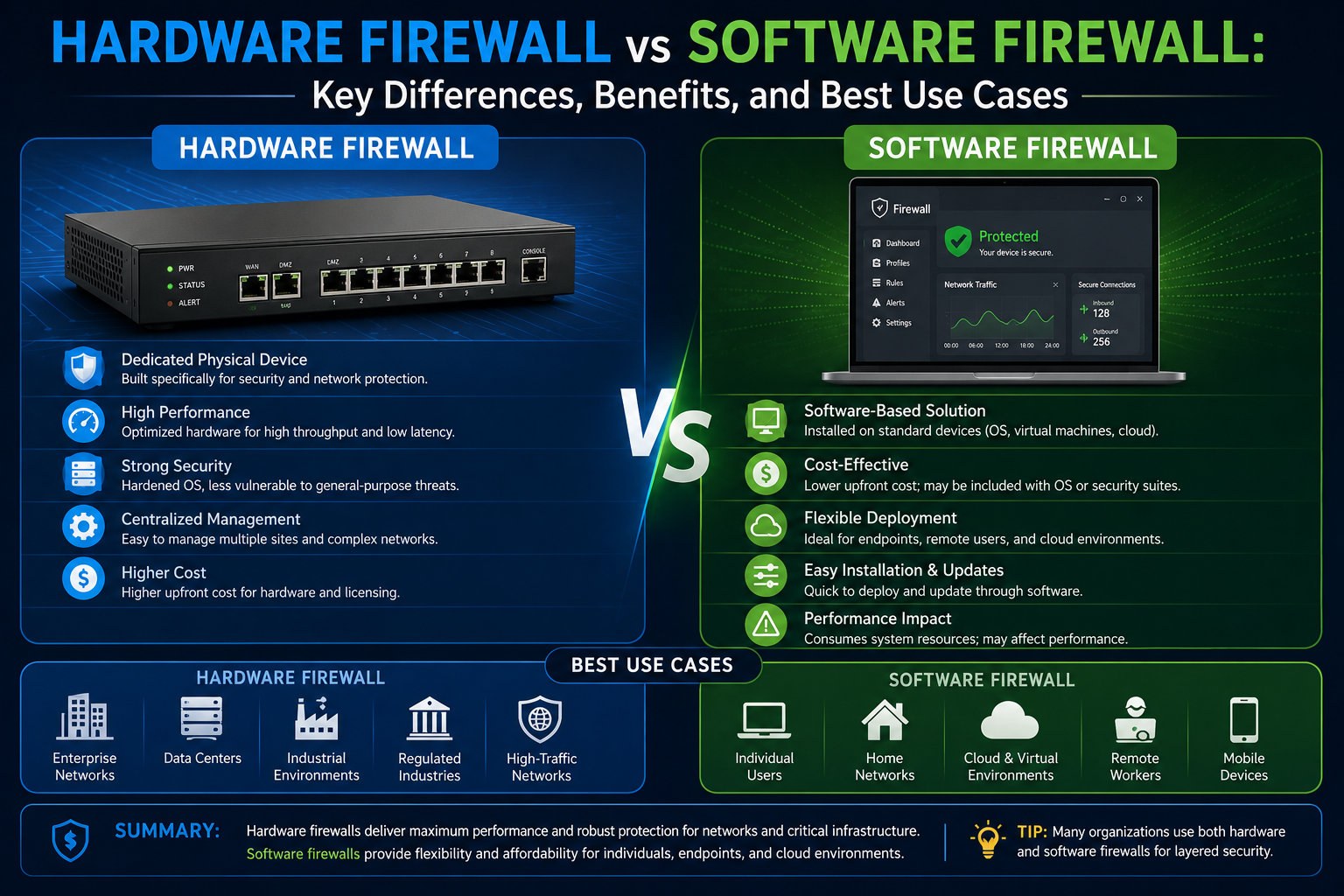
Hardware firewalls provide centralized protection at the network level. They are built to handle large volumes of traffic, enforce consistent policies across entire infrastructures, and act as a strong first barrier between internal systems and external networks. Their strength lies in scale, stability, and the ability to manage security for many users and devices at once. In environments such as corporate networks, data centers, and enterprise systems, they form the foundation of perimeter defense and help ensure that only approved traffic enters or leaves the network.
Software firewalls, on the other hand, focus on the individual device. They extend protection beyond the boundaries of any single network and remain active regardless of where a device is connected. This makes them especially important in environments where mobility, remote work, and unpredictable network conditions are common. Their ability to monitor application behavior and control device-level traffic adds a more detailed layer of protection that complements broader network defenses.
In practice, the most effective security strategies do not rely on choosing one over the other. Instead, they combine both approaches to create layered protection. Hardware firewalls manage the external perimeter, while software firewalls protect internal endpoints. Together, they reduce exposure, improve visibility, and provide multiple opportunities to detect and block threats.
As digital environments continue to expand and become more distributed, the importance of this layered approach will only increase. Networks are no longer confined to a single location, and devices are constantly moving between trusted and untrusted environments. In this landscape, security depends on flexibility, depth, and coordination between different protective systems working together rather than in isolation.