Modern computer networks are expected to operate with incredible speed and reliability. Businesses, streaming services, cloud applications, financial systems, and communication platforms all depend on uninterrupted connectivity. Even a brief interruption can create noticeable problems for users, including dropped voice calls, frozen video meetings, delayed applications, or interrupted data transfers. As networks became larger and more complex, engineers needed a faster and more dependable way to detect failures between networking devices. This need eventually led to the development of Bidirectional Forwarding Detection, commonly known as BFD.
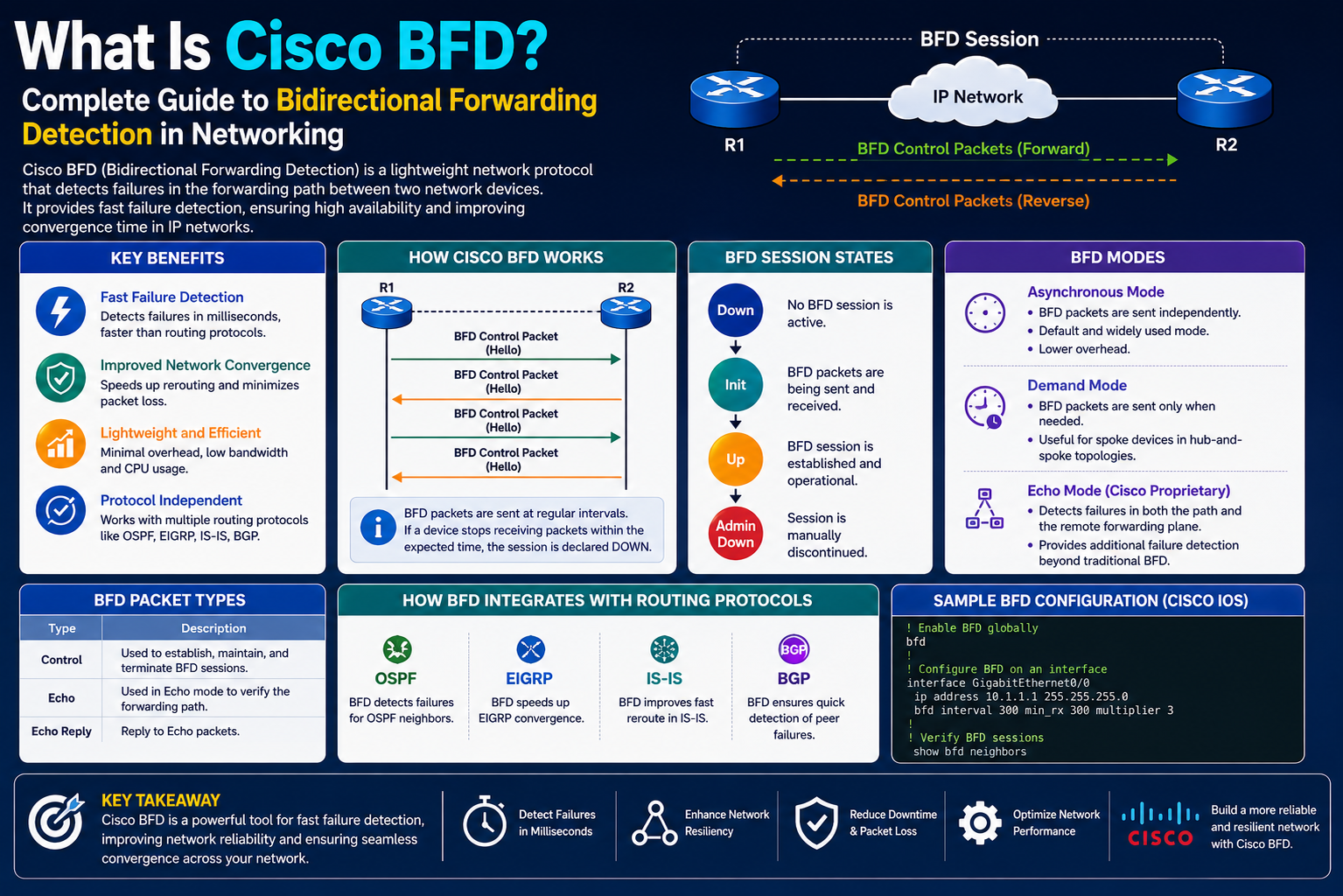
Cisco BFD is a lightweight network protocol designed to quickly detect communication failures between two connected devices, usually routers or switches. Instead of waiting for routing protocols to discover that a connection has failed, BFD continuously monitors the forwarding path between devices. It rapidly identifies disruptions and immediately informs routing protocols so they can react without delay. The result is significantly faster network recovery and improved stability.
To understand why BFD became important, it helps to first look at how networks traditionally handled failures. Before BFD was widely implemented, routing protocols such as OSPF, EIGRP, and BGP relied on their own timers and mechanisms to determine whether a neighboring router was still reachable. These protocols exchanged periodic hello messages and waited for a specific amount of time before declaring a neighbor down.
Although these mechanisms worked, they were not always fast enough for modern network demands. For example, if a routing protocol used a dead timer of several seconds, the network would continue attempting to send traffic over a failed path until the timer expired. During that time, users could experience application interruptions, packet loss, or poor performance.
As internet usage expanded and real-time services became common, slower failure detection created serious problems. Voice over IP calls could disconnect, streaming media could freeze, and cloud applications could become unresponsive. Network engineers needed a solution capable of identifying failures in milliseconds instead of seconds.
That challenge is exactly what BFD was designed to solve.
BFD works independently from routing protocols. Instead of relying on the timers built into OSPF or BGP, BFD creates its own monitoring sessions between devices. These sessions exchange small packets at extremely fast intervals. If the packets stop arriving within the expected timeframe, BFD immediately assumes the forwarding path has failed.
One of the most important characteristics of BFD is that it is protocol independent. This means it does not belong exclusively to OSPF, EIGRP, BGP, or any other routing technology. Instead, it functions as a universal failure detection mechanism that can support multiple routing protocols simultaneously.
This independence provides a major advantage in enterprise and service provider networks. Rather than configuring different failure detection methods for each routing protocol, engineers can use BFD as a unified solution. Once BFD detects a problem, it informs the relevant routing protocol, which then recalculates routes and updates forwarding tables.
The term “Bidirectional Forwarding Detection” can seem intimidating at first, but its meaning becomes straightforward when broken into parts.
The word “bidirectional” refers to communication occurring in both directions. Each router participating in a BFD session sends monitoring packets to its neighbor while also receiving packets from that neighbor. Both devices actively verify connectivity.
The word “forwarding” relates to the forwarding path used to transmit network traffic. BFD specifically monitors whether packets can continue traveling between devices.
Finally, the word “detection” highlights the main purpose of the protocol. BFD exists to quickly detect faults, interruptions, or connectivity failures.
Together, the name accurately describes the protocol’s function. BFD continuously verifies bidirectional communication across the forwarding path to rapidly detect failures.
The speed of BFD is one of its defining features. Traditional routing protocol timers might take several seconds to identify a failed link. In contrast, BFD can detect failures in milliseconds. This rapid response dramatically improves network convergence.
Convergence is the process by which routers adjust to changes in network topology. When a router or link fails, the network must calculate new paths so traffic can continue reaching its destination. Faster convergence means shorter outages and fewer disruptions for users.
Imagine a large organization with multiple branch offices connected through redundant links. If one connection suddenly fails, users should ideally never notice the interruption. BFD helps make that possible by quickly detecting the failure and notifying routing protocols so alternate routes can be activated almost immediately.
BFD is especially valuable in environments where uptime is critical. Financial institutions, healthcare organizations, cloud providers, and telecommunications companies often rely on rapid failover mechanisms to maintain uninterrupted services.
For example, in a data center environment, thousands of applications may depend on stable network communication. A delay of even a few seconds during a routing failure could interrupt database synchronization, virtual machine communication, or application access. BFD minimizes these risks by reducing the time required to detect connectivity problems.
Another area where BFD provides significant benefits is Voice over IP communication. Voice traffic is extremely sensitive to delays and interruptions. If a routing failure takes too long to detect, active calls may disconnect or suffer from severe audio degradation. Rapid fault detection helps preserve call quality and user experience.
Streaming services and video conferencing platforms also benefit from fast convergence. Modern users expect smooth, uninterrupted communication. BFD contributes to that reliability by enabling networking devices to react quickly when problems occur.
One reason BFD became widely adopted is its efficiency. The packets exchanged during BFD sessions are intentionally lightweight and consume very little bandwidth. Even when packets are sent at frequent intervals, the overall resource usage remains relatively low.
This efficiency allows BFD to scale across large environments without creating excessive overhead. Networks containing hundreds or even thousands of routing relationships can still use BFD effectively.
BFD sessions are typically established between directly connected routers, though they may also operate across more complex network designs. Once the session begins, the routers exchange control packets at negotiated intervals.
Each router expects to receive packets within a specific timeframe. If multiple packets are missed consecutively, the session transitions to a down state. The router then immediately informs the associated routing protocol about the detected failure.
It is important to understand that BFD itself does not calculate alternate routes. That responsibility still belongs to routing protocols such as OSPF or EIGRP. BFD simply acts as the rapid detection mechanism.
This separation of responsibilities is one of the reasons BFD integrates so well into existing networks. Routing protocols continue performing their normal operations while BFD enhances failure detection speed.
Network engineers often compare BFD to a heartbeat monitoring system. Just as medical equipment continuously checks a patient’s heartbeat, BFD continuously verifies communication between routers. As long as packets continue flowing in both directions, the connection is considered healthy.
If the heartbeat stops, BFD immediately recognizes that something is wrong.
The protocol also supports different operational modes depending on network requirements. In asynchronous mode, routers continuously exchange packets with each other at defined intervals. This is the most commonly used mode because it provides constant monitoring.
Another mode, called demand mode, reduces the number of packets exchanged under stable conditions. This approach can conserve resources in certain environments, though asynchronous mode remains more widely implemented.
BFD can also operate over various types of network connections. It is not limited to a single technology or medium. Engineers commonly use BFD with Ethernet connections, MPLS environments, VPNs, and other routed infrastructures.
Its flexibility makes it valuable in both enterprise networks and large-scale service provider deployments.
Although BFD is extremely powerful, proper configuration is important. Detection timers that are set too aggressively may create instability in networks experiencing congestion or temporary packet loss. If packets are delayed long enough to exceed the configured threshold, BFD may incorrectly assume a failure has occurred.
This situation is known as a false positive.
To avoid unnecessary disruptions, engineers carefully tune BFD intervals and detection multipliers based on network conditions. Faster timers provide quicker detection, but they also increase sensitivity to temporary issues.
Balancing speed and stability is a key part of successful BFD implementation.
The relationship between BFD and routing protocols is another important concept to understand. Many routing protocols already include hello and dead timers, so some people initially question why BFD is necessary.
The answer lies in consistency and speed.
Different routing protocols use different timer mechanisms. Configuring extremely fast timers directly within those protocols may increase CPU usage or create scalability problems. BFD provides a standardized approach that works across multiple protocols without requiring aggressive routing protocol timer adjustments.
This creates a cleaner and more manageable network design.
BFD also improves operational consistency. Instead of relying on separate detection methods for OSPF, BGP, and EIGRP, engineers can standardize around a single rapid failure detection protocol.
As networking technology evolved, the importance of rapid convergence continued growing. Cloud computing, virtualization, remote work, and global connectivity all increased dependence on stable networking infrastructure.
Users today expect applications to remain available at all times. Even brief outages can impact productivity, revenue, and customer experience. BFD plays a key role in meeting those expectations by helping networks recover from failures faster than traditional detection methods.
The protocol is also frequently discussed in networking certifications and technical training because it represents a foundational concept in modern routing design. Understanding how BFD works helps engineers better understand convergence, resiliency, and high-availability networking.
In practical deployments, BFD is often paired with dynamic routing protocols in environments where redundancy is critical. Multiple links may exist between locations, data centers, or service providers. If one path becomes unavailable, traffic must shift quickly to another available route.
Without rapid failure detection, users may notice interruptions during the transition period.
BFD significantly reduces this recovery time.
Another advantage of BFD is that it can monitor failures beyond simple physical link loss. A cable disconnect is usually easy for routers to detect because the interface immediately changes state.
However, some failures are more subtle.
For example, an intermediate device might stop forwarding traffic correctly even though interfaces remain physically active. In these situations, traditional link-state monitoring may not recognize the problem immediately.
BFD helps identify these forwarding failures because it actively verifies packet exchange between devices.
This capability makes BFD especially valuable in complex routed environments where failures may occur deeper within the forwarding path.
The protocol’s simplicity also contributes to its popularity. Although the underlying concepts involve networking fundamentals, the operational idea is straightforward. Devices continuously exchange lightweight packets, monitor connectivity, and notify routing protocols when communication fails.
Despite that simplicity, the impact on network stability can be enormous.
Modern enterprises increasingly rely on highly available infrastructure to support hybrid workforces, cloud services, and globally distributed applications. Fast failure detection is no longer considered optional in many environments.
BFD has become one of the most trusted mechanisms for achieving that goal.
As organizations continue building more resilient and performance-driven networks, protocols like BFD remain essential components of modern routing architecture. By rapidly detecting interruptions and helping routing protocols respond faster, BFD contributes directly to smoother communication, improved application availability, and more reliable network operations.
How Cisco BFD Operates Inside a Network Environment
Understanding the purpose of Cisco BFD is only the beginning. To fully appreciate its value, it is important to explore how the protocol actually operates within a live network. Although BFD is often described as a simple fault detection mechanism, its internal behavior plays a major role in modern routing stability and convergence efficiency.
At its core, BFD functions by creating a monitoring relationship between two network devices. These devices are usually routers, though switches and other systems capable of supporting routed communication may also participate. Once the relationship is established, both devices continuously exchange lightweight control packets.
These packets act as health checks.
As long as both devices continue receiving the packets within the expected time interval, the forwarding path is considered operational. If the packets stop arriving, BFD assumes that communication has failed and immediately alerts the associated routing protocols.
This process sounds simple, but several important mechanisms work together behind the scenes.
The first stage of BFD operation is session establishment. Before monitoring can begin, both devices must create a BFD session with each other. A session represents an active agreement between two routers to exchange monitoring packets.
During session establishment, routers negotiate operational parameters such as transmission intervals and detection timing. These settings determine how often packets are exchanged and how quickly failures are declared.
The routers also exchange unique identifiers that help maintain synchronization between the session participants.
Once negotiation is complete, the session transitions into an active monitoring state.
The continuous exchange of packets is what allows BFD to detect failures so quickly. These packets are often referred to as hello packets or control packets. Unlike large data packets carrying user traffic, BFD packets are intentionally small and lightweight.
Because the packets contain minimal information, they can be transmitted frequently without consuming excessive bandwidth.
This low overhead is one reason BFD scales effectively in enterprise and service provider environments.
The timing intervals used by BFD are significantly shorter than traditional routing protocol timers. In many deployments, devices exchange packets every few milliseconds. This means routers constantly verify whether communication remains healthy.
If a device suddenly stops receiving packets from its neighbor, it immediately begins counting missed intervals.
BFD does not typically declare a failure after missing a single packet. Temporary packet loss can occur in busy networks, so the protocol uses a detection multiplier to determine how many consecutive packets may be missed before the session is considered down.
For example, imagine a network configured to send BFD packets every 50 milliseconds with a detection multiplier of 3. If three consecutive packets are missed, the router declares the session down after approximately 150 milliseconds.
This rapid detection speed is dramatically faster than many traditional routing protocol timers.
The combination of interval settings and detection multipliers gives network engineers flexibility. Faster intervals provide quicker failure detection, while larger multipliers offer more tolerance for temporary disruptions.
Finding the right balance is critical.
Aggressive settings may improve convergence speed but also increase the risk of false positives during periods of congestion or high CPU utilization. Conservative settings reduce unnecessary session drops but slightly increase detection time.
Network design goals usually determine how these values are configured.
BFD sessions transition through several states during operation. These states help routers maintain synchronization and accurately track connectivity status.
The first state is typically the down state. In this condition, the session is inactive or has not yet been fully established.
When devices begin exchanging packets successfully, the session progresses through initialization states until both routers confirm bidirectional communication. Once this verification occurs, the session enters the up state.
The up state represents normal operation.
While in this condition, both routers continuously exchange packets and monitor connectivity. If communication fails, the session returns to the down state and routing protocols are immediately informed.
The bidirectional nature of BFD is especially important.
Some network monitoring methods only verify communication in one direction. However, real-world networking issues may affect only part of the communication path. A router might still be capable of sending packets while simultaneously being unable to receive them correctly.
BFD verifies communication in both directions, which allows it to identify asymmetric failures more effectively.
This bidirectional verification improves reliability and reduces the risk of hidden forwarding problems.
One of the most important operational concepts in BFD is that it monitors the forwarding plane rather than the control plane alone.
The control plane handles routing calculations and protocol communication, while the forwarding plane is responsible for actually moving packets through the network.
A router’s control plane may still appear healthy even when forwarding problems exist. For example, routing protocols could continue exchanging updates while actual traffic forwarding becomes impaired.
Because BFD monitors forwarding behavior directly, it can detect failures that traditional routing hello mechanisms might miss.
This capability makes BFD particularly valuable in complex network infrastructures.
BFD can also operate across different routing technologies and topologies. Engineers frequently deploy it alongside OSPF, EIGRP, IS-IS, and BGP.
Each routing protocol benefits from faster failure notification.
For example, OSPF normally relies on hello and dead timers to determine whether neighboring routers remain reachable. Although those timers can be adjusted for faster convergence, extremely aggressive settings may increase CPU load and reduce scalability.
BFD solves this problem by handling failure detection independently.
When BFD detects a failure, it immediately informs OSPF that the neighbor relationship should be terminated. OSPF can then recalculate routes without waiting for its own dead timer to expire.
The same principle applies to EIGRP and other routing protocols.
BGP benefits significantly from BFD as well. Unlike interior routing protocols, BGP often uses relatively long timers because it was designed for stability across large internet-scale environments.
Without BFD, BGP sessions may take a considerable amount of time to recognize failures.
By integrating BFD with BGP, network engineers can dramatically reduce failover times while maintaining stable routing behavior.
This is especially useful in environments where rapid internet or WAN failover is required.
BFD is also widely used in MPLS networks. Service providers depend on extremely fast convergence to maintain service continuity for customers. BFD helps identify failures within MPLS forwarding paths and supports high-availability architectures.
In large-scale environments, even small improvements in failure detection time can significantly improve user experience.
Another interesting aspect of BFD operation is echo mode.
In standard asynchronous mode, routers exchange control packets directly with each other. Echo mode introduces an additional mechanism where packets are looped back through the forwarding path.
This allows routers to verify not only communication with the neighbor but also the health of the actual forwarding infrastructure.
Echo mode can improve detection accuracy in certain network designs, though it is not always required.
The protocol also supports authentication features.
Security is an important consideration in networking, particularly when routing relationships exist across shared or untrusted environments. BFD authentication helps protect sessions from spoofed packets or unauthorized participation.
Authentication mechanisms ensure that only legitimate routers can establish and maintain BFD sessions.
Operational visibility is another important component of BFD deployments.
Network engineers commonly use monitoring commands to verify session status, timer values, neighbor relationships, and packet statistics. These tools help identify misconfigurations, troubleshoot failures, and confirm stable operation.
For example, engineers may check whether sessions remain consistently in the up state or whether repeated flapping is occurring.
Flapping refers to sessions repeatedly transitioning between up and down states.
Frequent flapping usually indicates an underlying problem such as congestion, unstable links, excessive CPU utilization, or overly aggressive timer settings.
Careful troubleshooting is necessary to determine the root cause.
In many enterprise environments, BFD is implemented selectively rather than universally. Engineers typically prioritize critical links where rapid convergence provides the greatest benefit.
Core routers, WAN connections, data center interconnects, and redundant paths often receive BFD protection first.
This targeted approach balances performance improvements with operational complexity.
Scalability considerations also influence deployment decisions.
Although BFD is lightweight, maintaining thousands of sessions can still consume CPU resources on networking devices. Modern hardware platforms are generally optimized for large-scale BFD operation, but careful planning remains important in very large networks.
Hardware acceleration capabilities may also affect performance.
Some networking platforms support BFD processing directly in hardware, allowing sessions to operate efficiently with minimal CPU impact. Hardware-assisted implementations often achieve higher scalability and more consistent performance.
Software-based processing may still perform well but could become more resource-intensive under heavy session loads.
Network engineers therefore consider platform capabilities when designing BFD deployments.
Redundant network designs benefit enormously from BFD.
Consider an organization with dual WAN connections between headquarters and remote offices. If one provider experiences an outage, traffic should shift to the backup connection immediately.
Without rapid failure detection, users may experience delays while routing protocols wait for timers to expire.
With BFD enabled, the failed path can be detected almost instantly, allowing traffic to reroute much faster.
This rapid recovery improves application availability and reduces user disruption.
Virtualized and cloud-connected infrastructures have further increased the importance of fast convergence.
Applications are often distributed across multiple data centers or cloud regions. Traffic paths may traverse complex hybrid environments involving physical routers, virtual appliances, and software-defined networking platforms.
BFD helps maintain reliability across these dynamic infrastructures by providing consistent failure detection.
The protocol’s flexibility also makes it useful in multi-vendor environments.
Although many engineers associate BFD closely with Cisco networking, the protocol itself is standardized and supported by multiple vendors. This interoperability allows organizations to maintain consistent failure detection across diverse infrastructures.
Standardization contributed greatly to the protocol’s widespread adoption.
Another operational advantage of BFD is its simplicity from the perspective of routing protocols. Because BFD handles detection separately, routing protocols can focus on their primary responsibility of calculating routes.
This modular design improves maintainability and reduces configuration complexity.
Engineers can standardize BFD behavior while allowing different routing protocols to coexist within the same environment.
The protocol’s efficiency becomes especially noticeable during network instability.
When failures occur, BFD reacts immediately without requiring extensive route recalculations beforehand. Routing protocols receive timely notifications and can quickly determine alternate forwarding paths.
This minimizes packet loss and reduces service interruption.
In highly available environments, these milliseconds can make a substantial difference.
Users may never even realize that a failure occurred because traffic reroutes so quickly.
As organizations continue demanding greater uptime and faster recovery from failures, BFD remains one of the most effective tools for improving network responsiveness. Its ability to provide rapid, protocol-independent failure detection has made it a foundational component of resilient routing architectures across modern enterprise and service provider networks.
Configuring Cisco BFD and Understanding Real-World Deployment Practices
Implementing Cisco BFD successfully involves more than simply enabling a feature on a router. Network engineers must understand where BFD should be deployed, how timer values influence performance, and how the protocol interacts with routing technologies across different environments.
Although the actual configuration commands are often straightforward, designing an effective BFD deployment requires careful planning and operational awareness.
One of the first steps in deploying BFD is identifying the parts of the network where rapid convergence is most valuable. Not every connection necessarily requires millisecond-level failure detection.
In many organizations, engineers prioritize critical infrastructure paths first.
Core routers, WAN connections, internet edge devices, data center interconnects, and redundant uplinks are common candidates for BFD implementation. These links often carry essential traffic, so minimizing outage duration is particularly important.
For example, consider a business with multiple offices connected through redundant WAN circuits. If the primary connection fails, users expect applications to continue functioning without noticeable interruption. BFD allows the network to detect the outage quickly and reroute traffic through the backup path almost immediately.
Without BFD, routing protocol timers might delay failover long enough for users to experience application timeouts or disrupted communication.
Before enabling BFD, engineers usually review the existing routing architecture. Since BFD works alongside routing protocols rather than replacing them, understanding how protocols like OSPF, EIGRP, IS-IS, or BGP are configured is essential.
The routing protocols remain responsible for calculating alternate paths after failures occur.
BFD simply accelerates the detection process.
Most Cisco platforms require BFD to be enabled globally before configuring it on individual interfaces or routing neighbors. This global activation prepares the device to support BFD sessions.
Afterward, engineers apply BFD settings to specific interfaces or protocol neighbors depending on the network design.
Interface-level configuration is common in many environments because it allows routers connected over a shared link to automatically establish BFD sessions. Once enabled on both sides, the routers begin exchanging monitoring packets and negotiating operational parameters.
The timer configuration is one of the most important aspects of deployment.
BFD typically uses three key values: transmission interval, receive interval, and detection multiplier.
The transmission interval determines how frequently a router sends BFD packets.
The receive interval defines the minimum rate at which the router expects to receive packets from its neighbor.
The detection multiplier specifies how many consecutive packets can be missed before the session is declared down.
Together, these settings determine how quickly failures are detected.
For example, a network using a 50 millisecond transmission interval with a multiplier of 3 could detect failures in roughly 150 milliseconds.
While extremely fast timers may sound ideal, aggressive configurations are not always appropriate.
Temporary congestion, CPU spikes, or packet loss could delay BFD packets long enough to trigger unnecessary session failures. These false positives may cause routing instability and repeated convergence events.
As a result, engineers carefully evaluate network conditions before selecting timer values.
Stable, low-latency environments such as data centers may support very aggressive timers.
Long-distance WAN connections or heavily utilized links may require more conservative settings.
Testing is an important part of the deployment process.
Engineers often implement BFD in controlled stages, verifying session stability before expanding the configuration across larger portions of the network. Monitoring tools and operational commands help confirm that sessions remain healthy and that timers are functioning as expected.
One common verification step involves checking neighbor relationships.
Operational commands display information about active BFD sessions, including the session state, local and remote timer values, detection multipliers, and interface details.
If sessions remain consistently in the up state, the configuration is generally functioning properly.
If sessions repeatedly transition between up and down states, troubleshooting becomes necessary.
Frequent session flapping can indicate several possible issues.
Network congestion may delay packets.
CPU utilization on the router may be excessively high.
Timer values may be too aggressive for the environment.
Physical link instability could also contribute to inconsistent communication.
Troubleshooting BFD requires examining both the network infrastructure and the device performance.
In many cases, slightly increasing timer intervals or detection multipliers resolves stability issues without significantly impacting convergence speed.
BFD integration with OSPF is one of the most common deployment scenarios.
OSPF normally relies on hello packets and dead timers to maintain neighbor relationships. While these timers can be tuned for faster detection, extremely aggressive settings may create scalability challenges.
By using BFD, OSPF can maintain standard hello intervals while still benefiting from rapid failure detection.
When BFD identifies a failure, it immediately informs OSPF that the neighbor relationship should be terminated. OSPF then recalculates routes and updates the routing table.
This separation improves both efficiency and consistency.
BGP deployments also benefit greatly from BFD.
Because BGP was designed for large-scale internet routing, its default timers are relatively conservative. Without BFD, BGP sessions may take a significant amount of time to recognize failures.
This delay can be problematic for organizations requiring fast WAN or internet failover.
BFD solves this problem by providing rapid failure notification while allowing BGP to maintain stable operational timers.
This combination is especially valuable in enterprise edge and service provider environments.
Another important consideration during deployment is hardware capability.
Modern networking platforms vary significantly in terms of performance and architecture. Some devices process BFD packets using dedicated hardware acceleration, while others rely primarily on software processing.
Hardware-assisted BFD typically supports larger session counts with lower CPU impact.
Software-based implementations may still perform effectively, but engineers must carefully monitor resource utilization in large-scale environments.
Scalability planning becomes increasingly important as the number of BFD sessions grows.
A small enterprise network may only require a handful of sessions.
Large service provider networks may support thousands.
Although BFD packets are lightweight, maintaining high-frequency monitoring across many sessions can still consume system resources.
Proper design helps prevent performance issues.
Some organizations implement BFD selectively rather than enabling it universally across every connection.
This selective strategy focuses resources on the most critical paths while reducing unnecessary operational overhead.
For example, BFD may be enabled on core infrastructure and WAN links while omitted from low-priority access segments.
This approach often provides the best balance between performance and efficiency.
Security considerations also influence deployment decisions.
Because BFD participates in routing-related communication, protecting sessions from unauthorized interference is important.
Authentication mechanisms help ensure that only trusted devices can establish valid BFD relationships.
Without authentication, malicious actors could potentially attempt to disrupt sessions by injecting false packets.
Although such attacks are less common in private enterprise environments, security best practices still recommend protecting critical routing infrastructure whenever possible.
Network engineers must also understand how BFD interacts with high-availability technologies.
Many enterprise networks rely on redundant architectures involving multiple routers, switches, or internet providers. Technologies such as first-hop redundancy protocols, dynamic routing, and load balancing all depend on accurate failure detection.
BFD complements these technologies by improving responsiveness.
For example, if a primary WAN router becomes unreachable, BFD can quickly notify routing protocols so traffic shifts to the standby path.
This rapid failover minimizes service interruption and improves user experience.
Cloud and hybrid networking environments have introduced additional deployment considerations.
Organizations increasingly connect on-premises infrastructure to cloud providers using VPNs, direct connectivity services, or software-defined WAN platforms.
These environments often involve dynamic traffic patterns and distributed applications.
Rapid failure detection remains critical because application performance may depend on consistent connectivity between geographically separated resources.
BFD helps maintain stability across these hybrid architectures.
Service providers frequently use BFD within MPLS networks to improve resiliency.
MPLS infrastructures support large volumes of customer traffic, so minimizing downtime is essential. BFD can rapidly detect forwarding failures within MPLS label-switched paths and trigger fast rerouting mechanisms.
This capability contributes to highly available carrier-grade networking.
Data centers represent another major area where BFD provides value.
Modern data centers rely heavily on virtualization, east-west traffic flows, and distributed applications. Network interruptions can impact storage replication, virtual machine migration, and application synchronization.
Fast convergence helps preserve stability in these performance-sensitive environments.
Automation and software-defined networking have also increased interest in BFD.
As networks become more programmable, automated systems rely on accurate and timely state information. Rapid failure detection allows orchestration platforms and controllers to respond more intelligently to changing conditions.
BFD therefore supports not only traditional routing but also modern automated infrastructure management.
Operational visibility remains essential after deployment.
Monitoring platforms often collect BFD session statistics and generate alerts when sessions fail or flap repeatedly. This visibility helps network teams identify underlying issues before users experience major disruptions.
For example, repeated BFD instability on a WAN circuit might indicate provider-side packet loss or intermittent congestion.
Early detection allows engineers to investigate and resolve problems proactively.
Documentation is another important operational practice.
Because BFD settings can vary between environments, maintaining accurate records of configured intervals, multipliers, and deployment locations helps simplify troubleshooting and future expansion.
Clear documentation also improves consistency across large organizations where multiple engineers manage the infrastructure.
Training and familiarity are equally important.
Although BFD is conceptually straightforward, successful deployment requires understanding how it interacts with routing protocols, hardware limitations, and network design principles.
Engineers responsible for maintaining enterprise or service provider infrastructure benefit greatly from hands-on experience with BFD behavior under real-world conditions.
Simulated failure testing is often part of deployment validation.
Engineers intentionally disconnect links or shut down interfaces to observe how quickly the network converges. These tests confirm that BFD sessions operate correctly and that routing protocols respond as expected.
Testing also helps identify unintended side effects before production issues occur.
As networking continues evolving toward increasingly resilient and distributed architectures, rapid fault detection remains a critical requirement. Applications, users, and businesses depend on stable communication at all times.
Cisco BFD helps meet these demands by providing one of the fastest and most reliable failure detection mechanisms available in modern routing environments.
Its lightweight design, protocol independence, and rapid response capabilities make it a fundamental tool for improving network convergence and maintaining high availability across enterprise, cloud, and service provider infrastructures.
Cisco BFD Best Practices, Performance Optimization, and Common Deployment Challenges
As enterprise and service provider networks continue expanding, maintaining stable and uninterrupted connectivity has become more important than ever. Organizations now depend on applications that operate continuously across multiple locations, cloud platforms, and distributed infrastructures. In these environments, even small network interruptions can create significant operational problems.
Cisco BFD plays an important role in reducing downtime and improving convergence speed, but successful implementation requires more than simply enabling the protocol. Network engineers must understand best practices, optimization strategies, scalability concerns, and operational challenges that can arise in real-world deployments.
A properly designed BFD implementation can dramatically improve resiliency and responsiveness. On the other hand, poor configuration choices may create instability, excessive CPU usage, or unnecessary session failures. Understanding these practical considerations helps engineers deploy BFD effectively while avoiding common mistakes.
One of the first best practices in any BFD deployment is identifying where rapid failure detection provides the greatest benefit. Although BFD is highly efficient, enabling it everywhere without careful planning is not always necessary.
In many organizations, the most important traffic flows travel across the network core, WAN links, internet edge devices, data center interconnects, and cloud connectivity paths. These areas usually receive the highest priority because outages in these locations affect large portions of the infrastructure.
For example, a company may operate multiple branch offices connected through redundant WAN circuits. If the primary path fails, users expect applications to remain available through the backup connection. BFD ensures that the failure is identified quickly so routing protocols can redirect traffic almost immediately.
In contrast, some low-priority access segments may not require millisecond-level convergence. Carefully selecting deployment locations helps balance resiliency with operational efficiency.
Timer tuning is one of the most important aspects of BFD optimization.
Many engineers initially focus only on achieving the fastest possible failure detection times. While aggressive timers can improve convergence speed, they also increase sensitivity to temporary network conditions such as congestion, packet delay, or CPU spikes.
This sensitivity can lead to false positives.
A false positive occurs when BFD incorrectly declares a session down even though the underlying connection remains functional. False positives are particularly disruptive because they trigger unnecessary routing reconvergence events.
Frequent unnecessary failovers may actually reduce overall network stability.
For this reason, engineers carefully evaluate the environment before selecting timer values.
High-performance data center environments with low latency and minimal congestion may support extremely fast intervals.
Long-distance WAN links or heavily utilized circuits often require more conservative settings.
Finding the right balance between responsiveness and stability is critical.
The detection multiplier also plays an important role in optimization.
A small multiplier allows failures to be detected quickly because fewer missed packets are required before the session transitions down.
A larger multiplier increases tolerance for temporary disruptions.
For example, a network configured with a 50 millisecond interval and a multiplier of 3 will react much faster than a network using the same interval with a multiplier of 10.
Conclusion
Cisco BFD, or Bidirectional Forwarding Detection, has become an essential component in modern networking because of its ability to provide extremely fast failure detection and improve overall network stability. As enterprise infrastructures, cloud services, and large-scale communication systems continue to grow, the demand for uninterrupted connectivity has increased significantly. Traditional routing protocol timers alone are often not fast enough to meet the expectations of modern applications that require real-time communication and minimal downtime.
By continuously exchanging lightweight control packets between devices, BFD quickly identifies forwarding failures and immediately informs routing protocols such as OSPF, EIGRP, IS-IS, and BGP. This rapid notification process allows networks to converge much faster and reroute traffic with minimal disruption. Whether used in enterprise environments, data centers, service provider infrastructures, or cloud-connected architectures, BFD helps maintain high availability and reliable communication.
Another major advantage of Cisco BFD is its protocol-independent design. Instead of relying on separate failure detection mechanisms within individual routing protocols, organizations can use BFD as a unified and consistent monitoring solution. This simplifies network operations while improving convergence speed across different routing environments.
Successful BFD deployment, however, requires careful planning and optimization. Engineers must balance timer settings, monitor device performance, and ensure scalability for large environments. Proper testing and gradual implementation help avoid instability and false positives while maximizing the benefits of rapid fault detection.
As networks continue evolving toward more distributed, automated, and performance-sensitive architectures, BFD remains a valuable technology for ensuring resiliency and operational continuity. Its lightweight design, fast detection capabilities, and seamless integration with routing protocols make it one of the most effective tools for improving modern network reliability and maintaining stable connectivity in demanding environments.