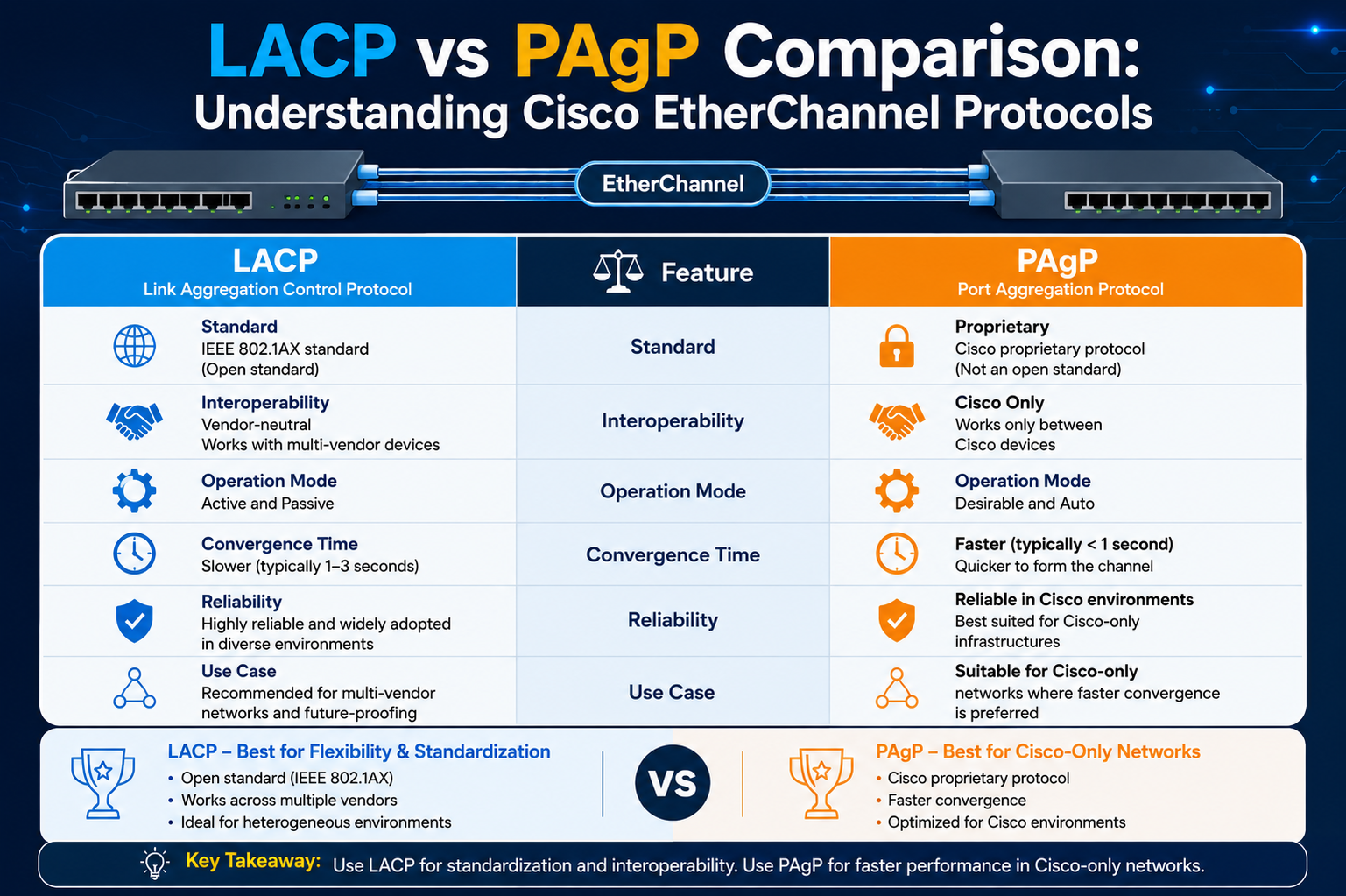
Modern computer networks must handle enormous amounts of data traffic while remaining reliable and efficient. As organizations rely more heavily on digital communication, the need for faster and more resilient network connections becomes increasingly important. One technology that plays a key role in achieving these goals is link aggregation. Link aggregation allows multiple physical network connections to be combined into a single logical link, effectively increasing bandwidth while also improving reliability. Two protocols commonly associated with link aggregation are Link Aggregation Control Protocol and Port Aggregation Protocol. Although both perform similar roles, they were developed under different circumstances and follow different standards.
To understand how these protocols work, it is helpful to first examine the concept of link aggregation itself. In traditional networking environments, a single cable or link connects two devices, such as switches or servers. This link carries all data between the two endpoints. While this setup works in many situations, it introduces two main limitations. First, the bandwidth of the connection is restricted by the capacity of that single cable. Second, if that cable fails, the connection between the devices is completely lost.
Link aggregation addresses these limitations by grouping several physical links into one logical channel. Instead of relying on a single cable, multiple cables operate together as one combined connection. Data traffic can then be distributed across these links, effectively increasing the total bandwidth available. If one of the links fails, the remaining links continue to carry traffic, which improves redundancy and ensures better network stability.
The idea behind link aggregation is not new. Network engineers began experimenting with methods to combine links as early as the 1990s. At that time, networking vendors developed their own proprietary solutions to solve bandwidth and redundancy problems. These solutions worked well within a vendor’s equipment ecosystem but often lacked compatibility with hardware from other manufacturers. As a result, organizations that used equipment from different vendors sometimes faced integration challenges.
One of the earliest and most influential proprietary approaches to link aggregation came from Cisco, a major manufacturer of networking hardware. Cisco introduced a technology known as EtherChannel, which allowed multiple Ethernet links to be bundled together. EtherChannel improved both bandwidth and fault tolerance between switches and other network devices. To manage and coordinate these aggregated connections automatically, Cisco developed a protocol called Port Aggregation Protocol, often abbreviated as PAgP.
PAgP was designed specifically for Cisco equipment. Its primary purpose was to simplify the process of creating aggregated links between compatible switches. Instead of manually configuring every parameter, network devices could communicate with one another using PAgP messages. These messages allowed devices to determine whether the other end of the connection supported link aggregation and whether the links could be safely combined into a group.
When two switches that support PAgP are connected, the protocol exchanges control messages that help negotiate the formation of an aggregated link group. If both sides agree on the configuration, the individual ports are bundled together into a logical interface. This interface behaves like a single high-capacity link even though multiple physical cables are involved.
While PAgP offered a convenient way to automate link aggregation within Cisco environments, it remained limited by its proprietary nature. Organizations that used networking hardware from multiple vendors could not rely on PAgP because it was designed specifically for Cisco systems. This limitation became more noticeable as networks grew larger and more diverse.
To address interoperability concerns, the networking industry began working toward a standardized approach to link aggregation. The goal was to create a protocol that could be implemented by any networking vendor, allowing devices from different manufacturers to cooperate in forming aggregated links. This effort eventually led to the development of the Link Aggregation Control Protocol, commonly known as LACP.
LACP was introduced as part of an official networking standard developed by the Institute of Electrical and Electronics Engineers. It was initially included in the IEEE 802.3ad standard and later incorporated into the broader IEEE 802.1AX specification. By defining a standardized protocol for link aggregation, the IEEE ensured that networking equipment from different vendors could interoperate using the same mechanism.
Unlike proprietary solutions, standardized protocols offer a major advantage in terms of flexibility. Because LACP follows an industry standard, it can be implemented by many different networking vendors. This means that switches, servers, and other devices from different manufacturers can participate in the same aggregated link group as long as they support the protocol.
The introduction of LACP significantly improved the practicality of link aggregation in modern networks. Organizations that operate mixed environments with equipment from multiple vendors can rely on LACP to create consistent and reliable aggregated connections. The protocol ensures that participating devices exchange information about their capabilities, verify compatibility, and manage the aggregation process automatically.
Another important aspect of link aggregation is traffic distribution. When multiple links are grouped together, the network must determine how to distribute data across them efficiently. If all traffic were sent over a single link, the remaining links would remain unused, defeating the purpose of aggregation. To avoid this situation, load balancing mechanisms are used.
Load balancing algorithms distribute packets across the available links in the group. These algorithms may consider factors such as source and destination addresses, transport layer ports, or other parameters. By spreading traffic across multiple links, the network can utilize the combined bandwidth more effectively and reduce congestion on individual links.
In addition to improving bandwidth, link aggregation also enhances redundancy. Network reliability is critical for organizations that depend on continuous connectivity. If a single cable fails in a traditional setup, communication between devices may stop entirely until the issue is resolved. With link aggregation, however, the failure of one link does not necessarily interrupt communication.
When a link within an aggregated group fails, the protocol automatically removes that link from the group while keeping the remaining links active. Traffic is redistributed across the remaining connections, allowing communication to continue without major disruption. This capability makes link aggregation a valuable tool for maintaining network availability.
Another concept related to modern link aggregation deployments is cross-switch aggregation. In traditional setups, aggregated links typically connect two individual switches. However, many modern networks use switch stacks or clusters to increase scalability and resilience. Cross-switch aggregation allows links in the same aggregation group to connect to different physical switches within a stack or cluster.
This approach provides additional redundancy. If one switch in the stack fails, the links connected to other switches can continue operating, reducing the likelihood of network outages. Cross-switch aggregation is particularly useful in high-availability environments such as data centers, where minimizing downtime is essential.
Protocols like LACP are designed to support such advanced scenarios. Because LACP is standardized and widely implemented, it can operate in environments that involve multiple switches and complex network architectures. This capability contributes to its popularity in modern networking deployments.
While LACP and PAgP share the same fundamental purpose—managing aggregated links—they represent different stages in the evolution of networking technology. PAgP reflects an earlier era when proprietary solutions were common and interoperability was less of a priority. LACP, on the other hand, reflects the industry’s shift toward open standards that enable cooperation between devices from different vendors.
Understanding the historical context behind these protocols helps explain why both still exist in modern networks. Many organizations continue to operate legacy equipment that supports PAgP, especially in environments built entirely around Cisco hardware. At the same time, LACP has become the preferred solution in networks that prioritize vendor neutrality and compatibility.
Network engineers must therefore understand both protocols and their roles within different environments. While the underlying principles of link aggregation remain consistent, the mechanisms used to negotiate and manage aggregated links can vary depending on the protocol in use.
In practice, the choice between these protocols often depends on the type of networking equipment deployed and the design goals of the network. Some organizations prioritize simplicity within a single-vendor ecosystem, while others emphasize flexibility and interoperability across multiple platforms.
Regardless of which protocol is used, the core benefits of link aggregation remain the same. By combining multiple physical connections into a unified logical link, networks can achieve greater bandwidth, improved reliability, and more efficient traffic distribution. These advantages make link aggregation an essential component of modern network infrastructure.
As networks continue to evolve, the principles behind link aggregation remain relevant. Increasing demands for bandwidth, reliability, and scalability ensure that technologies capable of combining multiple connections will continue to play a critical role in network design. Understanding the protocols that manage these aggregated links provides valuable insight into how modern networks maintain both performance and resilience.
Operational Behavior and Communication Mechanisms of LACP and PAgP
When examining the practical differences between Link Aggregation Control Protocol and Port Aggregation Protocol, one of the most important areas to understand is how these protocols actually operate. Although both protocols exist to create and manage aggregated links, they do so through different communication mechanisms and operational modes. These differences influence how network devices negotiate link aggregation, how administrators configure network equipment, and how networks behave under various conditions.
At a basic level, both protocols rely on communication between network devices to determine whether link aggregation should occur. When two switches are connected using multiple Ethernet cables, each cable initially behaves as an independent connection. The aggregation protocol must determine whether the links share compatible characteristics and whether they can safely be grouped together into a single logical interface.
Without a negotiation protocol, administrators would need to configure every aggregated link manually on both ends of the connection. This approach is possible, but it increases the risk of configuration mismatches. If the two ends of the connection are not configured identically, network problems such as loops or traffic imbalance can occur. Protocol-based negotiation reduces these risks by allowing devices to exchange information before forming the aggregated link.
Link Aggregation Control Protocol uses a structured communication method based on protocol data units. These small control packets are exchanged between devices participating in link aggregation. The messages carry important information such as system identifiers, port priorities, and operational parameters. By analyzing this information, devices can determine whether they should join the same aggregation group.
Each device participating in LACP is assigned a role during the negotiation process. One device acts as the “actor,” while the other functions as the “partner.” These roles help organize communication and ensure that both ends agree on the structure of the aggregated link. The actor sends protocol messages that advertise its capabilities and configuration details. The partner evaluates this information and responds with its own data.
The exchange of these control messages continues at regular intervals while the aggregated link remains active. This ongoing communication allows devices to monitor the status of each physical link within the group. If a link becomes unavailable, the protocol quickly detects the change and removes the affected link from the aggregation group. The remaining links continue operating normally, which helps maintain network stability.
One of the key characteristics of LACP is its use of operating modes that control how actively a device participates in negotiation. These modes determine whether a device initiates communication or simply waits for requests from the other side. The two primary modes used in LACP are commonly known as active and passive.
In active mode, a device actively attempts to establish an aggregated link by sending control messages to the device on the other end of the connection. These messages invite the partner device to participate in link aggregation. If the partner device is capable of supporting aggregation and is configured appropriately, it responds to the request and the aggregation process begins.
Passive mode behaves differently. A device configured in passive mode does not initiate aggregation requests on its own. Instead, it waits for incoming control messages from the partner device. When a passive device receives a request from an active device, it responds appropriately and participates in the aggregation process.
For link aggregation to occur using LACP, at least one device must operate in active mode. If both devices are configured in passive mode, neither device sends the initial control messages needed to start negotiation. As a result, the aggregated link cannot be formed. This requirement ensures that at least one side of the connection takes responsibility for initiating communication.
Port Aggregation Protocol follows a similar general concept but uses different terminology and behavior. Because PAgP was developed specifically for Cisco environments, its operational structure reflects Cisco’s design philosophy and naming conventions.
In PAgP-based networks, switches exchange PAgP messages to determine whether an aggregated connection should be created. These messages include information about port capabilities, device identifiers, and configuration parameters. By analyzing these messages, switches determine whether the connected ports can safely form an EtherChannel group.
PAgP uses two primary operating modes known as desirable and auto. These modes serve functions that closely resemble the active and passive modes used in LACP. The desirable mode acts as the initiating mode in PAgP. A switch configured in desirable mode actively sends PAgP messages to its partner device in an attempt to establish an aggregated connection.
When the partner device receives these messages, it evaluates the request and determines whether it can participate in the aggregation group. If the partner device is configured either in desirable mode or auto mode, it responds positively and the EtherChannel formation process begins.
Auto mode functions as the listening mode in PAgP. A switch configured in auto mode does not initiate aggregation requests on its own. Instead, it waits for incoming messages from a device operating in desirable mode. When it receives such a request, it responds appropriately and participates in the aggregation process.
Just like the passive mode in LACP, the auto mode in PAgP cannot establish an aggregated link on its own. If both switches are configured in auto mode, neither device initiates communication and aggregation does not occur. At least one device must be configured in desirable mode to start the negotiation process.
Another operational difference between the protocols involves how they handle link compatibility checks. When aggregation protocols evaluate links for inclusion in a group, they examine several parameters to ensure that the links behave consistently. These parameters typically include speed, duplex settings, and VLAN configuration.
For aggregation to work correctly, the participating links must share the same characteristics. For example, combining a one-gigabit link with a ten-gigabit link would create unpredictable behavior. Therefore, aggregation protocols verify that all links in the group operate at the same speed and use compatible configurations.
Both LACP and PAgP perform these compatibility checks automatically. If a link does not meet the required conditions, it is excluded from the aggregation group. This verification process helps prevent network instability and ensures that traffic distribution occurs correctly across the available links.
The protocols also use mechanisms to determine which links should remain active when the number of physical links exceeds the allowed limit. Some switches support more physical connections than the number of active links permitted in an aggregation group. In such cases, the protocols select the most suitable links based on priority values.
These priority mechanisms help ensure that the most reliable and desirable links remain active. If one of the active links fails, a standby link can quickly replace it. This approach maintains consistent bandwidth and improves overall resilience.
Another important operational aspect involves traffic distribution across aggregated links. While the aggregation protocols manage the grouping of links, they do not directly control how individual packets are distributed across those links. Instead, load balancing algorithms handle this responsibility.
Load balancing methods vary depending on the switch platform and configuration. Some algorithms distribute traffic based on the source and destination media access control addresses. Others may use network layer addresses or transport layer port numbers. These algorithms aim to spread traffic evenly across the available links without disrupting the order of packets within individual flows.
Maintaining packet order is important because many network applications rely on receiving packets in the correct sequence. If packets from the same communication flow were transmitted across different links without proper coordination, they might arrive out of order. Aggregation mechanisms therefore ensure that packets belonging to a single flow follow the same physical path whenever possible.
Both LACP and PAgP rely on the switch hardware and software to implement these load balancing strategies effectively. Although the protocols manage link negotiation and monitoring, the distribution of traffic depends on the capabilities of the network device itself.
Monitoring and fault detection are also critical parts of protocol operation. Aggregation protocols continuously exchange control messages to verify that each link in the group remains operational. If a device stops receiving messages from a particular link, the protocol interprets this as a failure.
When a link failure occurs, the protocol quickly removes the affected link from the aggregation group. Traffic is redistributed across the remaining links, allowing communication to continue with minimal disruption. Once the failed link becomes operational again, it can be reintegrated into the group after the negotiation process confirms that conditions are appropriate.
These operational behaviors highlight the importance of protocol communication in maintaining stable aggregated connections. By continuously exchanging information and monitoring link conditions, aggregation protocols help ensure that networks remain efficient and resilient even when individual components fail.
Understanding these operational mechanisms is essential for network administrators who design and maintain modern networks. The ability to configure and troubleshoot aggregation protocols allows engineers to optimize bandwidth usage, improve redundancy, and maintain consistent performance across network infrastructure.
While the core purpose of both protocols remains the same, their operational details reveal subtle differences that influence how they are deployed in real-world environments. These differences become particularly important when networks include devices from multiple vendors or when advanced aggregation scenarios are required.
Practical Deployment Considerations and Network Design Implications
When network engineers design large and reliable infrastructures, they must carefully choose the technologies that will support performance, scalability, and resilience. Link aggregation protocols play an important role in these decisions because they influence how switches, servers, and other devices connect to one another. Although Link Aggregation Control Protocol and Port Aggregation Protocol serve similar functions, their characteristics affect how they are deployed in real-world networks.
One of the most significant practical considerations is vendor compatibility. Modern organizations often use equipment from multiple manufacturers due to cost considerations, specialized hardware requirements, or historical purchasing decisions. In these environments, interoperability becomes a critical factor in network design.
Link Aggregation Control Protocol offers a clear advantage in mixed environments because it follows an industry-standard specification. Network devices from many different vendors implement this protocol, allowing them to participate in the same aggregation groups. As long as the devices support the protocol and share compatible configurations, they can work together without requiring proprietary features.
This interoperability provides network designers with greater flexibility. Instead of being restricted to a single hardware vendor, organizations can build networks that incorporate devices from different manufacturers while still maintaining consistent functionality. This flexibility can also simplify future upgrades because new equipment can be integrated without replacing the entire infrastructure.
Port Aggregation Protocol, by contrast, was created specifically for a single vendor’s ecosystem. While this approach can offer advantages within that environment, it limits compatibility with devices from other manufacturers. Networks that rely entirely on a single vendor’s switches may not encounter significant issues with this limitation. However, organizations that plan to integrate equipment from different vendors often find that proprietary protocols restrict their options.
Because of this difference, many modern networks rely primarily on the standardized protocol. Even within environments that use equipment from the vendor that created the proprietary protocol, administrators often prefer the standardized approach because it provides more flexibility for future expansion.
Another important deployment factor involves scalability. As networks grow larger and more complex, the ability to manage multiple aggregated links efficiently becomes increasingly important. Large data centers, enterprise campuses, and service provider networks frequently use link aggregation to increase bandwidth between core infrastructure components.
In these environments, the standardized protocol supports advanced capabilities that make large-scale deployment easier to manage. One such capability involves aggregating links across multiple physical switches. This design technique improves redundancy by ensuring that aggregated links are not limited to a single device.
In a traditional configuration, an aggregated link connects two individual switches. While this setup improves bandwidth and redundancy compared to a single link, it still depends on the availability of both switches. If one of the switches fails, the entire aggregated connection may be lost.
Cross-switch aggregation addresses this limitation by allowing links within the same aggregation group to connect to different switches in a stack or cluster. When one switch fails, the remaining switches continue to provide connectivity through the surviving links. This approach significantly improves fault tolerance and reduces the risk of network outages.
The standardized protocol supports this type of deployment, which makes it particularly valuable in high-availability environments such as data centers. Data centers often host critical applications that require continuous connectivity. By distributing aggregated links across multiple switches, administrators can ensure that hardware failures do not interrupt essential services.
Network administrators must also consider how aggregation protocols interact with network topology. For example, many enterprise networks follow hierarchical designs that include access, distribution, and core layers. Aggregated links are commonly used to connect these layers because they provide increased bandwidth between major network segments.
At the access layer, switches that connect user devices may use aggregated links to connect to distribution switches. This design allows large numbers of client devices to share high-capacity uplinks without overwhelming a single connection. Aggregation also provides redundancy so that connectivity remains available even if one link fails.
At the distribution and core layers, aggregated links often connect high-performance switches that handle large volumes of traffic. In these areas of the network, aggregation helps maintain efficient data flow between different parts of the infrastructure. Because these connections carry significant traffic loads, reliability and performance are essential.
Another deployment scenario involves server connectivity. Many modern servers include multiple network interface cards that can participate in link aggregation groups. By combining these interfaces, servers can achieve higher bandwidth connections to the network while also gaining redundancy.
This configuration is particularly useful in environments that host virtual machines, large databases, or storage systems. These applications often generate substantial network traffic, and aggregated links help ensure that the network can handle the workload efficiently.
When configuring aggregation between servers and switches, administrators typically choose the standardized protocol because it is supported by a wide range of operating systems and network interface drivers. This compatibility simplifies deployment and ensures that the server and switch can negotiate the aggregated connection successfully.
Management and troubleshooting are also important considerations when selecting aggregation protocols. Network administrators must be able to monitor the status of aggregated links and quickly identify problems when they occur. Aggregation protocols assist with this task by providing information about link states, partner devices, and operational parameters.
Monitoring tools built into network devices can display detailed information about aggregated links, including which physical ports are active and how traffic is distributed across them. These tools allow administrators to verify that aggregation is functioning correctly and to diagnose issues when links fail or behave unexpectedly.
Configuration consistency is another key factor in successful deployments. For aggregation protocols to work properly, both ends of the connection must use compatible settings. These settings include port speed, duplex configuration, and aggregation parameters. Mismatched settings can prevent the aggregated link from forming or cause unstable behavior.
To avoid these issues, administrators typically follow standardized configuration procedures and verify settings carefully before enabling aggregation. Many network devices provide validation mechanisms that warn administrators if incompatible parameters are detected during configuration.
Security considerations also influence aggregation deployments. While link aggregation itself is primarily concerned with performance and redundancy, it interacts with other network features that enforce security policies. For example, aggregated links may carry traffic associated with multiple virtual networks.
Administrators must ensure that security policies such as access control lists and segmentation rules remain consistent across all links within the aggregation group. Because aggregated links behave as a single logical interface, security policies are typically applied at the logical level rather than individually on each physical port.
Maintenance and upgrades present another practical aspect of link aggregation. In large networks, administrators often need to perform hardware replacements, firmware updates, or configuration changes without disrupting active services. Aggregated links provide flexibility during these operations because traffic can continue flowing through remaining links while individual ports are temporarily taken offline.
For example, if a network engineer needs to replace a cable or upgrade a switch port, the protocol can remove that link from the aggregation group while the other links continue carrying traffic. Once the maintenance task is complete, the link can rejoin the group after the protocol confirms that it meets the required conditions.
This capability reduces downtime and allows administrators to perform maintenance tasks with minimal impact on users and applications. In environments where continuous availability is essential, such flexibility is extremely valuable.
Training and operational familiarity also play roles in deployment decisions. Network engineers often work with technologies that are widely documented and commonly used across the industry. Standardized protocols tend to attract broader adoption, which leads to more learning resources, community knowledge, and operational experience.
When engineers encounter problems in production networks, the availability of shared knowledge can significantly accelerate troubleshooting. Technologies that follow widely adopted standards benefit from extensive documentation and widespread familiarity among networking professionals.
Ultimately, the decision to use one aggregation protocol over another depends on several factors, including the type of equipment deployed, long-term scalability goals, and interoperability requirements. While proprietary protocols may still appear in legacy or single-vendor environments, many modern networks favor standardized solutions because they provide greater flexibility and compatibility.
Understanding the practical implications of these protocols helps network engineers design infrastructures that can adapt to changing demands. As network traffic continues to grow and organizations rely more heavily on digital services, technologies that combine bandwidth, resilience, and interoperability will remain central to network architecture.
Through careful planning and proper configuration, link aggregation protocols enable networks to operate efficiently even under heavy workloads and changing conditions. By distributing traffic across multiple physical connections while maintaining logical simplicity, aggregation technologies support the reliable and scalable communication systems that modern organizations depend upon.
Performance, Reliability, and Future Relevance of Link Aggregation Protocols
As networks continue to grow in size and complexity, the technologies used to maintain performance and reliability become increasingly important. Link aggregation protocols play a significant role in ensuring that modern network infrastructures can handle large volumes of data while maintaining stability. While earlier sections explored the origins, operational mechanisms, and deployment considerations of link aggregation technologies, a deeper examination of their impact on performance, resilience, and long-term relevance provides further insight into why these protocols remain essential in modern networking.
At the heart of link aggregation lies the concept of combining multiple physical connections into a single logical pathway. This logical connection behaves as if it were a single link with greater capacity than any individual cable. The aggregated link allows devices to exchange large amounts of data more efficiently than they could through a single interface. As organizations rely more heavily on cloud computing, virtualization, high-definition media, and data-intensive applications, the demand for high-capacity network links has increased significantly.
One of the most immediate benefits of link aggregation protocols is improved bandwidth utilization. Instead of relying on one connection that may quickly become saturated, aggregated links distribute network traffic across several physical paths. Each link contributes to the overall throughput, enabling the network to handle larger data flows without introducing severe congestion.
This improvement in bandwidth is particularly valuable in environments where multiple users or systems communicate simultaneously. Enterprise networks often connect hundreds or thousands of devices, including workstations, mobile devices, printers, and servers. When all these devices share a limited number of network paths, congestion can occur quickly. Aggregated links help alleviate this problem by expanding the available capacity between switches or other critical devices.
In large data centers, link aggregation becomes even more important. Data centers host massive collections of servers that run applications, manage databases, and deliver online services. These servers exchange enormous amounts of data both internally and externally. Aggregated links between switches help ensure that this traffic can flow efficiently without overwhelming individual connections.
Another important aspect of link aggregation performance is load distribution. Simply grouping multiple links together does not automatically guarantee efficient use of all available bandwidth. Instead, the network must distribute traffic intelligently so that each link carries a portion of the overall load. If traffic were sent only through one link while the others remained idle, the benefits of aggregation would be lost.
To prevent this imbalance, network devices use load-balancing algorithms that distribute traffic across the available links in an aggregation group. These algorithms analyze certain characteristics of network packets to determine which link should carry each flow of data. Common parameters used for this decision include the source and destination addresses of the communicating devices, as well as transport layer information such as port numbers.
The purpose of these algorithms is not only to distribute traffic evenly but also to maintain the integrity of individual data flows. When packets belonging to the same communication session travel through different paths, they may arrive at their destination in the wrong order. Many applications expect packets to arrive sequentially, and out-of-order delivery can cause performance issues or even communication failures.
To avoid such problems, load-balancing algorithms ensure that packets from a single flow follow the same physical path whenever possible. At the same time, packets from different flows can be distributed across other available links. This approach allows the network to utilize multiple connections efficiently while preserving proper packet sequencing.
Reliability is another major advantage provided by link aggregation protocols. In traditional network designs that rely on single links, the failure of a cable or port can immediately disrupt communication between connected devices. Troubleshooting and repairing such failures may require time, during which services become unavailable.
Aggregated links reduce this risk by providing built-in redundancy. When several physical links form part of the same logical connection, the failure of one link does not necessarily interrupt communication. Instead, the remaining links continue to carry traffic while the failed link is temporarily removed from the aggregation group.
This automatic failover capability is made possible through the continuous monitoring performed by link aggregation protocols. Devices exchange control messages at regular intervals to verify that each link remains operational. If a link stops responding or experiences a failure, the protocol detects the problem and removes the link from the active group.
Traffic that was previously using the failed link is then redistributed across the remaining links. Because this process occurs automatically and rapidly, users and applications may not notice any interruption. Once the failed link becomes operational again, the protocol can reintegrate it into the aggregation group after confirming that it meets all configuration requirements.
In addition to handling individual link failures, link aggregation also contributes to broader network resilience. Many modern networks incorporate redundant switches, multiple routing paths, and high-availability architectures designed to prevent service interruptions. Aggregated links complement these designs by ensuring that connectivity between devices remains robust even when components fail.
For example, organizations often deploy multiple switches in clusters or stacks to provide redundancy. In such configurations, aggregated links may connect devices to several switches simultaneously. This arrangement ensures that the failure of a single switch does not completely disrupt connectivity. Traffic can continue flowing through links connected to other operational switches within the group.
The ability to aggregate links across multiple switches has become increasingly valuable in modern networking environments. Data centers and enterprise networks frequently rely on switch stacking technologies or multi-chassis configurations that allow several physical switches to operate as a unified system. Aggregation protocols that support these advanced designs enable networks to maintain connectivity even when individual switches experience problems.
Another dimension of link aggregation performance involves latency and packet processing efficiency. While aggregation primarily focuses on increasing bandwidth and redundancy, it can also influence how quickly data moves through the network. When traffic is distributed across multiple links, congestion is reduced on individual connections. Lower congestion often leads to lower latency and smoother communication between devices.
This improvement is especially important for applications that require real-time or near-real-time communication. Voice communication systems, video conferencing platforms, online collaboration tools, and interactive applications depend on consistent and predictable network performance. By reducing congestion and distributing traffic more evenly, aggregated links help maintain the responsiveness these applications require.
The growing use of virtualization and cloud technologies has further increased the importance of link aggregation. Virtualized environments often run multiple virtual machines on a single physical server. Each virtual machine generates network traffic that must pass through the server’s network interfaces. Aggregating these interfaces allows the server to handle higher traffic volumes without becoming a bottleneck.
In cloud infrastructures, aggregated links also help ensure that large volumes of data can move between compute nodes, storage systems, and network gateways. Storage replication, database synchronization, and distributed computing tasks often involve transferring large datasets across the network. Aggregated links provide the capacity needed to support these operations efficiently.
Network engineers must also consider how link aggregation interacts with other network protocols and technologies. For example, many networks use spanning tree mechanisms to prevent loops in layer-2 topologies. When multiple physical links exist between switches, spanning tree protocols may normally disable some of those links to prevent loops.
However, aggregated links appear to the spanning tree system as a single logical connection. Because the protocol treats the entire aggregation group as one link, it does not block individual member links within that group. This behavior allows all aggregated links to remain active simultaneously while still maintaining loop prevention across the broader network.
Quality of service mechanisms also operate alongside link aggregation in many environments. Networks that carry different types of traffic often prioritize certain applications over others. For instance, voice or video traffic may receive higher priority than background data transfers. Aggregated links must support these prioritization mechanisms so that important traffic continues to receive the necessary resources.
Administrators therefore configure quality of service policies on the logical aggregated interface rather than on individual physical ports. This approach ensures that prioritization rules apply consistently across all links within the aggregation group.
Another practical aspect of link aggregation involves monitoring and performance analysis. Network administrators rely on monitoring tools to understand how their infrastructure performs under different workloads. Aggregated links generate statistics that provide insight into traffic distribution, link utilization, and potential congestion points.
These monitoring systems allow engineers to identify situations in which one link within the aggregation group carries significantly more traffic than others. If such imbalances occur frequently, administrators may adjust load-balancing parameters or investigate whether specific applications generate disproportionate traffic flows.
Capacity planning also benefits from aggregation monitoring. By analyzing historical traffic patterns, network engineers can determine when additional links should be added to an aggregation group to accommodate increasing demand. Because aggregation protocols support dynamic membership, administrators can expand the group by adding new physical links without redesigning the entire network connection.
Conclusion
Link aggregation has become an essential technique in modern networking, helping organizations improve bandwidth, reliability, and overall network efficiency. Both LACP and PAgP were developed to simplify the process of combining multiple physical Ethernet links into a single logical connection, allowing networks to handle higher traffic volumes while also providing redundancy. Although the two protocols serve the same primary purpose, their design philosophies and levels of flexibility differ.
PAgP was created as a proprietary protocol specifically for Cisco devices. It allows compatible switches to automatically negotiate and form an EtherChannel connection, making it relatively simple to deploy in networks built entirely with Cisco equipment. In environments where Cisco hardware dominates the infrastructure, PAgP can function effectively and provide the benefits of link aggregation without requiring complex configuration.
LACP, on the other hand, was developed as an industry-standard protocol and has been widely adopted across networking platforms from many different vendors. Because of its standardized design, it enables devices from various manufacturers to participate in the same aggregation group. This interoperability makes LACP especially valuable in modern networks where organizations often deploy equipment from multiple vendors or expand their infrastructure over time.
Another advantage of LACP is its broader flexibility, including support for advanced configurations such as cross-switch link aggregation. This capability allows aggregated links to span multiple switches, improving redundancy and network resilience in complex environments.
Ultimately, both protocols provide mechanisms for increasing bandwidth and improving fault tolerance. The most suitable option often depends on the network environment and the types of devices being used. Understanding how each protocol operates helps network engineers design more efficient, scalable, and resilient infrastructures capable of supporting growing communication demands.