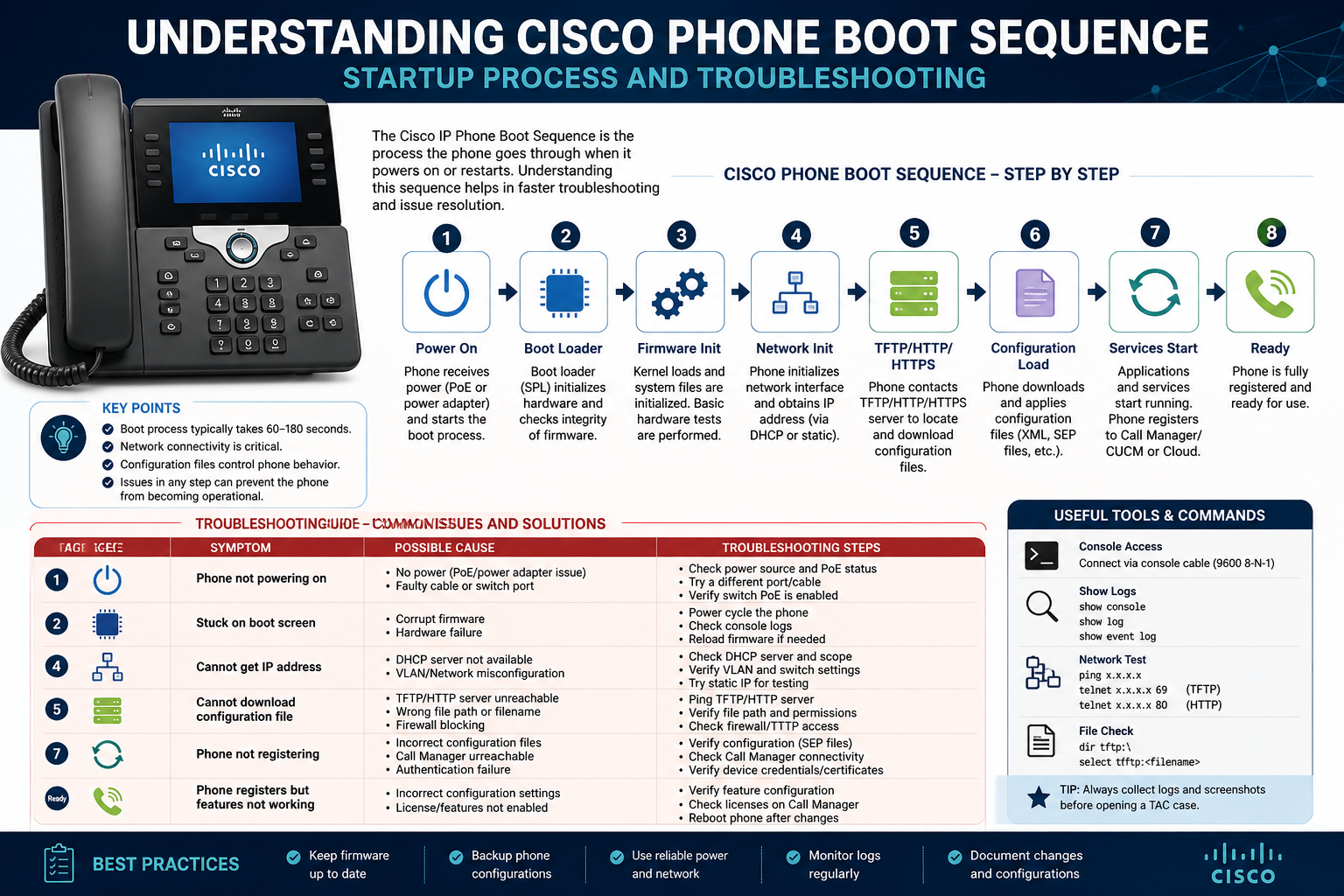
Cisco IP phones are widely used in enterprise communication systems because they rely on a structured, network-driven boot process rather than traditional analog telephony infrastructure. In environments that use Cisco Unified Communications Manager, the phone boot process is not just about turning on a device; it is a carefully orchestrated sequence of network interactions that ensures the device becomes fully operational, properly configured, and securely registered to the call control system.
The boot process begins the moment the device receives power and continues until it successfully registers with Cisco Unified Communications Manager. During this time, the phone interacts with several network services, including switches, DHCP servers, TFTP services, and call control components. Each step depends on the successful completion of the previous one, meaning that even a small issue in the early stages can prevent the phone from functioning correctly.
Understanding this process is essential for anyone working in enterprise voice networks. It helps in troubleshooting registration issues, diagnosing network misconfigurations, and ensuring smooth deployment of VoIP infrastructure. The boot sequence is also consistent across most Cisco IP phone models, which makes it a foundational concept in Cisco collaboration environments.
Power Initialization and Physical Network Detection
The first stage of the Cisco IP phone boot process begins with power initialization. Cisco IP phones typically use Power over Ethernet, which allows both electrical power and data connectivity to be delivered through a single Ethernet cable. When the phone is connected to a PoE-enabled switch, it immediately begins drawing power and initializes its internal hardware components.
At this stage, the phone performs a hardware-level self-check. It verifies internal memory, loads its basic firmware stored in flash memory, and prepares its network interface card for communication. This is not yet related to voice configuration or call control; it is purely a hardware and firmware readiness stage.
Once the phone is powered and stable, it activates its network interface and begins listening for network signals. The switch port plays a critical role here because it determines whether the device will be assigned to a data VLAN or a dedicated voice VLAN. This decision affects all subsequent communication, as voice traffic must be properly segmented for performance and quality.
In enterprise networks, Cisco switches often use protocols such as CDP to identify connected devices. When the switch detects a Cisco IP phone, it communicates VLAN information to the device. This ensures that voice traffic is separated from regular data traffic, which improves call quality and reduces congestion. At this point, the phone is aware that it is part of a voice-enabled network environment and begins preparing for network configuration.
The power initialization stage may seem simple, but it is critical. If the phone does not receive sufficient power or if the switch port is not configured for PoE, the device will fail to boot entirely. Similarly, if the physical connection is unstable, the phone may restart repeatedly or fail to progress to the next boot phase.
Network Discovery and Voice VLAN Assignment
After the initial hardware startup, the Cisco IP phone enters the network discovery phase. This stage is where the device determines how it should communicate within the enterprise network. One of the most important tasks during this phase is identifying the correct VLAN for voice traffic.
In many enterprise environments, voice and data traffic are separated into different VLANs to ensure optimal performance. The switch communicates voice VLAN information to the phone using CDP or LLDP-MED protocols. Once the phone receives this information, it configures its network interface to operate within the specified voice VLAN.
This VLAN assignment is crucial because it determines how the phone will interact with DHCP servers, call control systems, and other network services. Without the correct VLAN configuration, the phone may receive an incorrect IP address or fail to reach essential services such as Cisco Unified Communications Manager.
During this phase, the phone also begins sending network discovery packets. These packets help confirm connectivity and ensure that the device is properly recognized on the network. The switch responds with configuration details that guide the phone into the correct network segment.
It is important to note that VLAN assignment is not manually configured on the phone in most cases. Instead, it is dynamically learned from the network infrastructure. This automation reduces configuration errors and simplifies large-scale deployments.
If VLAN discovery fails, the phone may default to the data VLAN, which can prevent it from accessing voice services. In troubleshooting scenarios, verifying VLAN configuration is often one of the first steps when a phone cannot proceed beyond the boot stage.
DHCP Request and IP Address Assignment
Once the Cisco IP phone has been assigned to the correct VLAN, it proceeds to the DHCP stage. This is one of the most critical steps in the boot process because the phone cannot communicate further without a valid IP address.
The phone broadcasts a DHCP request across the network, asking for configuration details such as IP address, subnet mask, default gateway, and DNS server information. A DHCP server responds with an available IP address and network configuration settings.
In enterprise Cisco environments, DHCP responses often include additional options that are specific to IP telephony. One of the most important is the option that provides the address of the TFTP server. This server is responsible for delivering configuration files and firmware updates to the phone.
Once the phone receives a DHCP acknowledgment, it configures its network interface with the assigned IP address. At this point, the device becomes fully addressable within the network and can begin communicating with other services.
If DHCP fails, the phone cannot proceed with the boot process. In such cases, it may assign itself a fallback IP address, but this typically does not allow communication with Cisco Unified Communications Manager. DHCP issues are often caused by misconfigured scopes, exhausted IP pools, or incorrect VLAN assignments.
The DHCP stage also ensures that the phone is aware of essential network services. Without this information, the device would not know where to retrieve its configuration files or how to locate the call control system.
Contacting the TFTP Server and Configuration Retrieval
After successfully obtaining an IP address, the Cisco IP phone moves to the configuration retrieval stage. This involves contacting the TFTP server, which plays a central role in Cisco IP telephony environments.
The phone uses the information received from the DHCP server to locate the TFTP service. Once it connects, it requests configuration files that define how the device should behave within the network. These files include settings such as firmware version information, device-specific configuration parameters, and call control instructions.
The configuration file is essential because it tells the phone how to connect to Cisco Unified Communications Manager. Without this file, the phone would not know which call control system to register with or how to authenticate itself.
During this process, the phone may also download firmware updates if the version stored on the server is newer than the version installed on the device. This ensures consistency across all endpoints in the network and allows administrators to maintain standardized configurations.
The interaction with the TFTP server is highly dependent on network stability. If the phone cannot reach the server, it may remain stuck in a configuration loop or continuously attempt to reconnect. This makes TFTP accessibility a key factor in successful phone deployment.
In addition to configuration files, the TFTP server may also provide localization data, device settings, and security certificates. These components ensure that the phone is fully prepared for secure communication within the enterprise environment.
Firmware Validation and System Readiness
Before proceeding to registration, the Cisco IP phone performs firmware validation. This step ensures that the software running on the device is compatible with the network environment and Cisco Unified Communications Manager.
If the phone detects that its firmware is outdated, it will download the updated version from the TFTP server. This process may involve rebooting the device once the update is complete. Firmware consistency is essential in enterprise environments because mismatched versions can lead to registration failures or feature incompatibility.
During firmware validation, the phone also checks internal system integrity. It verifies that essential components are functioning correctly and that configuration files are properly loaded. This ensures that the device is stable before attempting to connect to the call control system.
At this stage, the phone is almost fully operational from a network perspective. It has power, network connectivity, an IP address, configuration files, and updated firmware. The final step is establishing communication with Cisco Unified Communications Manager.
Preparing for Call Control Communication
After completing all previous stages, the Cisco IP phone prepares to establish a connection with Cisco Unified Communications Manager. This is the final phase before the device becomes operational for end users.
The phone uses the configuration file obtained earlier to identify the call control server. It then initiates a secure communication process to establish trust and verify credentials. This ensures that only authorized devices are allowed to register within the network.
During this stage, the phone may exchange authentication data and request registration approval. Cisco Unified Communications Manager evaluates the request and determines whether the device is permitted to join the system.
If the request is successful, the phone transitions into a registered state and becomes ready for voice communication. At this point, users can begin making and receiving calls.
However, if registration fails, the phone may display error messages or remain in a non-registered state. Common causes of failure include incorrect configuration files, network connectivity issues, or mismatched firmware versions.
The preparation stage is the final checkpoint before full functionality is achieved. It ensures that the phone is not only connected to the network but also fully authorized and properly configured for enterprise communication.
The Role of the Bootloader and Firmware Initialization
When a Cisco IP phone moves beyond the basic hardware power-up stage, a more sophisticated software layer begins to take control. This is the bootloader, a lightweight program embedded in the device’s flash memory that is responsible for coordinating the early stages of the operating system startup.
The bootloader is essential because it bridges the gap between raw hardware initialization and full operating system execution. It ensures that the correct firmware image is loaded, validates system integrity, and prepares the device for network communication. Without this component, the phone would not be able to interpret configuration files or establish contact with external services.
During initialization, the bootloader checks the integrity of the installed firmware by comparing stored checksums and version identifiers. If the firmware is corrupted or outdated, the bootloader will attempt to recover the system by downloading a new image from a configured network source. This recovery mechanism is critical in enterprise environments where large fleets of phones must remain consistent and operational.
Once firmware validation is complete, the bootloader hands control over to the main operating system. This operating system is responsible for managing network interfaces, handling voice protocols, and interacting with Cisco Unified Communications Manager. At this point, the phone transitions from a static hardware device into a fully network-aware endpoint capable of complex communication tasks.
The importance of this stage is often underestimated, but it is one of the most crucial parts of the entire boot sequence. Any disruption at the bootloader level can prevent the phone from progressing further, leaving it in a continuous restart loop or recovery mode.
Advanced DHCP Processing and Option-Based Network Intelligence
The DHCP process in Cisco IP phone environments is far more advanced than a simple IP address assignment. In addition to providing basic network configuration, DHCP also delivers critical intelligence that guides the phone’s behavior during the rest of the boot process.
One of the most important DHCP options used in Cisco environments is the option that identifies the TFTP server location. This is typically configured using Option 150 or Option 66, depending on the network design. These options inform the phone where to retrieve configuration files, firmware updates, and device-specific settings.
When the phone sends a DHCP request, it is not only asking for an IP address but also requesting a complete operational profile. The DHCP server responds with multiple parameters that shape how the device behaves within the enterprise network. This includes gateway information, subnet configuration, DNS servers, and critical service endpoints.
The DHCP stage also plays a role in determining redundancy behavior. In environments with multiple call control servers, DHCP options can provide a list of alternative TFTP or Cisco Unified Communications Manager nodes. This ensures that the phone can still function even if one server becomes unavailable.
Another important aspect of DHCP processing is lease management. The phone periodically renews its IP lease to ensure continued network connectivity. If the lease expires or becomes invalid, the phone may restart the DHCP process, which can temporarily interrupt service.
In complex enterprise environments, DHCP misconfiguration is one of the most common causes of phone boot failures. Incorrect option settings can lead to devices failing to locate configuration servers or registering with incorrect call control systems.
TFTP Communication and Configuration File Architecture
Once DHCP has successfully provided network configuration details, the Cisco IP phone proceeds to communicate with the TFTP server. This stage is critical because it determines how the device will behave within the call control environment.
The TFTP server stores configuration files that define device behavior, security settings, firmware versions, and call routing instructions. When the phone connects to the server, it requests a specific configuration file based on its unique device identifier, such as its MAC address.
Each Cisco IP phone retrieves a personalized configuration file that contains instructions tailored to its role in the network. These files define parameters such as device name, extension number, button layout, codec preferences, and server addresses.
The structure of these configuration files is hierarchical. Some settings are inherited from global templates, while others are specific to individual devices. This allows administrators to manage large deployments efficiently while still maintaining granular control over individual endpoints.
If the TFTP server is unavailable or unreachable, the phone cannot retrieve its configuration file and will remain in a limited functionality state. In some cases, the device may continuously retry connection attempts until the server becomes available again.
TFTP communication is also responsible for delivering firmware updates. When a new firmware version is detected, the phone downloads the update and applies it during the boot cycle. This ensures that all devices remain consistent in terms of features and security capabilities.
Cisco Unified Communications Manager Discovery Mechanisms
After obtaining configuration data from the TFTP server, the Cisco IP phone must locate and communicate with Cisco Unified Communications Manager. This process involves discovery mechanisms that allow the phone to identify the correct call control system within the network.
In many enterprise deployments, the address of Cisco Unified Communications Manager is included in the configuration file retrieved from TFTP. This allows the phone to directly initiate communication without additional discovery steps.
However, in more complex environments, multiple call control nodes may exist. In such cases, the phone may be configured with a list of possible servers. It will attempt to connect to each one in sequence until a successful connection is established.
The discovery process is designed to be resilient. If the primary call control node is unavailable, the phone automatically attempts to connect to secondary or tertiary nodes. This ensures high availability and minimizes downtime.
Cisco Unified Communications Manager acts as the central intelligence system for voice communication. It manages call routing, device registration, feature provisioning, and session control. Without successful discovery of this system, the phone cannot function as a voice endpoint.
During this stage, the phone also prepares authentication credentials and security parameters. These are used to verify that the device is authorized to join the communication cluster.
Registration Protocols and Device Authentication Flow
Once the Cisco IP phone has successfully located Cisco Unified Communications Manager, it begins the registration process. This is a structured communication exchange where the device presents its identity and requests permission to join the system.
The registration protocol varies depending on whether the phone uses SCCP or SIP signaling. In SCCP-based environments, the phone communicates using a lightweight protocol designed specifically for Cisco voice systems. In SIP environments, the phone uses a standardized internet protocol for session initiation.
Regardless of the protocol, the registration process begins with the phone sending a registration request that includes its device identifier, firmware version, and configuration data. Cisco Unified Communications Manager evaluates this information against its internal database.
If the device is recognized and authorized, the server responds with approval and assigns the phone a directory number and operational profile. This allows the phone to begin handling calls and interacting with other endpoints.
If the device is not recognized or is misconfigured, registration will fail. In such cases, the phone may display a registration error or remain in a disconnected state.
Authentication also involves security checks. In secure deployments, the phone must present valid certificates that confirm its identity. These certificates are validated by Cisco Unified Communications Manager before registration is approved.
Security Framework: Certificates, Encryption, and Trust Establishment
Security plays a major role in the Cisco IP phone boot process, especially in modern enterprise environments where encrypted communication is standard. During boot, the phone establishes a trust relationship with Cisco Unified Communications Manager using digital certificates.
These certificates are stored on the device and are validated during the registration process. If the certificate is valid, the phone is trusted and allowed to join the network. If it is invalid or expired, registration is denied.
In secure deployments, signaling traffic between the phone and call control system is encrypted using TLS. This ensures that sensitive information such as call data, credentials, and configuration details cannot be intercepted.
Media streams, which carry actual voice data, are often encrypted using SRTP. This adds an additional layer of protection for voice communication, ensuring that conversations remain private and secure.
Cisco also uses trust lists to manage device authentication. These lists define which servers and certificates are trusted by the phone. If a server is not included in the trust list, the phone will reject communication attempts.
The security framework is designed to prevent unauthorized devices from accessing the communication system. It ensures that only properly configured and authenticated endpoints can participate in voice traffic.
Device Pool Assignment and Call Routing Configuration
Once the phone is registered, Cisco Unified Communications Manager assigns it to a device pool. This pool defines how the device behaves within the network, including its call routing rules, region settings, and codec preferences.
Device pools are essential for managing large-scale deployments because they allow administrators to apply consistent policies to groups of devices. For example, phones in one geographic region may use different codecs or call routing rules than phones in another region.
The device pool assignment also determines how calls are handled during network congestion. It influences bandwidth allocation and prioritization of voice traffic over data traffic.
Call routing configuration is another important aspect of this stage. The phone is assigned a directory number and is linked to a specific user or extension. This allows incoming and outgoing calls to be properly routed within the communication system.
Without proper device pool assignment, the phone may function but not operate correctly within the broader communication infrastructure.
Error States, Boot Failures, and Recovery Mechanisms
Although the Cisco IP phone boot process is highly structured, failures can occur at any stage. These failures can be caused by network misconfiguration, hardware issues, or server unavailability.
One of the most common failure points is DHCP. If the phone cannot obtain an IP address, it cannot proceed to any further stage of the boot process. Similarly, TFTP failures prevent configuration retrieval, effectively blocking the device from registering.
Another common issue is registration failure with Cisco Unified Communications Manager. This can occur due to incorrect configuration files, mismatched firmware versions, or authentication problems.
Cisco IP phones are designed with recovery mechanisms that allow them to retry failed processes. For example, if TFTP communication fails, the phone will periodically attempt to reconnect. If registration fails, it may reinitiate the discovery process.
Some devices also include diagnostic modes that provide detailed logging information. These logs help administrators identify the exact stage at which the boot process failed.
In severe cases, the phone may enter a recovery state where it attempts to download firmware or reset configuration settings. This ensures that the device can recover from critical failures without manual intervention.
Network Dependencies and Infrastructure Sensitivity
The Cisco IP phone boot process is highly dependent on network infrastructure. Every stage relies on a different service, and failure in any component can disrupt the entire sequence.
Switch configuration plays a key role because it determines VLAN assignment and power delivery. DHCP servers provide essential network configuration, while TFTP servers deliver operational files. Cisco Unified Communications Manager handles call control and registration.
This interdependence means that even small configuration errors can have significant impact. For example, incorrect VLAN tagging can prevent DHCP requests from reaching the server, while firewall restrictions can block TFTP communication.
In large enterprise environments, redundancy is often implemented to reduce these risks. Multiple DHCP servers, TFTP servers, and call control nodes ensure that the system remains operational even if one component fails.
The sensitivity of the boot process highlights the importance of proper network design. Each component must be correctly configured and aligned with the others to ensure smooth operation.
Cisco IP Phone Boot Process Troubleshooting in Real Enterprise Networks
When Cisco IP phones fail to complete their boot sequence, the issue is rarely caused by a single isolated factor. In real enterprise environments, multiple dependencies interact at once, and even a minor misconfiguration can interrupt the entire chain of events leading to Cisco Unified Communications Manager registration. Troubleshooting therefore requires a structured understanding of how each stage behaves under normal and abnormal conditions.
One of the first observations during troubleshooting is the point at which the device stops progressing. If the phone fails early, the issue is usually physical or power-related. If it stops later in the process, the cause is more likely network-based or configuration-driven. This distinction is important because it narrows down the scope of investigation significantly.
In many environments, administrators rely on the phone’s on-screen status messages to identify where the boot process is breaking down. These messages provide indirect clues about DHCP failures, TFTP timeouts, or registration rejection. However, these indicators only show symptoms, not root causes. Deeper analysis is often required to fully resolve persistent issues.
A key troubleshooting approach involves isolating each dependency in the boot chain. This means verifying switch connectivity, VLAN assignment behavior, DHCP response accuracy, and TFTP accessibility independently. By validating each component separately, administrators can identify where the breakdown occurs without assumptions about upstream systems.
Another important factor is environmental consistency. If only one phone fails while others succeed, the issue is likely device-specific. If multiple phones fail simultaneously, the issue is more likely network-wide. This distinction helps determine whether the focus should be on hardware replacement or infrastructure correction.
Packet-Level Behavior and Network Flow Analysis During Boot
Understanding Cisco IP phone boot issues at a deeper level requires analyzing packet-level behavior. Each stage of the boot process generates specific types of network traffic that can be observed using network monitoring tools.
During initial power-up and VLAN negotiation, the phone exchanges discovery frames with the switch. These frames confirm whether voice VLAN tagging is correctly applied. If these frames are missing or misinterpreted, the phone may remain in a default VLAN, preventing further communication with voice services.
In the DHCP stage, the phone broadcasts request packets to obtain network configuration. A failure at this stage is often visible as repeated broadcast attempts without a corresponding acknowledgment response. This indicates either a DHCP server issue or a VLAN routing problem preventing the request from reaching the server.
Once an IP address is assigned, the phone begins communicating with the TFTP server. This interaction typically involves small, repeated file request packets. If the TFTP server is unreachable, these requests will continue without response, creating a loop behavior in network traffic.
During Cisco Unified Communications Manager discovery and registration, the phone generates more structured TCP-based communication patterns. These include session initiation attempts, authentication exchanges, and configuration synchronization messages. If registration fails, these packets may be repeatedly retransmitted or rejected.
Analyzing these patterns helps pinpoint exactly where the communication chain breaks. Rather than relying on device messages alone, packet flow analysis provides a more accurate representation of system behavior.
Log Interpretation and Internal Diagnostic Signals
Cisco IP phones generate internal logs that capture detailed information about each stage of the boot process. These logs are not always visible to end users but are extremely valuable for diagnosing complex issues.
Each log entry corresponds to a specific event in the boot sequence, such as VLAN assignment confirmation, DHCP lease acquisition, or TFTP file retrieval. By analyzing the order and timing of these events, administrators can reconstruct the entire boot timeline.
One common pattern observed in failed boots is repeated attempts to contact a service without progression. For example, a phone may continuously attempt DHCP requests without receiving a valid response, indicating a network segmentation issue.
Another diagnostic pattern involves successful early-stage completion followed by failure during configuration retrieval. This typically indicates TFTP accessibility problems or incorrect server addressing.
In more complex scenarios, logs may show successful configuration retrieval but failed registration attempts. This often points to authentication mismatches or Cisco Unified Communications Manager cluster configuration issues.
Interpreting logs requires understanding not only what messages appear but also what is missing. A missing expected event is often more significant than an error message because it indicates a breakdown before a formal failure was detected.
Cisco Unified Communications Manager Cluster Behavior and Device Interaction
In enterprise deployments, Cisco Unified Communications Manager rarely operates as a single standalone system. Instead, it functions as a clustered environment where multiple nodes share call processing responsibilities.
This clustering introduces additional complexity into the phone boot process. When a Cisco IP phone attempts to register, it may be directed to different nodes depending on load balancing, geographic location, or redundancy configuration.
If one node in the cluster is unavailable, the phone may attempt to connect to another node. This failover behavior ensures continuity but can also introduce delays during registration if multiple nodes are unreachable or misconfigured.
Cluster synchronization is also critical. Configuration inconsistencies between nodes can lead to unpredictable registration behavior, where some phones register successfully while others fail under identical conditions.
Device load distribution across cluster nodes influences call performance after boot as well. Phones assigned to overloaded nodes may experience slower registration or delayed feature activation.
In large-scale environments, cluster design directly impacts boot reliability. Poorly balanced clusters or improperly configured redundancy groups can create intermittent registration failures that are difficult to diagnose without detailed system analysis.
Quality of Service Impact on Boot Communication Stability
Quality of Service plays an indirect but important role in Cisco IP phone boot performance. While boot traffic is generally low in volume, it is highly sensitive to latency, packet loss, and jitter.
During DHCP and TFTP stages, packet delays can cause timeouts that force the phone to retry requests. In congested networks, these delays may lead to extended boot times or failed initialization sequences.
Voice VLAN traffic is typically prioritized using QoS policies, but boot-related traffic must also be properly classified to ensure reliable delivery. If management or configuration traffic is treated as low priority, it may be delayed during peak network usage.
In some environments, misconfigured QoS policies can inadvertently deprioritize TFTP or registration traffic, causing inconsistent phone behavior during startup. This is especially common in networks where voice and data policies are not properly aligned.
QoS also influences post-boot behavior. Once the phone is registered, it continues to rely on network quality for call signaling and media transport. Poor QoS configuration can therefore affect both boot success and ongoing call performance.
Power Delivery Issues and PoE Behavior Variability
Power over Ethernet is a fundamental requirement for Cisco IP phones, but variations in power delivery can significantly impact boot stability. Different PoE standards provide varying levels of power, and insufficient power allocation can lead to partial or unstable boot sequences.
When a switch port does not deliver adequate power, the phone may repeatedly restart or fail to complete hardware initialization. In some cases, the device may power on but shut down network interfaces intermittently.
Power negotiation between the switch and phone occurs during initial connection. If negotiation fails or is inconsistent, the phone may operate in a reduced power state, limiting its ability to fully initialize network services.
In large deployments, power budgeting at the switch level is also important. If too many devices draw power simultaneously, switches may prioritize certain ports and temporarily restrict others, affecting boot reliability.
Environmental factors such as cable quality and distance from the switch can also influence power stability. Even minor fluctuations in power delivery can disrupt sensitive boot processes.
Firmware Lifecycle Management and Version Compatibility Challenges
Firmware consistency is a critical factor in ensuring reliable Cisco IP phone operation. Devices running different firmware versions may behave differently during boot, especially when interacting with Cisco Unified Communications Manager.
Firmware mismatches can lead to registration failures, feature incompatibility, or unexpected reboot cycles. This is particularly common during network upgrades where some devices are updated before others.
Lifecycle management involves coordinating firmware updates across all endpoints to ensure uniform behavior. However, in large environments, this process is not always synchronized, leading to temporary inconsistencies.
Older firmware versions may lack support for newer security protocols or configuration structures. This can prevent successful communication with updated call control systems.
Firmware upgrades typically occur during the boot process when the phone detects a newer version on the TFTP server. While this ensures automation, it also introduces variability in boot time depending on file size and network speed.
Survivability Modes and Remote Site Operation Scenarios
In distributed enterprise environments, Cisco IP phones may operate in locations where direct access to Cisco Unified Communications Manager is not always guaranteed. In such cases, survivability mechanisms ensure continued basic functionality.
During network disruptions, phones may enter a fallback mode where limited call control capabilities are provided locally. This allows essential communication to continue even when centralized systems are unavailable.
In these scenarios, the boot process may complete successfully at the network level but fail at full registration. Instead of full functionality, the device operates with restricted capabilities.
Survivability configurations are typically preloaded into the phone during normal boot cycles. These configurations determine how the device behaves when primary call control systems become unreachable.
Remote site resilience depends heavily on correct configuration of backup systems and redundancy paths. Without proper design, phones may repeatedly attempt to reconnect without transitioning into survivability mode.
Wireless Cisco IP Phone Boot Behavior and Mobility Considerations
Wireless Cisco IP phones introduce additional complexity into the boot process because they rely on wireless network association instead of direct Ethernet connectivity.
During startup, the device must first authenticate with a wireless access point before any DHCP or configuration processes can begin. This introduces an additional dependency layer compared to wired devices.
Wireless signal strength, authentication protocols, and roaming behavior all influence boot success. Weak or unstable wireless connections can significantly delay or interrupt the boot sequence.
Roaming between access points during boot can also cause inconsistent behavior, especially if VLAN assignment changes or network authentication resets during movement.
In enterprise environments, wireless IP phone deployment requires careful alignment between wireless infrastructure and voice network design. Misalignment can lead to intermittent registration failures or delayed boot completion.
Large-Scale Deployment Challenges and Operational Consistency
When deploying Cisco IP phones at scale, maintaining consistency across thousands of devices becomes a major operational challenge. Even minor configuration variations can lead to inconsistent boot behavior across the network.
One of the biggest challenges is ensuring uniform DHCP, VLAN, and TFTP configuration across all network segments. Any deviation can result in localized boot failures that are difficult to detect immediately.
Another challenge is firmware synchronization. When devices are added to the network at different times, they may run different firmware versions, leading to inconsistent behavior during registration.
Operational consistency also depends on standardized switch configuration. If different access switches handle voice VLAN tagging differently, phones may experience varying boot experiences depending on their physical location.
Monitoring and logging systems are often used in large deployments to identify patterns in boot failures. By analyzing trends, administrators can detect systemic issues rather than isolated device problems.
Real-World Failure Scenarios and Systemic Root Causes
In real enterprise environments, Cisco IP phone boot failures often stem from combinations of issues rather than single-point failures. For example, a misconfigured VLAN combined with an overloaded DHCP server can create intermittent failures that appear random.
Another common scenario involves partial network outages where some services remain available while others are degraded. In such cases, phones may complete early boot stages but fail during configuration retrieval or registration.
Firmware mismatches across cluster nodes can also create inconsistent behavior where some phones register successfully while others fail under identical conditions.
In highly segmented networks, routing misconfigurations can prevent phones from reaching required services even though local connectivity appears functional.
Understanding these real-world scenarios requires a holistic view of the entire network ecosystem rather than focusing on individual components in isolation.
Conclusion
The Cisco IP phone bootup process is a carefully engineered sequence that transforms a simple hardware device into a fully functional network communication endpoint. Across its multiple stages—from power initialization and VLAN discovery to DHCP assignment, TFTP configuration retrieval, and final registration with Cisco Unified Communications Manager—each step plays a critical role in ensuring that the phone becomes correctly integrated into the enterprise voice infrastructure.
What makes this process particularly significant is its dependency-driven nature. Every phase relies on the successful completion of the previous one, meaning that even minor disruptions in the network can have a cascading effect on the entire boot sequence. A misconfigured switch port, an unavailable DHCP server, an incorrect VLAN assignment, or a missing configuration file can all prevent the phone from reaching its final registered state. This interconnected structure is what gives Cisco IP telephony its flexibility and scalability, but it also introduces complexity that requires careful planning and monitoring.
From a practical perspective, understanding the boot process is not just about knowing how a phone starts—it is about understanding how enterprise communication systems are built and maintained. Each stage reflects a different layer of network services working together: physical connectivity, data link configuration, IP addressing, configuration management, and application-level call control. When viewed holistically, the boot process becomes a real-time demonstration of how modern enterprise networks coordinate multiple services to deliver seamless voice communication.
Troubleshooting within this environment requires more than surface-level observation. Effective diagnosis depends on the ability to isolate each stage of the process and evaluate its dependencies. Whether analyzing DHCP behavior, inspecting TFTP accessibility, reviewing VLAN assignments, or validating Cisco Unified Communications Manager registration logs, each layer provides critical insight into system health. This structured approach helps reduce downtime and ensures faster resolution of issues when they occur.
In large-scale deployments, the importance of consistency cannot be overstated. Uniform configuration across network devices, synchronized firmware versions, properly designed redundancy, and well-structured call control clusters all contribute to predictable and reliable boot behavior. Without this consistency, even well-designed systems can exhibit unpredictable failures that are difficult to trace.
Security also plays an increasingly important role in the boot process. Certificate validation, encrypted signaling, and trust relationships between endpoints and call control systems ensure that only authorized devices participate in the communication network. As enterprise environments continue to evolve, these security mechanisms are becoming more deeply integrated into the boot lifecycle itself.
Ultimately, the Cisco IP phone bootup process is more than a technical sequence—it is a reflection of how modern enterprise communication systems operate as interconnected ecosystems. Each phone boot represents the coordination of multiple infrastructure layers working together in real time. For network engineers and administrators, mastering this process provides not only troubleshooting capability but also a deeper understanding of how voice services are delivered reliably across complex environments.