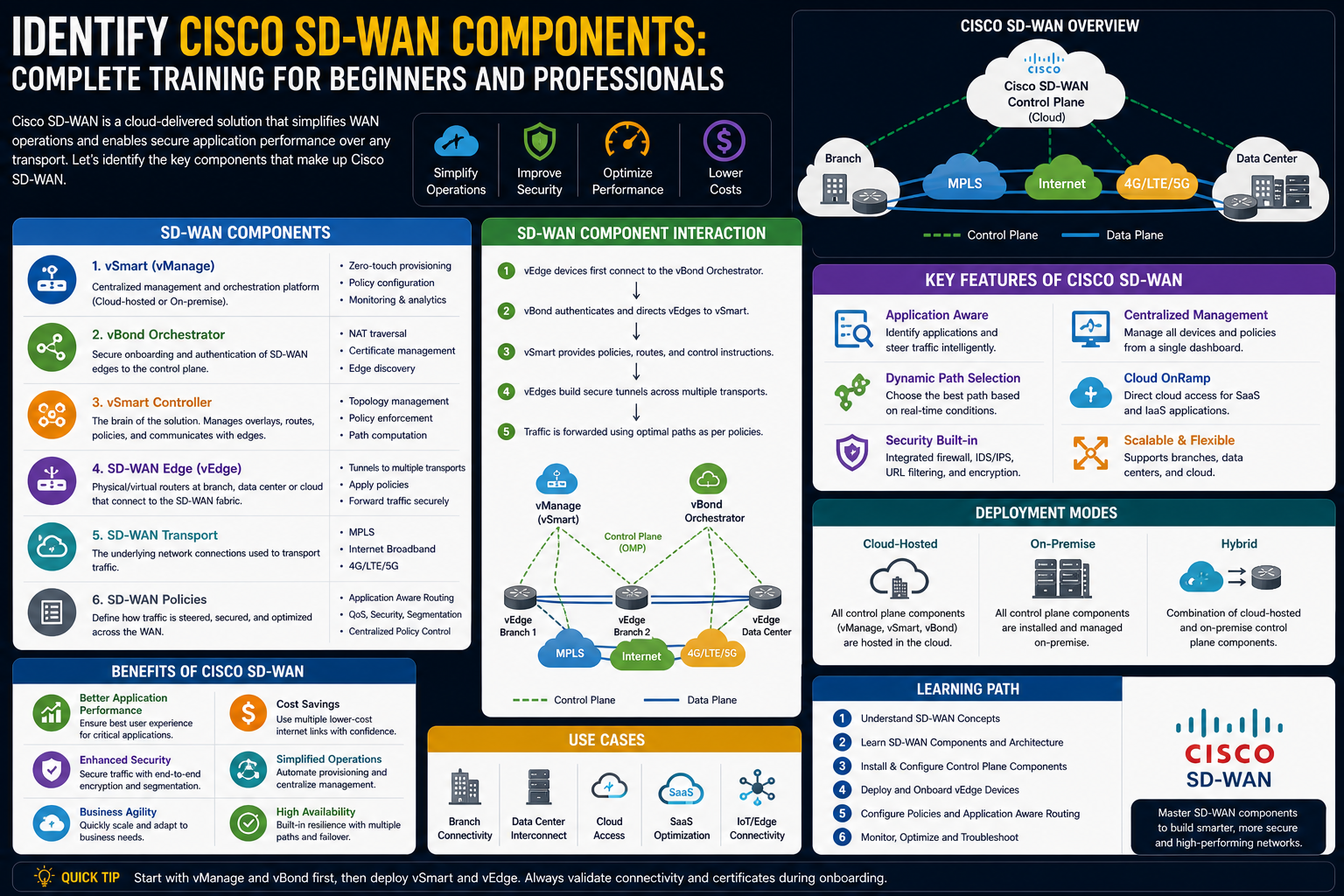
Cisco SD-WAN represents a major shift in how enterprise networks are designed, deployed, and managed. Instead of relying heavily on traditional, hardware-centric WAN architectures, SD-WAN introduces a software-defined approach that separates control, management, and data handling into distinct layers. This separation allows organizations to build more flexible, scalable, and secure networks that can adapt to modern business demands such as cloud adoption, remote work, and distributed applications.
At its core, SD-WAN is designed to simplify the complexity of wide-area networking. Traditional WAN setups often depend on static routing, expensive leased lines, and manual configuration processes. These limitations can make it difficult for businesses to respond quickly to changing traffic patterns or application requirements. Cisco SD-WAN addresses these challenges by introducing centralized intelligence and automated policy control, allowing network behavior to be defined and enforced dynamically.
The architecture of SD-WAN is built around several key components that work together to form a cohesive system. These components are distributed across different planes, each responsible for a specific set of functions. This separation ensures that the network can scale efficiently while maintaining performance and security across diverse environments.
One of the most important advantages of Cisco SD-WAN is its ability to support multiple transport types. Whether using MPLS, broadband internet, LTE, or fiber connections, SD-WAN can intelligently route traffic based on application needs and network conditions. This flexibility enables organizations to optimize costs while maintaining high levels of performance for critical applications.
Another defining characteristic of SD-WAN is its centralized policy management. Instead of configuring each network device individually, administrators can define policies from a single management platform. These policies are then automatically distributed across the network, ensuring consistent behavior and reducing the likelihood of configuration errors.
The intelligence built into SD-WAN allows it to continuously monitor network conditions in real time. It can detect latency, jitter, packet loss, and bandwidth availability, and then make routing decisions based on this data. This dynamic approach ensures that applications always receive the best possible path through the network.
Security is also a fundamental aspect of Cisco SD-WAN. Encryption is applied across all communication channels, ensuring that data remains protected even when traversing public networks. In addition, SD-WAN integrates security policies directly into the network fabric, reducing the need for separate security appliances in many cases.
The architecture of Cisco SD-WAN is typically divided into four primary functional planes. Each plane is responsible for a different aspect of network operation. These include the data plane, control plane, management plane, and orchestration plane. Understanding these planes is essential to understanding how SD-WAN operates as a whole.
The data plane is responsible for forwarding traffic across the network. It handles the actual movement of packets between endpoints, ensuring that data reaches its destination efficiently. Devices operating in the data plane are typically located at branch offices, data centers, or cloud environments.
The control plane is responsible for determining how traffic should be routed. It maintains routing information, network topology data, and policy rules. This plane ensures that data packets take the most efficient and appropriate path through the network based on current conditions and configured policies.
The management plane provides centralized visibility and configuration capabilities. It allows network administrators to monitor performance, deploy configurations, and manage policies across the entire SD-WAN infrastructure. This plane acts as the operational interface for the network.
The orchestration plane is responsible for coordinating the initial setup and connectivity of SD-WAN components. It ensures that devices can securely join the network and establish trust relationships with other components. This plane plays a critical role in automating deployment and simplifying onboarding processes.
Each of these planes works together to create a unified and intelligent networking system. By separating responsibilities, SD-WAN ensures that each function can operate independently while still contributing to overall network performance.
The evolution of Cisco SD-WAN has been driven by the increasing demand for cloud-based services. As organizations move applications to cloud environments, traditional WAN architectures struggle to provide the required performance and flexibility. SD-WAN addresses this by enabling direct cloud access and optimizing traffic flow to SaaS and IaaS platforms.
Another important driver behind SD-WAN adoption is the growth of remote and hybrid work models. Employees now require secure and reliable access to corporate resources from multiple locations. SD-WAN supports this by extending consistent network policies and security controls to remote users and branch offices.
In addition to improving performance and flexibility, SD-WAN also helps reduce operational costs. By leveraging inexpensive internet connections alongside traditional WAN links, organizations can reduce dependency on costly private circuits. Intelligent traffic steering ensures that critical applications still receive priority routing when needed.
Cisco SD-WAN also enhances visibility across the entire network. Administrators can gain detailed insights into application performance, user experience, and network health. This level of visibility allows for faster troubleshooting and more informed decision-making.
The modular nature of SD-WAN components makes it highly adaptable to different enterprise environments. Whether deployed in small branch networks or large global infrastructures, the same architectural principles apply. This consistency simplifies scaling and expansion over time.
The integration of automation is another key feature of Cisco SD-WAN. Many configuration tasks that once required manual intervention are now automated through centralized policies and templates. This reduces human error and accelerates deployment times.
As organizations continue to adopt digital transformation strategies, SD-WAN plays a critical role in enabling agile and responsive network infrastructures. Its ability to integrate with cloud services, support diverse connectivity options, and enforce intelligent policies makes it a foundational technology for modern networking.
Understanding SD-WAN begins with recognizing its architectural separation and the purpose of each functional plane. This foundational knowledge is essential before exploring the specific components that operate within each plane, as each component contributes to the overall behavior and intelligence of the network system.
Data Plane Operation in Cisco SD-WAN and the Role of vEdge Devices
The data plane in Cisco SD-WAN is responsible for handling the actual movement of traffic across the network. It focuses entirely on forwarding packets between endpoints based on the policies and instructions received from higher-level control components. This plane is designed to operate efficiently even under varying network conditions, ensuring that application traffic is delivered with minimal delay and disruption.
Within the data plane, vEdge routers play a central role in traditional SD-WAN deployments. These devices are typically placed at branch locations or edge sites where user traffic enters or exits the network. Their primary function is to encapsulate, encrypt, and forward traffic across WAN links while maintaining adherence to centrally defined policies.
The vEdge architecture is optimized for secure and scalable transport of data. Each vEdge device forms secure tunnels with other SD-WAN components, ensuring that all communication is encrypted. This allows organizations to safely transmit sensitive information across public or private network links without compromising security.
In many environments, vEdge devices are responsible for making local forwarding decisions. These decisions are based on policies received from the control plane, which define how different types of traffic should be treated. For example, latency-sensitive applications may be directed through low-latency links, while bulk data transfers may use more cost-effective paths.
The data plane is designed to be highly resilient. Even if connectivity to centralized controllers is temporarily lost, vEdge devices can continue forwarding traffic based on previously received policies. This ensures continuity of service even during partial network outages.
Another important aspect of the data plane is traffic segmentation. SD-WAN allows different types of traffic to be isolated using virtual routing and forwarding techniques. This ensures that business-critical applications are separated from less important traffic, improving both performance and security.
The efficiency of the data plane is enhanced by its ability to dynamically adapt to changing network conditions. If a particular path becomes congested or degraded, traffic can be rerouted automatically to maintain optimal performance. This dynamic behavior is a key advantage over traditional static routing methods.
Cisco cEdge Devices and the Evolution of SD-WAN Edge Routing
Cisco cEdge devices represent a modern evolution of SD-WAN edge routing technology. Unlike traditional vEdge routers, which are based on a specialized operating system, cEdge devices run on Cisco IOS XE, which is widely used across enterprise networking environments.
The introduction of cEdge devices allows organizations to unify their routing infrastructure under a single operating system. This simplifies network management by reducing the need to maintain multiple device types with different software architectures.
cEdge devices support the same core SD-WAN functionality as vEdge routers, including secure tunneling, policy-based routing, and centralized management. However, they also integrate more closely with traditional routing features found in IOS XE environments.
This integration enables organizations to gradually transition from legacy WAN architectures to SD-WAN without requiring a complete infrastructure overhaul. Existing IOS XE-based routers can often be upgraded to support SD-WAN functionality, reducing deployment complexity.
cEdge devices also enhance application awareness within the network. They are capable of identifying application types and applying policies based on application behavior rather than just IP addresses or ports. This allows for more granular control over traffic flows.
Another key advantage of cEdge devices is their scalability. They are designed to support high-performance environments where large volumes of traffic must be processed efficiently. This makes them suitable for both branch offices and larger enterprise edge locations.
The flexibility of cEdge devices extends to their integration with cloud environments. They can establish secure connections to cloud-based applications and services, ensuring consistent performance across hybrid infrastructures.
Control Plane Intelligence and the Function of vSmart Controllers
The control plane in Cisco SD-WAN is responsible for managing how traffic is routed across the network. It does not directly forward data but instead determines the optimal paths that data should follow based on policies and network conditions.
At the core of the control plane are vSmart controllers. These components maintain a global view of the network topology and distribute routing and policy information to edge devices. Their role is essential in ensuring that traffic flows are optimized and consistent across the entire SD-WAN fabric.
vSmart controllers operate using a centralized policy model. Administrators define routing and traffic handling rules, which are then distributed to all connected devices. This ensures that policies are applied uniformly throughout the network.
One of the key functions of vSmart controllers is to manage dynamic routing decisions. They evaluate available paths and determine the most efficient route for each type of traffic. These decisions are based on factors such as latency, packet loss, and bandwidth availability.
vSmart controllers also play a role in maintaining network stability. By continuously monitoring the state of the network, they can quickly adapt routing decisions when conditions change. This ensures that applications remain highly available and performant.
The communication between vSmart controllers and edge devices is highly secure. All exchanges are encrypted, and authentication mechanisms ensure that only trusted devices can participate in the SD-WAN fabric.
In environments with multiple vSmart controllers, the control plane becomes more resilient and scalable. Traffic and policy distribution can be balanced across multiple controllers, reducing the risk of overload and improving redundancy.
Orchestration Layer and the Functionality of vBond Orchestrator
The orchestration plane is responsible for the initial establishment of trust and connectivity within the SD-WAN network. It ensures that devices can securely join the network and begin communicating with other components.
The vBond orchestrator is the primary component within this plane. It acts as the first point of contact for new SD-WAN devices attempting to join the fabric. Its role is to authenticate devices and facilitate their connection to the appropriate controllers.
When a new device is introduced into the network, it first contacts the vBond orchestrator. The orchestrator verifies the identity of the device using predefined authentication methods. Once verified, it provides the necessary information for the device to connect to vManage and vSmart controllers.
The vBond orchestrator also plays an important role in environments where devices are located behind NAT (Network Address Translation). It helps establish initial connectivity by coordinating NAT traversal, ensuring that devices can communicate even when they are not directly reachable.
This functionality is particularly important in modern network environments where branch devices are often deployed in remote or privately addressed locations. The vBond orchestrator ensures that these devices can still securely join the SD-WAN fabric.
In addition to authentication and connectivity, the vBond orchestrator helps distribute network information to newly joined devices. This ensures that they can quickly integrate into the existing topology and begin participating in traffic forwarding.
The communication between vBond and other SD-WAN components is maintained using secure tunnels. These tunnels ensure that all orchestration traffic is protected from unauthorized access or interception.
Management Plane Operations and the Role of vManage
The management plane provides centralized control and visibility over the entire SD-WAN environment. It is responsible for configuration, monitoring, reporting, and policy management across all connected devices.
At the center of the management plane is vManage. This component acts as the primary interface for administrators to interact with the SD-WAN system. Through vManage, network configurations can be defined, deployed, and monitored in a centralized manner.
vManage allows administrators to create templates that define how devices should be configured. These templates can then be applied across multiple devices, ensuring consistency and reducing manual configuration effort.
Monitoring capabilities within vManage provide real-time insights into network performance. Administrators can view metrics such as bandwidth usage, application performance, and device health. This visibility enables proactive network management.
The management plane also supports logging and reporting functions. These features allow organizations to analyze historical data and identify trends in network behavior. This information can be used to optimize performance and troubleshoot issues.
Policy management is another key function of vManage. Administrators can define traffic handling rules that determine how different types of traffic should be treated across the network. These policies are then distributed to all relevant devices.
The centralized nature of vManage simplifies network operations. Instead of configuring each device individually, administrators can manage the entire network from a single interface. This reduces operational complexity and improves efficiency.
Communication Between SD-WAN Components and Secure Tunnel Architecture
Cisco SD-WAN relies heavily on secure communication channels between its components. These channels are established using encrypted tunnels that ensure data integrity and confidentiality.
vEdge and cEdge devices communicate with controllers using DTLS or TLS-based tunnels. These tunnels provide secure pathways for exchanging routing information, policies, and management data.
The use of secure tunnels ensures that all communication within the SD-WAN fabric is protected from external threats. This is especially important in environments where traffic traverses public networks.
Each SD-WAN component maintains persistent or semi-persistent connections with other components. These connections allow for continuous exchange of network state information and rapid response to changes.
The architecture of these communication channels is designed to be resilient. If one path becomes unavailable, alternative tunnels can be established automatically to maintain connectivity.
Authentication is a critical part of this communication framework. Each device must prove its identity before it is allowed to participate in the SD-WAN network. This prevents unauthorized devices from joining the fabric.
Deployment Models in Cisco SD-WAN Environments
Cisco SD-WAN can be deployed in several different models depending on organizational needs and infrastructure requirements. Each model offers different levels of control, scalability, and operational complexity.
In an on-premises deployment model, all SD-WAN components are hosted within the organization’s own data centers. This provides maximum control over infrastructure but requires significant management effort.
Cloud-based deployment models involve hosting SD-WAN controllers in cloud environments. This reduces infrastructure overhead and allows for easier scalability. It is particularly useful for organizations with distributed operations.
Hybrid deployment models combine both on-premises and cloud-based components. This approach allows organizations to balance control and flexibility based on specific requirements.
Each deployment model uses the same core SD-WAN architecture. However, the location and management of components may differ depending on the chosen approach.
Cisco SD-WAN Product Structure and Ecosystem Components
The Cisco SD-WAN ecosystem consists of multiple integrated components that work together to deliver end-to-end networking functionality. These components include edge devices, controllers, and management systems.
Each component plays a specific role within the overall architecture. Edge devices handle traffic forwarding, controllers manage routing intelligence, and management systems provide centralized control.
The ecosystem is designed to be modular, allowing organizations to deploy only the components they need. This flexibility makes it suitable for a wide range of network environments.
The integration between components is tightly coordinated to ensure consistent performance and security. All parts of the system communicate through secure and standardized protocols.
The overall structure of Cisco SD-WAN reflects a shift toward software-defined networking principles, where intelligence and control are centralized while data forwarding remains distributed.
Controller Deployment Models and Architectural Variations in Cisco SD-WAN
Cisco SD-WAN is designed with flexibility in mind, especially when it comes to how controllers are deployed across different environments. Organizations rarely operate under identical constraints, so the architecture must adapt to different levels of scale, security requirements, geographic distribution, and operational maturity. This is why controller deployment models play such a critical role in shaping how an SD-WAN network behaves in real-world scenarios.
In a typical SD-WAN environment, controllers include vManage, vSmart, and vBond, each serving a distinct function within the management, control, and orchestration planes. How these components are deployed—whether on-premises, in the cloud, or in a hybrid model—directly impacts performance, resilience, and administrative overhead.
On-premises deployment models place all controller components within an organization’s internal data centers. This model is often chosen by enterprises with strict regulatory requirements or those that need full control over their infrastructure. In this setup, latency between controllers and edge devices can be tightly managed because everything remains within a controlled environment.
However, on-premises deployments require significant investment in hardware, maintenance, and operational expertise. Organizations must ensure redundancy, scalability, and disaster recovery planning for each controller component. This makes the model more complex to manage at scale, especially for globally distributed enterprises.
Cloud-based deployment models shift controller infrastructure to cloud service environments. In this approach, vManage, vSmart, and vBond may be hosted in cloud data centers, reducing the need for physical infrastructure management. This model is particularly beneficial for organizations adopting cloud-first strategies or those with rapidly expanding branch networks.
One of the major advantages of cloud deployment is scalability. Resources can be adjusted dynamically based on demand, allowing the SD-WAN environment to grow without significant hardware investment. Additionally, cloud providers often offer built-in redundancy and high availability, reducing the operational burden on internal IT teams.
Hybrid deployment models combine elements of both on-premises and cloud-based architectures. In this setup, some controllers may remain within the enterprise data center while others are hosted in the cloud. This approach is often used during migration phases or in environments where certain workloads must remain local due to compliance requirements.
Hybrid architectures provide a balance between control and flexibility. They allow organizations to gradually transition toward cloud adoption while maintaining critical services on-premises. This model also supports multi-region deployments, where different geographic locations may use different controller placements based on latency and connectivity needs.
Regardless of deployment model, the logical separation of SD-WAN planes remains consistent. This consistency ensures that operational behavior does not change even when physical deployment strategies differ. It also allows organizations to redesign infrastructure without altering the fundamental SD-WAN architecture.
Cisco SD-WAN Product Ecosystem and Integrated Components
The Cisco SD-WAN ecosystem is not limited to a single product or device. Instead, it consists of multiple integrated components that work together to deliver a complete networking solution. These components span edge devices, controllers, security integrations, and analytics platforms.
At the edge of the network, devices such as vEdge and cEdge routers form the foundation of traffic forwarding. These devices are responsible for securely transmitting data between branch locations, data centers, and cloud environments. They operate under centralized policies but execute decisions locally to ensure efficiency.
Within the control layer, vSmart controllers manage routing intelligence and policy distribution. They maintain a global view of network topology and continuously optimize traffic paths based on real-time conditions. This ensures that applications receive the most efficient routing possible at any given time.
The orchestration layer, represented by vBond, ensures secure onboarding of devices into the SD-WAN fabric. It acts as the initial trust anchor, verifying identity and facilitating secure connections between components. Without this layer, automated deployment of SD-WAN would not be possible at scale.
The management layer, centered around vManage, provides centralized visibility and control. It allows administrators to configure policies, monitor performance, and analyze network behavior from a single interface. This centralized approach significantly reduces operational complexity.
Beyond core SD-WAN components, Cisco integrates additional capabilities such as security services, application visibility tools, and cloud connectivity enhancements. These integrations extend the functionality of SD-WAN beyond traditional networking, transforming it into a comprehensive digital infrastructure platform.
Security integration is particularly important in modern SD-WAN environments. Features such as encryption, segmentation, and threat detection are embedded directly into the network fabric. This reduces reliance on external security appliances and ensures consistent policy enforcement across all traffic flows.
Application visibility tools allow administrators to understand how specific applications are performing across the network. Instead of focusing solely on network metrics, SD-WAN provides insights into user experience and application behavior. This shift enables more informed decision-making.
Cloud connectivity enhancements ensure that SD-WAN can seamlessly integrate with public cloud platforms. Direct cloud access, optimized routing, and secure tunnels help improve performance for cloud-hosted applications.
Deep Dive into SD-WAN Traffic Flow and Path Selection Behavior
Traffic flow in Cisco SD-WAN is governed by a combination of centralized policies and real-time network conditions. Unlike traditional routing systems that rely on static tables, SD-WAN dynamically evaluates multiple paths before selecting the most appropriate one.
When a packet enters the SD-WAN fabric through a vEdge or cEdge device, it is first classified based on application type, policy rules, and security requirements. This classification determines how the traffic should be treated throughout its journey.
Once classified, the device consults routing information provided by vSmart controllers. This information includes available paths, performance metrics, and policy constraints. Based on this data, the device selects the optimal route for forwarding traffic.
Path selection is not a one-time decision. Instead, SD-WAN continuously monitors network conditions such as latency, jitter, and packet loss. If a path becomes degraded, traffic can be rerouted automatically to maintain application performance.
This dynamic behavior is one of the key advantages of SD-WAN over traditional WAN architectures. It ensures that applications remain responsive even under changing network conditions.
Traffic engineering policies play a major role in shaping path selection behavior. These policies define how different types of traffic should be prioritized. For example, voice and video traffic may be given preference over bulk data transfers.
In addition to performance-based routing, SD-WAN also considers cost optimization. Organizations can configure policies that balance performance with cost efficiency, ensuring that expensive links are used only when necessary.
Role of Security in Cisco SD-WAN Architecture
Security is deeply embedded into Cisco SD-WAN architecture rather than being treated as an external layer. Every component of the system contributes to maintaining a secure network environment.
All communication between SD-WAN components is encrypted using secure protocols. This ensures that data remains protected as it traverses public or private networks. Encryption is applied consistently across all tunnels, regardless of deployment model.
Identity verification is another critical aspect of SD-WAN security. Each device must authenticate itself before joining the network. This prevents unauthorized access and ensures that only trusted devices participate in the SD-WAN fabric.
Segmentation is used to isolate different types of traffic within the network. This prevents sensitive data from being exposed to unnecessary risk and allows organizations to enforce strict access controls.
Policy-driven security allows administrators to define rules that govern how traffic is handled. These rules are enforced consistently across all devices, ensuring uniform protection throughout the network.
Threat detection capabilities can be integrated into SD-WAN environments to identify malicious activity. This enhances overall network resilience and provides early warning of potential security issues.
Operational Management and Network Visibility Enhancements
Operational management in Cisco SD-WAN is centered around simplicity and visibility. The system is designed to reduce manual intervention while providing deep insights into network behavior.
Centralized management through vManage allows administrators to oversee the entire network from a single interface. This includes configuration, monitoring, troubleshooting, and reporting.
Real-time dashboards provide visibility into network performance metrics. These dashboards help administrators quickly identify issues and understand traffic patterns.
Historical data analysis enables long-term optimization of network performance. By examining trends over time, organizations can make informed decisions about capacity planning and policy adjustments.
Automation plays a significant role in operational efficiency. Many routine tasks such as device onboarding, configuration deployment, and policy updates can be automated, reducing the risk of human error.
Troubleshooting tools within SD-WAN allow for rapid identification of network issues. These tools provide detailed insights into path performance, device health, and application behavior.
Scalability and Global Network Expansion Considerations
Cisco SD-WAN is designed to support large-scale, globally distributed networks. Its architecture allows organizations to expand their network footprint without significantly increasing operational complexity.
Scalability is achieved through distributed architecture and centralized control. Edge devices handle local traffic processing while controllers manage global intelligence.
As organizations expand into new regions, additional SD-WAN devices can be deployed and automatically integrated into the existing network. This simplifies expansion and reduces deployment time.
Load balancing across controllers ensures that no single component becomes a bottleneck. This enhances performance and supports high availability in large deployments.
Geographic distribution of controllers can be optimized to reduce latency. By placing controllers closer to edge devices, communication efficiency is improved.
Integration with Cloud and Digital Transformation Strategies
Modern enterprises increasingly rely on cloud-based applications and services. Cisco SD-WAN is designed to support this shift by providing optimized cloud connectivity.
Direct access to cloud platforms reduces dependency on centralized data centers. This improves application performance and reduces latency for cloud-hosted services.
SD-WAN also supports multi-cloud environments, allowing organizations to connect to multiple cloud providers simultaneously. This flexibility is essential for modern digital strategies.
Application-aware routing ensures that cloud traffic is handled efficiently based on performance requirements. This improves user experience for SaaS and cloud-native applications.
Evolution of SD-WAN and Future-Oriented Networking Principles
Cisco SD-WAN represents a broader evolution in networking architecture. It moves away from rigid, hardware-dependent systems toward flexible, software-defined models.
This evolution is driven by the need for agility, scalability, and automation in modern IT environments. Traditional WAN architectures cannot easily support the demands of cloud computing and distributed workforces.
SD-WAN introduces intelligence into the network itself, allowing it to adapt dynamically to changing conditions. This shift fundamentally changes how networks are designed and operated.
As organizations continue to adopt digital transformation strategies, SD-WAN will remain a foundational technology supporting connectivity, security, and performance across global infrastructures.
Advanced Policy Control and Traffic Engineering in Cisco SD-WAN
Cisco SD-WAN introduces a highly flexible policy framework that goes far beyond traditional routing rules. Instead of relying on static configurations, the system uses centralized policies that define how traffic should behave across the entire network fabric. These policies can be application-aware, site-aware, or path-aware, allowing granular control over traffic flows.
Application-aware policies are particularly important in modern enterprise environments. Instead of treating all traffic equally, SD-WAN can identify specific applications and apply tailored routing decisions. For example, real-time communication tools may require low latency paths, while backup traffic can be routed through lower-cost links without affecting user experience.
Site-aware policies allow organizations to define behavior based on location. Branch offices, data centers, and cloud environments can each have customized traffic handling rules. This ensures that each site operates optimally based on its role within the overall network architecture.
Path-aware policies focus on the characteristics of available network links. SD-WAN continuously evaluates metrics such as jitter, latency, and packet loss to determine which path is most suitable for a given type of traffic. These decisions are made dynamically, allowing the network to adapt in real time.
Policy enforcement occurs directly at the edge devices, meaning decisions are implemented close to the source of traffic. This reduces unnecessary backhaul and improves overall efficiency. The centralized controller defines the rules, but execution happens locally, ensuring scalability.
Quality of Service Optimization Across SD-WAN Infrastructure
Quality of Service (QoS) plays a central role in ensuring that critical applications receive the bandwidth and priority they require. Cisco SD-WAN enhances QoS by integrating it directly into the policy framework rather than treating it as a separate configuration layer.
Traffic is classified based on application type, business priority, and performance requirements. Once classified, it is assigned to specific queues that determine how it is processed across the network.
High-priority traffic such as voice and video is typically placed in low-latency queues to ensure smooth performance. Less sensitive traffic, such as file transfers or updates, is assigned to best-effort queues.
SD-WAN also enables end-to-end QoS consistency across multiple transport types. Whether traffic is traveling over MPLS, broadband, or LTE, QoS policies remain consistent. This ensures predictable performance regardless of underlying infrastructure.
Bandwidth allocation can be dynamically adjusted based on real-time network conditions. If congestion is detected, SD-WAN can reprioritize traffic or shift flows to alternative paths to maintain service quality.
Enhanced Security Architecture with Integrated Threat Protection
Security in Cisco SD-WAN extends beyond encryption and authentication. The architecture is designed to provide layered protection that spans connectivity, policy enforcement, and traffic inspection.
Secure segmentation ensures that different types of traffic remain isolated from each other. This prevents unauthorized access and limits the potential impact of security breaches. Each segment operates independently, with its own policies and routing behavior.
Identity-based access control is another important security feature. Devices must authenticate using trusted certificates before joining the SD-WAN fabric. This ensures that only verified endpoints participate in network communication.
Encrypted tunnels protect all data in transit. These tunnels are established between SD-WAN components and remain active throughout communication sessions. Even if traffic passes through public infrastructure, it remains unreadable to unauthorized parties.
Threat detection capabilities can be integrated into the SD-WAN environment through security services. These services analyze traffic patterns to identify anomalies or malicious behavior. When threats are detected, policies can be automatically adjusted to mitigate risk.
Security policies are enforced consistently across all devices, eliminating configuration gaps that often occur in traditional networks. This uniform enforcement reduces the attack surface and improves overall resilience.
Troubleshooting and Network Diagnostics in SD-WAN Environments
Troubleshooting in Cisco SD-WAN is significantly more efficient compared to traditional networking environments due to centralized visibility and real-time analytics. Administrators can quickly identify issues without manually accessing individual devices.
One of the key diagnostic capabilities is path visualization. This allows administrators to see how traffic is flowing across the network and identify any degraded or suboptimal routes.
Performance metrics such as latency, jitter, and packet loss are continuously monitored. These metrics provide insight into the health of network links and help pinpoint performance issues.
Application-level visibility further enhances troubleshooting. Instead of focusing solely on network behavior, administrators can analyze how specific applications are performing across different locations.
Event logs provide detailed information about system behavior, including device status changes, policy updates, and connectivity events. These logs are centralized, making it easier to correlate issues across the network.
Remote troubleshooting tools allow administrators to run diagnostics without physically accessing devices. This reduces resolution time and minimizes disruption to network operations.
Scalability Challenges and Optimization Techniques in Large SD-WAN Deployments
As SD-WAN networks grow, scalability becomes an important consideration. Large deployments may include hundreds or thousands of branch sites, each generating significant traffic and management overhead.
One of the key scalability strategies is hierarchical control plane design. By distributing control responsibilities across multiple vSmart controllers, the system avoids overloading any single component.
Load balancing ensures that traffic and control messages are evenly distributed across available resources. This improves performance and prevents bottlenecks in large-scale environments.
Efficient policy design is also essential for scalability. Overly complex policies can increase processing overhead on edge devices. Simplifying policy structures helps maintain performance as the network grows.
Device onboarding automation plays a major role in scaling SD-WAN environments. New devices can be added to the network with minimal manual configuration, reducing deployment time and operational effort.
Geographic distribution of infrastructure helps reduce latency in global deployments. By placing controllers closer to edge devices, communication efficiency is improved across regions.
Migration Strategies from Traditional WAN to SD-WAN
Migrating from traditional WAN architectures to Cisco SD-WAN requires careful planning to ensure minimal disruption. Most organizations adopt a phased approach rather than a full-scale immediate transition.
The first phase typically involves deploying SD-WAN alongside existing WAN infrastructure. This allows both systems to operate in parallel while testing performance and compatibility.
Gradual migration of traffic ensures that critical applications are not impacted during the transition. Less sensitive traffic is often moved first, followed by mission-critical workloads.
Integration with existing routing protocols is an important consideration during migration. SD-WAN can coexist with traditional routing systems, allowing for smooth interoperability.
Training and operational adaptation are also key factors. Network teams must become familiar with new tools, interfaces, and operational models introduced by SD-WAN.
Over time, legacy WAN components can be phased out as SD-WAN becomes the primary networking architecture. This gradual transition reduces risk and ensures stability.
Role of Analytics and Telemetry in Network Optimization
Telemetry and analytics are fundamental to the intelligence of Cisco SD-WAN. The system continuously collects data from all network components to provide a comprehensive view of performance and behavior.
This data includes application usage patterns, link performance metrics, and device health indicators. By analyzing this information, administrators can gain deep insights into network operations.
Predictive analytics can identify potential issues before they impact users. For example, if a link shows signs of degradation, traffic can be rerouted proactively.
Historical analytics allow organizations to understand long-term trends. This information is useful for capacity planning and infrastructure optimization.
Real-time analytics enable immediate decision-making. Network adjustments can be made dynamically based on current conditions, improving responsiveness.
The combination of telemetry and analytics transforms SD-WAN into an intelligent system capable of self-optimization.
Conclusion
Cisco SD-WAN represents a significant shift in how modern enterprise networks are designed, operated, and optimized. By separating networking into distinct planes—data, control, management, and orchestration—it introduces a level of clarity and efficiency that traditional WAN architectures struggle to achieve. Each plane plays a specialized role, yet all work together to deliver a unified, intelligent networking experience that adapts dynamically to changing business and application demands.
One of the most impactful aspects of SD-WAN is its ability to simplify complexity while improving performance. Instead of relying on rigid, manually configured routing systems, SD-WAN uses centralized policies and real-time intelligence to determine how traffic should flow. This ensures that applications receive the most efficient path based on current network conditions such as latency, jitter, and congestion. The result is a more responsive and reliable user experience across distributed environments.
The integration of components such as vEdge, cEdge, vSmart, vBond, and vManage forms a complete ecosystem that supports secure connectivity, automated deployment, and centralized control. Each component contributes to a specific function, whether it is forwarding traffic, managing policies, or orchestrating device onboarding. Together, they create a network fabric that is both highly scalable and operationally efficient.
Security is deeply embedded within the SD-WAN architecture rather than being added as an external layer. Through encryption, authentication, and segmentation, Cisco SD-WAN ensures that data remains protected across all transport types and environments. This built-in security model reduces complexity while maintaining strong protection for enterprise traffic.
Equally important is the role of visibility and analytics. Continuous telemetry allows organizations to monitor network health, analyze application performance, and identify potential issues before they escalate. This proactive approach to network management improves reliability and reduces downtime.
As enterprises continue to adopt cloud services, remote work models, and digital transformation strategies, the need for flexible and intelligent networking becomes increasingly critical. Cisco SD-WAN addresses these needs by providing a scalable, policy-driven, and application-aware infrastructure that can evolve with organizational requirements.
Ultimately, SD-WAN is not just an upgrade to traditional networking—it is a foundational change in how networks operate. It brings together automation, security, performance optimization, and centralized control into a single cohesive system, enabling organizations to build networks that are more agile, resilient, and aligned with modern digital demands.