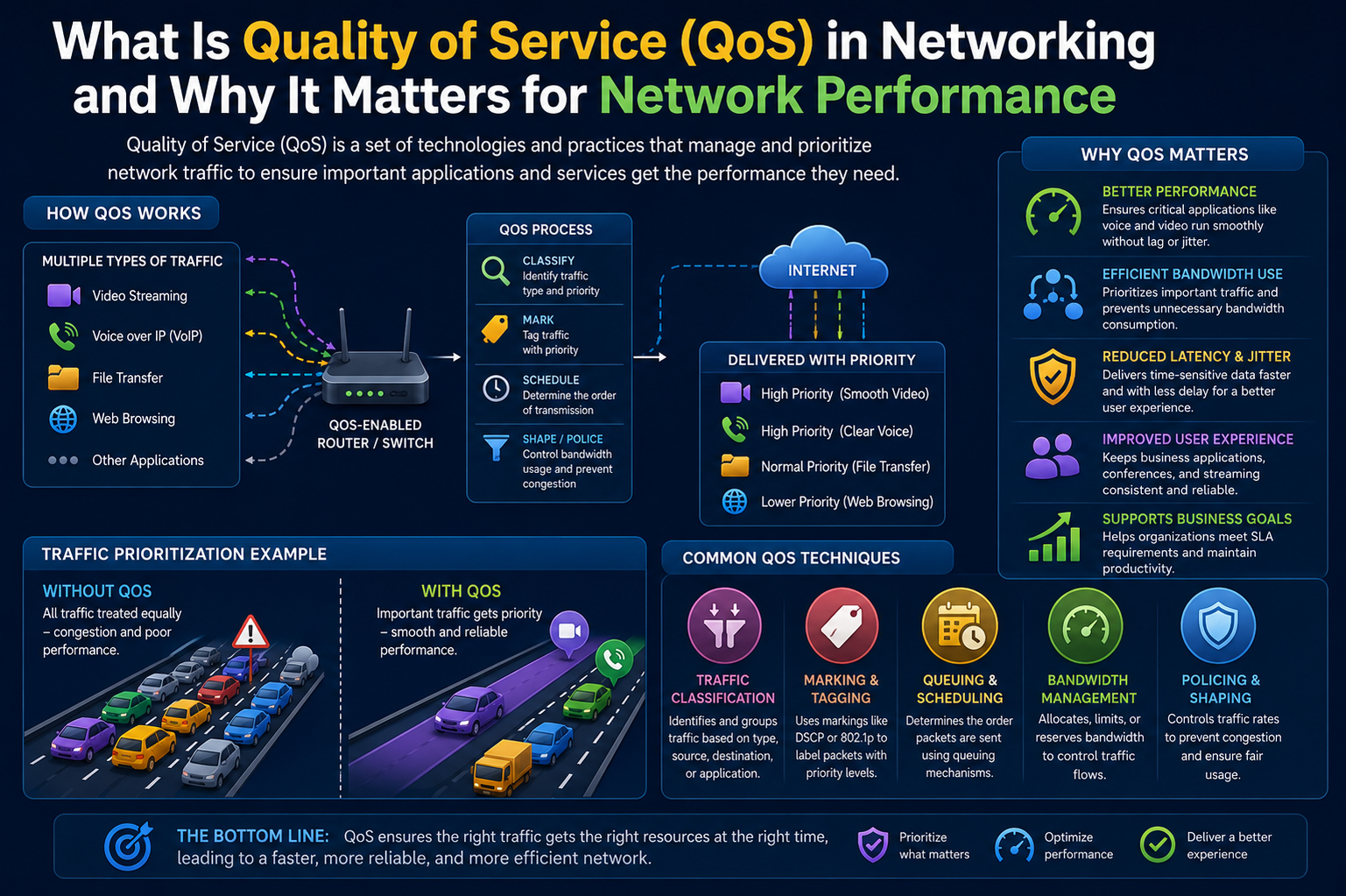
Modern computer networks are expected to handle an enormous variety of digital activities at the same time. A single business network may carry video conferences, cloud applications, online transactions, security camera feeds, email communication, voice calls, remote desktop sessions, and data backups simultaneously. Every one of these services competes for the same network resources. Without a system to organize and prioritize this traffic, networks can become congested, slow, and unreliable.
This challenge is where Quality of Service, commonly known as QoS, becomes important. QoS is a collection of networking technologies and methods used to manage traffic flow and ensure that important applications receive the network resources they need. Instead of treating all data equally, QoS allows network administrators to determine which traffic should receive priority during times of congestion.
The growing dependence on real-time communication has made QoS more essential than ever. Years ago, most office networks mainly supported email and file sharing. These applications could tolerate small delays because they were not highly time-sensitive. Today, organizations rely heavily on live communication platforms, cloud-based services, and connected devices that demand immediate and uninterrupted performance.
Voice and video communication are especially sensitive to delays. A file download may take a few extra seconds without causing major problems, but a video conference with constant freezing and audio interruptions can make communication nearly impossible. QoS helps reduce these disruptions by ensuring that time-sensitive traffic receives faster and more reliable handling.
The increasing popularity of remote work has also intensified the need for traffic prioritization. Employees now connect from homes, branch offices, and mobile devices while using collaboration platforms, virtual desktops, and cloud applications. Networks must support these services while also handling ordinary internet browsing, software updates, and background synchronization tasks. Without traffic management, critical applications may compete equally with low-priority traffic, leading to poor performance.
Another major factor contributing to network complexity is the rise of the Internet of Things. Smart sensors, surveillance cameras, industrial systems, and connected devices generate continuous streams of data. In large environments, thousands of devices may operate at the same time. Some of these systems require immediate responses, especially in healthcare, manufacturing, or security environments. QoS ensures that essential machine communications are not delayed by less important traffic.
At its core, QoS focuses on delivering predictable network performance. It is not simply about making a network faster. Even high-speed networks can suffer from congestion if traffic is unmanaged. QoS works by controlling how traffic is classified, prioritized, queued, and transmitted.
One of the most important ideas behind QoS is that not all traffic has the same requirements. Different applications behave differently and tolerate network issues in different ways. Understanding these differences is essential for designing effective QoS policies.
Applications such as video streaming and Voice over IP rely on steady packet delivery. They require low latency and minimal jitter to function correctly. If packets arrive too late or out of sequence, the user experiences frozen images, distorted audio, or broken communication.
By contrast, applications such as email and file transfers are less sensitive to delays. If an email arrives a few seconds later than expected, users may never notice. These applications can tolerate brief interruptions and variable delivery times more easily.
This distinction between time-sensitive and delay-tolerant applications forms the basis of QoS decision-making. Network administrators identify which services are most important and configure policies that protect them during periods of congestion.
Bandwidth plays a central role in QoS. Bandwidth refers to the maximum amount of data that can travel across a network connection within a specific period. It is often compared to the width of a highway. A wider highway allows more cars to travel simultaneously, while a narrower highway creates bottlenecks.
However, having high bandwidth alone does not guarantee smooth performance. When too many applications attempt to use the network at the same time, congestion occurs. QoS helps manage this congestion by determining how bandwidth is distributed among applications.
Throughput is another important concept. While bandwidth describes the theoretical capacity of a connection, throughput measures the actual amount of data successfully transferred. Network conditions, hardware limitations, interference, and congestion all affect throughput.
Latency is one of the most commonly discussed QoS measurements. Latency refers to the time required for a packet to travel from its source to its destination. High latency can create noticeable delays in communication. During a video meeting, excessive latency may cause awkward pauses between speakers.
Jitter is closely related to latency. Instead of measuring total delay, jitter measures variations in packet arrival times. Even if overall latency is low, inconsistent delivery timing can disrupt voice and video communication. Smooth audio and video streams depend on packets arriving in a predictable sequence.
Packet loss occurs when data packets fail to reach their destination. Congestion is one of the most common causes of packet loss. When network devices become overloaded, they may discard packets to relieve pressure. Lost packets can force retransmissions or cause visible interruptions in media applications.
QoS attempts to reduce these problems by intelligently controlling how traffic flows through the network. Instead of allowing devices to process packets randomly, QoS introduces structure and prioritization.
Classification is one of the first stages in the QoS process. During classification, traffic is identified according to characteristics such as application type, protocol, source address, destination address, or port number. Once identified, packets can be assigned to specific categories or classes.
For example, voice traffic may be placed into a high-priority class, while file downloads may be assigned lower priority. These classifications allow network devices to make informed decisions about how packets should be handled.
Marking is another important aspect of QoS. After traffic is classified, packets may receive special markings in their headers. These markings indicate the desired level of service and help routers and switches recognize packet priorities throughout the network.
One widely used marking system is the Differentiated Services Code Point, often abbreviated as DSCP. DSCP values are stored within the IP packet header and indicate how traffic should be treated. Network devices read these values and apply corresponding QoS policies.
Queuing mechanisms determine the order in which packets are transmitted when congestion occurs. Since network devices cannot always send every packet immediately, they temporarily store packets in queues. QoS algorithms decide which queues should receive priority.
Priority queuing ensures that important traffic is transmitted before lower-priority traffic. This approach minimizes delays for applications such as voice calls and live video sessions.
Weighted queuing methods provide a more balanced approach by allocating network resources proportionally among different traffic classes. Instead of allowing one traffic type to dominate completely, weighted systems ensure that multiple applications continue receiving service.
Traffic shaping is another technique commonly associated with QoS. Traffic shaping controls the rate at which data enters the network. By smoothing traffic bursts, shaping helps prevent sudden congestion and stabilizes network performance.
Traffic policing operates differently. Instead of smoothing traffic, policing enforces strict bandwidth limits. Packets exceeding defined thresholds may be dropped or marked for lower priority treatment.
Together, these mechanisms help maintain orderly network behavior during periods of heavy usage.
QoS can be implemented at multiple points throughout a network. Routers, switches, wireless access points, and firewalls may all participate in traffic management. End-to-end QoS becomes more effective when multiple devices consistently apply the same policies.
Wireless networks present additional QoS challenges because radio bandwidth is shared among users and devices. Interference, distance, and signal quality can affect performance significantly. Wireless QoS standards help prioritize voice and video traffic in crowded environments.
Cloud computing has also changed how organizations approach QoS. Many business-critical applications now operate across the public internet rather than inside private networks. This shift reduces direct administrative control over traffic paths.
As a result, organizations increasingly rely on technologies such as software-defined networking and intelligent traffic analysis to improve visibility and optimize application performance.
The relationship between QoS and user experience is extremely important. Users rarely think about packet delivery, latency measurements, or bandwidth allocation. Instead, they judge networks based on how applications perform.
If voice calls remain clear, video conferences run smoothly, and applications respond quickly, users perceive the network as reliable. QoS works behind the scenes to create this consistent experience.
Business priorities heavily influence QoS strategies. Not every organization values applications equally. A financial institution may prioritize transaction systems above everything else, while a media company may focus on high-quality video delivery.
Healthcare organizations often prioritize patient monitoring systems and emergency communication traffic. Manufacturing companies may emphasize industrial control systems and sensor networks.
Because every environment is different, QoS policies must align with operational needs rather than following a universal template.
Security considerations also intersect with QoS planning. Malicious traffic, denial-of-service attacks, or excessive unauthorized bandwidth consumption can degrade network performance. QoS policies may help contain these issues by restricting bandwidth usage for suspicious or non-essential traffic.
Monitoring is essential for successful QoS implementation. Administrators continuously evaluate latency, throughput, packet loss, and application performance to determine whether policies are effective.
Modern monitoring tools provide visibility into traffic patterns and help identify bottlenecks. By analyzing network behavior, administrators can refine QoS configurations and respond to changing demands.
Scalability is another important concern. Networks constantly evolve as organizations adopt new applications, hire additional employees, and expand operations. QoS policies that work well today may become insufficient in the future.
For this reason, QoS planning should consider long-term growth and flexibility. Policies must adapt to emerging technologies and changing business requirements.
The evolution of multimedia applications has significantly increased the importance of QoS. High-definition video streaming, interactive collaboration platforms, and real-time gaming require reliable low-latency connections.
Consumers now expect smooth digital experiences both at home and in the workplace. Buffering, lag, and interruptions quickly lead to frustration.
Mobile networks also depend heavily on QoS technologies. Smartphones continuously switch between applications such as video streaming, voice calls, social media, navigation, and cloud synchronization. Mobile providers use QoS mechanisms to maintain service quality across crowded wireless environments.
Fifth-generation wireless technology introduces even more advanced traffic management capabilities. Different services may require vastly different network characteristics. Autonomous vehicles, remote medical systems, and industrial automation all place unique demands on latency and reliability.
QoS enables networks to support these diverse services simultaneously.
One common misunderstanding is that QoS creates additional bandwidth. In reality, QoS does not increase physical network capacity. Instead, it manages existing resources more intelligently.
If a network consistently operates beyond its available capacity, upgrading infrastructure may still be necessary. QoS improves efficiency, but it cannot completely overcome severe bandwidth shortages.
Another misconception is that QoS only benefits large enterprises. In reality, even small organizations can benefit from traffic prioritization. A small office running cloud applications, internet calling, and video meetings may experience noticeable improvements after implementing QoS policies.
Home users may also encounter QoS features in modern routers. These features can prioritize gaming traffic, video streaming, or work-related applications to improve performance during busy internet usage periods.
As networks continue evolving, QoS remains one of the most valuable tools for maintaining performance and reliability. It allows organizations to balance competing demands while ensuring that critical applications receive the resources they require.
Understanding QoS begins with recognizing that modern networks are no longer simple systems carrying uniform traffic. They are dynamic environments supporting countless applications with different performance expectations.
The ability to identify, prioritize, and manage traffic intelligently has become a fundamental part of network administration. QoS transforms unmanaged data flow into organized communication, helping networks deliver stable and predictable service even under heavy demand.
Traffic Prioritization, Congestion Management, and Service Models
As digital communication becomes more advanced, networks must support an increasingly diverse range of applications. Some services demand immediate delivery with minimal interruption, while others can tolerate delays without significant consequences. Managing these competing requirements is one of the primary responsibilities of Quality of Service.
QoS is not based on a single feature or protocol. Instead, it combines multiple technologies and strategies that work together to control how traffic moves through a network. One of the most important aspects of QoS is traffic prioritization.
Traffic prioritization determines which applications receive preferential treatment during periods of congestion. This process is essential because network resources are limited. When too many packets compete for transmission simultaneously, delays and packet loss can occur.
Without prioritization, critical applications may suffer alongside less important traffic. A software update download could interfere with a voice call, or a large backup process might disrupt a video conference. QoS prevents these situations by ensuring that essential traffic receives higher priority.
To understand prioritization, it is useful to think of a network as a busy transportation system. If every vehicle attempted to use the same lane with equal importance, traffic congestion would quickly become unmanageable. By creating dedicated lanes and traffic rules, transportation systems improve efficiency. QoS performs a similar role for digital communication.
Network traffic is generally divided into classes based on business importance and technical requirements. Each class receives different handling characteristics.
Real-time communication traffic is usually placed into the highest priority category. This includes Voice over IP calls, video conferencing, interactive collaboration platforms, and live streaming applications.
These applications are extremely sensitive to latency and jitter. Even small interruptions can produce noticeable degradation. Users may hear distorted audio, see frozen video frames, or experience delayed communication.
Transactional applications often receive high priority as well. Financial systems, online ordering platforms, healthcare applications, and industrial control systems may require reliable low-latency communication to function properly.
Meanwhile, less time-sensitive applications are assigned lower priorities. Email synchronization, large file downloads, software updates, and background backups can usually tolerate delays without severely affecting users.
QoS policies help ensure that high-priority traffic continues operating smoothly even when lower-priority activities consume significant bandwidth.
Congestion management is one of the core functions of QoS. Congestion occurs when incoming traffic exceeds the available transmission capacity of a network device or connection.
When congestion develops, routers and switches must decide how to handle the excess traffic. Without QoS, devices often process packets using simple first-come, first-served methods. Under heavy load, important traffic may become delayed or discarded.
QoS introduces intelligent congestion management techniques that organize packet transmission according to predefined policies.
Queuing systems are central to congestion management. Network devices temporarily store packets in queues before forwarding them. Different queuing strategies determine how packets are selected for transmission.
First-In, First-Out queuing is the simplest approach. Packets are transmitted in the order they arrive. While straightforward, this method provides no prioritization.
Priority queuing improves upon this by assigning packets to different priority levels. High-priority queues are processed before lower-priority queues. This ensures that essential applications receive faster transmission.
However, strict priority queuing can create problems if high-priority traffic continuously dominates the network. Lower-priority traffic may experience excessive delays or complete starvation.
To avoid this issue, many networks use weighted queuing methods. Weighted systems allocate transmission opportunities proportionally among traffic classes. High-priority traffic still receives preference, but lower-priority traffic continues receiving some level of service.
Weighted Fair Queuing is a common approach that distributes bandwidth among traffic flows more evenly. This technique improves fairness while maintaining prioritization.
Class-Based Weighted Fair Queuing extends this idea by grouping traffic into classes and assigning bandwidth percentages to each category. Administrators can reserve specific portions of bandwidth for critical applications.
Low Latency Queuing combines strict priority handling with weighted allocation methods. This approach is especially useful for voice and video traffic because it minimizes delays while preventing lower-priority starvation.
Packet scheduling algorithms determine exactly when packets are transmitted. These algorithms play a major role in overall network behavior during congestion.
Round Robin scheduling rotates transmission opportunities among queues in sequence. Weighted Round Robin modifies this approach by assigning additional transmission opportunities to higher-priority queues.
Deficit Round Robin improves fairness further by accounting for differences in packet sizes. These scheduling methods help balance efficiency and prioritization.
Traffic shaping is another major congestion management technique. Instead of allowing applications to send traffic at uncontrolled rates, shaping regulates transmission speeds.
Traffic bursts are common in computer networks. Certain applications may suddenly generate large amounts of traffic within short periods. These bursts can overwhelm network devices and create congestion.
Traffic shaping smooths these bursts by buffering excess packets and releasing them gradually. This controlled flow reduces congestion and improves overall stability.
Shaping is often applied at network edges where traffic enters slower links. For example, a high-speed internal network may connect to a lower-capacity internet connection. Traffic shaping helps prevent internal devices from flooding the slower link.
Traffic policing works differently from shaping. Instead of buffering excess traffic, policing strictly enforces bandwidth limits.
When traffic exceeds defined thresholds, packets may be discarded or marked for lower-priority treatment. Policing is useful for preventing individual users or applications from consuming excessive resources.
Bandwidth allocation is another key component of QoS design. Administrators determine how available bandwidth should be distributed among traffic classes.
Bandwidth guarantees reserve minimum capacity for important applications. This ensures that critical services continue functioning even during congestion.
Bandwidth limits restrict how much capacity lower-priority applications can consume. These limits prevent non-essential activities from overwhelming the network.
Effective bandwidth management requires careful planning. Allocating too much bandwidth to one application may reduce efficiency elsewhere, while insufficient allocation can degrade performance.
Admission control is another technique associated with QoS. Admission control determines whether new traffic flows should be allowed into the network based on available resources.
For example, a voice network may limit the number of simultaneous calls to maintain acceptable quality. If additional calls would exceed available capacity, the network may reject new sessions rather than degrading existing communication.
This approach prioritizes service quality over unlimited access.
QoS service models provide structured frameworks for traffic management. Three major models are commonly discussed: Best Effort, Differentiated Services, and Integrated Services.
Best Effort is the simplest and most basic networking model. In a Best Effort environment, all packets receive equal treatment. The network attempts to deliver traffic as efficiently as possible, but no guarantees are provided.
Most traditional internet communication originally operated using Best Effort principles. While simple and scalable, this model becomes problematic when networks carry real-time applications.
Under congestion, voice and video traffic may suffer significant degradation because the network lacks prioritization mechanisms.
Differentiated Services was developed to improve scalability while introducing traffic prioritization. In this model, traffic is grouped into classes, and packets receive markings indicating their desired level of service.
Routers and switches examine these markings and apply corresponding forwarding behaviors. High-priority traffic receives preferential treatment, while lower-priority traffic receives standard handling.
Differentiated Services is highly scalable because routers do not need to maintain detailed information about individual traffic flows. Instead, they process packets according to traffic classes.
The Differentiated Services Code Point field plays a central role in this model. Different DSCP values correspond to different service levels.
For example, expedited forwarding may be used for delay-sensitive traffic such as voice communication, while assured forwarding may provide enhanced reliability for important business applications.
Integrated Services takes a different approach. Instead of classifying traffic broadly, Integrated Services reserves resources for specific application flows.
This model uses the Resource Reservation Protocol to establish reservations along the communication path before traffic transmission begins.
By reserving bandwidth and other resources in advance, Integrated Services can provide strong quality guarantees.
However, maintaining detailed state information for many individual flows creates scalability challenges in large networks. As a result, Integrated Services is less commonly used across large-scale environments.
Despite these limitations, the concept of resource reservation remains important in specialized applications requiring extremely predictable performance.
QoS implementation often depends on network architecture. Enterprise networks, service provider environments, wireless systems, and data centers may all use different approaches.
Enterprise networks commonly apply QoS policies at routers, switches, and wireless controllers. Policies are typically designed around business application priorities.
Internet service providers may implement QoS to manage customer traffic, maintain service quality, and control congestion across shared infrastructure.
Data centers rely on QoS to support virtualization, cloud computing, storage traffic, and application performance. In these environments, even brief congestion events can affect multiple services simultaneously.
Wireless QoS introduces additional considerations because wireless bandwidth is shared dynamically among connected devices.
Wireless multimedia standards prioritize voice and video traffic to improve user experiences in crowded wireless environments.
The rapid growth of video traffic has significantly influenced QoS strategies. Video applications now consume a substantial portion of network bandwidth globally.
Streaming platforms, video conferencing systems, remote education tools, and surveillance systems generate continuous high-bandwidth traffic.
QoS policies help maintain video quality by reducing buffering, packet loss, and interruptions.
Voice communication remains one of the most sensitive application categories. Human conversations depend on real-time interaction.
Even moderate delays can disrupt natural conversation flow. Excessive jitter or packet loss may create robotic audio effects, missing words, or dropped calls.
QoS mechanisms specifically designed for voice traffic aim to minimize these problems by reducing latency and prioritizing packet delivery.
Cloud applications have introduced additional complexity into QoS planning. Many organizations no longer control the full communication path between users and applications.
Traffic may travel across multiple providers, public internet connections, and geographically distributed data centers.
As a result, organizations increasingly rely on application-aware networking technologies to optimize traffic routing and maintain performance visibility.
Software-defined networking has further transformed QoS management. Traditional networking often required manual configuration across multiple devices.
Software-defined approaches centralize policy management and allow networks to respond dynamically to changing conditions.
Automation improves consistency and enables faster adaptation to traffic demands.
Artificial intelligence and machine learning are beginning to influence QoS systems as well. Advanced analytics can identify traffic patterns, predict congestion, and optimize resource allocation automatically.
These technologies may eventually allow networks to adjust QoS policies in real time based on application behavior and user experience metrics.
Monitoring remains critical regardless of the technologies used. QoS policies should never remain static without evaluation.
Real-World QoS Deployment, Optimization, and Future Networking Demands
Implementing Quality of Service in a real-world network involves much more than enabling a few settings on routers or switches. Effective QoS requires planning, analysis, monitoring, and continuous adjustment. Every organization has different applications, communication patterns, and operational priorities, meaning QoS strategies must be carefully tailored to specific environments.
The first stage of successful QoS deployment begins with understanding the network itself. Administrators must identify what types of traffic exist, how applications behave, and which services are most critical to business operations.
Traffic analysis provides the foundation for this process. Without visibility into network behavior, creating meaningful QoS policies becomes difficult. Administrators use monitoring tools to observe bandwidth usage, application activity, traffic flows, and congestion points.
This information helps determine which applications consume the most bandwidth and which services require prioritization.
A common mistake in QoS implementation is attempting to prioritize too many applications. If every service receives high priority, prioritization loses its effectiveness.
Successful QoS design focuses on protecting the applications that truly require enhanced handling. Real-time communication systems, transactional platforms, and mission-critical services usually receive the highest attention.
Business discussions often play a major role during planning. Different departments may have different expectations regarding network performance.
Executives may depend heavily on video meetings, customer service teams may require uninterrupted voice communication, and engineering departments may rely on cloud-based collaboration tools.
QoS planning involves balancing these competing priorities while maintaining fairness across the organization.
Once application requirements are identified, administrators typically define traffic classes. Each class represents a category of applications with similar performance needs.
For example, one class may contain voice traffic, another may contain video conferencing, while additional classes may support business applications, standard data traffic, and background services.
Each class receives specific handling policies related to bandwidth allocation, priority levels, and congestion management.
Traffic classification can occur in several ways. Administrators may identify traffic based on source addresses, destination addresses, transport protocols, port numbers, or application signatures.
Modern networking equipment often includes deep packet inspection capabilities that help identify application types more accurately.
After classification, packets are commonly marked using QoS values within packet headers. These markings help devices recognize traffic priorities throughout the network path.
Consistent marking is important because QoS decisions often depend on these values. If packets lose their markings or receive incorrect classifications, traffic handling becomes inconsistent.
Policy enforcement occurs across multiple network layers. Edge devices often perform initial classification and marking because they are closest to the traffic source.
Core network devices then apply forwarding policies based on these markings. Maintaining consistency between edge and core policies is essential for end-to-end QoS effectiveness.
Testing is a critical part of deployment. QoS policies should be validated in controlled environments before widespread implementation.
Testing allows administrators to verify that applications behave as expected under different traffic conditions.
Simulated congestion scenarios are especially valuable because they reveal how prioritization mechanisms respond during heavy load.
Rollout strategies often involve gradual deployment rather than immediate organization-wide activation. Administrators may implement QoS policies in phases across departments, branch offices, or network segments.
This phased approach reduces operational risk and allows adjustments before full deployment.
Wireless networking environments require especially careful QoS planning. Unlike wired networks, wireless systems rely on shared radio frequencies.
Bandwidth availability can change rapidly depending on signal strength, interference, device density, and environmental conditions.
Voice and video traffic over wireless networks may experience performance degradation if QoS is not properly configured.
Wireless QoS standards help prioritize multimedia traffic and improve responsiveness for time-sensitive applications.
Remote work environments have also increased the importance of QoS. Employees now connect using home internet services, wireless networks, and virtual private networks.
Business-critical applications must compete with entertainment streaming, gaming, and personal internet usage.
Organizations often implement QoS policies at branch locations and VPN gateways to improve application reliability for remote workers.
Cloud adoption has significantly changed traffic patterns as well. Traditional enterprise applications once operated primarily inside local data centers.
Today, many services are delivered through public cloud platforms located across the internet.
This shift creates new challenges because organizations may have limited control over external network segments.
To address this issue, many organizations deploy software-defined wide area networking solutions. These technologies provide intelligent traffic routing, application awareness, and dynamic path optimization.
Instead of relying solely on static routes, software-defined networking systems can select traffic paths based on real-time network conditions.
If one connection experiences congestion or latency problems, traffic may automatically shift to a better-performing path.
Data center environments rely heavily on QoS due to the concentration of applications and virtualized services.
Storage traffic, application synchronization, virtualization management, and user communications all share the same infrastructure.
Even brief congestion events can affect large numbers of services simultaneously.
QoS policies in data centers often focus on protecting storage communications and maintaining application responsiveness.
Virtualization introduces additional complexity because multiple virtual machines may share the same physical network interfaces.
Hypervisors and virtual switches increasingly support QoS features that help control bandwidth usage among virtualized workloads.
Internet service providers also use QoS extensively. Providers must manage enormous amounts of traffic generated by residential users, businesses, streaming services, gaming platforms, and cloud applications.
QoS allows providers to maintain service quality and reduce congestion across shared infrastructure.
Some providers implement traffic shaping policies during peak usage periods to prevent excessive bandwidth consumption from overwhelming network resources.
Large-scale events can place extraordinary pressure on networks. Live sports broadcasts, major software releases, global conferences, and emergency situations may cause sudden traffic surges.
QoS mechanisms help networks remain stable during these periods by prioritizing critical communication and controlling congestion.
Healthcare networks provide an excellent example of QoS importance in critical environments. Hospitals depend on electronic medical records, imaging systems, patient monitoring devices, and emergency communication platforms.
Delays or interruptions in these systems can affect patient care.
QoS policies help ensure that life-critical applications maintain reliable communication even during periods of heavy network usage.
Industrial environments also depend on reliable low-latency communication. Manufacturing systems, automation controllers, robotics platforms, and monitoring sensors exchange continuous streams of operational data.
Industrial control traffic often requires predictable timing and extremely low latency.
QoS mechanisms help maintain synchronization and prevent communication delays that could disrupt production processes.
Educational institutions increasingly rely on digital learning platforms, video lectures, cloud collaboration tools, and wireless access.
Large numbers of students connecting simultaneously can create congestion challenges.
QoS policies help educational networks support remote learning, online assessments, and multimedia content delivery.
Security systems also benefit from QoS. Surveillance cameras, access control systems, alarm monitoring platforms, and incident response communication often require reliable connectivity.
Prioritizing security-related traffic helps ensure consistent operation during emergencies.
Monitoring and optimization continue long after initial deployment. Networks constantly evolve as organizations adopt new applications and technologies.
QoS policies that work well today may become ineffective over time if traffic patterns change.
Continuous monitoring allows administrators to identify bottlenecks, evaluate application performance, and refine policies.
Performance monitoring tools collect detailed statistics related to latency, jitter, packet loss, throughput, and bandwidth utilization.
Application performance monitoring systems provide additional insight into user experience and service responsiveness.
Trend analysis is especially useful for capacity planning. By observing traffic growth over time, organizations can anticipate future bandwidth requirements and infrastructure upgrades.
QoS optimization often involves balancing competing goals. Administrators must protect critical applications without excessively restricting other services.
Overly aggressive prioritization may negatively affect ordinary users, while insufficient prioritization may leave essential applications vulnerable to congestion.
Finding the right balance requires careful analysis and adjustment.
Automation is becoming increasingly important in modern QoS management. Large networks may contain thousands of devices, making manual configuration difficult.
Automated policy deployment improves consistency and reduces configuration errors.
Centralized management platforms allow administrators to define policies once and distribute them across the network.
Artificial intelligence is beginning to influence traffic optimization as well. Machine learning systems can analyze network behavior patterns and predict congestion before problems occur.
Future QoS systems may dynamically adjust bandwidth allocations and routing decisions based on real-time conditions.
Edge computing is another trend shaping QoS requirements. Instead of processing all data in centralized cloud environments, edge computing moves processing closer to users and devices.
This approach reduces latency and improves responsiveness for applications such as autonomous vehicles, industrial automation, and augmented reality.
QoS will play a major role in supporting these low-latency environments.
Fifth-generation wireless networks introduce advanced service differentiation capabilities. Different applications may require completely different network behaviors.
Autonomous transportation systems require extremely low latency, while streaming platforms demand high bandwidth.
Massive sensor deployments prioritize scalability and efficiency.
QoS technologies help support these diverse communication requirements simultaneously.
Network slicing is one of the emerging concepts associated with advanced wireless networking.
Instead of operating as a single shared infrastructure, networks can create separate virtual segments optimized for specific applications.
Each slice may have its own QoS policies, bandwidth allocations, and performance characteristics.
The growth of immersive technologies such as virtual reality and augmented reality will place even greater demands on network performance.
These applications require high bandwidth, minimal latency, and consistent responsiveness to create realistic user experiences.
QoS Engineering Across Wireless, Cloud, and Modern Distributed Systems
Modern networks are no longer confined to fixed, predictable environments where traffic flows between a small number of controlled devices. Instead, today’s digital ecosystems are distributed, mobile, cloud-connected, and heavily dependent on wireless communication. As a result, Quality of Service has evolved beyond traditional router-based traffic prioritization into a broader discipline that spans wireless systems, cloud platforms, data centers, and wide-area network architectures.
In this expanded landscape, QoS is not just a feature configured on a single device. It is a coordinated set of behaviors across multiple layers of infrastructure, designed to preserve performance consistency even when network conditions change rapidly. Understanding these advanced environments is essential for maintaining reliable application performance in modern enterprises.
One of the most challenging environments for QoS is wireless networking. Unlike wired connections, wireless communication operates over shared radio frequencies, where all nearby devices compete for access to the same medium. This creates inherent unpredictability in transmission timing, interference levels, and available bandwidth.
In a wireless network, devices do not transmit simultaneously without coordination. Instead, they use contention-based mechanisms to determine when they can send data. When many devices attempt to communicate at the same time, collisions or retransmissions can occur, increasing delay and reducing effective throughput.
To address these challenges, wireless QoS introduces prioritization mechanisms that influence how access to the medium is granted. Time-sensitive traffic such as voice and video is given preferential treatment so that it can maintain smoother performance even in crowded environments.
Modern Wi-Fi systems implement enhanced traffic handling techniques that classify packets into different priority levels. Voice traffic typically receives the highest priority because it is extremely sensitive to delay and jitter. Video traffic is also prioritized but may tolerate slightly more variability than voice. Background traffic such as file downloads and software updates is assigned lower priority to prevent it from interfering with real-time communication.
Even with prioritization, wireless networks remain sensitive to environmental conditions. Physical obstacles, signal degradation, distance from access points, and interference from other devices can all impact performance. QoS in this context helps reduce the impact of congestion, but it cannot fully eliminate the physical limitations of wireless communication.
In enterprise environments, wireless QoS becomes especially important in high-density areas such as offices, stadiums, hospitals, and campuses. These environments may have hundreds or thousands of devices competing for connectivity simultaneously. Without QoS, performance can degrade quickly under heavy load.
Moving beyond wireless networks, data center environments present another complex QoS challenge. Unlike traditional office networks, data centers are designed for extremely high-speed communication between servers, storage systems, and virtual machines. Traffic within a data center often flows east-to-west, meaning between internal systems rather than to external networks.
This internal traffic is often highly dynamic and unpredictable. Virtual machines may be created, moved, or deleted frequently, causing sudden changes in traffic patterns. Applications may generate bursts of data that temporarily overwhelm network links, leading to microcongestion events known as microbursts.
Microbursts occur when a large amount of traffic is transmitted in a very short time interval. Even if average bandwidth usage appears low, these short bursts can exceed link capacity and cause packet loss or delay. QoS mechanisms in data centers help manage these bursts by smoothing traffic flow and prioritizing critical system communication.
Storage traffic is often one of the highest priorities in data center environments. Systems that handle databases, virtual machine storage, and distributed file systems require consistent performance to prevent application slowdowns. QoS policies ensure that storage communication receives stable bandwidth and low latency even during periods of congestion.
Another important aspect of data center QoS is the need to support multi-tenant environments. Cloud providers often host multiple customers on shared infrastructure. Each tenant may run applications with different performance requirements, making traffic isolation and prioritization essential.
Software-defined networking plays a major role in managing QoS in data centers. Instead of relying on static configuration, SDN allows administrators to define centralized policies that are dynamically enforced across the entire network fabric. This improves consistency and allows faster adaptation to changing workloads.
Conclusion
Quality of Service (QoS) plays a vital role in ensuring that modern computer networks operate efficiently, reliably, and in a way that supports the diverse demands of today’s digital applications. As networks continue to carry a mix of voice communication, video conferencing, cloud computing, online transactions, and IoT data, the need to manage traffic intelligently becomes increasingly important. Without QoS, all data would compete equally for limited bandwidth, often leading to congestion, delays, packet loss, and poor user experiences.
By prioritizing critical traffic and allocating network resources based on application requirements, QoS helps maintain stable performance even under heavy load. Time-sensitive services such as real-time voice and video benefit the most, as they require low latency and minimal jitter to function properly. At the same time, less urgent traffic like file downloads and background updates can continue without disrupting essential operations.
QoS is not a single technology but a combination of classification, queuing, bandwidth management, and traffic control techniques working together. When properly designed and implemented, it allows organizations to balance performance, fairness, and efficiency across their entire network infrastructure.
Ultimately, QoS ensures that networks are not just fast, but intelligently managed. It transforms unpredictable traffic behavior into structured communication, enabling consistent performance, improved reliability, and a better overall experience for users and applications in any modern networking environment.