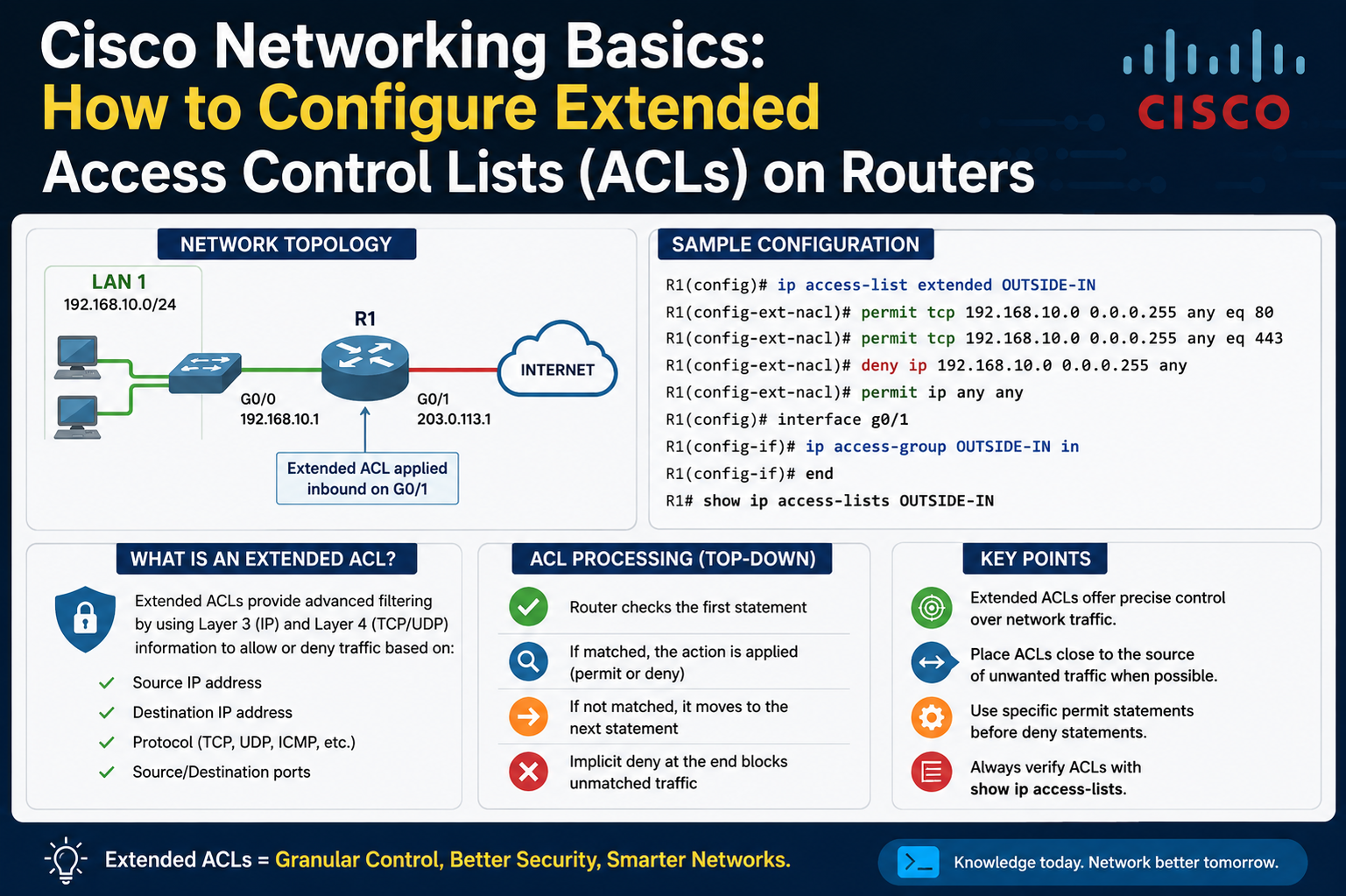
Computer networks allow devices to communicate with each other by exchanging data packets across routers, switches, and other networking equipment. In modern environments, where networks often connect hundreds or thousands of devices, managing and controlling that traffic becomes essential. Without proper control, networks can become vulnerable to unauthorized access, excessive traffic, or malicious activity. One of the most important tools used to manage network traffic on routers is the access control list.
Access control lists, commonly known as ACLs, are rules configured on routers that determine whether certain network traffic should be allowed or blocked. They act as traffic filters, examining packets as they travel through the router and deciding whether those packets should continue toward their destination. This filtering capability allows network administrators to enforce security policies, restrict unwanted communication, and regulate how systems interact across different parts of a network.
Routers produced by Cisco include powerful ACL features that help administrators manage complex network environments. Among the different types of ACLs available, extended access lists offer the highest level of control and flexibility. They allow filtering based on multiple conditions such as protocol type, source address, destination address, and even specific port numbers. Because of this detailed filtering ability, extended ACLs are widely used to enforce precise network policies.
To understand extended access lists, it is helpful to begin with the broader concept of how routers process network traffic. When a packet arrives at a router interface, the router examines the packet header to determine its destination. The router then consults its routing table to determine where the packet should be forwarded. If an access control list is applied to that interface, the router checks the packet against the ACL rules before forwarding it. The packet is compared sequentially against each rule until a match is found.
Each rule in an ACL contains two main components: a condition and an action. The condition describes the type of traffic the rule applies to, such as packets coming from a specific IP address or destined for a certain port. The action determines whether that traffic should be permitted or denied. When a packet matches a rule, the router immediately applies the action specified in that rule.
The order of rules in an ACL is extremely important. ACLs are processed sequentially from top to bottom. Once a packet matches a rule, the router stops checking further rules and applies the decision. Because of this behavior, rules that block specific traffic must appear before rules that allow broader categories of traffic. Careful planning of rule order is therefore essential when designing access control lists.
Extended access lists differ significantly from standard access lists. Standard ACLs examine only the source IP address of a packet. This means they can determine where traffic comes from but cannot control where that traffic is going or which services it is using. Extended ACLs, on the other hand, provide much deeper inspection. They can evaluate both the source and destination addresses, identify the protocol used, and even filter traffic based on port numbers.
This level of detail makes extended ACLs especially useful in environments where specific applications must be controlled. Many network services operate on well-known ports. Web traffic, file transfers, remote connections, and other services each rely on particular port numbers to function. By referencing those ports in ACL rules, administrators can permit or deny access to specific services without disrupting other types of traffic.
For example, web browsing commonly uses port 80 for standard web communication and port 443 for encrypted web connections. An administrator might want to prevent a particular device from accessing a web server while still allowing other types of communication between those systems. An extended access list can accomplish this by denying traffic on those ports while allowing all other protocols to pass through normally.
This ability to filter traffic at such a granular level transforms extended ACLs into powerful security tools. Instead of applying broad restrictions that might disrupt legitimate communication, administrators can target very specific types of traffic. This approach minimizes disruption while still protecting critical resources.
Another advantage of extended access lists is their ability to identify specific hosts within a network. Networks are typically divided into subnets, each containing multiple devices. ACLs can target an entire subnet or a single host depending on the configuration. When a rule references a single device, it ensures that the restriction applies only to that exact system and not to others in the same network segment.
When working with IP addresses in ACLs, routers use something called a wildcard mask. A wildcard mask determines which portions of an IP address must match exactly and which portions can vary. While subnet masks define the network portion of an address, wildcard masks perform the opposite function by identifying which bits can change when matching traffic.
Understanding wildcard masks is an essential step in mastering ACL configuration. For example, a wildcard mask of 0.0.0.0 means every bit must match exactly, which effectively identifies a single host. On the other hand, a mask that allows variation in certain octets can represent an entire subnet. By adjusting wildcard masks appropriately, administrators can apply ACL rules to large networks or individual devices.
Extended access lists also provide the ability to filter traffic by protocol type. Different kinds of communication use different protocols within the IP suite. Transmission Control Protocol, commonly abbreviated as TCP, is used for reliable, connection-oriented communication. User Datagram Protocol, or UDP, is used for faster, connectionless communication. Internet Control Message Protocol handles diagnostic and control messages such as network reachability checks.
Because extended ACLs can identify these protocols, administrators can create rules that apply only to certain types of network communication. For instance, a rule might allow UDP traffic for a streaming application while blocking TCP connections from a particular host. This capability makes ACLs adaptable to a wide variety of networking requirements.
Port numbers provide an additional layer of precision. Many applications depend on specific TCP or UDP ports to communicate. By specifying port numbers within ACL rules, administrators can control access to individual services running on servers or devices. This ensures that sensitive services remain protected while other services remain accessible.
Imagine a scenario in which a device attempts to access a server through a web browser. The device sends a packet destined for port 80 or port 443 on the server. If an ACL contains a rule that denies traffic to those ports from that device, the router will drop the packet before it ever reaches the server. From the user’s perspective, the connection simply fails because the router blocks the traffic.
However, if the same device attempts to use another service on the server that operates on a different port, the ACL might allow that communication. In this way, extended ACLs enable administrators to fine-tune network access without interfering with legitimate operations.
Another important concept associated with access control lists is the implicit deny rule. Every ACL contains a hidden rule at the end that denies all traffic not explicitly permitted. This rule is not displayed in the configuration but is always present. Because of this behavior, any traffic that does not match a permit rule will automatically be blocked.
The implicit deny rule is an important security feature because it ensures that only authorized traffic is allowed through the router. However, it can also cause unexpected disruptions if administrators forget to include permit statements for legitimate communication. Without careful planning, an ACL might accidentally block large portions of network traffic.
To prevent such issues, administrators typically add a final rule that explicitly permits general traffic after all specific deny rules have been listed. This ensures that only the intended restrictions apply while all other communication remains unaffected.
Extended access lists also rely on numbering or naming conventions that help routers identify them. Traditionally, extended ACLs use a specific numeric range. When administrators create a rule within that range, the router recognizes it as an extended access list and interprets the command accordingly. More modern configurations allow administrators to assign descriptive names to ACLs, making them easier to manage in large networks.
The flexibility of extended ACLs allows them to be used in many different situations. Organizations often use them to protect sensitive servers, restrict access between departments, or prevent unauthorized communication between networks. In large enterprise environments, ACLs form a critical component of the overall security architecture.
Even smaller networks benefit from the control provided by access control lists. Home labs, small business networks, and training environments frequently rely on ACLs to simulate real-world security policies. Learning how to configure extended ACLs therefore provides a valuable skill for anyone working with network infrastructure.
The power of extended access lists lies in their ability to combine multiple filtering criteria into a single rule. Instead of simply allowing or blocking traffic based on its origin, administrators can evaluate where the traffic is going, what protocol it uses, and which application service it targets. This combination of conditions enables extremely precise traffic management.
Because routers examine every packet against ACL rules, efficient design is important. Placing the most frequently matched rules near the top of the list can improve processing efficiency. Careful rule organization ensures that routers can process traffic quickly without unnecessary delays.
Network administrators also consider where ACLs should be applied within the network topology. Extended access lists are typically placed as close as possible to the source of the traffic being filtered. This placement prevents unwanted traffic from traveling through the network before being blocked, conserving bandwidth and reducing unnecessary processing.
As networks continue to grow in size and complexity, the need for detailed traffic control becomes increasingly important. Extended access control lists provide a powerful mechanism for enforcing policies, protecting systems, and maintaining orderly communication between devices.
Understanding how these lists function at a conceptual level is the first step toward effective configuration. Once administrators understand how routers evaluate packets, interpret ACL rules, and apply filtering decisions, they can begin designing access control policies that align with the needs of their networks.
Building and Configuring Extended Access Lists for Precise Traffic Control
Once the basic concept of access control lists is understood, the next step is learning how extended ACLs are actually created and configured on a router. Extended access lists allow administrators to define detailed rules that filter traffic based on multiple parameters. This flexibility enables networks to enforce very precise communication policies, ensuring that only authorized traffic is allowed while unwanted connections are blocked.
Routers manufactured by Cisco provide powerful command-line tools that allow administrators to define ACL rules directly within the device configuration. Through these commands, a router can be instructed to analyze incoming or outgoing packets and determine whether they should be permitted or denied. Because routers sit at key junction points within a network, applying these rules at the router level allows organizations to control traffic across entire segments of their infrastructure.
When configuring an extended access list, administrators typically begin by identifying the exact traffic they want to control. This involves defining several characteristics of the traffic, including the source address, the destination address, the protocol being used, and the port number associated with a specific service. Each of these elements helps narrow down the rule so that it targets only the intended communication.
Consider a situation in which a network administrator wants to prevent a particular computer from accessing a web server. Blocking all communication between the two devices might solve the immediate concern, but doing so could also disrupt other necessary services. For example, the computer might still need to send emails, transfer files, or communicate with other applications running on that server. Instead of blocking all communication, the administrator may choose to restrict only specific services that are causing problems.
Extended ACLs make this type of selective restriction possible. By specifying the protocol and port number, a rule can be created that blocks access to a particular service while leaving other services unaffected. This level of precision allows networks to remain functional while still enforcing strict security policies.
The process of creating an extended ACL generally begins in the router’s configuration mode. From there, the administrator defines a rule using an ACL number or name along with the filtering criteria. Each rule is written as a statement that instructs the router to permit or deny certain types of traffic.
A typical extended ACL rule contains several parts that describe the traffic being examined. The rule identifies whether the traffic should be permitted or denied, specifies the protocol involved, defines the source address, and identifies the destination address. Optional parameters can also specify port numbers or other details that further refine the rule.
When the router receives a packet, it evaluates the packet against the ACL rules in the order they appear. The router compares the packet’s characteristics with the conditions listed in each rule. As soon as a match is found, the router applies the action associated with that rule and stops checking the rest of the list. This sequential evaluation process means that the placement of rules within the list plays a critical role in determining how traffic is handled.
Because rule order is so important, administrators must carefully design the ACL to ensure that specific restrictions appear before broader permissions. If a general permit rule appears too early in the list, it may allow traffic that should have been blocked by a more specific rule later in the sequence. Thoughtful rule placement prevents such mistakes and ensures that the ACL behaves exactly as intended.
One of the first elements defined in an extended ACL rule is the protocol type. Most network applications rely on either TCP or UDP, which are two major transport-layer protocols used in IP networking. TCP provides reliable communication with built-in mechanisms for error detection and packet ordering. UDP, on the other hand, offers faster communication by eliminating some of these reliability features.
Because extended ACLs can differentiate between protocols, administrators can create rules that apply only to certain types of communication. For instance, an organization might allow UDP traffic for streaming services while restricting TCP connections from particular devices. This capability adds another layer of control that standard access lists cannot provide.
After specifying the protocol, the next step is identifying the source of the traffic. The source address indicates the device or network that is sending the packet. By defining this address, administrators can apply restrictions to individual hosts or entire subnets. If a rule targets a single device, the router will block only traffic originating from that device while leaving other devices unaffected.
Following the source address, the destination address must also be defined. This specifies where the packet is headed. Extended ACLs allow administrators to control communication between specific pairs of devices, meaning that restrictions can apply only when certain hosts attempt to communicate with particular servers or networks.
Port numbers are often used to refine ACL rules even further. Many network services operate on well-known ports. Web traffic commonly uses port 80 for standard communication and port 443 for encrypted connections. File transfer services, remote management tools, and other applications each rely on their own designated ports.
By referencing these port numbers in an extended ACL rule, administrators can control access to individual services without blocking all communication between devices. For example, a rule might deny TCP traffic directed toward port 80 on a specific server. This would prevent web access to that server while allowing other services to remain available.
To illustrate this concept, imagine a computer attempting to connect to a web server through a browser. When the user enters a website address, the computer sends a request to the server using TCP and port 80 or port 443. If an ACL rule denies traffic from that computer to those ports on the server, the router will discard the packet before it reaches its destination.
The result is that the computer cannot access the website hosted on that server, even though other types of communication may still work normally. This demonstrates how extended ACLs can target specific services rather than entire devices.
After defining the necessary deny rules, administrators must consider the implicit deny rule that exists at the end of every access control list. Because any traffic not explicitly permitted will automatically be blocked, an ACL that contains only deny rules could unintentionally prevent legitimate communication.
To avoid this situation, administrators typically add a final permit statement that allows general traffic to pass through. This rule effectively overrides the implicit deny for all traffic not previously matched by earlier rules. As a result, only the specific restrictions defined earlier in the list remain in effect.
The addition of this permit rule ensures that the ACL blocks only the intended traffic while allowing all other communication to proceed normally. Without it, the router would block every packet that does not match a permit statement, potentially disrupting large portions of the network.
Once the ACL rules have been created, they must be applied to a router interface before they can take effect. An ACL exists in the router’s configuration, but it does nothing until it is attached to an interface where traffic can be inspected. Applying the ACL tells the router to evaluate packets passing through that interface according to the rules defined in the list.
When attaching an ACL to an interface, administrators must also specify the direction in which the traffic will be examined. Traffic can be filtered as it enters an interface or as it exits. The direction chosen determines which packets are evaluated against the ACL rules.
Inbound filtering examines packets as they arrive at the router interface before they are routed to another network. Outbound filtering examines packets just before they leave the router through a particular interface. Choosing the correct direction is important because it determines when and where the filtering occurs.
A helpful way to visualize this process is to imagine standing inside the router and watching traffic move through its interfaces. If a packet is entering the router through a particular interface, that packet is considered inbound traffic on that interface. If the packet is leaving the router through the interface, it is considered outbound traffic.
In many cases, extended ACLs are applied as close as possible to the source of the traffic being filtered. This approach prevents unwanted traffic from traveling deeper into the network before being blocked. By stopping undesirable packets early, the router conserves bandwidth and reduces unnecessary processing across other devices.
Another important aspect of ACL configuration is verification. After creating and applying an access list, administrators typically review the configuration to ensure that it contains the intended rules. Routers provide commands that display the contents of an ACL along with counters showing how many packets have matched each rule.
These counters help administrators determine whether the ACL is functioning correctly. If a rule is designed to block certain traffic, the counter should increase whenever that traffic attempts to pass through the router. Monitoring these statistics helps confirm that the filtering policy is working as expected.
Testing is another essential step in the configuration process. Administrators may simulate traffic from specific hosts or attempt connections to restricted services to verify that the ACL behaves correctly. Successful tests confirm that the intended restrictions are in place while legitimate communication remains unaffected.
As networks evolve, ACL rules may need to be updated or expanded. New services may be introduced, additional hosts may require access, or new security policies may need to be enforced. Because extended ACLs are highly customizable, they can be adjusted to accommodate changing network requirements without requiring major infrastructure changes.
Careful planning, accurate rule creation, and thorough testing are the foundations of effective ACL configuration. By defining precise filtering criteria and applying those rules at strategic points within the network, administrators can maintain tight control over how devices communicate.
Extended access lists provide the flexibility needed to protect systems while still supporting the wide variety of applications that modern networks depend on. Through thoughtful configuration, these tools become a critical component of network management and security.
Advanced Implementation Strategies, Optimization, and Troubleshooting Techniques
As network environments grow in scale and complexity, extended access lists evolve from simple filtering tools into carefully engineered control mechanisms that shape how data moves across an infrastructure. At this stage, configuring rules is no longer just about blocking or allowing traffic; it becomes about designing predictable, efficient, and secure communication patterns across multiple interconnected networks. Extended ACLs on routers from Cisco are especially powerful in this regard because they can enforce highly specific policies while still maintaining operational flexibility.
A well-designed extended access list does more than control access. It contributes to the overall stability and efficiency of a network by reducing unnecessary traffic, isolating sensitive systems, and ensuring that only intended communication paths are used. However, achieving this level of control requires a deeper understanding of how ACLs behave internally, how rules interact with each other, and how design decisions affect long-term performance.
One of the most important advanced concepts in ACL design is rule interaction. Every rule in an access list exists within a sequence, and each rule has the potential to influence or override others depending on its position. This means that even a correctly written rule can behave unexpectedly if placed in the wrong order. In complex configurations, this becomes a common source of misconfiguration.
When multiple rules apply to similar traffic patterns, a situation known as rule shadowing can occur. This happens when a broader rule unintentionally matches traffic that was intended to be controlled by a more specific rule placed later in the list. Because ACLs are evaluated sequentially, the router never reaches the more specific rule if the earlier rule already matches the packet. This makes careful sequencing essential when designing extended access lists.
To avoid rule shadowing, network engineers often begin by defining the most specific conditions first. These rules target individual hosts, specific protocols, or precise port numbers. Broader rules, such as general permissions or default allowances, are placed later in the list. This structure ensures that precise restrictions are evaluated before general allowances, preserving the intended logic of the access list.
Another important aspect of advanced ACL configuration is the use of logging. Logging allows administrators to gain visibility into how traffic interacts with access control rules. When enabled on specific rules, logging records details about packets that match those conditions. This information can include source addresses, destination addresses, and protocol types.
Logging is particularly useful when troubleshooting unexpected network behavior. For example, if a user reports that a service is unavailable, logging can help determine whether an ACL rule is blocking the traffic. Instead of guessing which rule might be responsible, administrators can examine log entries to identify exactly which rule was triggered and when.
However, logging must be used carefully. In high-traffic environments, excessive logging can generate large volumes of data and increase processing overhead on the router. For this reason, it is typically applied selectively to critical rules rather than every entry in the ACL.
Another advanced technique involves refining wildcard masks to create highly targeted traffic definitions. While basic configurations often use simple wildcard masks to match single hosts or entire subnets, more advanced setups take advantage of partial matching. This allows administrators to define patterns that apply to multiple subnets or specific ranges of addresses without manually listing each one.
Wildcard masks operate by indicating which bits in an IP address should be evaluated and which should be ignored. This bit-level control enables extremely flexible matching criteria. In large-scale networks, this flexibility becomes essential because it reduces the number of individual rules required to achieve complex filtering goals.
For example, instead of writing separate rules for each subnet within a department, a single carefully constructed wildcard mask can represent all relevant networks. This not only simplifies configuration but also improves readability and reduces the chance of configuration errors.
As networks expand, performance considerations become increasingly important. Every packet that enters a router interface is evaluated against the ACL rules applied to that interface. In large environments, this can result in significant processing demands. Efficient ACL design helps minimize this load by ensuring that packets are matched and processed as quickly as possible.
One performance optimization strategy involves placing frequently matched rules near the top of the access list. Since ACLs are processed sequentially, positioning common traffic patterns early in the list reduces the average number of comparisons required for each packet. This improves processing efficiency and reduces latency.
Another optimization technique involves consolidating rules wherever possible. Instead of creating multiple similar rules for different services or hosts, administrators can often combine conditions into a single rule using logical grouping. This reduces the total number of entries in the ACL, making it easier for the router to process traffic.
However, optimization must be balanced with clarity. Overly complex rules can become difficult to manage and troubleshoot. In practice, the most effective ACL designs strike a balance between efficiency and readability, ensuring that rules are both performant and understandable.
In real-world network environments, extended ACLs are often used to enforce segmentation between departments or functional groups. For example, an organization may want to restrict communication between a finance network and a general user network while still allowing both groups to access shared services such as email or authentication systems.
In such scenarios, ACLs are carefully crafted to permit necessary services while blocking unauthorized interactions. This requires a deep understanding of which applications are required for business operations and which communications should be restricted for security reasons. The goal is not to eliminate communication entirely but to control it in a structured and intentional way.
Another advanced application involves protecting critical infrastructure systems. Servers that host sensitive data are often isolated using extended ACLs that restrict access based on both source identity and service type. Only authorized systems are permitted to communicate with these servers, and even then, only through specific ports and protocols.
This layered approach to security ensures that even if one part of the network is compromised, attackers cannot easily move laterally to other systems. By controlling traffic at multiple points, extended ACLs help contain potential security breaches.
Troubleshooting extended access lists requires a systematic approach. When network issues arise, one of the first steps is to determine whether an ACL is involved in blocking the traffic. This can be done by reviewing the ACL configuration and examining packet counters associated with each rule.
Packet counters provide valuable insight into how traffic is flowing through the network. If a particular deny rule shows a high number of matches, it indicates that the rule is actively blocking traffic. Conversely, if expected permit rules show no activity, it may suggest that traffic is not reaching the ACL or is being blocked earlier in the network path.
Another useful troubleshooting method involves checking the interface configuration where the ACL is applied. Understanding whether the ACL is applied in the inbound or outbound direction is critical. A common mistake is applying the correct ACL to the wrong interface direction, resulting in unexpected traffic behavior.
Examining interface statistics can also help identify issues. If traffic is being dropped unexpectedly, interface counters may show whether packets are being received or discarded at the router level. Combining this information with ACL logs provides a clearer picture of where the problem is occurring.
Misconfiguration of port numbers is another frequent issue in extended ACL setups. Since many services rely on well-known ports, even a small error in specifying a port can result in blocked communication. For example, confusing port numbers for secure and non-secure services can lead to unintended access restrictions.
To prevent such issues, administrators must maintain accurate documentation of service port assignments and ensure that ACL rules reflect those values correctly. Consistency in configuration practices helps reduce errors and simplifies troubleshooting when problems arise.
Another common challenge involves unintended blocking caused by the implicit deny rule. Since every ACL automatically ends with a hidden deny statement, failing to include appropriate permit rules can result in complete communication failure. When this occurs, traffic that is not explicitly allowed is silently dropped without any visible error message.
Identifying this issue requires careful review of the ACL structure. Administrators must ensure that all necessary traffic is explicitly permitted either through specific rules or through a general permit statement that allows remaining communication.
Advanced ACL design also benefits from structured planning before implementation. Rather than configuring rules directly on a live system, administrators often design the ACL logic in advance. This includes identifying traffic flows, mapping communication requirements, and determining which systems require access to specific resources.
By visualizing traffic patterns before configuration, potential conflicts can be identified early. This reduces the likelihood of misconfiguration and ensures that the final ACL behaves as intended once deployed.
Another important consideration is change management. In dynamic network environments, ACLs often need to be updated as new services are introduced or existing systems are modified. Without proper change control, updates to ACLs can unintentionally disrupt critical services.
To mitigate this risk, changes are typically made incrementally and tested in controlled conditions before being applied to production systems. This ensures that new rules do not interfere with existing network behavior.
As networks continue to evolve, extended access lists remain a foundational tool for controlling traffic flow. Their ability to evaluate multiple attributes of a packet simultaneously makes them indispensable in environments that require both security and flexibility. Through careful design, optimization, and troubleshooting, ACLs become more than just configuration entries—they become essential components of network architecture that shape how systems communicate and interact across complex infrastructures.
Enterprise-Scale Design, Advanced ACL Architecture, and Modern Network Control Strategies
As networks evolve beyond simple segmented environments into large, interconnected infrastructures, extended access lists become less about individual rule creation and more about architectural design. At enterprise scale, traffic control is no longer handled as isolated configurations on a single router interface. Instead, it becomes part of a broader policy system that governs how entire zones, departments, and services communicate across distributed environments.
In this context, extended access lists are not just filtering tools—they function as policy enforcement mechanisms embedded within routing infrastructure. On routers from Cisco, these mechanisms are often integrated into layered network designs where multiple control points collectively define how traffic is permitted, restricted, or shaped across the organization.
Understanding ACLs at this level requires shifting perspective. Instead of thinking in terms of single rules applied to single interfaces, it becomes necessary to think in terms of traffic flows, trust boundaries, and security zones. Every decision made in ACL design influences how data moves between these zones, and how securely that movement is controlled.
Network Zoning and Policy Boundaries
In large-scale environments, networks are commonly divided into logical zones. These zones represent groups of systems that share similar security requirements and communication patterns. For example, a user zone may contain employee devices, a server zone may host internal applications, and a restricted zone may contain sensitive systems such as financial databases or administrative platforms.
Extended access lists are used to enforce the boundaries between these zones. Instead of allowing unrestricted communication across the network, ACLs define exactly which traffic is permitted between zones and under what conditions. This approach creates a structured environment where each zone operates with clearly defined communication rules.
The concept of trust becomes central in this design. Zones with higher sensitivity levels, such as data storage or identity management systems, are typically placed under stricter control. Traffic entering or leaving these zones is carefully filtered using extended ACL rules that evaluate not only source and destination addresses but also service types and application behavior.
This zoning approach reduces risk by limiting the potential pathways available for unauthorized access. Even if one segment of the network is compromised, ACL-enforced boundaries prevent unrestricted movement into more sensitive areas.
Extended ACLs as Policy Enforcement Layers
At enterprise scale, extended access lists function as one layer within a broader policy enforcement hierarchy. While firewalls may handle perimeter security, ACLs operate closer to the routing layer, providing internal segmentation and granular control.
This layered approach ensures that security is not dependent on a single control point. Instead, multiple mechanisms reinforce each other. If a packet passes through a firewall, it may still encounter ACL restrictions within the internal routing infrastructure. This redundancy increases overall resilience and reduces the likelihood of unauthorized communication.
Unlike dedicated security appliances, ACLs operate directly within routing logic. This means they evaluate traffic as part of the forwarding process rather than as an external inspection step. As a result, ACLs are highly efficient for high-throughput environments where performance is critical.
However, this efficiency comes with a design responsibility. Because ACLs are tightly integrated with routing behavior, poorly designed rules can unintentionally disrupt traffic flows at a fundamental level. This makes careful planning essential in enterprise deployments.
Named Extended ACLs and Structural Organization
As network configurations grow in size, managing ACLs using only numeric identifiers becomes increasingly difficult. To address this challenge, modern configurations support named extended access lists. These allow administrators to assign meaningful labels to ACLs rather than relying on numerical ranges.
Named ACLs improve clarity by associating rules with functional purposes rather than abstract numbers. For example, an ACL controlling access between user devices and application servers might be named according to its role within the network architecture. This makes it easier for administrators to understand the purpose of each ACL without needing to interpret numerical identifiers.
Beyond naming, modern systems also support structured rule organization within ACLs. Instead of appending rules in a rigid sequence, administrators can insert, remove, or reorder rules more flexibly. This capability is especially useful in dynamic environments where policies evolve over time.
This structural flexibility reduces operational risk during updates. Rather than rebuilding an entire ACL from scratch when changes are needed, administrators can modify only the relevant portion of the rule set. This minimizes disruption and supports more agile network management.
Sequence-Based Rule Control and Rule Lifecycle Management
In advanced configurations, ACL entries are often managed using sequence numbers. These numbers define the position of each rule within the list and allow precise control over rule ordering. Unlike simple linear configuration, sequence-based ACLs enable targeted modifications without affecting the entire structure.
This approach is particularly valuable in environments where policies change frequently. New rules can be inserted at specific positions, ensuring that they are evaluated in the correct order relative to existing rules. Similarly, outdated rules can be removed without rewriting the entire ACL.
Conclusion
Extended access control lists represent one of the most practical and enduring tools in network traffic management, especially within router-based infrastructures. Across all levels of network design, from small segmented environments to large enterprise systems, they provide a reliable method for controlling how data moves between devices, services, and network zones. Their strength lies in their flexibility, allowing administrators to define precise rules based on source and destination addresses, protocols, and even specific application ports.
In real-world environments, this level of control becomes essential for maintaining both security and operational stability. Instead of relying on broad restrictions that can disrupt legitimate communication, extended ACLs enable targeted filtering that aligns closely with organizational requirements. This ensures that critical services remain accessible while unauthorized or unnecessary traffic is effectively blocked at strategic points within the network.
Another important aspect of extended ACLs is their integration into the routing process. Because they operate directly on routers, they influence traffic at a fundamental level, shaping how packets are forwarded across networks. When designed properly, they contribute not only to security but also to overall network efficiency by reducing unwanted traffic early in the transmission path.
However, the effectiveness of extended ACLs depends heavily on careful planning and ongoing management. Rule order, specificity, and placement all play a crucial role in determining how traffic is handled. As networks evolve, ACL configurations must also be reviewed and adjusted to reflect new applications, services, and security requirements.
Ultimately, extended access lists remain a foundational skill in networking. They combine simplicity in concept with depth in application, making them essential for anyone involved in managing or securing modern network infrastructures.