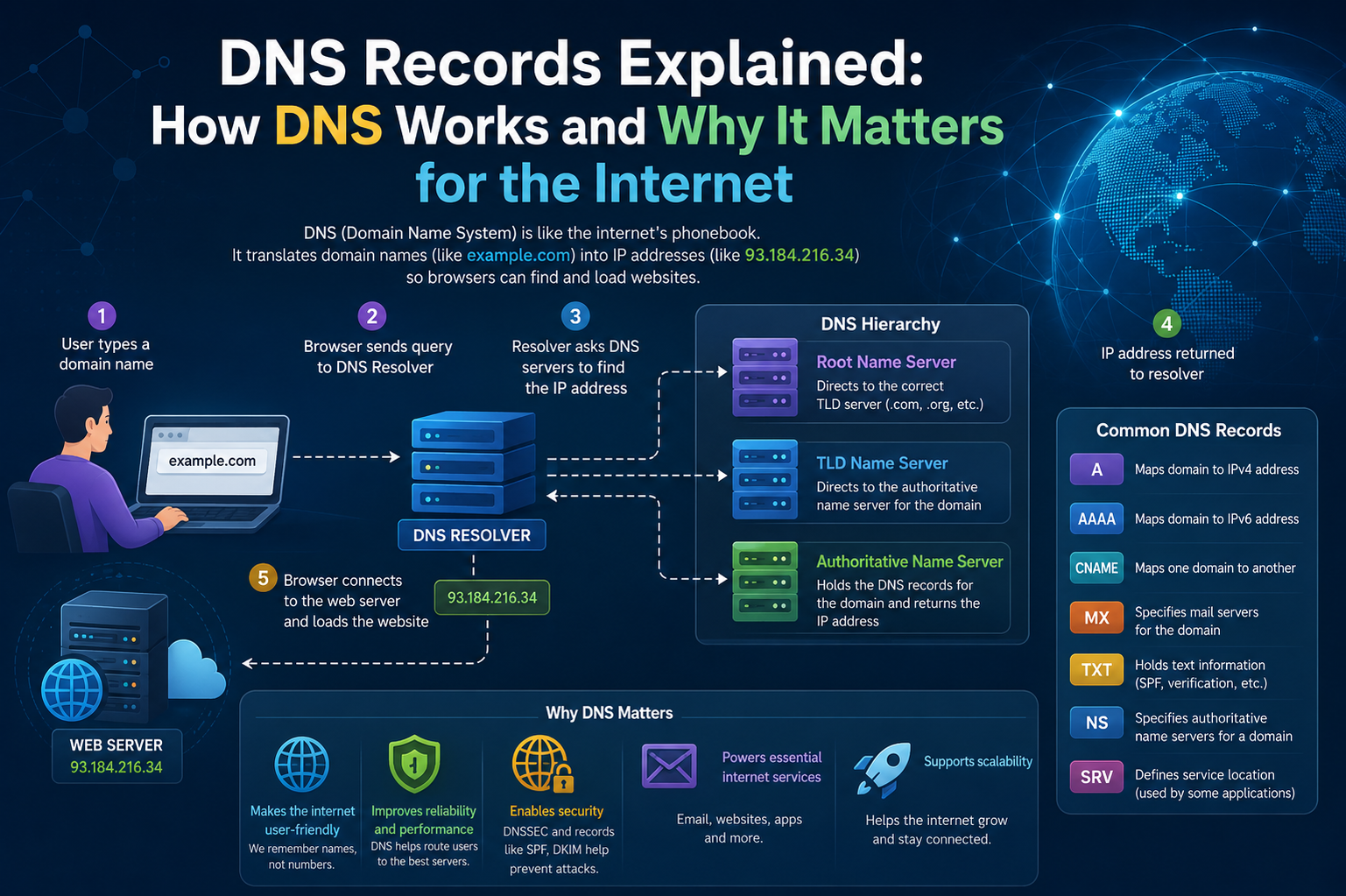
The modern internet feels almost effortless to use. People type a website name into a browser, press Enter, and instantly reach a destination somewhere across the world. Behind that seemingly simple action is a massive system constantly translating human-friendly names into machine-readable network addresses. That system is the Domain Name System, commonly known as DNS.
DNS is often compared to a phone book because it matches names with numbers. Instead of remembering long numerical IP addresses, users can simply remember names such as popular websites, services, or applications. While that comparison is useful for beginners, DNS is much more sophisticated than a digital directory. It is a distributed, hierarchical system that allows billions of devices to communicate efficiently every day.
At the center of DNS functionality are DNS records. These records contain the instructions that tell computers how to locate servers, deliver email, verify services, secure connections, and route traffic properly. Without DNS records, websites would become unreachable, email systems would fail, and many online applications would stop functioning correctly.
Understanding DNS records is important not only for network engineers and system administrators but also for anyone interested in how the internet works. Website owners, developers, cybersecurity professionals, and cloud administrators regularly interact with DNS records because they affect accessibility, performance, reliability, and security.
When someone enters a domain name into a browser, a sequence of DNS lookups begins. First, the computer checks its local cache to see if it already knows the correct IP address. If the answer is not cached locally, the request moves to a recursive resolver, often operated by an internet service provider or a public DNS service. That resolver then queries authoritative DNS servers until it finds the matching DNS records for the requested domain.
Those DNS records contain specific information that tells the resolver what to do next. Depending on the record type, the answer may include an IPv4 address, an IPv6 address, mail server details, domain aliases, verification information, or routing instructions.
DNS records are stored in DNS zones. A DNS zone is essentially a database of records associated with a domain. Each zone contains multiple entries, and every entry has a specific purpose. Together, these records create the complete DNS configuration for a domain.
Every DNS record includes several important components. One of the most visible parts is the record name, which identifies the host or domain associated with the entry. Another important field is the TTL value, short for Time to Live. TTL determines how long a DNS response can remain cached before it must be refreshed from the authoritative source.
TTL values significantly affect DNS performance and propagation behavior. Short TTL values allow changes to spread more quickly across the internet because cached information expires sooner. However, shorter caching times also increase the number of DNS queries reaching authoritative servers. Longer TTL values reduce server load and improve efficiency, but they can delay updates when changes are made.
Another common field is the record class. In most situations, the class value is simply IN, which represents internet-based DNS records. Although other classes exist, they are rarely encountered in standard internet operations.
The most important field is the record type itself. Different record types serve different purposes. Some direct users to web servers, while others identify mail systems or verify ownership of a domain. The type field determines how the information inside the record should be interpreted.
One of the most widely used DNS record types is the A record. The A stands for Address. This record maps a domain name to an IPv4 address. Whenever a user visits a website hosted on IPv4 infrastructure, an A record often provides the necessary translation.
For example, a domain might point to a server located at an address such as 192.0.2.1. Users never need to memorize that address because DNS performs the translation automatically. A records are fundamental to internet communication because they allow web browsers to locate the correct destination server.
Many websites use multiple A records for the same domain. This technique supports load balancing and redundancy. If one server becomes unavailable, another can continue serving traffic. Large organizations frequently distribute traffic across many servers located in different geographic regions.
Closely related to the A record is the AAAA record. While A records work with IPv4 addresses, AAAA records work with IPv6 addresses. IPv6 was developed to solve the address exhaustion problem associated with IPv4.
IPv4 addresses use a 32-bit structure, limiting the total number of available addresses. As internet-connected devices expanded dramatically, the available IPv4 pool became increasingly constrained. IPv6 addresses use a 128-bit structure, allowing an enormous number of unique addresses.
AAAA records enable devices to locate servers using IPv6 connectivity. As more organizations transition toward IPv6 support, AAAA records are becoming increasingly important in modern networking environments.
Although IPv6 adoption continues to grow, many systems still operate using dual-stack configurations. This means both IPv4 and IPv6 addresses are available simultaneously. In such cases, domains may contain both A and AAAA records.
Another major DNS record type is the CNAME record, which stands for Canonical Name. A CNAME record creates an alias from one domain name to another. Instead of pointing directly to an IP address, a CNAME points to another hostname.
CNAME records are extremely useful in environments where multiple services share infrastructure. For instance, a company might direct a blog subdomain to a separate hosting platform without assigning independent IP addresses manually.
When a DNS resolver encounters a CNAME record, it performs another lookup for the target hostname. The final destination is resolved only after following the alias chain.
CNAME records simplify administration because changes only need to be made in one place. If the target hostname changes its underlying IP address, all associated aliases continue working automatically.
However, CNAME records come with important restrictions. A CNAME cannot coexist with other records of the same name because the alias effectively replaces all other DNS data for that hostname. This limitation often surprises beginners who attempt to combine CNAME entries with other record types.
Mail delivery on the internet depends heavily on MX records, or Mail Exchange records. These records specify which mail servers are responsible for accepting email for a domain.
When someone sends an email, the sending server performs an MX lookup to determine where the message should be delivered. MX records contain both a mail server hostname and a priority value.
Priority values are extremely important because they establish failover behavior. Lower numbers represent higher priority. If the primary mail server becomes unavailable, backup servers with higher numerical values can continue accepting messages.
This redundancy improves reliability and helps prevent lost email during outages or maintenance periods. Large organizations often configure multiple MX records across geographically distributed systems.
MX records also play an important role in spam filtering and email authentication. Misconfigured mail records can cause delivery failures, rejected messages, or security warnings.
Another essential DNS record type is the NS record, which stands for Name Server. NS records identify the authoritative DNS servers responsible for a domain.
Authoritative DNS servers hold the official DNS records for a domain. When recursive resolvers need accurate information, they eventually query these authoritative systems.
A domain typically uses multiple authoritative name servers for redundancy and reliability. If one name server becomes unavailable, others can continue responding to queries.
The delegation process within DNS heavily depends on NS records. Top-level domain servers use NS records to direct queries toward the correct authoritative servers for individual domains.
Without NS records, the DNS hierarchy would not function efficiently. They are foundational to the distributed architecture that allows DNS to scale globally.
Reverse DNS lookups rely on PTR records, also known as Pointer records. Unlike A records, which translate names into addresses, PTR records translate addresses back into names.
PTR records are commonly used in email systems, network diagnostics, logging, and security analysis. Many mail servers perform reverse DNS checks to validate incoming connections.
If an IP address lacks proper PTR records, some email systems may treat messages as suspicious or spam-like. Reverse DNS consistency is therefore an important component of email reputation management.
PTR records are stored differently from standard DNS records. They exist within special reverse lookup zones that use structures such as in-addr.arpa for IPv4 and ip6.arpa for IPv6.
Understanding reverse DNS can initially feel confusing because the address structure appears reversed. However, this design allows hierarchical delegation similar to traditional DNS.
TXT records represent another flexible and widely used DNS record type. TXT stands for Text. These records store arbitrary text data associated with a domain.
Originally, TXT records were designed for human-readable notes. Over time, they evolved into an essential tool for machine-readable verification and authentication.
Today, TXT records support many internet security and verification mechanisms. Email authentication systems such as SPF, DKIM, and DMARC rely heavily on TXT records.
SPF records help identify which mail servers are authorized to send email for a domain. This reduces the risk of email spoofing and phishing attacks.
DKIM adds cryptographic signatures to outgoing email messages. Receiving servers can validate these signatures using public keys stored in DNS TXT records.
DMARC builds on SPF and DKIM by defining policies for handling suspicious messages. Organizations use DMARC to improve email security and reporting visibility.
TXT records are also commonly used for domain ownership verification. Many online services require administrators to add a verification token into DNS before activating integrations or issuing certificates.
Another increasingly important DNS record type is the CAA record, which stands for Certification Authority Authorization. CAA records specify which certificate authorities are allowed to issue digital certificates for a domain.
This record type improves security by reducing the risk of unauthorized certificate issuance. If a certificate authority checks DNS and finds restrictive CAA policies, it should refuse to issue certificates unless authorized.
Digital certificates are critical for encrypted HTTPS connections. By controlling certificate issuance policies through DNS, organizations gain additional protection against fraudulent or accidental certificate creation.
Although many internet users never see DNS directly, nearly every online activity depends on it. Streaming services, cloud applications, messaging platforms, gaming systems, and mobile apps all rely on DNS lookups to locate servers and services.
DNS records also influence internet performance. Efficient DNS configurations reduce latency and improve user experience. Poorly configured DNS environments can introduce delays, outages, or routing problems.
Large-scale platforms often use advanced DNS techniques such as geographic routing, weighted responses, and traffic management. These methods allow services to direct users toward the nearest or healthiest infrastructure automatically.
DNS caching plays a major role in internet scalability. Without caching, every domain lookup would require repeated communication with authoritative servers, dramatically increasing traffic and latency.
Caching occurs at multiple levels, including operating systems, browsers, recursive resolvers, and network devices. TTL values determine how long cached responses remain valid.
DNS propagation is another concept frequently misunderstood. When DNS records change, updates do not become visible everywhere instantly. Instead, changes spread gradually as cached information expires.
Propagation times vary depending on TTL settings, resolver behavior, and network conditions. Some changes appear within minutes, while others may take hours.
Security is also a major concern within DNS infrastructure. Attackers frequently target DNS because manipulating name resolution can redirect users to malicious systems.
DNS spoofing and cache poisoning attacks attempt to inject false DNS information into caches or resolvers. If successful, users may unknowingly connect to fraudulent websites.
To improve DNS security, technologies such as DNSSEC were developed. DNSSEC adds cryptographic signatures to DNS responses, allowing resolvers to verify authenticity and integrity.
DNSSEC does not encrypt DNS traffic, but it helps prevent tampering and forgery. Adoption continues to grow, particularly among governments, financial institutions, and security-conscious organizations.
Modern networking environments often integrate DNS with cloud services, automation systems, and orchestration platforms. Dynamic DNS updates allow systems to modify records automatically when infrastructure changes.
This automation is especially important in containerized and cloud-native environments where workloads frequently move between servers or data centers.
As organizations increasingly rely on distributed systems, DNS becomes even more critical. A single DNS misconfiguration can impact websites, APIs, authentication systems, and communication platforms simultaneously.
Despite its complexity, DNS remains remarkably efficient and resilient. Billions of DNS queries occur every day, usually completing within fractions of a second. Most users never notice the enormous infrastructure operating behind the scenes.
Understanding DNS records provides valuable insight into how internet communication functions. Each record type serves a distinct role, and together they create the framework that makes online connectivity possible.
Exploring Common DNS Record Types and Their Real-World Functions
DNS records are far more than simple mappings between names and addresses. Each record type was designed to solve specific networking challenges, and together they create the communication framework used across the internet. While many people interact with DNS every day without realizing it, administrators and engineers depend on DNS records constantly to keep services running smoothly.
The real value of understanding DNS records becomes clear when examining how different systems rely on them in practical environments. Websites, email servers, cloud platforms, mobile applications, and security tools all use DNS records differently. Each record type contributes to reliability, security, scalability, or service discovery.
A records are usually the first DNS records people encounter. Their role is straightforward: they connect domain names to IPv4 addresses. Even though the concept appears simple, A records are involved in countless internet interactions every second.
When a person opens a browser and enters a domain name, the browser eventually needs a destination IP address. A record provides that translation. Once the correct address is found, the browser can establish a connection with the target server.
Many organizations use multiple A records for the same hostname. This allows traffic distribution across several servers. One common method is round-robin DNS, where different IP addresses are returned in rotating order.
Round-robin DNS helps distribute traffic load among servers, improving availability and balancing demand. Although it is not as sophisticated as dedicated load balancers, it remains widely used because of its simplicity.
Records also support disaster recovery planning. Organizations can redirect traffic to backup systems by updating DNS entries during outages or maintenance windows.
Cloud computing environments rely heavily on A records as well. Virtual machines, application gateways, and container platforms often use dynamically managed DNS entries to reflect changing infrastructure.
AAAA records extend the same functionality into IPv6 networking. As internet-connected devices continue expanding globally, IPv6 adoption becomes increasingly important.
IPv6 solves many limitations associated with IPv4, particularly address exhaustion. The enormous address space provided by IPv6 enables virtually unlimited device connectivity.
Internet service providers, telecommunications companies, and cloud platforms increasingly support IPv6 connectivity. Websites that publish AAAA records allow IPv6-capable users to connect directly without relying on IPv4 translation systems.
Dual-stack deployments are common during the transition period between IPv4 and IPv6. In these environments, domains publish both A and AAAA records simultaneously.
Modern operating systems usually prefer IPv6 connections when available. If the network supports IPv6 and a valid AAAA record exists, the client may use the IPv6 route automatically.
CNAME records introduce flexibility into DNS management. Instead of directly assigning IP addresses to every hostname, administrators can create aliases that point to canonical hostnames.
This approach simplifies infrastructure management significantly. Imagine a company using separate subdomains for support, media, documentation, and customer portals. Rather than assigning individual IP addresses everywhere, administrators can point multiple aliases toward centralized services.
CNAME records are especially useful with third-party hosting platforms and cloud services. Many content delivery networks and software platforms instruct customers to create CNAME entries during setup.
One major advantage of CNAME records is maintainability. If the target hostname changes its underlying IP address, the aliases continue functioning automatically because the final resolution occurs dynamically.
However, excessive chaining of CNAME records can introduce delays. Each additional alias requires another DNS lookup step. Efficient DNS design minimizes unnecessary indirection.
Administrators must also understand CNAME restrictions carefully. Since a CNAME effectively replaces other records for that hostname, combining CNAME entries with additional record types creates conflicts.
MX records are essential for email routing. Every domain capable of receiving email depends on properly configured mail exchange records.
When an email server attempts delivery, it performs a DNS lookup for MX records associated with the recipient domain. The returned records identify which mail servers should accept incoming messages.
Priority values determine delivery order. Lower numerical values represent higher priority servers. If the preferred server is unavailable, the sending system automatically attempts delivery to backup servers.
This redundancy improves resilience and prevents lost messages during service interruptions. Enterprise email systems often use geographically distributed mail servers to improve availability.
MX records must point to hostnames rather than raw IP addresses. Those hostnames are then resolved separately using A or AAAA records.
Proper email routing depends not only on MX records but also on supporting DNS infrastructure. Missing or incorrect records can cause rejected mail, delayed delivery, or spam classification.
Spam filtering systems frequently analyze DNS configurations to evaluate domain legitimacy. Domains lacking proper mail authentication records may appear suspicious.
TXT records play a major role in email authentication technologies. SPF records, which are stored as TXT entries, specify which servers are authorized to send mail on behalf of a domain.
Without SPF protection, attackers can forge sender addresses easily. SPF helps receiving systems verify whether incoming messages originate from approved infrastructure.
DKIM authentication also relies on TXT records. Outgoing messages are cryptographically signed, and the corresponding public key is stored within DNS.
Receiving mail servers use the DNS-based public key to validate message integrity. If the signature verification fails, the email may be flagged or rejected.
DMARC policies extend these protections further. Organizations can instruct receiving systems how to handle suspicious messages and generate detailed reporting information.
Together, SPF, DKIM, and DMARC form the foundation of modern email security. All three depend heavily on TXT-based DNS records.
TXT records are not limited to email authentication. Many online platforms use TXT verification for proving domain ownership.
For example, cloud services, analytics tools, certificate providers, and communication platforms often request verification tokens. Administrators add those tokens into DNS TXT records to demonstrate control over the domain.
TXT records also support various service discovery mechanisms. Some applications use DNS text entries to distribute configuration information across networks.
NS records define which authoritative name servers control a domain. These records are fundamental to the DNS hierarchy itself.
Whenever a resolver attempts to locate DNS information, it follows a delegation chain. Root servers direct queries toward top-level domain servers, which then refer resolvers to authoritative name servers using NS records.
Without accurate NS records, domains become unreachable because resolvers cannot locate authoritative DNS data.
Organizations typically configure multiple authoritative name servers to improve resilience. If one server becomes unavailable due to network failure or maintenance, others can continue handling requests.
Redundant NS configurations are especially important for business-critical services. DNS outages can affect websites, email systems, APIs, authentication platforms, and cloud applications simultaneously.
Large organizations often distribute authoritative DNS infrastructure across different geographic regions and network providers. This improves availability and reduces the impact of localized disruptions.
PTR records provide reverse mapping functionality. Instead of translating names into addresses, they translate addresses into names.
Reverse DNS plays a significant role in security analysis and operational troubleshooting. Administrators frequently use reverse lookups when investigating suspicious connections, analyzing logs, or diagnosing network problems.
Email systems also rely heavily on reverse DNS validation. Many receiving servers check whether incoming IP addresses have valid PTR records.
A mismatch between forward and reverse DNS information can negatively affect email reputation. Some spam filtering systems reject messages from improperly configured servers.
PTR records are generally managed by whoever controls the IP address allocation. In many cases, internet service providers or hosting companies manage reverse DNS zones.
This arrangement sometimes complicates troubleshooting because administrators may need coordination with upstream providers to modify PTR entries.
CAA records strengthen certificate management security. Before issuing a digital certificate, participating certificate authorities can check DNS CAA records to determine whether they are authorized.
If restrictive CAA policies exist, unauthorized authorities should refuse certificate issuance requests. This reduces the risk of accidental or malicious certificate generation.
Certificates are critical for HTTPS encryption. Since browsers rely on certificate trust chains to verify websites, protecting certificate issuance becomes extremely important.
Organizations increasingly use CAA records alongside certificate transparency monitoring and automated renewal systems.
DNS records are also central to cloud-native architectures. Modern cloud platforms often generate and update DNS entries dynamically as workloads scale or move.
Container orchestration systems use service discovery mechanisms heavily dependent on DNS. Instead of hardcoding server addresses, applications query DNS to locate services dynamically.
This flexibility supports rapid scaling and infrastructure automation. As new instances appear or disappear, DNS records update automatically.
Content delivery networks also depend heavily on DNS-based routing. When users access globally distributed platforms, DNS systems may direct them toward the nearest edge server.
Geographic DNS routing improves performance by reducing latency. Instead of serving every user from a central location, traffic is distributed intelligently across multiple regions.
Some DNS providers support weighted routing policies as well. These configurations distribute traffic proportionally between different systems.
Weighted routing helps organizations test new infrastructure gradually, shift traffic during maintenance, or balance workloads across multiple environments.
Health-check integrations further enhance DNS routing. DNS providers can monitor server availability and automatically remove unhealthy systems from responses.
This capability improves reliability and supports high-availability architectures.
DNS caching significantly affects performance. Recursive resolvers store responses temporarily according to TTL settings.
Caching reduces repeated queries to authoritative servers, decreasing latency and improving scalability. However, administrators must balance performance benefits against update flexibility.
Short TTL values allow rapid changes but increase query frequency. Long TTL values reduce server load but slow propagation during updates.
DNS propagation behavior often confuses users because changes do not appear instantly everywhere. Cached information across different resolvers expires at different times.
Some internet service providers also apply their own caching policies, which can extend propagation delays unexpectedly.
DNS troubleshooting requires understanding how recursive resolvers, caches, authoritative servers, and local operating systems interact.
Administrators frequently use diagnostic tools to inspect DNS behavior. Common troubleshooting activities include verifying record correctness, checking propagation status, analyzing delegation chains, and validating response consistency.
DNS misconfigurations can produce many different symptoms. Websites may become unreachable, email delivery may fail, or cloud services may stop responding correctly.
Even minor syntax errors within DNS zones can create widespread operational problems. Since DNS acts as a foundational dependency for so many systems, accurate management is essential.
Automation has become increasingly important in DNS administration. Infrastructure-as-code practices allow organizations to manage DNS changes systematically and consistently.
Automated deployment pipelines can update DNS records alongside application releases, reducing manual effort and minimizing configuration drift.
Security monitoring is another critical area. Attackers sometimes target DNS because successful manipulation can redirect users silently.
Malicious DNS changes may lead users toward phishing websites, fraudulent login portals, or malware distribution systems.
Organizations increasingly monitor DNS logs for unusual behavior, suspicious queries, and unauthorized modifications.
Encrypted DNS technologies such as DNS over HTTPS and DNS over TLS are also gaining attention. These protocols protect DNS traffic from interception and monitoring during transit.
Traditional DNS queries are usually unencrypted, making them visible to network observers. Encrypted DNS improves privacy and reduces certain surveillance risks.
As internet infrastructure continues evolving, DNS records remain central to communication, security, scalability, and service delivery.
Understanding the practical roles of DNS record types provides valuable insight into how digital systems operate behind the scenes every day.
DNS Queries, Troubleshooting, Security, and the Future of DNS Infrastructure
DNS works so efficiently that most people rarely think about it until something goes wrong. A website suddenly becomes unreachable, email messages stop arriving, or cloud applications fail to connect properly. In many of these situations, DNS issues are involved somewhere in the chain.
Understanding how DNS queries function, how troubleshooting works, and how security challenges affect DNS infrastructure provides deeper insight into the internet’s operational foundation. DNS is not merely a background service. It is one of the most critical components of modern digital communication.
Every time a device connects to an online resource, DNS queries begin a process of locating the correct destination. These queries occur constantly across browsers, applications, smartphones, cloud systems, streaming platforms, and enterprise networks.
A DNS query starts when a user enters a domain name or when an application attempts to connect to a remote service. The operating system first checks whether the answer already exists locally.
Modern systems maintain local DNS caches to reduce unnecessary network requests. Browsers may also maintain their own internal DNS caches.
If the requested information is unavailable locally, the query is sent to a recursive resolver. Recursive resolvers are responsible for obtaining answers on behalf of clients.
Internet service providers commonly operate recursive DNS servers for customers, though many organizations use public DNS resolvers or private enterprise DNS infrastructure.
When the recursive resolver receives a query, it may already have the answer cached. If so, it immediately returns the result to the client.
If the answer is not cached, the resolver begins a recursive lookup process across the DNS hierarchy.
The resolver first contacts a root DNS server. Root servers do not store complete DNS records for every domain. Instead, they direct resolvers toward the appropriate top-level domain servers.
For example, if the query targets a domain ending in .com, the root server refers the resolver to the .com top-level domain infrastructure.
The resolver then contacts the top-level domain server, which returns NS records identifying the authoritative name servers responsible for the requested domain.
Finally, the resolver queries the authoritative server directly to obtain the required DNS records.
This entire process usually completes within milliseconds. Despite involving multiple distributed systems worldwide, DNS remains remarkably efficient.
Caching is one of the main reasons DNS performs so well at internet scale. Recursive resolvers store responses according to TTL values, reducing repeated queries.
Caching decreases latency for users while reducing load on authoritative servers. Without widespread DNS caching, internet infrastructure would experience significantly higher traffic volumes.
However, caching also creates operational challenges. DNS changes may not become visible immediately because older responses remain stored in caches.
Administrators often reduce TTL values temporarily before making major DNS changes. Lower TTL values allow caches to expire more quickly, accelerating propagation.
Once the migration or update completes successfully, TTL values are usually increased again to improve efficiency.
DNS propagation is frequently misunderstood. Changes do not travel outward like a broadcast message. Instead, propagation occurs gradually as caches refresh their stored information.
Different recursive resolvers may refresh records at different times, leading to temporary inconsistencies across networks.
Troubleshooting DNS problems requires systematic analysis. Since many systems depend on DNS, failures can appear in unexpected ways.
A website outage may actually result from expired DNS records. Email failures may stem from incorrect MX entries. Authentication issues may involve missing TXT verification records.
One of the first troubleshooting steps is verifying whether the domain resolves correctly.
Administrators commonly perform DNS lookups to inspect records directly. These queries reveal whether authoritative servers are returning the expected responses.
When analyzing DNS responses, several fields become especially important. The returned IP addresses, TTL values, record types, and authoritative sources help identify potential issues.
Inconsistent responses between different resolvers may indicate propagation delays or caching discrepancies.
Sometimes DNS issues originate locally rather than globally. A corrupted operating system cache or browser cache can produce outdated results even after authoritative records have been updated.
Flushing local DNS caches often resolves such problems.
DNS delegation errors represent another common issue. If NS records are configured incorrectly, recursive resolvers may fail to locate authoritative servers.
This type of failure can render an entire domain unreachable despite otherwise correct record configurations.
DNS zone syntax errors may also cause problems. Since DNS records follow strict formatting rules, small mistakes can invalidate entries.
Misplaced punctuation, missing periods, incorrect priorities, or invalid hostnames may all create operational failures.
Email systems are particularly sensitive to DNS accuracy. Misconfigured SPF, DKIM, or DMARC records can cause legitimate email messages to be rejected.
Spam filtering platforms increasingly rely on DNS-based authentication checks to evaluate message legitimacy.
Reverse DNS mismatches are another frequent email-related problem. Many receiving servers compare forward and reverse DNS information to verify consistency.
If an IP address lacks a valid PTR record or resolves inconsistently, mail delivery reputation may suffer.
Cloud migrations often introduce DNS complexity as well. Organizations moving services between providers frequently update DNS entries to redirect traffic.
During migrations, administrators must carefully coordinate TTL adjustments, load balancing behavior, certificate configurations, and propagation timing.
DNS load balancing techniques continue evolving in modern infrastructure environments.
Basic round-robin DNS distributes traffic evenly among multiple servers, but more advanced systems support geographic routing, weighted policies, latency optimization, and health monitoring.
Geographic DNS routing directs users toward infrastructure located near their physical region. This reduces latency and improves application responsiveness.
For example, users in Asia may receive responses pointing toward Asian data centers, while European users are directed toward European infrastructure.
Weighted routing allows organizations to distribute traffic proportionally between environments.
A company launching a new platform version might initially direct only a small percentage of users toward the updated infrastructure.
Health-based routing improves reliability further. DNS providers can monitor server availability continuously and remove failed systems from responses automatically.
This reduces downtime and supports resilient architectures.
Content delivery networks rely heavily on DNS intelligence. CDNs use DNS routing to distribute users across edge servers globally.
When someone accesses a large streaming service or media platform, DNS often determines which edge node will provide the content.
DNS-based traffic management therefore directly affects performance, scalability, and user experience.
Security concerns surrounding DNS have increased dramatically in recent years.
Because DNS controls how users locate online resources, attackers frequently target DNS infrastructure.
DNS spoofing attacks attempt to provide false DNS information to users or resolvers. If successful, users may be redirected toward malicious websites without realizing it.
Cache poisoning attacks are particularly dangerous because they corrupt cached DNS responses within recursive resolvers.
Once poisoned, a resolver may distribute false information to many users simultaneously.
Phishing campaigns often rely on DNS manipulation techniques to impersonate legitimate services.
Attackers may also compromise DNS registrar accounts or administrative interfaces to alter authoritative records directly.
DNS hijacking incidents can affect websites, email systems, cloud applications, and authentication platforms.
To improve DNS integrity, DNSSEC was developed.
DNSSEC adds digital signatures to DNS responses, allowing resolvers to verify that records were not altered during transit.
With DNSSEC enabled, authoritative servers cryptographically sign their DNS data. Recursive resolvers validate these signatures before trusting the responses.
DNSSEC significantly reduces the risk of spoofing and cache poisoning attacks.
However, DNSSEC implementation introduces additional complexity. Key management, signature expiration, and delegation chains require careful administration.
Despite the challenges, DNSSEC adoption continues growing across government, financial, and enterprise sectors.
Privacy concerns also influence modern DNS development.
Traditional DNS queries are generally unencrypted. Anyone monitoring network traffic may observe which domains users are accessing.
To address this issue, encrypted DNS protocols emerged.
DNS over HTTPS encapsulates DNS traffic inside encrypted HTTPS connections. DNS over TLS provides similar protection using dedicated encrypted channels.
These technologies improve privacy by preventing intermediaries from easily monitoring or modifying DNS requests.
However, encrypted DNS also creates operational debates regarding network visibility, filtering, and centralized resolver control.
Enterprise environments sometimes rely on DNS monitoring for threat detection, parental controls, or compliance enforcement.
Balancing privacy, security, and operational visibility remains an ongoing challenge.
DNS also plays a major role in cybersecurity defense.
Security teams frequently analyze DNS logs to detect suspicious activity.
Malware often communicates with command-and-control infrastructure through DNS queries. Unusual lookup patterns may indicate compromised systems.
Threat intelligence platforms monitor malicious domains and distribute blocking policies through DNS filtering systems.
Protective DNS services can prevent users from accessing known malicious destinations.
DNS tunneling represents another security concern. Attackers sometimes abuse DNS queries to transmit hidden data through networks.
Because DNS traffic is often allowed through firewalls, tunneling techniques may bypass traditional controls.
Organizations therefore increasingly monitor DNS traffic behavior alongside conventional security logging.
Automation is transforming DNS management as infrastructure grows more dynamic.
Cloud-native environments frequently scale applications automatically based on demand.
As workloads appear and disappear, DNS systems must update rapidly to reflect changing infrastructure.
Infrastructure-as-code tools allow administrators to manage DNS configurations programmatically.
Instead of manually editing records through graphical interfaces, organizations define DNS settings in version-controlled configuration files.
This improves consistency, reduces human error, and supports automated deployment pipelines.
Container orchestration platforms also depend heavily on internal DNS systems.
Microservices architectures require applications to locate one another dynamically across distributed environments.
Internal DNS service discovery allows containers and workloads to communicate efficiently without relying on static IP assignments.
The future of DNS will likely involve continued emphasis on automation, security, privacy, and scalability.
As billions of additional devices connect through smart infrastructure, mobile networks, industrial systems, and Internet of Things platforms, DNS demand will continue expanding.
Edge computing environments may introduce even more distributed DNS architectures.
Artificial intelligence systems and large-scale analytics platforms may also depend increasingly on dynamic service discovery and intelligent traffic routing.
Despite decades of internet evolution, DNS remains one of the most important technologies enabling digital communication.
Every website visit, email message, application request, cloud workload, and streaming session depends on DNS functioning correctly.
DNS records are the instructions that make this entire system possible. They direct traffic, identify services, secure communications, verify ownership, and support global connectivity.
Understanding how DNS queries operate, how records interact, and how modern infrastructure depends on DNS provides valuable insight into the hidden systems powering the internet every day.
DNS Management, Performance Optimization, and Modern Internet Challenges
DNS has evolved far beyond its original role as a simple directory service for translating names into IP addresses. In the early days of networking, DNS mainly existed to help users avoid memorizing long numerical addresses. Today, however, DNS has become one of the most strategically important systems on the internet.
Modern organizations depend on DNS not only for accessibility, but also for security, performance optimization, business continuity, global traffic distribution, cloud integration, and infrastructure automation. As internet architecture becomes increasingly distributed, DNS continues expanding in complexity and importance.
A well-designed DNS environment can improve application speed, reduce downtime, strengthen cybersecurity, and simplify infrastructure management. Poor DNS planning, on the other hand, can cause outages, security vulnerabilities, slow performance, and operational instability.
Understanding advanced DNS management practices helps explain why DNS has become such a critical part of modern technology infrastructure.
One of the most important concepts in advanced DNS administration is redundancy. DNS is often described as a foundational internet service because nearly every online system depends on it. If DNS becomes unavailable, users may lose access to websites, applications, email services, cloud platforms, and authentication systems simultaneously.
To reduce the risk of outages, organizations deploy redundant DNS infrastructure across multiple servers and geographic regions. Authoritative name servers are commonly distributed across separate networks, data centers, and providers.
Conclusion
DNS records are one of the most important building blocks of the modern internet. They quietly manage the connection between domain names, servers, applications, and online services, allowing users to access websites and digital platforms without needing to remember complex IP addresses. From A and AAAA records to MX, TXT, CNAME, PTR, NS, and CAA records, each type serves a specific purpose that keeps internet communication organized, secure, and efficient.
As technology continues to evolve, DNS has become much more than a simple name resolution system. It now supports cloud infrastructure, email authentication, cybersecurity, traffic routing, content delivery, automation, and global scalability. Businesses and organizations rely heavily on accurate DNS configurations to maintain uptime, improve website performance, protect user data, and ensure reliable digital experiences.
Understanding how DNS records work provides valuable insight into the hidden systems powering nearly every online interaction. Whether someone is managing a website, deploying cloud services, troubleshooting network issues, or learning about internet infrastructure, DNS knowledge remains highly relevant. As the internet grows more complex and interconnected, DNS will continue playing a critical role in enabling secure, fast, and reliable communication across the digital world.