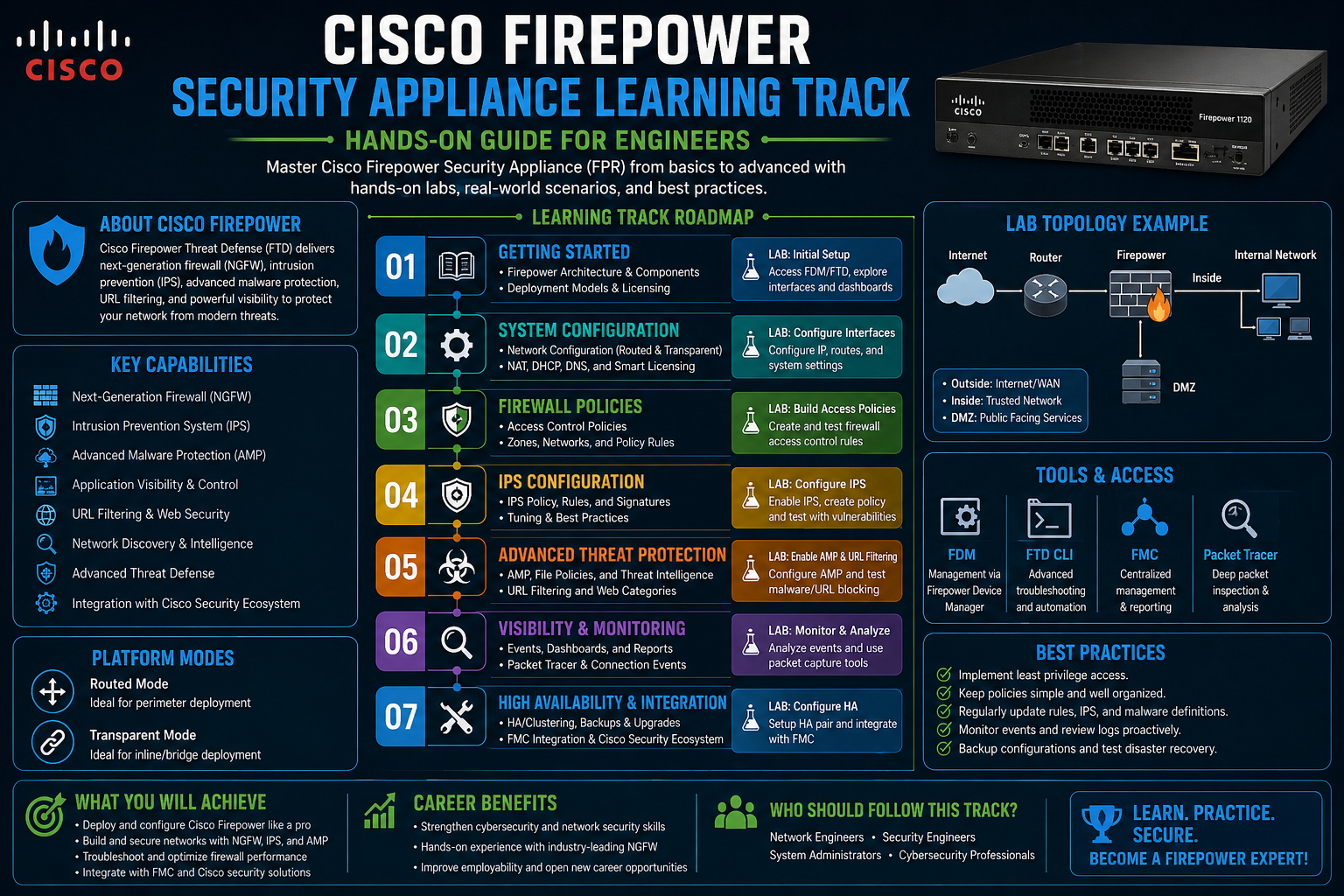
Modern organizations depend heavily on secure and reliable networks, and as digital environments expand, the complexity of protecting them grows just as rapidly. One of the most significant advancements in network security has been the development of next-generation firewall technologies, and Cisco Firepower Threat Defense stands out as a powerful solution in this space. To understand its importance, it is necessary to explore how firewall technologies have evolved and why modern infrastructures require more than traditional defenses.
Early firewalls were relatively simple tools designed to filter traffic based on basic rules such as IP addresses and port numbers. These packet-filtering firewalls acted as gatekeepers, allowing or denying traffic without deeply inspecting its content. While effective at the time, they could not detect more sophisticated threats that operate within allowed traffic channels. As cyber threats evolved, attackers began exploiting application-level vulnerabilities and using encrypted traffic to bypass traditional controls.
Stateful inspection firewalls emerged as an improvement, offering the ability to track active connections and make decisions based on the state of those connections. This allowed for more intelligent filtering, as the firewall could differentiate between legitimate traffic and suspicious activity more effectively. However, even these firewalls struggled to keep pace with the increasing sophistication of cyberattacks, especially those involving malware, advanced persistent threats, and application-layer exploits.
The need for deeper visibility and control led to the development of next-generation firewalls. These systems combine traditional firewall capabilities with advanced features such as intrusion prevention, application awareness, user identity tracking, and threat intelligence integration. Cisco Firepower Threat Defense represents this new generation of security solutions, offering a unified platform that integrates multiple layers of defense into a single, cohesive system.
Firepower Threat Defense is designed to provide comprehensive protection by analyzing traffic at multiple levels. It does not simply rely on static rules but uses dynamic policies and intelligence-driven mechanisms to identify and mitigate threats. This includes the ability to inspect encrypted traffic, detect malicious behavior patterns, and enforce granular access control policies based on applications and users rather than just network parameters.
Another key aspect of Firepower is its integration with centralized management systems. Instead of configuring each device individually, administrators can manage multiple Firepower devices from a single interface, ensuring consistency and simplifying policy enforcement. This centralized approach is essential for large-scale environments where maintaining uniform security policies across multiple locations can otherwise become a complex and error-prone task.
As organizations continue to adopt cloud technologies, remote work environments, and interconnected systems, the role of advanced firewall solutions becomes even more critical. Firepower is designed to operate effectively in these modern environments, providing flexibility in deployment and scalability to meet changing demands. Whether deployed on-premises, in the cloud, or as part of a hybrid infrastructure, it offers the adaptability required to secure diverse network architectures.
Understanding the evolution of firewall technology provides valuable context for appreciating the capabilities of Firepower. It highlights how security solutions have transitioned from simple filtering mechanisms to intelligent systems capable of analyzing and responding to complex threats in real time. This progression reflects the broader trend in cybersecurity toward proactive and adaptive defense strategies.
Exploring the Core Components of Firepower Threat Defense
At the heart of Firepower Threat Defense lies a set of integrated components that work together to deliver comprehensive security. These components are designed to provide visibility, control, and protection across all layers of the network, ensuring that threats can be detected and mitigated before they cause significant damage.
One of the most important elements of Firepower is its ability to combine multiple security functions into a single platform. Traditionally, organizations relied on separate devices for firewalling, intrusion prevention, and malware detection. This approach often led to increased complexity, higher costs, and gaps in security coverage. Firepower addresses these challenges by integrating these functions into a unified system, allowing for more efficient and effective threat management.
Intrusion prevention is a critical feature of Firepower, enabling the system to detect and block malicious activities within network traffic. Unlike basic firewalls that rely solely on predefined rules, intrusion prevention systems analyze traffic patterns and behaviors to identify potential threats. This includes detecting known attack signatures as well as identifying anomalies that may indicate new or emerging threats.
Another essential component is application awareness, which allows Firepower to identify and control traffic based on the applications being used rather than just ports and protocols. This capability is particularly important in modern networks where applications often use dynamic ports or encrypted communication channels. By understanding the context of the traffic, Firepower can enforce more precise security policies and prevent unauthorized or risky applications from accessing the network.
User identity integration further enhances the system’s capabilities by linking network activity to specific users. This allows administrators to create policies based on user roles and responsibilities, ensuring that access is granted only to those who need it. It also provides valuable insights into user behavior, helping to identify potential insider threats or compromised accounts.
Malware protection is another key aspect of Firepower, offering advanced detection and prevention mechanisms to stop malicious software from entering or spreading within the network. This includes real-time analysis of files and traffic, as well as the ability to retrospectively identify threats that may have initially gone undetected. By continuously monitoring and analyzing network activity, Firepower can respond to threats even after they have entered the system.
Centralized management plays a crucial role in ensuring that all these components work together effectively. Through a unified management interface, administrators can configure policies, monitor network activity, and respond to incidents from a single location. This not only simplifies operations but also improves visibility and control across the entire network.
The integration of threat intelligence is another distinguishing feature of Firepower. By leveraging global threat data, the system can stay updated on the latest attack trends and vulnerabilities. This enables it to proactively block known threats and adapt to new ones, providing a higher level of protection than static security measures.
These core components collectively enable Firepower to deliver a comprehensive security solution that addresses the challenges of modern network environments. By combining multiple layers of defense into a single platform, it provides a more efficient and effective approach to protecting critical assets and data.
Firepower Management and Device Architecture
A critical aspect of Firepower’s effectiveness lies in its architecture, which separates management and enforcement functions to provide flexibility and scalability. This design allows organizations to deploy and manage their security infrastructure in a way that best suits their operational needs.
The management component serves as the central hub for configuring policies, monitoring activity, and analyzing security events. It provides a comprehensive interface through which administrators can control all aspects of the system. This centralized approach ensures consistency across devices and simplifies the process of implementing and updating security policies.
The enforcement component, on the other hand, is responsible for inspecting and filtering network traffic based on the policies defined in the management system. These devices operate at the network edge or within internal segments, analyzing traffic in real time to detect and block threats. By separating these functions, Firepower allows organizations to scale their security infrastructure without compromising performance or manageability.
One of the key benefits of this architecture is the ability to manage multiple devices from a single interface. This is particularly important for large organizations with distributed networks, as it enables them to maintain consistent security policies across all locations. It also reduces the administrative overhead associated with managing individual devices, freeing up resources for more strategic tasks.
The communication between management and enforcement components is designed to be secure and efficient. Policies are deployed from the management system to the enforcement devices, which then apply them to network traffic. This process ensures that all devices operate with the latest configurations and that any changes can be implemented quickly and consistently.
Another important aspect of Firepower’s architecture is its support for different deployment models. Organizations can choose to deploy the system in various configurations depending on their specific requirements. This includes options for centralized management with distributed enforcement, as well as more localized setups for smaller environments.
The flexibility of this architecture also extends to integration with other security tools and systems. Firepower can work alongside other components in a broader security ecosystem, sharing information and coordinating responses to threats. This integration enhances overall security by providing a more comprehensive view of network activity and enabling more effective incident response.
Scalability is a key consideration in modern network environments, and Firepower’s architecture is designed to accommodate growth. As organizations expand their networks or increase their security requirements, they can add additional enforcement devices or adjust their management setup accordingly. This ensures that the system can continue to provide effective protection without requiring a complete redesign.
By separating management and enforcement functions and supporting flexible deployment options, Firepower provides a robust and adaptable architecture that meets the needs of modern organizations. This design not only enhances security but also simplifies administration and supports future growth.
Zones and Deployment Strategies in Firepower
Effective network security requires more than just advanced technology; it also depends on how that technology is deployed and configured. Firepower introduces the concept of security zones as a way to organize and control network traffic, providing a structured approach to policy enforcement.
Zones are logical groupings of network interfaces that represent different areas of the network. For example, an organization might define separate zones for internal networks, external connections, and sensitive segments such as data centers. By categorizing interfaces into zones, administrators can create policies that control how traffic flows between these areas.
This approach simplifies policy management by allowing rules to be defined based on zones rather than individual interfaces. Instead of creating separate rules for each interface, administrators can apply a single policy to all traffic moving between specific zones. This not only reduces complexity but also ensures consistency across the network.
The use of zones also enhances security by providing a clear framework for controlling access. For example, traffic from an external zone to an internal zone can be subject to stricter controls than traffic within the internal network. This layered approach helps to prevent unauthorized access and limit the potential impact of security incidents.
Deployment strategies play a crucial role in determining how effectively Firepower can protect a network. Organizations must consider factors such as network size, complexity, and security requirements when deciding how to deploy the system. This includes choosing the appropriate placement for enforcement devices and determining how traffic will be routed through them.
One common deployment approach is to position Firepower devices at the network perimeter, where they can inspect incoming and outgoing traffic. This provides a first line of defense against external threats and helps to prevent malicious traffic from entering the network. However, relying solely on perimeter defenses may not be sufficient, especially in environments with internal threats or complex network architectures.
To address these challenges, organizations often deploy Firepower devices within internal network segments as well. This allows for deeper inspection of traffic and provides additional layers of protection. By monitoring traffic within the network, Firepower can detect and respond to threats that may have bypassed perimeter defenses or originated from internal sources.
Another important consideration is the integration of Firepower with existing network infrastructure. This includes ensuring compatibility with routing and switching devices, as well as coordinating with other security tools. Proper integration is essential for achieving seamless operation and maximizing the effectiveness of the system.
Flexibility is a key advantage of Firepower’s deployment options. Organizations can tailor their deployment to meet specific needs, whether that involves securing a small office or protecting a large, distributed enterprise network. This adaptability ensures that Firepower can provide effective security in a wide range of environments.
By combining the use of zones with flexible deployment strategies, Firepower enables organizations to implement a structured and effective approach to network security. This not only enhances protection but also simplifies management and supports the evolving needs of modern networks.
Building a Strong Foundation with Initial Configuration
The effectiveness of any advanced security platform depends heavily on how well it is configured from the very beginning. When working with Cisco Firepower Threat Defense, the initial setup phase is not just a routine task but a critical step that determines how efficiently the system will operate over time. Establishing a solid foundation ensures that all future configurations, policies, and security controls function as intended without unnecessary complications.
The initial configuration process begins with preparing the management environment. A centralized management system is essential for maintaining control over multiple devices and ensuring consistent policy enforcement. During this stage, administrators define core settings such as system identity, network connectivity, and access credentials. These foundational elements allow the system to communicate effectively with other components and establish a secure management channel.
Setting up the management interface requires careful planning. It involves assigning appropriate IP addresses, configuring network parameters, and ensuring that the device can reach other critical systems within the network. This step is crucial because any misconfiguration at this stage can lead to connectivity issues that may disrupt the entire security infrastructure. A well-planned setup ensures smooth communication between management and enforcement components.
Once the management environment is in place, attention shifts to configuring the enforcement device. This involves preparing the Firepower Threat Defense appliance to inspect and control network traffic. Administrators must define how the device will interact with the network, including its role in traffic flow and its position within the overall architecture. This stage requires a clear understanding of the network topology and security requirements.
Registering the enforcement device with the management system is a key milestone in the configuration process. This step establishes a trusted relationship between the two components, allowing policies to be deployed and updates to be synchronized. The registration process typically involves authentication mechanisms that ensure only authorized devices can be managed. Once registered, the device becomes part of the centralized management framework, enabling streamlined operations.
Another important aspect of initial configuration is defining network zones and interfaces. Interfaces serve as the connection points between the device and different parts of the network, while zones provide a logical structure for organizing these interfaces. Properly mapping interfaces to zones ensures that traffic flows are clearly defined and that security policies can be applied effectively. This structured approach simplifies management and reduces the likelihood of configuration errors.
Routing configuration is also a fundamental part of the setup process. The device must know how to direct traffic to its intended destinations, which requires defining routes and gateways. Static routes are often used for predictable traffic paths, while dynamic routing may be implemented in more complex environments. Accurate routing ensures that traffic passes through the device as intended, allowing it to be inspected and controlled.
Saving and deploying configurations is the final step in the initial setup. Unlike some systems where changes take effect immediately, Firepower requires configurations to be explicitly deployed. This process ensures that all changes are reviewed and applied consistently. It also provides an opportunity to verify that the configuration is correct before it becomes active, reducing the risk of errors that could impact network operations.
A well-executed initial configuration lays the groundwork for all subsequent activities. It ensures that the system operates reliably, that policies can be enforced effectively, and that administrators have the visibility and control they need to manage the network. By investing time and effort into this stage, organizations can avoid many common issues and create a stable and secure environment.
Understanding Licensing and System Readiness
Licensing is a crucial component of the Firepower ecosystem, as it determines which features and capabilities are available for use. Unlike basic firewall solutions that offer a fixed set of functionalities, Firepower provides a flexible approach where specific features can be enabled or disabled based on licensing. This flexibility allows organizations to tailor the system to their needs, but it also requires careful planning to ensure that all necessary capabilities are available.
The licensing process begins with identifying the features required for the organization’s security strategy. These may include intrusion prevention, advanced malware protection, application control, and content filtering. Each of these features plays a specific role in protecting the network, and their availability depends on the licenses applied to the system. Understanding these requirements is essential for making informed decisions during the setup process.
Applying licenses involves associating them with the management system and ensuring that they are correctly distributed to the enforcement devices. This process typically includes verifying the authenticity of the licenses and confirming that they are compatible with the system. Once applied, the system can activate the corresponding features, allowing administrators to configure and use them as needed.
Licensing also impacts system performance and resource allocation. Some advanced features require additional processing power and memory, which must be considered when planning the deployment. Ensuring that the hardware can support the enabled features is essential for maintaining optimal performance and avoiding bottlenecks. This highlights the importance of aligning licensing decisions with hardware capabilities.
Another aspect of licensing is ongoing management and renewal. Licenses are often time-bound, requiring periodic renewal to maintain access to certain features. Keeping track of license status and expiration dates is an important administrative task, as expired licenses can result in reduced functionality or loss of protection. Proactive management ensures that the system remains fully operational at all times.
System readiness extends beyond licensing to include overall preparedness for operation. This involves verifying that all components are functioning correctly, that configurations are properly applied, and that the system is capable of handling expected traffic loads. Conducting thorough checks during this stage helps identify potential issues before they impact production environments.
Testing is an important part of ensuring system readiness. By simulating different types of traffic and scenarios, administrators can verify that the system behaves as expected. This includes confirming that policies are enforced correctly, that threats are detected and blocked, and that legitimate traffic is allowed to pass without disruption. Testing provides confidence in the system’s ability to protect the network.
Monitoring tools also play a role in assessing readiness. These tools provide insights into system performance, resource utilization, and security events. By analyzing this information, administrators can identify areas for improvement and make necessary adjustments. Continuous monitoring ensures that the system remains effective as network conditions evolve.
A thorough understanding of licensing and system readiness is essential for maximizing the value of Firepower. It ensures that all necessary features are available, that the system operates efficiently, and that it is prepared to handle the challenges of modern network environments. By addressing these aspects during the setup phase, organizations can create a strong and reliable security foundation.
Routing and Traffic Flow Management
Managing how data moves through a network is a fundamental aspect of security, and Firepower provides robust capabilities for handling routing and traffic flow. Understanding these mechanisms is essential for ensuring that traffic is properly inspected and controlled as it passes through the system.
Routing determines the path that data takes from its source to its destination. In the context of Firepower, routing configuration ensures that traffic flows through the device so that it can be analyzed and filtered. Without proper routing, traffic may bypass the device entirely, leaving the network vulnerable to threats. This makes routing a critical component of the overall security strategy.
Static routing is often used in simpler environments where network paths are predictable. Administrators define specific routes that direct traffic to particular destinations, ensuring that it passes through the appropriate interfaces. This approach provides a high level of control and is relatively easy to configure, making it suitable for many scenarios.
In more complex environments, dynamic routing protocols may be used to automatically adjust routes based on network conditions. These protocols allow the system to adapt to changes such as link failures or congestion, ensuring that traffic continues to flow efficiently. While more complex to configure, dynamic routing provides greater flexibility and resilience.
Interface configuration is closely tied to routing. Each interface represents a connection point to a different part of the network, and its settings determine how traffic is handled. This includes assigning IP addresses, defining security zones, and configuring parameters such as speed and duplex settings. Proper interface configuration ensures that traffic is received and transmitted correctly.
Traffic flow management also involves understanding how packets are processed by the system. When traffic enters the device, it is evaluated against defined policies to determine whether it should be allowed, blocked, or subjected to further inspection. This process involves multiple stages, including access control, intrusion prevention, and application inspection.
Ensuring that traffic flows correctly through these stages requires careful planning and configuration. Administrators must define policies that align with organizational requirements while avoiding conflicts or unintended consequences. This often involves testing and refining configurations to achieve the desired balance between security and usability.
Another important aspect of traffic flow management is handling network address translation. NAT allows private IP addresses to be translated into public addresses, enabling communication with external networks. It also provides an additional layer of security by masking internal network details. Configuring NAT correctly is essential for ensuring that traffic can reach its intended destinations while maintaining security.
Monitoring traffic flow is an ongoing task that provides valuable insights into network behavior. By analyzing traffic patterns, administrators can identify anomalies, detect potential threats, and optimize performance. This information can also be used to refine policies and improve overall security posture.
Effective routing and traffic flow management are essential for ensuring that Firepower can perform its role of protecting the network. By carefully configuring these elements, organizations can ensure that all traffic is properly inspected and controlled, reducing the risk of security breaches and maintaining smooth network operations.
Network Address Translation and Policy Planning
Network address translation plays a vital role in modern networking, particularly in environments where private and public networks must interact. Within Firepower, NAT is not just a connectivity tool but also an integral part of the security framework. Proper planning and implementation of NAT policies are essential for achieving both functionality and protection.
At its core, NAT modifies the IP address information in network packets as they pass through the device. This allows multiple devices within a private network to share a single public IP address when accessing external resources. It also enables external systems to communicate with internal resources under controlled conditions. This dual functionality makes NAT a key component of network design.
There are different approaches to implementing NAT, each suited to specific scenarios. Automatic NAT simplifies the process by applying predefined rules based on object definitions. This approach is straightforward and works well for common use cases where standard translation is sufficient. It reduces the complexity of configuration and minimizes the risk of errors.
Manual NAT, on the other hand, provides greater flexibility and control. It allows administrators to define detailed rules that specify how traffic should be translated under various conditions. This is particularly useful in complex environments where multiple networks, services, and requirements must be accommodated. While more powerful, manual NAT requires careful planning to ensure that rules do not conflict or produce unintended results.
Planning NAT policies involves understanding the network architecture and the types of traffic that need to be supported. This includes identifying which systems require external access, how traffic should be routed, and what level of security is needed. A well-designed NAT policy ensures that communication is seamless while maintaining strict control over access.
One of the challenges in NAT configuration is ensuring compatibility with other network functions. For example, certain applications and protocols may be sensitive to address translation, requiring additional configuration to function correctly. Understanding these requirements is essential for avoiding disruptions and ensuring smooth operation.
NAT also interacts with other security features within Firepower. For example, access control policies must account for translated addresses to ensure that rules are applied correctly. This requires careful coordination between NAT and policy configurations, as inconsistencies can lead to unexpected behavior.
Testing is an important part of NAT implementation. By verifying that translations occur as expected and that traffic flows correctly, administrators can identify and resolve issues before they impact users. This includes testing both inbound and outbound traffic, as well as different scenarios such as failover and redundancy.
Monitoring NAT activity provides additional insights into network behavior. It allows administrators to track how addresses are being translated, identify potential issues, and optimize configurations. This information can also be used for troubleshooting and performance tuning.
Effective NAT and policy planning are essential for creating a secure and functional network environment. By carefully designing and implementing these elements, organizations can ensure that their networks operate efficiently while maintaining strong security controls.
Gaining Visibility Through Discovery and Network Awareness
As networks grow in size and complexity, one of the biggest challenges for security professionals is maintaining clear visibility into what is actually happening inside the environment. Without accurate and up-to-date information about devices, users, and traffic patterns, even the most advanced security controls can become ineffective. This is where the discovery capabilities within Cisco Firepower Threat Defense play a crucial role, helping organizations build a detailed understanding of their network landscape.
Discovery functionality allows the system to automatically identify and profile hosts within the network. Instead of relying solely on manual documentation, which can quickly become outdated, Firepower continuously collects information about devices, operating systems, applications, and user activity. This dynamic approach ensures that administrators always have access to current and relevant data, enabling them to make informed decisions about security policies.
The process of discovery involves monitoring network traffic and extracting key details from it. As devices communicate with each other, Firepower analyzes the data to determine characteristics such as device type, operating system, and services in use. Over time, this information is compiled into detailed host profiles that provide a comprehensive view of each device on the network. These profiles serve as a valuable resource for identifying potential risks and understanding normal behavior patterns.
One of the key benefits of discovery is its ability to reveal unknown or unmanaged devices. In many environments, it is common for devices to be connected without proper authorization or documentation. These can include personal devices, unauthorized servers, or outdated systems that have been forgotten over time. By identifying these devices, Firepower helps organizations reduce their attack surface and enforce better control over network access.
Discovery also plays an important role in identifying vulnerabilities. By analyzing the characteristics of each device, the system can determine whether it may be susceptible to known threats. This information can then be used to prioritize security measures and address the most critical risks first. Instead of applying a one-size-fits-all approach, administrators can tailor their strategies based on the specific needs of their environment.
Enhancing discovery with active scanning techniques further improves accuracy and depth of information. Tools such as network scanning can be integrated to gather additional details that may not be visible through passive monitoring alone. This combination of passive and active methods ensures a more complete understanding of the network, allowing for better decision-making and stronger security posture.
Another advantage of discovery is its contribution to policy creation. By understanding how devices and users interact within the network, administrators can develop more effective access control policies. For example, if certain applications are frequently used by specific groups of users, policies can be designed to allow that traffic while restricting unnecessary or risky activities. This approach ensures that security measures align with actual usage patterns rather than assumptions.
The continuous nature of discovery means that it adapts to changes in the network. As new devices are added, existing devices are updated, or usage patterns shift, the system automatically reflects these changes in its profiles. This ongoing visibility is essential for maintaining security in dynamic environments where conditions can change rapidly.
In addition to improving security, discovery also supports operational efficiency. By providing a clear picture of the network, it helps administrators troubleshoot issues, optimize performance, and plan for future growth. This makes it a valuable tool not only for security teams but also for network and system administrators.
Ultimately, discovery transforms the way organizations understand and manage their networks. By replacing guesswork with accurate data, it enables more effective security strategies and reduces the likelihood of overlooked risks. In a landscape where visibility is key to protection, this capability becomes an essential part of any modern security solution.
Strengthening Control with Access Policies and Threat Prevention
Once visibility into the network is established, the next step is to enforce control over how traffic is allowed to flow. Access control policies are at the core of this process, providing the rules and logic that determine which traffic is permitted and which is blocked. In Cisco Firepower Threat Defense, these policies go beyond simple filtering to incorporate advanced threat prevention techniques that enhance overall security.
Access control policies are designed to evaluate traffic based on a wide range of criteria. This includes not only traditional factors such as source and destination addresses but also applications, users, and content. By considering these additional elements, Firepower can make more informed decisions about whether to allow or deny traffic. This level of granularity ensures that legitimate activities are not unnecessarily restricted while potential threats are effectively blocked.
The integration of application awareness into access control policies is particularly important. Modern applications often use dynamic ports and encrypted communication, making them difficult to identify using traditional methods. Firepower addresses this challenge by analyzing traffic at a deeper level, allowing it to recognize applications regardless of how they are transmitted. This enables administrators to create policies that specifically target applications rather than relying on less precise indicators.
Intrusion prevention is another critical component of access control. By inspecting traffic for known attack patterns and suspicious behavior, Firepower can detect and block threats before they reach their targets. This proactive approach is essential for defending against a wide range of attacks, including exploits, malware delivery, and unauthorized access attempts. The ability to integrate intrusion prevention directly into access control policies ensures that security is enforced consistently across all traffic.
Content inspection further enhances protection by analyzing the data within network traffic. This includes examining files for malicious content, filtering web traffic based on categories, and decrypting secure connections when necessary. These capabilities allow Firepower to detect threats that may be hidden within otherwise legitimate traffic, providing an additional layer of defense.
The use of encryption in modern networks presents both opportunities and challenges. While it helps protect data from interception, it can also be used by attackers to conceal malicious activity. Firepower addresses this issue by providing controlled decryption capabilities, allowing administrators to inspect encrypted traffic without compromising privacy or performance. This ensures that threats cannot bypass security measures simply by using encryption.
Policy design requires careful consideration to balance security and usability. Overly restrictive policies can disrupt legitimate activities, while overly permissive ones can leave the network vulnerable. Achieving the right balance involves understanding the needs of the organization and continuously refining policies based on observed behavior and emerging threats.
Automation and intelligence play a significant role in enhancing access control. By leveraging threat intelligence data, Firepower can automatically update its policies to address new risks. This reduces the need for manual intervention and ensures that the system remains effective against evolving threats. Automation also helps streamline operations, allowing administrators to focus on higher-level tasks.
Monitoring and analysis are essential for maintaining effective access control. By reviewing logs and alerts, administrators can gain insights into how policies are being applied and identify any issues that need to be addressed. This ongoing process of evaluation and adjustment ensures that policies remain aligned with organizational goals and security requirements.
Through the combination of granular control, advanced threat detection, and continuous improvement, access control policies form a powerful defense mechanism. They enable organizations to regulate network activity with precision while protecting against a wide range of threats, making them a cornerstone of modern network security.
Enhancing Protection with Security Intelligence and High Availability
In addition to controlling traffic and detecting threats, maintaining a resilient and adaptive security posture requires the use of intelligence and redundancy. Cisco Firepower Threat Defense incorporates both of these elements through its security intelligence capabilities and high availability features, ensuring that protection remains effective even in challenging conditions.
Security intelligence provides the system with up-to-date information about known threats. This includes data on malicious IP addresses, domains, and URLs that are associated with harmful activities. By integrating this information into its policies, Firepower can proactively block connections to and from these sources, reducing the risk of compromise. This approach shifts the focus from reactive defense to proactive prevention.
The use of dynamic feeds allows security intelligence to remain current without requiring constant manual updates. These feeds are regularly refreshed with new information, ensuring that the system can respond to emerging threats in real time. This continuous flow of data enhances the effectiveness of security measures and helps organizations stay ahead of attackers.
Custom intelligence lists provide additional flexibility by allowing administrators to define their own rules based on specific requirements. For example, an organization may choose to block certain regions, restrict access to known risky sites, or allow trusted partners. This level of customization ensures that security intelligence aligns with the unique needs of the environment.
The integration of security intelligence with access control policies creates a unified approach to threat prevention. Instead of operating as a separate layer, intelligence becomes part of the decision-making process for all traffic. This ensures that known threats are blocked as early as possible, reducing the load on other security mechanisms and improving overall efficiency.
High availability is another critical aspect of maintaining a reliable security infrastructure. Network security devices must remain operational at all times, as any downtime can expose the network to risks. Firepower addresses this requirement by supporting high availability configurations that provide redundancy and failover capabilities.
In a high availability setup, two devices work together to ensure continuous operation. One device actively handles traffic while the other remains on standby, ready to take over if needed. This arrangement ensures that even if one device fails, the other can seamlessly continue operations without disrupting network activity.
Implementing high availability requires careful planning and configuration. This includes ensuring that both devices are synchronized in terms of policies and settings, as well as configuring communication between them. Proper setup ensures that failover occurs smoothly and that there is no loss of data or functionality during the transition.
Testing is an essential part of high availability deployment. By simulating failure scenarios, administrators can verify that the system behaves as expected and that failover mechanisms work correctly. This provides confidence in the system’s ability to maintain protection under مختلف conditions.
Monitoring also plays a key role in maintaining high availability. By keeping track of device status and performance, administrators can identify potential issues before they lead to failures. This proactive approach helps ensure that the system remains reliable and that any problems are addressed promptly.
The combination of security intelligence and high availability creates a robust and resilient security framework. Intelligence ensures that the system is always aware of the latest threats, while high availability ensures that protection is maintained without interruption. Together, these capabilities provide a strong foundation for safeguarding modern networks against an ever-changing threat landscape.
Conclusion
Cisco Firepower Threat Defense represents a comprehensive approach to modern network security, combining visibility, control, and resilience into a single integrated solution. Throughout this learning journey, it becomes clear that securing today’s networks requires more than traditional defenses. From understanding the evolution of firewalls to implementing advanced features such as discovery, access control, and threat intelligence, each layer plays a vital role in building a strong security posture.
A well-configured environment begins with careful planning and a solid initial setup, ensuring that all components work together seamlessly. As configurations expand into routing, network address translation, and policy enforcement, the importance of precision and continuous monitoring becomes even more evident. Visibility through discovery enhances awareness, while access control policies and intrusion prevention provide the mechanisms needed to actively defend against threats.
At the same time, security intelligence and high availability ensure that protection remains both proactive and reliable. These capabilities allow organizations to respond to emerging risks while maintaining uninterrupted operations. The result is a dynamic security framework that adapts to changing environments and evolving threats.
By developing a deep understanding of these concepts and applying them effectively, professionals can create secure, efficient, and scalable networks that meet the demands of modern digital environments.