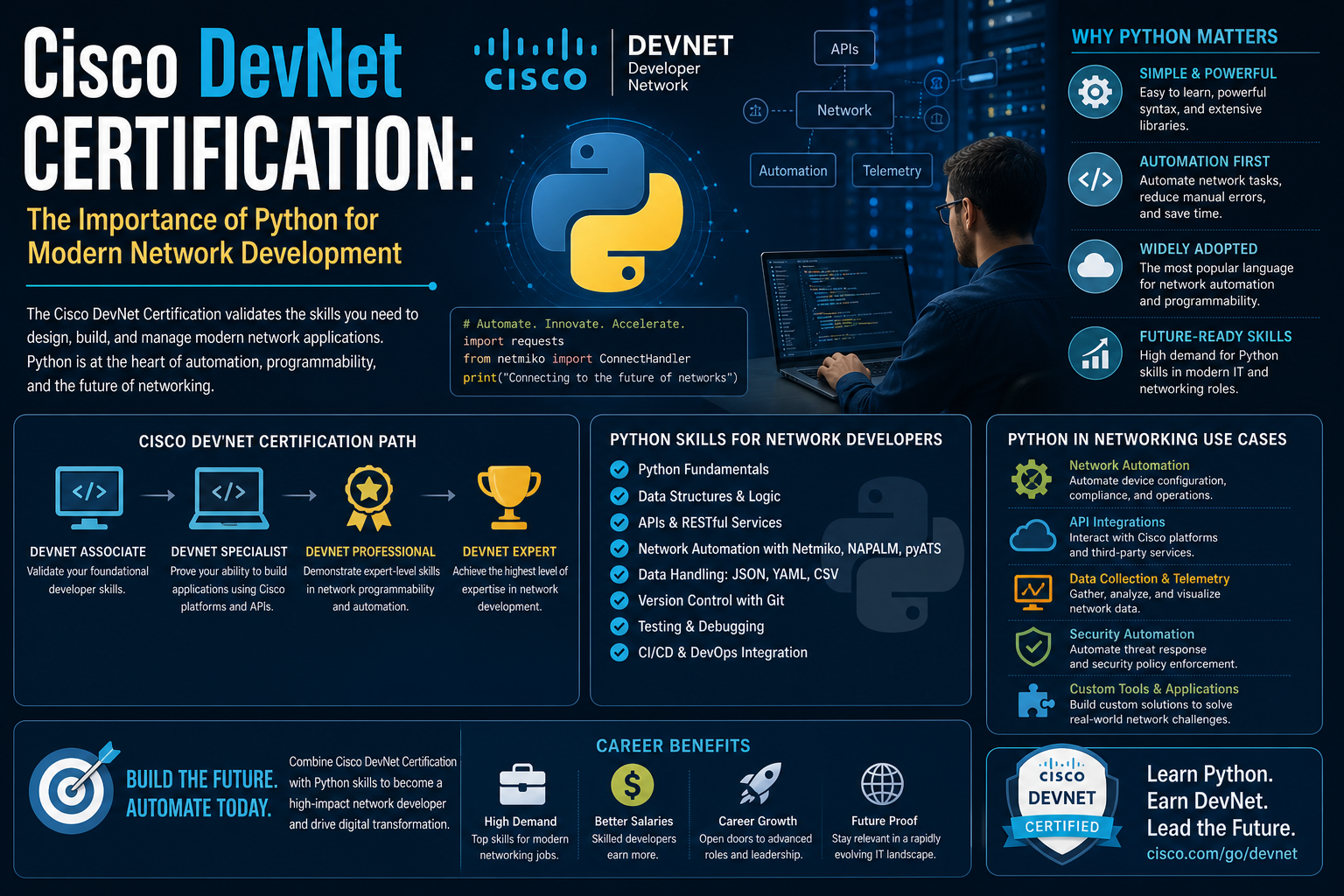
The field of networking has undergone a dramatic transformation over the past decade. What was once a discipline centered mainly on configuring hardware devices, managing routing protocols, and maintaining stable connectivity has evolved into a highly dynamic environment shaped by automation, software integration, and cloud-driven infrastructure. Traditional networking tasks that used to require manual intervention are increasingly being replaced by programmable workflows designed to improve speed, accuracy, and scalability.
This shift is not just a trend but a response to the growing complexity of modern IT environments. Organizations now operate across hybrid infrastructures that span on-premises data centers, multiple cloud platforms, and distributed edge locations. Each of these environments generates continuous streams of configuration changes, monitoring data, and operational demands. Managing such complexity manually is no longer practical.
As networks expanded in size and complexity, the need for automation became unavoidable. Repetitive tasks such as device configuration, log analysis, compliance auditing, and network provisioning required more efficient methods. This is where the integration of software principles into networking began to reshape the industry. Networking professionals started to realize that understanding code and automation was becoming just as important as understanding protocols and hardware behavior.
This transition has also been driven by the increasing demand for agility in IT operations. Businesses now expect rapid deployment of services, minimal downtime, and the ability to scale infrastructure instantly. These expectations cannot be met through manual configuration alone. Instead, programmable infrastructure has emerged as a solution, allowing engineers to define network behavior using scripts and automation tools.
In this evolving environment, the traditional boundary between network engineering and software development has become less defined. Network engineers are now expected to think in terms of systems, logic, and automation pipelines rather than isolated device configurations. This shift has made programming knowledge a critical part of modern networking skill sets.
Rise of Cisco DevNet and What It Represents
As networking moved toward automation and software-defined infrastructure, industry leaders recognized the need for structured learning paths that reflect this new reality. Cisco DevNet emerged as a response to this demand, representing a shift in how networking skills are validated and developed.
Rather than focusing solely on hardware configuration and traditional networking knowledge, DevNet places emphasis on software development concepts, APIs, automation workflows, and integration between systems. It acknowledges that modern network professionals must be capable of interacting with infrastructure programmatically.
The introduction of DevNet marked a significant shift in certification philosophy. It signaled that networking is no longer limited to device-level operations but extends into the realm of software engineering. This change reflects how deeply automation has become embedded in enterprise environments.
DevNet also highlights the importance of understanding how different systems communicate. Modern networks rely heavily on APIs, data models, and programmable interfaces that allow systems to exchange information without human intervention. This requires a different way of thinking, one that blends networking knowledge with software logic.
By introducing this certification track, Cisco effectively acknowledged that the future of networking lies in automation, integration, and programmability. It also highlighted the growing importance of developers in infrastructure roles and the increasing overlap between IT disciplines that were once considered separate.
Why Programming Skills Became Essential for Network Engineers
The integration of programming into networking did not happen overnight. It developed gradually as networks became more complex and organizations began seeking ways to reduce operational overhead. At the core of this transformation is the need for efficiency and consistency.
Manual configuration, while reliable in small environments, becomes increasingly error-prone at scale. A single misconfiguration can lead to outages, security vulnerabilities, or performance degradation. Programming offers a way to reduce these risks by enabling repeatable and standardized processes.
With automation scripts, network engineers can define desired states for infrastructure rather than configuring each device individually. This approach reduces human error and ensures consistency across large environments. It also enables faster deployment of services, which is critical in competitive industries.
Programming skills also empower engineers to analyze data more effectively. Modern networks generate large volumes of telemetry data that can be used to detect anomalies, optimize performance, and predict failures. Without programming knowledge, extracting meaningful insights from this data becomes challenging.
Another important factor is integration. Networks today do not operate in isolation. They interact with cloud platforms, security systems, monitoring tools, and application services. Programming allows engineers to create workflows that connect these systems together, enabling seamless communication and automation across different layers of infrastructure.
This growing reliance on automation and integration has made programming a foundational skill for network engineers. It is no longer optional for those who want to remain relevant in the industry. Instead, it has become an essential capability that supports nearly every aspect of modern network operations.
Python as the Default Language of Modern Infrastructure
Among the various programming languages available, Python has emerged as a dominant choice in the networking and automation space. Its popularity is not accidental but the result of several practical advantages that align well with the needs of IT professionals.
Python is widely regarded as a general-purpose language, meaning it can be used across different domains including web development, data analysis, artificial intelligence, and infrastructure automation. This versatility makes it particularly valuable for network engineers who need a tool that can adapt to multiple use cases.
One of the key reasons Python stands out is its simplicity. The language is designed to be readable and easy to understand, even for individuals who do not have a formal background in software development. This lowers the barrier to entry and allows network professionals to learn programming without being overwhelmed by complex syntax.
Another reason for Python’s widespread adoption is its extensive library ecosystem. Python offers a vast collection of modules and frameworks that simplify common tasks such as sending HTTP requests, parsing data formats, interacting with APIs, and automating system processes. These tools significantly reduce development time and make automation more accessible.
Python’s role in infrastructure automation is particularly important. Many modern networking tools and platforms provide Python-based SDKs or support Python scripting for automation tasks. This integration allows engineers to interact directly with network devices and cloud services using simple scripts.
The language has also become deeply embedded in DevOps practices, where automation and continuous integration are central concepts. Python’s ability to connect different systems and automate workflows makes it a natural fit for these environments.
In addition, Python’s cross-platform compatibility ensures that scripts can run across different operating systems without major modifications. This flexibility is crucial in environments where infrastructure spans multiple platforms and technologies.
Simplicity and Readability of Python in Technical Environments
One of the most significant advantages of Python in technical fields is its emphasis on readability. Unlike many programming languages that rely on complex syntax and strict structural rules, Python is designed to resemble natural language as closely as possible.
This readability is especially valuable in networking environments where scripts are often written, modified, and maintained by multiple engineers over time. Clear and understandable code reduces the likelihood of errors and makes collaboration more efficient.
In many cases, network engineers are not professional software developers. They may have limited programming experience but still need to write automation scripts to manage infrastructure. Python’s straightforward syntax allows these professionals to quickly learn the basics and become productive in a short amount of time.
The simplicity of Python also contributes to faster troubleshooting. When automation scripts fail or behave unexpectedly, readable code makes it easier to identify issues and apply fixes. This is particularly important in production environments where downtime must be minimized.
Another aspect of Python’s design is its focus on reducing unnecessary complexity. The language avoids excessive symbols and rigid formatting requirements, allowing engineers to concentrate on logic rather than syntax. This makes it easier to focus on solving real-world problems rather than struggling with language-specific constraints.
Python’s clean structure also supports better documentation practices. Well-written scripts can serve as both functional tools and learning resources for other engineers. This encourages knowledge sharing within teams and improves overall operational efficiency.
Community Growth and Ecosystem Strength
One of the strongest factors behind Python’s success is its global community. Over the years, Python has developed into one of the most widely supported programming languages, with contributions from developers across industries and regions.
This community-driven growth has resulted in a vast ecosystem of tools, libraries, and frameworks that continue to expand. For network automation, this means access to ready-made solutions for common challenges such as device communication, data parsing, and API interaction.
The strength of Python’s ecosystem also means that engineers rarely need to build tools from scratch. Instead, they can rely on existing libraries that have been tested and refined by large communities of users. This significantly accelerates development and reduces the complexity of automation projects.
Another important aspect of the Python community is its accessibility. Learning resources, discussions, and shared knowledge are widely available, making it easier for beginners to get started and for experienced professionals to deepen their understanding.
This collaborative environment has also contributed to Python’s stability and continuous improvement. As new challenges emerge in technology, the language evolves through community contributions, ensuring it remains relevant in changing environments.
In networking contexts, this ecosystem strength translates into practical benefits. Engineers can leverage community-developed tools to interact with network devices, automate configuration tasks, and analyze performance data without reinventing existing solutions.
How Python Fits into Everyday Networking Tasks
In practical networking environments, Python plays a central role in simplifying and automating daily operations. Many tasks that were once performed manually can now be handled through scripts, reducing workload and improving accuracy.
For example, configuration management can be automated using Python scripts that apply standardized settings across multiple devices. This ensures consistency and reduces the risk of human error during deployment.
Monitoring and diagnostics also benefit from Python automation. Scripts can be used to collect system logs, analyze performance metrics, and identify potential issues before they escalate into critical failures.
Another common use case involves interacting with network APIs. Modern devices and platforms expose programmable interfaces that allow engineers to retrieve data, modify configurations, and manage services programmatically. Python provides the tools needed to interact with these APIs efficiently.
Data processing is another area where Python proves valuable. Networks generate large volumes of structured and unstructured data that must be analyzed for insights. Python’s data handling capabilities make it easier to filter, transform, and interpret this information.
Automation also extends to routine maintenance tasks such as backups, updates, and compliance checks. By automating these processes, engineers can ensure they are performed consistently without requiring manual intervention.
Expanding the Role of APIs in Modern Network Automation
As networking continues to evolve toward software-driven infrastructure, APIs have become one of the most important building blocks of modern systems. Instead of interacting directly with devices through command-line interfaces, engineers now increasingly rely on APIs to communicate with network platforms in a structured and predictable way.
An API, or application programming interface, acts as a bridge between systems. It defines how different software components can request and exchange information. In networking environments, APIs allow engineers to retrieve device information, modify configurations, and trigger operational tasks without logging into each device individually.
This shift fundamentally changes how network management is performed. Rather than thinking in terms of individual devices, engineers now think in terms of systems and services. Networks are treated as programmable entities that can be controlled through defined interfaces.
Python plays a central role in this transformation because of its ability to interact easily with APIs. Through simple and readable syntax, it becomes possible to send requests, process responses, and integrate network functions into larger automation workflows.
Modern networking platforms, including cloud-based systems and enterprise infrastructure tools, expose extensive API capabilities. These APIs often return structured data formats that can be easily interpreted and processed. This enables automation scripts to make decisions based on real-time network conditions.
The growing importance of APIs also reflects a broader shift toward abstraction in networking. Instead of dealing with low-level device configurations, engineers now interact with higher-level constructs that represent services, policies, and network behavior.
This abstraction reduces complexity and increases flexibility. It allows networks to be managed more efficiently and adapted more quickly to changing business requirements.
Understanding Automation Workflows in Network Environments
Automation in networking is not just about writing scripts. It involves designing workflows that define how tasks are executed, how systems interact, and how outcomes are validated. These workflows form the backbone of modern network operations.
A typical automation workflow begins with data collection. Information is gathered from devices, monitoring systems, or APIs. This data is then processed to identify the current state of the network.
Once the current state is understood, the system compares it with a desired state. This comparison determines whether changes are required. If discrepancies are found, automation logic is triggered to bring the system back into alignment.
This approach is often referred to as state-driven automation. It ensures that networks remain consistent and compliant with predefined configurations.
Python is particularly well-suited for building these workflows because of its ability to handle data processing, logic implementation, and system integration in a unified environment.
In many cases, automation workflows also include validation steps. After changes are applied, the system verifies whether the intended outcome was achieved. This feedback loop is essential for maintaining reliability in complex environments.
These workflows are not limited to configuration management. They can also include monitoring, alerting, reporting, and remediation processes. Together, they form a continuous cycle of observation, decision-making, and execution.
The Shift from Manual Configuration to Intent-Based Networking
Traditional networking relied heavily on manual configuration. Engineers would log into devices, enter commands, and adjust settings individually. While this approach worked in smaller environments, it does not scale effectively in modern infrastructures.
As networks became larger and more complex, a new approach emerged: intent-based networking. Instead of configuring devices manually, engineers define what they want the network to achieve. The system then automatically translates that intent into configuration actions.
This represents a major conceptual shift. The focus moves away from how tasks are performed and toward what the desired outcome should be.
Python supports this model by enabling engineers to build logic that translates high-level requirements into automated actions. Scripts can interpret intent, evaluate system state, and apply necessary changes across the network.
Intent-based networking also improves consistency. Because configurations are generated automatically, there is less room for human error. This leads to more stable and predictable network behavior.
Another advantage is scalability. As networks grow, manual configuration becomes impractical. Intent-based systems allow changes to be applied across thousands of devices simultaneously, significantly improving operational efficiency.
This approach also enhances agility. Organizations can respond more quickly to changing demands, whether that involves scaling services, deploying new applications, or adjusting security policies.
Python as a Bridge Between Networking and Software Engineering
One of the most important roles Python plays in modern IT is acting as a bridge between traditional networking and software engineering. These two domains, once separate, are now deeply interconnected.
Networking professionals are increasingly expected to understand programming concepts, while software engineers must often interact with infrastructure systems. Python provides a common language that allows both groups to collaborate effectively.
This shared foundation reduces communication barriers and improves workflow integration. Instead of relying on separate tools and processes, teams can build unified systems that combine networking logic with software automation.
Python’s flexibility is key to this integration. It can be used for simple automation tasks as well as complex system orchestration. This makes it suitable for both beginners and advanced engineers.
In addition, Python supports multiple programming paradigms, including procedural, object-oriented, and functional styles. This allows engineers to choose the approach that best fits their needs.
The language also integrates well with other technologies commonly used in IT environments. Whether interacting with cloud services, databases, or monitoring tools, Python can serve as a central orchestration layer.
This bridging role has made Python one of the most important tools in modern infrastructure engineering. It enables collaboration, simplifies automation, and supports the convergence of networking and software disciplines.
Infrastructure as Code and Its Connection to Python
One of the most significant developments in modern IT operations is the concept of infrastructure as code. This approach treats infrastructure configuration as software, allowing it to be defined, managed, and version-controlled like application code.
Instead of manually configuring servers, networks, and services, engineers define infrastructure using declarative or programmatic definitions. These definitions can then be executed to automatically provision and manage systems.
Python plays an important role in this ecosystem by providing the flexibility needed to build custom automation logic. It allows engineers to define infrastructure behavior, integrate different systems, and extend automation frameworks.
Infrastructure as code improves consistency by ensuring that environments are created in a repeatable manner. This reduces configuration drift and makes it easier to maintain large-scale systems.
It also enhances collaboration between teams. Developers, network engineers, and operations teams can work from the same definitions, ensuring alignment across the organization.
Another advantage is version control. Infrastructure definitions can be stored, tracked, and reviewed over time. This provides transparency and makes it easier to audit changes.
Python-based tools often support infrastructure as code principles by enabling dynamic configuration generation and automated deployment processes. This makes it easier to adapt infrastructure to changing requirements.
The Growing Importance of Network Programmability
Network programmability refers to the ability to control and manage network behavior through software. This concept has become increasingly important as organizations seek more flexible and efficient ways to manage infrastructure.
Traditionally, networks were static and manually configured. Changes required direct interaction with devices, which was time-consuming and error-prone. Programmability changes this by allowing networks to be controlled through code.
Python is one of the primary languages used in network programmability because of its simplicity and extensive library support. It enables engineers to write scripts that interact directly with network devices and controllers.
Programmable networks offer several advantages. They are more adaptable, allowing changes to be implemented quickly in response to business needs. They are also more consistent, as automation reduces the likelihood of human error.
In addition, programmability enables advanced use cases such as dynamic routing adjustments, automated load balancing, and real-time traffic optimization.
As networks become more software-defined, programmability will continue to play a central role in their design and operation.
Integration of Python with Cloud and Hybrid Environments
Modern networks rarely exist in isolation. Instead, they are part of larger ecosystems that include cloud platforms, on-premises systems, and edge computing environments. Managing these hybrid infrastructures requires tools that can operate across different domains.
Python is particularly effective in this context because of its ability to integrate with a wide range of cloud services and APIs. It allows engineers to manage resources across multiple platforms using a unified approach.
In hybrid environments, consistency becomes a major challenge. Different systems often have different configuration models and operational requirements. Python helps bridge these differences by providing a flexible automation layer.
Engineers can use Python to synchronize configurations, monitor performance, and manage resources across distributed environments. This ensures that systems remain aligned even when operating in different locations or platforms.
Cloud integration also introduces scalability challenges. Python-based automation helps address these challenges by enabling dynamic resource provisioning and automated scaling processes.
Another important aspect is observability. Hybrid environments generate large amounts of operational data. Python can be used to collect, process, and analyze this data to provide insights into system performance and health.
Security Considerations in Automated Networking Systems
As automation becomes more prevalent in networking, security becomes an increasingly important consideration. Automated systems have the ability to make changes across large infrastructures, which means any vulnerability can have widespread impact.
One of the key security principles in automated environments is access control. It is essential to ensure that only authorized systems and users can execute automation tasks.
Python scripts used in network automation must be carefully designed to avoid exposing sensitive information or introducing security risks. This includes proper handling of credentials, secure communication with APIs, and validation of inputs.
Another important aspect is auditing. Automated actions should be logged and tracked so that changes can be reviewed and analyzed if necessary. This helps maintain accountability and transparency.
Security also involves validating the behavior of automation systems. Scripts should be tested thoroughly to ensure they behave as expected under different conditions.
In addition, automation can actually improve security when implemented correctly. It allows for faster detection of anomalies, automated enforcement of policies, and consistent application of security configurations.
By reducing manual intervention, automation also reduces the likelihood of human error, which is a common source of security issues.
Scaling Automation Across Large Enterprise Environments
As organizations grow, the complexity of their networks increases exponentially. What begins as a manageable number of devices in a small infrastructure quickly expands into thousands of routers, switches, firewalls, virtual networks, and cloud resources distributed across multiple regions. At this scale, manual management becomes not only inefficient but practically impossible.
Automation is no longer just a productivity enhancement in these environments—it becomes a necessity for operational survival. Large enterprises rely on automation to ensure consistency, reduce downtime, and maintain visibility across vast and distributed infrastructures. Without it, even routine changes can introduce risk and delay.
Python plays a central role in enabling this scale. Its flexibility allows engineers to build modular automation systems that can grow alongside infrastructure. Instead of writing isolated scripts for individual tasks, teams design reusable components that can be combined into larger workflows.
Scalability in automation is not just about handling more devices. It also involves handling more types of systems, more complex policies, and more dynamic conditions. Networks today are no longer static; they change constantly based on user demand, application behavior, and security requirements.
To manage this effectively, automation systems must be able to adapt in real time. Python’s ability to integrate with monitoring tools, APIs, and event-driven systems makes it ideal for this kind of dynamic environment.
In large-scale operations, automation is often structured into layers. One layer handles data collection, another processes decisions, and another executes changes. Python helps unify these layers into a coherent system that can be maintained and extended over time.
Event-Driven Networking and Real-Time Responsiveness
Traditional automation often operates on scheduled intervals, where scripts run at predefined times to check system status or apply changes. While this approach is useful, it is not always sufficient for modern network demands.
Event-driven networking introduces a more responsive model. Instead of waiting for scheduled tasks, systems react immediately to changes or triggers within the environment. These triggers can include network failures, traffic spikes, security alerts, or configuration changes.
Python is well-suited for building event-driven systems because it can easily integrate with message queues, monitoring tools, and notification systems. This allows automation scripts to respond dynamically to real-time conditions.
In an event-driven model, the network effectively becomes self-aware. It can detect anomalies, evaluate conditions, and trigger corrective actions without human intervention. This reduces response time and improves system resilience.
For example, if a network device becomes overloaded, an event-driven system can automatically redistribute traffic or scale resources. Similarly, if a security threat is detected, automated responses can isolate affected systems and apply mitigation measures.
This level of responsiveness is increasingly important in environments where downtime is costly and user expectations are high. Applications must remain available, secure, and performant at all times.
Event-driven automation also improves efficiency by eliminating unnecessary checks. Instead of continuously polling systems, actions are only taken when specific conditions are met. This reduces overhead and allows systems to operate more intelligently.
Observability and Data-Driven Network Management
As networks become more complex, visibility into system behavior becomes essential. Observability refers to the ability to understand what is happening inside a system based on the data it produces.
Modern networks generate enormous amounts of telemetry data, including logs, metrics, and traces. This data provides insight into performance, reliability, and security. However, without proper processing, it remains difficult to interpret.
Python is widely used to process and analyze this data because of its strong capabilities in data manipulation and integration. Engineers use it to collect information from multiple sources, transform it into meaningful formats, and generate actionable insights.
Observability goes beyond simple monitoring. It involves understanding relationships between different components of the network and identifying patterns that may indicate underlying issues.
For example, a slight increase in latency across multiple devices might indicate a broader infrastructure problem. Without proper analysis, such patterns could go unnoticed until they escalate into larger failures.
Automation plays a key role in observability by enabling continuous data collection and analysis. Python scripts can aggregate information from distributed systems and provide a unified view of network health.
This data-driven approach allows organizations to make informed decisions about capacity planning, performance optimization, and security improvements.
Evolution of Network Engineer Roles in a Programmable Era
The rise of automation and programmability has significantly changed the role of network engineers. In the past, their primary responsibilities focused on configuring hardware, troubleshooting connectivity issues, and maintaining network stability.
Today, those responsibilities have expanded to include scripting, system design, automation development, and integration with software systems. Network engineers are increasingly expected to think like developers.
This shift does not eliminate traditional networking skills but enhances them. Engineers must still understand routing, switching, and security principles, but they must also be able to apply programming logic to these domains.
Python has become a key skill in this transformation because it allows engineers to bridge the gap between infrastructure and software. It enables them to automate repetitive tasks, analyze system behavior, and build scalable solutions.
As a result, the modern network engineer is often a hybrid professional who combines knowledge of hardware systems with software development capabilities.
This evolution has also led to the emergence of new job roles focused specifically on automation, infrastructure engineering, and network programmability. These roles require a deeper understanding of both networking concepts and programming principles.
The demand for such professionals continues to grow as organizations adopt more automated and software-defined infrastructures.
The Role of DevNet in Shaping Modern Skill Sets
In response to the changing nature of networking, structured learning paths have evolved to reflect new industry requirements. DevNet represents one of the most significant shifts in how networking skills are validated.
Instead of focusing solely on device configuration and protocol knowledge, DevNet emphasizes programming, automation, and integration. It reflects the reality that modern networks are software-driven systems.
One of the key aspects of DevNet is its focus on practical, hands-on skills. It encourages engineers to work with APIs, build automation scripts, and understand how software interacts with infrastructure.
Python is central to this approach because it provides the foundation for most automation tasks covered in modern networking environments. Engineers are expected to understand how to use it to interact with network devices, cloud platforms, and management systems.
This emphasis on programming skills represents a broader shift in the IT industry. Certifications and training programs are no longer limited to theoretical knowledge but increasingly focus on applied, real-world capabilities.
DevNet also highlights the importance of understanding system integration. Modern networks do not operate in isolation; they are part of larger ecosystems that include cloud services, security platforms, and application layers.
By incorporating these concepts into its structure, DevNet helps prepare professionals for the realities of modern infrastructure environments.
Python Libraries That Shape Network Automation Workflows
One of the reasons Python is so widely used in networking is its extensive ecosystem of libraries. These libraries provide pre-built functionality that simplifies complex tasks and accelerates development.
Instead of writing everything from scratch, engineers can rely on libraries that handle common operations such as API communication, device interaction, and data processing.
This modular approach significantly reduces development time and allows engineers to focus on designing workflows rather than low-level implementation details.
In network automation environments, libraries often serve as building blocks for larger systems. Engineers combine multiple libraries to create end-to-end automation solutions that span configuration, monitoring, and reporting.
The strength of Python’s ecosystem lies in its adaptability. As new technologies emerge, libraries are developed to support them, ensuring that Python remains relevant in evolving environments.
This continuous expansion of capabilities is one of the key reasons Python has maintained its position as a leading language in automation and infrastructure engineering.
Troubleshooting in Automated Network Systems
While automation reduces the likelihood of human error, it does not eliminate the possibility of issues. In fact, automated systems introduce new types of challenges that require different troubleshooting approaches.
When something goes wrong in an automated environment, engineers must analyze both the underlying infrastructure and the automation logic itself. This dual-layer complexity requires strong problem-solving skills and a deep understanding of system interactions.
Python assists in troubleshooting by providing tools for logging, debugging, and data analysis. Engineers can use scripts to trace execution paths, inspect system states, and identify points of failure.
One of the key challenges in automated systems is ensuring that errors are detected early. Without proper monitoring, small issues can escalate quickly and affect large portions of the network.
Automation systems must therefore include robust error-handling mechanisms. These mechanisms ensure that failures are detected, logged, and addressed appropriately.
Another important aspect of troubleshooting is reproducibility. Engineers often need to recreate conditions that led to a failure in order to understand its cause. Python scripts can help simulate network conditions and test system behavior under controlled scenarios.
This structured approach to troubleshooting is essential in maintaining reliability in complex automated environments.
Security Automation and Policy Enforcement
As networks become more automated, security must also evolve to match this level of sophistication. Manual security enforcement is no longer sufficient in environments where configurations change dynamically and continuously.
Automation allows security policies to be applied consistently across large infrastructures. Instead of manually configuring rules on individual devices, policies can be defined centrally and enforced automatically.
Python plays a key role in implementing security automation because it enables integration between different security tools and systems. It can be used to monitor compliance, detect anomalies, and apply corrective actions.
One of the major benefits of security automation is speed. Threats can be detected and mitigated much faster than through manual processes. This reduces exposure and limits potential damage.
Another advantage is consistency. Automated systems ensure that security policies are applied uniformly across all devices and environments, reducing the risk of configuration drift.
Security automation also improves scalability. As networks grow, maintaining consistent security manually becomes increasingly difficult. Automation ensures that policies scale with infrastructure.
Artificial Intelligence and the Future of Network Automation
The future of network automation is increasingly influenced by artificial intelligence and machine learning. These technologies enable systems to move beyond rule-based automation and toward intelligent decision-making.
AI-driven systems can analyze large volumes of network data to identify patterns, predict failures, and optimize performance. This allows networks to become more adaptive and self-managing.
Python is widely used in this area because it has strong support for machine learning libraries and data analysis tools. It serves as a common language between automation systems and AI models.
In the future, networks are expected to become more autonomous. Instead of relying on predefined scripts, systems will be able to learn from behavior and adjust automatically.
This shift represents the next stage in the evolution of networking—from manual configuration to automation, and from automation to intelligent systems.
As this transformation continues, the role of Python will remain central due to its flexibility, simplicity, and integration capabilities.
Continuous Learning and Adaptation in a Software-Driven Networking World
One of the most important realities of modern networking is that it never stays still. Technologies evolve, protocols are updated, cloud platforms expand their capabilities, and security threats become more sophisticated. In this environment, static knowledge quickly becomes outdated. Professionals who succeed are those who treat learning as a continuous process rather than a one-time achievement.
The introduction of automation and programmability has accelerated this need for ongoing adaptation. In traditional networking roles, a professional could rely on stable knowledge of routing, switching, and infrastructure design for many years. While these fundamentals are still important, they are no longer sufficient on their own.
Now, engineers are expected to understand not only how networks function but also how they can be controlled programmatically. This means regularly updating skills in scripting, API integration, and automation design. Python fits naturally into this environment because it evolves alongside industry needs while remaining stable and easy to learn.
Continuous learning in this space is not limited to mastering new tools. It also involves shifting how problems are approached. Instead of solving issues manually each time they appear, engineers learn to design systems that prevent or automatically resolve those issues. This shift in mindset is one of the most significant changes brought about by automation.
The Expanding Role of Python in Multi-Domain Infrastructure
As IT environments become more interconnected, Python is increasingly used across multiple domains beyond networking alone. It plays a role in cloud computing, cybersecurity, data analytics, DevOps pipelines, and even artificial intelligence systems that interact with infrastructure.
This cross-domain applicability makes Python particularly valuable in modern organizations. A single language can be used to automate network devices, manage cloud resources, analyze security logs, and coordinate deployment pipelines. This reduces fragmentation in skill sets and encourages more unified engineering practices.
In cloud environments, Python is often used to interact with infrastructure services through APIs. Engineers can provision virtual machines, configure load balancers, and manage storage systems using automated scripts. This eliminates the need for manual configuration through graphical interfaces and allows infrastructure to be treated as code.
In cybersecurity, Python is frequently used to detect threats, analyze logs, and automate incident response. Security teams use scripts to identify unusual patterns in network traffic or system behavior. This allows faster detection of potential attacks and more efficient mitigation strategies.
In DevOps workflows, Python serves as a glue language that connects different stages of the software delivery pipeline. It can automate testing, deployment, monitoring, and rollback processes. This improves efficiency and reduces the risk of human error during critical operations.
This widespread usage across domains reinforces Python’s position as a foundational skill for modern IT professionals. It is no longer limited to programming roles but has become a universal tool for infrastructure management.
Conclusion
The evolution of networking toward automation and programmability has fundamentally changed what it means to be a network professional. Tasks that were once performed manually are now increasingly handled through software-driven systems, and this shift has created a clear demand for professionals who can bridge the gap between traditional networking and modern programming practices.
Python has emerged as a central tool in this transformation due to its simplicity, flexibility, and widespread adoption across IT domains. Its readability makes it accessible to network engineers who may not have a formal background in software development, while its powerful libraries and frameworks enable complex automation tasks to be implemented efficiently. From API integration and configuration management to data analysis and infrastructure orchestration, Python provides a unified approach to solving modern networking challenges.
The introduction of DevNet and similar certification pathways reflects the industry’s recognition that networking is no longer limited to hardware configuration and protocol management. Instead, it now includes software development concepts, automation workflows, and system integration skills. This shift highlights the importance of understanding not just how networks operate, but how they can be programmed and optimized.
At the same time, the rise of automation does not diminish the value of human expertise. Instead, it elevates it. Engineers are now expected to design intelligent systems, define automation logic, and ensure that infrastructure aligns with business objectives. Python acts as a bridge that enables this transformation, allowing professionals to turn ideas into functional, scalable solutions.
As technology continues to advance, the demand for automation, cloud integration, and intelligent infrastructure will only increase. Professionals who invest in learning Python today are positioning themselves to remain relevant in a rapidly changing industry. While tools and platforms may evolve over time, the underlying principles of programmability, efficiency, and adaptability will remain constant.
Ultimately, Python is not just a programming language for networking—it is a foundational skill that empowers professionals to navigate the future of IT with confidence and capability.