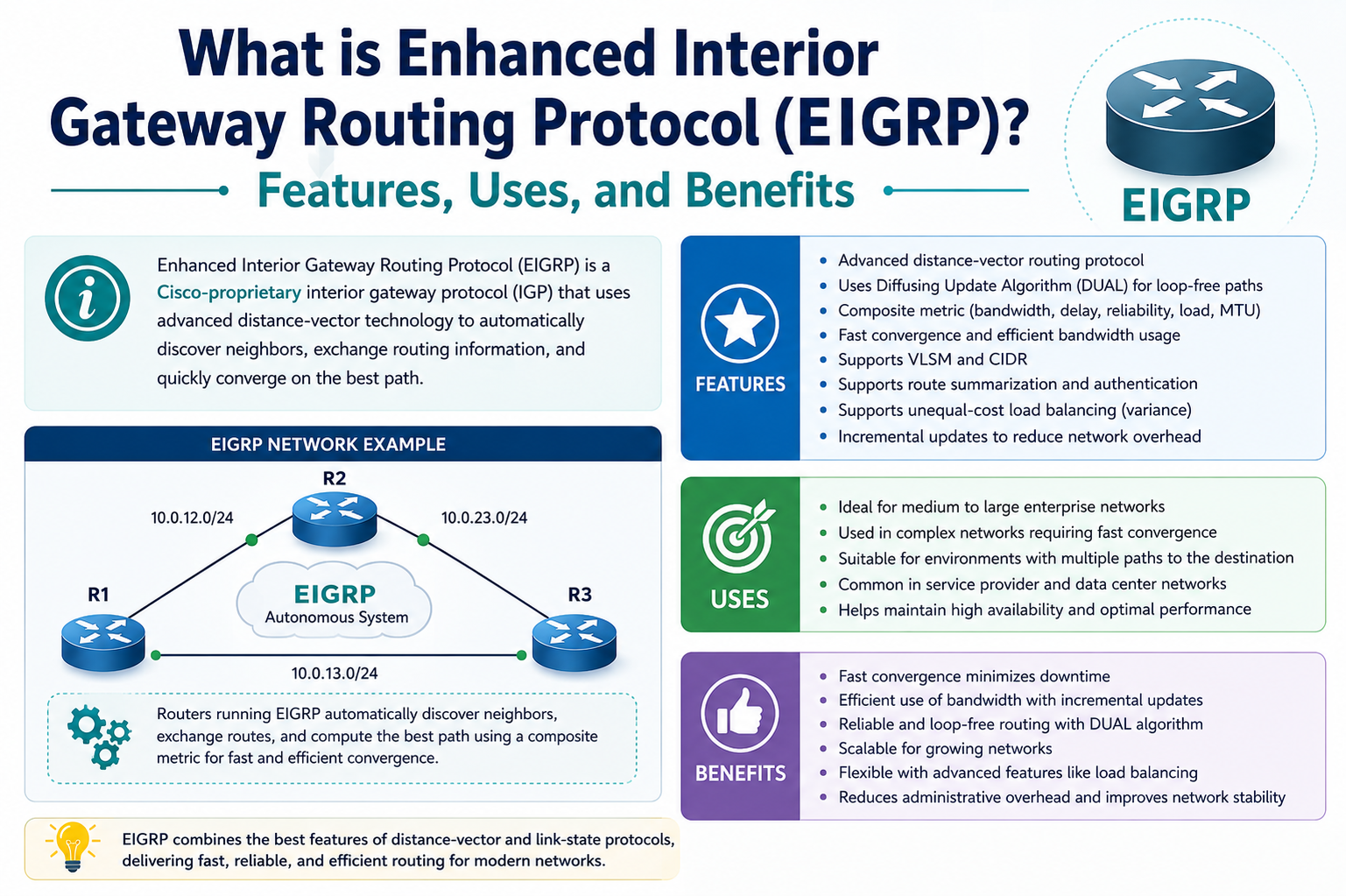
EIGRP is best understood as a response to a very practical problem in networking: how to allow routers inside large organizations to share routing information quickly, accurately, and with minimal waste of network resources. As networks expanded beyond small office setups into complex enterprise systems, older routing approaches began to struggle with slow updates, routing loops, and inefficient bandwidth usage. EIGRP emerged as a solution designed to overcome these limitations while keeping configuration and operation manageable for network engineers.
Originally developed in the early era of modern enterprise networking, EIGRP was created to improve upon earlier distance-vector protocols that relied on periodic full-table updates. Instead of repeatedly sending large routing tables across the network, EIGRP introduced a more intelligent approach where only relevant changes are shared. This shift alone dramatically reduced unnecessary network traffic and improved overall responsiveness.
At its core, EIGRP operates as an advanced distance-vector protocol, sometimes described as a hybrid approach because it borrows ideas from both distance-vector and link-state behaviors. Traditional distance-vector protocols rely heavily on simple hop counts and periodic updates, while link-state protocols build a complete map of the network. EIGRP takes a middle path: it does not build a full network map like link-state protocols, but it is significantly more intelligent than basic distance-vector systems in how it calculates and distributes routing information.
One of the most important ideas in EIGRP is that routers do not blindly trust periodic updates. Instead, they build relationships with neighboring routers and exchange structured, incremental information. This neighbor-based approach allows routers to maintain a more stable and accurate view of the network without overwhelming it with constant updates.
When EIGRP-enabled routers are connected in a network, the first step is discovery. Each router begins sending small “hello” messages to identify other routers running the same protocol. Once a mutual acknowledgment is established, a neighbor relationship forms. This relationship is not just a simple acknowledgment of existence; it becomes a trusted communication channel where routing information can be exchanged reliably and efficiently.
These neighbor relationships form the backbone of EIGRP’s operation. Without neighbors, there is no routing intelligence sharing. With neighbors, routers can begin exchanging information about available paths, network changes, and best routes to reach different destinations. The stability of these relationships directly affects the stability of the entire routing system.
Another foundational concept in EIGRP is its use of structured decision-making for route selection. Instead of relying on a single metric such as hop count, EIGRP evaluates multiple factors when determining the best path. These factors typically include bandwidth and delay, although additional metrics can be incorporated depending on configuration. This multi-metric approach allows EIGRP to choose routes that are not just short, but also efficient in terms of performance.
A key strength of EIGRP lies in how quickly it reacts to network changes. In traditional protocols, a broken link might take time to propagate through the network, causing temporary inconsistencies or delays. EIGRP reduces this delay significantly through a mechanism designed to ensure rapid recalculation of routes whenever a change occurs.
This behavior is powered by a core algorithm known as Diffusing Update Algorithm (DUAL). DUAL is responsible for maintaining loop-free routing decisions while also ensuring that backup routes are available when needed. Instead of recomputing routes from scratch every time a failure occurs, EIGRP can often switch to a pre-calculated alternative path almost instantly. This ability is one of the main reasons EIGRP is known for fast convergence.
Convergence refers to the process by which all routers in a network agree on the best available paths after a change occurs. In many traditional routing protocols, convergence can take several seconds or even minutes depending on network size. EIGRP aims to reduce this time as much as possible, ensuring that routing tables are updated quickly and consistently across the entire network.
Another important feature of EIGRP is its modular design. It uses protocol-dependent components that allow it to handle multiple network layer protocols independently. This means that routing information for one protocol can be processed without interfering with another. Although modern networks primarily use IP, this modular design reflects EIGRP’s flexibility and scalability principles.
EIGRP also introduces the concept of reliable communication between routers without relying on the underlying transport layer in a traditional sense. Instead, it uses its own reliability mechanism to ensure that important routing updates are delivered accurately. This is essential because routing information must be consistent across all routers to avoid instability or loops.
Within this system, not all updates are sent in the same way. Some information is shared proactively, while other updates are only sent when a change occurs. This event-driven nature helps reduce unnecessary traffic and ensures that the network is not constantly overloaded with repetitive data.
As routers build their understanding of the network, they store information in specialized internal structures. One structure holds all known routes, including primary and backup paths. Another structure filters this information to determine the most efficient route for actual data forwarding. This separation ensures that decision-making is both organized and efficient.
A particularly important aspect of EIGRP is its emphasis on backup paths. Unlike simpler protocols that only store a single best route, EIGRP maintains additional feasible alternatives. These backup routes are critical for ensuring continuity in the event of a failure. If the primary route becomes unavailable, the system can immediately switch to a backup without needing to recompute the entire network.
This design makes EIGRP highly resilient in environments where uptime is critical. Large organizations with multiple interconnected sites benefit significantly from this resilience, as it reduces the risk of downtime caused by network changes or failures.
Another important element in understanding EIGRP is its efficiency in bandwidth usage. Because it does not rely on full periodic updates, it consumes significantly less network capacity compared to older protocols. This makes it especially suitable for large-scale deployments where bandwidth is a valuable resource.
The combination of neighbor-based communication, intelligent route selection, rapid convergence, and efficient bandwidth usage forms the foundation of EIGRP’s behavior. These characteristics allow it to operate effectively in both small and large networks while maintaining stability and performance.
As networks continue to grow in complexity, the principles behind EIGRP remain relevant. Its design reflects a careful balance between simplicity and intelligence, ensuring that routing decisions are both fast and reliable without overwhelming network resources.
Inside EIGRP Operations — Packet Types, Tables, and Routing Intelligence Flow
In any routing system, the real intelligence lies not just in how routers connect, but in how they communicate. EIGRP relies on a structured communication model built around specific packet types, internal databases, and a carefully designed update process that ensures consistency across the entire network.
At the heart of this system is the idea that routers do not continuously broadcast full routing tables. Instead, they exchange small, purpose-driven packets that carry only the information needed at a given moment. This makes communication more efficient and reduces unnecessary load on the network.
EIGRP uses several distinct packet types, each serving a specialized function. The first and most fundamental are hello packets. These packets are responsible for discovering and maintaining neighbor relationships. Routers periodically send these small messages to announce their presence. If another router receives a hello packet and meets the required compatibility conditions, a neighbor relationship is established. This relationship becomes the foundation for all further communication.
Once neighbors are established, routers begin exchanging update packets. These packets contain routing information such as newly discovered paths or changes to existing routes. Unlike older protocols that send entire routing tables regularly, EIGRP sends only what has changed. This selective update mechanism is one of the key reasons for its efficiency.
When a router needs information about a route that it does not currently know or when a path becomes uncertain, it sends query packets. These packets ask neighboring routers whether they have a valid route to a particular destination. This process allows the network to collaboratively determine the best possible path rather than relying on a single router’s knowledge.
Responses to these queries come in the form of reply packets. These packets carry the requested routing information back to the origin router, completing the information exchange cycle. Together, these four packet types form a dynamic communication system that keeps routing information current and consistent.
Behind these packet exchanges, EIGRP maintains several internal data structures that help it manage routing decisions efficiently. The most important of these is the neighbor table, which stores information about directly connected EIGRP routers. This table is continuously updated as hello packets are received, ensuring that the router always knows which neighbors are active.
Another critical structure is the topology table. This table contains all known routes to various destinations, including primary routes and backup options. Unlike a simple routing table, the topology table is more comprehensive, storing not only the best route but also alternative paths that could be used if needed.
From the topology table, the routing table is derived. The routing table is the final decision-making layer that determines which routes are actually used to forward traffic. Only the best available paths are installed here, ensuring that data forwarding is always optimized.
The transition from topology table to routing table is governed by a decision process that ensures loop-free routing. This is where the Diffusing Update Algorithm (DUAL) plays a central role. DUAL evaluates available routes, compares their metrics, and determines which path is the most efficient while also ensuring that backup routes are safe to use if needed.
One of the most powerful features of this system is the concept of feasible successors. These are backup routes that have already been validated as safe alternatives. If the primary route fails, a feasible successor can immediately take over without triggering a network-wide recalculation. This dramatically improves convergence speed and reduces instability during failures.
The packet exchange process is also tightly controlled to prevent unnecessary network flooding. EIGRP uses multicast addressing to efficiently distribute packets to multiple neighbors simultaneously. This ensures that updates reach all relevant routers without requiring individual transmissions to each one.
Another important aspect of EIGRP’s operation is how it manages reliability. Although it operates over a connectionless transport environment, it implements its own reliability mechanism to ensure that critical packets are delivered correctly. If a packet is not acknowledged, it is retransmitted until successful delivery is confirmed. This ensures consistency in routing information even in less stable network conditions.
EIGRP also manages routing information in a way that minimizes computational overhead. Instead of recalculating routes from scratch with every update, it incrementally adjusts its topology based on changes. This incremental approach allows the protocol to scale effectively even in large and complex networks.
The relationship between packet types and internal tables creates a continuous loop of information flow. Hello packets maintain neighbor awareness, update packets share new information, query and reply packets resolve uncertainties, and internal tables store and refine all received data. Together, these components form a self-sustaining system that keeps the network synchronized.
This architecture is designed for both speed and stability. By limiting unnecessary updates and relying on structured communication, EIGRP avoids many of the inefficiencies that plagued earlier routing protocols. At the same time, its reliance on validated backup paths ensures that it remains resilient even in the face of sudden network changes.
Performance, Optimization, Troubleshooting, and Real-World Behavior of EIGRP
Modern enterprise networks require routing systems that not only function correctly but also adapt quickly under pressure. EIGRP is designed with this adaptability in mind, offering a range of optimization techniques, load distribution strategies, and diagnostic behaviors that make it suitable for complex environments.
One of the most important performance features in EIGRP is its ability to balance traffic across multiple routes. When multiple paths to the same destination exist, EIGRP can distribute traffic across them to improve efficiency. In equal-cost scenarios, where multiple routes have identical metrics, traffic is automatically shared across these paths. This reduces congestion on any single link and improves overall throughput.
In more advanced scenarios, EIGRP can also perform unequal-cost load balancing. This means that even if one path is slightly less efficient than another, it can still be used in proportion to its performance. This flexibility allows networks to take advantage of all available resources rather than relying solely on the best single path.
Another important optimization technique is route summarization. In large networks, routing tables can become extremely large and difficult to manage. Summarization reduces this complexity by combining multiple specific routes into a single broader entry. This not only reduces memory usage but also improves stability by limiting the frequency of routing updates.
EIGRP also allows certain routers to be configured in a way that limits the information they receive. These routers, often located at the edge of a network, do not need full routing information. By restricting unnecessary updates, the protocol reduces processing overhead and improves efficiency in smaller segments of the network.
Despite its efficiency, EIGRP environments can still experience issues that require troubleshooting. One common problem involves neighbor relationships failing to form. Since neighbor relationships are essential for communication, any mismatch in configuration can prevent routers from exchanging information. This can occur due to inconsistent settings, mismatched parameters, or network segmentation issues that prevent hello packets from being properly received.
Another issue that can arise is route instability, often referred to as route fluctuation. This occurs when routes repeatedly appear and disappear from the routing table. Such instability can disrupt traffic flow and reduce network reliability. In many cases, this is caused by inconsistent metrics or unstable links that trigger frequent recalculations.
In some situations, routers may have conflicting views of the network. This inconsistency can lead to inefficient routing or even traffic loops. Ensuring that all routers use consistent path calculation parameters is essential for maintaining stability. When inconsistencies occur, they can often be traced back to configuration differences or changes in network topology that were not fully propagated.
EIGRP’s fast convergence mechanisms play a major role in minimizing the impact of such issues. When a failure occurs, the protocol quickly identifies whether a feasible successor is available. If so, it immediately switches to the backup path, avoiding delays caused by recalculation. If no backup exists, the protocol initiates a controlled search process to find a new route while limiting the scope of the query to avoid unnecessary network-wide impact.
This controlled query mechanism is an important optimization feature. Instead of flooding the entire network with requests, EIGRP limits the search area to only relevant routers. This reduces processing overhead and speeds up recovery time.
In real-world environments, these features combine to create a highly resilient routing system. Large organizations with multiple branches and data centers rely on EIGRP’s ability to adapt quickly to changes without disrupting communication. Whether dealing with link failures, traffic congestion, or network expansion, the protocol maintains stable routing behavior.
EIGRP is also well-suited for hybrid network environments where multiple routing protocols coexist. Through controlled redistribution, it can exchange routing information with other systems, allowing different parts of a network to operate using different routing strategies while still maintaining connectivity. This flexibility is particularly useful in large-scale infrastructures where complete standardization is not always possible.
Another real-world advantage is EIGRP’s ability to support redundant paths across geographically distributed networks. By maintaining multiple potential routes, it ensures that communication remains uninterrupted even if a major link fails. This redundancy is a key factor in maintaining high availability in enterprise systems.
Ultimately, the strength of EIGRP lies in its combination of speed, adaptability, and efficient resource usage. It is not just a routing protocol but a dynamic system designed to maintain stability in environments where conditions are constantly changing.
Deep Mechanics, Stability Control, and Large-Scale Network Intelligence
In large enterprise environments, routing is not just about finding a path from one point to another. It is about maintaining stability under constant change, preventing routing loops in complex topologies, and ensuring that recovery from failures happens without disrupting active communication. EIGRP achieves this through a deeper internal logic that goes far beyond simple route selection. Understanding these advanced behaviors requires looking into how decisions are formed, how loop prevention actually works in practice, and how the protocol behaves under stress conditions.
At the center of EIGRP’s advanced intelligence is its decision engine, which continuously evaluates routes using multiple layers of information. Each route is not simply “good” or “bad.” Instead, it is evaluated based on a structured comparison of distance values that reflect both the router’s own calculation and the information reported by its neighbors. This dual-perspective evaluation is what gives EIGRP its stability in dynamic environments.
Every router maintains two important values for each route: the best known distance to a destination and the distance reported by a neighbor. The first value represents the router’s own calculation of how far a destination is. The second represents what a neighboring router claims as its distance to that same destination. The relationship between these two values determines whether a route is considered safe to use as a backup.
A route becomes a primary choice when it has the lowest calculated distance. However, EIGRP does not stop at selecting a single best route. It also evaluates whether alternative routes can safely be used if the primary path fails. These alternatives are only accepted if they satisfy a strict condition ensuring that they will not create loops if activated. This condition is what allows EIGRP to maintain pre-validated backup routes.
When a router identifies a backup path that meets the safety condition, it is stored as a standby option. This allows the system to respond instantly to failures without recomputation. The existence of these backup routes is one of the key reasons EIGRP is known for fast recovery behavior in unstable networks.
The process that governs all of this decision-making is the Diffusing Update Algorithm. Rather than treating routing as a static calculation, this algorithm treats it as a continuous negotiation between routers. When a change occurs, the system does not immediately flood the network with recalculations. Instead, it isolates the affected area and determines whether local adjustments are sufficient before expanding the scope of the update.
This controlled propagation of changes is essential in preventing unnecessary disruption. Without it, a single network failure could trigger widespread recalculations across the entire topology. Instead, EIGRP ensures that only routers affected by a change participate in the recalculation process.
A key behavioral state within this system is the distinction between stable and active computation states. Under normal conditions, routes remain in a stable state where no recalculation is required. However, when a route becomes uncertain and no valid backup exists, the system enters an active exploration phase. During this phase, routers actively query neighbors to discover alternative paths.
This active state is carefully controlled because excessive querying can overwhelm a network. To prevent this, EIGRP restricts the spread of queries and ensures that only relevant routers are involved in the search process. If a router cannot find a valid path within a reasonable time, it may trigger a condition where the route is temporarily considered unstable until resolution occurs.
One of the most important aspects of this process is how EIGRP prevents routing loops during active exploration. Because multiple routers may simultaneously search for alternative paths, there is a risk that inconsistent information could lead to circular routing decisions. To prevent this, EIGRP enforces strict conditions on which routes can be accepted as valid alternatives. These conditions ensure that a router never chooses a path that could indirectly lead back to itself through a loop.
Another layer of intelligence lies in how EIGRP evaluates route cost. Unlike simpler protocols that rely on a single metric, EIGRP uses a composite approach. This approach considers multiple factors that reflect real network performance. The most important of these are bandwidth and delay, which together provide a balanced view of both capacity and responsiveness.
Bandwidth represents the capacity of a link, while delay reflects the time it takes for data to traverse that link. By combining these values, EIGRP can evaluate not just how fast a link is in theory, but how it behaves in practice. This leads to more realistic routing decisions that better reflect actual network conditions.
The calculation of route cost is controlled by a set of configurable weight values that determine how much influence each metric has. These weights allow network designers to adjust how routing decisions are made, although in most environments they remain at default values to ensure consistency. If these values are misconfigured, routing behavior can become unpredictable, leading to suboptimal path selection.
The reason bandwidth and delay are prioritized is because they are relatively stable compared to other metrics such as load or reliability, which can fluctuate rapidly. By focusing on stable metrics, EIGRP avoids unnecessary route changes caused by temporary network fluctuations.
Beyond metric calculation, EIGRP also includes mechanisms to ensure that routing updates do not overwhelm network resources. One such mechanism is the use of controlled update propagation. Instead of broadcasting updates to all routers, EIGRP only sends updates to those that are directly affected by a change. This reduces unnecessary traffic and ensures that routing updates remain targeted and efficient.
Another important aspect of stability is how EIGRP handles timing. Each neighbor relationship is maintained through periodic signaling that confirms continued connectivity. If a router stops receiving these signals, it assumes that the neighbor is no longer reachable and begins recalculating routes accordingly. This mechanism ensures that outdated routing information does not persist in the network.
However, timing must be carefully balanced. If signals are sent too frequently, they can consume unnecessary bandwidth. If they are sent too infrequently, failure detection becomes slow. EIGRP uses carefully tuned intervals to maintain this balance, ensuring both responsiveness and efficiency.
In large-scale deployments, scalability becomes a critical concern. Networks with hundreds or thousands of routers cannot afford to process full routing updates for every small change. To address this, EIGRP supports hierarchical design strategies where routing information is structured in layers. At the edge of the network, routers may only need a simplified view of the topology, while core routers maintain more detailed information.
This hierarchical approach is reinforced through the use of routing summarization. By grouping multiple detailed routes into a single summarized entry, routers reduce the size of their routing tables. This not only improves performance but also reduces the complexity of decision-making processes.
Summarization also plays a role in limiting the spread of routing changes. When routes are summarized, changes within a summarized range do not need to be individually advertised beyond certain boundaries. This containment of routing information helps stabilize large networks by preventing unnecessary propagation of local changes.
Another scalability feature is the concept of limiting routing responsibility for certain routers. Some routers are configured to operate in a reduced-information mode where they do not receive full routing details. These routers still participate in the network but rely on simplified routing knowledge. This reduces memory usage and processing requirements, allowing smaller devices to function efficiently within large infrastructures.
Security and integrity are also important in advanced EIGRP deployments. Because routing information directly affects traffic flow, it must be protected from unauthorized changes. EIGRP supports authentication mechanisms that ensure routing updates are only accepted from trusted neighbors. This prevents malicious or misconfigured devices from injecting false routing information into the network.
Authentication works by verifying that routing messages include a valid verification key. If the key does not match expected values, the message is ignored. This ensures that only authorized devices can influence routing decisions, adding a layer of protection to the network’s core intelligence system.
Despite its advanced stability mechanisms, EIGRP environments can still experience complex issues that require deep analysis. One of the most challenging situations occurs when a route becomes stuck in an active state. This happens when a router is unable to find a valid backup path and continues querying neighbors without receiving a definitive response. In such cases, the route remains unresolved, causing temporary instability.
This condition often indicates deeper network issues such as missing routes, misconfigured summarization, or inconsistent topology information. Resolving it requires careful examination of routing tables and neighbor relationships to identify where the communication breakdown is occurring.
Another subtle issue arises when routers disagree about the best path due to metric inconsistencies. If different routers calculate route costs differently, they may select different primary paths, leading to inefficient routing behavior. Ensuring consistent metric interpretation across all routers is essential for maintaining predictable performance.
The topology table plays a key role in diagnosing such issues. By examining all known routes, including backup paths, network engineers can identify whether alternative routes exist and why they are not being selected. This deeper visibility into routing decisions is one of the reasons EIGRP is considered both powerful and complex.
In environments where multiple routing protocols coexist, EIGRP must also interact with external systems. This is achieved through controlled redistribution, where routing information is exchanged between different protocols. However, this process introduces complexity because different protocols may interpret metrics differently. Without careful design, redistribution can introduce routing loops or inconsistencies.
To manage this, EIGRP assigns administrative preference values to routes learned from external sources. These values help determine which routes should be preferred when multiple sources provide information about the same destination. By controlling route preference, the system maintains consistency even when multiple routing protocols are involved.
In highly dynamic environments, the ability of EIGRP to adapt while maintaining stability is what makes it particularly valuable. It balances rapid response with careful validation, ensuring that changes are absorbed without disrupting the broader network structure.
As networks continue to grow in size and complexity, the deeper mechanisms of EIGRP become increasingly important. Its combination of intelligent decision-making, controlled update propagation, and strict loop prevention allows it to function reliably even under demanding conditions where simpler protocols would struggle to maintain stability.
Scalable Architectures, Advanced Deployment Patterns, and Operational Strategy
In large enterprise environments, routing is not simply a background function—it becomes a foundational design decision that influences performance, resilience, and the ability of a network to evolve over time. EIGRP plays a significant role in these environments because it is capable of adapting to both small, simple topologies and highly complex, multi-site infrastructures without requiring fundamentally different operational models. However, achieving this level of stability and scalability depends heavily on how the protocol is designed, deployed, and managed across the network.
At the enterprise level, routing design is not about isolated routers making independent decisions. It is about creating a coordinated structure where multiple routing domains work together while still maintaining clarity and control. EIGRP supports this through its ability to scale hierarchically, meaning that networks can be divided into logical segments while still sharing routing intelligence where needed.
One of the most important design considerations in large-scale EIGRP deployments is the separation of core, distribution, and edge layers. The core layer is responsible for high-speed transport of traffic across the network backbone. In this layer, routing decisions must be extremely stable and fast, with minimal recalculation under normal conditions. EIGRP contributes to this stability by maintaining consistent routing information and ensuring that changes in one part of the network do not unnecessarily propagate into the core.
At the distribution layer, routing becomes more dynamic. This layer often connects multiple subnets or regional networks and is responsible for aggregating routing information. Here, summarization becomes a critical tool. By consolidating multiple detailed routes into broader summarized entries, EIGRP reduces the size of routing tables and limits the impact of topology changes. This ensures that instability in one segment does not cascade across the entire network.
At the edge layer, where end devices and branch networks connect, routing is often simplified. Edge routers typically do not require full visibility into the entire network. Instead, they rely on summarized routes and a limited set of routing information that allows them to forward traffic efficiently without consuming excessive resources. This is where EIGRP’s ability to operate in a reduced-information mode becomes particularly valuable, as it allows smaller devices to participate in a large routing system without being overwhelmed.
A key concept in enterprise design is routing domain control. In EIGRP, routing domains are defined using autonomous system boundaries. All routers within the same routing domain share routing information, while communication between different domains must be explicitly configured. This separation allows network designers to isolate different parts of an infrastructure, reducing the risk of unintended routing behavior spreading across organizational boundaries.
When multiple routing domains exist, controlled exchange of routing information becomes necessary. This process, known as redistribution, allows routes from one routing system to be shared with another. However, redistribution must be handled carefully, because differences in routing metrics and decision logic can create inconsistencies. In well-designed environments, redistribution is tightly controlled and often filtered to ensure that only relevant routes are exchanged.
Another important aspect of enterprise EIGRP design is redundancy. Modern networks are expected to remain operational even when individual links or devices fail. EIGRP supports this requirement through its ability to maintain multiple feasible paths and quickly switch between them when necessary. However, redundancy is not just about having multiple paths—it is about designing those paths in a way that avoids instability and routing loops.
In practice, redundancy is often implemented using multiple connections between distribution and core layers, as well as redundant links between branch sites and headquarters. EIGRP evaluates these paths continuously and selects the most efficient combination based on its metric calculations. When properly designed, this ensures that traffic is always routed through the best available path while maintaining immediate fallback options.
Another key consideration is convergence behavior in large topologies. While EIGRP is known for fast convergence, the actual convergence time in a large network depends heavily on design structure. In poorly designed networks with excessive interconnections, route recalculation can become complex and time-consuming. In contrast, hierarchical designs with clear boundaries allow EIGRP to converge more efficiently by limiting the scope of updates.
The concept of query containment becomes especially important in this context. When a route becomes unavailable and no backup path exists, EIGRP begins a query process to find an alternative route. In large networks, uncontrolled query propagation can lead to excessive processing overhead. To prevent this, network designers implement structures that limit how far queries can spread. This ensures that only relevant parts of the network participate in the search for new routes.
One common design strategy involves creating clear boundary points where query propagation is naturally stopped. These boundaries are often aligned with summarization points, where multiple routes are already consolidated. Because summarized routes do not require detailed knowledge of internal changes, they naturally act as barriers that prevent unnecessary query expansion.
Another important design consideration is stability under change. Large networks are rarely static; they evolve as new sites are added, traffic patterns change, and infrastructure is upgraded. EIGRP must be able to accommodate these changes without destabilizing existing routing behavior. This is achieved through incremental updates, where only affected parts of the network are recalculated rather than triggering full-scale reconvergence.
In environments where high availability is critical, such as financial systems or large-scale communication infrastructures, even small disruptions can have significant consequences. EIGRP addresses this by prioritizing fast failover mechanisms. When a primary route becomes unavailable, pre-calculated feasible successors allow traffic to be redirected immediately. This minimizes downtime and ensures continuity of service.
Another important aspect of enterprise deployment is bandwidth optimization. Large networks often include links with varying capacities, ranging from high-speed backbone connections to lower-speed branch connections. EIGRP takes these differences into account when calculating route metrics, ensuring that traffic is directed in a way that avoids overloading weaker links.
In some cases, traffic engineering techniques are used to influence how EIGRP selects routes. By adjusting metric components such as bandwidth and delay, network designers can guide traffic along preferred paths. However, this must be done carefully, as inconsistent configuration can lead to suboptimal routing or unintended load distribution.
Monitoring and visibility are also essential components of EIGRP operations in enterprise environments. Because routing decisions are dynamic, it is important to continuously observe how routes are being selected and how the network responds to changes. Internal structures such as topology provide deep insight into both active and backup paths, allowing engineers to understand not just what route is being used, but why it was chosen.
This visibility is particularly useful when diagnosing performance issues. For example, if traffic is not following an expected path, analysis of routing decisions can reveal whether an alternative route was preferred due to metric differences or whether a configuration inconsistency influenced the decision. This level of transparency is one of the strengths of EIGRP’s design.
Security considerations also play a major role in enterprise deployments. Because routing information directly influences traffic flow, it becomes a potential target for misconfiguration or malicious interference. EIGRP addresses this through authentication mechanisms that ensure only authorized routers can participate in routing exchanges. This prevents unauthorized devices from injecting incorrect routing information into the network.
In environments where multiple administrative domains exist, this becomes even more important. Authentication ensures that routing trust is maintained across organizational boundaries, reducing the risk of accidental or intentional disruption.
As networks grow more complex, integration with other routing systems becomes inevitable. Many enterprises operate environments where multiple routing protocols coexist due to legacy systems, acquisitions, or architectural requirements. EIGRP supports this through controlled interaction mechanisms that allow routing information to be exchanged with other protocols while maintaining internal consistency.
However, this integration introduces additional design challenges. Different routing protocols often use different metrics and decision logic, meaning that direct comparison is not always possible. To address this, route translation and preference mechanisms are used to ensure that imported routes are correctly evaluated within the EIGRP environment.
Another advanced design consideration involves handling large-scale branch networks. In such environments, hundreds or even thousands of remote sites may connect back to a central infrastructure. EIGRP supports this scale by allowing branch routers to operate in simplified modes where they receive only essential routing information. This reduces overhead at the edge while maintaining full connectivity to the core network.
In highly distributed environments, partial connectivity failures are also common. EIGRP’s ability to quickly detect and adapt to such failures ensures that traffic is rerouted efficiently without requiring manual intervention. This is particularly important in environments where physical access to network devices is limited.
Performance tuning is another critical aspect of enterprise EIGRP design. While the protocol performs efficiently by default, large-scale deployments may require fine-tuning to optimize convergence behavior, reduce unnecessary traffic, or improve load distribution. This tuning must be done carefully, as excessive modification can introduce instability.
One area of tuning involves adjusting how frequently routing information is exchanged. While frequent updates can improve responsiveness, they can also increase overhead. Conversely, less frequent updates reduce overhead but may delay convergence. Finding the right balance depends on network size, topology, and performance requirements.
Conclusion
EIGRP (Enhanced Interior Gateway Routing Protocol) remains one of the most intelligent and efficient routing protocols designed for enterprise networking environments. Its ability to combine rapid convergence, reliable route calculation, scalable architecture, and efficient bandwidth usage has made it a trusted solution for complex network infrastructures. Unlike older routing protocols that struggle with slow updates and limited flexibility, EIGRP provides a more adaptive and responsive approach to managing communication between routers.
One of the greatest strengths of EIGRP is its balance between performance and simplicity. It offers advanced capabilities such as feasible successors, unequal-cost load balancing, route summarization, and fast failover mechanisms while still remaining relatively manageable for network administrators. These features help organizations maintain stable connectivity even when network conditions change unexpectedly.
EIGRP also demonstrates how modern routing protocols are designed not just for connectivity, but for resilience, scalability, and operational efficiency. From branch office deployments to large multi-site enterprise networks, it provides the flexibility needed to support evolving infrastructures and increasing traffic demands.
Understanding how EIGRP functions—from neighbor relationships and packet exchanges to topology calculations and optimization techniques—gives networking professionals valuable insight into how modern enterprise routing operates. Its continued relevance highlights the importance of intelligent routing design in maintaining reliable and high-performing networks.