In modern computing environments, communication between devices is the backbone of nearly every digital process. Whether it is a small office system or a large-scale infrastructure supporting critical operations, the way devices are interconnected determines how efficiently and reliably data moves. This structural arrangement is known as network topology, and it forms the basis for understanding how a dual ring topology works.
Network topology refers to the arrangement of devices and communication paths within a network. It describes both the physical layout, meaning how devices are actually connected through cables or wireless links, and the logical layout, which describes how data flows through the system regardless of physical connections. These two perspectives often overlap, but they are not always identical. A network may be physically arranged one way while operating logically in a different pattern, depending on protocols and configuration.
Different topologies have evolved to meet different needs. Some are designed for simplicity, others for scalability, and some for resilience under failure conditions. Among these, ring-based structures are particularly interesting because they enforce a structured and predictable flow of data. Unlike more open or centralized systems, a ring topology connects each device to exactly two others, forming a closed loop. This loop ensures that data travels in a consistent path from one node to the next.
In a basic ring setup, data typically moves in one direction around the loop. Each device acts as both a receiver and a transmitter, passing information along until it reaches its destination. This approach reduces complexity in routing decisions because there are no multiple paths to choose from. However, it also introduces a critical limitation: if a single device or connection in the loop fails, communication across the entire network can be disrupted.
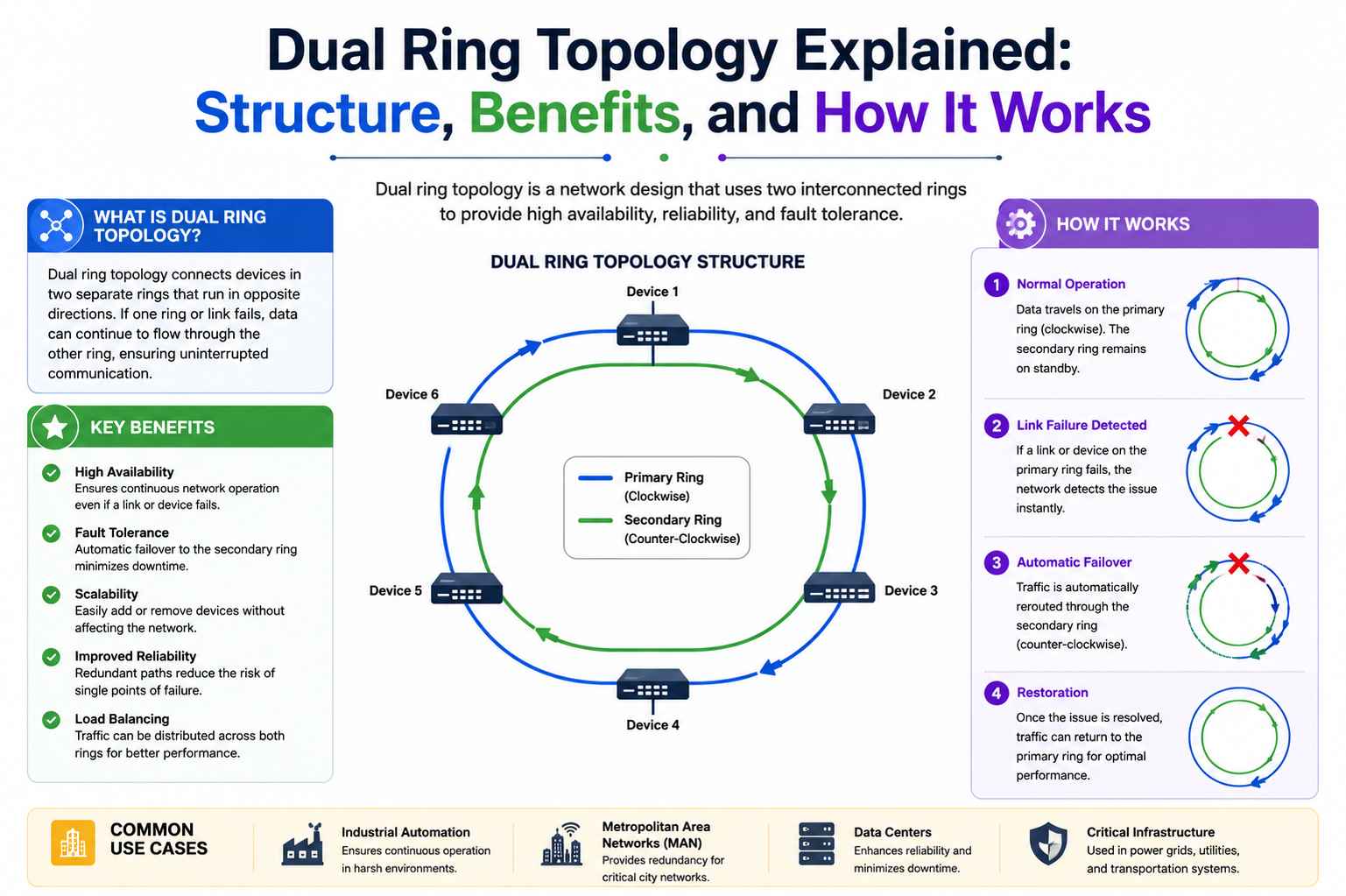
To address this limitation, a more advanced variation was developed that introduces redundancy into the ring structure. Instead of relying on a single loop, this design uses two interconnected loops that operate in opposite directions. This structure is known as a dual ring topology. It retains the organized flow of a ring network but adds an additional layer of reliability by ensuring that data always has an alternative route if one path becomes unavailable.
At a conceptual level, a dual ring topology can be imagined as two circular pathways laid over one another. Devices are connected in such a way that they participate in both loops simultaneously. One loop serves as the primary pathway for data transmission, while the other remains available as a backup route. Under normal conditions, data flows through one direction on the primary loop, following a predictable sequence of device-to-device communication. The secondary loop remains idle or lightly used depending on system configuration.
The reason this structure is significant lies in its approach to fault tolerance. In network design, fault tolerance refers to the ability of a system to continue operating even when one or more components fail. In a single ring configuration, a break in the loop disrupts the entire communication flow. In a dual ring system, however, the presence of a second loop allows the system to re-route data in the opposite direction, bypassing the point of failure. This ability to recover automatically from disruption is one of the key reasons this topology is used in environments where consistent uptime is important.
Another important aspect of understanding dual ring structures is recognizing how data control is maintained. Many ring-based networks rely on a controlled transmission method often described in terms of orderly access. Instead of allowing all devices to transmit data at once, the network passes control permission along the ring in a structured sequence. This prevents collisions, where multiple devices attempt to send data simultaneously, which can lead to corruption or loss of information. By controlling when each device can transmit, the system maintains stability even under heavy communication load.
The introduction of a second ring does not change this fundamental principle but enhances it. The system still maintains controlled access, but now has flexibility in direction. If one direction becomes inefficient or blocked due to a failure, communication can continue in the opposite direction without requiring a complete system reset. This adaptability is what distinguishes dual ring designs from simpler loop-based networks.
From a structural perspective, devices in a dual ring configuration are not simply connected in a circular chain. Each device is connected in a way that allows participation in both loops. This means that every node has multiple communication interfaces, enabling it to send and receive data in more than one direction. These connections are typically managed through networking hardware that ensures signals are correctly forwarded along both paths without interference.
The design also introduces a sense of balance in network traffic distribution. While one loop may carry the primary load, the secondary loop can either remain on standby or share traffic under certain configurations. This flexibility allows network administrators to optimize performance based on demand and reliability requirements. In environments where uptime is critical, both loops may even be used simultaneously under a controlled strategy to distribute traffic more evenly.
Despite its structured advantages, the concept of dual ring topology is not only about redundancy. It also reflects an early approach to solving scalability and reliability challenges in network engineering. As systems grew larger and more complex, engineers needed ways to maintain predictable communication while reducing the risk of single points of failure. The dual ring design emerged as a practical solution that balanced simplicity with resilience.
However, understanding its foundation also requires acknowledging its inherent limitations. Because every device is part of a closed loop structure, adding or removing nodes requires careful adjustment of the entire configuration. Unlike more flexible architectures where devices can be added independently, ring-based systems demand precise alignment of connections. This makes planning and maintenance more structured but also more complex as the system grows.
Even with these limitations, the dual ring concept remains an important step in the evolution of network design. It represents a shift from single-path communication systems toward redundant architectures that prioritize continuity. By duplicating the communication loop and reversing data flow direction in case of disruption, it introduces a simple yet effective method of maintaining connectivity under failure conditions.
As networks continue to evolve, the principles behind dual ring structures still influence modern designs. Concepts such as redundancy, alternative routing, and structured data flow remain central to how reliable systems are built today. Understanding this foundational structure provides insight into why modern networks prioritize multiple pathways and failover mechanisms, even when they no longer rely on strict ring-based layouts.
Internal Mechanisms, Data Movement, and Operational Behavior in Dual Ring Structures
The operation of a dual ring topology is based on a carefully coordinated flow of data between interconnected devices. While its physical structure may appear simple at first glance, the internal behavior of data transmission involves several coordinated mechanisms that ensure stability, order, and continuity across the entire system.
At the core of this system is the concept of directional data movement. In a dual ring setup, two circular paths exist simultaneously, each supporting communication in opposite directions. One path typically carries data in a clockwise direction, while the other carries it counterclockwise. This opposing movement creates a natural redundancy, allowing information to reach its destination even if one path becomes blocked or interrupted.
Each device in the network plays an active role in this process. Rather than acting as passive endpoints, devices function as forwarding points that receive incoming data, interpret whether it is intended for them, and then pass it along if necessary. This continuous relay process ensures that information progresses steadily through the system without requiring direct long-distance communication between source and destination nodes.
A key mechanism that supports this structured flow is controlled access to transmission rights. In many implementations, a circulating permission signal is used to determine which device is allowed to send data at any given moment. This signal moves through the network in sequence, granting temporary transmission rights to each device it reaches. Once a device completes its communication, it passes the permission signal along to the next node in the sequence.
This method prevents multiple devices from transmitting simultaneously on the same path, which would otherwise lead to data collisions and loss of integrity. By enforcing orderly access, the network maintains stability even when multiple devices are actively communicating.
In a dual ring configuration, this permission system is duplicated across both loops. Under normal conditions, only one loop actively handles transmission rights while the other remains in a standby state or operates under reduced load. However, both loops are continuously monitored to ensure they are ready to take over if needed. This constant readiness is essential for maintaining uninterrupted communication.
When a disruption occurs in one part of the network, the system responds by detecting the interruption and redirecting data flow through the alternative loop. This process is not manual but automated, relying on built-in detection mechanisms that identify breaks in communication paths. Once a failure is detected, the direction of data flow is reversed, allowing communication to continue without requiring manual intervention or system shutdown.
This automatic rerouting is one of the most important operational characteristics of dual ring systems. It ensures that even if a cable is damaged, a device fails, or a connection is interrupted, the overall network remains functional. The ability to dynamically adjust direction gives the system a level of resilience that single-loop configurations cannot provide.
Another important aspect of internal operation is how devices synchronize their communication roles. Because each device participates in both loops, it must be capable of handling incoming and outgoing data in multiple directions. This requires coordination at the interface level, where devices manage data buffering, forwarding decisions, and timing control to ensure smooth transmission.
Timing plays a crucial role in maintaining order within the network. Since data travels in a continuous loop, even small delays can accumulate and affect overall performance. To prevent congestion, devices regulate how quickly they process and forward data. This ensures that information moves through the system at a consistent pace, avoiding bottlenecks that could disrupt communication flow.
The dual loop structure also introduces a form of load distribution, even when not explicitly configured for balancing. Because there are two possible directions for data to travel, the system can distribute traffic in a way that reduces strain on any single path. In more advanced configurations, both loops may be actively used to share communication load, improving efficiency and reducing latency across the network.
When examining failure behavior in detail, the system’s response is both immediate and structured. If a connection between two devices is interrupted, the affected segment is isolated while the rest of the network continues operating. The system then redirects data around the failure point using the opposite direction loop. This ensures that only a small portion of the network is impacted rather than the entire system.
Recovery from failure is equally important. Once the disrupted segment is repaired, the network does not require a complete restart. Instead, it reintegrates the restored connection into the existing structure and gradually returns to its normal operating state. This ability to recover without full interruption is essential in environments where continuous operation is required.
The internal behavior of a dual ring system also depends heavily on how devices manage routing decisions. Even though the structure is physically circular, logical decision-making ensures that data is only forwarded when necessary. Devices evaluate whether incoming data is intended for them or should be passed along, reducing unnecessary processing and maintaining efficiency.
In addition to routing and transmission control, error detection mechanisms play a vital role in maintaining system integrity. Devices monitor data integrity as it moves through the network, checking for inconsistencies or corruption. If errors are detected, corrective actions such as retransmission or rerouting may be triggered depending on system configuration.
All of these internal mechanisms work together to create a coordinated communication environment. The dual ring structure is not simply about having two loops; it is about how those loops interact dynamically to maintain stability, ensure continuous data flow, and adapt to changing network conditions without interruption.
Performance Characteristics, Practical Challenges, and Comparative Behavior in Dual Ring Systems
The performance of a dual ring topology is shaped by a balance between reliability, structured communication, and inherent design constraints. While the system is built to provide redundancy and fault tolerance, its real-world behavior depends on factors such as network size, traffic volume, and configuration complexity.
One of the most noticeable performance characteristics of a dual ring system is its predictable data flow. Because communication follows a structured path, network behavior remains consistent under normal conditions. This predictability makes it easier to manage communication timing and reduces uncertainty in data delivery patterns. However, this structured flow also introduces limitations when the system scales beyond a certain size.
As more devices are added to the network, the length of the communication loop increases. This means that data must pass through more intermediate nodes before reaching its destination. Each additional node introduces a small delay, and over time these delays accumulate. As a result, larger ring-based systems may experience higher latency compared to more flexible topologies.
Despite this, the presence of two loops provides a significant improvement in reliability compared to single-path designs. If one segment of the network experiences a failure, the system can quickly switch to the alternative loop, ensuring continued communication. This ability to maintain operation under failure conditions is one of the strongest advantages of dual ring design.
However, this resilience comes with increased structural complexity. Every device in the network must be properly integrated into both loops, and each connection must be carefully maintained to ensure proper alignment. This increases the effort required for setup, maintenance, and troubleshooting. Even small changes in the network, such as adding or removing a device, require adjustments across multiple connection points.
Scalability is another important consideration. While dual ring systems work efficiently in smaller or moderately sized environments, they become more difficult to manage as the network grows. The circular nature of the structure means that every new device affects the entire communication path. This interconnected dependency limits flexibility compared to more decentralized architectures.
When compared to more centralized designs, such as those where devices connect through a central hub, dual ring systems distribute communication more evenly across the network. This reduces reliance on a single central point, which improves resilience. However, centralized systems often offer easier expansion and simpler management, highlighting a trade-off between simplicity and fault tolerance.
In comparison with fully interconnected designs where each device connects directly to many others, dual ring systems are more efficient in terms of connection requirements. They require fewer physical links while still maintaining redundancy. However, fully interconnected systems provide faster communication paths and greater flexibility, albeit at significantly higher cost and complexity.
Another important performance factor is fault recovery speed. In dual ring systems, detection and rerouting occur quickly, allowing communication to resume almost immediately after a disruption. However, the efficiency of this process depends on the responsiveness of the devices and the integrity of the secondary loop. If multiple failures occur simultaneously, recovery becomes more complicated and may lead to partial or full communication breakdown.
Traffic management also plays a role in performance behavior. Under normal conditions, communication follows a steady pattern, but during periods of heavy load, congestion can occur as data circulates through multiple nodes. Although the second loop can help distribute traffic in advanced configurations, it is not inherently designed as a full load-balancing system in its simplest form.
Maintenance is another area where performance considerations become important. Because the network relies on continuous connectivity between devices, diagnosing issues requires careful inspection of multiple points in the loop. A single faulty connection can impact communication flow, and identifying the exact location of a problem may require systematic analysis of the entire structure.
Despite these challenges, dual ring systems remain relevant in environments where stability and continuity are more important than flexibility or rapid expansion. Their structured design ensures that communication remains consistent, and their redundancy mechanisms provide a strong safeguard against single-point failures.
In practical use, these systems are often chosen for environments where predictable communication patterns and high availability are essential. The trade-off between complexity and reliability is accepted in exchange for the assurance that data can continue flowing even when part of the network is compromised.
Over time, as networking technology has evolved, many of the principles behind dual ring structures have been integrated into more advanced and flexible systems. Concepts such as redundant pathways, automated failover, and directional data routing continue to influence modern network design, even when the strict circular structure itself is no longer used.
The behavior of dual ring systems, therefore, represents an important stage in the evolution of network engineering, demonstrating how structured redundancy can be used to maintain communication stability under challenging conditions.
Engineering Design, and Modern Relevance of Dual Ring Architectures
The concept of dual ring topology did not emerge in isolation. It developed as part of a broader evolution in networking where engineers were constantly trying to solve one persistent challenge: how to keep communication running even when parts of the system fail. While earlier parts of the discussion focused on how dual ring systems operate internally and how they behave under normal and faulty conditions, understanding their real-world relevance requires looking at how and where these systems have been applied, how engineers design them in practice, and how they have adapted over time alongside modern networking technologies.
In real deployments, dual ring structures are most commonly associated with environments where continuous availability is more important than simplicity or cost efficiency. These environments often cannot tolerate even short interruptions in communication because the systems they support are responsible for critical operations. Over time, this requirement for uninterrupted connectivity has made ring-based redundancy a foundational concept in several industries, even when modern implementations no longer strictly resemble traditional circular layouts.
One of the most significant areas where dual ring principles have been historically applied is in telecommunications infrastructure. Large-scale communication networks, especially those built using fiber optic systems, often rely on ring-based architectures to ensure that data can travel between cities, regions, or data centers without interruption. In such systems, physical fiber cables are arranged in looped configurations, allowing signals to travel in both directions. If one segment of the fiber is damaged due to environmental factors or physical disruption, traffic can immediately be redirected through the opposite direction, maintaining continuity of service.
These types of implementations are not limited to simple local networks. They extend across metropolitan and even national-scale infrastructures, where maintaining uptime is essential for services like internet connectivity, voice communication, and emergency systems. The dual ring principle becomes especially valuable in these environments because physical repair of long-distance infrastructure can take time, and uninterrupted service must still be maintained during outages.
Another important domain where dual ring concepts are widely used is industrial automation and control systems. In environments such as manufacturing plants, energy production facilities, and transportation control centers, network reliability directly impacts operational safety and efficiency. Machines, sensors, and control units must continuously exchange data to maintain synchronized operations. A disruption in communication can lead to production delays, safety risks, or system shutdowns.
In these industrial settings, dual ring architectures are often implemented as part of larger control networks. Devices are connected in looped structures that allow signals to circulate continuously. If a fault occurs in one segment, the system automatically reroutes communication, ensuring that critical control signals still reach their destination. This redundancy is particularly important in systems where automated processes depend on real-time data exchange.
Beyond industrial and telecommunications applications, dual ring principles have also influenced transportation and metropolitan infrastructure networks. In railway signaling systems and traffic control systems, redundant communication paths are essential to ensure that control signals are always delivered reliably. While the physical implementation may not always resemble a perfect ring, the underlying principle of dual-direction redundancy remains consistent.
When designing such systems, engineers must carefully consider physical layout and logical structure. A key challenge in real-world deployment is that physical geography does not always allow for perfect circular arrangements. Instead, networks often take on irregular loop shapes that approximate ring behavior. Despite this irregularity, the logical principle remains the same: two pathways exist for communication, and failure in one path does not eliminate connectivity.
In addition to physical layout, timing and distance play a crucial role in system design. Because data must travel through multiple intermediate nodes, engineers must account for propagation delays. In fiber-based systems, these delays are minimal but still significant when dealing with large distances. In electrical or hybrid systems, delays can become more pronounced depending on signal conversion and processing times at each node. Careful planning ensures that communication remains synchronized across the entire network.
A major aspect of real-world dual ring deployment involves the selection of appropriate switching and routing behavior. In some systems, one ring is designated as the primary active path while the second remains in standby mode. In other systems, both rings may operate simultaneously under controlled conditions, sharing traffic to improve efficiency. This decision depends on the performance requirements of the environment and the level of redundancy required.
In more advanced implementations, automatic switching mechanisms are integrated into the network. These mechanisms continuously monitor the health of connections and detect anomalies such as signal loss or degradation. When an issue is detected, the system triggers a rapid reconfiguration of traffic flow, redirecting communication through the unaffected ring. This process occurs in a matter of milliseconds in well-designed systems, minimizing disruption.
Failure scenarios in real-world environments can be more complex than theoretical models suggest. While a single failure in one segment is easily handled by rerouting, multiple simultaneous failures introduce additional challenges. If two or more non-adjacent segments of both rings are disrupted, the network may become segmented into isolated portions. In such cases, some devices may still communicate within their isolated segment, but full network-wide communication becomes impossible until repairs are made.
Engineers often refer to such situations as segmentation events, where the continuity of the ring structure is broken into smaller operational fragments. Designing systems to minimize the probability and impact of such events is a key part of network planning. This includes strategic placement of nodes, redundancy in physical pathways, and careful monitoring of infrastructure health.
Monitoring and maintenance systems play a critical role in ensuring the reliability of dual ring networks. In large-scale deployments, continuous observation of network status is required to detect early signs of failure. This includes monitoring signal quality, connection stability, and device responsiveness. When anomalies are detected, alerts are generated so that maintenance teams can respond before failures escalate into larger disruptions.
In modern implementations, monitoring is often integrated into centralized management systems that provide real-time visibility into network health. These systems allow engineers to visualize the structure of both rings, identify potential weak points, and track the flow of data across the network. This level of visibility is essential in complex environments where manual inspection would be impractical.
Another important aspect of real-world deployment is the integration of dual ring structures into hybrid network architectures. In many cases, ring-based redundancy is combined with other topologies such as star or mesh configurations. For example, a central backbone network may use a mesh structure for high-speed interconnection between major nodes, while regional segments use ring-based loops for local redundancy.
This hybrid approach allows engineers to balance scalability, performance, and reliability. The ring segments provide fault tolerance within local areas, while the broader network structure ensures efficient long-distance communication. This combination reflects a practical evolution of network design, where no single topology is sufficient on its own.
Security considerations also play a role in dual ring deployments. Because devices are interconnected in a continuous loop, unauthorized access to any single point in the network can potentially allow influence over data flow. Physical security of infrastructure becomes particularly important in environments where cables or network nodes are distributed across large areas. Additionally, logical security measures are required to ensure that data passing through intermediate nodes cannot be intercepted or altered.
In modern environments, encryption and access control mechanisms are typically applied at multiple layers of the network to mitigate these risks. Even if data passes through multiple devices, it remains protected against unauthorized access or modification. This layered approach to security ensures that the structural openness of ring-based communication does not translate into vulnerability.
Over time, as networking technology has advanced, traditional dual ring implementations have gradually been replaced or integrated into more flexible systems. Ethernet-based networks, for example, now dominate most enterprise environments due to their scalability and simplicity. However, the underlying principles of redundancy and alternate routing remain deeply influenced by ring-based designs.
In particular, modern technologies such as software-defined networking and distributed routing protocols have inherited the concept of multiple available paths between nodes. While these systems no longer rely on physical loops, they still embody the idea that communication should not depend on a single path. Instead, multiple routes are maintained dynamically, allowing traffic to be redirected automatically in response to changing network conditions.
This evolution shows that while the physical structure of dual ring topology may not be as common today, its conceptual influence remains significant. Many modern resilience strategies in networking can trace their origins back to ring-based redundancy models. The idea that a system should continue operating even when parts of it fail is now a standard principle across virtually all network designs.
In some specialized environments, dual ring structures continue to be actively used due to their simplicity and predictability. These environments often prioritize stability over flexibility and benefit from the deterministic nature of ring-based communication. Because the path of data is predefined, behavior is easier to analyze and troubleshoot compared to more dynamic routing systems.
Despite its reduced prevalence in general-purpose networking, the dual ring model remains an important reference point in network design education and engineering practice. It provides a clear example of how redundancy can be implemented in a structured and efficient way, and it continues to influence how engineers think about fault tolerance and system resilience.
Looking at its broader role in networking evolution, dual ring architecture represents a transitional stage between simple linear communication models and the highly dynamic, multi-path systems used today. It introduced the idea that redundancy should be built into the structure of a network rather than added as an external layer. This idea has since become fundamental to modern infrastructure design.
Even as technology continues to evolve, the principles demonstrated by dual ring systems remain relevant. Concepts such as automatic failover, directional redundancy, structured data flow, and loop-based resilience continue to shape how networks are built and maintained. While the physical form may change, the underlying logic persists, reflecting the lasting influence of early network design strategies on contemporary systems.
Fault Analysis, Optimization Strategies, and Evolving Network Design Perspectives
When examining dual ring topology at a deeper engineering level, the focus shifts from basic structure and deployment into more nuanced concerns such as performance tuning, fault behavior under complex conditions, optimization strategies, and the way this architecture interacts with modern networking principles. While earlier discussions establish how dual ring systems operate and where they are used, a more advanced perspective reveals how engineers evaluate, refine, and sometimes reimagine these systems in response to real operational demands.
One of the most important aspects of advanced network design in dual ring systems is understanding how performance behaves under stress. Under ideal conditions, data flows in a predictable circular pattern with minimal interruption. However, real-world networks rarely operate under ideal conditions. Traffic bursts, uneven load distribution, and unexpected node behavior can introduce subtle inefficiencies that accumulate over time.
In a dual ring environment, one of the first performance challenges is propagation delay amplification. Because data must traverse multiple intermediate devices, each hop introduces a small delay. While individual delays may be negligible, their cumulative effect becomes more noticeable as network size increases. Engineers often analyze this behavior by modeling the network as a series of sequential processing points, each contributing to total transmission latency.
This delay characteristic becomes especially important in time-sensitive environments. Systems that rely on synchronized operations, such as industrial automation or real-time monitoring, must ensure that delays remain within acceptable thresholds. If timing drift becomes too large, it can lead to inconsistencies between devices, where some nodes act on outdated information while others operate on current data.
To mitigate these timing challenges, engineers may introduce controlled buffering strategies at each node. Buffering allows devices to temporarily store incoming data before forwarding it, smoothing out variations in transmission speed. However, excessive buffering can introduce its own issues, including increased latency and reduced responsiveness. Balancing these trade-offs is a central concern in optimizing dual ring performance.
Another important area of analysis is fault propagation behavior. While dual ring systems are designed to isolate and bypass failures, not all faults behave in a clean or predictable manner. For example, intermittent failures—where a connection alternates between working and failing—can create instability in routing decisions. In such cases, the network may repeatedly switch between primary and secondary paths, leading to oscillation behavior.
This oscillation can reduce efficiency and introduce instability in data flow. To address this, engineers often implement threshold-based decision mechanisms. Instead of reacting immediately to a single detected fault, the system waits for confirmation over a short period before initiating a reroute. This prevents unnecessary switching caused by temporary or false-positive disruptions.
In more complex scenarios, multiple faults may occur in different segments of both rings simultaneously. These multi-fault conditions are significantly more difficult to manage because they can fragment the network into partially connected regions. Each segment may continue operating internally, but communication between segments becomes restricted or impossible. This type of failure is particularly important in large-scale systems, where the probability of multiple concurrent issues increases with size and complexity.
To analyze such situations, engineers often use segmentation modeling techniques. These models simulate how the network behaves when certain links or nodes are removed from the structure. By studying segmentation outcomes, designers can identify critical points whose failure would have the most significant impact on overall connectivity. This helps in reinforcing weak points or introducing additional redundancy where necessary.
Optimization in dual ring systems also extends to traffic distribution strategies. While traditional implementations often rely on a single active ring, more advanced configurations allow both rings to be utilized simultaneously under controlled conditions. This approach, sometimes referred to as dual-active operation, enables load sharing between the two loops.
In dual-active configurations, traffic is distributed based on proximity, congestion levels, or predefined routing rules. Instead of forcing all data to circulate through a single direction, the system dynamically selects the most efficient path for each transmission. This improves overall throughput and reduces the likelihood of congestion buildup in any one segment of the network.
However, implementing dual-active behavior introduces additional complexity. Because data may travel through different paths, maintaining consistency becomes more challenging. Engineers must ensure that data ordering remains correct, especially in systems where sequence integrity is important. This requires careful coordination between devices to prevent situations where out-of-order delivery leads to processing errors.
Another advanced consideration is synchronization across the network. In dual ring systems, each device must maintain awareness of its position within the loop and its relationship to neighboring nodes. Synchronization protocols help ensure that devices operate in harmony, particularly when transitioning between primary and secondary paths.
Clock synchronization becomes especially important in environments where timing accuracy is critical. Even small discrepancies in device timing can lead to inconsistencies in data interpretation. To address this, systems may implement periodic synchronization signals that align device clocks and maintain consistent timing across the network.
From an engineering perspective, troubleshooting dual ring networks requires a structured diagnostic approach. Because the system is inherently circular, a fault in one part of the network can influence communication across the entire loop. This makes fault isolation both essential and challenging.
One common troubleshooting method involves logical segmentation testing. Engineers temporarily divide the network into smaller sections to identify where communication breaks down. By isolating segments, they can determine whether a fault is localized to a specific device, connection, or broader structural issue.
Another diagnostic technique involves directional testing. Because data flows in two directions across dual rings, engineers can compare behavior in both paths to identify inconsistencies. If one direction functions normally while the other exhibits problems, the fault can often be narrowed down to a specific segment or device within the affected loop.
Error pattern analysis also plays a key role in troubleshooting. By examining the frequency, type, and location of transmission errors, engineers can identify underlying causes such as signal degradation, hardware malfunction, or configuration mismatch. Over time, these patterns help build a detailed understanding of network health and stability.
Beyond troubleshooting, long-term optimization often focuses on reducing structural inefficiencies. One approach involves minimizing the number of hops data must travel between frequently communicating nodes. By strategically placing high-traffic devices closer together within the ring, engineers can reduce average transmission distance and improve overall responsiveness.
Another optimization strategy involves selective redundancy reinforcement. Instead of treating all segments of the network equally, engineers identify critical paths that carry higher traffic or support essential operations. These segments may receive additional protection, such as improved hardware or supplementary backup links, to ensure higher reliability.
As network requirements evolve, dual ring structures are often integrated into broader hybrid architectures. In these hybrid systems, ring-based redundancy is combined with more flexible topologies such as hierarchical or mesh-based structures. This allows organizations to retain the reliability benefits of ring systems while gaining the scalability and flexibility of modern network designs.
In such hybrid environments, dual ring segments often serve as local reliability zones within a larger interconnected framework. Each zone operates with its own redundancy mechanisms, while higher-level routing systems manage communication between zones. This layered approach reflects a shift toward modular network design, where different topological principles are combined to meet specific functional requirements.
From a theoretical perspective, dual ring topology also serves as a useful model for studying distributed systems behavior. Its predictable structure makes it easier to analyze how information propagates through interconnected nodes, how failures affect system stability, and how redundancy influences resilience. These insights extend beyond networking and into broader fields such as systems engineering and distributed computing theory.
One of the key theoretical insights derived from dual ring systems is the relationship between redundancy and complexity. While adding a second loop increases fault tolerance, it also introduces additional coordination requirements. This creates a trade-off between reliability and operational simplicity. Understanding this trade-off is essential for designing systems that are both robust and manageable.
Conclusion
Dual ring topology remains one of the most important concepts in the history of network design because it introduced a practical way to achieve redundancy, reliability, and continuous communication within interconnected systems. By using two circular communication paths that operate in opposite directions, this topology provides a dependable method for maintaining network functionality even when failures occur. Its ability to automatically reroute data during disruptions made it especially valuable in environments where uptime and stability are essential.
Throughout the evolution of networking, dual ring systems demonstrated how structured communication could reduce data collisions, improve fault tolerance, and support predictable network behavior. Although the topology can become more complex and expensive as networks expand, its strengths in resilience and failover protection have made it a preferred choice in critical infrastructure, industrial systems, telecommunications, and other reliability-focused environments.
The design also helped shape many of the networking principles still used today. Concepts such as redundant pathways, automatic recovery, controlled data flow, and alternate routing strategies all reflect ideas that were strengthened through dual ring architecture. Even as modern networks increasingly rely on more scalable and flexible technologies, the core philosophy behind dual ring topology continues to influence how engineers build dependable communication systems.
Understanding dual ring topology is therefore more than learning about a specific network structure. It is also an opportunity to understand how network reliability evolved over time and why redundancy remains a fundamental requirement in modern digital communication.