In modern digital communication, data does not travel across the internet as a single continuous stream. Instead, it is broken into smaller units called packets. Each of these packets carries not only a portion of the actual data but also a set of instructions that guide it through complex and often unpredictable network paths. At the core of this instruction set lies the TCP header, a structured segment that ensures data can move reliably from one device to another without confusion, loss, or corruption.
To understand the TCP header properly, it is important to first understand the environment in which it operates. The internet is built on layered communication models, where each layer has a specific responsibility. Transmission Control Protocol, commonly known as TCP, operates at the transport layer. Its primary responsibility is to provide reliable communication between applications running on different devices. Unlike simpler protocols that send data without confirmation, TCP establishes a structured conversation between sender and receiver before any meaningful data transfer begins. The TCP header is the mechanism that carries all the essential information required for this structured communication.
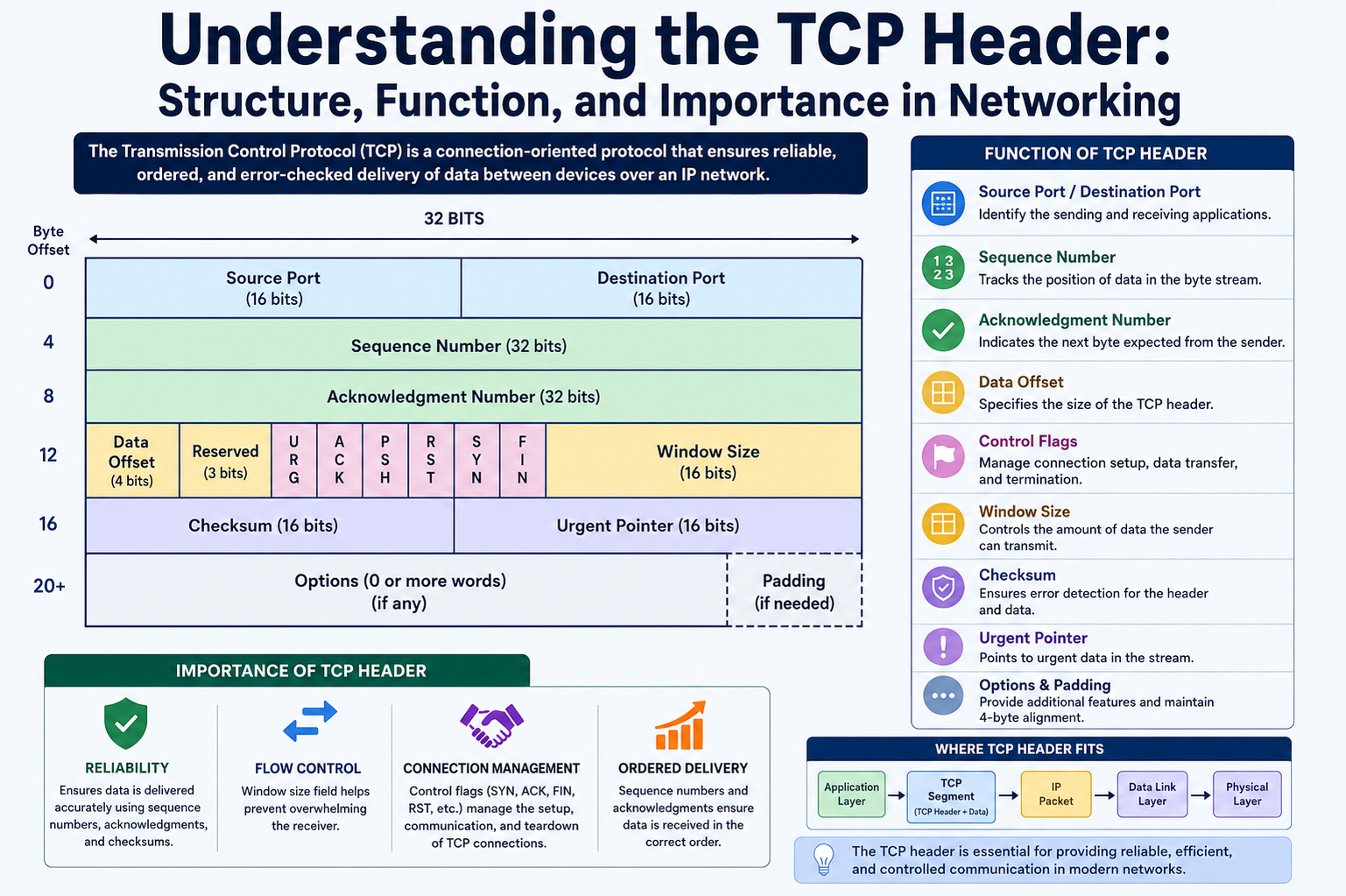
Every TCP segment begins with the TCP header, followed by the actual payload data. The header acts like a control panel attached to every packet, ensuring that both ends of the communication understand what is being sent, how it should be processed, and how to verify that it arrives correctly. Without this header, packets would have no identity, no order, and no guarantee of successful delivery.
The structure of the TCP header is carefully designed to support reliability and control. It contains multiple fields, each serving a specific role in the communication process. These fields work together to manage connection setup, data sequencing, flow regulation, and error detection. While the payload carries meaningful information such as a web page, email content, or file data, the header ensures that this information reaches the correct destination in usable form.
One of the most fundamental aspects of the TCP header is its role in identifying communication endpoints. Every device on a network may run multiple applications at the same time. For example, a computer might be browsing the web, downloading files, and streaming media simultaneously. To manage this complexity, TCP uses identifiers known as ports. The header includes both a source port and a destination port. These values act like internal addressing labels that specify which application on the sending device initiated the communication and which application on the receiving device should process it. This allows multiple conversations to occur simultaneously without interference.
Another essential function of the TCP header is ensuring that data is not only delivered but also reconstructed in the correct order. When data is sent across a network, it is divided into segments that may take different paths to reach the destination. As a result, they may arrive out of sequence. The header contains mechanisms that allow the receiving system to rebuild the original message accurately. This is crucial for maintaining data integrity, especially in applications where order matters, such as loading web pages or transferring files.
To support ordering, the TCP header assigns identifiers that help track each segment. These identifiers allow the receiver to understand the position of each piece of data within the overall stream. This structured approach ensures that even if packets arrive at different times, they can still be assembled correctly into the original message.
The TCP header also plays a critical role in establishing communication between two devices. Before any data is transmitted, TCP performs a process that sets up a reliable connection. This process involves an exchange of control information between sender and receiver, ensuring that both sides are ready to communicate. The header carries the necessary signals that manage this setup phase. It also supports the termination of connections once communication is complete, ensuring that resources are released properly.
In addition to managing connections, the TCP header provides mechanisms for flow control. Network devices often differ in speed and processing capability. If one device sends data faster than the other can process it, congestion and data loss may occur. To prevent this, the TCP header includes information that tells the sender how much data the receiver can handle at a given time. This adaptive behavior helps maintain balance in communication and prevents overwhelming slower systems.
Error detection is another essential function embedded within the TCP header. Networks are not perfectly reliable environments. Data can become corrupted due to noise, interference, or routing issues. To address this, the header includes a mechanism that allows the receiving device to verify whether the data has been altered during transmission. If errors are detected, the affected data can be retransmitted, ensuring accuracy and reliability.
The TCP header is also designed with flexibility in mind. While it has a standard structure, it can include additional optional fields depending on the requirements of the communication. These optional elements allow TCP to adapt to different network conditions and performance needs. This flexibility is one of the reasons TCP remains widely used across diverse applications and systems.
From a structural perspective, the TCP header is organized in a highly efficient binary format. Each field has a defined size, measured in bits, which ensures consistency across all implementations. This standardized format allows devices from different manufacturers and operating systems to communicate seamlessly without ambiguity.
Although the TCP header is relatively small compared to the data it carries, its importance cannot be overstated. It acts as the foundation of reliable internet communication, ensuring that every packet has direction, purpose, and accountability. Without it, the internet would not be able to support the complex, high-speed, and reliable data exchange that modern applications depend on.
Understanding the TCP header provides a deeper appreciation of how digital communication actually works behind the scenes. Every time a webpage loads, a message is sent, or a file is downloaded, countless TCP headers are working silently in the background, coordinating the movement of data across global networks with precision and reliability.
Internal Structure and Functional Behavior of the TCP Header
The TCP header is not a random collection of data fields but a carefully engineered structure designed to support structured communication between devices. Each part of the header contributes to a specific aspect of the Transmission Control Protocol’s behavior, and together they form a system that manages connection reliability, data sequencing, and communication control.
At the beginning of the TCP header lies the addressing information, which consists of the source port and destination port. These two fields establish the logical endpoints of communication between applications. While IP addresses identify devices on a network, port numbers identify specific processes running on those devices. This distinction is critical because modern computing systems handle multiple network operations simultaneously. Without port-level identification, data would have no way of reaching the correct application.
Following the addressing fields is the sequence number, one of the most important components of the TCP header. This field assigns a numerical position to each segment of data within a continuous stream. Since data is often divided into multiple packets before transmission, the sequence number ensures that the receiving system can reconstruct the original order. Each byte of data in a TCP stream is effectively tracked, allowing precise reassembly even when packets arrive out of sequence due to varying network paths.
Complementing the sequence number is the acknowledgment number. This field is used by the receiving device to confirm successful receipt of data. When a packet is received correctly, the receiver sends back an acknowledgment indicating the next expected sequence number. This mechanism forms the basis of TCP’s reliability, as it ensures that the sender is constantly aware of which data has been successfully delivered and which may need retransmission.
The data offset field is another important part of the TCP header structure. It indicates where the actual data begins within the packet. Since the header can vary in size depending on optional fields, the data offset ensures that the receiving system can accurately determine where the payload starts. This prevents confusion between control information and actual transmitted data.
Within the header, there is also a reserved section. This portion is not actively used in standard communication but is reserved for future enhancements or protocol extensions. Its presence reflects the forward-compatible design of TCP, allowing room for future development without altering the fundamental structure of the protocol.
One of the most dynamic parts of the TCP header is the set of control flags. These flags are individual bits that act as switches to manage different stages and behaviors of communication. They control how connections are established, maintained, and terminated. For example, certain flags initiate connection setup, while others signal termination or indicate special handling of data. These control signals allow TCP to function as a stateful protocol, meaning it maintains awareness of the communication session over time.
Another critical field is the window size, which is directly related to flow control. This value determines how much data the receiver is willing to accept at a given time without acknowledgment. It acts as a buffer management system, preventing overload on the receiving side. If the receiver is busy or processing data slowly, it can reduce the window size, effectively slowing down the sender. This dynamic adjustment helps maintain smooth and stable communication.
Error detection is handled through the checksum field. This field contains a calculated value based on the contents of the TCP header and data. When the packet arrives at its destination, the receiver recalculates the checksum and compares it with the received value. If they match, the data is considered intact. If not, it indicates corruption, and the packet is discarded or retransmitted. This simple yet powerful mechanism plays a major role in maintaining data integrity across unreliable networks.
The urgent pointer field adds another layer of control by identifying data that requires immediate attention. When certain information is marked as urgent, this field indicates its position within the data stream. Although not commonly used in modern applications, it reflects TCP’s ability to prioritize specific segments of data when necessary.
Finally, the options field provides extensibility to the TCP header. This area can include additional parameters that enhance communication efficiency or performance. These options may define maximum segment sizes, timestamps, or other advanced features that improve synchronization and throughput. Because this field is variable in length, it allows TCP to adapt to different network environments without changing its core structure.
Together, these fields form a highly coordinated system. The TCP header is not just a static container but a dynamic control mechanism that continuously interacts with both sender and receiver. It manages timing, order, reliability, and flow in a way that ensures smooth communication even across complex and unstable network conditions.
Understanding the internal structure of the TCP header reveals how deeply engineered modern networking protocols are. Every field has a purpose, and every bit contributes to maintaining the integrity and efficiency of data transmission across the global internet.
Real-World Behavior, Performance Impact, and Network Management Role of the TCP Header
In practical networking environments, the TCP header plays a far more active role than simply organizing packet information. It directly influences performance, stability, and reliability across a wide range of real-world applications. From web browsing and file transfers to streaming and remote communication, the behavior of the TCP header determines how efficiently data flows through complex networks.
One of the most significant real-world functions of the TCP header is its role in congestion management. Networks are shared environments where multiple systems compete for bandwidth. When too much data is sent too quickly, congestion can occur, leading to packet loss and delays. The TCP header helps manage this situation through its flow control and acknowledgment mechanisms. By adjusting transmission rates based on feedback from the receiver, TCP ensures that data flow remains balanced and responsive to current network conditions.
Latency is another factor influenced indirectly by the TCP header. Although TCP itself does not eliminate delay, it manages retransmissions and ordering in a way that minimizes disruption. When packets are lost or delayed, the acknowledgment system within the header ensures that missing data is detected and resent. This recovery process is essential for maintaining reliability, even if it introduces slight delays in exchange for accuracy.
In high-performance environments, the behavior of the TCP header becomes even more critical. Applications that require continuous data flow, such as video streaming or large file transfers, depend on efficient window size management. The window size field in the TCP header dynamically adjusts to match network capacity. If the network is performing well, the window size can increase, allowing more data to be sent before waiting for acknowledgment. If conditions worsen, the window size decreases, reducing congestion risk.
Another important aspect is how the TCP header contributes to connection stability. Every TCP session follows a structured lifecycle, starting with connection establishment, continuing through data exchange, and ending with proper termination. Throughout this process, the header carries control signals that maintain synchronization between sender and receiver. This ensures that both ends of the communication remain aligned, even if network conditions fluctuate.
Security also benefits indirectly from the structure of the TCP header. While TCP itself is not a security protocol, the integrity checks and structured communication it provides make it more difficult for corrupted or malformed data to go unnoticed. The checksum field, in particular, plays a key role in detecting unintended modifications. In more advanced systems, TCP behavior is often combined with additional security layers to ensure safe and reliable communication.
In troubleshooting network issues, the TCP header becomes a valuable source of diagnostic information. Network engineers analyze header fields to identify problems such as packet loss, retransmissions, or congestion. For example, repeated acknowledgments or missing sequence numbers may indicate unstable network paths. Similarly, abnormal window size changes can suggest performance bottlenecks or overloaded receivers. By examining these patterns, it becomes possible to pinpoint issues that would otherwise remain hidden.
The TCP header also influences how different applications experience the network. Interactive applications, such as remote desktop systems, rely heavily on low latency and fast acknowledgment cycles. In contrast, bulk data transfers prioritize throughput and stability over speed. The flexibility of the TCP header allows it to support both types of communication by adjusting parameters dynamically based on conditions and requirements.
In distributed systems, where multiple devices communicate across large distances, the TCP header ensures consistency despite variations in network quality. Whether data is traveling across local networks or global infrastructure, the same header structure ensures predictable behavior. This consistency is one of the key reasons TCP remains foundational to internet communication.
Over time, the TCP header has also evolved to support improvements in network performance. While its core structure remains stable, optional enhancements allow it to adapt to modern requirements such as higher bandwidth, longer distances, and more complex routing environments. These enhancements ensure that TCP continues to function effectively in an evolving digital landscape.
Ultimately, the TCP header is not just a technical construct but a dynamic control system that shapes how data behaves across networks. It manages timing, ensures reliability, adapts to changing conditions, and supports a wide variety of applications without requiring manual intervention. Every packet that travels across the internet carries this hidden structure, silently coordinating communication between billions of devices worldwide.
Advanced TCP Header Behavior, Connection Lifecycle, and Performance Mechanics in Real Networks
The TCP header becomes significantly more powerful when viewed not just as a static structure inside packets, but as an active participant in a constantly evolving communication process. In real-world networks, every TCP segment is part of a larger behavioral system where timing, state changes, congestion responses, and adaptive adjustments all depend on the information carried inside the header.
To fully understand how TCP functions in practice, it is necessary to move beyond individual fields and examine how the TCP header drives the lifecycle of a connection, how it responds to network conditions, and how it adapts dynamically to maintain stability across unpredictable environments.
The Connection Lifecycle and Stateful Nature of TCP Communication
TCP is fundamentally a connection-oriented protocol, which means it does not simply send data blindly from one device to another. Instead, it establishes a structured session before any meaningful data transfer begins. This session-based behavior is controlled entirely through information embedded in the TCP header, particularly through control signals that define the state of the connection.
A TCP connection moves through a series of well-defined states. These states are not abstract concepts; they are actively managed through header flags and sequence coordination. Before data transfer begins, both devices must agree to communicate. This agreement is achieved through a synchronization process where the TCP header plays a central role in exchanging control information.
During this early phase, the header carries signals that initiate synchronization between sender and receiver. Once both sides acknowledge readiness, a stable communication channel is established. This stateful nature is what differentiates TCP from simpler protocols that transmit data without confirmation or setup.
Once the connection is established, the TCP header continues to govern every stage of communication. Each packet carries updated sequence information, acknowledgment responses, and flow control indicators that maintain synchronization between both endpoints. The connection remains active as long as both sides continue exchanging valid header-controlled segments.
When communication is complete, the connection must be terminated in an orderly manner. This is also managed through TCP header control information. Rather than abruptly stopping transmission, TCP ensures that both sides agree to close the session, preventing data loss or incomplete transfers. This structured lifecycle is essential for maintaining data integrity across unreliable networks.
Control Flags as Decision-Making Signals
Within the TCP header, control flags serve as the decision-making system of the protocol. Each flag represents a binary signal that influences the behavior of the connection. These flags are not passive indicators; they actively determine how devices respond to incoming and outgoing packets.
In practice, these control flags guide the entire communication process. Some flags initiate connection setup, others acknowledge received data, and some signal termination. There are also flags that modify behavior during special conditions, such as urgent data transmission or synchronization recovery.
What makes these flags powerful is their ability to work in combination. Multiple flags can be set simultaneously, allowing complex instructions to be embedded within a single header. This layered signaling system allows TCP to maintain flexibility while still preserving strict control over communication flow.
For example, during the early stages of a connection, specific flags indicate synchronization requests and acknowledgments. During normal data transfer, different flags confirm receipt of packets and maintain continuity. When the session ends, termination-related flags ensure that both sides close the connection cleanly.
These control signals are essential for maintaining reliability in environments where packet loss, delay, or duplication may occur. Without them, there would be no way for devices to coordinate actions or recover from transmission errors.
Congestion Control and Adaptive Transmission Behavior
One of the most advanced functions influenced by the TCP header is congestion control. Networks are shared systems, and multiple data streams often compete for limited bandwidth. If all senders transmit data at maximum speed without restriction, congestion quickly builds, leading to packet loss and performance degradation.
To prevent this, TCP uses adaptive mechanisms that adjust transmission rates based on network conditions. These mechanisms rely heavily on feedback derived from TCP header fields, especially acknowledgment patterns and timing behavior.
When a connection begins, TCP does not immediately send large amounts of data. Instead, it starts cautiously and gradually increases the transmission rate. This slow initial behavior allows the protocol to probe the network and determine how much data it can handle without causing congestion.
As acknowledgments are received, the sender interprets successful delivery as a signal that the network can support higher throughput. The transmission rate is then increased progressively. However, if packet loss or delayed acknowledgments are detected, TCP interprets this as a sign of congestion and reduces the sending rate accordingly.
This continuous adjustment creates a self-regulating system that balances efficiency and stability. The TCP header plays a critical role in this process by carrying the necessary sequence and acknowledgment information that enables these decisions.
Window Mechanisms and Flow Adaptation
The window size field in the TCP header is one of the most important tools for managing data flow between devices. It determines how much unacknowledged data can be in transit at any given time. This mechanism ensures that the sender does not overwhelm the receiver with more data than it can process.
In real-world networks, window behavior is dynamic. It changes based on the receiver’s capacity, network conditions, and overall system performance. When the receiver is operating efficiently, it can advertise a larger window, allowing more data to flow without waiting for acknowledgments. When resources are limited, the window shrinks, slowing down transmission.
This adaptive window system is critical in modern applications where network conditions vary constantly. For example, mobile networks experience fluctuating signal strength, which directly affects how much data can be reliably transmitted. The TCP header allows the protocol to respond to these changes in real time.
There is also an extended concept known as window scaling, which allows TCP to handle much larger data transfers than originally possible. This enhancement ensures that modern high-speed networks can fully utilize available bandwidth without being constrained by older limitations.
Reliability Through Retransmission Logic
One of the defining characteristics of TCP is its ability to guarantee reliable delivery. This reliability is achieved through a combination of sequence tracking, acknowledgment feedback, and retransmission mechanisms, all of which depend on TCP header information.
When a packet is sent, it is assigned a sequence position. If the sender does not receive confirmation that this packet has been successfully received, it assumes that the packet may have been lost or corrupted. In response, the sender retransmits the missing data.
This process is not random or wasteful. TCP uses timing-based logic to determine when retransmission is necessary. If acknowledgments are delayed beyond expected thresholds, the sender interprets this as potential packet loss.
In more advanced scenarios, TCP can detect patterns of missing packets and respond more efficiently. Instead of waiting for long timeouts, it can quickly retransmit specific segments based on partial acknowledgment information. This reduces delay and improves overall performance.
Selective Acknowledgment and Precision Recovery
In complex network environments, traditional acknowledgment methods may not be efficient enough. This is where selective acknowledgment behavior becomes important. Instead of confirming only the last received packet, the receiver can indicate exactly which segments have arrived successfully and which are missing.
This level of precision allows the sender to retransmit only the missing pieces rather than resending large portions of data unnecessarily. The TCP header supports this behavior through optional enhancements that extend its basic functionality.
Selective acknowledgment significantly improves performance in environments with high packet loss or variable latency, such as wireless or long-distance networks. It reduces redundancy and ensures faster recovery from transmission errors.
Options Field and Protocol Extensibility
The options field in the TCP header provides flexibility that allows the protocol to evolve without changing its core structure. This field can carry additional parameters that enhance performance, improve synchronization, or optimize data transfer behavior.
Some of these options relate to timing information, which helps measure round-trip delays between sender and receiver. Others define maximum segment sizes, which determine how large individual packets can be before being split. These adjustments are crucial for optimizing performance across different types of networks.
Because the options field is variable in length, it allows TCP to remain adaptable. New capabilities can be introduced without disrupting existing systems, ensuring long-term compatibility across diverse network infrastructures.
Real-World Packet Flow and Behavioral Dynamics
To understand how the TCP header functions in practice, it helps to visualize a continuous stream of communication. When a user loads a webpage, the browser sends a request that is broken into TCP segments. Each segment carries a header that includes sequence information, control signals, and flow indicators.
As the server responds, it sends data back in similarly structured segments. Each packet is tracked, acknowledged, and verified through the header system. If any packet is delayed or lost, the communication adjusts automatically.
During high-demand situations, such as downloading large files or streaming content, thousands of TCP segments may be exchanged in rapid succession. Despite this volume, the header ensures that each segment is accounted for and properly integrated into the final output.
Even in unstable environments, such as mobile networks or congested internet routes, TCP maintains consistency through continuous adjustment. The header acts as a real-time control system that responds to every change in network behavior.
Performance Optimization in Modern Networks
Modern networking environments require TCP to operate efficiently under a wide range of conditions. High-speed broadband, wireless connectivity, and global data centers all place different demands on the protocol. The TCP header enables optimization by allowing fine-grained control over transmission behavior.
By adjusting sequence flow, window size, acknowledgment timing, and retransmission strategies, TCP can adapt to both high-performance and low-bandwidth environments. This adaptability ensures that applications remain responsive regardless of underlying network conditions.
In high-latency environments, TCP focuses on maintaining stability and reducing unnecessary retransmissions. In high-speed environments, it prioritizes throughput and efficient data streaming. These adjustments are continuously guided by information embedded within the TCP header.
Interaction with Complex Network Paths
In modern internet infrastructure, data rarely travels in a straight line between two devices. Instead, it passes through multiple intermediate systems, each potentially introducing delay or variation in delivery time. The TCP header ensures that despite this complexity, communication remains consistent and reliable.
Because each packet is independently tracked, variations in routing do not affect the final outcome. The receiver can reorder segments based on sequence information, ensuring that the original message is reconstructed correctly regardless of delivery path differences.
This ability to handle unpredictable routing behavior is one of the reasons TCP remains essential for global communication systems.
Continuous Adaptation as a Core Principle
At its core, the TCP header enables continuous adaptation. It is not a static structure but part of a dynamic system that responds to real-time feedback. Every acknowledgment, every sequence update, and every control signal contributes to a constantly adjusting communication process.
This adaptability allows TCP to function effectively across vastly different environments, from small local networks to global-scale infrastructure. The header ensures that regardless of complexity, communication remains structured, reliable, and recoverable under all conditions.
TCP Header in Modern Networks — Security, Optimization, Hardware Acceleration, and Real-World Constraints
As networking technology has evolved, the TCP header has remained structurally consistent, yet its role inside modern systems has become significantly more complex. It now operates in environments shaped by high-speed fiber links, wireless mobility, global-scale data centers, and security-driven architectures. While the fundamental fields inside the TCP header have not changed dramatically, the way they are interpreted, optimized, and protected has expanded into a sophisticated ecosystem of hardware, software, and security mechanisms.
Understanding this modern behavior requires looking at how TCP headers interact with security threats, performance tuning strategies, operating system internals, and network hardware acceleration. These elements collectively define how TCP performs in today’s internet rather than just how it is defined in theory.
TCP Header Behavior in Secure and Hostile Environments
One of the most important aspects of modern TCP communication is that it often takes place in untrusted environments. Public networks expose TCP sessions to various forms of interference, manipulation, and attack. Because of this, the information contained in the TCP header becomes a potential target as well as a control mechanism.
Attackers may attempt to exploit sequence numbers, acknowledgment fields, or control flags to disrupt communication. For example, if an attacker can predict or guess sequence numbers, they may attempt to inject fake packets into an active connection. This can lead to data corruption or session hijacking. Although modern systems use randomized sequence generation to reduce this risk, the underlying reliance on TCP header values remains critical.
Another common threat involves forged acknowledgment responses. Since TCP relies heavily on acknowledgments to confirm delivery, false acknowledgments can confuse the sender into believing data has been received successfully when it has not. This can lead to silent data loss or desynchronization between endpoints.
Control flags in the TCP header are also sensitive to manipulation. Improperly crafted flags can attempt to prematurely close connections or reset sessions. A sudden reset signal, if accepted, can terminate active communication unexpectedly. Because of this, modern systems often validate TCP header behavior carefully before acting on control instructions.
These security considerations highlight an important reality: the TCP header is not just a communication tool, but also a potential attack surface that must be interpreted carefully and defensively.
Connection Stability Under Real-World Network Stress
In real networks, stability is rarely guaranteed. Packet loss, jitter, congestion, and routing changes are common. The TCP header plays a continuous role in adapting to these conditions through timing adjustments and retransmission logic.
One of the key elements influencing stability is how acknowledgment timing is interpreted. The sender uses acknowledgment patterns in the TCP header to estimate whether the network is stable or congested. If acknowledgments arrive consistently, the connection is considered healthy. If they become delayed or irregular, TCP interprets this as congestion or packet loss.
This leads to adjustments in transmission behavior. The sender may reduce sending rates, retransmit missing segments, or adjust window sizes. These decisions are not static; they are continuously recalculated based on real-time feedback carried in the TCP header.
Retransmission timing is especially important. TCP uses internal timers to determine when a packet should be resent. If a packet is not acknowledged within a calculated time window, it is assumed lost. However, setting this timing incorrectly can either cause unnecessary retransmissions or slow recovery. Modern implementations dynamically adjust these timers based on observed network performance.
Sequence Numbers and Flow Consistency at Scale
As network speeds increase, sequence number management becomes more complex. In high-throughput environments, millions of packets may be exchanged within a short time. The TCP header’s sequence numbering system must remain accurate even under extreme load.
Sequence numbers allow TCP to maintain a consistent stream of data regardless of how packets are split, delayed, or reordered. In large-scale systems such as data centers or cloud platforms, this ordering mechanism becomes essential for maintaining consistency across distributed services.
However, sequence management is not isolated. It interacts with acknowledgment behavior, window scaling, and retransmission logic. If any part of this system becomes unstable, the entire communication stream can degrade.
Modern operating systems often implement advanced algorithms to manage sequence flow efficiently. These algorithms ensure that even under heavy traffic, sequence tracking remains accurate and synchronized across both endpoints.
TCP Header Interaction with Operating System Network Stacks
The TCP header does not operate in isolation; it is processed by the operating system’s networking stack. This stack is responsible for interpreting header fields, managing buffers, handling retransmissions, and maintaining connection state.
When a packet arrives, the operating system reads the TCP header and determines how to process it. Sequence numbers are checked against expected values, acknowledgment fields are validated, and control flags are interpreted. Based on this information, the system decides whether to accept, reorder, or discard the packet.
This process happens at extremely high speed, often within microseconds. To support this level of performance, modern operating systems use highly optimized data structures and buffering strategies. The TCP header acts as the input to this entire processing pipeline.
Additionally, operating systems maintain connection state tables that track active TCP sessions. Each entry corresponds to an ongoing conversation and is continuously updated using information extracted from TCP headers. This ensures that long-lived connections remain stable even as network conditions fluctuate.
Hardware Acceleration and TCP Offloading
As network speeds have increased, processing every TCP header in software has become computationally expensive. To address this, modern systems often rely on hardware acceleration techniques.
Network interface cards (NICs) can offload certain TCP processing tasks directly from the CPU. This includes handling checksum calculations, segmentation, and even parts of acknowledgment processing. By moving these tasks into hardware, systems reduce CPU load and improve overall throughput.
In some cases, entire TCP segments can be processed at the hardware level before reaching the operating system. The TCP header is interpreted directly by network hardware, allowing faster data movement and lower latency.
This hardware-level optimization does not change the structure of the TCP header itself, but it changes how quickly and efficiently it is processed. The same fields still exist, but they are handled closer to the network interface rather than deep within the software stack.
Segmentation, MSS, and Packet Construction Efficiency
Another important aspect of TCP header behavior is how data is divided into segments before transmission. The maximum segment size (MSS) defines how much data can be included in a single TCP packet. This value is influenced by both network conditions and underlying protocol constraints.
The TCP header works closely with this segmentation process. Each segment must be properly labeled with sequence numbers and control information to ensure correct reconstruction at the destination. If segments are too large, they may be fragmented at lower network layers, reducing efficiency. If they are too small, overhead increases due to excessive header repetition.
Finding the optimal segment size is therefore a balance between efficiency and reliability. Modern systems often negotiate MSS values during connection setup to optimize performance based on network conditions.
Congestion Algorithms and Adaptive Behavior
While the TCP header does not directly implement congestion algorithms, it provides the data required for them to function. Modern TCP implementations use sophisticated congestion control mechanisms that interpret acknowledgment patterns and sequence behavior.
These algorithms adjust sending rates based on observed network performance. For example, when packet loss is detected through missing acknowledgments, the sender reduces transmission speed. When stability is observed, transmission gradually increases.
Different environments may use different congestion strategies, but all rely on TCP header information as their primary input source. This includes sequence tracking, acknowledgment timing, and window size adjustments.
The result is a highly adaptive system that continuously reacts to network conditions without manual intervention.
Impact of Middleboxes, NAT, and Network Filtering
In modern networks, TCP headers often pass through intermediate systems such as routers, firewalls, and network address translation (NAT) devices. These systems may inspect or modify TCP header fields as part of their operation.
For example, NAT devices rewrite port numbers in the TCP header to allow multiple devices to share a single external IP address. Firewalls may inspect control flags to determine whether a connection should be allowed or blocked.
These modifications introduce additional complexity into TCP behavior. The protocol must remain robust even when header fields are altered in transit. This is one reason why TCP includes error detection and strict sequencing rules.
However, these intermediate systems can also introduce challenges. Improper handling of TCP headers by middleboxes can lead to broken connections, delayed acknowledgments, or unexpected resets.
Conclusion
The TCP header is a fundamental building block of modern digital communication, quietly working behind every online action from loading a webpage to sending an email or streaming content. It provides the structure and intelligence needed for reliable data transfer across complex and often unpredictable networks. Through its carefully designed fields, it manages addressing, sequencing, flow control, error detection, and connection handling, ensuring that data arrives accurately and in the correct order.
What makes the TCP header especially powerful is its ability to adapt dynamically to changing network conditions. Whether dealing with congestion, packet loss, or varying latency, it continuously helps regulate communication between devices. This adaptability allows TCP to maintain stability even in large-scale global networks where millions of data exchanges occur simultaneously.
In modern networking environments, the TCP header is more than just a technical format—it is an active coordination system that supports performance optimization, reliability, and compatibility across diverse technologies. Its integration with operating systems, hardware acceleration, and security mechanisms further enhances its efficiency and resilience.
Understanding the TCP header provides valuable insight into how the internet truly functions beneath the surface. It reveals that every smooth digital experience relies on a highly organized system of rules and signals working together to ensure that information travels safely, efficiently, and consistently across the world.