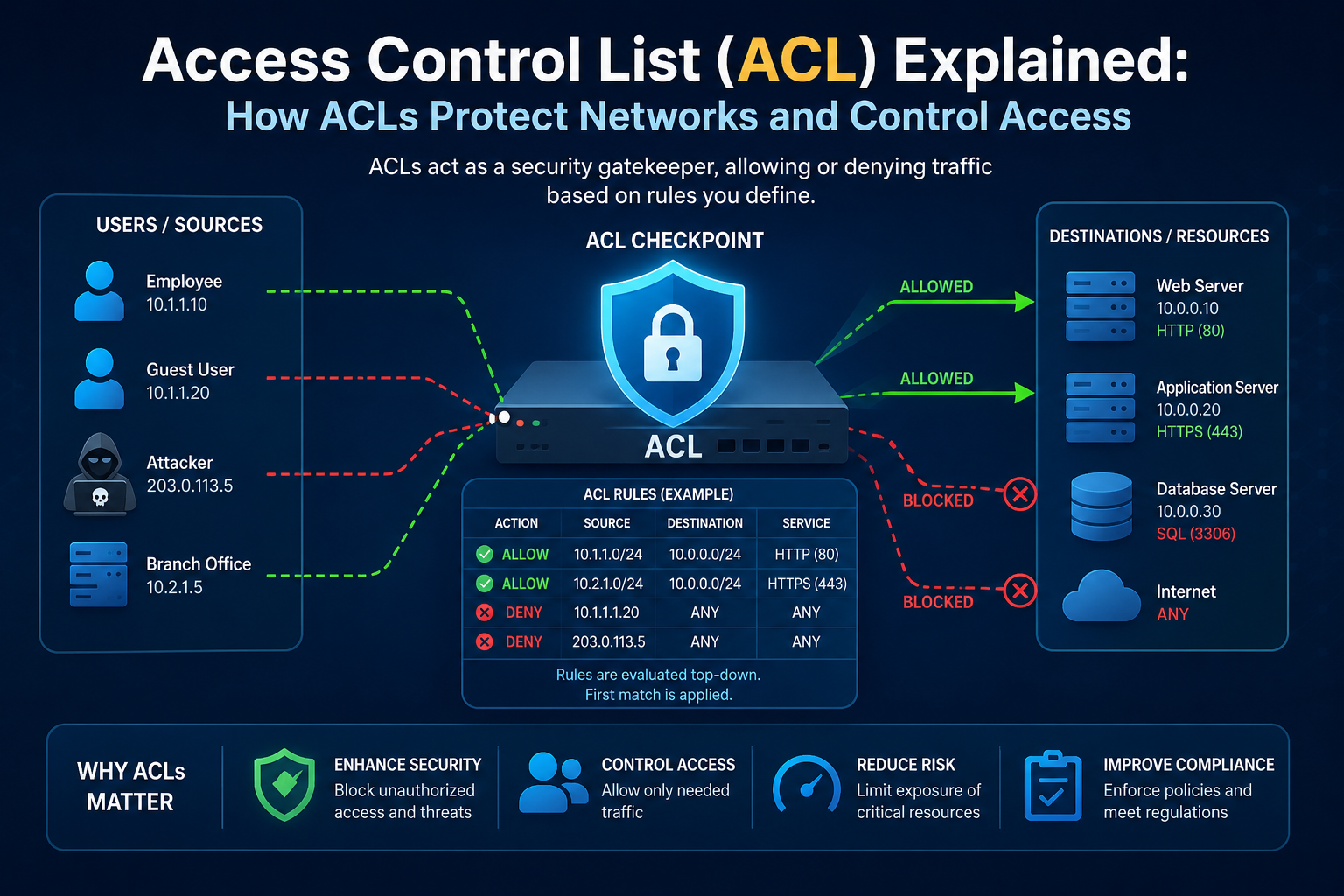
Modern computer networks rely on structured rules to determine how data travels between devices. Every message, request, or file sent across a network moves in the form of packets that follow established protocols. While this flow of information allows systems to communicate efficiently, it also introduces potential risks. Unauthorized access, malicious traffic, and accidental exposure of sensitive information can occur if networks are not carefully protected. One of the fundamental tools used to manage and secure network communication is the access control list, commonly known as an ACL.
An access control list is essentially a collection of rules used by network devices to control which traffic is permitted and which traffic is blocked. These rules are usually implemented on devices such as routers and firewalls. By evaluating incoming and outgoing packets based on defined conditions, ACLs help administrators regulate how information flows within and between networks. Instead of allowing unrestricted communication, the network can apply clear criteria that determine which devices, protocols, or services are allowed to interact.
To understand the importance of ACLs, it is useful to first consider the basic structure of a network. A network typically consists of multiple interconnected devices including computers, servers, switches, and routers. These devices exchange information constantly, whether users are browsing the internet, sending emails, accessing applications, or transferring files. Each of these interactions produces network traffic, which moves across different segments of the network infrastructure.
Without proper controls in place, any device could attempt to communicate with any other device, potentially exposing sensitive systems to unwanted access. For example, an external user might attempt to connect to a server that stores confidential data, or a malicious program might try to spread across network segments. ACLs provide a way to prevent such scenarios by specifying exactly what types of traffic are acceptable.
The concept behind ACLs is similar to maintaining a guest list at a secured location. Only individuals whose names appear on the list are permitted entry. In networking terms, the ACL contains rules that determine which packets meet the requirements for entry into the network or into specific areas of it. If a packet meets the criteria defined in the rule set, it is allowed to proceed. If it does not match the conditions, the system blocks it.
The rules that make up an ACL are based on several characteristics of network traffic. One of the most common criteria used in ACL rules is the Internet Protocol address, often referred to as the IP address. Every device connected to a network has an IP address that uniquely identifies it. By specifying allowed or blocked IP addresses, administrators can control which devices are permitted to communicate with particular systems.
In addition to IP addresses, ACL rules can also consider other factors such as port numbers and communication protocols. Port numbers identify specific services running on a device. For instance, certain ports are commonly used for web traffic, file transfers, or remote access services. By controlling traffic based on these ports, ACLs can restrict or allow access to particular services rather than blocking an entire device.
Protocols also play an important role in network communication. Different protocols define how data is formatted and transmitted. For example, some protocols manage web traffic, while others handle file sharing or email communication. ACLs can inspect these protocols and determine whether they are allowed within the network environment.
The ability to evaluate multiple factors gives ACLs significant flexibility. Instead of applying a single rule to all traffic, administrators can create detailed conditions that reflect the network’s security requirements. For example, a rule might allow internal users to access web services while preventing external devices from connecting to sensitive systems. Another rule might block traffic associated with certain applications that are considered risky or unnecessary.
One of the defining characteristics of an ACL is that its rules are evaluated in a specific order. When a packet arrives at a network device that uses ACLs, the device checks the packet against each rule in the list, starting from the top. As soon as a rule matches the packet’s characteristics, the corresponding action is applied. This action usually either permits the packet to continue or denies it.
Because ACLs are processed sequentially, the order of rules is extremely important. If a general rule appears before a more specific one, it may override the intended behavior of the later rule. For example, a rule that broadly allows traffic from a large network range could unintentionally permit traffic that should have been blocked by a more precise rule placed lower in the list. For this reason, administrators typically arrange rules from the most specific conditions to the most general ones.
Another important feature of ACLs is the presence of a default rule. If a packet does not match any of the defined rules in the list, the device must still decide how to handle it. Many security policies adopt a default action that denies all unmatched traffic. This approach follows a security philosophy often described as denying by default and permitting only explicitly approved communication.
This strategy helps ensure that only traffic meeting clearly defined conditions can pass through the network. Instead of trying to block every possible threat individually, administrators allow only known and trusted traffic while blocking everything else. This approach significantly reduces the risk of unauthorized access.
ACLs can operate in different parts of a network depending on how they are implemented. One common location is at the network boundary, where internal systems connect to external networks. By placing ACLs at this boundary, administrators can control what types of traffic enter or leave the network environment.
For example, an organization may want to allow employees to browse websites while preventing external devices from accessing internal systems directly. An ACL applied at the network edge could allow outbound web traffic while denying inbound requests that attempt to connect to internal resources.
ACLs can also be applied internally within a network. In large environments, networks are often divided into segments that separate different departments or functions. These segments may contain systems with varying levels of sensitivity. For instance, one segment may host public services while another contains confidential data or critical infrastructure.
Applying ACLs between these segments helps enforce security boundaries. Even if an attacker gains access to one part of the network, the ACLs can prevent them from moving laterally into more sensitive areas. This layered approach strengthens the overall security posture of the network.
Beyond security, ACLs also contribute to efficient network management. By controlling traffic flow, administrators can ensure that important services receive priority while unnecessary or potentially harmful traffic is restricted. This control can improve network performance and reduce congestion.
For example, an organization that relies heavily on voice communication over the network might implement rules that prioritize voice-related traffic. At the same time, traffic associated with less critical services could be limited during peak usage periods. By shaping traffic in this way, ACLs help maintain consistent performance for essential applications.
Understanding ACLs also requires recognizing the difference between broad and detailed rule sets. Some ACL configurations are designed to apply general policies that affect large portions of the network. Others provide fine-grained control over individual services or devices. The level of detail chosen often depends on the complexity of the network and the organization’s security requirements.
In simpler networks, administrators may rely on straightforward rules that allow communication between trusted devices while blocking external traffic. In more complex environments, ACLs may include numerous conditions that govern specific types of interactions between various systems.
Although ACLs are powerful tools, they are not designed to operate in isolation. They are typically part of a larger security strategy that includes other technologies such as authentication systems, monitoring tools, and intrusion detection mechanisms. Together, these components create multiple layers of protection that work collectively to defend the network.
Another important aspect of ACLs is their role in preventing common types of cyber threats. Many attacks rely on scanning networks for vulnerable services or attempting unauthorized connections to sensitive systems. By restricting which devices can access certain services, ACLs reduce the opportunities for attackers to exploit these vulnerabilities.
For instance, a database server might only need to communicate with a specific application server. By using ACLs to block all other devices from connecting to the database server, administrators limit potential attack paths. Even if a malicious actor attempts to access the server, the ACL rules would prevent the connection from being established.
ACLs can also help mitigate the spread of malware within a network. If a compromised device attempts to communicate with other systems in order to propagate malicious code, ACL rules may prevent those communications from occurring. By restricting unnecessary connections, ACLs reduce the chances that malware can move freely across the network.
Despite their effectiveness, ACLs must be carefully planned and maintained. Poorly designed rule sets can lead to unintended consequences such as blocking legitimate traffic or allowing unwanted communication. This is why administrators typically analyze network behavior before implementing ACL policies.
Studying network traffic patterns helps identify which services and devices require communication with each other. By understanding these patterns, administrators can design ACL rules that support normal operations while preventing unauthorized access. This process often involves documenting frequently used protocols, common communication paths, and trusted device ranges.
Another consideration is scalability. As networks grow and evolve, new devices, services, and applications may be introduced. ACL rules must adapt to these changes while maintaining the desired level of security. Without periodic updates, outdated rules may either block necessary communication or fail to protect against emerging threats.
For this reason, ACL management is an ongoing process rather than a one-time configuration. Administrators regularly review existing rules to ensure they remain aligned with the network’s operational and security requirements. Over time, rule sets may be refined, reorganized, or simplified to maintain clarity and efficiency.
In many ways, ACLs represent the intersection between network functionality and security control. They allow networks to remain open enough to support communication while maintaining strict boundaries that protect sensitive resources. By defining clear policies about who can communicate with whom and under what conditions, ACLs establish order within complex digital environments.
Understanding these foundational concepts provides a strong starting point for exploring how ACLs function in greater detail. As networks become increasingly interconnected and data continues to move across vast infrastructures, the ability to control and monitor traffic becomes more important than ever. Access control lists remain one of the most practical and widely used tools for achieving that goal.
Understanding How ACLs Control Traffic and Enforce Network Policies
Networks are constantly processing large volumes of information. Every time a user loads a webpage, sends a message, or connects to a remote service, multiple packets of data travel across routers and switches before reaching their destination. Managing this flow of information requires mechanisms that evaluate whether each packet should be allowed to continue or stopped before it causes potential harm. Access control lists provide a structured method for making these decisions in real time.
An ACL functions as a rule-based filtering system built directly into network devices. When traffic arrives at a router or firewall, the device compares the packet’s attributes against the conditions defined in the ACL. Each packet contains specific pieces of information, such as its source address, destination address, and protocol type. By examining these details, the device determines whether the packet satisfies any rule in the list.
The evaluation process begins the moment a packet reaches the network device where the ACL is applied. The device inspects the packet’s header, which contains the key identifiers used for filtering. The packet is then compared against the first rule in the access control list. If the packet meets the rule’s conditions, the device immediately performs the action associated with that rule.
This action typically involves either permitting the packet to continue or denying it entirely. If the packet is permitted, it moves forward toward its destination. If the packet is denied, it is discarded by the device and never reaches the intended system. Once a matching rule is found, the evaluation process stops. The packet does not continue down the rest of the list because a decision has already been made.
If the packet does not match the first rule, the device proceeds to the second rule in the list. This process continues sequentially until either a rule matches the packet or the end of the list is reached. Because ACLs operate sequentially, the placement of each rule significantly influences how traffic is handled.
Administrators must carefully structure the order of ACL rules to avoid conflicts or unintended outcomes. Specific rules that target precise conditions should typically appear near the top of the list. Broader rules that apply to larger sets of traffic are usually placed lower. This ordering ensures that detailed filtering occurs before more general policies are applied.
For example, imagine a network where a specific device must be blocked from accessing a server, while all other devices on the same network are allowed. If the rule allowing the entire network appears before the rule blocking the individual device, the system will permit that device because it matches the broader rule first. Reversing the order ensures the blocking rule is evaluated before the general permission rule.
This sequential decision-making process is one of the defining characteristics of ACLs. It allows administrators to design layered policies that gradually evaluate traffic based on increasingly broad criteria. By organizing rules logically, administrators can create filtering systems that are both efficient and predictable.
Another important concept in ACL operation is the default rule applied when no explicit rule matches a packet. In many network environments, the default action is to deny any traffic that has not been specifically permitted. This approach reflects a cautious security philosophy that prioritizes control over unrestricted access.
By denying all unspecified traffic, administrators ensure that only communication explicitly approved in the rule set can occur. This reduces the likelihood that unknown or suspicious traffic will slip through unnoticed. The network becomes more secure because every permitted interaction must be intentionally defined.
The structure of ACLs also allows networks to enforce organizational policies. Many organizations define rules about how systems should communicate, which services are permitted, and which applications are restricted. ACLs translate these policies into enforceable technical controls.
For instance, a company may allow employees to access web services and internal applications but restrict access to certain external services that could introduce security risks. ACL rules can block traffic associated with those services while leaving essential communication unaffected.
Another common use involves protecting sensitive systems that should only be accessed by authorized devices. For example, a database server containing confidential records might only accept connections from specific application servers. ACL rules can ensure that only those approved systems are allowed to communicate with the database.
Access control lists can also be used to limit communication between different segments of a network. Many organizations divide their networks into separate sections that isolate various functions. A research department, administrative systems, and public services may each operate within their own network segments.
Although these segments share the same overall infrastructure, they often require different levels of protection. ACLs placed between segments control how traffic flows from one area to another. This segmentation helps contain potential security incidents by preventing unauthorized movement across the network.
For example, if a workstation becomes compromised by malware, segmentation rules enforced through ACLs may prevent the malware from accessing critical servers. Even though the device remains connected to the network, its ability to interact with sensitive resources is limited by the filtering rules.
ACLs also help organizations manage bandwidth and maintain reliable performance for important applications. Not all network traffic carries the same level of importance. Some types of communication are essential for business operations, while others are less critical.
By identifying different categories of traffic, administrators can create rules that give priority to important services. Voice communication, for example, often requires stable and uninterrupted connectivity. ACL rules can help ensure that such traffic is treated appropriately within the network environment.
Similarly, administrators may choose to block certain forms of traffic entirely if they consume excessive bandwidth or pose potential risks. File-sharing applications, for instance, might generate large volumes of traffic that interfere with normal operations. ACLs can prevent such applications from operating on the network.
Understanding how ACLs evaluate packets also involves recognizing the information contained within those packets. Every packet includes a source address that identifies where it originated and a destination address that indicates where it is headed. These addresses allow ACLs to determine which devices are communicating.
Ports provide another important piece of information. Each service running on a device uses a specific port number to distinguish itself from other services. Web servers, email servers, and file transfer systems all rely on designated ports to handle requests. ACLs can filter traffic based on these ports, allowing administrators to permit or deny access to individual services.
Protocols further define the nature of the communication. Different protocols govern how data is transmitted and interpreted across the network. By specifying which protocols are allowed, ACLs help ensure that only appropriate types of communication occur within the network.
Combining these elements allows ACLs to perform detailed filtering. A rule might allow traffic originating from a particular network range to access a specific service while blocking all other communication attempts. Another rule might deny traffic using a certain protocol while permitting others.
This layered filtering capability enables networks to enforce sophisticated policies without requiring complex processing systems. ACLs rely on straightforward comparisons between packet attributes and rule conditions, making them efficient even in high-traffic environments.
While ACLs are powerful tools for managing traffic, they also require thoughtful planning to avoid unintended disruptions. A single misconfigured rule can block legitimate communication and interrupt normal operations. For example, if a rule mistakenly denies traffic from an internal network range, users may suddenly lose access to important services.
Because of this risk, administrators typically analyze network behavior before implementing ACL rules. Monitoring tools can reveal how devices communicate with each other, which services are frequently used, and which traffic patterns are normal for the organization.
This analysis helps administrators design rules that reflect actual operational needs rather than assumptions. Instead of broadly blocking traffic and hoping nothing breaks, they can create targeted rules that allow essential communication while still enforcing strong security controls.
Another important consideration involves the location where ACLs are applied. Depending on the device and configuration, ACLs may filter traffic as it enters an interface or as it exits. This distinction affects how traffic flows through the network and can influence overall performance.
Applying ACLs closer to the source of unwanted traffic can reduce unnecessary processing. If unwanted packets are filtered early in their path, they consume fewer network resources. Conversely, applying ACLs near the destination may provide more context for evaluating traffic.
Choosing the appropriate placement requires an understanding of network architecture and communication patterns. Administrators often balance efficiency and security when deciding where ACLs should operate.
Over time, networks may accumulate large numbers of ACL rules as new policies and requirements emerge. Without proper management, these lists can become difficult to maintain. Redundant or outdated rules may remain in place long after they are needed, complicating the rule set and increasing the risk of errors.
Maintaining clarity within ACL configurations is therefore essential. Administrators periodically review existing rules to identify unnecessary entries and reorganize the list if needed. Simplifying the rule set helps ensure that the filtering process remains efficient and understandable.
Another important practice involves documenting the purpose of each rule. Clear documentation allows administrators to understand why a rule was created and what function it serves. When network changes occur, this information helps determine whether the rule should be modified, removed, or left unchanged.
Monitoring also plays a crucial role in evaluating how ACLs affect network behavior. Logs generated by network devices can reveal which packets are being permitted or denied. By examining these logs, administrators can detect unusual patterns that may indicate misconfigurations or potential security threats.
For example, repeated attempts to access restricted services might signal that a system is being targeted by automated scanning tools. Because ACLs record denied traffic, they can provide valuable insight into these activities. Administrators can then investigate the source of the traffic and take appropriate action.
Understanding how ACLs control traffic provides deeper insight into their value within network security. They serve not only as protective barriers but also as tools for enforcing organizational policies and maintaining orderly communication. By evaluating packets against clearly defined conditions, ACLs ensure that networks remain both functional and secure.
As networks grow more complex and interconnected, the ability to manage traffic with precision becomes increasingly important. Access control lists offer a practical and reliable method for accomplishing this task, enabling administrators to shape network behavior while safeguarding critical systems.
Implementing, Testing, and Maintaining Access Control Lists in Real-World Networks
Once the purpose and operation of access control lists are understood, the next step is learning how they are applied and maintained within a real network environment. ACLs are not just theoretical security concepts; they are practical tools that administrators configure on network devices to enforce policies and manage communication. Their effectiveness depends largely on how carefully they are implemented, monitored, and maintained over time.
When administrators decide to deploy ACLs, the process usually begins with a thorough examination of the network itself. Before defining rules, it is important to understand how devices interact, which services are commonly used, and where critical resources are located. Without this understanding, rules may be created that unintentionally block legitimate communication or leave sensitive areas insufficiently protected.
Analyzing network behavior often involves studying traffic patterns. Administrators observe which systems communicate with each other regularly and identify the protocols and services involved in these interactions. By examining these patterns, they gain insight into the normal operation of the network. This knowledge becomes the foundation for designing ACL rules that align with real usage rather than assumptions.
Another step in preparation involves identifying the most valuable assets within the network. Certain systems contain sensitive information or perform essential functions that must be protected carefully. Examples include database servers, authentication services, and management systems. ACL rules can be designed to limit which devices are allowed to interact with these resources, thereby reducing the risk of unauthorized access.
After gaining a clear picture of network behavior and priorities, administrators begin constructing the rule sets that will define the ACL. Each rule represents a condition that determines whether specific traffic should be allowed or blocked. The conditions may involve the origin of the traffic, its destination, the protocol used, or the service being accessed.
When creating these rules, administrators usually follow a logical strategy that emphasizes precision. Specific conditions are written first so that the most narrowly defined traffic patterns are evaluated before broader rules are applied. This approach reduces the likelihood that a general rule will override a more detailed one.
Consider a scenario in which a company operates several internal servers, including one dedicated to financial data. Only certain authorized systems should be able to connect to that server. An ACL rule might therefore permit traffic from a designated group of devices while denying all other connections to that system. Because this rule targets a specific resource and group of devices, it would typically appear near the beginning of the list.
More general rules may appear later in the list. These could allow broader communication among trusted network segments or permit access to common services such as web browsing. By structuring the rules in this manner, administrators ensure that sensitive restrictions are applied before wider permissions are considered.
The placement of ACLs within the network also plays a critical role in their effectiveness. ACLs can be applied to routers, firewalls, or other network devices responsible for directing traffic between segments. Each device has interfaces through which data enters and exits, and ACLs can be configured to filter traffic at these points.
Applying an ACL to incoming traffic means the rules evaluate packets as they arrive at the interface. If a packet fails to meet the conditions defined in the list, it is blocked before it can continue through the network. Applying the ACL to outgoing traffic means the packet is evaluated as it leaves the interface.
Deciding where to place ACLs requires careful planning. Filtering traffic closer to its source can reduce unnecessary processing across the network. If unwanted packets are blocked early in their journey, they consume fewer resources and create less congestion. On the other hand, filtering near the destination may provide additional context that helps determine whether the communication should be permitted.
Many network administrators adopt a balanced approach by applying ACLs at strategic points throughout the network infrastructure. For instance, boundary devices connecting internal systems to external networks often enforce strict filtering rules. Internal segmentation points may also use ACLs to control communication between departments or operational zones.
Once the rules have been designed and placed appropriately, administrators move on to the process of implementation. During this stage, the rules are entered into the configuration of the relevant network devices. Each device stores the ACL and uses it to evaluate traffic in real time.
Although the technical steps involved in configuring ACLs vary depending on the hardware and software used, the underlying principles remain consistent. Administrators define the conditions for each rule and specify whether the matching traffic should be permitted or denied. The completed rule set is then activated so that the device begins enforcing the policy.
However, implementation does not end with activating the rules. Testing is a crucial phase that ensures the ACL behaves as intended. Even carefully planned rules can produce unexpected results once they interact with real network traffic. For this reason, administrators often test ACL configurations in controlled environments before deploying them widely.
Testing involves generating different types of traffic to verify that the rules correctly allow or block communication. For example, if a rule is intended to prevent external devices from accessing a particular server, administrators may attempt to initiate connections from outside the network to confirm that the connection is rejected.
Similarly, they may test legitimate connections from authorized systems to ensure that those communications continue to function normally. By observing how the network responds to these tests, administrators can identify any adjustments needed in the rule set.
Monitoring tools play an important role during the testing phase. These tools capture network packets and display detailed information about their origin, destination, and protocol. By analyzing this data, administrators can determine whether the ACL rules are affecting traffic in the expected manner.
If the monitoring process reveals that legitimate traffic is being blocked, administrators can review the relevant rule and modify it accordingly. Likewise, if unwanted traffic is still passing through, additional rules may be required to close the gap.
After testing confirms that the ACL functions properly, it can be deployed fully within the production environment. Even at this stage, however, the process of managing ACLs is far from complete. Networks are dynamic systems that evolve over time. New devices are added, applications change, and organizational requirements shift. ACL rules must adapt to these changes to remain effective.
Regular maintenance is therefore an essential aspect of ACL management. Administrators periodically review the existing rule sets to ensure that they continue to reflect current operational needs. During these reviews, outdated or unnecessary rules may be removed to simplify the configuration.
Simplifying ACLs is important because overly complex rule sets can become difficult to interpret and maintain. When many rules accumulate over time, administrators may struggle to understand how they interact with one another. This complexity increases the risk of errors during future updates.
Another maintenance activity involves verifying that ACLs are not negatively affecting network performance. Although ACL processing is generally efficient, extremely large rule sets can introduce additional workload for network devices. Monitoring performance metrics helps ensure that the filtering process does not slow down communication unnecessarily.
Logging mechanisms also support ongoing maintenance. Many network devices can record events related to ACL activity, including instances where packets are denied. Reviewing these logs helps administrators identify unusual patterns of traffic that might indicate attempted security breaches or misconfigured applications.
For example, repeated attempts to access a blocked service could suggest that an external system is scanning the network for vulnerabilities. Alternatively, it might indicate that an internal application is attempting to connect to a resource it should not use. Either situation warrants investigation.
Logs can also reveal whether legitimate traffic is being denied unintentionally. If users report difficulties accessing certain services, administrators can examine the logs to determine whether an ACL rule is responsible. Adjustments can then be made to restore proper communication without weakening security.
In addition to technical maintenance, effective ACL management involves careful documentation. Recording the purpose of each rule and the reason it was implemented helps ensure that future administrators understand its role within the network. Documentation provides context that prevents rules from being modified or removed without fully understanding their impact.
Documentation becomes particularly valuable in large organizations where multiple administrators share responsibility for network management. Clear records allow team members to collaborate effectively and maintain consistency in how ACL policies are applied.
Over time, organizations often refine their security strategies based on experience and emerging threats. ACLs play a key role in these strategies by providing a flexible mechanism for enforcing new policies. If a new vulnerability is discovered in a certain service, administrators can quickly implement rules that restrict access to that service while longer-term solutions are developed.
Similarly, when new departments or systems are introduced into the network, ACLs can define how those elements interact with existing infrastructure. This adaptability ensures that security policies evolve alongside technological changes.
It is also important to recognize that ACLs are most effective when integrated into a broader network security framework. While ACLs control traffic based on defined criteria, other security technologies may analyze behavior, authenticate users, or detect anomalies. Together, these tools form a layered defense that strengthens overall protection.
Within this layered environment, ACLs act as one of the first points of inspection for network traffic. By filtering packets according to clearly defined rules, they prevent many unwanted communications from progressing further into the network. This early filtering reduces the workload for other security systems and helps maintain an organized flow of data.
As networks continue to expand and support increasingly diverse applications, the need for reliable traffic control becomes even more important. Access control lists provide a practical method for shaping network communication while maintaining strong security boundaries.
Through careful planning, thoughtful implementation, and consistent maintenance, ACLs enable administrators to regulate how systems interact across complex digital infrastructures. By defining which traffic is permitted and which is denied, they create a structured environment in which communication can occur safely and efficiently.
Real-World Scaling, and Modern Network Security Challenges
As networks expand beyond simple on-premise setups into complex environments that include cloud services, remote users, hybrid infrastructure, and distributed applications, access control lists evolve from basic filtering tools into part of a much larger security ecosystem. In modern environments, ACLs are no longer used only to allow or deny traffic in straightforward scenarios. They become foundational components in layered security designs that must operate efficiently at scale while supporting highly dynamic traffic patterns.
One of the most important shifts in modern networking is the increase in distributed architectures. Instead of a single centralized network boundary, organizations now operate across multiple environments that may include private data centers, cloud platforms, and remote endpoints. In such environments, ACLs are often deployed in multiple layers rather than a single location. Each layer enforces a different level of control, contributing to a broader defense strategy that spans the entire infrastructure.
At a deeper level, ACL design requires understanding how traffic direction influences security behavior. Traffic entering a network behaves differently from traffic leaving it, and ACL rules must reflect this distinction. Inbound traffic is often treated with higher scrutiny because it originates from external or less trusted sources. Outbound traffic, while generally more trusted, can still pose risks if internal systems are compromised. For this reason, ACLs may be configured separately for each direction, allowing more precise control over communication flows.
Another advanced aspect of ACL configuration involves interface-based application. Network devices typically have multiple interfaces, each connected to different segments or networks. ACLs can be applied specifically to these interfaces, meaning that the same device may enforce different rules depending on where the traffic enters or exits. This approach provides granular control over each connection point in the network infrastructure.
In large-scale environments, administrators must also consider how ACL rules are processed efficiently. As rule sets grow, performance can become a concern. Each packet must be evaluated against the ACL list, and if the list contains many rules, this evaluation process can introduce latency. To mitigate this, administrators carefully optimize rule order and eliminate redundant entries. Efficient design ensures that frequently matched rules appear near the top, reducing the number of comparisons required for most traffic.
Optimization also involves consolidating rules where possible. Instead of creating multiple similar rules for different IP ranges or services, administrators may combine them into broader but carefully structured conditions. This reduces complexity while maintaining security intent. However, this must be balanced carefully, as overly broad rules can weaken protection if not designed properly.
A critical concept in advanced ACL design is the implicit deny principle. In most configurations, if a packet does not match any rule in the list, it is automatically denied. This behavior is not always explicitly written but is built into the logic of many systems. The presence of an implicit deny ensures that only traffic matching defined rules is allowed, reinforcing a security model based on explicit permission rather than assumption.
This approach aligns with the principle of least privilege, which is central to modern security design. The idea is that every system, user, and process should have only the minimum level of access necessary to perform its function. ACLs enforce this principle by allowing precise control over communication paths. Instead of broadly trusting entire networks, administrators define specific permissions that limit exposure.
As networks become more complex, ACLs often interact with other security mechanisms such as firewalls and intrusion prevention systems. While ACLs primarily focus on packet filtering based on static attributes like IP addresses and ports, firewalls may include deeper inspection capabilities. Modern firewalls, often referred to as next-generation firewalls, can analyze application-level data, detect threats, and enforce identity-based policies.
Conclusion
Access Control Lists (ACLs) remain one of the most essential mechanisms in network security and traffic management. At their core, they provide a structured way to control how data moves across networks by allowing or denying packets based on defined rules. These rules typically consider factors such as IP addresses, protocols, and port numbers, enabling administrators to shape communication paths with precision and consistency.
Across different environments, ACLs serve multiple purposes. They protect sensitive systems from unauthorized access, help segment networks into secure zones, and reduce exposure to potential threats. By enforcing clear boundaries between trusted and untrusted traffic, ACLs contribute significantly to maintaining a stable and secure network infrastructure. Their ability to filter traffic at the packet level makes them both efficient and reliable for enforcing foundational security policies.
The effectiveness of ACLs depends heavily on proper design, implementation, and maintenance. Well-structured rule sets ensure that legitimate traffic flows smoothly while unwanted communication is blocked. However, poorly configured ACLs can lead to disruptions or security gaps, highlighting the importance of careful planning and continuous review. As networks evolve, ACL configurations must adapt to new applications, services, and security requirements.
In modern networking environments, ACLs often work alongside more advanced security technologies, forming part of a layered defense strategy. While newer systems may offer deeper inspection and dynamic control, ACLs continue to provide fast, rule-based filtering that forms the backbone of network access control.
Ultimately, understanding ACLs is fundamental for anyone involved in networking or cybersecurity. They represent a practical and powerful tool for enforcing security policies, managing traffic efficiently, and ensuring that network communication remains both controlled and secure.