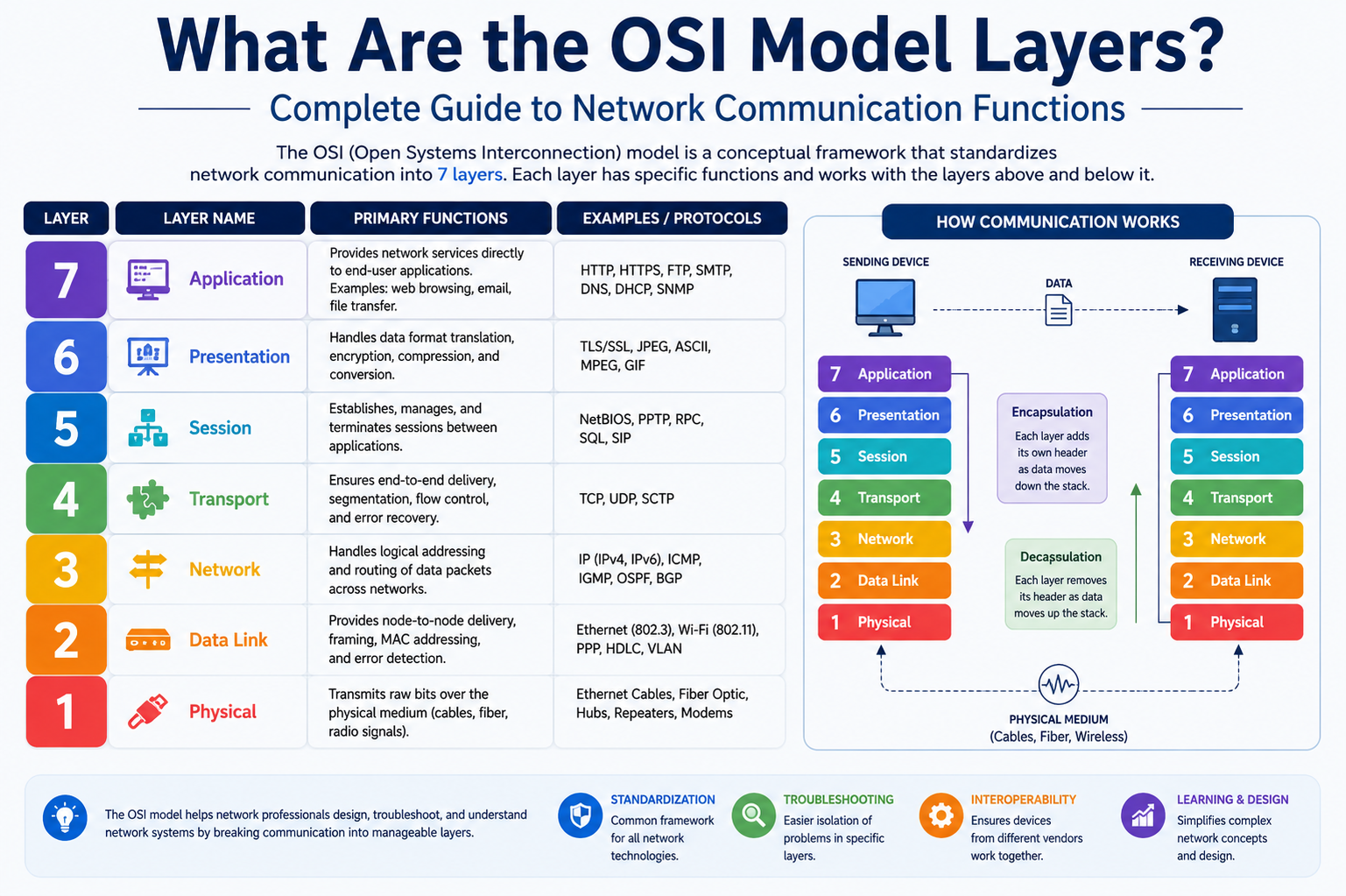
Modern networking often feels invisible because data moves so quickly between devices that most people never stop to think about the systems working in the background. A person opens a browser, sends a message, uploads a file, streams a movie, or joins an online meeting without seeing the enormous amount of coordination happening behind the scenes. Yet every action performed across a network depends on a structured process that allows devices from different manufacturers, operating systems, and locations to communicate in a predictable way.
The OSI model was created to make that communication easier to understand. OSI stands for Open Systems Interconnection, and the model acts as a conceptual framework that explains how data travels across a network from one device to another. Instead of treating communication as one giant process, the OSI model breaks networking tasks into seven separate layers. Each layer performs a specific role and works together with the layers above and below it.
This layered approach helps organize network functions in a logical and standardized way. Engineers, technicians, developers, and students use the OSI model to understand how data moves through networks, identify where problems occur, and design systems that work efficiently together. Without a structured model like this, networking would become far more difficult to manage because every manufacturer and software developer might use completely different communication methods.
One of the most important strengths of the OSI model is its ability to simplify complexity. Networking involves electrical signals, hardware devices, routing decisions, security processes, software communication, and user applications. Trying to understand all of those elements at once would be overwhelming. By separating networking responsibilities into layers, the OSI model allows people to focus on one specific part of communication at a time.
Although the OSI model contains seven layers, the lower three layers form the physical and structural foundation of network communication. These layers are responsible for transmitting raw data, organizing local communication, and directing traffic across networks. Before higher-level applications can function properly, the lower layers must successfully move data from one point to another.
Understanding these foundational layers helps explain how information physically travels across networks and how devices identify each other during communication. These concepts may seem technical at first, but they become much easier to understand when viewed as a step-by-step process.
Understanding Layered Communication
Imagine sending a package through an international shipping company. The package does not instantly appear at its destination. Instead, it moves through several stages. The item is packaged, labeled, sorted, routed through transportation systems, and eventually delivered to the recipient. Different departments handle different responsibilities throughout the process.
The OSI model works in a similar way. Each layer handles a particular networking task before passing the data to another layer. At the sending device, data moves downward through the seven layers until it reaches the physical medium. At the receiving device, the information moves upward through the layers until the final application receives it.
This layered communication process provides several important benefits. First, it improves compatibility between systems. Devices made by different companies can still communicate because they follow common networking standards. Second, it makes troubleshooting easier because network administrators can isolate problems to a particular layer. Third, it allows technologies to evolve independently. Developers can improve one layer without redesigning the entire networking system.
Each layer uses its own form of data organization. As information travels through the layers, additional control information is attached to help guide the communication process. This process is commonly known as encapsulation. When the receiving device processes the information, it removes those control details layer by layer until only the original data remains.
The seven layers of the OSI model are:
Physical Layer Data Link Layer Network Layer Transport Layer Session Layer Presentation Layer Application Layer
The lower layers primarily focus on moving data across hardware and networks, while the upper layers focus more on software communication and user interaction.
The Physical Layer and the Movement of Raw Data
The Physical Layer is the first layer of the OSI model and serves as the foundation of all network communication. This layer deals with the actual transmission of raw bits across physical media. It is responsible for moving electrical signals, radio waves, or light pulses from one device to another.
At this stage, the network does not interpret the meaning of the data. The Physical Layer simply handles the movement of binary information represented by zeros and ones. Every email, video stream, file transfer, or website request eventually becomes a stream of binary data that travels through physical connections.
The Physical Layer includes networking hardware and transmission technologies. Cables, connectors, switches, network interface cards, wireless signals, and fiber-optic systems all operate at this layer. It defines characteristics such as voltage levels, signal timing, data rates, cable specifications, and physical connector types.
Different forms of transmission media exist depending on networking needs. Copper cables remain widely used because they are affordable and practical for many environments. Fiber-optic cables provide extremely high speeds and long-distance communication using light signals. Wireless communication eliminates physical cables entirely by transmitting data through radio frequencies.
One important responsibility of the Physical Layer is converting digital data into signals suitable for transmission. A computer processes information digitally, but that information must travel through a medium in a usable form. Electrical impulses may represent binary values across copper cables, while flashes of light may carry the same data through optical fibers.
The Physical Layer also determines how devices physically connect to networks. Different connector standards and cable designs support various networking environments. Offices, homes, data centers, and telecommunications systems often use different physical technologies depending on speed, distance, and reliability requirements.
Wireless networking also depends heavily on the Physical Layer. Wi-Fi communication uses radio frequencies to transmit data between devices and wireless access points. Signal strength, interference, frequency ranges, and transmission power all influence wireless performance.
Although the Physical Layer may seem simple because it only handles raw transmission, it plays a crucial role in network stability. Problems at this layer can prevent communication entirely. Damaged cables, failing connectors, signal interference, or hardware malfunctions can interrupt data transmission before higher layers even become involved.
The Data Link Layer and Local Network Communication
Once raw bits travel across the physical medium, the Data Link Layer organizes that information into structured units called frames. This second layer focuses on reliable communication between devices located on the same local network segment.
The Data Link Layer ensures that devices can identify each other correctly and exchange data with fewer transmission errors. While the Physical Layer only moves raw signals, the Data Link Layer adds organization and control.
One of the most important features of this layer is physical addressing. Devices on a local network use unique hardware addresses known as MAC addresses. Every network interface card contains its own MAC address, which helps identify devices during local communication.
When one computer sends data to another device on the same network, the Data Link Layer uses MAC addresses to determine where the information should go. This process allows local traffic to reach the intended destination efficiently.
The Data Link Layer also handles error detection. During transmission, electrical interference or signal problems may corrupt data. To help identify these issues, the layer adds error-checking information to frames. If the receiving device detects corruption, the damaged frame can be discarded or retransmitted depending on the protocol being used.
Another key responsibility involves controlling access to the transmission medium. Multiple devices often share the same network infrastructure, especially in wireless environments. The Data Link Layer helps manage how devices take turns transmitting data to reduce collisions and communication conflicts.
Network switches operate heavily at this layer. A switch learns MAC addresses connected to its ports and forwards frames only to the appropriate destination. This selective forwarding improves efficiency because unnecessary traffic does not spread across the entire network.
The Data Link Layer is often divided into two sublayers. The Logical Link Control sublayer handles communication management and error handling, while the Media Access Control sublayer controls addressing and access to the physical medium.
Wireless communication introduces additional challenges at this layer. Radio signals may experience interference from walls, electronic devices, or overlapping wireless networks. The Data Link Layer helps manage retransmissions and communication timing to improve reliability.
The Data Link Layer is essential for maintaining orderly communication within local networks. Without it, devices would struggle to identify destinations accurately or detect corrupted information.
The Network Layer and Traffic Routing
The Network Layer represents the third layer of the OSI model and focuses on routing data across multiple interconnected networks. While the Data Link Layer handles local communication, the Network Layer manages communication between distant systems.
This layer introduces logical addressing, which allows devices to identify systems beyond their local network. Internet Protocol addresses, commonly known as IP addresses, operate at this layer.
An IP address provides a logical identifier that helps route traffic through complex networks. Unlike MAC addresses, which remain tied to hardware, IP addresses can change depending on network location.
The Network Layer determines the best path for data to travel between source and destination devices. This process is known as routing. Routers examine destination IP addresses and decide where packets should go next.
The internet itself depends heavily on routing decisions. Data rarely travels directly from one device to another. Instead, packets pass through multiple routers and networks before reaching their final destination.
The Network Layer breaks information into packets that contain addressing and routing details. Each packet can travel independently across networks and may even take different routes before arriving at the destination.
Routing protocols help routers exchange information about available paths and network conditions. These protocols allow routers to adapt when networks change, connections fail, or congestion occurs.
Congestion management is another important responsibility at this layer. Networks can become overloaded when too much traffic flows through certain paths. Routing systems help distribute traffic efficiently to reduce delays.
The Network Layer also supports communication between completely different network technologies. A device connected through wireless communication can still exchange data with a device connected through fiber-optic infrastructure because routing systems handle the transition between networks.
One of the major strengths of the Network Layer is scalability. Modern global communication would not function without systems capable of directing traffic across billions of connected devices.
The internet uses a packet-switching approach rather than maintaining permanent communication paths. This method allows networks to use resources more efficiently because data can share transmission paths dynamically.
The Network Layer also plays a role in fragmentation. Different networks may support different packet sizes, so routers sometimes divide packets into smaller pieces for compatibility during transmission.
Security considerations frequently involve this layer as well. Firewalls, filtering systems, and routing policies often inspect IP information to control network access and traffic flow.
How the Lower Layers Work Together
The first three OSI layers operate closely together to create the foundation of communication.
The Physical Layer handles raw signal transmission. The Data Link Layer organizes communication within local networks. The Network Layer routes packets across larger interconnected systems.
Together, these layers enable devices to exchange information across homes, offices, businesses, and the global internet.
For example, when a person visits a website, the process begins with the creation of data at higher layers. Eventually, that information moves downward to the Network Layer, where packets receive destination IP addresses. The Data Link Layer then creates frames using local hardware addresses, and the Physical Layer converts everything into signals for transmission.
As data travels across routers and networks, the lower layers repeatedly process and forward information until it reaches the destination system.
Even though users rarely think about these underlying processes, they form the backbone of all digital communication.
Why the OSI Model Still Matters
Although networking technologies continue evolving rapidly, the OSI model remains valuable because it provides a universal framework for understanding communication systems.
Professionals use the OSI model for troubleshooting because it helps isolate problems logically. If a cable fails, the issue likely exists at the Physical Layer. If routing problems occur, the Network Layer may be responsible. If applications cannot communicate properly, higher layers may require investigation.
The model also improves communication among technical teams. Instead of describing vague networking issues, professionals can discuss problems according to specific layers.
Educationally, the OSI model provides a clear structure for learning networking concepts. Students can study one layer at a time rather than attempting to understand all networking functions simultaneously.
Modern networks involve cloud computing, wireless systems, virtualization, streaming media, mobile devices, and internet-based services. Even though real-world protocols sometimes combine multiple OSI functions, the layered model still offers an effective way to organize networking knowledge.
Understanding the lower OSI layers builds the foundation for exploring the more advanced communication processes handled by the upper layers. As data moves upward through the model, communication becomes increasingly focused on reliability, sessions, formatting, and application interaction.
Transport and Session Layers in Modern Network Communication
The lower layers of the OSI model establish the physical and structural foundation for network communication, but moving data successfully across networks is only part of the overall process. Once information can travel between devices, networks must also ensure that data arrives reliably, remains organized, and supports meaningful communication between applications.
This is where the middle layers of the OSI model become extremely important. The Transport Layer and Session Layer work together to manage communication quality, maintain orderly exchanges, and coordinate interactions between systems.
Without these layers, network communication would become unpredictable and chaotic. Data might arrive incomplete, applications could lose synchronization, and systems would struggle to maintain stable communication sessions.
The Transport Layer focuses primarily on reliable end-to-end delivery, while the Session Layer manages communication sessions between applications. Together, these layers help transform raw network connectivity into stable, usable communication.
Why Reliable Communication Matters
Modern networks carry enormous amounts of information every second. Emails, cloud applications, streaming services, video calls, gaming platforms, and business systems all depend on data reaching the correct destination accurately.
However, networks are imperfect environments. Congestion, interference, hardware failures, overloaded systems, and signal loss can all interrupt communication.
Imagine downloading a large file without any form of reliability control. Missing pieces of data could corrupt the file entirely. Likewise, during an online meeting, communication delays or synchronization issues could disrupt conversations.
Reliable communication requires mechanisms that organize data, verify delivery, and manage timing between devices. The OSI model addresses these needs primarily through the Transport and Session layers.
These layers are responsible for ensuring that devices communicate efficiently and consistently, even when networks experience challenges.
The Role of the Transport Layer
The Transport Layer is the fourth layer of the OSI model and acts as the manager of end-to-end communication between devices.
While the Network Layer focuses on routing packets across networks, the Transport Layer focuses on ensuring that data reaches the destination correctly and in the proper order.
One of its most important responsibilities is segmentation. Large amounts of information cannot always travel efficiently as one massive block of data. Instead, the Transport Layer divides information into smaller units called segments.
These segments travel independently across the network and are later reassembled at the receiving device.
Segmentation improves efficiency because smaller pieces of data are easier to manage during transmission. If one segment becomes lost or corrupted, only that segment may need retransmission rather than the entire communication.
The Transport Layer also handles sequencing. Each segment receives sequence information so the receiving system can reassemble data correctly. Since segments may arrive out of order due to varying network paths and delays, sequencing ensures that the original information remains intact.
Error detection is another critical responsibility. The Transport Layer checks whether segments arrive correctly and identifies missing or damaged information.
If errors occur, retransmission mechanisms can recover the missing data. This process is essential for activities requiring accuracy, such as file transfers, database communication, and web browsing.
Flow control also plays a major role. Devices on a network may operate at different speeds. A powerful server might send data much faster than a smaller device can process it.
The Transport Layer helps regulate transmission speed to prevent overwhelming the receiving system.
Congestion control further improves communication stability. Networks sometimes experience heavy traffic that slows performance. Transport protocols can adjust transmission behavior to reduce congestion and improve efficiency.
Together, these functions help create dependable communication across networks of all sizes.
Understanding TCP
Transmission Control Protocol, commonly called TCP, is one of the most widely used Transport Layer protocols.
TCP is designed for reliability. It establishes a structured connection between devices before communication begins.
This connection-oriented approach allows systems to coordinate communication carefully.
Before transmitting data, TCP performs a process often described as a handshake. During this process, devices confirm that both sides are ready for communication.
Once the connection is established, TCP begins transmitting segments while monitoring delivery status.
Every segment contains sequence numbers and acknowledgment information. The receiving device confirms which data has arrived successfully.
If acknowledgments fail to appear within a certain time, TCP assumes segments were lost and retransmits them.
TCP prioritizes accuracy and completeness over speed. This makes it ideal for applications where reliable delivery is essential.
Activities such as:
Web browsing Email communication File transfers Remote administration Cloud applications Database synchronization
all rely heavily on TCP because incomplete or corrupted information could cause major problems.
TCP also includes congestion management features. If the network becomes overloaded, TCP can reduce transmission speed temporarily to minimize packet loss and stabilize communication.
Although TCP introduces additional overhead because of its reliability features, the tradeoff is worthwhile for many applications.
Understanding UDP
The User Datagram Protocol, known as UDP, takes a very different approach.
UDP is considered connectionless because it does not establish a formal communication session before transmitting data.
Unlike TCP, UDP does not guarantee delivery, sequencing, or retransmission.
At first glance, this may sound like a disadvantage, but UDP serves an important role in modern networking.
Some applications prioritize speed and low latency over perfect reliability.
For example, during live video streaming or online gaming, occasional packet loss may be less noticeable than delays caused by retransmissions.
If a few packets disappear during a live stream, viewers may briefly experience reduced quality, but the overall communication continues smoothly.
However, if the system constantly pauses to recover every missing packet, the experience could become frustrating.
UDP minimizes overhead by sending data quickly without maintaining extensive control mechanisms.
Applications that commonly use UDP include:
Streaming media Voice communication Online gaming Real-time broadcasts Video conferencing Certain DNS operations
In these situations, speed and responsiveness matter more than recovering every lost piece of data.
Because UDP provides minimal control, applications themselves may implement additional reliability features when necessary.
Ports and Communication Channels
The Transport Layer also introduces the concept of ports.
A device may run multiple network applications simultaneously. For example, a computer could browse websites, stream music, download files, and send emails at the same time.
Ports help identify which application should receive incoming data.
Each communication session uses specific port numbers associated with particular services or applications.
For example, web traffic commonly uses one set of ports, while email services use others.
Ports function like numbered channels that organize network communication inside a device.
Without ports, devices would struggle to direct incoming information to the correct software processes.
The combination of IP addresses and port numbers allows networks to manage countless simultaneous communication sessions efficiently.
The Importance of End-to-End Communication
One of the Transport Layer’s greatest strengths is its focus on end-to-end communication.
Lower layers may handle transmission between neighboring devices, but the Transport Layer ensures that complete communication occurs between the original sender and the final recipient.
This distinction becomes especially important across large networks like the internet.
Data may pass through many routers, switches, wireless systems, and service providers before reaching its destination.
The Transport Layer maintains communication consistency despite these complex paths.
This capability allows users to interact with remote systems as though communication were happening directly.
Introducing the Session Layer
Above the Transport Layer sits the Session Layer, which represents the fifth layer of the OSI model.
While the Transport Layer focuses on reliable delivery, the Session Layer focuses on managing communication sessions between applications.
A session refers to an ongoing exchange of information between systems.
Many modern applications require continuous communication rather than isolated data transfers.
For example:
Video meetings Remote desktop connections Online gaming sessions Collaborative cloud applications Messaging systems
all depend on coordinated interactions over time.
The Session Layer helps establish, maintain, synchronize, and terminate these interactions.
Without session management, applications could lose track of communication states, causing interruptions and confusion.
Establishing Communication Sessions
One important function of the Session Layer is session establishment.
Before meaningful communication begins, systems often need to negotiate how interactions will occur.
This process may involve authentication, synchronization settings, or communication rules.
Once established, the session provides a structured environment for ongoing exchanges.
The Session Layer ensures that both systems remain synchronized throughout communication.
This synchronization becomes especially important during lengthy or interactive processes.
For example, when accessing a remote server, the system must maintain awareness of the active session throughout the interaction.
If synchronization fails, users may become disconnected or lose unsaved work.
Maintaining Active Sessions
Communication sessions sometimes last for extended periods.
Video conferences, remote work sessions, online games, and cloud applications may remain active for hours.
The Session Layer helps maintain continuity throughout these interactions.
Checkpointing is one technique associated with session management.
Instead of restarting an entire communication process after interruption, systems can resume from a previous checkpoint.
This capability improves efficiency and user experience.
Synchronization also helps coordinate data exchange timing.
In interactive environments, systems must often take turns sending or receiving information.
The Session Layer helps organize these exchanges to prevent communication conflicts.
Session Termination and Resource Management
Eventually, communication sessions end.
The Session Layer manages graceful session termination so systems can release resources properly.
Abruptly ending communication without proper coordination may leave incomplete transactions or wasted system resources.
Graceful termination ensures that both systems understand when communication has finished.
This process becomes particularly important in business environments where stable communication supports critical operations.
The Session Layer in Real-World Communication
Although users rarely notice the Session Layer directly, its influence appears throughout everyday digital experiences.
When users remain logged into applications, maintain cloud synchronization, or continue uninterrupted online conversations, session management is working behind the scenes.
Authentication systems often rely on session tracking to verify user identity throughout interactions.
Streaming platforms maintain sessions to continue playback smoothly.
Collaborative software coordinates editing sessions among multiple users simultaneously.
Remote desktop systems preserve session continuity while users control distant computers.
The Session Layer helps make these interactions feel seamless and organized.
How the Transport and Session Layers Work Together
The Transport and Session layers complement each other closely.
The Transport Layer ensures that data arrives accurately and efficiently.
The Session Layer organizes ongoing communication between applications.
Together, they support stable and reliable network interactions.
Consider a video conference.
The Transport Layer handles data delivery using protocols optimized for audio and video traffic.
Meanwhile, the Session Layer maintains the communication session, manages synchronization, and coordinates interaction continuity.
Without the Transport Layer, communication reliability would suffer.
Without the Session Layer, long-running interactions could become unstable and disorganized.
The Growing Importance of Reliable Communication
As modern communication becomes increasingly dependent on cloud services, remote collaboration, streaming platforms, and connected devices, the responsibilities of these layers continue growing in importance.
Businesses rely on stable communication for operations, financial transactions, and customer interactions.
Individuals depend on reliable networking for entertainment, education, social communication, and remote work.
The Transport and Session layers help provide the consistency and coordination needed for these digital experiences.
Although users may never directly interact with these layers, they experience their benefits constantly through smooth, uninterrupted communication.
Understanding these layers also improves troubleshooting skills.
Connection delays, retransmission problems, unstable sessions, and interrupted applications often relate to Transport or Session Layer behavior.
By studying how these layers function, network professionals gain deeper insight into how modern communication systems maintain reliability and organization across complex environments.
Presentation and Application Layers in Everyday Networking
As data moves upward through the OSI model, communication becomes increasingly focused on usability, interpretation, and interaction with software applications. The lower layers handle transmission, routing, and delivery, while the upper layers focus on making information understandable and useful to people and programs.
The Presentation Layer and Application Layer sit near the top of the OSI model and play a major role in the digital experiences people use every day.
These layers help applications communicate effectively, manage data formatting, support encryption, and provide direct access to network services.
Without these upper layers, users would not be able to browse websites, send messages, access cloud applications, stream content, or interact with online platforms in practical ways.
Although many users never hear about these layers, they influence nearly every digital interaction.
The Shift From Transmission to Usability
Lower networking layers focus heavily on transporting data from one location to another. Once information reaches its destination successfully, another challenge begins.
The receiving system must understand and process that information correctly.
Different devices and applications may store data using different formats, character systems, encryption methods, or compression techniques.
Without standardization, communication between systems could become unreliable.
The Presentation Layer helps solve these issues by translating and preparing information for applications.
Above it, the Application Layer provides direct communication between software applications and network services.
These layers help bridge the gap between technical network operations and human interaction.
Understanding the Presentation Layer
The Presentation Layer is the sixth layer of the OSI model.
Its primary role involves formatting, translating, encrypting, and compressing data so that applications can communicate properly.
This layer acts as a translator between different systems.
Computers and applications may represent information differently depending on operating systems, software architectures, and encoding standards.
The Presentation Layer ensures that transmitted information appears correctly when received.
Without this layer, devices might struggle to interpret exchanged data accurately.
Data Translation and Formatting
One major responsibility of the Presentation Layer involves data translation.
Different systems may use different methods for representing text, numbers, images, audio, or video.
For communication to succeed, both the sending and receiving systems must understand the same format.
The Presentation Layer converts data into standardized representations during transmission.
Character encoding provides a good example.
Computers store text using numerical representations for letters and symbols.
Different encoding systems exist for various languages and character sets.
The Presentation Layer helps ensure that text created on one system displays correctly on another.
This capability becomes especially important in global communication environments where users exchange information across different languages and platforms.
Multimedia content also depends heavily on formatting standards.
Images, audio files, and videos use specific encoding methods so applications can display them correctly.
The Presentation Layer helps coordinate these conversions.
Data Compression and Efficiency
Another important function of the Presentation Layer involves data compression.
Large files consume significant bandwidth and storage space.
Compression techniques reduce file sizes to improve transmission efficiency.
Compressed data travels more quickly across networks because fewer bits need transmission.
Streaming platforms, cloud storage services, file transfers, and multimedia applications all rely on compression to improve performance.
There are two general types of compression.
Lossless compression reduces file size while preserving all original information.
Lossy compression sacrifices some detail to achieve greater size reduction.
The choice depends on the type of content and application requirements.
For example, text documents often use lossless compression because accuracy matters.
Audio and video streaming may use lossy compression because slight quality reductions are less noticeable to users.
The Presentation Layer helps coordinate these compression methods during communication.
Encryption and Secure Communication
Security is another critical responsibility associated with the Presentation Layer.
Modern communication frequently involves sensitive information such as passwords, financial transactions, personal messages, and business data.
Encryption protects this information during transmission.
Encryption transforms readable information into encoded data that unauthorized users cannot easily interpret.
Only systems possessing the appropriate decryption mechanisms can restore the original information.
Secure communication has become increasingly important as internet usage expands.
Online shopping, digital banking, remote work, and cloud computing all depend heavily on encryption technologies.
The Presentation Layer helps manage encryption and decryption processes so applications can communicate securely.
Without encryption, attackers could intercept sensitive data traveling across networks.
Encryption also supports authentication and integrity verification.
These features help ensure that communication originates from legitimate sources and remains unaltered during transmission.
The Presentation Layer in Everyday Technology
Although users rarely think about the Presentation Layer directly, they interact with its functions constantly.
Watching streaming video, viewing images online, sending secure messages, opening documents, and accessing encrypted websites all involve formatting and translation processes.
For example, when a user visits a secure website, encryption technologies protect communication between the browser and server.
When users stream high-definition video, compression techniques help reduce bandwidth usage while maintaining quality.
When people exchange files across different operating systems, formatting standards help preserve compatibility.
The Presentation Layer helps make these interactions smooth and consistent.
Introducing the Application Layer
The Application Layer represents the seventh and highest layer of the OSI model.
This layer serves as the direct interface between network services and software applications.
Contrary to what some people assume, the Application Layer is not the application itself.
Instead, it provides the network-related services that applications use for communication.
Web browsers, email clients, messaging platforms, cloud applications, and countless other programs rely on Application Layer services.
This layer determines how software accesses network resources and exchanges information.
Application Layer Services
The Application Layer supports many functions that users interact with daily.
These services include:
Web communication Email transfer File sharing Remote access Name resolution Network resource discovery Messaging services Streaming support
Each service uses specific protocols designed for particular communication purposes.
Protocols establish rules that define how devices exchange information.
Standardized protocols improve compatibility between systems developed by different organizations.
Web Communication and HTTP
One of the most familiar Application Layer functions involves web browsing.
When users open websites, browsers communicate with web servers using standardized communication methods.
The browser sends requests for webpages, images, videos, and other resources.
The server responds by delivering the requested content.
This exchange allows users to access websites, online services, and cloud applications.
Modern websites often involve continuous communication between browsers and servers.
Dynamic applications update information in real time, load multimedia content, and support interactive experiences.
The Application Layer coordinates these exchanges.
Email Communication
Email systems also rely heavily on Application Layer services.
Sending an email involves several coordinated processes.
Messages must move from the sender’s device to outgoing mail servers, travel across networks, and reach the recipient’s mail system.
Protocols help organize message transfer, storage, and retrieval.
The Application Layer manages these interactions so users can send and receive communication efficiently.
Modern email systems also support attachments, formatting, security features, and synchronization across devices.
File Transfers and Remote Access
Many organizations depend on network file sharing and remote system access.
The Application Layer supports protocols that allow users to upload, download, and manage files across networks.
Remote access technologies also depend on this layer.
Administrators can connect to distant systems, manage servers, and troubleshoot infrastructure remotely.
Remote work environments increasingly rely on these capabilities.
Cloud computing platforms further expand these functions by allowing users to access applications and data from virtually anywhere.
Domain Name Resolution
One particularly important Application Layer service involves name resolution.
Humans prefer readable names for websites and services, but networks use numerical IP addresses for routing.
Name resolution systems translate readable names into network addresses.
Without this capability, users would need to memorize numerical addresses for every online service.
This translation process occurs constantly behind the scenes during internet usage.
The Application Layer and User Experience
The Application Layer has a direct influence on user experience.
Users may never see the lower networking layers, but they interact constantly with applications powered by Application Layer services.
Fast website loading, reliable email delivery, smooth streaming, cloud synchronization, and responsive online communication all depend partly on Application Layer functionality.
Modern applications often combine multiple communication services simultaneously.
A single collaboration platform may support messaging, video conferencing, file sharing, notifications, and cloud storage within one environment.
The Application Layer helps coordinate these services.
How the Upper Layers Work Together
The Presentation and Application layers complement each other closely.
The Application Layer manages communication between software and network services.
The Presentation Layer ensures that information appears in a usable and secure format.
For example, during secure web browsing:
The Application Layer handles communication between the browser and server.
The Presentation Layer encrypts and formats the transmitted information.
Together, these layers create the seamless digital experiences users expect.
The Relationship Between All Seven Layers
Although each OSI layer has its own responsibilities, all seven layers work together continuously.
A simple online activity may involve every layer simultaneously.
When a user streams a video:
The Application Layer manages streaming communication.
The Presentation Layer compresses and formats multimedia data.
The Session Layer maintains synchronization.
The Transport Layer manages delivery reliability and flow control.
The Network Layer routes packets across networks.
The Data Link Layer organizes local communication.
The Physical Layer transmits signals across cables or wireless media.
This layered cooperation allows complex communication to occur efficiently.
Why the OSI Model Remains Important
The OSI model continues serving as one of the most valuable educational and troubleshooting frameworks in networking.
Even though modern technologies sometimes combine multiple functions into integrated systems, the layered approach still provides a logical structure for understanding communication.
Network engineers, developers, administrators, cybersecurity professionals, and students use the OSI model to analyze problems and design solutions.
The model also supports interoperability by encouraging standardized communication methods.
As networking technologies continue evolving through cloud computing, virtualization, wireless expansion, artificial intelligence, and global connectivity, the fundamental principles represented by the OSI model remain highly relevant.
Understanding these layers helps explain how billions of devices communicate reliably every day across homes, businesses, and global infrastructure.
Behind every message, video stream, online search, cloud application, and digital transaction lies a coordinated sequence of processes working together through the layered structure of modern networking.
The OSI model is often introduced as a theoretical framework for understanding how network communication works, but its influence extends far beyond textbooks and certification studies. Even though modern networks use technologies that are far more advanced than those available when the OSI model was first developed, the model continues to play a major role in the design, management, security, and troubleshooting of communication systems around the world.
Conclusion
The OSI model remains one of the most important conceptual frameworks in networking, even as technologies continue to evolve at a rapid pace. By dividing communication into seven distinct layers, it provides a clear and structured way to understand how data moves from one device to another across complex and interconnected systems. Each layer has a specific responsibility, from the physical transmission of signals to the interaction between applications, and together they form a complete picture of network communication.
What makes the OSI model especially valuable is its ability to simplify complexity. Modern networks involve countless technologies working together simultaneously, including wired and wireless systems, cloud platforms, mobile networks, and security infrastructures. Without a structured model, understanding or troubleshooting these systems would be extremely difficult. The layered approach allows professionals to isolate issues, improve performance, and design more reliable systems.
Beyond troubleshooting, the OSI model also supports learning and communication within the field of networking. It provides a universal language that helps engineers, developers, and administrators describe problems and solutions in a consistent way. Even though real-world protocols such as TCP/IP do not perfectly match the OSI structure, the conceptual clarity it provides remains unmatched.
In a world increasingly dependent on digital communication, the OSI model continues to serve as a foundational guide. It not only explains how networks function but also helps shape how they are built, secured, and improved for the future.