Modern networks are expected to operate continuously without interruption. Businesses depend on stable connectivity for communication, cloud applications, financial transactions, security systems, remote work, and customer services. Even a short outage can disrupt productivity, damage user trust, and create expensive operational problems. Because of this, network engineers design infrastructures with redundancy in mind. Redundancy is the concept of creating backup systems that can take over automatically if a primary device fails.
One of the most important devices in any network is the router. Routers direct traffic between networks and allow devices to communicate beyond their local environment. If a router suddenly stops working, users may lose internet access, access to remote offices, or connectivity to critical applications. To prevent this type of failure from bringing an entire network offline, engineers use gateway redundancy protocols.
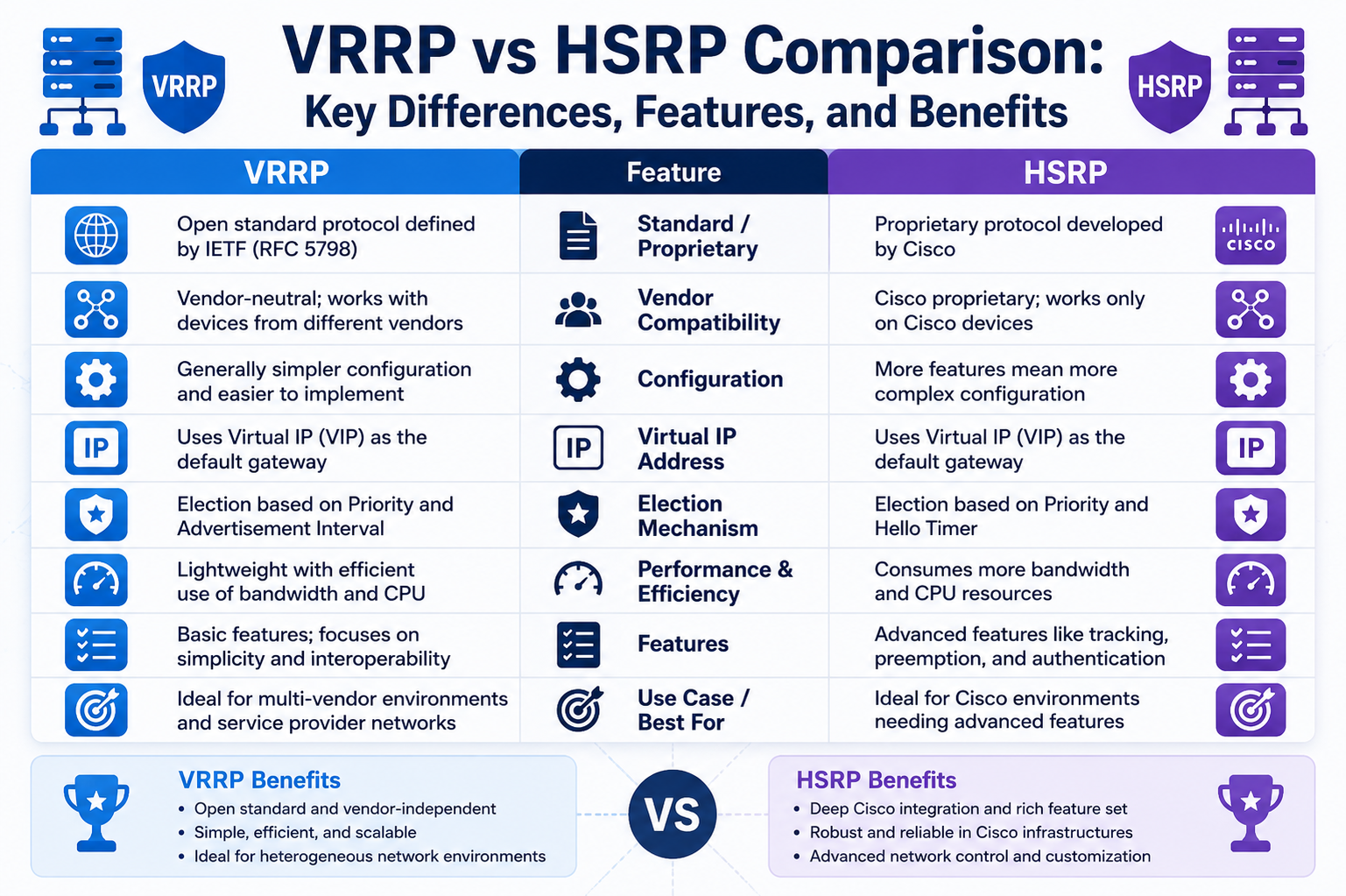
Two of the most widely known protocols for this purpose are VRRP and HSRP. These technologies allow multiple routers to work together so that if one router fails, another router immediately takes over. Both protocols aim to improve availability and reduce downtime, but they differ in design, implementation, and compatibility.
Understanding how these protocols function begins with understanding the role of a default gateway. In a local network, devices communicate directly with one another when they are on the same subnet. However, when a device needs to reach another network, it sends traffic to a default gateway. The default gateway is usually a router interface connected to the local network. Every computer, printer, server, and mobile device depends on this gateway to reach external destinations.
The challenge is that a traditional default gateway represents a single point of failure. If the router associated with that gateway fails, all connected devices lose the ability to communicate outside the local network. Even if another router exists on the network, hosts will still attempt to send traffic to the failed gateway because their configurations do not automatically change.
VRRP and HSRP solve this problem by introducing the concept of a virtual router. Instead of hosts pointing to a physical router, they point to a shared virtual IP address. Multiple routers participate in maintaining this virtual gateway. One router actively forwards traffic while another waits in standby mode, ready to take over if needed.
This design dramatically increases network resilience. Users may not even notice when a failover occurs because the transition happens very quickly. In environments where uptime is critical, such as hospitals, financial institutions, manufacturing plants, or cloud data centers, this capability becomes extremely valuable.
VRRP stands for Virtual Router Redundancy Protocol. It is an open standard protocol designed to provide high availability for default gateways. Because it is an open standard, VRRP can be implemented by many networking vendors. This makes it attractive for organizations using equipment from multiple manufacturers.
HSRP stands for Hot Standby Router Protocol. It was developed by Cisco as a proprietary solution for gateway redundancy. HSRP performs many of the same functions as VRRP, but it is primarily associated with Cisco environments.
At a basic level, both protocols accomplish the same goal. They provide a backup mechanism that prevents a router failure from disconnecting users from external networks. However, the details of how they operate, elect active routers, handle failover, and support advanced features create important differences.
To appreciate the value of these protocols, it helps to imagine a real-world scenario. Consider a company with hundreds of employees working from a single office. The office uses one router as the gateway to the internet and to cloud applications. If that router crashes because of hardware failure or software corruption, employees immediately lose access to email, communication platforms, customer databases, and remote resources.
Without redundancy, the IT team would need to troubleshoot the failed router, repair or replace it, and restore connectivity manually. This process could take minutes or even hours. During that time, the organization may experience lost productivity and financial impact.
With VRRP or HSRP in place, a secondary router is already prepared to take over. The standby router continuously monitors the health of the active router. If it detects that the active router is no longer responding, it automatically assumes responsibility for the virtual gateway. Traffic continues flowing with minimal interruption.
This failover process relies on communication between routers. Routers participating in redundancy groups exchange messages at regular intervals. These messages confirm that the active router is still operational. If the standby router stops receiving these messages, it assumes the active router has failed.
One of the most important aspects of these protocols is transparency. End-user devices do not need to know which physical router is currently active. Devices simply continue sending traffic to the same virtual IP address. The redundancy protocol handles the transition behind the scenes.
The concept of virtual MAC addresses also plays a major role. Since hosts use ARP to map IP addresses to MAC addresses, the virtual router must maintain a consistent identity on the network. Both VRRP and HSRP use virtual MAC addresses to ensure seamless transitions during failover events.
When redundancy protocols are configured properly, failover can occur very quickly. Some implementations achieve transitions in only a few seconds or less. Faster failover reduces the likelihood that users will notice interruptions.
Another major consideration in modern networking is scalability. Enterprise environments often contain multiple VLANs, multiple routers, and diverse traffic patterns. Redundancy protocols must be flexible enough to support these complex designs. Engineers may configure multiple redundancy groups to distribute traffic efficiently and avoid overloading a single device.
The importance of network reliability has grown significantly with the rise of cloud computing and remote work. Many organizations now depend on constant access to online services. A gateway failure no longer affects only local resources; it can disconnect users from essential cloud platforms, collaboration tools, and remote systems.
This shift has increased demand for resilient infrastructure. Businesses expect networks to remain available around the clock. Gateway redundancy protocols are now considered fundamental components of enterprise networking rather than optional enhancements.
VRRP became popular partly because of its interoperability. Organizations using routers from different manufacturers often prefer standards-based technologies to avoid vendor lock-in. Because VRRP is standardized, network administrators can deploy it across multi-vendor environments with greater flexibility.
HSRP, on the other hand, gained popularity in Cisco-focused environments. Cisco has long been a dominant player in enterprise networking, and many organizations built their infrastructures entirely around Cisco hardware. In these environments, HSRP integrated naturally with other Cisco technologies and management tools.
The election process used by these protocols determines which router becomes active. Typically, routers are assigned priority values. The router with the highest priority assumes the active role. If that router fails, the router with the next-highest priority takes over.
Priority values give administrators control over traffic flow and failover behavior. For example, a more powerful router with higher processing capabilities may be assigned a higher priority so it becomes the primary gateway. Less powerful routers can remain in standby mode until needed.
Preemption is another important feature. Preemption allows a higher-priority router to reclaim the active role after recovering from a failure. Without preemption, the standby router that took over during the outage may remain active indefinitely.
Administrators must carefully decide whether to enable preemption. In some environments, frequent role changes can create instability. In others, returning traffic to the preferred router is desirable for performance or policy reasons.
Another factor influencing redundancy design is convergence time. Convergence refers to how quickly the network recognizes a failure and restores connectivity. Faster convergence improves availability but may increase sensitivity to temporary interruptions.
Modern networks often tune timers carefully to balance responsiveness and stability. Aggressive timers can detect failures quickly, but they may also trigger unnecessary failovers if brief network disruptions occur.
The physical design of the network also affects redundancy strategies. Since both routers must remain connected to the same LAN segment, switches and VLAN configurations become important. If the standby router loses connectivity to the LAN, failover may not function correctly.
Power redundancy is another consideration. Using two routers does not guarantee high availability if both routers depend on the same power source. Organizations often connect redundant routers to separate power supplies, backup batteries, or different electrical circuits.
Environmental reliability matters as well. Data centers commonly use climate control systems, redundant cooling, and fire suppression technologies to protect networking equipment. High availability is not achieved through protocols alone; it requires careful planning across the entire infrastructure.
One misconception about redundancy protocols is that they eliminate all downtime. In reality, failover still requires some transition time. Applications sensitive to brief interruptions may experience momentary disruptions during the switchover.
However, the downtime is typically far shorter than manual recovery processes. For most users, the transition is barely noticeable.
Security also plays a role in redundancy protocol deployment. Unauthorized devices should never be allowed to participate in redundancy groups. Administrators often implement authentication features and access controls to prevent malicious activity.
Monitoring tools are equally important. Network teams use monitoring systems to track the status of redundancy groups, detect failures, and verify that failover mechanisms operate correctly. Proactive monitoring helps identify problems before they affect users.
As organizations grow, redundancy becomes increasingly critical. A small office may tolerate occasional outages, but large enterprises often require continuous connectivity. Industries such as healthcare, finance, telecommunications, and transportation depend on highly available networks.
The evolution of networking technologies has also influenced redundancy protocols. Virtualization, software-defined networking, and cloud integration have changed how networks are designed and managed. Despite these changes, the need for reliable default gateways remains constant.
VRRP and HSRP continue to serve as foundational technologies in enterprise networking. Although newer architectures and technologies exist, the principles behind these protocols remain highly relevant.
One advantage of studying these protocols is that they reveal broader concepts in networking. Understanding redundancy teaches engineers about fault tolerance, failover mechanisms, scalability, and resilience. These principles apply far beyond gateway redundancy.
The choice between VRRP and HSRP often depends on the organization’s infrastructure and operational goals. Companies using equipment from multiple vendors may favor VRRP because of its open standard nature. Organizations heavily invested in Cisco hardware may prefer HSRP because of its tight integration with Cisco ecosystems.
Performance considerations can also influence decisions. Some environments prioritize rapid failover, while others emphasize simplified management or interoperability.
Cost is another factor. Open standards can reduce dependency on a single vendor, potentially lowering long-term infrastructure costs. Proprietary solutions may offer enhanced integration but can increase reliance on specific hardware platforms.
Training and familiarity also matter. Network engineers often choose technologies they know well. Teams experienced with Cisco systems may feel more comfortable managing HSRP configurations and troubleshooting Cisco-specific features.
As networks continue evolving, redundancy protocols remain essential for maintaining uninterrupted communication. Whether supporting office workers, cloud applications, or industrial systems, reliable gateways form the backbone of stable connectivity.
The importance of these technologies becomes especially clear during unexpected failures. Hardware eventually fails, software bugs occur, cables become disconnected, and power interruptions happen. Redundancy protocols provide a safety net that minimizes the impact of these unavoidable events.
Understanding how VRRP and HSRP work provides valuable insight into the design of resilient networks. These protocols demonstrate how intelligent coordination between devices can maintain connectivity even when individual components fail.
The foundations established by gateway redundancy protocols continue influencing modern networking strategies. Even as technologies advance, the need for automatic failover and high availability remains central to network design.
Exploring the Architecture and Operational Differences Between VRRP and HSRP
Although VRRP and HSRP share the same general objective of gateway redundancy, their internal operation reveals important distinctions. These differences influence compatibility, deployment strategies, failover behavior, scalability, and administrative control. Understanding these operational details helps network engineers design environments that align with organizational goals and technical requirements.
At the center of both protocols is the idea of a redundancy group. Multiple routers cooperate as members of this group, presenting a single virtual gateway to hosts on the network. However, the way each protocol establishes and manages this relationship differs.
VRRP was developed as an open standard to ensure interoperability across networking vendors. Its design reflects the goal of creating a consistent method for default gateway redundancy regardless of hardware manufacturer. This flexibility made VRRP attractive in environments where routers from different vendors coexist.
HSRP, in contrast, was created specifically for Cisco networks. Because Cisco controlled the protocol design, HSRP could integrate deeply with Cisco hardware and operating systems. This integration gave Cisco administrators access to features tailored for their ecosystem.
One of the first differences visible during deployment involves terminology. VRRP refers to the primary forwarding router as the master router, while backup routers remain in standby roles. HSRP uses the terms active router and standby router. Though the concepts are similar, the naming conventions reflect differences in protocol design.
The election process used to determine the primary router is another area where distinctions emerge. In VRRP, the router with the highest priority becomes the master router. If priorities are equal, the router with the highest IP address wins the election.
HSRP also uses priority values, but the protocol handles election behavior differently in certain situations. Administrators can tune priority values to control which router becomes active under normal operating conditions.
The handling of virtual IP addresses reveals one of the most discussed differences between the protocols. VRRP typically allows the virtual IP address to match the actual IP address of the master router. This approach simplifies some deployments because the master router already owns the gateway address.
HSRP generally creates a separate virtual IP address independent of the physical interfaces. The active router forwards traffic on behalf of this shared virtual address while maintaining its own interface IP.
This distinction may appear small, but it affects failover mechanics and network behavior. VRRP’s approach can simplify configuration in certain environments, while HSRP’s separation of physical and virtual addresses provides flexibility in others.
The way these protocols identify themselves on the network is also important. Both protocols use multicast communication to exchange status information among participating routers. These messages allow routers to monitor each other’s health and determine whether failover is necessary.
VRRP uses standardized multicast addresses defined by industry specifications. HSRP uses Cisco-specific multicast addresses associated with its proprietary design.
Timing mechanisms play a critical role in redundancy operations. Routers exchange periodic messages known as advertisements or hello packets. These messages indicate that the active router remains functional.
In VRRP, advertisement intervals are typically shorter by default than HSRP timers. This can result in faster failover detection under standard configurations. However, administrators can tune timers in both protocols to achieve faster or slower convergence depending on operational needs.
Aggressive timer settings reduce downtime but can increase the risk of false failovers caused by temporary congestion or packet loss. Conservative timer settings improve stability but extend recovery times.
The virtual MAC address structure also differs between the protocols. Each redundancy group uses a unique virtual MAC address associated with the shared gateway. Hosts on the network map the virtual IP address to this MAC address using ARP.
VRRP uses a standardized virtual MAC format based on its protocol specifications. HSRP uses a Cisco-defined MAC address range. These MAC addresses ensure that hosts continue forwarding traffic correctly after failover events.
Authentication capabilities represent another point of comparison. Earlier VRRP versions supported simple authentication methods, but these mechanisms were eventually removed because they offered limited security.
HSRP includes authentication options that help prevent unauthorized devices from joining redundancy groups. In modern environments, network administrators often supplement protocol authentication with broader security controls such as switch port security and network segmentation.
One operational difference that significantly affects deployment decisions is vendor interoperability. Because VRRP is standardized, organizations can implement it across routers from multiple manufacturers.
For example, a company using equipment from different networking vendors can deploy VRRP to create consistent redundancy behavior without replacing existing infrastructure.
HSRP’s proprietary nature limits this flexibility. Since HSRP is designed for Cisco environments, organizations using non-Cisco routers may not be able to implement it universally.
This distinction becomes especially important during mergers, infrastructure expansions, or gradual hardware upgrades. Multi-vendor compatibility provides long-term flexibility that some organizations consider essential.
Scalability considerations also influence protocol selection. Enterprise networks often support many VLANs, each requiring its own gateway redundancy configuration. Administrators may deploy multiple redundancy groups to distribute workloads across routers.
VRRP supports this model efficiently by allowing different routers to act as masters for different groups. HSRP can accomplish similar designs through multiple standby groups.
Load distribution is closely related to scalability. While both protocols focus primarily on redundancy, administrators frequently seek ways to balance traffic between routers.
VRRP implementations can support load balancing by distributing gateway responsibilities across multiple groups. Hosts in one subnet may use one router as the primary gateway, while another subnet uses a different router.
HSRP can also achieve load sharing through multiple groups, although its traditional design emphasizes active-standby behavior rather than true simultaneous forwarding.
The operational complexity of these configurations increases as networks grow. Engineers must carefully plan IP addressing, VLAN assignments, routing policies, and failover strategies.
Preemption behavior is another major consideration. In VRRP, preemption is generally enabled by default. This means that if a higher-priority router recovers from failure, it automatically resumes the master role.
HSRP traditionally requires preemption to be configured manually. Without preemption enabled, the standby router that took over during the outage may remain active indefinitely.
This difference affects network stability and operational predictability. Automatic preemption can restore preferred traffic flows, but frequent failovers may disrupt sensitive applications.
Tracking mechanisms provide additional intelligence for redundancy decisions. Both protocols can monitor interface states or other network conditions. If a critical interface fails, the router can reduce its priority, allowing another router to assume the active role.
For example, a router connected to the internet through a failed WAN link should not remain the active gateway. Tracking mechanisms help ensure that the most capable router remains active.
These features become particularly valuable in complex enterprise environments where simple interface monitoring is insufficient.
Network convergence extends beyond the redundancy protocol itself. Routing protocols such as OSPF or EIGRP must also react to topology changes. Gateway redundancy works most effectively when combined with efficient routing convergence.
Administrators therefore consider the broader network architecture when designing redundancy solutions.
One area where Cisco environments gained an advantage was protocol integration. HSRP worked closely with other Cisco technologies and management systems, simplifying administration for organizations standardized on Cisco hardware.
This integration included monitoring capabilities, troubleshooting tools, and interoperability with Cisco routing and switching platforms.
VRRP’s strength remained its openness and flexibility. In environments where avoiding vendor dependency was important, VRRP provided a standardized solution with broad compatibility.
Redundancy protocols also influence maintenance operations. Network engineers often need to upgrade firmware, replace hardware, or perform configuration changes without disrupting users.
With properly configured redundancy groups, administrators can shift active roles between routers intentionally, allowing maintenance on one device while traffic continues flowing through another.
This capability reduces planned downtime and improves operational efficiency.
Another important operational topic is split-brain scenarios. A split-brain condition occurs when multiple routers incorrectly assume they are the active gateway simultaneously.
This situation can create traffic instability, duplicate forwarding, and connectivity problems. Proper timer configuration, network design, and monitoring reduce the risk of split-brain behavior.
The physical network layout also affects redundancy reliability. Both routers participating in a redundancy group should connect through resilient switching infrastructure.
If both routers depend on the same switch and that switch fails, gateway redundancy becomes ineffective. High-availability designs therefore include redundant switches, links, and power systems.
Data center architectures often implement layered redundancy strategies. Gateway redundancy protocols operate alongside redundant core switches, multiple uplinks, clustered firewalls, and backup internet connections.
This layered approach ensures that no single hardware failure disrupts critical services.
Virtualization has also influenced gateway redundancy design. Virtual routers and software-defined networking platforms increasingly support redundancy features similar to VRRP and HSRP.
Although the underlying infrastructure may differ, the principle of maintaining a consistent gateway through failover remains the same.
Cloud computing environments have introduced additional considerations. Hybrid infrastructures connecting on-premises networks to cloud providers require resilient connectivity paths.
Redundancy protocols help maintain stable communication between internal users and external cloud resources.
Troubleshooting redundancy issues requires careful analysis. Engineers may examine hello timers, state transitions, ARP tables, interface statistics, and routing information.
Common problems include mismatched configurations, timer inconsistencies, authentication failures, VLAN misconfigurations, and multicast communication issues.
Monitoring tools can help identify these problems early. Alerts related to state changes or excessive failovers often indicate deeper infrastructure issues.
Performance testing is also important. Organizations frequently simulate failures to verify that redundancy mechanisms function correctly. These tests ensure that failover occurs within acceptable timeframes.
Documentation plays a critical role in managing redundancy environments. Engineers must maintain accurate records of group numbers, virtual IP addresses, priority values, tracking settings, and failover policies.
Without clear documentation, troubleshooting and maintenance become far more difficult.
Training and operational familiarity further influence protocol choice. Teams experienced with Cisco technologies may naturally prefer HSRP because of existing expertise and established operational procedures.
Organizations prioritizing interoperability and open standards may instead focus on VRRP.
As networks become increasingly critical to business operations, the operational reliability provided by redundancy protocols remains indispensable.
Although VRRP and HSRP differ in implementation details, both serve the same fundamental purpose: preventing gateway failures from disrupting communication.
The distinctions between them highlight broader themes in networking, including interoperability versus vendor integration, simplicity versus customization, and openness versus proprietary optimization.
By understanding these architectural and operational differences, network professionals can design infrastructures that deliver stable, resilient connectivity in a wide range of environments.
Choosing Between VRRP and HSRP in Modern Network Environments
Selecting the right redundancy protocol involves more than simply comparing technical specifications. Organizations must consider infrastructure design, vendor compatibility, operational goals, future scalability, and maintenance strategies. Both VRRP and HSRP provide reliable gateway failover, but their strengths become more apparent when viewed through the lens of real-world network operations.
Modern networks are more complex than ever before. Businesses rely on cloud applications, hybrid environments, remote connectivity, virtualization, and real-time communication systems. In this environment, network interruptions can affect nearly every aspect of operations.
As a result, organizations increasingly prioritize resilience during infrastructure planning. Redundancy protocols are no longer considered optional in enterprise environments. They are part of a broader strategy focused on minimizing outages and maintaining continuous connectivity.
One of the first considerations when choosing between VRRP and HSRP is the existing hardware ecosystem. Organizations using routers and switches from multiple vendors often prefer open standards because they reduce dependency on a single manufacturer.
VRRP fits naturally into these environments because it is vendor-neutral. Engineers can deploy VRRP across equipment from different manufacturers while maintaining consistent redundancy behavior.
This flexibility becomes especially valuable during gradual infrastructure upgrades. A company may replace routers over several years rather than all at once. Open standards allow older and newer hardware from different vendors to coexist more easily.
HSRP is better suited for organizations heavily invested in Cisco infrastructure. In networks where Cisco routers, switches, and management systems dominate the environment, HSRP integrates seamlessly with existing operational practices.
Many enterprises choose Cisco equipment specifically because of its unified ecosystem. In these environments, proprietary protocols may provide operational simplicity and familiar management workflows.
Budget considerations also affect decision-making. Networking hardware represents a major investment, and organizations often seek solutions that maximize flexibility while controlling long-term costs.
Open standards can reduce vendor lock-in, allowing businesses to choose hardware based on price, performance, and operational needs rather than protocol limitations.
However, some organizations prioritize consistency over flexibility. Standardizing on a single vendor can simplify training, support contracts, troubleshooting procedures, and management tools.
Operational expertise is another critical factor. A highly skilled network team familiar with Cisco technologies may manage HSRP environments more effectively than a mixed-vendor design.
Similarly, organizations experienced with standards-based networking may prefer VRRP because it aligns with their broader infrastructure philosophy.
Scalability requirements also influence protocol selection. Small office networks may require only a simple active-standby configuration. Large enterprises, however, often support dozens or hundreds of VLANs, each with unique redundancy requirements.
In these environments, engineers may deploy multiple redundancy groups to distribute traffic efficiently across routers.
For example, one router might serve as the primary gateway for half the VLANs while another router serves the remaining VLANs. This approach balances traffic loads while maintaining redundancy.
Both VRRP and HSRP support these designs, although implementation details differ.
Performance expectations continue increasing as businesses rely more heavily on digital services. Applications such as video conferencing, cloud collaboration, online transactions, and industrial automation demand stable, low-latency connectivity.
Gateway redundancy protocols contribute to performance indirectly by minimizing outages and maintaining traffic flow during failures.
Failover speed becomes especially important in environments supporting sensitive applications. Even short interruptions can disrupt voice calls, video streams, or real-time industrial systems.
Administrators often tune protocol timers to achieve faster convergence. However, aggressive failover settings require careful testing to avoid instability.
Maintenance planning is another area where redundancy protocols provide significant operational value. Organizations regularly perform firmware upgrades, hardware replacements, security updates, and configuration changes.
Without redundancy, these activities may require scheduled downtime. With redundancy protocols, engineers can intentionally shift traffic to standby devices while maintaining connectivity.
This capability reduces disruption and allows maintenance to occur during normal operating hours in some cases.
Disaster recovery planning also benefits from redundancy technologies. While VRRP and HSRP primarily protect against local router failures, they can form part of broader continuity strategies.
For example, redundancy groups may operate alongside multiple internet connections, redundant firewalls, backup power systems, and secondary data centers.
Together, these technologies create resilient infrastructures capable of withstanding hardware failures, connectivity interruptions, and environmental incidents.
Security considerations increasingly shape network design decisions as well. Modern networks face constant threats ranging from unauthorized access attempts to distributed denial-of-service attacks.
Although redundancy protocols themselves are not security solutions, their configuration affects overall network stability and resilience.
Administrators must protect redundancy groups from unauthorized participation or malicious manipulation. Secure management practices, network segmentation, authentication mechanisms, and access controls all contribute to protecting the integrity of failover systems.
Monitoring and visibility have become essential components of modern network management. Organizations depend on monitoring systems to track device health, bandwidth usage, failover events, and application performance.
Redundancy protocols generate valuable operational data that helps engineers identify patterns and troubleshoot issues.
Frequent failovers may indicate unstable links, failing hardware, power problems, or congestion. Monitoring tools allow administrators to investigate these issues proactively before users experience major disruptions.
Automation is also transforming network operations. Modern management platforms increasingly automate configuration deployment, policy enforcement, and monitoring.
Redundancy protocols must fit within these automated workflows. Standardized configurations and centralized management simplify large-scale deployments.
VRRP’s standards-based design may align well with automation frameworks supporting multi-vendor environments. HSRP integrates effectively within Cisco-focused automation ecosystems.
The growth of software-defined networking has introduced new approaches to high availability. In software-defined environments, centralized controllers dynamically manage traffic flows and failover decisions.
Despite these architectural changes, the core objective remains the same: maintaining uninterrupted connectivity when failures occur.
Traditional redundancy protocols continue playing an important role, especially in branch offices, campus networks, and hybrid environments.
Virtualization has further expanded the need for resilient networking. Virtual machines, containerized applications, and cloud-hosted services all depend on stable connectivity.
If a gateway fails in a heavily virtualized environment, large numbers of workloads may become unreachable simultaneously.
Redundancy protocols therefore remain highly relevant even as physical infrastructure evolves.
Organizations must also think about future growth when choosing technologies. Networks rarely remain static. New locations, additional users, cloud integrations, and emerging applications continually reshape infrastructure requirements.
A redundancy solution that works well for a small network today may become insufficient as the organization expands.
Flexibility and scalability therefore become critical evaluation criteria.
Interoperability is especially important for businesses expecting acquisitions, mergers, or partnerships. Integrating networks from different organizations often introduces equipment diversity.
Open standards can simplify these transitions by allowing broader compatibility.
Reliability testing is another major operational practice. Organizations committed to high availability regularly test failover mechanisms under controlled conditions.
These tests verify that standby routers assume active roles correctly and that applications remain accessible during transitions.
Testing also helps identify configuration weaknesses that might otherwise remain hidden until a real failure occurs.
Documentation quality strongly influences long-term manageability. Engineers must clearly document redundancy group configurations, priority assignments, timer settings, and failover policies.
Accurate documentation reduces troubleshooting time and helps maintain consistency across large environments.
Human factors also affect redundancy success. Even well-designed systems can fail if administrators misunderstand protocol behavior or misconfigure settings.
Training, operational procedures, and change management processes therefore play important roles in maintaining stable redundancy deployments.
The broader networking industry continues evolving toward automation, cloud integration, and software-defined architectures. However, the principles behind VRRP and HSRP remain deeply relevant.
Networks still require resilient gateways, rapid failover, and continuous availability. Whether implemented through traditional hardware routers or virtualized infrastructure, redundancy concepts continue supporting modern communication systems.
Some organizations eventually transition toward advanced load-balancing and clustering technologies that extend beyond basic gateway redundancy.
Nevertheless, VRRP and HSRP often remain foundational components within these larger architectures.
Choosing between the protocols ultimately depends on balancing interoperability, operational familiarity, infrastructure consistency, and future goals.
For multi-vendor environments prioritizing flexibility and standards compliance, VRRP often represents the most practical choice.
For Cisco-centric environments emphasizing tight integration and operational familiarity, HSRP may provide the smoothest experience.
In either case, successful implementation depends less on the protocol itself and more on careful planning, testing, monitoring, and maintenance.
Redundancy protocols are only one piece of a resilient network strategy. Reliable switching infrastructure, redundant power systems, strong monitoring practices, secure configurations, and effective operational procedures all contribute to high availability.
When combined thoughtfully, these elements create networks capable of supporting modern business demands with minimal disruption.
The continued relevance of VRRP and HSRP demonstrates the enduring importance of reliability in networking. No matter how advanced digital infrastructure becomes, organizations will always need systems that can continue operating when failures occur.
Gateway redundancy protocols remain among the most practical and effective tools for achieving that goal.
Real-World Deployments, and the Future of Gateway Availability
As enterprise networks continue growing in complexity, redundancy protocols such as VRRP and HSRP have evolved from optional reliability features into essential components of infrastructure design. Modern organizations rely on uninterrupted connectivity for nearly every business function, including cloud computing, digital communication, online collaboration, cybersecurity monitoring, industrial automation, remote access, and customer-facing services. Even a brief interruption in gateway availability can ripple through an organization, affecting productivity, revenue, and operational continuity.
The increasing dependence on stable connectivity has changed how network engineers approach infrastructure planning. High availability is no longer treated as a luxury reserved for massive corporations or data centers. Small businesses, educational institutions, healthcare organizations, retail environments, and distributed enterprises all require resilient network architectures capable of surviving failures without significant downtime.
In this environment, redundancy protocols form one layer of a much larger availability strategy. VRRP and HSRP are designed specifically to protect the default gateway, but the effectiveness of these protocols depends heavily on the surrounding infrastructure. Engineers must think carefully about switches, routing protocols, WAN connectivity, firewall redundancy, power systems, virtualization platforms, monitoring tools, and traffic engineering.
Understanding how redundancy protocols fit into broader network design helps explain why they remain relevant despite rapid technological changes in networking.
One of the most important shifts in recent years has been the movement toward always-connected digital environments. Employees expect uninterrupted access to applications regardless of their location. Cloud-based software platforms require stable internet access. Remote workers connect through VPNs and secure tunnels that depend on reliable gateway functionality.
Because of these expectations, organizations increasingly build networks with multiple layers of fault tolerance. Gateway redundancy becomes one component within a larger ecosystem of resilience.
A common enterprise design includes redundant core switches, multiple distribution switches, backup internet providers, redundant firewalls, and secondary power supplies. In these environments, VRRP or HSRP operates alongside many other redundancy mechanisms.
For example, a campus network may use two high-performance routers connected to redundant core switches. These routers participate in a VRRP or HSRP group that provides a virtual default gateway for users across multiple VLANs. If one router experiences a hardware failure, the standby router assumes responsibility almost immediately.
At the same time, routing protocols may dynamically adjust traffic paths, redundant firewalls may continue processing security policies, and backup internet circuits may remain active. Together, these systems create a highly available network capable of surviving multiple failure scenarios.
One reason redundancy protocols remain so valuable is their transparency. End-user devices do not need to understand which router is currently forwarding traffic. Devices continue using the same gateway IP address regardless of which physical router is active.
This simplicity greatly reduces operational complexity for end systems. Users are not required to change settings during outages, and applications continue operating with minimal disruption.
The relationship between redundancy protocols and switching infrastructure is particularly important. Both VRRP and HSRP assume that participating routers remain connected to the same Layer 2 segment. If switching infrastructure fails or becomes unstable, gateway redundancy may not function correctly.
For this reason, organizations often deploy redundant switches alongside redundant routers. Access switches may connect to multiple distribution switches, while core switches operate in resilient pairs.
These designs reduce the risk of a single switch failure isolating users from their gateways.
Link aggregation technologies further improve reliability by combining multiple physical links into logical connections. If one cable fails, traffic continues using the remaining links.
Combining link redundancy with gateway redundancy creates stronger fault tolerance across the network.
Power redundancy is another critical factor. Two routers provide little benefit if both depend on the same electrical circuit or power supply. Enterprise environments therefore commonly use uninterruptible power supplies, backup generators, dual power feeds, and redundant power modules.
Environmental conditions also matter. Data centers and network rooms often include climate control systems, fire suppression technologies, and physical security controls designed to protect critical equipment.
Redundancy is most effective when every layer of infrastructure receives attention.
Large organizations frequently implement geographic redundancy as well. Multiple data centers or regional offices may operate in active-active or active-standby configurations.
Conclusion
VRRP and HSRP remain essential technologies in building reliable network infrastructures. Even as networking continues to evolve through cloud computing, virtualization, automation, and software-defined systems, the need for uninterrupted gateway access remains unchanged. Both protocols address a critical challenge in network design: eliminating the single point of failure at the default gateway. By enabling automatic failover between routers, they ensure that connectivity is preserved even when hardware or software issues occur unexpectedly.
Although both technologies serve the same purpose, they differ in philosophy and implementation. VRRP follows an open standard approach, allowing interoperability across multiple vendors and offering flexibility in diverse network environments. This makes it especially useful for organizations that avoid vendor lock-in or operate mixed hardware infrastructures. HSRP, in contrast, is designed for tightly integrated environments where consistency, simplicity, and deep ecosystem compatibility are prioritized. This distinction allows organizations to choose a solution that best aligns with their operational strategy and existing infrastructure investments.
One of the greatest strengths of both protocols is their ability to provide seamless failover with minimal disruption to end users. When a primary router fails, the standby device quickly assumes responsibility for the virtual gateway, often within seconds. This process ensures that users continue accessing applications, services, and external networks without needing to reconfigure devices or manually intervene. In high-demand environments, this uninterrupted connectivity is critical to maintaining productivity and service continuity.
However, achieving true high availability requires more than just enabling VRRP or HSRP. Proper network design, redundant switching, reliable power systems, and accurate configuration are all essential. Continuous monitoring and regular failover testing also play a crucial role in ensuring that redundancy mechanisms function as expected during real failures. Without these supporting practices, even well-configured redundancy protocols may fail to deliver the intended level of resilience.
As networks continue to expand into cloud, edge, and hybrid environments, the importance of gateway redundancy will only increase. VRRP and HSRP will remain foundational tools in network engineering, evolving alongside modern technologies while continuing to ensure that connectivity remains stable, reliable, and available whenever it is needed.