The Certified Information Systems Security Professional credential is widely regarded as one of the most respected qualifications in the information security field. Many professionals assume that the greatest challenge in earning this credential is passing the examination itself. The exam certainly demands a deep understanding of security concepts, policies, and decision-making strategies, but the test is only one part of the overall certification journey. What truly distinguishes this credential from many others is the emphasis on professional experience.
The experience requirement ensures that individuals who hold the credential have spent meaningful time working with real security challenges in practical environments. Rather than certifying people solely on theoretical knowledge, the certification process focuses on professionals who have demonstrated their abilities in actual workplace scenarios. This emphasis reinforces the credibility of the credential and contributes to its reputation within the cybersecurity community.
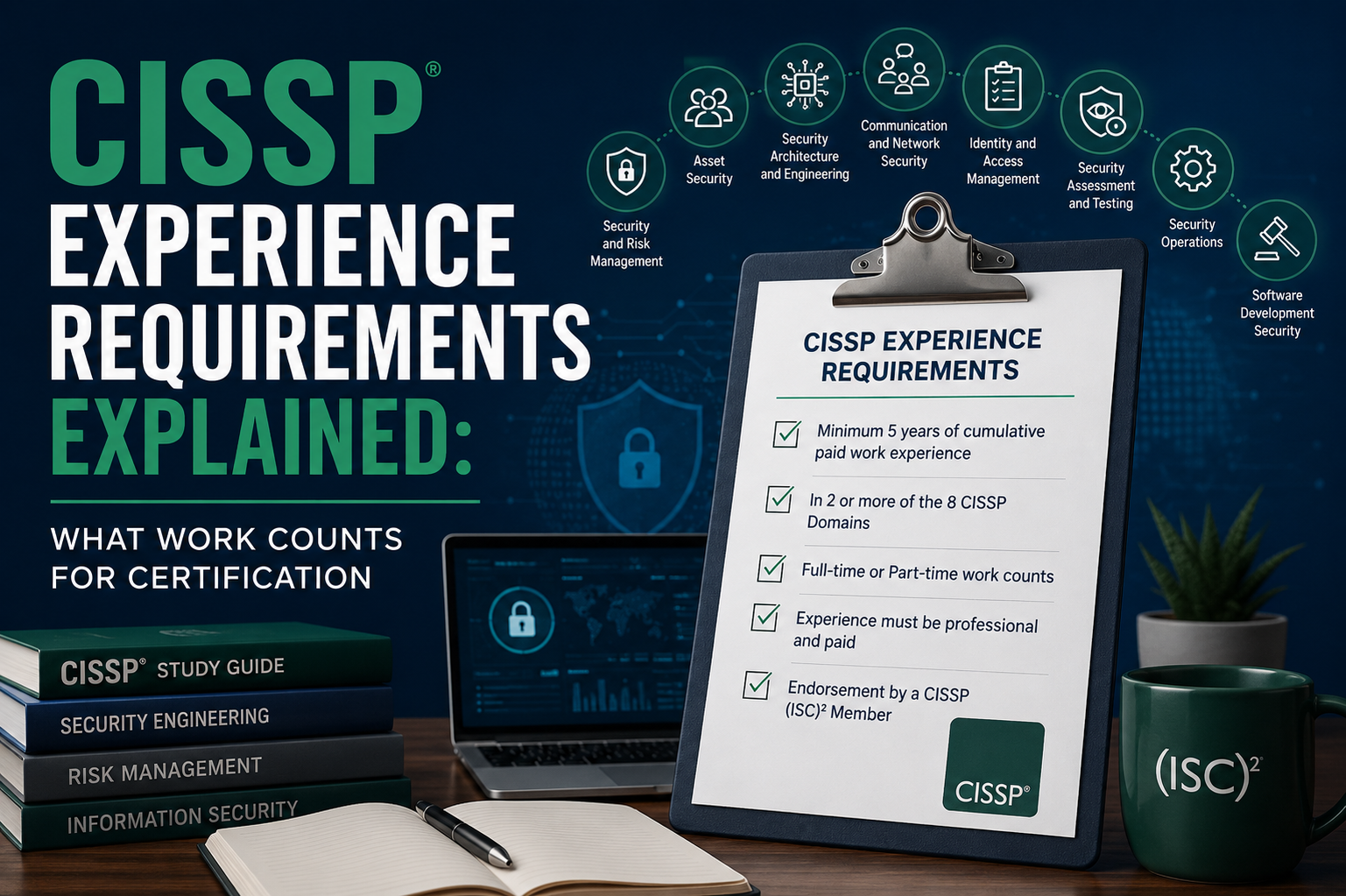
At the heart of the experience requirement is a minimum of five years of cumulative paid work experience in roles related to information security. The word “cumulative” is particularly important because it highlights that the required experience does not have to come from a single job or organization. Instead, it can be accumulated across different roles, industries, and time periods as long as the work performed aligns with recognized security responsibilities.
Many individuals mistakenly believe that only job titles that explicitly contain the word “security” qualify for this requirement. In reality, experience is evaluated based on the nature of the work performed rather than the title attached to a role. A professional might work as a systems administrator, network engineer, software developer, or IT manager while still performing tasks that contribute directly to organizational security. These responsibilities can count toward the experience requirement if they involve protecting systems, managing risks, or implementing safeguards that align with recognized security practices.
The experience evaluation process is built around eight broad domains of information security knowledge. These domains represent the core areas of expertise expected from security professionals and form the foundation for both the certification exam and the experience validation process. Rather than focusing on narrow technical tasks, the domains emphasize a wide perspective on security management, governance, architecture, and operational practices.
The first domain focuses on security and risk management. Work within this area often involves developing security policies, assessing organizational risks, establishing governance structures, and ensuring compliance with regulations or internal standards. Professionals who participate in risk assessments, help define security policies, or contribute to strategic security planning are gaining experience that aligns with this domain. Even individuals working outside traditional security teams may participate in these activities when organizations integrate risk management into broader operational processes.
Another domain centers on asset security, which involves protecting organizational information and resources. This includes understanding how data is classified, how it is stored, and how it should be handled throughout its lifecycle. Employees who work with sensitive information, design data protection policies, or implement storage and handling procedures contribute to asset security. In many organizations, data protection responsibilities extend across departments, allowing professionals from various technical roles to gain relevant experience.
Security architecture and engineering represent another major domain. This area focuses on designing and building secure systems, infrastructure, and applications. Engineers and administrators who configure secure networks, deploy protective technologies, or design resilient systems are participating in this domain. Their work contributes directly to the development of secure environments where systems can operate safely despite evolving threats.
Communication and network security is another key domain that involves protecting data as it moves through networks. Professionals responsible for configuring firewalls, monitoring network activity, managing secure communication channels, or designing network segmentation strategies are building experience within this domain. Even roles that primarily focus on networking rather than security can contribute valuable experience if security controls are part of the job responsibilities.
Identity and access management is another area of focus that involves controlling how users access systems and resources. Tasks such as managing user accounts, implementing authentication systems, defining access policies, or reviewing permissions contribute to this domain. In modern organizations where digital identity management plays a critical role in protecting systems, many IT professionals gain experience in this area through everyday administrative tasks.
Security assessment and testing is another domain that involves evaluating the effectiveness of security controls. Activities such as conducting vulnerability assessments, reviewing system configurations, testing defenses, and participating in internal audits fall into this category. Professionals who regularly evaluate systems to ensure they meet security standards are gaining valuable experience within this domain.
Security operations represent the day-to-day activities required to maintain a secure environment. This includes monitoring systems, responding to incidents, managing logs, and maintaining security tools. Many IT operations professionals spend part of their time performing tasks that fall within this domain, especially in organizations where security responsibilities are distributed across teams.
The final domain involves software development security. This domain focuses on integrating security practices into the development lifecycle of applications and software systems. Developers who implement secure coding practices, review application security requirements, or participate in testing for vulnerabilities are gaining experience relevant to this domain.
One important aspect of the experience requirement is that qualifying work must cover at least two of these domains. This requirement reflects the broad nature of information security. The certification is designed to represent professionals who understand security from multiple perspectives rather than focusing exclusively on a single narrow specialty. By requiring experience across multiple domains, the certification process ensures that candidates develop a well-rounded understanding of security challenges.
Professionals often discover that their daily responsibilities already include activities related to several of these domains. For example, a systems administrator might manage user access permissions, configure secure network settings, monitor system logs, and apply security updates. Even if the administrator’s official job title does not include the word “security,” these tasks demonstrate practical experience in multiple security domains.
Similarly, a network engineer might design network segmentation strategies, configure secure communication protocols, and monitor traffic for unusual activity. These responsibilities clearly align with several security domains and contribute to the required experience.
Another example involves software developers who integrate authentication systems, implement encryption features, and follow secure coding practices. These tasks fall within the software development security domain and may also connect to other areas such as identity management and security architecture.
The flexibility in recognizing different types of experience allows professionals from many technical backgrounds to pursue the certification. Instead of limiting eligibility to people working in dedicated security positions, the experience requirement acknowledges that security responsibilities are integrated into many roles across modern organizations.
When candidates prepare to document their experience, they must carefully describe the responsibilities they performed in previous roles. Rather than focusing only on job titles or general descriptions, they should highlight the specific security-related tasks they carried out. Clear descriptions help demonstrate how their work aligns with recognized security domains and how their responsibilities contributed to protecting systems, managing risks, or implementing security controls.
This approach also encourages professionals to reflect on the security aspects of their careers. Many individuals underestimate the amount of security work they have performed until they examine their past roles more closely. Activities such as managing system updates, enforcing access policies, conducting risk assessments, or monitoring system activity are all important components of organizational security.
Another key point about the experience requirement is that the work must be paid employment. Volunteer roles, hobby projects, or informal work typically do not count toward the requirement because the certification process focuses on professional experience within organizational environments. Paid work demonstrates that individuals have operated within structured environments where security responsibilities have real consequences for business operations and data protection.
However, the concept of cumulative experience means that the five-year requirement can be built gradually over time. Professionals may accumulate relevant experience across several positions while advancing through their careers. Someone might begin in a general IT support role, transition into system administration, and later move into a more specialized security position. Each stage of this career path can contribute toward the overall experience requirement if the responsibilities align with security domains.
The emphasis on cumulative experience also reflects the evolving nature of security careers. Many professionals enter the field from related technical disciplines rather than starting directly in security roles. By recognizing experience gained in different positions, the certification process acknowledges that expertise in security often develops through diverse career paths.
Another important aspect of the experience requirement is verification. Candidates must validate their work history and responsibilities as part of the certification process. This verification step reinforces the credibility of the credential by ensuring that experience claims are genuine and supported by professional records. Organizations responsible for evaluating experience may review documentation and confirm details about job responsibilities and employment periods.
Because of this verification process, candidates benefit from maintaining accurate records of their professional responsibilities throughout their careers. Detailed resumes, job descriptions, and documentation of projects can help demonstrate how previous work aligns with security domains.
For professionals who have not yet accumulated the full five years of required experience, there is still a pathway forward. Individuals who pass the certification exam before meeting the experience requirement can hold a temporary status while they continue gaining professional experience. During this period, they work toward completing the remaining years needed for full certification. This pathway allows motivated professionals to begin the certification process while still building their careers.
The overall structure of the experience requirement reflects a balance between theoretical knowledge and practical expertise. Passing a rigorous exam demonstrates that an individual understands security principles, but professional experience proves that those principles can be applied effectively in real environments. By combining these two elements, the certification ensures that credential holders possess both knowledge and practical capability.
For many professionals, the experience requirement initially appears intimidating. However, when they examine their career history in detail, they often discover that their roles already involve a wide range of security responsibilities. From managing user access and protecting data to designing secure networks and monitoring system activity, many IT professionals contribute to security in ways that align closely with recognized domains.
Understanding how experience is evaluated is the first step toward navigating the certification process successfully. By recognizing the broad scope of qualifying work and documenting their responsibilities carefully, professionals can build a clear picture of how their careers align with the expectations for experienced security practitioners.
How Different Types of Professional Work Contribute to CISSP Experience
Building the required professional experience for a security credential often feels complicated at first. Many professionals assume the requirement applies only to people who work full-time in dedicated security positions. In reality, the experience criteria are designed to recognize the many ways individuals contribute to protecting information systems within an organization. Security responsibilities are rarely confined to a single department, and the certification process reflects this reality.
The required experience is built on cumulative professional work. This means experience can come from multiple jobs across several years, rather than from one continuous role. Professionals frequently move through different positions while developing their careers, and each stage can contribute meaningful experience if the work involves protecting systems, managing risks, or implementing safeguards.
One of the most straightforward ways to meet the requirement is through full-time employment in roles that regularly involve security tasks. Positions such as system administrator, network engineer, security analyst, infrastructure engineer, or IT manager often include responsibilities that fall within recognized security domains. Even when security is only one part of a broader role, the tasks performed can still contribute toward the required experience.
Consider a system administrator responsible for managing servers and organizational infrastructure. On the surface, this role may appear focused on operational reliability rather than security. However, system administrators often perform several critical security-related tasks as part of their daily work. They apply operating system patches, manage system permissions, configure security settings, monitor system logs, and enforce policies that protect sensitive information. Each of these activities directly supports organizational security.
Similarly, network engineers often contribute significant security experience through their responsibilities. Designing network architecture, implementing segmentation, configuring secure communication protocols, and maintaining firewalls are all essential elements of network security. When professionals perform these activities as part of their job, they are gaining hands-on experience in protecting organizational data as it moves through digital infrastructure.
Software developers also play an important role in organizational security. Modern development practices increasingly emphasize the integration of security measures throughout the software lifecycle. Developers who implement authentication systems, incorporate encryption mechanisms, validate user input, and review code for vulnerabilities are actively contributing to application security. These activities fall within recognized security domains and can be counted as part of professional experience.
In many organizations, security responsibilities are distributed across multiple roles rather than concentrated within a single security team. Smaller organizations in particular often rely on IT professionals who manage both operational and security-related tasks. An IT generalist might maintain systems, configure network equipment, manage access control, and respond to potential security incidents. This combination of responsibilities provides valuable real-world experience across several security domains.
The key factor in determining whether work experience qualifies is the nature of the responsibilities performed. Job titles alone do not determine eligibility. Instead, the evaluation focuses on whether an individual has actively participated in activities that contribute to protecting systems, managing risks, or designing secure environments.
Professionals who want to demonstrate their experience must describe their work in a way that highlights these responsibilities. When documenting experience, it is helpful to focus on specific tasks rather than general job descriptions. Explaining how systems were secured, how risks were assessed, or how policies were implemented provides a clearer picture of the security contributions made in each role.
Another important pathway for building experience involves part-time work. Security careers do not always begin with full-time positions dedicated exclusively to cybersecurity. Some professionals gain early experience through part-time roles that involve security-related responsibilities. The certification process recognizes that individuals may work part-time while transitioning into the field or while balancing other professional commitments.
Part-time experience can contribute toward the total requirement as long as the hours meet certain minimum thresholds. To qualify, part-time work must generally involve at least twenty hours per week. This ensures that the experience reflects meaningful professional involvement rather than occasional or incidental tasks. At the same time, part-time work cannot exceed the range that would normally be considered full-time employment.
The calculation of part-time experience is typically based on total hours worked. For example, full-time employment is often measured using a forty-hour work week across a standard working year. When part-time experience is submitted, the total number of hours worked is converted into an equivalent amount of full-time experience. This approach ensures that the evaluation process remains consistent regardless of whether the work was performed on a full-time or part-time basis.
Imagine a professional who works twenty hours per week performing system administration tasks that include security responsibilities. Over time, those hours accumulate and can be converted into an equivalent amount of full-time experience. This allows individuals who begin their careers gradually to build toward the required professional experience while continuing to develop their skills.
The part-time pathway can be especially helpful for professionals who are transitioning into security from another field. Someone working in a general IT role may gradually take on more security responsibilities as they gain experience and expertise. Over time, those responsibilities can represent significant professional involvement in security-related work.
Another important source of experience comes from internships. Internships often provide an entry point into the technology industry, giving individuals the opportunity to work alongside experienced professionals while learning practical skills. Although internships are typically associated with early career stages, they can provide valuable exposure to real security challenges within organizational environments.
Internship experience can count toward the professional experience requirement if it involves relevant security tasks. These tasks must align with recognized security domains and represent meaningful contributions to organizational security practices. The key factor is that the work performed must demonstrate involvement in protecting systems, managing risks, or implementing security measures.
Internships can be either paid or unpaid, depending on the structure of the program. What matters most is the quality and relevance of the work performed during the internship. If the responsibilities involve activities such as monitoring security alerts, assisting with vulnerability assessments, supporting incident response efforts, or helping implement security policies, the experience may qualify toward the requirement.
Because internships often occur earlier in a professional’s career, documenting them carefully is particularly important. Verification of internship experience typically requires confirmation from the organization where the internship took place. This documentation helps demonstrate that the internship was a structured professional experience rather than informal or temporary involvement.
Supervisors who oversaw the internship may also be asked to confirm details about the work performed. This verification step ensures that the experience claimed accurately reflects the responsibilities carried out during the internship period. For individuals who gained valuable security exposure during internships, maintaining good communication with former supervisors can be helpful when verifying experience later in their careers.
Internships also serve another important purpose beyond accumulating experience. They introduce individuals to the practical realities of working in security environments. Students and early career professionals often gain their first exposure to security monitoring systems, incident response processes, and organizational risk management practices during internships.
Through this exposure, they develop an understanding of how theoretical knowledge translates into real-world security operations. They may observe how teams investigate potential threats, how policies are implemented across departments, and how organizations balance security needs with operational requirements. These insights contribute to a deeper understanding of the field.
Another benefit of internships is the opportunity to explore different areas of security. Some interns work with infrastructure teams responsible for securing networks and systems. Others assist application development teams that integrate security into software projects. Some may even participate in compliance and risk management activities that focus on regulatory requirements and governance frameworks.
Each of these experiences contributes to a broader perspective on information security. By working in different environments, individuals gain exposure to the diverse responsibilities that make up the security profession. This diversity of experience aligns well with the expectation that security professionals understand multiple domains rather than focusing exclusively on one narrow specialization.
As professionals accumulate experience through full-time work, part-time roles, and internships, they gradually build a portfolio of responsibilities that demonstrate their involvement in security practices. This portfolio reflects not only the number of years worked but also the range of security activities performed.
Over time, many professionals discover that their career paths naturally intersect with several security domains. A network engineer might begin by configuring infrastructure and later move into monitoring and incident response. A developer might start by writing application code and eventually become involved in secure development practices and vulnerability testing. An IT administrator might initially manage systems but later take on responsibilities related to identity management and access control.
These evolving responsibilities illustrate how security experience often develops organically within technology careers. Rather than following a rigid path, professionals gain experience by responding to the needs of their organizations and adapting to new challenges as technology environments change.
The cumulative nature of the experience requirement recognizes this reality. By allowing experience from different roles, organizations, and time periods to count toward the total requirement, the certification process reflects the diverse ways individuals contribute to protecting digital systems. Over the course of several years, professionals often develop a deep and varied understanding of security practices through the work they perform every day.
As individuals continue progressing through their careers, they may also take on leadership responsibilities that further expand their security experience. Managing security teams, developing organizational policies, coordinating incident response activities, and guiding strategic security initiatives all contribute to professional expertise within the field.
These experiences help shape professionals who understand not only the technical aspects of security but also the organizational and managerial challenges involved in protecting modern information systems. Such breadth of experience is precisely what the certification process seeks to recognize and validate.
Education, Certifications, and Verification in the CISSP Experience Process
Earning a respected security credential requires more than passing a challenging exam. The experience requirement is designed to ensure that individuals who receive the credential have a solid foundation of professional practice in real-world environments. However, the certification process also recognizes that education and other professional qualifications can contribute to a person’s development as a security professional. Because of this, certain academic achievements or related certifications may reduce the amount of work experience required.
The standard requirement calls for five years of cumulative paid work experience in roles connected to information security. Yet individuals who possess specific educational qualifications or approved professional certifications may receive credit toward that requirement. In many cases, this credit reduces the required professional experience by one year. As a result, some candidates need only four years of qualifying work experience rather than five.
This adjustment acknowledges the value of formal education and professional credentials in building foundational knowledge about security principles. Academic programs often provide structured learning in topics such as risk management, cryptography, networking, operating systems, and system architecture. These subjects form the theoretical basis for many security practices used in real-world organizations.
A degree in technology, computer science, cybersecurity, or a related discipline may qualify for the one-year experience waiver. The reasoning behind this credit is that individuals who complete a rigorous academic program have already invested substantial time studying technical and conceptual aspects of information systems. This educational background can provide a strong starting point for understanding how security mechanisms function within complex computing environments.
An advanced degree can also qualify for the same reduction in required experience. Graduate programs often explore topics such as information assurance, advanced network design, digital forensics, and security governance. These areas deepen a student’s understanding of both the technical and strategic dimensions of cybersecurity. Through research, projects, and advanced coursework, students gain insight into the challenges organizations face when protecting sensitive information.
Although academic achievements can reduce the experience requirement, the reduction is limited. A candidate can receive only one year of credit through education or through certain professional certifications, but not both. This rule ensures that all credential holders still possess a substantial amount of real-world experience before earning the full certification. Even with the reduction, candidates must still demonstrate at least four years of professional work that aligns with the recognized security domains.
This balance between education and experience highlights an important principle in the security profession. Theoretical knowledge is valuable, but it becomes truly meaningful when applied within practical situations. Organizations rely on security professionals who can interpret policies, design safeguards, and respond to evolving threats. These tasks require judgment and insight that often develop only through hands-on work.
Professional certifications in related technology or security areas may also provide credit toward the experience requirement. Many technology certifications demonstrate expertise in networking, system administration, cloud architecture, or security operations. By earning these credentials, professionals show that they have invested time and effort in developing specialized skills that support secure computing environments.
These certifications often involve rigorous examinations that test knowledge of technical systems, operational procedures, and best practices. Some focus on network security principles, others on system administration or threat detection. Regardless of their specific focus, they reflect a professional commitment to understanding the technologies and processes used to protect digital infrastructure.
Although certifications and academic degrees can contribute to professional development, they do not replace the need for meaningful workplace experience. Security professionals must be able to apply what they have learned in real environments where systems must remain operational while facing potential threats. The experience requirement ensures that individuals have encountered these challenges and developed practical strategies for addressing them.
Another essential component of the certification process is the endorsement or sponsorship step. After passing the exam and documenting professional experience, candidates must have their qualifications endorsed by a recognized professional who already holds the credential or by another approved authority. This endorsement process adds an additional layer of verification and professional accountability.
The purpose of sponsorship is to confirm that the candidate’s experience claims accurately reflect the work they have performed. The sponsor reviews the candidate’s experience documentation and verifies that the responsibilities described align with recognized security domains. By endorsing the candidate, the sponsor attests that the individual has demonstrated the professional competence expected of someone seeking the credential.
This process reinforces the professional community surrounding the certification. Experienced practitioners help maintain the integrity of the credential by ensuring that new candidates meet the established standards. It also creates a sense of professional responsibility, as sponsors must carefully evaluate the experience they are endorsing.
For many candidates, finding a sponsor involves reaching out to colleagues, supervisors, or mentors who already hold the credential. Security professionals often build strong professional networks over the course of their careers, and these networks can play an important role during the certification process. A mentor or experienced colleague who understands the candidate’s work history may be well positioned to review and confirm their experience.
The endorsement step highlights the collaborative nature of the security profession. Protecting information systems is rarely the work of a single individual. Instead, security relies on teams of professionals who combine their knowledge and experience to safeguard complex digital environments. The sponsorship requirement reflects this collective approach by involving established professionals in the certification process.
Once experience has been verified and endorsed, candidates move closer to earning the credential. However, the journey toward certification often begins long before the application process. Most security professionals gradually accumulate experience over many years while working in a variety of technical roles. These roles expose them to different aspects of system protection, risk management, and operational security.
Early career professionals might begin with responsibilities that focus primarily on maintaining systems or supporting users. Over time, they may become involved in implementing access controls, monitoring network activity, or responding to operational incidents. These experiences provide valuable insight into how security challenges arise and how organizations respond to them.
As professionals advance in their careers, they often take on more strategic responsibilities related to security governance and risk management. Instead of focusing only on technical controls, they may begin developing policies, conducting risk assessments, or designing long-term security strategies for their organizations. These activities expand their perspective from operational security to broader organizational protection.
The diversity of responsibilities encountered during a security career helps professionals develop the broad perspective required for leadership roles. Security leaders must understand how technical systems interact with business processes, regulatory requirements, and organizational goals. They must also balance competing priorities, such as maintaining usability while implementing strong protective measures.
The certification experience requirement reflects this need for broad expertise. By requiring candidates to demonstrate work across multiple security domains, the certification ensures that professionals understand security from several angles. They must be familiar with risk management principles, infrastructure protection, identity management, operational monitoring, and other critical areas.
Another aspect of the experience process involves documenting professional responsibilities in detail. Candidates must carefully describe the tasks they performed in each role and explain how those tasks align with recognized security domains. This documentation provides the foundation for evaluating whether the candidate’s work meets the required criteria.
Preparing this documentation often encourages professionals to reflect on the many ways they have contributed to organizational security throughout their careers. Tasks that once seemed routine may reveal their importance when viewed through the lens of security domains. Managing system access, reviewing audit logs, implementing encryption, and conducting system testing are all examples of activities that play vital roles in protecting information systems.
The process of documenting experience also highlights the evolving nature of the security field. Technologies, threats, and defensive strategies continue to change as organizations rely increasingly on digital infrastructure. Security professionals must continually adapt to these changes, learning new tools and developing new approaches to managing risk.
Over the years, many professionals expand their expertise by working with emerging technologies such as cloud computing, distributed systems, mobile platforms, and large-scale data environments. Each new technological shift introduces additional security considerations that professionals must address. Experience gained in these areas contributes to the broader understanding required for senior security roles.
The experience requirement ultimately serves as a safeguard for the credibility of the certification. By ensuring that credential holders have spent years working with real security challenges, the certification maintains its reputation as a mark of professional competence. Employers, colleagues, and organizations can trust that individuals who hold the credential have demonstrated both knowledge and practical ability.
For candidates pursuing the certification, the experience requirement represents an opportunity rather than merely an obstacle. It encourages professionals to build meaningful careers in information security and to develop expertise across multiple aspects of system protection. Each role they hold, each challenge they face, and each responsibility they assume contributes to the foundation of knowledge required for long-term success in the field.
Through years of practical work, professionals gain insight into how organizations protect their most valuable digital assets. They learn how security policies influence daily operations, how technology can both create and mitigate risks, and how teams collaborate to respond to emerging threats. This collective experience shapes individuals into well-rounded security professionals capable of guiding organizations through an increasingly complex digital landscape.
Translating Real-World Work into Recognized Security Experience
Translating Real Work into Security Experience
One of the most misunderstood aspects of building qualifying experience is the assumption that job titles determine eligibility. In reality, titles often reveal very little about the actual responsibilities a person performs in a technical environment. Many organizations use broad or generic titles that fail to capture the security-related nature of daily work, especially in smaller companies or hybrid IT teams where roles overlap significantly.
Security experience is evaluated based on what a person actually does, not what their business card says. This means that professionals working under titles such as systems engineer, IT support specialist, software developer, or infrastructure administrator may still accumulate substantial security experience if their responsibilities involve protecting systems, managing risks, or implementing controls.
In practice, this requires a shift in thinking. Instead of viewing experience as tied to formal job descriptions, it is more accurate to view it as a collection of tasks and responsibilities. Every activity that contributes to securing information systems can potentially form part of a candidate’s qualifying experience if it aligns with recognized security domains.
For example, a professional managing server environments might routinely configure authentication systems, enforce password policies, and monitor system logs. Although these tasks may be considered operational maintenance, they directly contribute to identity management, security operations, and system protection. When documented correctly, such responsibilities demonstrate meaningful involvement in security practices.
Similarly, a developer working on business applications may implement input validation, secure session handling, and encryption protocols. Even if the role is primarily focused on building software features, these security-related tasks can represent significant contributions to application security. The key lies in recognizing these responsibilities as part of a broader security framework rather than treating them as isolated technical tasks.
Understanding how to translate everyday work into structured experience is often one of the most important skills for candidates preparing their documentation. It requires careful reflection on past roles and an ability to identify security-relevant activities that may not have been explicitly labeled as such at the time.
When Security Work is Hidden Inside Non-Security Roles
In many organizations, security responsibilities are embedded within general IT functions. This is particularly common in environments where dedicated security teams are small or nonexistent. In these cases, IT professionals often take on security tasks alongside their primary responsibilities.
A help desk technician, for instance, may regularly reset user credentials, manage access permissions, and assist with authentication issues. While these tasks might appear routine, they are directly connected to identity and access management, which is a core area of information security. Over time, repeated involvement in such activities can contribute significantly to qualifying experience.
Likewise, network administrators may focus on maintaining connectivity and performance but also handle firewall configurations, intrusion prevention systems, and secure routing policies. These responsibilities place them squarely within communication and network security, even if their official role is not labeled as a security position.
In larger organizations, responsibilities may be more clearly divided, but even there, security is rarely isolated. System administrators, database managers, cloud engineers, and DevOps professionals often interact with security controls as part of their regular workflows. They may enforce access policies, manage encryption keys, or respond to security alerts generated by monitoring systems.
The challenge for professionals in these roles is recognizing that security experience does not require working exclusively in a security department. Instead, it emerges through consistent involvement in tasks that protect systems, enforce policies, and reduce organizational risk.
Contract, Freelance, and Consulting Experience in Security Contexts
Another important pathway for building experience involves contract-based or consulting work. Many professionals in the technology field work across multiple organizations rather than holding long-term positions within a single company. These engagements can provide valuable exposure to different systems, environments, and security challenges.
Contract work often involves implementing or maintaining systems for clients with varying security requirements. A consultant may be tasked with designing secure network architectures, conducting system audits, or assisting with compliance efforts. Each of these responsibilities contributes to recognized security domains if performed in a professional capacity.
Freelance work can also involve security-related tasks, although it must be structured in a way that reflects professional engagement rather than informal assistance. For example, a contractor who configures secure cloud environments for multiple clients is gaining experience in security architecture and operations. Similarly, a consultant who reviews application security or conducts vulnerability assessments is contributing to security assessment and testing domains.
One of the key advantages of consulting experience is exposure to diverse environments. Unlike traditional roles where systems remain relatively stable, consultants often encounter different technologies, security frameworks, and organizational policies. This diversity can strengthen a professional’s understanding of how security principles are applied across industries.
However, consulting experience must still meet the same standards of verification and documentation as traditional employment. Clear records of responsibilities, engagement duration, and client interactions are essential. Without proper documentation, it can become difficult to demonstrate the relevance and legitimacy of the work performed.
Multi-Project Environments and Cross-Domain Experience
Modern IT environments often require professionals to work across multiple projects simultaneously. In these situations, individuals may contribute to several security-related initiatives at the same time, each aligned with different aspects of information security.
For instance, a systems engineer might participate in a cloud migration project while also supporting identity management improvements and assisting with security monitoring implementation. Each of these efforts corresponds to different security domains, yet all occur within the same professional role.
This type of cross-domain experience is particularly valuable because it reflects the interconnected nature of modern security environments. Systems do not operate in isolation, and security controls often span multiple layers of infrastructure, applications, and operational processes.
Conclusion
The experience requirement for CISSP is designed to ensure that the credential represents more than theoretical knowledge. It confirms that professionals have spent meaningful time working with real systems, real risks, and real security decisions in professional environments. This practical foundation is what gives the certification its long-standing credibility in the field of information security.
Understanding what counts as experience is less about fitting into a narrow job title and more about recognizing the security value in everyday technical responsibilities. Tasks such as managing access controls, securing networks, monitoring systems, supporting users, or developing applications all contribute to building relevant expertise when they involve protecting information and reducing risk.
The flexibility in accepting different roles, part-time work, internships, and related qualifications reflects how modern security careers actually develop. Most professionals do not begin directly in dedicated security positions. Instead, they grow into the field through gradual exposure, expanding responsibilities, and hands-on problem-solving across multiple domains.
Ultimately, CISSP experience is about demonstrated involvement in safeguarding information systems over time. It values consistency, practical contribution, and a broad understanding of security principles applied in real environments. By the time candidates meet the requirement, they are expected to have developed not just knowledge, but the judgment and awareness that come from sustained professional practice in cybersecurity.