In modern digital workplaces, access to applications and data is no longer something that can be safely controlled by simple credentials alone. Organizations have moved far beyond the idea that a username and password are enough to determine whether a person should be trusted. Workforces are distributed across cities, countries, and time zones. Employees connect from personal devices, corporate laptops, mobile phones, and shared systems. Applications are hosted in multiple clouds, and sensitive data flows continuously between services. In this environment, traditional access control methods struggle to keep up.
This is where the idea behind Microsoft Entra ID Conditional Access becomes significant. Instead of relying on a single authentication event, access decisions are made dynamically, based on real-time evaluation of multiple signals. Every attempt to access a resource is treated as a new situation that must be assessed in context rather than automatically trusted.
At its core, Conditional Access is part of a broader shift toward identity-driven security. Identity is no longer just a login credential; it has become the primary control plane for security decisions. When a user attempts to sign in, the system does not simply ask whether the password is correct. It evaluates who the user is, what device they are using, where they are connecting from, and whether anything about the attempt appears unusual or risky.
This approach aligns closely with the modern security philosophy often described as zero trust. Instead of assuming trust based on network location or previous authentication, every access attempt is verified continuously. Trust is not granted permanently. It is evaluated each time access is requested.
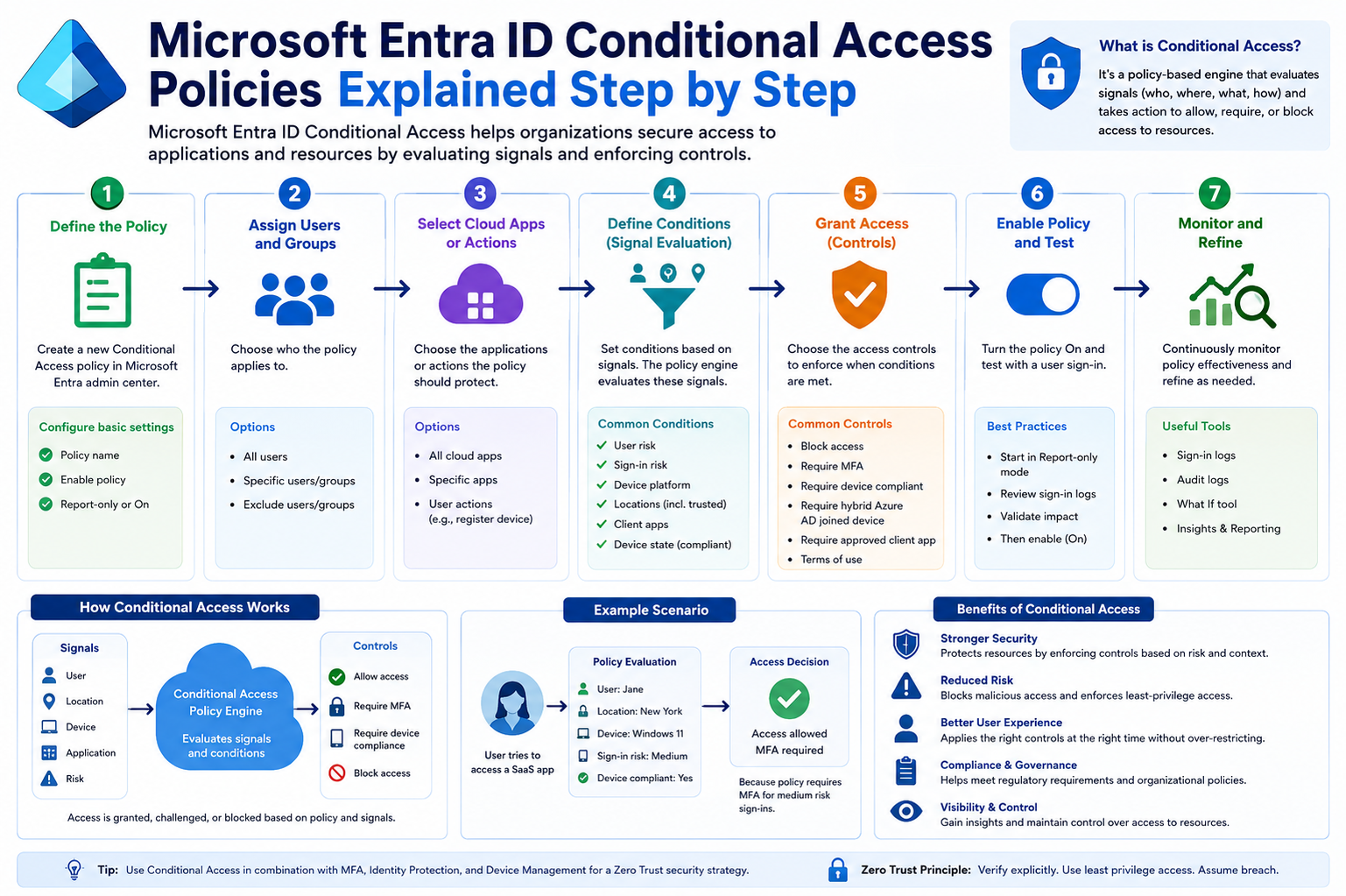
Microsoft Entra ID Conditional Access operates as a decision-making layer within identity management. It sits between the user’s sign-in attempt and the application they are trying to reach. When a request is made, it does not immediately allow or deny access. Instead, it gathers contextual information from multiple sources. These signals are then compared against predefined organizational rules that determine how access should be handled.
These signals can include identity-related information such as user roles or group membership. They can also include device-based information, such as whether the device is managed or compliant with security standards. Location is another important factor, helping determine whether a sign-in attempt is coming from a familiar or unexpected region. Risk indicators also play a major role, where unusual behavior patterns may suggest a compromised account or suspicious activity.
What makes this approach powerful is that it is not static. Security decisions are not based on fixed rules alone but are adaptive. For example, a login attempt from a trusted device in a familiar location may be allowed without interruption. The same user attempting to sign in from an unfamiliar country on a new device may be required to complete additional verification steps or may be blocked entirely.
The system effectively acts as a dynamic gatekeeper that evaluates context in real time. Rather than applying the same rule to every situation, it adjusts responses based on the level of risk associated with each access attempt.
This shift from static security to adaptive decision-making reflects the growing complexity of modern IT environments. Organizations no longer operate within fixed boundaries. Employees work remotely, contractors access systems temporarily, and business applications are accessed across multiple platforms. In such environments, rigid access rules can either become too restrictive or too weak.
Conditional Access provides a balance by introducing flexibility without sacrificing control. It allows organizations to define policies that respond intelligently to different scenarios. These policies are not just about granting or denying access but about shaping how access should occur under specific conditions.
To understand this better, it helps to think of Conditional Access as a continuous evaluation process rather than a single checkpoint. Each sign-in attempt passes through a series of checks. The system evaluates identity, device posture, location, application sensitivity, and risk signals before making a decision. This process happens almost instantly, ensuring that security does not slow down the user experience unnecessarily.
Another important aspect of this approach is its alignment with modern threat landscapes. Cybersecurity threats have become more sophisticated and less predictable. Attackers often use stolen credentials, compromised devices, or unusual access patterns to bypass traditional defenses. Static security rules are often insufficient to detect these behaviors.
By incorporating contextual signals, Conditional Access adds an additional layer of intelligence. It can identify when something does not fit expected patterns and respond accordingly. This might include requiring additional authentication steps or restricting access entirely.
Identity plays a central role in this system. Every access decision starts with verifying who the user is. But identity alone is not enough. It must be combined with contextual information to build a complete picture of the access attempt. This layered approach helps reduce the risk of unauthorized access while minimizing disruption for legitimate users.
Device context is another critical component. Not all devices pose the same level of risk. A managed corporate laptop that meets security requirements is considered more trustworthy than an unknown personal device. By evaluating device health and compliance status, Conditional Access can enforce policies that ensure only secure devices are allowed to access sensitive resources.
Location-based signals add another layer of intelligence. While remote work is now common, unusual geographic patterns can indicate potential threats. For example, a login attempt from a region where the user has never previously accessed the system may trigger additional verification steps.
Risk-based evaluation further enhances security by analyzing behavioral patterns. If a sign-in attempt appears unusual compared to the user’s normal activity, the system can respond more cautiously. This helps detect potential account compromise even when credentials are correct.
All these signals come together to form a comprehensive decision-making framework. Rather than relying on any single factor, Conditional Access evaluates multiple dimensions simultaneously. This reduces the likelihood of false trust while maintaining a smooth user experience when conditions are safe.
The flexibility of this system allows organizations to adapt security policies to their specific needs. Different users, applications, and scenarios can be treated differently based on their importance and sensitivity. For example, access to financial systems may require stricter controls than access to general communication tools. Similarly, administrators may be subject to stronger authentication requirements than standard users.
This layered and adaptive approach reflects a broader transformation in how organizations think about security. Instead of building walls around networks, they are focusing on securing identities and controlling access at the point of interaction.
As digital environments continue to evolve, the importance of adaptive access control systems becomes even more significant. The ability to evaluate context in real time and respond intelligently to changing conditions is becoming a foundational requirement for secure operations.
How Adaptive Access Decisions Are Evaluated and Enforced
When a user attempts to access an application protected by Microsoft Entra ID Conditional Access, the system begins a detailed evaluation process in the background. This process is not visible to the user, but it plays a critical role in determining whether access is granted smoothly, restricted, or challenged with additional security steps.
The evaluation begins the moment a sign-in request is received. Instead of treating the request as a simple yes-or-no decision, the system collects a wide range of contextual signals. These signals help build a real-time profile of the access attempt. The goal is to understand not just who is requesting access, but also under what conditions the request is being made.
Identity is the first and most fundamental signal. The system identifies the user account attempting to sign in and determines whether it belongs to an individual, a group, or a specific organizational role. This helps define baseline expectations for access behavior. For example, administrative accounts are typically subject to stricter scrutiny than regular user accounts due to their elevated privileges.
Once identity is established, attention shifts to the application being accessed. Not all applications carry the same level of sensitivity. Some contain highly confidential data, while others are used for general productivity. Conditional Access allows different rules to be applied depending on the importance of the application. Access to sensitive systems may require stronger verification methods, while less critical tools may allow smoother entry.
Device information is another essential factor in the decision-making process. The system evaluates whether the device being used is known, managed, and compliant with organizational standards. Managed devices often follow security policies that enforce encryption, antivirus protection, and system updates. These devices are considered lower risk compared to unmanaged or unknown devices.
When a device does not meet compliance standards, Conditional Access can enforce restrictions. Instead of allowing full access, it may require the user to bring the device into compliance first or apply additional authentication steps before granting access.
Location-based evaluation adds another layer of context. The system assesses where the sign-in request originates. Familiar locations may be considered lower risk, while unfamiliar or unexpected locations can raise suspicion. However, location alone does not determine the final decision. It is always evaluated alongside other signals.
Risk detection plays a particularly important role in modern environments. The system continuously analyzes sign-in behavior patterns to detect anomalies. If a login attempt appears unusual compared to the user’s normal activity, it may be flagged as risky. This does not automatically mean the attempt is malicious, but it does trigger additional safeguards.
Once all signals are collected, the system compares them against predefined policies. These policies define how different conditions should be handled. Each policy consists of conditions and access controls. Conditions define the scenario being evaluated, while access controls define the response.
Access controls determine what happens next. In some cases, access is allowed without interruption. In other cases, additional authentication steps are required. This often includes multi-factor authentication, where the user must verify their identity using an additional method beyond their password. In more sensitive situations, access may be blocked entirely.
There are also session-based controls that influence what happens after access is granted. Instead of simply allowing entry and ending the evaluation, Conditional Access can continue to monitor the session. It can enforce limitations such as requiring re-authentication after a certain period or restricting the ability to download sensitive data.
This continuous control model ensures that security does not end at the point of login. Instead, it extends throughout the entire session, adapting as conditions change.
One of the strengths of this approach is its ability to balance security with usability. Not every sign-in attempt is treated as suspicious. When conditions are normal and low risk, users experience minimal friction. This helps maintain productivity while still enforcing security where it matters most.
At the same time, the system is capable of escalating security requirements when necessary. If a user attempts to sign in under unusual circumstances, the system can respond with stronger authentication requirements or restrict access entirely. This dynamic response model ensures that security is proportional to risk.
The enforcement mechanism is also highly flexible. Policies can be applied to specific users, groups, applications, or scenarios. This allows organizations to tailor their security posture to different business needs. For example, executives handling sensitive financial data may be subject to stricter policies than employees accessing general communication tools.
Similarly, external users such as partners or contractors may be subject to more restrictive access conditions than internal employees. This helps reduce risk while still enabling collaboration across organizational boundaries.
The integration of multiple signals into a single decision-making process is what makes Conditional Access particularly effective. Instead of relying on isolated factors, it builds a comprehensive view of each access attempt. This reduces the chances of both false positives and false negatives.
As environments become more complex, this type of adaptive evaluation becomes increasingly important. Static rules cannot easily account for the wide range of scenarios that occur in modern digital ecosystems. Conditional Access addresses this challenge by continuously adjusting its decisions based on real-time context.
Designing, Applying, and Managing Adaptive Access Strategies at Scale
Implementing adaptive access control in a large organization requires careful planning and thoughtful design. Microsoft Entra ID Conditional Access is powerful, but its effectiveness depends on how well policies are structured, tested, and maintained over time. Without proper design, even a strong security system can become difficult to manage or overly restrictive for users.
The first step in designing access strategies is understanding the different types of users within an organization. Not all users interact with systems in the same way. Some access highly sensitive data regularly, while others use basic tools for communication and collaboration. Identifying these differences is essential for building meaningful policies.
Once user roles are understood, attention shifts to applications and data sensitivity. Different systems carry different levels of importance. Financial systems, identity management tools, and administrative interfaces require stronger protection than general productivity applications. This variation forms the basis for layered security design.
A well-designed strategy avoids applying a single rule across all users and applications. Instead, it builds multiple layers of control that reflect real-world usage patterns. This ensures that security measures are appropriate rather than excessive or insufficient.
Policy design also involves deciding how strict conditions should be under different circumstances. For example, access from trusted devices within familiar environments may require minimal verification. However, access from unknown devices or unusual locations may require stronger authentication steps.
One of the most important aspects of design is balancing security with usability. Overly strict policies can frustrate users and disrupt productivity. On the other hand, overly lenient policies can expose the organization to unnecessary risk. The goal is to find a middle ground where security is strong but not disruptive.
Testing plays a crucial role in this process. Before policies are applied broadly, they are typically tested in controlled environments or limited user groups. This allows administrators to observe how policies behave in real scenarios without affecting the entire organization. Adjustments can then be made based on observed behavior.
Once policies are deployed, ongoing monitoring becomes essential. Security environments are not static. User behavior, device landscapes, and threat patterns change over time. Policies that work well today may need adjustment in the future. Continuous evaluation ensures that access controls remain effective and relevant.
Scalability is another important consideration. As organizations grow, the number of users, devices, and applications increases significantly. Conditional Access must be able to handle this complexity without becoming unmanageable. This requires structured policy design, clear naming conventions, and consistent governance practices.
Governance ensures that policies remain organized and understandable. Without proper governance, access rules can become fragmented and difficult to maintain. Clear documentation of policy intent and scope helps ensure long-term sustainability.
Another important aspect of management is handling exceptions. In some cases, users may require temporary access outside normal policy conditions. These exceptions must be carefully controlled to avoid weakening overall security. Temporary adjustments should be monitored and reviewed to ensure they do not become permanent gaps.
Over time, organizations often refine their access strategies based on observed patterns. For example, if certain conditions consistently trigger unnecessary security prompts, policies may be adjusted to improve usability without compromising safety. Similarly, if new types of threats emerge, policies may be strengthened accordingly.
Troubleshooting also plays a role in ongoing management. When users experience access issues, administrators must be able to identify which condition or policy is responsible. Understanding how different signals interact helps in diagnosing and resolving access problems efficiently.
As digital environments continue to evolve, adaptive access control becomes more central to overall security strategy. It is no longer just a technical feature but a foundational element of identity-based security architecture. The ability to evaluate context, enforce dynamic policies, and adapt to changing conditions is essential for maintaining secure and productive operations in modern organizations.
Over time, organizations increasingly rely on this adaptive model not just for protection but for enabling secure collaboration across diverse environments, devices, and user groups.
Signal Intelligence, and Real-Time Identity Defense in Conditional Access Systems
As identity systems evolve into the central control point of enterprise security, Microsoft Entra ID Conditional Access becomes more than a policy engine. It functions as a continuously operating decision layer embedded within a broader identity security architecture. Its effectiveness depends not only on how policies are written, but also on how deeply it is integrated with surrounding systems, how signals are interpreted, and how consistently decisions are enforced across environments.
At scale, Conditional Access is not a standalone feature. It becomes part of a distributed security architecture where identity, device management, risk evaluation, and application access all interact dynamically. Understanding this architecture is essential for designing resilient security frameworks that remain effective even as organizational complexity increases.
Architecting Conditional Access in Large Identity Ecosystems
In large environments, identity systems are rarely isolated. They interact with multiple layers of infrastructure, including cloud applications, on-premises resources, endpoint management systems, and external identity providers. Within this ecosystem, Microsoft Entra ID acts as the central identity authority, while Conditional Access serves as the real-time enforcement layer that evaluates access behavior.
At a structural level, every authentication request passes through a chain of identity validation, policy evaluation, and token issuance. Conditional Access sits between authentication and authorization, ensuring that access decisions are not purely based on credential validity. Instead, every request is evaluated within a contextual framework that considers risk, device posture, and environmental signals.
This architecture enables a shift from perimeter-based security to identity-centric enforcement. Instead of relying on network boundaries, the system evaluates trust at the moment of access. This is particularly important in hybrid environments where users may connect from corporate networks, home environments, or public networks without any consistent perimeter boundary.
Within this model, Conditional Access policies are not static rules but dynamic decision layers that can vary based on user context. The same user may receive different access outcomes depending on the device, location, or risk state at the time of login. This variability is intentional and reflects the adaptive nature of modern security architecture.
Signal Intelligence and Decision Enrichment
One of the most important aspects of Conditional Access is its reliance on signal aggregation. Each access request is enriched with multiple layers of contextual information before a decision is made. These signals are continuously updated and evaluated in real time.
Identity signals include user attributes, group membership, and assigned roles. These define baseline expectations for access privileges. Device signals provide information about the health, compliance state, and trust level of the endpoint being used. Location signals help identify whether access attempts originate from familiar or unusual geographic regions.
Behavioral signals are particularly significant in modern threat detection. These signals analyze patterns of user activity over time. When behavior deviates from established norms, it may indicate account compromise or unauthorized access attempts. Instead of relying on a single indicator, Conditional Access evaluates combinations of signals to determine risk.
This multi-layered signal intelligence allows the system to make nuanced decisions. A single unusual factor does not necessarily trigger a block. Instead, the system evaluates the overall risk profile of the sign-in attempt. This prevents unnecessary disruptions while maintaining strong security enforcement.
Over time, these signals contribute to a more adaptive security posture. The system learns from interaction patterns and adjusts responses based on observed behavior. While not fully autonomous, this adaptive layer significantly improves the accuracy of access decisions.
Continuous Access Evaluation and Session Security
Traditional authentication systems focus primarily on the moment of login. Once access is granted, the session is often considered trusted until expiration. Conditional Access introduces a more dynamic approach by extending evaluation beyond initial authentication.
Continuous access evaluation allows security policies to remain active throughout the user session. Instead of treating login as a single event, the system monitors session behavior and can respond to changes in risk conditions. If a user’s risk level changes during a session, access can be re-evaluated without requiring a full sign-out and sign-in cycle.
This approach significantly improves security responsiveness. For example, if a device becomes non-compliant during an active session or if unusual behavior is detected, the system can enforce restrictions or revoke access tokens. This ensures that security is not limited to initial authentication but remains active throughout the lifecycle of the session.
Session-level controls also allow administrators to define how long users remain authenticated, how frequently re-authentication is required, and what actions are permitted during active sessions. These controls help reduce the risk of unauthorized data access even after initial login approval.
Integration with Endpoint Management and Compliance Systems
Conditional Access becomes significantly more powerful when integrated with endpoint management solutions such as Microsoft Intune, a core component of Microsoft Intune. This integration allows identity decisions to be influenced by device compliance states.
Device compliance policies define whether a device meets organizational security requirements. These requirements may include encryption standards, operating system version, antivirus status, and configuration settings. When a device does not meet compliance criteria, Conditional Access can restrict or block access to sensitive resources.
This integration creates a unified security model where identity and device posture are evaluated together. Instead of treating devices and identities as separate entities, the system evaluates them as a combined trust framework.
For example, a user logging in from a compliant corporate device may experience seamless access, while the same user on a non-compliant personal device may be required to complete additional authentication steps or be restricted from accessing sensitive applications.
This relationship between identity and device management strengthens the overall security posture by ensuring that access decisions are not based solely on credentials.
Risk-Based Identity Protection Synergy
Conditional Access also works closely with identity protection systems such as Microsoft Entra ID Protection within Microsoft Entra ID. These systems analyze sign-in behavior and assign risk levels based on detected anomalies.
Risk detection mechanisms evaluate patterns such as unfamiliar sign-in locations, impossible travel scenarios, leaked credentials, or unusual access behavior. When risk is detected, it is assigned a severity level that influences Conditional Access decisions.
High-risk sign-ins may be blocked automatically, while medium-risk sign-ins may require additional verification. Low-risk sign-ins may proceed without interruption. This dynamic response ensures that security actions are proportional to the level of threat.
The synergy between Conditional Access and identity protection systems enables a more intelligent security framework. Instead of relying on static rules, decisions are continuously informed by real-time risk analysis.
This integration is particularly effective in preventing account compromise scenarios where attackers attempt to use valid credentials from unfamiliar environments. Even if credentials are correct, risk signals can trigger protective actions before access is granted.
Policy Conflict, Priority, and Resolution Behavior
In complex environments, multiple Conditional Access policies often apply to the same user or application. Understanding how these policies interact is critical for maintaining predictable security behavior.
When multiple policies are triggered, the system evaluates all applicable conditions and enforces the most restrictive outcome. This ensures that security is not weakened when multiple rules overlap. Instead, the strictest applicable control takes precedence.
Policy conflicts are resolved based on evaluation logic that considers both scope and condition specificity. Policies targeting broader groups may be overridden by more specific policies that apply to particular users or applications.
This layered resolution model allows organizations to build flexible policy structures without creating ambiguity in access decisions. However, it also requires careful planning to avoid unintended restrictions or overly permissive configurations.
Clear policy design and structured grouping strategies help reduce complexity and ensure predictable outcomes. Without proper structure, overlapping policies can lead to inconsistent user experiences or unexpected access behavior.
Operational Monitoring and Security Observability
Monitoring Conditional Access activity is essential for maintaining visibility into access patterns and policy effectiveness. Every sign-in attempt generates logs that capture detailed information about evaluation results, applied policies, and final outcomes.
These logs provide insight into how policies are functioning in real-world conditions. They help administrators identify trends such as frequent authentication challenges, blocked sign-ins, or unusual access patterns.
Operational visibility is critical for both security and usability. From a security perspective, logs help detect potential threats or misconfigurations. From a usability perspective, they help identify policies that may be too restrictive or causing unnecessary friction.
Over time, this data supports continuous improvement of security policies. Administrators can refine conditions, adjust thresholds, and optimize access controls based on real usage patterns.
Observability also plays a key role in incident response. When suspicious activity is detected, logs provide the necessary context to understand how access decisions were made and what signals contributed to those decisions.
Common Design Pitfalls and Structural Weaknesses
Despite its flexibility, Conditional Access can become difficult to manage if not designed carefully. One common issue is excessive policy fragmentation. When too many overlapping policies exist, it becomes difficult to predict how access decisions will be applied.
Another challenge is overly restrictive configuration. While strong security is important, overly aggressive policies can disrupt productivity and lead to user frustration. This often occurs when policies are applied uniformly without considering differences in user roles or application sensitivity.
Inconsistent use of groups and roles can also create complexity. Without clear identity structure, policies may become difficult to maintain and scale. This can lead to unintended access restrictions or security gaps.
Another structural weakness arises when organizations fail to regularly review and update policies. As environments evolve, outdated policies may no longer reflect current risk conditions or business needs.
Avoiding these pitfalls requires disciplined policy governance, clear documentation, and continuous evaluation of security effectiveness.
Adaptive Security Evolution in Hybrid Environments
Modern organizations operate in hybrid environments where cloud and on-premises systems coexist. In such environments, identity becomes the unifying layer that connects disparate systems.
Conditional Access plays a central role in enabling secure hybrid operations. It allows organizations to apply consistent access controls across different environments while still adapting to contextual differences.
As hybrid environments continue to expand, the need for adaptive security becomes even more critical. Static boundaries are no longer sufficient to define trust. Instead, trust must be continuously evaluated based on real-time conditions.
This evolution reflects a broader shift in cybersecurity thinking. Security is no longer a perimeter but a continuous process of evaluation and response. Identity becomes the foundation of this model, and Conditional Access becomes the mechanism that enforces it.
In this evolving landscape, access decisions are no longer simple binary outcomes. They are dynamic, context-aware responses that reflect the complexity of modern digital ecosystems.
Governance, Automation, Zero Trust Maturity, and the Future of Adaptive Identity Security
As organizations expand their digital ecosystems, Conditional Access evolves from a configuration feature into a governance discipline. It is no longer enough to simply create policies that control access. The real challenge lies in managing those policies over time, ensuring they remain aligned with business needs, security risks, and user behavior changes. At scale, Microsoft Entra ID Conditional Access becomes part of a broader identity governance framework that defines how trust is established, maintained, and continuously validated.
This stage of maturity is where identity security shifts from reactive control to proactive governance. Instead of responding to threats after they occur, organizations begin shaping access behavior through structured policy design, automation, and lifecycle management.
Governance as the Foundation of Conditional Access Strategy
In complex environments, Conditional Access policies accumulate rapidly. Different teams create rules for specific applications, user groups, compliance needs, and risk scenarios. Over time, this leads to a layered policy environment that can become difficult to interpret without strong governance structures.
Governance introduces order into this complexity. It ensures that every policy has a clear purpose, defined ownership, and measurable impact. Without governance, Conditional Access risks becoming fragmented, where overlapping rules produce inconsistent access behavior.
A mature governance model starts with classification. Policies are categorized based on intent, such as baseline security enforcement, high-risk protection, privileged access control, or guest access restrictions. This categorization helps administrators understand how policies interact and which ones take precedence in different scenarios.
Ownership is another critical element. Every policy must have a responsible owner who understands its purpose and maintains it over time. This prevents policy drift, where rules remain active long after their original intent becomes outdated.
Documentation also plays a key role in governance. Clear descriptions of policy logic, conditions, and expected outcomes ensure that future administrators can interpret configurations without confusion. In large environments, undocumented policies can become hidden risks that affect access without being fully understood.
Policy Lifecycle Management and Continuous Optimization
Conditional Access policies are not static configurations. They exist within a lifecycle that begins with design, moves through testing and deployment, and continues into monitoring and optimization.
During the design phase, policies are aligned with security objectives and business requirements. This stage involves identifying risk scenarios, defining access conditions, and determining enforcement actions. The goal is to ensure that each policy addresses a specific security need without overlapping unnecessarily with others.
Testing is essential before full deployment. Policies are often introduced in controlled environments or limited user groups to observe their behavior. This helps identify unintended consequences, such as excessive authentication prompts or blocked access to legitimate users.
Once deployed, policies enter the monitoring phase. This is where real-world usage data becomes critical. Administrators analyze sign-in logs, access patterns, and enforcement outcomes to determine whether policies are functioning as intended.
Over time, policies must be optimized. Optimization may involve adjusting conditions, refining user groups, or modifying enforcement strength. For example, a policy that initially required strict multi-factor authentication for all users may be adjusted to apply only to high-risk sign-ins once behavior patterns are better understood.
Lifecycle management ensures that Conditional Access remains adaptive rather than rigid. Without continuous optimization, even well-designed policies can become misaligned with evolving organizational needs.
Automation and Policy Intelligence at Scale
As environments grow, manual policy management becomes increasingly inefficient. This is where automation begins to play a critical role in Conditional Access strategy. Automation does not replace human decision-making but enhances it by reducing repetitive tasks and improving response speed.
Within Microsoft Entra ID, automation is often driven by risk signals, identity protection insights, and compliance data. When unusual behavior is detected, automated policies can enforce actions such as requiring additional authentication or blocking access entirely.
Integration with Microsoft Entra ID Protection enables automated risk-based responses. If a sign-in attempt is classified as high risk, Conditional Access can automatically enforce stronger authentication requirements or restrict access until the risk is resolved.
This reduces the need for manual intervention while ensuring rapid response to potential threats. Automation is particularly valuable in environments where large volumes of sign-in events occur continuously.
Automation also extends to policy lifecycle management. Some organizations implement automated reviews that identify unused or redundant policies. Others use automation to suggest policy improvements based on observed access patterns.
However, automation must be carefully controlled. Over-automation can lead to unpredictable access behavior if not properly governed. The goal is to enhance decision-making, not replace oversight.
Zero Trust Maturity and Conditional Access Evolution
Conditional Access is a core component of the Zero Trust security model. In a mature Zero Trust environment, no user or device is inherently trusted. Every access attempt is evaluated based on identity, context, and risk.
As organizations progress in Zero Trust maturity, Conditional Access policies become more granular and context-aware. Early-stage implementations may focus on basic multi-factor authentication and device compliance. More mature environments introduce dynamic risk evaluation, session control, and continuous access monitoring.
In advanced Zero Trust models, trust is never static. It is continuously reassessed throughout the user session. This means that access decisions are not final at login but can change based on evolving conditions.
For example, a user may begin a session on a compliant device in a trusted location. However, if the device later becomes non-compliant or the user behavior changes significantly, access can be restricted or revoked dynamically.
This continuous validation approach reflects the core principle of Zero Trust: never assume trust, always verify.
As maturity increases, Conditional Access becomes more integrated with other identity systems, including privileged identity management and identity governance frameworks within Microsoft Entra ID. This creates a unified security architecture where access is consistently evaluated across all identity interactions.
Privileged Access and High-Risk Identity Protection
Privileged accounts represent one of the highest risk categories in any organization. These accounts have elevated permissions and can make system-wide changes. As a result, they require stricter Conditional Access policies.
In mature environments, privileged access is often subject to additional verification layers. This may include mandatory multi-factor authentication, restricted access locations, or time-bound access approvals.
Conditional Access plays a key role in enforcing these restrictions dynamically. Instead of granting permanent elevated access, systems can require just-in-time authentication based on real-time context.
Privileged Identity Management within Microsoft Entra ID supports this approach by allowing temporary elevation of privileges. Conditional Access ensures that even these temporary privileges are protected by contextual security checks.
This reduces the risk of privilege abuse while still allowing administrators to perform necessary tasks. It also ensures that elevated access is always monitored and controlled.
High-risk identity protection extends this concept further by analyzing behavioral anomalies associated with privileged accounts. If unusual activity is detected, Conditional Access can enforce immediate restrictions or require re-authentication.
Emergency Access and Resilience Planning
In any identity system, resilience is as important as security. Organizations must ensure that access remains available even in exceptional circumstances, such as system misconfigurations or authentication failures.
Emergency access accounts are a critical part of this resilience strategy. These accounts are designed to bypass certain Conditional Access restrictions in controlled scenarios, ensuring that administrators can regain control of the environment if needed.
However, emergency access must be carefully protected. Conditional Access policies are often designed to monitor and restrict how these accounts are used. Even when bypassing standard rules, logging and auditing remain active.
This ensures that emergency access is not misused while still providing a fallback mechanism for critical situations.
Resilience planning also includes redundancy in policy design. Organizations must ensure that Conditional Access configurations do not create single points of failure that could lock out legitimate users.
Human Behavior and Security Experience Design
While Conditional Access is a technical system, its effectiveness is heavily influenced by human behavior. Security decisions directly affect user experience, and poorly designed policies can lead to frustration, workarounds, or reduced productivity.
Understanding user behavior is therefore an essential part of policy design. Frequent authentication prompts, unexpected access blocks, or inconsistent enforcement can lead users to develop unsafe habits, such as reusing sessions or avoiding secure workflows.
A well-designed Conditional Access strategy aims to minimize unnecessary friction while maintaining strong security. This requires careful balancing of authentication frequency, risk thresholds, and session controls.
User experience design in identity security is not about removing security steps but about applying them intelligently. Users should only be challenged when there is meaningful risk. When conditions are safe, access should remain smooth and uninterrupted.
This balance improves both security compliance and user satisfaction, ensuring that security measures are accepted rather than resisted.
Conclusion
Microsoft Extra ID Conditional Access represents a major shift in how organizations approach identity security. Instead of relying on fixed rules or static authentication methods, it introduces a dynamic model where every access attempt is evaluated in real time. This approach recognizes that trust cannot be assumed permanently and must instead be continuously validated based on context, risk, and behavior.
By combining signals such as user identity, device health, location, and risk level, Conditional Access enables organizations to make more informed security decisions. This reduces reliance on passwords alone and strengthens protection against modern threats such as credential theft, phishing, and unauthorized access from compromised devices. At the same time, it helps maintain a smooth user experience by only introducing additional security steps when necessary.
One of its most important strengths is flexibility. Organizations can tailor policies to match different users, applications, and risk scenarios. This ensures that security is not applied in a one-size-fits-all manner but is instead aligned with real-world business needs. High-risk access attempts can be restricted or challenged, while low-risk scenarios remain seamless and uninterrupted.
Conditional Access also supports broader security strategies such as Zero Trust, where no user or device is automatically trusted. Every interaction is verified continuously, creating a more resilient and adaptive security posture.
As digital environments continue to grow in complexity, Conditional Access plays a critical role in bridging security and usability. It allows organizations to stay protected without sacrificing productivity, making it a foundational element of modern identity-driven security architecture.