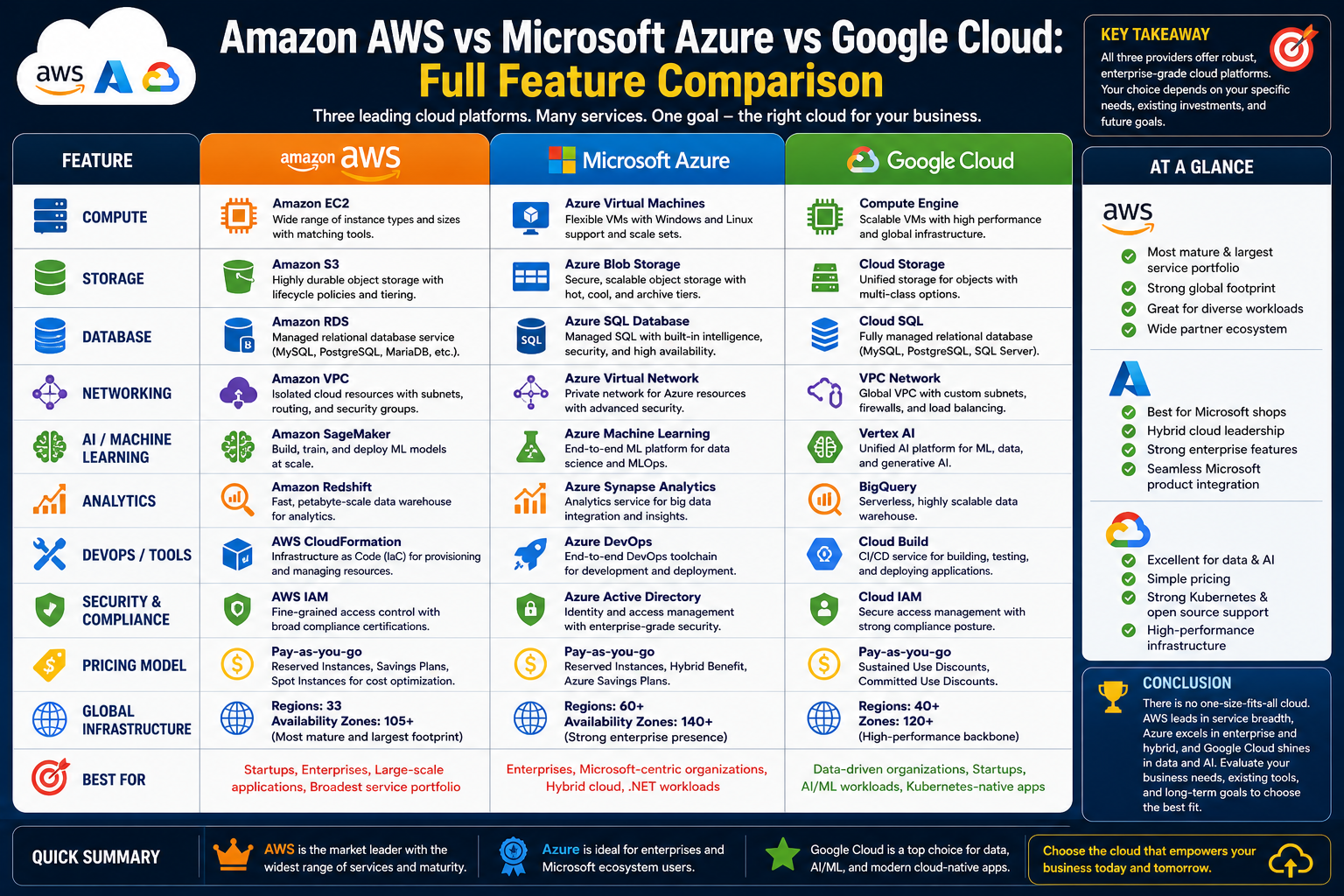
The competition among Amazon Web Services, Microsoft Azure, and Google Cloud represents one of the most significant shifts in modern computing. What once required organizations to invest heavily in physical servers, data centers, and maintenance teams has now transformed into a flexible, on-demand model where computing power is rented over the internet. This transformation has not only changed how businesses operate but has also redefined how software is built, deployed, and scaled.
Cloud computing is no longer an experimental technology or a future consideration. It has become the foundation of modern digital infrastructure. From streaming services and mobile applications to financial systems and government operations, nearly every digital service relies on cloud platforms in some form. As a result, the choice between cloud providers is no longer a technical detail handled by engineers in isolation. It is a strategic decision that can influence cost efficiency, innovation speed, global expansion, and long-term business resilience.
At the center of this transformation are three dominant providers. Amazon Web Services, Microsoft Azure, and Google Cloud Platform have established themselves as the primary forces in the cloud ecosystem. While dozens of other providers exist, these three control a significant share of the global market and shape industry standards. Each brings a different philosophy, history, and technological focus to the table, which makes the competition both intense and highly specialized.
Although all three platforms offer similar core capabilities such as computing power, storage systems, networking, and databases, the way they approach these services differs significantly. These differences influence which industries gravitate toward each provider and how organizations design their digital strategies. Understanding this competition requires looking beyond surface-level features and into the deeper architectural and strategic decisions that define each platform.
AWS and the Foundation of Large-Scale Cloud Computing
Amazon Web Services is widely recognized as the pioneer of modern cloud computing. It entered the market earlier than its major competitors and effectively defined what cloud infrastructure would look like for the rest of the industry. This early start allowed AWS to mature its services, refine its offerings, and build a vast global infrastructure that now spans numerous regions and availability zones.
One of the key reasons AWS maintains a strong position is the sheer depth and breadth of its service ecosystem. Over time, it has expanded far beyond basic computing and storage. It now includes advanced tools for artificial intelligence, machine learning, data analytics, Internet of Things integration, serverless computing, container orchestration, and enterprise security. This extensive catalog allows organizations to build almost any type of digital system without leaving the AWS environment.
The maturity of AWS services also plays a critical role in its dominance. Because it has been in the market longer than its competitors, many of its services are more refined and battle-tested. Large enterprises often rely on AWS because it provides stability at scale. Systems that must handle millions of transactions per second or support global user bases benefit from the reliability that AWS infrastructure offers.
Another defining characteristic of AWS is its flexibility. It is designed to support a wide range of workloads, from small experimental applications to massive enterprise systems. This adaptability makes it attractive to organizations at different stages of growth. Startups can begin with simple services and gradually expand into more complex architectures without changing platforms.
However, this flexibility comes with complexity. The vast number of services available within AWS can make it difficult for new users to navigate. There are multiple ways to achieve the same outcome, and selecting the right configuration often requires experience. As a result, organizations sometimes face challenges in managing costs and optimizing architecture effectively.
Despite this complexity, AWS remains widely regarded as the most comprehensive cloud ecosystem available. Its long-standing presence, continuous innovation, and global infrastructure contribute to its reputation as a foundational pillar of cloud computing.
Microsoft Azure and Its Enterprise-Centric Approach
Microsoft Azure entered the cloud market after AWS but quickly established itself as a strong competitor, particularly within enterprise environments. Its growth has been closely tied to Microsoft’s existing dominance in business software, operating systems, and productivity tools. This connection has played a major role in how Azure is adopted across industries.
One of Azure’s defining strengths is its integration with existing Microsoft technologies. Many organizations already rely on tools such as Windows Server, Active Directory, and Microsoft 365. Azure fits naturally into this ecosystem, allowing businesses to extend their on-premises environments into the cloud without completely redesigning their infrastructure. This hybrid approach has made Azure especially attractive to large enterprises and government institutions that require gradual migration strategies rather than complete overhauls.
Hybrid cloud capability is one of Azure’s strongest strategic advantages. Instead of forcing organizations to move entirely to the cloud, Azure supports environments where on-premises systems and cloud services coexist. This flexibility is particularly important for industries with strict regulatory requirements or legacy systems that cannot be easily replaced.
Azure has also invested heavily in expanding its global infrastructure. It operates numerous data centers across multiple regions, enabling organizations to deploy applications closer to their users and meet data residency requirements. This global reach supports both performance optimization and compliance needs.
Another important aspect of Azure’s growth is its increasing openness to non-Microsoft technologies. While it was once primarily associated with Windows-based environments, it now supports Linux, open-source frameworks, and third-party development tools. This shift reflects a broader industry trend toward interoperability and flexibility, allowing Azure to appeal to a wider audience.
In addition to infrastructure services, Azure offers a wide range of enterprise-focused tools, including identity management, security solutions, analytics platforms, and developer services. These tools are designed to support large-scale business operations where governance, compliance, and integration are critical.
Azure’s position in the cloud market is strongly tied to its ability to serve organizations that prioritize continuity, enterprise integration, and hybrid deployment strategies. Rather than competing purely on service variety, it emphasizes seamless integration with existing business environments.
Google Cloud and Its Focus on Data Intelligence and Innovation
Google Cloud Platform represents a different philosophy compared to AWS and Azure. While it may not match the scale or market share of its competitors, it has carved out a strong identity centered on data analytics, artificial intelligence, and modern application development practices.
Google’s background in handling massive-scale consumer services such as search, video streaming, and advertising has heavily influenced its cloud strategy. It was built on an internal infrastructure designed to process enormous volumes of data efficiently. This heritage gives Google Cloud a strong foundation in distributed computing, data processing, and machine learning.
One of the key strengths of Google Cloud is its leadership in data analytics and artificial intelligence. It provides advanced tools for processing large datasets, building machine learning models, and extracting insights from complex information systems. These capabilities are particularly valuable for organizations that rely heavily on data-driven decision-making.
Google Cloud also emphasizes containerization and open-source technologies. The development of Kubernetes, one of the most widely used container orchestration systems, has significantly influenced modern application architecture. This focus on containers and microservices aligns with the broader industry shift toward modular, scalable systems that can be deployed across multiple environments.
Another defining characteristic of Google Cloud is its commitment to open standards. It often promotes interoperability and avoids locking users into proprietary systems. This approach appeals to developers and organizations that prefer flexibility and portability across different platforms.
Despite its strengths, Google Cloud has a smaller service portfolio compared to AWS and Azure. While it covers essential areas such as computing, storage, and networking, its range of specialized enterprise services is more limited. This can make it less suitable for organizations that require highly customized or niche cloud solutions.
However, its strength lies in innovation rather than breadth. Google Cloud often introduces advanced technologies in areas such as data processing, artificial intelligence, and machine learning before they become widely adopted elsewhere. This positions it as a platform for organizations focused on cutting-edge digital transformation rather than traditional enterprise infrastructure.
Emerging Differences in Positioning and Strategic Direction
Although AWS, Azure, and Google Cloud offer similar foundational services, their strategic directions differ significantly. These differences influence how organizations select and use each platform.
AWS tends to position itself as a comprehensive, all-purpose cloud ecosystem. Its goal is to provide every possible tool an organization might need, regardless of industry or scale. This approach makes it highly versatile but also complex to navigate.
Azure focuses on integration and hybrid environments. It is designed to extend existing enterprise systems into the cloud rather than replace them entirely. This makes it especially appealing to organizations with established infrastructure and long-term enterprise commitments.
Google Cloud, on the other hand, prioritizes innovation in data and intelligence. It is optimized for organizations that want to leverage advanced analytics, machine learning, and modern application architectures. While it may not offer the same breadth of services, it excels in areas that require deep computational and analytical capabilities.
These differing approaches create a diverse cloud ecosystem where no single provider dominates every aspect of the market. Instead, each provider has established strengths that appeal to different types of users and use cases.
Economic Models of Cloud Consumption and How Value Is Measured
One of the most important yet least understood aspects of cloud computing is how cost is structured and how value is actually measured over time. While cloud platforms are often described as “pay-as-you-go,” this phrase hides a much more complex reality. AWS, Microsoft Azure, and Google Cloud each implement consumption-based pricing, but the way resources are packaged, billed, and optimized varies significantly.
At a basic level, all three providers charge for compute power, storage usage, and network traffic. However, the way these resources are broken down into billable units can differ. Compute resources might be charged by the second, minute, or hour, depending on configuration. Storage might be priced based on performance tier, redundancy level, or geographic location. Even network traffic can be categorized differently depending on whether data is moving between regions, availability zones, or external endpoints.
AWS typically offers the widest range of pricing models due to its extensive service catalog. It provides on-demand pricing for flexibility, reserved capacity for predictable workloads, and spot-based pricing for opportunistic workloads. This layered structure allows organizations to optimize costs, but it also introduces complexity in decision-making.
Azure takes a slightly more structured approach, often bundling services into enterprise agreements that align with organizational commitments. This makes cost forecasting more predictable for large enterprises but may reduce flexibility for smaller or rapidly changing workloads. Azure’s pricing strategy is closely aligned with enterprise procurement models, which is one of the reasons it is widely adopted in large organizations.
Google Cloud tends to emphasize sustained-use discounts and automatic cost reductions over time. Instead of requiring users to pre-commit to long-term contracts, it often rewards continuous usage. This approach simplifies pricing for many developers but may not always provide the same level of granular control seen in AWS.
The underlying challenge across all platforms is that cloud cost is not static. It evolves based on architecture decisions, scaling behavior, and usage patterns. This makes financial planning in cloud environments fundamentally different from traditional infrastructure budgeting.
Hidden Complexity of Pricing and Cost Management
Although cloud computing is often promoted as cost-efficient, the reality is that managing expenses in large-scale cloud environments can become extremely complex. This complexity arises from the dynamic nature of cloud resources, where services can be created, scaled, and terminated within seconds.
One of the most significant cost challenges is resource sprawl. In cloud environments, it is easy to create virtual machines, databases, and storage resources without strict oversight. Over time, unused or underutilized resources accumulate, leading to unnecessary expenses. This issue is particularly common in development environments where temporary resources are not always properly decommissioned.
Another challenge is the variability of workloads. Unlike traditional infrastructure, where capacity is fixed, cloud systems scale dynamically based on demand. While this elasticity is beneficial for performance, it can make cost prediction difficult. Sudden spikes in usage can lead to unexpected billing increases, especially in applications with unpredictable traffic patterns.
Each cloud provider offers cost management tools, but their effectiveness depends on how well organizations integrate them into their operational processes. AWS provides detailed billing reports and cost allocation tools that allow users to break down expenses by service or project. Azure integrates cost management into enterprise governance frameworks, enabling organizations to align spending with business units. Google Cloud focuses on simplicity and automated recommendations to optimize usage.
Despite these tools, cost optimization remains an ongoing discipline rather than a one-time configuration. Organizations must continuously monitor usage patterns, adjust scaling policies, and refine architectural decisions to maintain financial efficiency.
Architectural Philosophies Behind Each Platform
Beyond pricing and services, the most fundamental differences between AWS, Azure, and Google Cloud lie in their architectural philosophies. These philosophies influence how systems are designed, deployed, and scaled across each platform.
AWS architecture is built around modularity and service independence. Each service is designed to function as a building block that can be combined with others to create complex systems. This approach provides maximum flexibility but requires careful design to ensure systems remain maintainable and efficient.
Azure architecture is strongly influenced by enterprise integration. It is designed to work seamlessly with existing Microsoft environments and traditional IT infrastructure. This means many Azure services are optimized for hybrid deployment scenarios where cloud and on-premises systems operate together. The architecture emphasizes consistency and integration over fragmentation.
Google Cloud architecture is heavily influenced by its internal systems, which were designed for massive-scale distributed computing. This results in a strong focus on automation, containerization, and microservices. Google Cloud encourages developers to build applications that are stateless, scalable, and highly modular.
These architectural differences shape how applications evolve. Systems built on AWS often become highly customized and service-oriented. Systems built on Azure tend to integrate deeply with enterprise identity and governance structures. Systems built on Google Cloud often prioritize scalability and data-driven design principles.
Identity, Security, and Compliance Ecosystems
Security is one of the most critical factors in cloud adoption, and each provider approaches it differently based on its ecosystem and target audience.
AWS offers a highly granular security model that allows users to define detailed permissions for every service and resource. This level of control is powerful but can become complex in large environments. Security policies are often managed through identity and access management systems that require careful configuration.
Azure places strong emphasis on identity management as a core security layer. It integrates deeply with enterprise identity systems, allowing organizations to manage user access across cloud and on-premises environments. This unified identity approach simplifies governance in large organizations and supports strict compliance requirements.
Google Cloud takes a more automated approach to security. It emphasizes default security configurations, encryption by default, and minimal manual intervention. Its model is designed to reduce human error by enforcing secure practices at the platform level rather than relying heavily on manual configuration.
Compliance is another major consideration across all three platforms. Each provider supports a wide range of certifications and regulatory standards, including financial regulations, healthcare requirements, and government security frameworks. However, the way compliance is implemented differs. AWS provides extensive customization for compliance controls, Azure integrates compliance into enterprise governance frameworks, and Google Cloud focuses on simplifying compliance through automation.
Hybrid and Multi-Cloud Strategies in Practice
Modern enterprises rarely rely on a single cloud provider. Instead, many adopt hybrid or multi-cloud strategies that combine different platforms based on workload requirements, cost considerations, and risk management.
Hybrid cloud environments combine on-premises infrastructure with public cloud services. This approach is particularly common in industries that require strict data control or have legacy systems that cannot be easily migrated. Azure is often a preferred choice in hybrid scenarios due to its strong integration with traditional enterprise systems and support for seamless connectivity between environments.
Multi-cloud strategies involve using more than one cloud provider simultaneously. Organizations may use AWS for core infrastructure, Azure for enterprise integration, and Google Cloud for data analytics. This approach reduces dependency on a single vendor and allows businesses to take advantage of the strengths of each platform.
However, multi-cloud environments introduce operational complexity. Managing multiple platforms requires consistent security policies, unified monitoring systems, and cross-platform interoperability. Data movement between clouds can also introduce latency and cost challenges.
Despite these challenges, multi-cloud adoption continues to grow as organizations seek flexibility and resilience. It allows businesses to avoid vendor lock-in while optimizing workloads based on specific platform strengths.
Developer Experience and Tooling Ecosystems
The developer experience across AWS, Azure, and Google Cloud plays a significant role in how quickly organizations can build and deploy applications.
AWS provides a vast set of tools and APIs that support nearly every aspect of application development. However, the sheer number of services can make it difficult for developers to identify the best solution for a given problem. Once mastered, AWS offers powerful capabilities for building highly customized systems.
Azure focuses heavily on integrated development environments and enterprise development workflows. It provides strong support for enterprise application development, particularly in environments that rely on Microsoft development tools. This makes it easier for developers already familiar with Microsoft ecosystems to transition into cloud development.
Google Cloud emphasizes simplicity and developer productivity. Its tools are designed to reduce operational overhead and encourage rapid experimentation. It integrates strongly with open-source tools and modern development frameworks, making it popular among developers working on scalable web applications and data-intensive systems.
The differences in developer experience reflect the broader philosophies of each provider. AWS prioritizes depth and flexibility, Azure prioritizes enterprise integration, and Google Cloud prioritizes simplicity and innovation.
Data Platforms and Analytics Ecosystem Differences
Data processing and analytics have become central to cloud computing, and each provider has developed unique strengths in this area.
AWS offers a wide range of data services that support everything from real-time streaming to large-scale data warehousing. Its ecosystem allows organizations to build complex data pipelines that integrate multiple sources and processing engines.
Azure integrates analytics deeply into enterprise systems, enabling organizations to combine operational data with business intelligence tools. It is particularly strong in environments where data must be shared across departments and integrated into existing reporting systems.
Google Cloud is widely recognized for its leadership in data analytics and machine learning. Its systems are designed to process massive datasets efficiently and extract meaningful insights using advanced algorithms. This makes it especially popular among organizations focused on artificial intelligence and predictive analytics.
Each platform supports modern data architectures, but the emphasis differs. AWS focuses on flexibility, Azure focuses on integration, and Google Cloud focuses on intelligence and automation.
Global Infrastructure and Network Design
The physical infrastructure behind cloud platforms plays a critical role in performance, reliability, and scalability. AWS, Azure, and Google Cloud all operate global networks of data centers, but their design philosophies differ.
AWS has the largest global footprint, with a vast number of availability zones and regions. This allows it to support applications that require low latency and high availability across multiple geographic locations.
Azure has also built a strong global presence, with a particular emphasis on regional coverage and compliance zones. Its infrastructure is designed to support enterprise workloads that require data residency and regulatory alignment.
Google Cloud focuses on high-performance networking and data transfer efficiency. Its infrastructure is built on the same global network that supports Google’s own services, which gives it a strong advantage in data routing and internal communication efficiency.
Network design also influences application performance. AWS prioritizes redundancy and scalability, Azure emphasizes enterprise-grade connectivity, and Google Cloud focuses on speed and optimization of data flow.
Industry-Specific Adoption Patterns Across Cloud Platforms
Different industries tend to gravitate toward specific cloud platforms based on their operational needs and technical requirements.
Financial services organizations often prefer AWS due to its mature security controls and extensive service ecosystem. Its ability to support large-scale transactional systems makes it suitable for banking and payment systems.
Enterprise organizations with existing Microsoft infrastructure frequently adopt Azure because of its seamless integration with Windows-based systems and enterprise identity management tools. This reduces migration complexity and operational disruption.
Technology companies and data-driven organizations often choose Google Cloud for its strengths in analytics, machine learning, and containerized application development. Its open-source approach and innovation focus align well with modern software development practices.
Startups tend to evaluate all three platforms based on cost efficiency, scalability, and available development tools. Their choice often depends on the type of product being built and the anticipated growth trajectory.
Government organizations require strict compliance, security, and reliability, which leads them to carefully evaluate AWS and Azure based on regulatory certifications and infrastructure guarantees.
Each industry’s adoption pattern reflects not only technical requirements but also organizational culture and long-term strategic goals.
The Next Phase of Cloud Computing and the Shift Toward Intelligent Infrastructure
The competition between AWS, Microsoft Azure, and Google Cloud is no longer limited to infrastructure capacity or service catalog size. It is increasingly defined by how each platform evolves toward intelligent, automated, and deeply integrated computing environments. The cloud is no longer just a place to host applications; it is becoming the foundation for decision-making systems, autonomous scaling, and real-time digital ecosystems.
This shift represents a transition from infrastructure-centric computing to intelligence-centric computing. Instead of simply providing virtual machines and storage, cloud providers are embedding advanced analytics, machine learning capabilities, automation engines, and predictive systems directly into their platforms. As a result, organizations are no longer just consuming infrastructure; they are consuming intelligence as a service.
AWS continues to expand its ecosystem with highly specialized tools that support automation, predictive scaling, and distributed computing. Azure is integrating cloud intelligence into enterprise workflows, enabling organizations to connect operational systems with decision-making frameworks. Google Cloud is pushing aggressively into AI-first infrastructure, leveraging its long-standing expertise in large-scale data processing and machine learning research.
These developments signal that the future of cloud computing will not be defined solely by infrastructure competition but by how effectively each provider transforms raw data into actionable intelligence.
Artificial Intelligence as the Central Competitive Layer
Artificial intelligence has become one of the most important battlegrounds in cloud computing. Each of the major providers is investing heavily in machine learning platforms, generative AI services, and model training infrastructure. However, their approaches differ significantly in design philosophy and integration strategy.
AWS focuses on providing a broad set of machine learning tools that allow developers to build, train, and deploy models at scale. Its approach is modular, allowing users to choose from pre-built models or design custom solutions depending on their needs. This flexibility supports a wide range of industries, from retail forecasting to fraud detection systems.
Microsoft Azure integrates artificial intelligence directly into enterprise workflows. Rather than treating AI as a standalone service, it embeds intelligence into productivity tools, business applications, and enterprise analytics systems. This allows organizations to apply AI without fundamentally changing their existing operational structures.
Google Cloud takes a research-driven approach, leveraging its deep expertise in machine learning and data science. It focuses heavily on model performance, scalability, and advanced neural network architectures. Its systems are designed to process massive datasets and deliver highly optimized AI outputs.
The competition in AI is not just about who offers the most advanced models but about how seamlessly AI can be integrated into everyday business processes. This integration is becoming the defining factor in cloud platform selection for many organizations.
The Rise of Serverless Computing and Event-Driven Architecture
One of the most transformative developments in cloud computing is the rise of serverless architecture. In traditional systems, developers must manage servers, scaling policies, and infrastructure maintenance. Serverless computing removes this responsibility by allowing applications to run without direct server management.
AWS pioneered this approach with early serverless offerings that enabled developers to execute code in response to events without provisioning infrastructure. This model significantly reduced operational overhead and introduced a new way of thinking about application design.
Azure adopted serverless computing by integrating it into enterprise workflows and business automation systems. Its approach focuses on enabling event-driven processes within organizational systems, allowing businesses to automate tasks across multiple applications and services.
Google Cloud also supports serverless computing with a strong emphasis on simplicity and scalability. Its implementation is tightly integrated with container-based architectures and modern application frameworks, making it particularly attractive for developers building microservices-based systems.
Serverless computing is fundamentally changing how applications are designed. Instead of thinking in terms of servers and infrastructure, developers now think in terms of events, triggers, and functions. This shift reduces complexity but introduces new challenges in monitoring, debugging, and cost prediction.
Edge Computing and the Expansion Beyond Centralized Data Centers
As digital systems become more distributed, the importance of edge computing has increased significantly. Edge computing refers to processing data closer to where it is generated rather than relying solely on centralized data centers.
AWS has developed edge computing capabilities that allow data processing to occur in multiple geographic locations, reducing latency and improving responsiveness for applications such as gaming, streaming, and industrial automation.
Azure has integrated edge computing into its hybrid cloud strategy, enabling organizations to extend cloud capabilities into on-premises environments and remote locations. This approach is particularly valuable for industries that require real-time processing and strict data control.
Google Cloud leverages its global network infrastructure to support edge computing in highly distributed environments. Its focus is on optimizing data flow and minimizing latency for applications that require rapid decision-making.
Edge computing is becoming increasingly important as technologies such as autonomous systems, smart cities, and Internet-connected devices continue to expand. These systems require real-time processing capabilities that cannot rely solely on distant cloud data centers.
Multi-Cloud Reality and the End of Single-Platform Dependency
Although cloud providers compete aggressively, the reality of modern enterprise architecture is moving toward multi-cloud environments. Organizations are increasingly using multiple cloud platforms simultaneously rather than relying on a single provider.
This shift is driven by several factors. First, different cloud platforms offer different strengths. AWS may be preferred for infrastructure-heavy workloads, Azure for enterprise integration, and Google Cloud for analytics and AI. Second, multi-cloud strategies reduce dependency on a single vendor, which helps mitigate risk. Third, regulatory requirements in some industries require data to be distributed across multiple environments.
However, multi-cloud adoption introduces significant complexity. Managing multiple platforms requires unified governance frameworks, consistent security policies, and integrated monitoring systems. Data transfer between clouds can also introduce latency and additional costs.
Despite these challenges, multi-cloud environments are becoming the norm rather than the exception. The cloud ecosystem is evolving toward interoperability, where systems are designed to operate across multiple providers seamlessly.
Security Evolution and the Shift Toward Zero Trust Models
Security in cloud computing has evolved significantly over time. Traditional perimeter-based security models are no longer sufficient in environments where systems are distributed across multiple platforms and accessed from various locations.
Modern cloud security is increasingly based on the zero trust model, which assumes that no user or system should be trusted by default, even if they are inside the network perimeter. Instead, every request is verified, authenticated, and authorized continuously.
AWS provides highly granular security controls that allow organizations to define detailed access policies. This flexibility enables complex security architectures but requires careful management to avoid misconfigurations.
Azure integrates security deeply into identity management systems, making user authentication and access control central to its security model. This is particularly useful for large enterprises that require unified identity governance across multiple systems.
Google Cloud emphasizes automated security enforcement, reducing reliance on manual configuration. It builds security into the default behavior of its systems, helping minimize human error and configuration mistakes.
Security is no longer a separate layer in cloud computing. It is embedded into every aspect of infrastructure, application design, and data management.
Sustainability and the Environmental Impact of Cloud Infrastructure
As cloud computing continues to grow, environmental sustainability has become an important consideration. Data centers consume significant amounts of energy, and cloud providers are under increasing pressure to reduce their environmental footprint.
AWS has made substantial investments in renewable energy projects and energy-efficient data center designs. It focuses on optimizing resource utilization to reduce waste and improve efficiency.
Microsoft Azure has committed to long-term sustainability goals, including carbon reduction and renewable energy integration. It is also exploring carbon-negative initiatives to offset environmental impact.
Google Cloud has positioned sustainability as a core part of its infrastructure strategy. It emphasizes energy-efficient computing and has made efforts to match its global operations with renewable energy sources.
Sustainability is becoming a competitive factor in cloud selection. Organizations are increasingly considering environmental impact when choosing infrastructure providers, especially as regulatory frameworks evolve.
The Changing Nature of Cloud Skills and Workforce Demand
The evolution of cloud computing is also transforming the skills required in the technology workforce. Traditional system administration roles are shifting toward cloud architecture, automation engineering, and data-driven infrastructure management.
AWS skills often focus on understanding a wide range of services and how they integrate into complex architectures. Azure skills emphasize enterprise integration, identity management, and hybrid cloud operations. Google Cloud skills are increasingly centered on data analytics, machine learning, and containerized application development.
As cloud platforms continue to evolve, the demand for professionals who understand multi-cloud environments is growing. Organizations are looking for individuals who can design systems that operate across different providers while maintaining performance, security, and cost efficiency.
Automation is also reducing the need for manual infrastructure management. This is shifting the focus of cloud roles toward strategic design, optimization, and governance rather than routine maintenance.
Governance, Compliance, and Digital Regulation Pressure
Governance and compliance have become central to cloud adoption, particularly as regulations around data privacy and digital sovereignty continue to expand globally.
AWS provides extensive tools for policy enforcement, audit tracking, and compliance reporting. These tools allow organizations to build highly controlled environments that meet regulatory requirements.
Azure integrates governance into enterprise management systems, enabling organizations to align cloud operations with corporate policies and regulatory frameworks. This is particularly important for industries such as healthcare, finance, and government operations.
Google Cloud emphasizes transparency and automated compliance controls. It provides tools that help organizations maintain regulatory alignment without requiring extensive manual configuration.
As regulations become more complex, cloud governance is evolving into a continuous process rather than a static configuration. Organizations must constantly monitor compliance status and adapt to changing legal requirements.
The Increasing Role of Automation and Autonomous Cloud Systems
Automation is becoming one of the defining characteristics of modern cloud platforms. Rather than relying on manual configuration and management, cloud systems are increasingly capable of self-optimization.
AWS uses automation to manage scaling, load balancing, and infrastructure provisioning. This allows systems to adjust dynamically based on demand.
Azure integrates automation into enterprise workflows, enabling business processes to trigger automated cloud actions. This creates tightly connected systems where business logic and infrastructure behavior are linked.
Google Cloud focuses heavily on autonomous system behavior, using machine learning to optimize resource allocation, performance, and cost efficiency automatically.
The long-term direction of cloud computing appears to be moving toward fully autonomous infrastructure systems that require minimal human intervention. These systems will continuously optimize themselves based on performance metrics, usage patterns, and predictive analytics.
Long-Term Evolution of Cloud Ecosystems and Competitive Dynamics
The competitive landscape between AWS, Azure, and Google Cloud is not static. It continues to evolve as new technologies emerge and enterprise needs change. While AWS currently maintains a leadership position in terms of scale and service breadth, Azure continues to expand its enterprise dominance through integration strategies. Google Cloud continues to strengthen its position in data intelligence and AI-driven systems.
The future of cloud computing will likely not be defined by a single dominant provider but by a more interconnected ecosystem where each platform plays a specialized role. Organizations will increasingly adopt hybrid and multi-cloud strategies that leverage the strengths of each provider simultaneously.
As cloud platforms continue to evolve, the boundaries between infrastructure, intelligence, and application development will continue to blur. Computing will become more distributed, more automated, and more deeply integrated into every aspect of digital systems.
Conclusion
The competition between AWS, Microsoft Azure, and Google Cloud represents far more than a market rivalry between three technology companies. It reflects a fundamental transformation in how computing is delivered, consumed, and integrated into everyday business operations. What began as a shift from physical servers to virtual infrastructure has now evolved into a global ecosystem where computing power, data intelligence, automation, and security are delivered as interconnected services at scale.
Across the cloud industry, one clear pattern stands out: there is no single universal winner for every scenario. Instead, each provider has developed distinct strengths shaped by its history, design philosophy, and target audience. AWS continues to lead through scale, maturity, and service breadth. Azure strengthens its position through enterprise integration, hybrid capabilities, and alignment with existing business ecosystems. Google Cloud advances through innovation in data analytics, artificial intelligence, and open-source-driven architecture. These differences ensure that the cloud landscape remains competitive, diverse, and continuously evolving.
One of the most important realizations in this cloud era is that technology decisions are no longer purely technical. They are strategic, financial, and operational decisions that influence long-term business direction. Choosing a cloud provider impacts how quickly an organization can innovate, how efficiently it can scale, how securely it can operate, and how effectively it can respond to changing market demands. As a result, cloud platforms have become deeply embedded in corporate strategy rather than functioning as isolated infrastructure tools.
Another defining aspect of this competition is the increasing convergence of services. While AWS, Azure, and Google Cloud began with distinct identities, they are gradually moving toward similar foundational offerings. All three now provide compute, storage, networking, artificial intelligence, analytics, and serverless capabilities. However, even as their service catalogs converge, their execution models remain different. AWS prioritizes flexibility and depth, Azure emphasizes integration and enterprise continuity, and Google Cloud focuses on intelligence and optimization. This convergence means that differentiation is no longer about what services exist, but how effectively they are delivered and integrated.
The rise of multi-cloud and hybrid cloud strategies further reinforces this reality. Very few organizations today rely exclusively on a single cloud provider. Instead, businesses distribute workloads based on performance requirements, cost efficiency, regulatory compliance, and technical specialization. This approach reduces dependency on any single vendor while allowing organizations to take advantage of the unique strengths each platform offers. However, it also introduces complexity in governance, security, and interoperability, requiring more advanced cloud management practices.
At the same time, cloud computing is becoming increasingly intelligent. The integration of artificial intelligence, machine learning, and automation into cloud platforms is transforming them from passive infrastructure providers into active decision-making systems. Cloud environments are now capable of optimizing workloads, predicting demand, detecting anomalies, and even suggesting architectural improvements. This shift represents a major step toward autonomous computing environments where human intervention becomes less frequent and more strategic.
Security and compliance have also evolved into central pillars of cloud adoption. As data becomes more distributed and regulations become more stringent, cloud providers are embedding security deeper into their architectures. Identity management, encryption, access control, and governance frameworks are no longer optional layers but core components of cloud design. This evolution reflects the growing importance of trust in digital infrastructure, especially for industries such as finance, healthcare, and government operations.
Another important dimension is sustainability. As cloud infrastructure expands globally, energy consumption and environmental impact have become critical considerations. Providers are investing in renewable energy, efficient data center designs, and carbon reduction initiatives. This shift demonstrates that cloud computing is not only shaping digital transformation but also influencing environmental responsibility in the technology sector.
From a workforce perspective, cloud computing continues to reshape skill requirements across the IT industry. Traditional infrastructure roles are being replaced by cloud architects, automation engineers, data specialists, and AI-focused developers. The emphasis is shifting from manual system administration to strategic design, optimization, and orchestration of distributed systems. Professionals are increasingly expected to understand not just one platform but the relationships between multiple cloud environments.
Looking at the broader trajectory of cloud computing, it is clear that the industry is moving toward deeper abstraction, greater automation, and more intelligent infrastructure. The boundaries between infrastructure, platform, and software are gradually dissolving. Applications are becoming more distributed, data is becoming more central, and computing resources are becoming more elastic and responsive to demand.
Ultimately, the competition between AWS, Azure, and Google Cloud is not about eliminating one another but about driving continuous innovation across the entire industry. Each platform pushes the others to evolve, improve, and expand their capabilities. This competitive dynamic benefits organizations and developers by accelerating technological progress and expanding the range of available tools and services.
As cloud computing continues to mature, it will remain a foundational element of digital transformation. Its influence will extend beyond IT departments into business strategy, product development, customer experience, and even global infrastructure planning. The evolution of cloud platforms is, in many ways, the evolution of modern computing itself—an ongoing shift toward a more connected, intelligent, and automated digital world.