Cloud computing has reshaped how organizations store data, deploy applications, and manage digital infrastructure. Among the major cloud platforms, Microsoft Azure has become a central choice for enterprises that already rely on Microsoft technologies. As organizations migrate workloads to the cloud, security becomes one of the most critical concerns. It is no longer enough to simply move systems online; businesses must ensure that identities, applications, and data remain protected in an environment that is constantly exposed to external threats.
Azure security is built around the idea that protection must be layered, adaptive, and continuously monitored. Unlike traditional on-premises systems where security was often perimeter-based, cloud environments require a more dynamic approach. Resources are distributed, users connect from multiple locations, and services interact across complex architectures. This shift has made cloud security a specialized discipline, requiring professionals who understand both infrastructure and cyber defense principles.
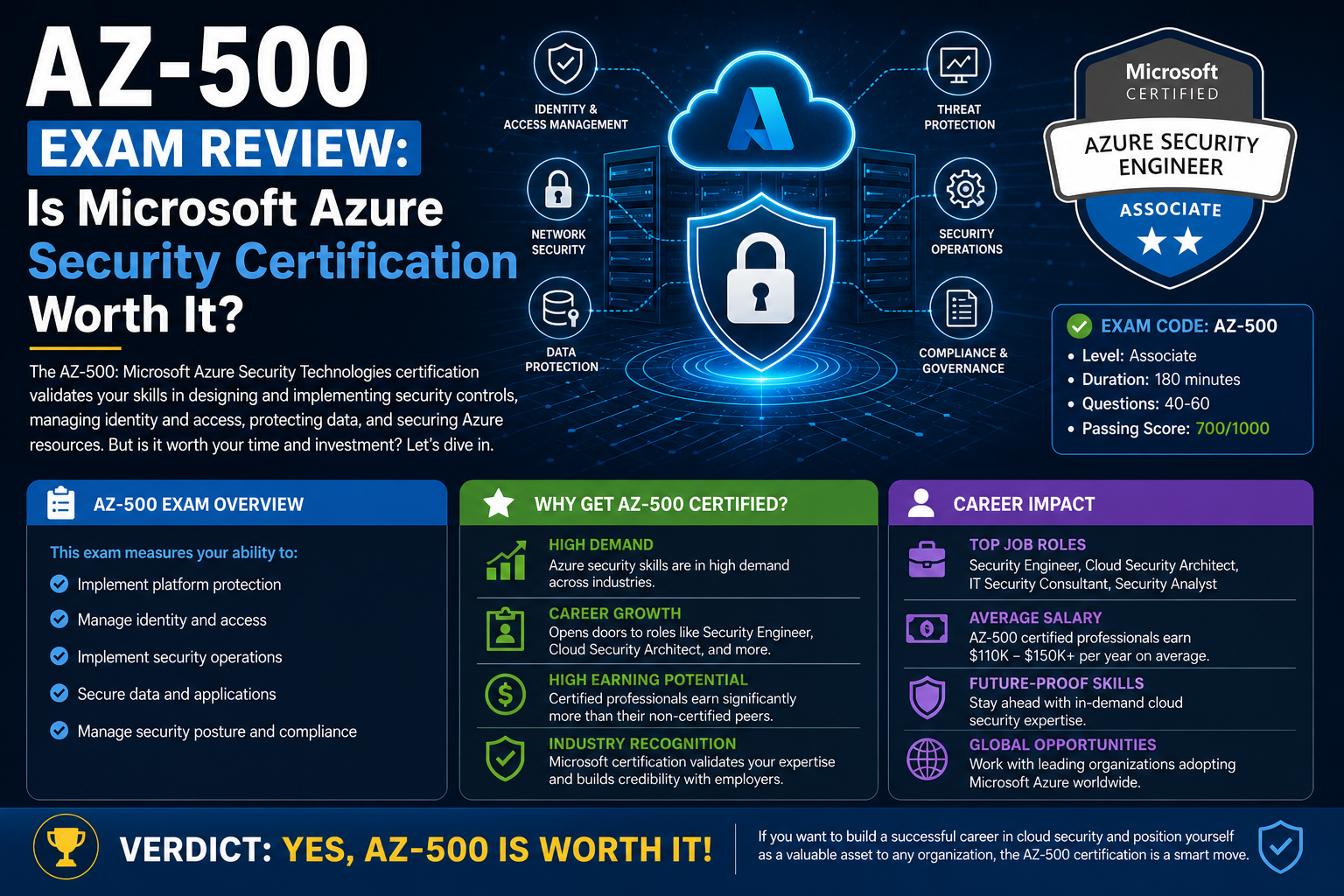
Within this landscape, Microsoft created structured certifications to validate expertise in managing Azure environments securely. One of the most recognized among them is the Azure Security Engineer certification, commonly associated with the AZ-500 exam. It focuses on assessing whether a professional can effectively secure Azure workloads, manage identity systems, implement threat protection, and maintain compliance across cloud services.
To understand whether this certification is valuable, it is important to first understand what modern cloud security demands. Security engineers are expected to think beyond simple configuration tasks. They must anticipate attacks, design secure architectures, respond to incidents, and enforce governance policies across distributed systems. This makes the role both technical and strategic, requiring a combination of hands-on skills and analytical thinking.
Azure security, in particular, revolves around several core principles: identity management, secure access control, threat detection, data protection, and infrastructure hardening. These principles are reflected directly in the AZ-500 exam structure, which evaluates how well a candidate can apply them in real-world scenarios.
The Purpose and Position of the AZ-500 Certification
The AZ-500 certification is designed to validate advanced-level expertise in securing Microsoft Azure environments. It is not intended for beginners or those with limited exposure to cloud technologies. Instead, it targets professionals who already have a working understanding of Azure services and want to specialize in security operations within that ecosystem.
At its core, the certification assesses whether a candidate can implement and manage security controls that protect cloud-based systems from evolving threats. These threats may include unauthorized access attempts, misconfigured permissions, data leakage, malware attacks, and distributed denial-of-service incidents. Each of these risks requires different mitigation strategies, and the AZ-500 evaluates how well a candidate can apply them in practice.
Unlike general IT certifications that focus broadly on networking or systems administration, the AZ-500 is specialized. It assumes that candidates already understand how cloud environments function. Instead of teaching basic concepts, it focuses on security implementation at a deeper level. This makes it particularly relevant for professionals who are transitioning into cybersecurity roles or expanding their responsibilities within cloud teams.
The certification also reflects the growing importance of cloud security in enterprise environments. As businesses continue to adopt cloud-first strategies, the demand for skilled security engineers has increased significantly. Organizations are no longer asking whether they need cloud security expertise; they are actively seeking professionals who can manage it effectively.
In this context, the AZ-500 serves as a benchmark. It signals that a professional has not only theoretical knowledge but also practical understanding of how to secure Azure workloads. However, its value depends heavily on the candidate’s existing skill level and career direction, which is why it is often viewed as an intermediate-to-advanced certification rather than an entry point.
Core Domains Covered in the AZ-500 Exam
The AZ-500 certification is structured around several key domains that represent the major responsibilities of an Azure security engineer. These domains reflect real-world tasks and challenges that professionals encounter when securing cloud environments.
Identity and Access Management in Azure
One of the most important areas covered in the certification is identity and access management. In cloud computing, identity is the new security perimeter. Instead of relying solely on network boundaries, modern systems depend on verifying who is accessing resources and what permissions they have.
Azure uses identity services to manage authentication and authorization. Security engineers must understand how to configure user identities, manage roles, and enforce access policies. This includes implementing role-based access control, managing privileged identities, and ensuring that users only have the permissions they need.
Identity management also involves protecting credentials and reducing the risk of unauthorized access. This may include implementing multi-factor authentication, conditional access policies, and identity protection mechanisms that detect suspicious behavior.
In real-world scenarios, misconfigured identity settings are one of the most common causes of security breaches. The AZ-500 examines whether candidates can correctly configure identity systems to minimize risk while maintaining usability.
Platform Protection and Infrastructure Security
Another major domain focuses on protecting the Azure platform itself. This involves securing virtual machines, containers, storage systems, and networking components. Each layer of infrastructure presents potential vulnerabilities if not configured correctly.
Security engineers must understand how to harden virtual machines by applying security baselines, managing patching strategies, and restricting unnecessary services. They also need to secure network traffic using firewalls, network security groups, and distributed denial-of-service protection mechanisms.
Platform protection extends to securing cloud-native services as well. As organizations adopt containerized applications and serverless computing, security responsibilities become more complex. Engineers must ensure that these services are configured securely and monitored continuously for suspicious activity.
A critical aspect of this domain is understanding how to design secure architectures. This includes isolating workloads, segmenting networks, and ensuring that sensitive data is not exposed through misconfigured services.
Security Operations and Threat Management
Security operations form the backbone of any cybersecurity strategy. In Azure environments, this involves monitoring systems for threats, analyzing security alerts, and responding to incidents in real time.
Security engineers must be familiar with tools and services that provide visibility into system activity. These tools help detect anomalies, identify potential attacks, and provide actionable insights for incident response.
Threat management also includes understanding how attackers operate. This involves recognizing common attack patterns such as phishing, privilege escalation, and lateral movement within cloud environments. By understanding these techniques, security professionals can better defend against them.
Incident response is another critical component. When a security event occurs, engineers must be able to investigate the issue, contain the threat, and restore normal operations. This requires not only technical skills but also structured thinking and decision-making under pressure.
Securing Data and Applications
The final major domain focuses on protecting data and applications within Azure. Data is often considered the most valuable asset in any organization, making its protection a top priority.
Security engineers must understand how to encrypt data both at rest and in transit. This ensures that even if data is intercepted or accessed without authorization, it remains unreadable. They must also manage encryption keys and ensure secure storage of sensitive information.
Application security involves ensuring that deployed applications are not vulnerable to exploitation. This includes securing APIs, managing application configurations, and ensuring that development practices align with security standards.
In modern cloud environments, applications are often distributed across multiple services. This increases complexity and requires engineers to understand how different components interact securely.
Skills and Knowledge Expected from Candidates
The AZ-500 certification assumes that candidates already possess a strong foundation in cloud computing and cybersecurity principles. It is not designed to teach basic concepts but rather to evaluate applied knowledge.
Candidates are expected to understand Azure networking, virtual machine management, and basic cloud architecture. They should also be familiar with scripting or automation concepts, as these are often used in security configurations.
A strong understanding of cybersecurity fundamentals is also essential. This includes knowledge of common threats, encryption methods, access control models, and security best practices.
In addition, candidates must be comfortable working with monitoring and diagnostic tools. Security in cloud environments is highly dependent on visibility, and engineers must be able to interpret logs, alerts, and system data to identify potential issues.
Problem-solving skills are equally important. Many scenarios in the AZ-500 exam simulate real-world challenges where multiple solutions may exist, and candidates must choose the most secure and efficient option.
The Evolving Nature of Cloud Security Threats
Cloud security is not a static field. Threats evolve continuously as attackers develop new techniques and exploit emerging technologies. This makes ongoing learning essential for any security professional.
One of the biggest challenges in cloud security is misconfiguration. Even small configuration errors can expose systems to significant risk. For example, incorrectly assigned permissions or open network ports can create vulnerabilities that attackers can exploit.
Another growing concern is identity-based attacks. Since cloud environments rely heavily on identity systems, attackers often target credentials rather than infrastructure. This makes identity protection a critical focus area for security engineers.
Data breaches also remain a major threat. As more organizations store sensitive information in the cloud, protecting that data becomes increasingly important. Encryption, access control, and monitoring all play a role in reducing this risk.
In addition, the rise of automation and artificial intelligence in cyberattacks has introduced new challenges. Attackers can now scale their operations and identify vulnerabilities more efficiently, requiring defenders to adopt equally advanced tools and strategies.
Why Specialization in Azure Security Matters
As cloud adoption continues to grow, general IT knowledge is no longer sufficient for managing complex environments. Organizations need specialists who understand specific platforms and their security models.
Azure security specialization is particularly valuable because many enterprises rely heavily on Microsoft technologies. This creates a strong demand for professionals who can secure integrated environments that include Windows Server, Active Directory, and Azure cloud services.
Specialization also allows professionals to develop deeper expertise in a focused area rather than maintaining broad but shallow knowledge. This depth is increasingly important in cybersecurity, where threats require precise and informed responses.
Security engineers who specialize in Azure are often involved in designing security frameworks, implementing compliance policies, and guiding organizational security strategies. This makes the role both technical and advisory in nature.
The Relationship Between Cloud Adoption and Security Demand
As organizations continue to move workloads to the cloud, security becomes a foundational requirement rather than an optional consideration. Every application, database, and service deployed in the cloud introduces potential risk if not properly secured.
This shift has led to a significant increase in demand for cloud security professionals. Companies are investing more in security infrastructure and prioritizing candidates who can demonstrate expertise in platforms like Azure.
The AZ-500 certification exists within this broader trend. It reflects the growing need for validated skills in cloud security management. While it is not the only path into cybersecurity, it represents a structured way to demonstrate capability in a highly relevant area of technology.
How the AZ-500 Aligns with Real-World Security Engineering Roles
The AZ-500 certification is often discussed in terms of exam objectives, but its real value becomes clearer when mapped to actual job roles in the cybersecurity and cloud engineering space. In modern IT environments, job titles rarely exist in isolation. Instead, responsibilities overlap across systems administration, cloud architecture, and security operations. The AZ-500 sits precisely at this intersection, focusing on professionals who are expected to secure cloud infrastructure while also understanding how that infrastructure is built and maintained.
In many organizations, the Azure Security Engineer role is not a standalone entry-level position. It is typically a specialization that comes after foundational experience in cloud administration or systems engineering. Professionals in this role are expected to act as the security layer for Azure environments, ensuring that configurations, identities, and workloads remain protected against internal misconfigurations and external threats.
The certification reflects this expectation by testing applied knowledge rather than theoretical memorization. It assumes that candidates are already familiar with Azure services and are now stepping into a role where security becomes the primary responsibility. This makes the AZ-500 particularly relevant for individuals transitioning from general cloud engineering into dedicated security-focused positions.
In practical job environments, Azure security engineers are often involved in tasks such as designing secure cloud architectures, reviewing access policies, responding to security incidents, and implementing compliance requirements. These responsibilities require not only technical understanding but also the ability to evaluate risk in real time.
What makes this role especially important is the shift toward shared responsibility in cloud computing. While cloud providers secure the underlying infrastructure, customers are responsible for securing their own data, identities, and configurations. The AZ-500 directly prepares professionals for this responsibility by focusing on the customer-side security model.
Mapping AZ-500 Skills to Industry Job Functions
One of the most effective ways to evaluate the usefulness of the AZ-500 is to map its skill areas to real job functions. In most cloud security roles, responsibilities can be grouped into several functional categories that align closely with the certification domains.
Identity management responsibilities often involve configuring authentication systems, enforcing multi-factor authentication, and managing privileged access. Security engineers are expected to ensure that only authorized users can access sensitive resources, and that those permissions are regularly reviewed and adjusted.
Infrastructure security responsibilities include protecting virtual machines, networks, and storage systems. Engineers must ensure that systems are hardened, properly segmented, and monitored for suspicious activity. This often involves configuring firewalls, implementing network security rules, and ensuring secure communication between services.
Operational security responsibilities involve monitoring systems for threats and responding to incidents. Security engineers must be able to analyze logs, interpret alerts, and investigate potential breaches. This requires both technical skill and analytical reasoning.
Data protection responsibilities focus on ensuring that sensitive information is encrypted and properly managed. Engineers must understand encryption mechanisms, key management systems, and data access policies.
Application security responsibilities involve ensuring that deployed applications do not introduce vulnerabilities into the environment. This includes reviewing application configurations, securing APIs, and ensuring that development practices align with security standards.
The AZ-500 certification aligns with all of these functional areas, which is why it is often seen as a comprehensive validation of Azure security engineering capability.
Exam Structure Thinking and Scenario-Based Evaluation
Unlike entry-level certifications that focus on recall-based questions, the AZ-500 places strong emphasis on scenario-based evaluation. This means candidates are often presented with real-world situations and must determine the best security solution based on context.
These scenarios may involve designing access control policies for a multi-department organization, securing a hybrid cloud environment, or responding to a simulated security breach. The goal is not just to test knowledge but to evaluate decision-making ability.
This approach reflects how security engineering works in practice. Rarely does a real-world problem have a single obvious solution. Instead, engineers must weigh trade-offs between usability, performance, and security.
For example, implementing strict access controls may improve security but reduce operational efficiency. On the other hand, overly permissive access may improve usability but increase risk exposure. Security engineers must find a balance that aligns with organizational needs.
The AZ-500 exam structure reinforces this mindset by requiring candidates to think like engineers rather than memorizing isolated facts. This is one of the reasons it is considered more challenging than many foundational certifications.
The Role of Identity Security in Modern Azure Environments
Identity security has become one of the most critical components of cloud protection. In traditional systems, network boundaries were the primary line of defense. However, in cloud environments, users connect from multiple locations, devices, and networks, making identity the central security control.
Azure places strong emphasis on identity management through its built-in services. Security engineers must understand how to configure authentication systems, manage user roles, and enforce conditional access policies.
One of the key challenges in identity security is preventing unauthorized access while maintaining usability. Users expect seamless access to resources, but security teams must ensure that this access is properly controlled.
Privileged access management is another important aspect. Not all users require administrative privileges, and even those who do should only have elevated access when necessary. Implementing just-in-time access and monitoring privileged accounts helps reduce the risk of misuse.
Identity protection also involves detecting unusual behavior. For example, if a user logs in from an unfamiliar location or device, the system may trigger additional verification steps. These adaptive security measures are essential in modern cloud environments where threats are constantly evolving.
The AZ-500 certification evaluates a candidate’s ability to implement these identity protection mechanisms effectively.
Infrastructure Hardening and Secure Cloud Architecture
Securing cloud infrastructure requires a deep understanding of how services interact within Azure. Unlike traditional environments where systems are physically isolated, cloud resources are interconnected through virtual networks and service integrations.
Infrastructure hardening involves reducing the attack surface of these systems. This includes disabling unnecessary services, applying security updates, and configuring secure defaults. Virtual machines, for example, must be regularly patched and monitored for vulnerabilities.
Network security plays a critical role in infrastructure protection. Security engineers must design network architectures that isolate sensitive workloads and control traffic flow between services. This often involves implementing subnet segmentation and defining strict communication rules.
Another important aspect is securing storage systems. Data stored in cloud environments must be protected against unauthorized access and accidental exposure. This includes configuring encryption, managing access policies, and ensuring proper backup strategies.
In addition, cloud-native services such as containers and serverless functions introduce new security considerations. These services are often ephemeral and highly dynamic, making traditional security approaches less effective. Engineers must adapt their strategies to account for this flexibility.
The AZ-500 certification evaluates whether candidates can design and implement secure infrastructure that aligns with best practices and organizational requirements.
Operational Security and Continuous Monitoring
Security is not a one-time configuration; it is an ongoing process. In cloud environments, continuous monitoring is essential for identifying threats and maintaining system integrity.
Operational security involves collecting and analyzing data from various sources within the cloud environment. This includes system logs, network activity, and application behavior. By correlating this data, security engineers can identify anomalies that may indicate potential threats.
One of the challenges in operational security is distinguishing between normal behavior and malicious activity. Cloud environments generate large volumes of data, and not all anomalies represent real threats. Engineers must develop the ability to interpret patterns and prioritize alerts effectively.
Incident response is a critical component of operational security. When a potential threat is detected, engineers must investigate the issue, determine its severity, and take appropriate action. This may involve isolating affected systems, revoking access, or restoring compromised resources.
Time is a crucial factor in incident response. The longer a threat remains undetected, the greater the potential damage. Therefore, security engineers must be able to act quickly and decisively.
The AZ-500 certification evaluates these capabilities by presenting scenarios that simulate real-world security incidents.
Data Protection Strategies in Cloud Environments
Data protection is one of the most important responsibilities in cloud security. Organizations store sensitive information such as customer records, financial data, and intellectual property in cloud systems, making it a prime target for attackers.
Encryption is the primary mechanism used to protect data. Data must be encrypted both at rest and in transit to ensure that it cannot be accessed without proper authorization. Security engineers must understand how encryption systems work and how to manage encryption keys securely.
Access control is another critical aspect of data protection. Not all users should have access to all data, and permissions must be carefully managed. This includes defining role-based access policies and regularly reviewing access rights.
Data classification also plays an important role. Not all data has the same level of sensitivity, and organizations must categorize information based on its importance. This helps determine the appropriate level of protection for different types of data.
Backup and recovery strategies are also essential. In the event of data loss or corruption, organizations must be able to restore information quickly and accurately. This requires careful planning and regular testing of backup systems.
The AZ-500 certification assesses a candidate’s ability to implement these data protection strategies effectively within Azure environments.
Integration of Security into DevOps Practices
Modern software development practices increasingly rely on DevOps methodologies, where development and operations teams collaborate closely to deliver applications quickly and efficiently. However, this speed must be balanced with security considerations.
Security integration into DevOps, often referred to as DevSecOps, ensures that security is embedded throughout the development lifecycle rather than being treated as a final step. This approach helps identify vulnerabilities early and reduces the risk of deploying insecure applications.
In Azure environments, security engineers work closely with development teams to ensure that applications are designed with security in mind. This includes reviewing code configurations, securing deployment pipelines, and enforcing security policies during application release.
Automated security testing is also an important component. By integrating security checks into deployment pipelines, organizations can identify issues before applications reach production environments.
The AZ-500 certification reflects this shift by including topics related to application security and secure development practices.
Common Challenges Faced by Candidates Preparing for AZ-500
Preparing for the AZ-500 certification presents several challenges, particularly for individuals who are new to cloud security. One of the most common difficulties is the breadth of topics covered in the exam.
Candidates must understand identity management, infrastructure security, operational monitoring, and data protection simultaneously. This requires not only technical knowledge but also the ability to connect different concepts.
Another challenge is the practical nature of the exam. Because it focuses on scenario-based questions, candidates must be able to apply knowledge rather than simply recall facts. This requires hands-on experience with Azure environments.
Time management is also a significant factor. The complexity of the exam means that candidates must be able to analyze questions quickly and make informed decisions under time constraints.
Finally, keeping up with evolving cloud technologies can be challenging. Azure services are continuously updated, and security practices evolve alongside them. Candidates must ensure that their knowledge remains current.
The Broader Industry Value of Azure Security Expertise
Beyond certification, Azure security expertise has become increasingly valuable in the broader IT industry. Organizations are investing heavily in cloud infrastructure, and security remains one of their top concerns.
Professionals with Azure security skills are often involved in high-level decision-making processes. They may contribute to architectural design, risk assessment, and compliance planning.
As cyber threats continue to evolve, organizations are prioritizing candidates who can demonstrate practical security experience in cloud environments. This has led to increased demand for professionals who understand both Azure infrastructure and security principles.
The AZ-500 certification serves as a structured way to validate these skills, but its true value lies in the knowledge and experience gained during preparation and application.
The Strategic Role of Azure Security Engineers in Modern Organizations
As organizations continue expanding their digital infrastructure into cloud environments, the role of security engineers has evolved from technical support functions into strategic business roles. Azure security professionals are no longer viewed as purely operational staff who configure settings or monitor alerts. Instead, they are increasingly involved in decision-making processes that influence how entire cloud ecosystems are designed, deployed, and maintained.
This shift reflects a broader transformation in cybersecurity. Security is no longer a final layer added after systems are built. It is now embedded into every stage of architecture, development, and operations. Azure security engineers are expected to understand not only how systems function but also how business goals intersect with security requirements.
In enterprise environments, these professionals often collaborate with cloud architects, DevOps teams, compliance officers, and executive leadership. Their input helps shape policies that govern identity access, data protection, and infrastructure design. This means their responsibilities extend beyond technical execution into risk evaluation and strategic planning.
One of the most important aspects of this role is translating technical risks into business impact. For example, a misconfigured access policy is not just a technical issue; it can represent financial loss, regulatory violations, or reputational damage. Security engineers must be able to communicate these risks clearly to non-technical stakeholders.
The AZ-500 certification aligns with this evolving role by emphasizing practical knowledge that supports real-world decision-making. It prepares professionals to think in terms of risk mitigation rather than isolated technical tasks.
Cloud Security as a Continuous Lifecycle Process
One of the most significant misunderstandings in cloud security is the idea that it is a one-time implementation. In reality, cloud security is a continuous lifecycle process that requires constant monitoring, evaluation, and improvement.
Unlike traditional IT systems that remain relatively static after deployment, cloud environments are dynamic. Resources are created, modified, and deleted frequently. Applications scale automatically based on demand, and users access systems from multiple locations and devices.
This dynamic nature means that security configurations can quickly become outdated or misaligned with current infrastructure. Security engineers must continuously review and adjust policies to ensure they remain effective.
A critical part of this lifecycle is monitoring. Continuous monitoring allows organizations to detect anomalies, identify vulnerabilities, and respond to threats in real time. Without monitoring, security becomes reactive rather than proactive.
Another important component is auditing. Regular audits help ensure that systems comply with internal policies and external regulations. They also help identify misconfigurations that may not be immediately visible during daily operations.
Finally, improvement is an ongoing requirement. Security strategies must evolve alongside technological advancements and emerging threats. What is considered secure today may not be sufficient tomorrow.
The AZ-500 certification reflects this lifecycle approach by emphasizing operational security, monitoring, and governance rather than static configuration knowledge.
Evolving Threat Landscape in Azure Environments
Cyber threats targeting cloud environments have become increasingly sophisticated. Attackers no longer rely on simple vulnerabilities or brute-force techniques. Instead, they use advanced strategies that exploit misconfigurations, identity weaknesses, and human error.
One of the most common attack vectors in cloud environments is identity compromise. Since cloud systems rely heavily on authentication, gaining access to valid credentials can allow attackers to bypass many traditional security controls. Phishing attacks, credential stuffing, and token theft are commonly used methods.
Another growing threat is misconfiguration exploitation. Cloud environments are highly configurable, and even small mistakes can expose sensitive resources. For example, incorrectly configured storage permissions can lead to unintended public access.
Lateral movement is also a significant concern. Once attackers gain access to one part of a cloud environment, they may attempt to move across systems to escalate privileges or access sensitive data. This makes network segmentation and access control critical components of defense strategies.
Ransomware attacks have also adapted to cloud environments. Instead of targeting individual machines, attackers may attempt to encrypt cloud-hosted data or disrupt critical services. This can have widespread impact on business operations.
In addition, supply chain attacks have become more prevalent. These attacks target third-party services or dependencies integrated into cloud environments. Because modern applications rely heavily on external services, this creates additional risk exposure.
Security engineers must understand these threats and implement defenses that address both technical vulnerabilities and human factors. The AZ-500 certification evaluates this understanding by presenting scenarios that reflect real-world attack patterns.
Identity-Centric Security Models in Azure
Modern security architecture is increasingly centered around identity rather than network boundaries. This shift reflects the reality that users, devices, and applications operate in distributed environments where traditional perimeter defenses are no longer sufficient.
Azure implements identity-centric security through services that manage authentication, authorization, and access control. Security engineers must design systems where identity becomes the primary control mechanism for resource access.
A key principle in this model is least privilege access. Users should only be granted the minimum permissions necessary to perform their tasks. This reduces the risk of accidental or malicious misuse of privileges.
Another important concept is conditional access. This allows organizations to define rules that determine when and how users can access resources. For example, access may be restricted based on location, device compliance, or risk level.
Multi-factor authentication plays a critical role in strengthening identity security. By requiring additional verification beyond passwords, organizations can significantly reduce the risk of unauthorized access.
Privileged identity management is another essential component. Administrative accounts are often targeted by attackers due to their elevated access levels. Implementing just-in-time access and monitoring privileged activities helps mitigate this risk.
Identity protection systems also use behavioral analytics to detect anomalies. For example, if a user suddenly logs in from an unusual location or performs unfamiliar actions, the system may trigger additional security checks.
The AZ-500 certification evaluates a candidate’s ability to implement and manage these identity-centric security controls effectively.
Designing Secure Azure Architectures
Security architecture in Azure is not simply about configuring individual services. It involves designing entire systems that are secure by default and resilient against potential threats.
A secure architecture begins with segmentation. By dividing environments into logical segments, organizations can limit the spread of potential attacks. For example, production systems may be isolated from development environments to prevent unauthorized access.
Network design plays a crucial role in architecture security. Security engineers must carefully design virtual networks, subnets, and routing rules to control traffic flow. This includes restricting inbound and outbound communication based on security requirements.
Another important consideration is redundancy and resilience. Secure systems must be able to withstand failures or attacks without significant disruption. This involves designing backup systems, failover mechanisms, and disaster recovery strategies.
Data flow design is also critical. Sensitive data should be protected throughout its lifecycle, including storage, processing, and transmission. Encryption and access control mechanisms must be integrated into every stage.
Security architecture also involves aligning technical design with compliance requirements. Many industries have strict regulatory standards that govern how data must be handled. Engineers must ensure that system designs meet these requirements from the outset.
The AZ-500 certification assesses the ability to understand and implement secure architectural principles within Azure environments.
Automation and Security Enforcement in Cloud Environments
Automation plays a significant role in modern cloud security. As environments become more complex, manual security management becomes inefficient and prone to error. Automation helps ensure consistency, scalability, and reliability in security enforcement.
Security policies can be automated to ensure that configurations remain consistent across environments. This reduces the risk of misconfiguration and helps enforce organizational standards.
Automated monitoring systems can continuously analyze logs and detect anomalies without human intervention. This allows security teams to respond more quickly to potential threats.
Incident response can also be partially automated. For example, predefined workflows can be triggered when certain security events occur, such as isolating compromised resources or revoking access.
Infrastructure as code is another important aspect of automation. By defining infrastructure through code, organizations can ensure that security configurations are consistently applied across deployments.
However, automation also introduces new challenges. If not properly designed, automated systems can propagate errors or vulnerabilities at scale. Therefore, security engineers must carefully design and test automation processes.
The AZ-500 certification evaluates understanding of how automation can be used to enhance security while maintaining control and oversight.
Compliance, Governance, and Regulatory Requirements
Security in cloud environments is not only about protecting systems from attackers. It also involves ensuring compliance with legal and regulatory requirements.
Organizations must adhere to various standards depending on their industry and geographic location. These standards may govern how data is stored, processed, and accessed.
Governance involves defining policies that control how cloud resources are used. This includes access control policies, data handling rules, and operational guidelines.
Security engineers play a key role in implementing governance frameworks. They ensure that technical configurations align with organizational policies and regulatory requirements.
Auditability is another important aspect. Organizations must be able to demonstrate that security controls are in place and functioning correctly. This requires detailed logging and reporting capabilities.
Failure to comply with regulatory requirements can result in significant penalties, making governance a critical responsibility in cloud security.
The AZ-500 certification evaluates knowledge of how security controls support compliance and governance objectives.
Career Progression in Azure Security Roles
Azure security engineering is often not the endpoint of a career path but rather a stepping stone toward more advanced roles. Professionals in this field may progress into cloud architecture, security consulting, or leadership positions.
With experience, security engineers may take on responsibilities such as designing enterprise-wide security strategies or leading security operations teams. These roles require a combination of technical expertise and strategic thinking.
Some professionals may also specialize further in areas such as penetration testing, incident response, or cloud compliance. Each of these paths builds on the foundational knowledge gained through roles like Azure security engineering.
Career progression in this field is strongly influenced by both experience and continuous learning. Certifications like AZ-500 provide a structured way to validate knowledge, but practical experience remains essential.
As organizations continue to invest in cloud technologies, demand for skilled security professionals is expected to remain strong. This creates opportunities for long-term career growth in the field.
Long-Term Relevance of Azure Security Expertise
The relevance of Azure security expertise is closely tied to the continued adoption of cloud computing. As more organizations migrate workloads to Azure, the need for security professionals who understand its ecosystem continues to grow.
Microsoft continues to expand Azure services, introducing new features and capabilities that require updated security approaches. This ensures that the field remains dynamic and evolving.
Security challenges are also becoming more complex as cloud environments integrate with artificial intelligence, machine learning, and edge computing. These technologies introduce new attack surfaces and require advanced security strategies.
As a result, Azure security expertise is unlikely to become obsolete in the foreseeable future. Instead, it will continue to evolve alongside technological advancements.
Professionals who invest in developing these skills position themselves for long-term relevance in the IT industry.
Conclusion
The discussion around the AZ-500 certification ultimately comes down to a broader question that applies to most professional credentials in IT: how well does it translate into real capability, career growth, and long-term relevance in an evolving industry? Unlike entry-level certifications that primarily validate familiarity with concepts, the AZ-500 sits in a more demanding space where applied knowledge, architectural understanding, and security judgment all intersect. This is what makes it both valuable and, at times, challenging to justify depending on a person’s current stage in their career.
It assumes a working understanding of Azure services and builds on that foundation by introducing security as the primary lens through which those services are managed. That distinction matters because it changes the expectation from “learning what the tools are” to “knowing how to secure them under real-world constraints.” For individuals already working in cloud administration, DevOps, or systems engineering, this transition often feels natural. For newcomers, however, it can feel overwhelming without prior exposure to Azure environments.
At the same time, it is important to recognize that certifications alone do not guarantee expertise. The AZ-500 can validate knowledge, but it cannot replace hands-on experience. Cloud security is highly situational, and real-world environments often involve constraints, legacy systems, and organizational politics that no exam can fully replicate. This is why the certification is most effective when it complements practical exposure rather than serving as a substitute for it. Professionals who combine both tend to gain the most value from it.
The evolving nature of cloud security also reinforces the importance of continuous learning. Azure itself is not static; services change, new features are introduced, and security threats evolve in response. This means that the knowledge tested in the AZ-500 represents a snapshot of best practices rather than a permanent endpoint. Those who pursue this certification must be prepared to keep updating their skills even after passing the exam, especially as identity threats, automation risks, and compliance requirements continue to grow in complexity.
From a career perspective, the certification can serve as a meaningful differentiator, particularly in competitive job markets. It signals to employers that a candidate is not only familiar with Azure but also capable of thinking in terms of security architecture and risk management. However, its impact is strongest when combined with demonstrated experience, problem-solving ability, and an understanding of broader cloud ecosystems.
Ultimately, the value of the AZ-500 is not universal; it is contextual. For someone deeply invested in Azure or already working in cloud-focused security roles, it can be a strong validation of skills and a useful stepping stone toward advanced responsibilities. For others still exploring cloud platforms or uncertain about their specialization, it may be more beneficial to build foundational experience first before committing to this level of certification.