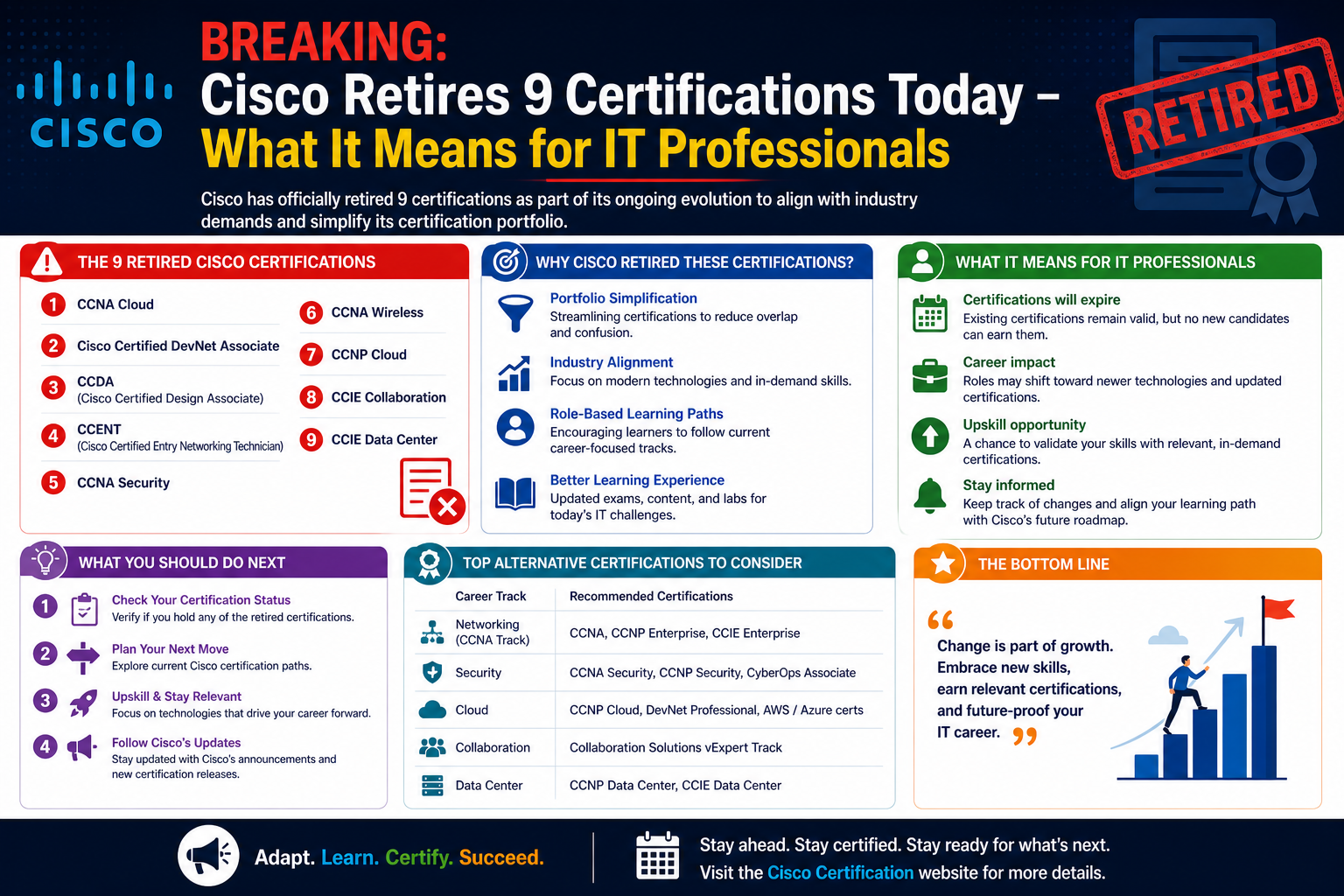
The Cisco certification ecosystem has long been considered one of the most structured and respected learning paths in the networking industry. For many years, professionals entering IT infrastructure, networking, and security roles viewed Cisco certifications as a clear roadmap for career progression. From foundational knowledge at the associate level to highly advanced expert certifications, the structure offered direction, predictability, and a sense of achievement at each milestone.
However, the certification landscape did not remain static. As technology evolved, so did the expectations of employers and the realities of modern IT environments. Traditional network roles began to overlap with cloud computing, automation, cybersecurity, and software-driven infrastructure. The rigid separation between different Cisco certification tracks started to feel increasingly disconnected from how real-world IT teams operate.
This shift created pressure on certification providers to rethink how skills are validated. Cisco’s response was a comprehensive restructuring of its certification framework, affecting nearly every level of its program. What once consisted of multiple specialized entry and associate-level certifications was consolidated into fewer, more unified pathways designed to reflect broader, more practical skill sets.
At the heart of this transformation was a recognition that employers were no longer hiring based solely on narrow specialization at early career stages. Instead, they were looking for professionals who could understand fundamental networking concepts while remaining adaptable across different technologies and environments. The result was a move toward simplification, consolidation, and modernization of Cisco’s certification architecture.
This change was not merely cosmetic. It represented a fundamental shift in philosophy—from training specialists early in their careers to building adaptable generalists first, then allowing specialization at more advanced stages. The impact of this decision is most visible in the changes made to entry-level certifications, particularly the elimination of CCENT and the restructuring of CCNA.
For learners and professionals already on a Cisco certification journey, this transformation required reassessment. Study paths that once felt linear became outdated overnight, and many had to adjust their expectations and learning strategies. While this created short-term disruption, it also opened the door to a more streamlined and relevant certification experience aligned with modern IT demands.
Understanding this turning point is essential because it explains not just what changed, but why the entire certification structure had to evolve. Without this context, the removal of familiar certifications can feel abrupt or even discouraging. In reality, these changes were part of a broader attempt to align certification outcomes with real-world job requirements.
Why Cisco Restructured Its Certification Program
The decision to overhaul Cisco’s certification program was driven by a combination of industry feedback, technological evolution, and changing job market expectations. Over time, Cisco observed that the traditional certification pathways were becoming overly fragmented. While specialization had its advantages, it also created complexity that did not always translate into better job readiness at early career stages.
Employers increasingly reported that entry-level candidates, despite holding certifications, often lacked a unified understanding of core networking principles. Instead, their knowledge was sometimes confined to narrow domains that did not reflect the interconnected nature of modern IT infrastructure. Networks today are no longer isolated systems; they are integrated with cloud services, security frameworks, automation tools, and software-defined technologies.
Cisco recognized that this shift required a rethinking of how foundational knowledge should be delivered. Rather than offering multiple entry points into specialized tracks, the goal became to establish a stronger, more universal baseline of networking knowledge. This would ensure that every certified associate-level professional shared a consistent understanding of essential concepts before moving into specialization.
Another driving factor was the increasing complexity of the certification pathway itself. Previously, learners had to choose from multiple CCNA tracks such as routing and switching, security, wireless, data center, and collaboration. While this allowed for early specialization, it also created confusion, especially for those new to the field. Many learners struggled to decide which path aligned best with their career goals before they had enough exposure to make an informed decision.
By simplifying the structure, Cisco aimed to remove this early decision pressure. Instead of forcing candidates to choose a specialization too soon, the new model allows them to build a broad foundation first. This approach mirrors how many organizations actually structure their teams, where junior engineers are expected to support multiple areas before focusing on a specific domain.
Additionally, the rise of automation and software-driven networking influenced the restructuring. Traditional networking knowledge alone was no longer sufficient. Professionals needed awareness of programmability, security fundamentals, and evolving infrastructure models. Cisco’s updated certification structure reflects this broader skill expectation by integrating a wider range of topics into foundational certifications.
Cost and efficiency also played a role. Maintaining multiple certification tracks requires significant updates, exam development, and content management. Consolidating pathways into fewer certifications allows Cisco to update content more efficiently and keep pace with rapid technological changes.
Ultimately, the restructuring reflects a strategic alignment between certification outcomes and real-world job roles. Instead of certifying narrow expertise too early, the program now emphasizes adaptability, foundational strength, and readiness for evolving responsibilities in modern IT environments.
The End of CCENT and Entry-Level Shift
One of the most noticeable changes in the restructuring was the removal of the CCENT certification, which previously served as the first formal step into Cisco’s certification hierarchy. For many aspiring network professionals, CCENT represented an accessible entry point. It validated basic networking knowledge and provided a stepping stone toward the CCNA certification, often allowing candidates to build confidence gradually.
Its elimination marked a significant shift in how Cisco approaches beginner-level certification. Without CCENT, the certification pathway no longer includes a tier below CCNA in the traditional sense. Instead, the CCNA itself now serves as the primary entry-level certification, designed to encompass foundational networking knowledge that was previously split across multiple exams.
This change reflects a broader simplification strategy. Rather than dividing foundational knowledge into multiple certifications, Cisco consolidated essential concepts into a single, more comprehensive exam. The intention was to ensure that every CCNA-certified professional has a well-rounded understanding of networking principles from the outset.
However, this transition also changed the experience for newcomers. Previously, learners could approach Cisco certification in smaller, incremental steps. CCENT allowed them to validate partial knowledge before committing to the more comprehensive CCNA certification. With its removal, learners now face a broader scope of study at the beginning of their journey.
The CCT certification remains available but serves a different purpose. It is more focused on technical support and field operations rather than theoretical networking knowledge. This distinction is important because it highlights how Cisco redefined entry-level roles. Instead of offering a tiered academic progression, the entry-level focus now splits between practical support roles and foundational networking roles.
For individuals entering the field, this means that the first major milestone is more demanding than before. The CCNA now requires a deeper and broader understanding of networking concepts right from the start. While this may seem challenging, it also ensures that certified professionals are better prepared for real-world environments where basic networking knowledge must be immediately applicable.
In essence, the removal of CCENT reflects Cisco’s broader goal of reducing fragmentation and increasing the relevance of its certifications. While it eliminated a familiar stepping stone, it also strengthened the significance of the CCNA as a true foundation for networking careers.
How the Traditional CCNA Path Used to Work
Before the restructuring, the CCNA certification existed as a collection of multiple specialized tracks. Each track focused on a specific domain within networking, allowing learners to tailor their certification journey based on their interests or career goals. Common paths included routing and switching, security, wireless networking, data center operations, collaboration systems, and service provider environments.
This structure offered a high degree of specialization early in a professional’s career. Candidates could choose a path aligned with a specific job role and build expertise in that area from the beginning. For example, someone interested in wireless networking could pursue a dedicated CCNA Wireless certification, while another focused on security could follow the CCNA Security path.
While this model provided depth, it also introduced fragmentation. Each certification required separate study materials, separate exams, and separate knowledge domains. As a result, learners often had limited exposure to broader networking concepts outside their chosen specialization. This created professionals who were highly skilled in one area but sometimes lacked flexibility across other domains.
The multi-path structure also made career decisions more complex for beginners. Choosing a specialization required early commitment, often before candidates had enough experience to understand which area suited them best. This sometimes led to misaligned career paths or the need to retrain in different certification tracks later on.
Despite these challenges, the traditional CCNA model reflected the networking industry at the time. Networks were more siloed, and roles were more clearly defined. Wireless engineers, security specialists, and routing experts often worked in distinct teams with limited overlap. The certification structure mirrored this separation.
However, as IT environments evolved, the boundaries between these roles began to blur. Modern network professionals are often expected to understand multiple domains, including security fundamentals, automation concepts, and cloud integration. This shift made the highly specialized CCNA structure less practical.
Cisco’s decision to retire multiple CCNA tracks and replace them with a single unified certification reflects this evolution. Instead of preparing candidates for narrow roles, the new approach emphasizes broad competency. This ensures that certified professionals can adapt to different environments and responsibilities more easily.
The transition from multiple CCNA paths to a single certification represents one of the most significant philosophical shifts in Cisco’s certification history. It marks the end of a highly segmented learning model and the beginning of a more integrated approach to foundational networking education.
The Philosophy Behind a Single CCNA Exam
The introduction of a single CCNA exam represents more than just structural simplification; it reflects a deeper shift in how Cisco defines foundational networking competence. Instead of separating knowledge into multiple specialized exams, the new model brings essential concepts together into one unified assessment.
At its core, this approach is built on the idea that entry-level networking professionals should have a broad and balanced understanding of core technologies. Rather than mastering one narrow area too early, candidates are expected to develop familiarity with multiple aspects of networking, including routing, switching, security fundamentals, wireless basics, and network automation concepts.
This philosophy aligns more closely with modern workplace expectations. In real-world environments, network professionals rarely work in isolation within a single domain. Even entry-level engineers are often required to troubleshoot across multiple systems, interact with security configurations, and understand how different network components interact.
By combining these knowledge areas into a single certification, Cisco aims to ensure that all CCNA-certified professionals share a consistent baseline. This reduces variability in skill sets and makes certification more meaningful from an employer’s perspective.
Another important aspect of this philosophy is efficiency. A single exam reduces the complexity of certification planning for learners. Instead of navigating multiple paths and deciding between different specializations early on, candidates can focus on building a strong general foundation first. This approach simplifies the learning journey and reduces decision fatigue at the start of a career.
It also allows Cisco to update content more effectively. As networking technologies evolve, a unified certification structure can adapt more quickly than multiple fragmented tracks. This ensures that the CCNA remains relevant in a rapidly changing industry where new technologies such as automation and cloud integration continue to reshape job roles.
The single-exam model also reinforces the idea of progression. Specialization is not removed but simply delayed. After completing the CCNA, professionals can move into more focused certifications at the professional level, where specialization becomes more appropriate and aligned with real-world job experience.
By restructuring the CCNA in this way, Cisco is effectively redefining what it means to be a certified associate-level professional. The emphasis is no longer on early specialization but on building adaptable, well-rounded skills that can serve as a foundation for multiple career paths in networking and IT infrastructure.
What the New CCNA Covers in Practice
The redesigned CCNA certification brings together a wide range of foundational networking topics into a single, comprehensive exam. Rather than focusing on one specific area of networking, it spans multiple domains to ensure a balanced understanding of modern network environments.
At a practical level, the certification includes core networking principles such as IP addressing, subnetting, routing fundamentals, and switching operations. These remain essential building blocks for any networking professional and form the backbone of the exam structure. However, the updated version expands beyond traditional concepts to include newer technologies and approaches.
Security fundamentals now play a more prominent role. Candidates are expected to understand basic network security principles, including access control, threat mitigation, and secure network design concepts. This reflects the growing importance of security in all aspects of IT infrastructure, rather than treating it as a separate specialization.
Wireless networking concepts are also included at a foundational level. While not as deep as specialized wireless certifications, the CCNA now ensures that professionals understand how wireless networks operate, how they integrate with wired systems, and how basic configuration and troubleshooting are performed.
Another important addition is network automation and programmability. As modern networks increasingly rely on software-driven management, understanding APIs, automation concepts, and programmable infrastructure has become essential. The CCNA introduces these ideas at a basic level to prepare candidates for more advanced exploration later in their careers.
The certification also emphasizes network services and infrastructure management. This includes understanding how different network components interact, how services are delivered across networks, and how to maintain operational stability in complex environments.
What makes this structure significant is its breadth. Instead of deeply focusing on one niche area, the CCNA ensures exposure to multiple domains. This creates professionals who are versatile and capable of adapting to different roles within IT teams.
From a practical standpoint, this means that CCNA-certified individuals are better prepared for entry-level roles such as network support, junior network engineering, and IT infrastructure assistance. They may not yet be specialists, but they possess enough knowledge to contribute meaningfully across various areas of networking operations.
This broader coverage reflects the reality of modern IT environments, where boundaries between networking, security, and automation are increasingly blurred.
From Associate to Professional Level: A Shift in Expectations
As the Cisco certification framework evolved, one of the most important transitions occurred between the associate and professional levels. While the CCNA was redesigned to create a unified foundation, the CCNP level was restructured to reflect a very different expectation: specialization begins here, not earlier.
In earlier certification models, the line between associate and professional levels was somewhat predictable. The CCNA prepared candidates for multiple narrow paths, and the CCNP expanded those same paths into deeper technical specialization. However, this approach often reinforced early fragmentation, where professionals were locked into specific domains before fully understanding broader networking principles.
With the updated structure, Cisco intentionally shifted this dynamic. The associate level became broader and more generalized, while the professional level became the point where specialization truly begins. This change reflects a more realistic view of how careers develop in modern IT environments.
Most professionals do not enter specialized roles immediately. Instead, they begin in general support or junior engineering positions where exposure to multiple systems is required. Over time, they naturally gravitate toward specific domains based on interest, organizational needs, and experience. The redesigned CCNP aligns with this progression by allowing professionals to choose specialization after building a strong foundation.
This shift also reflects changes in enterprise network architecture. Modern infrastructures are no longer isolated systems focused solely on routing or switching. They are integrated environments that combine security, automation, cloud connectivity, and software-defined technologies. A professional working at this level must understand not only their specialization but also how it interacts with adjacent systems.
The CCNP redesign acknowledges this reality by embedding core knowledge requirements that all professionals must share, regardless of their chosen path. At the same time, it allows deeper focus in specific areas such as enterprise networking, security, or service provider technologies. This balance between shared knowledge and specialization is central to the new structure.
Another key expectation at the professional level is problem-solving capability. Unlike the associate level, where understanding concepts is the primary goal, the CCNP expects candidates to apply knowledge in complex, real-world scenarios. This includes troubleshooting multi-layer network issues, designing scalable infrastructure, and implementing solutions that align with business requirements.
The shift in expectations is not just technical but also strategic. Professionals are increasingly expected to think beyond configuration and execution. They must understand why systems are designed in certain ways and how decisions impact performance, security, and scalability across the entire infrastructure.
This broader expectation sets the tone for the entire CCNP redesign. It is no longer just about advancing technical depth but about developing the ability to operate within complex, interconnected environments where decisions have wide-reaching consequences.
The New CCNP Structure and Core Exam Philosophy
The restructured CCNP certification introduced a more unified and streamlined model compared to its predecessor. Instead of multiple parallel certification tracks at the same level, the new structure is built around a core exam combined with a specialization exam. This two-part approach defines the foundation of professional-level certification.
The core exam represents the shared knowledge base required for all CCNP candidates. It focuses on advanced networking concepts that apply across multiple domains, ensuring that every certified professional has a strong understanding of enterprise-level networking principles. This includes topics such as advanced routing, infrastructure services, network architecture, and foundational automation concepts.
The purpose of the core exam is not to create specialists but to establish consistency. Regardless of the chosen specialization, every CCNP-certified professional must demonstrate mastery of this core knowledge. This ensures that professionals across different domains can communicate effectively and operate within the same technical framework.
The second component of the certification is the concentration or focus exam. This is where specialization becomes more defined. Candidates select a specific exam aligned with their chosen career direction, such as advanced routing, wireless design, network security, or automation-focused networking.
This structure replaces the older model where entire certifications were dedicated to individual domains. Instead of maintaining separate CCNP tracks for each specialization, Cisco consolidated them into a modular system. This allows for greater flexibility while reducing redundancy in certification design.
One of the most important philosophical changes in this structure is the separation of foundational knowledge from specialization. In earlier models, candidates often learned both simultaneously within separate certification tracks. Now, foundational knowledge is centralized, and specialization is layered on top of it.
This separation improves clarity in the learning process. Candidates first build a strong understanding of enterprise networking concepts through the core exam. Once this foundation is established, they can focus on advanced topics specific to their career goals. This creates a more logical and structured progression.
The modular design also benefits long-term career development. Professionals are no longer locked into a single certification path. They can expand or shift their specialization by taking different concentration exams without needing to rebuild foundational knowledge from scratch.
This flexibility is particularly important in modern IT environments, where roles often evolve over time. A professional who begins in routing and switching may later transition into automation or security. The CCNP structure supports this evolution without requiring a complete restart of the certification journey.
Overall, the new CCNP philosophy emphasizes adaptability, consistency, and targeted specialization, all built on a unified technical foundation.
Enterprise Consolidation and the End of Old CCNP Tracks
One of the most significant changes in the professional certification level was the consolidation of multiple legacy CCNP tracks into broader, more unified categories. In the older structure, certifications such as routing and switching, wireless, data center, and collaboration existed as separate paths, each with its own distinct certification identity.
This separation reflected a time when enterprise networks were more compartmentalized. Different teams often handled different aspects of infrastructure independently, and certification paths mirrored these organizational divisions. However, as network environments became more integrated, this model began to show limitations.
The updated structure replaced several of these distinct certifications with broader categories such as enterprise networking. Instead of maintaining separate tracks for routing, switching, and related technologies, these areas were combined into a single, more comprehensive certification path.
This consolidation reflects how enterprise networks actually function today. Routing, switching, wireless, and security are no longer isolated disciplines. They are interconnected components of a unified infrastructure. A change in one area often impacts others, requiring professionals to understand the system as a whole rather than individual parts.
By merging these tracks, Cisco reduced fragmentation and encouraged a more holistic understanding of enterprise networking. Professionals are now expected to understand how different technologies interact rather than focusing exclusively on one segment.
This change also simplifies career progression. Instead of selecting a highly specific path early in the professional level, candidates now choose broader categories that allow for greater flexibility. Within those categories, they can still specialize further through focus exams, but the overall structure is more streamlined.
The consolidation also improves relevance in hiring practices. Employers increasingly prefer candidates who can operate across multiple domains rather than those with narrowly defined expertise. A unified certification better reflects this expectation by ensuring that professionals have exposure to a wider range of technologies.
From a practical standpoint, this also reduces duplication in learning content. Many concepts that were previously repeated across multiple CCNP tracks are now centralized within core exams. This makes the certification more efficient while maintaining depth where necessary.
The end of old CCNP tracks represents a shift away from siloed networking knowledge toward integrated infrastructure understanding. It acknowledges that modern enterprise environments require professionals who can think across systems rather than within isolated technical boundaries.
Specialization Through Focus Exams Instead of Separate Certifications
A defining feature of the updated CCNP structure is the introduction of focus exams as the primary method of specialization. Rather than maintaining separate certification titles for each technical domain, Cisco now allows professionals to define their specialization through targeted exam choices.
This approach offers a more flexible and scalable model for professional development. Instead of committing to an entirely separate certification track, candidates can select focus exams that align with specific skills or job roles. These exams build on the shared foundation established by the core CCNP exam.
Focus exams cover a wide range of specialized topics. These include advanced routing techniques, enterprise wireless design, network automation, SD-WAN technologies, and more. Each exam represents a concentrated area of expertise, allowing professionals to develop depth in their chosen field.
What makes this model particularly effective is its modular nature. Professionals can combine different focus areas over time, expanding their skill set without needing to restart their certification journey. This allows for continuous learning and adaptation as job roles evolve.
The shift to focus exams also reflects the increasing complexity of modern IT environments. Specialization is still important, but it must be flexible enough to accommodate changing technologies. Fixed certification tracks often struggled to keep up with rapid advancements, whereas modular exams can be updated or replaced more efficiently.
Another advantage of this approach is clarity in skill validation. Employers can more easily understand what specific expertise a candidate possesses based on their chosen focus exams. This provides better alignment between certification outcomes and job requirements.
The focus exam model also encourages deeper engagement with specific technologies. Instead of covering multiple domains at a surface level, candidates can concentrate their efforts on mastering a particular area. This leads to stronger technical proficiency and more meaningful expertise.
At the same time, the shared core ensures that all professionals maintain a consistent understanding of foundational concepts. This balance between depth and breadth is a key strength of the redesigned certification structure.
The Role of Automation and Software-Defined Networking in CCNP
One of the most important additions to the modern CCNP framework is the emphasis on automation and software-defined networking. These topics represent a major shift in how networks are designed, managed, and maintained in contemporary IT environments.
Traditional networking relied heavily on manual configuration and device-by-device management. While this approach worked in earlier environments, it does not scale effectively in modern infrastructures where networks are larger, more dynamic, and more integrated with cloud services.
Automation introduces the ability to manage networks programmatically. Instead of configuring devices individually, engineers can use scripts, APIs, and centralized management tools to automate repetitive tasks. This improves efficiency, reduces human error, and allows for faster deployment of network changes.
Software-defined networking takes this concept further by separating control logic from physical hardware. This allows networks to be managed through centralized controllers rather than individual devices. The result is greater flexibility, scalability, and responsiveness to changing business needs.
The inclusion of these topics in the CCNP certification reflects their growing importance in real-world environments. Network engineers are no longer expected to work solely with manual configurations. They must also understand how automation tools integrate with traditional networking systems.
This shift changes the nature of the role itself. Modern network professionals are increasingly required to have a hybrid skill set that includes both infrastructure knowledge and basic programming or scripting awareness. While deep software development skills are not always required, familiarity with automation concepts is becoming essential.
The CCNP framework introduces these ideas in a structured way, allowing professionals to gradually build confidence in automation-related topics. This ensures that they are prepared for environments where infrastructure is increasingly driven by software.
By incorporating automation and software-defined networking into its certification structure, Cisco acknowledges that the future of networking is no longer purely hardware-based. It is a combination of physical infrastructure and software intelligence working together to deliver scalable and efficient systems.
DevNet and the Introduction of Programmability Career Paths
Alongside the restructuring of traditional networking certifications, Cisco introduced a new certification stream focused entirely on programmability and automation. This represents a significant expansion of the certification ecosystem into areas traditionally associated with software development and DevOps practices.
This new certification path emphasizes the ability to interact with network systems through code, APIs, and automation frameworks. It reflects the growing convergence between networking and software engineering disciplines.
Unlike traditional networking certifications, this path focuses less on device configuration and more on how systems can be controlled programmatically. Candidates are expected to understand how applications communicate with network infrastructure and how automation tools can be used to manage large-scale environments.
This shift acknowledges that modern IT environments are no longer managed exclusively through manual interfaces. Instead, they rely heavily on software-driven processes that require different skill sets compared to traditional networking roles.
The introduction of this certification stream also creates new career opportunities. Professionals who may not have followed traditional networking paths can now enter the IT infrastructure space through a software-oriented approach. This broadens the accessibility of networking careers.
At the same time, it provides existing network professionals with a pathway to expand their skills into automation and development. This hybrid skill set is increasingly valuable in organizations adopting cloud-native and DevOps practices.
The programmability-focused certification stream also highlights the changing nature of network operations. Networks are no longer static systems but dynamic environments that can be modified through code. This requires a different mindset, one that combines infrastructure knowledge with software logic.
By introducing this pathway, Cisco effectively bridges the gap between traditional networking and modern software-driven infrastructure management.
CCIE Evolution and the Shift Toward Real-World Mastery
The highest level of Cisco certification has always represented more than just technical knowledge. It has symbolized mastery, endurance, and the ability to perform under pressure in highly complex networking environments. With the restructuring of Cisco’s certification framework, the CCIE level also underwent refinement, though not as dramatically as the associate level.
Unlike earlier stages where simplification and consolidation were the main goals, the CCIE level retained its identity as a deeply specialized and highly demanding certification. However, the structure was adjusted to better align with modern enterprise architectures and evolving technology domains.
One of the most noticeable changes was the shift from narrowly defined legacy tracks toward broader, more modern categories. Traditional certifications such as routing and switching were replaced with enterprise-focused infrastructure certifications. This change reflects the reality that enterprise networks today are no longer defined solely by routing or switching expertise but by integrated systems that include automation, security, cloud connectivity, and wireless integration.
The CCIE structure now mirrors how real enterprise environments function. Instead of isolating expertise into separate technical silos, it emphasizes the ability to understand, design, and troubleshoot entire systems as unified infrastructures. This approach better reflects the responsibilities of senior engineers who are expected to work across multiple domains.
Despite these structural changes, the defining feature of CCIE certification remains unchanged: the rigorous lab exam. This hands-on assessment continues to test not only theoretical understanding but also practical ability under time constraints. It evaluates how effectively candidates can apply knowledge to solve complex, real-world problems.
The CCIE lab remains one of the most challenging professional certification experiences in the IT industry. It requires deep technical expertise, strong problem-solving skills, and the ability to remain focused under pressure. This ensures that CCIE-certified professionals are not just knowledgeable but capable of performing at an expert level in operational environments.
The evolution of CCIE reflects a broader industry trend. Expertise is no longer defined solely by memorization or isolated technical mastery. Instead, it is defined by the ability to integrate multiple technologies, adapt to complex environments, and make decisions that impact large-scale systems.
Enterprise Infrastructure as the Core of Modern CCIE Design
One of the most important structural changes in the CCIE framework is the introduction of enterprise infrastructure as a central domain. This reflects how modern networks are built and operated in real-world environments.
In earlier certification models, enterprise networking was often divided into separate disciplines. Routing, switching, wireless, and security were treated as distinct areas of expertise. While this separation made sense in traditional network environments, it no longer reflects how systems are designed today.
Modern enterprise networks are highly integrated. Wireless access points connect to centralized controllers, security policies are enforced across distributed environments, and routing decisions are influenced by software-defined architectures. These components no longer function independently; they operate as part of a unified system.
The updated CCIE structure recognizes this integration by grouping enterprise technologies into a single domain. This encourages professionals to think holistically rather than in isolated technical segments. Instead of focusing solely on one area, candidates must understand how different systems interact and support each other.
This approach better reflects the responsibilities of senior network engineers. At this level, professionals are not simply configuring devices; they are designing and maintaining entire infrastructure ecosystems. They must consider scalability, performance, resilience, and security simultaneously.
The enterprise infrastructure model also aligns with the increasing role of automation in network operations. Many modern systems are managed through centralized controllers and software-defined architectures. This requires engineers to understand not only physical network components but also the software systems that control them.
By integrating these concepts into a unified certification domain, the CCIE framework ensures that professionals are prepared for the complexity of modern enterprise environments. It emphasizes systems thinking rather than isolated technical execution.
Security Integration Across All Certification Levels
Another major theme in the updated Cisco certification structure is the increased integration of security across all levels of certification. In earlier models, security was often treated as a separate specialization, with its own dedicated certification track. While this approach allowed for deep expertise, it also created a separation between networking and security disciplines.
In modern IT environments, this separation no longer exists in practice. Security is not an isolated function; it is embedded in every layer of network design and operation. From access control and authentication to encryption and threat detection, security considerations are present throughout the entire infrastructure.
The updated certification structure reflects this reality by embedding security concepts into multiple certification levels rather than isolating them. At the associate level, candidates are introduced to basic security principles as part of foundational networking knowledge. At the professional and expert levels, security becomes increasingly integrated into advanced design and operational scenarios.
This integration ensures that all certified professionals, regardless of specialization, have a baseline understanding of security concepts. It also reflects the growing importance of cybersecurity in enterprise environments, where threats are constantly evolving and require proactive defense strategies.
At higher certification levels, security is no longer treated as a separate discipline but as a core component of network architecture. Professionals are expected to design systems that are secure by default, rather than adding security as an afterthought.
This shift represents a fundamental change in mindset. Security is no longer optional or isolated; it is a foundational requirement embedded in every aspect of network design and implementation.
The Role of Cloud and Hybrid Environments in Certification Design
As organizations increasingly adopt cloud-based and hybrid infrastructures, Cisco’s certification framework has evolved to reflect these changes. Traditional network models were built around on-premises infrastructure, where organizations had full control over physical hardware and network topology.
Today, many environments span across multiple platforms, including private data centers, public cloud providers, and hybrid architectures that combine both. This creates new challenges for network professionals, who must now understand how data flows across distributed environments.
The updated certification structure incorporates these realities by introducing concepts related to cloud integration, hybrid networking, and distributed infrastructure management. Candidates are expected to understand how traditional networking principles apply in environments where physical boundaries are no longer clearly defined.
This includes understanding how virtual networks operate, how connectivity is established between cloud and on-premises systems, and how policies are enforced across distributed environments. It also involves awareness of performance considerations, latency issues, and security implications in hybrid architectures.
By integrating cloud concepts into certification design, Cisco ensures that professionals are prepared for the environments they are most likely to encounter in modern enterprises. This reflects a broader industry trend where cloud and networking are no longer separate domains but interconnected components of a single infrastructure ecosystem.
The inclusion of cloud-related concepts also reinforces the importance of adaptability. Network professionals must be able to work across different platforms and technologies, often within the same environment. This requires a flexible understanding of networking principles that can be applied in both traditional and cloud-based systems.
Conclusion
The restructuring of Cisco’s certification program marks a significant shift in how networking knowledge is defined, validated, and applied in modern IT environments. What was once a highly segmented and specialization-heavy framework has been transformed into a more unified, flexible, and industry-aligned structure. This change reflects not only the evolution of Cisco’s internal certification philosophy but also the broader transformation of the IT landscape itself.
At the entry level, the removal of CCENT and the consolidation of multiple CCNA tracks into a single certification represents a move toward stronger foundational learning. Instead of guiding learners through multiple narrow pathways too early in their careers, the new approach emphasizes broad-based understanding. This ensures that individuals entering the networking field develop a more complete view of essential concepts before committing to specialization.
At the professional level, the redesigned CCNP structure introduces a balance between shared core knowledge and targeted specialization. The inclusion of a core exam ensures consistency across all certified professionals, while focus exams allow individuals to develop expertise in specific domains. This modular design reflects the reality of modern IT roles, where adaptability and cross-domain awareness are increasingly important.
The evolution of CCIE further reinforces the importance of real-world applicability and integrated systems thinking. Rather than focusing on isolated technical disciplines, expert-level certification now emphasizes enterprise-wide understanding, where networking, security, automation, and cloud concepts work together as part of a unified infrastructure.
Across all levels, one of the most important themes is integration. Security is no longer a standalone specialization but a foundational element embedded throughout the certification structure. Automation and programmability have shifted from advanced niche topics to essential skills. Cloud and hybrid environments are now central to how networking is taught and understood.
These changes highlight a broader industry truth: modern IT environments are interconnected, dynamic, and constantly evolving. As a result, certification frameworks must evolve as well, prioritizing adaptability over rigidity and practical understanding over isolated specialization.
For learners and professionals, this transformation represents both a challenge and an opportunity. While the learning path may feel more demanding at the beginning, it ultimately provides a more realistic and valuable preparation for real-world roles. The new structure encourages continuous learning, broader skill development, and the ability to adapt to emerging technologies over time.
In the long run, Cisco’s updated certification model aligns closely with the direction of the technology industry, where flexibility, integration, and automation define success more than ever before.