In traditional IT environments, applying software updates has always been a delicate operation. System administrators and developers often recall moments where a seemingly harmless patch introduced unexpected instability into production systems. These incidents are not rare exceptions; they are part of the historical reality of software maintenance. A patch applied on a Friday afternoon might appear successful during initial testing, only to reveal hidden compatibility issues by Monday morning when real users begin interacting with the system at scale.
The underlying issue is not simply technical failure, but the complexity of modern software ecosystems. Applications today are rarely isolated. They depend on multiple services, external APIs, databases, and infrastructure layers that all interact in real time. A minor change in one component can ripple across the entire system in unpredictable ways.
Because of this, many stakeholders develop a natural resistance to change. From their perspective, stability is more valuable than improvement. If a system is working, the instinct is often to leave it untouched. This mindset, while understandable, introduces a different kind of risk: stagnation. Systems that are not updated regularly accumulate technical debt, security vulnerabilities, and performance inefficiencies over time.
This tension between stability and progress is one of the central challenges in modern IT operations. Cloud computing and continuous integration practices were developed largely to address this exact problem.
The Shift Toward Cloud-Based Deployment Thinking
Cloud computing fundamentally changes how software is deployed and maintained. In traditional environments, infrastructure is static. Servers are physical machines that require manual configuration, physical maintenance, and scheduled downtime for updates. In cloud environments, infrastructure becomes flexible, programmable, and scalable.
This flexibility allows organizations to rethink how updates are applied. Instead of treating software deployment as a disruptive event, cloud systems enable it to become a continuous, controlled process.
One of the most important concepts supporting this shift is continuous integration (CI). Continuous integration is not a single tool or product. It is a methodology that emphasizes frequent code integration, automated testing, and early detection of issues. Developers regularly merge changes into a shared repository, and each integration is verified through automated processes.
The purpose of continuous integration is to detect problems early, when they are easier and cheaper to fix. Instead of waiting for a large release cycle where dozens of changes are bundled together, CI promotes incremental updates that reduce complexity and risk.
When combined with cloud infrastructure, continuous integration becomes even more powerful. Cloud platforms allow developers to automate deployment pipelines, scale testing environments on demand, and replicate production conditions with high accuracy.
The Evolution from Manual Deployments to Automated Pipelines
Before modern CI/CD practices became common, software deployment was often a manual and error-prone process. Developers would prepare release packages, hand them off to operations teams, and wait for scheduled maintenance windows to apply updates. This separation of responsibilities created delays and communication gaps.
The introduction of automated deployment pipelines transformed this workflow. Instead of manual intervention at every stage, updates now move through a series of automated steps. Code is built, tested, validated, and deployed based on predefined rules.
This automation reduces human error and increases consistency. More importantly, it enables faster feedback loops. Developers can see the results of their changes almost immediately, rather than waiting days or weeks for deployment cycles.
Cloud platforms enhance this model further by providing integrated tools for building, testing, and deploying applications. These tools allow organizations to design structured update workflows that match their risk tolerance and operational needs.
Method 1: The Development, QA, and Production Pipeline Model
One of the most widely used approaches to applying updates is the structured progression from development to quality assurance (QA) and finally to production. This method is often referred to as a multi-environment pipeline.
The Role of the Development Environment
The development environment is where software changes originate. Developers write code, implement features, and fix bugs in this controlled space. It is intentionally isolated from real users to allow experimentation without risk.
In this environment, developers also perform initial testing. This may include unit tests, smoke tests, and manual verification of functionality. The goal is not to guarantee perfection but to ensure that the code behaves as expected at a basic level.
Because development environments are flexible, they often differ from production in configuration, data volume, and infrastructure scale. This is acceptable because their purpose is exploratory rather than definitive.
Transitioning from Development to QA
Once code reaches a stable state in the development environment, it is promoted to the QA environment. This transition is a critical step in the update pipeline because it introduces a more realistic testing scenario.
The QA environment is designed to closely mirror production. This includes similar configurations, database structures, service dependencies, and system load conditions. The closer QA resembles production, the more reliable the test results will be.
In QA, dedicated testing teams evaluate the software from multiple perspectives. Functional testing ensures that features behave correctly. Regression testing ensures that new changes do not break existing functionality. Performance testing evaluates how the system behaves under load.
This stage often reveals issues that were not visible in development. For example, a change that works perfectly in isolation might fail when integrated with other services. A user interface update might introduce compatibility issues in certain browsers or devices.
The Importance of Staging as an Extension of QA
In many organizations, a staging environment is introduced between QA and production. Staging serves as a final verification layer before deployment.
Staging environments are often nearly identical to production systems. They may even use real production data (appropriately anonymized) to simulate real-world behavior as accurately as possible.
The purpose of staging is to eliminate last-minute surprises. If a problem exists in staging, it is highly likely to exist in production as well. This makes staging a critical safeguard against deployment failures.
Promoting Code to Production
After successful validation in QA and staging, code is promoted to production. This is the most sensitive stage of the pipeline because it directly affects end users.
Even with extensive testing, production environments are unique. They carry real traffic, unpredictable user behavior, and external dependencies that cannot always be simulated in testing environments.
For this reason, production deployments are often carefully controlled. Organizations may choose to deploy during low-traffic periods or use incremental rollout strategies to minimize risk.
How Continuous Integration Enhances the Pipeline Model
Continuous integration strengthens this entire pipeline by ensuring that code is tested frequently and consistently. Instead of waiting for large batches of changes, CI systems validate each update as it is introduced.
This reduces integration conflicts and makes debugging easier. When an issue arises, it is easier to trace because fewer changes have been introduced since the last stable state.
Cloud platforms enhance this model through automation tools that manage pipelines end-to-end. These systems can automatically trigger builds, run tests, and move code through environments based on predefined conditions.
Cloud-Based CI Pipelines in Practice
Different cloud providers offer their own implementations of CI pipelines. These systems allow organizations to define workflows that automate the entire update process.
Some pipelines focus on simplicity, allowing developers to define straightforward build-and-deploy rules. Others provide more advanced orchestration capabilities, enabling complex workflows involving multiple testing stages, approvals, and conditional deployments.
Regardless of implementation, the core idea remains the same: reduce manual intervention and increase reliability through automation.
Challenges in Multi-Environment Deployment Models
While the development–QA–production model is widely used, it is not without challenges. One of the most common issues is environment drift. Over time, differences can emerge between environments due to configuration changes, dependency updates, or infrastructure inconsistencies.
Another challenge is synchronization. Ensuring that all environments accurately reflect each other requires strict discipline and automation. Without it, test results may become unreliable.
Despite these challenges, the model remains foundational in modern software delivery because it provides a structured and predictable path for updates.
Why This Model Still Matters in Cloud Systems
Even in highly automated cloud environments, the development–QA–production pipeline remains relevant. It provides a logical separation of concerns and ensures that changes are validated before reaching users.
Cloud systems do not eliminate the need for testing; they enhance it. By combining structured pipelines with scalable infrastructure, organizations can achieve both speed and reliability in software updates.
This model also serves as the foundation for more advanced deployment strategies, including rolling updates, blue-green deployments, and failover-based systems, which build upon the same principles of controlled progression and risk reduction.
Moving Beyond Traditional Deployment Pipelines
While the development–QA–production pipeline provides a structured way to validate software changes, it still assumes one important thing: deployments are discrete events. Code is built, tested, and then pushed into production in a single transition. In modern cloud environments, this “all-at-once” mindset is often too rigid for systems that require high availability.
Today’s applications are expected to remain online continuously, even while updates are being applied. Users may be accessing services across different time zones, devices, and business-critical workflows. Any noticeable downtime can have financial and reputational consequences.
This expectation has led to the development of more dynamic deployment strategies. Instead of treating updates as a single switch, modern systems treat them as controlled transitions. Two of the most important approaches in this category are rolling updates and blue-green deployment.
Both methods aim to reduce risk and eliminate downtime, but they do so in fundamentally different ways.
Understanding the Core Idea of Rolling Updates
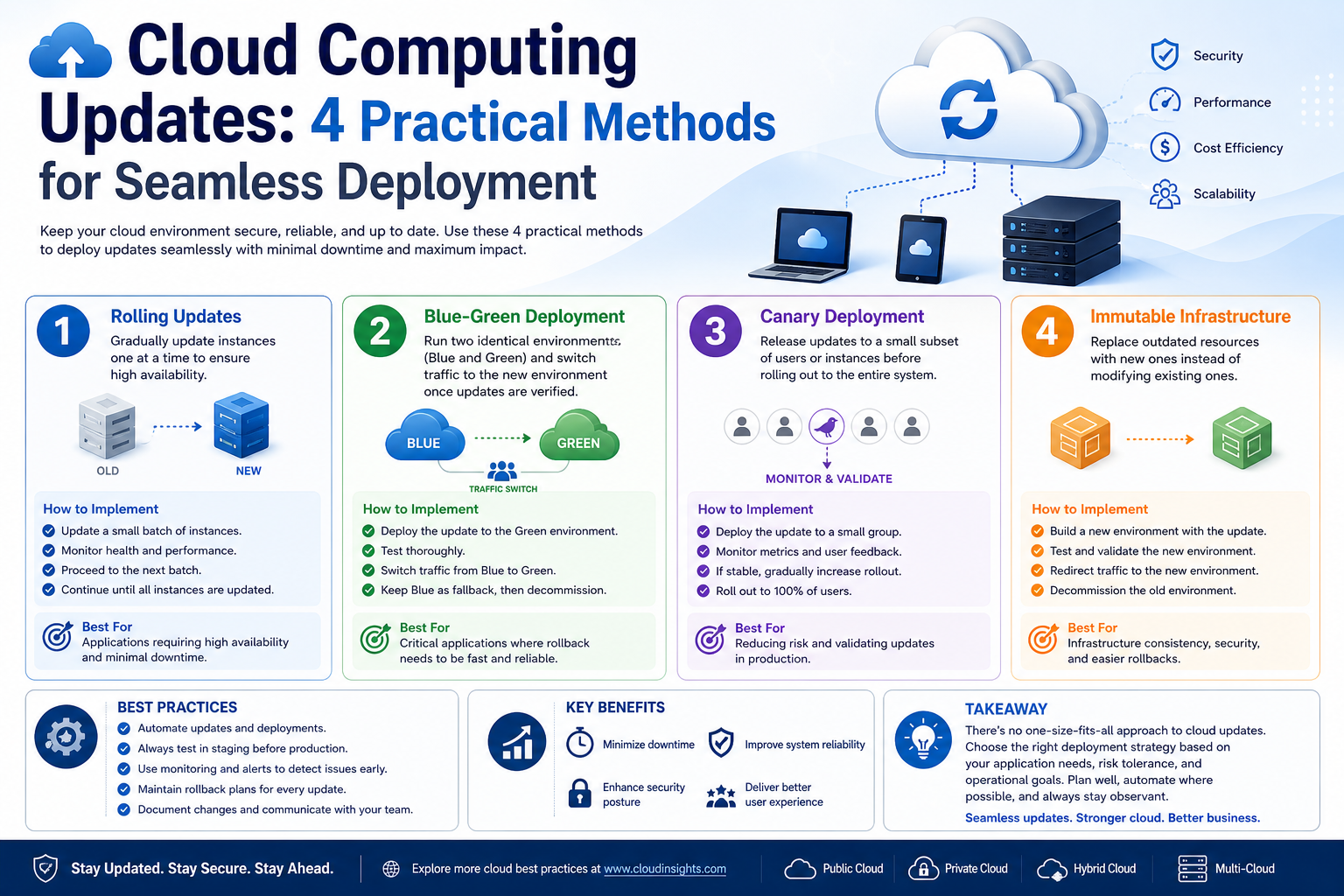
A rolling update is a deployment strategy where changes are gradually applied across a fleet of servers or instances rather than being deployed everywhere at once. Instead of stopping the entire system, individual nodes are updated in sequence.
This incremental approach ensures that part of the system remains operational while updates are being applied elsewhere. It creates a continuous availability model, where the application never fully goes offline.
Rolling updates are especially useful in distributed systems where traffic is balanced across multiple servers. Load balancers play a critical role here by directing user requests only to healthy instances.
A Practical Scenario: High-Traffic Web Applications
Imagine a large e-commerce platform handling thousands of requests per minute. The platform is distributed across multiple servers to handle traffic efficiently. Each server is identical and serves user requests through a load balancer.
Now consider that a critical bug has been discovered in the checkout process. Fixing this issue requires a new deployment.
If the update were applied to all servers simultaneously, the entire system might restart at once. This would result in a temporary outage, preventing users from completing purchases. Even a few minutes of downtime could translate into significant revenue loss.
Rolling updates solve this problem by updating one server at a time. While one instance is being updated, the remaining servers continue handling traffic. The load balancer automatically avoids sending requests to the instance undergoing maintenance.
Once the updated server is verified as healthy, it rejoins the pool, and the process continues with the next server.
The Role of Load Balancers in Rolling Deployments
Load balancers are essential to the success of rolling updates. They distribute incoming traffic across multiple servers based on availability, performance, and predefined routing rules.
During a rolling update, load balancers dynamically adjust routing decisions. If a server is temporarily taken offline for updates, traffic is automatically redirected to healthy nodes.
This ensures uninterrupted service even during deployment operations. Without load balancing, rolling updates would not be possible in a reliable way.
Advantages of Rolling Updates
Rolling updates offer several important advantages in cloud environments:
First, they eliminate full system downtime. Since only part of the system is updated at any given time, users can continue interacting with the application.
Second, they reduce deployment risk. If an issue is detected during the rollout, the process can be paused or rolled back before the entire system is affected.
Third, they allow for gradual validation. Each updated instance can be monitored individually before proceeding to the next.
This incremental validation is particularly useful for large-scale systems where issues may only appear under specific conditions.
Challenges and Limitations of Rolling Updates
Despite their benefits, rolling updates also introduce complexity. One of the main challenges is version inconsistency.
During a rolling update, different servers may run different versions of the application at the same time. This can lead to compatibility issues, especially if changes affect shared data structures or APIs.
For example, if a database schema is modified in a way that is incompatible with the previous version of the application, users routed to older servers may experience errors.
Another challenge is rollback complexity. If a problem is discovered mid-deployment, rolling back changes requires careful coordination to ensure all servers return to a stable version.
Finally, rolling updates can prolong deployment time. Since updates are applied sequentially, large systems may take longer to fully transition compared to other strategies.
The Concept of Two Identical Environments
Blue-green deployment introduces a different philosophy. Instead of updating servers one by one, it maintains two identical production environments.
One environment is active and serves live traffic. The other is inactive but fully synchronized. When an update is needed, it is applied to the inactive environment. Once validated, traffic is switched from the active environment to the updated one.
This switch happens almost instantly, which allows for near-zero downtime deployments.
How Blue-Green Deployment Works in Practice
Consider two identical environments: Blue and Green.
At any given time, only one environment is active. Suppose Blue is currently serving all production traffic. The Green environment remains idle but fully prepared.
When a new update is ready, it is deployed to the Green environment. Extensive testing is performed to ensure stability. Once everything is verified, traffic is switched from Blue to Green.
At that moment, Green becomes the active environment, and Blue becomes idle.
This switch is typically handled through routing configuration changes in load balancers or DNS systems.
Why Blue-Green Deployment Reduces Risk
The primary advantage of blue-green deployment is isolation. Because the new version is deployed in a separate environment, it does not interfere with the live system until the switch occurs.
This eliminates the risk of partial updates affecting users. Unlike rolling updates, there is no period where multiple versions run simultaneously in production.
If something goes wrong after the switch, traffic can be quickly redirected back to the previous environment, assuming it remains intact.
Resource Considerations in Blue-Green Systems
One tradeoff in blue-green deployment is resource duplication. Maintaining two full production environments requires additional infrastructure capacity.
This means organizations must effectively double their runtime resources, even if only one environment is actively serving traffic at a time.
In cloud environments, this cost is often manageable due to elastic scaling, but it still represents an important design consideration.
Traffic Management Strategies Within Blue-Green Deployment
Blue-green deployment is not always a simple binary switch. In practice, organizations often use variations that control how traffic is shifted between environments.
These variations allow for more controlled and safer deployments, especially when introducing significant changes.
Canary Deployment: Gradual Traffic Exposure
Canary deployment is a strategy where only a small percentage of traffic is initially directed to the new environment.
Instead of switching all users at once, the system gradually increases exposure.
For example, the new version might initially receive only 5% of traffic. If performance metrics remain stable, this percentage can be increased to 10%, then 25%, and so on.
This approach allows organizations to observe real-world behavior before committing fully to the new version.
If issues are detected, traffic can be quickly reduced or reverted.
Canary deployments are particularly useful when introducing new features or major architectural changes.
Linear Traffic Shifting
Linear deployment is another variation where traffic is increased in fixed increments over time.
Instead of adjusting based on metrics, the system follows a predictable pattern. For example, traffic might increase by 10% every 10 minutes until it reaches 100%.
This method provides a structured and predictable rollout process.
While it does not adapt dynamically to system behavior like canary deployment, it is easier to manage and forecast.
All-at-Once Deployment in Blue-Green Systems
All-at-once deployment is the simplest variation. Once the new environment is ready, all traffic is immediately switched over.
This approach is fast and straightforward but carries higher risk. If an issue exists, it will affect all users simultaneously.
For this reason, it is typically used when confidence in the update is very high or when changes are minimal.
Comparing Rolling Updates and Blue-Green Deployment
Although both strategies aim to reduce downtime and improve reliability, they differ significantly in execution.
Rolling updates focus on gradual changes within a single environment. Blue-green deployment focuses on switching between two complete environments.
Rolling updates minimize resource duplication but introduce version inconsistency. Blue-green deployment eliminates version mismatch but requires more infrastructure.
Choosing between them depends on system requirements, cost considerations, and risk tolerance.
Why Both Strategies Coexist in Cloud Architectures
Modern cloud systems rarely rely on a single deployment strategy. Instead, they combine multiple approaches depending on context.
For example, an organization might use blue-green deployment for major releases and rolling updates for minor patches.
Similarly, canary deployments may be layered on top of blue-green systems to further reduce risk.
This flexibility is one of the key advantages of cloud-native architectures. Deployment strategies are not fixed—they are configurable based on operational needs.
The Role of Automation in Deployment Strategies
Both rolling updates and blue-green deployments rely heavily on automation. Manual intervention is not scalable in modern cloud environments.
Automation tools manage instance health checks, traffic routing, deployment sequencing, and rollback procedures.
This reduces human error and ensures consistency across deployments.
As systems grow more complex, automation becomes not just helpful but essential for maintaining reliability.
Observability During Deployment Processes
Another critical aspect of modern deployment strategies is observability. During rolling updates or blue-green switches, systems must be closely monitored.
Metrics such as response time, error rates, CPU usage, and traffic distribution provide insight into system health.
Without observability, it becomes difficult to detect subtle issues before they escalate.
This is especially important in gradual deployment models like canary or rolling updates, where small changes in behavior may indicate larger underlying problems.
Why Controlled Deployment Strategies Are Essential Today
As applications become more distributed and user expectations increase, downtime becomes less acceptable.
Rolling updates and blue-green deployment provide structured ways to introduce change without disrupting service.
They represent a shift from reactive maintenance to proactive system design, where updates are planned, controlled, and continuously validated.
These strategies form the foundation for even more advanced approaches, including automated rollback systems, self-healing infrastructure, and adaptive traffic management models used in large-scale cloud platforms.
The Need for Always-On Systems in Modern Cloud Computing
In today’s digital landscape, downtime is no longer treated as a normal part of system maintenance. Users expect applications to remain available at all times, regardless of updates, failures, or infrastructure changes. Whether it is financial services, healthcare platforms, e-commerce systems, or enterprise applications, even a few seconds of disruption can have significant consequences.
This expectation has pushed cloud architecture toward designs that prioritize resilience above all else. While rolling updates and blue-green deployments focus on how updates are applied, another category of systems focuses on what happens when things fail unexpectedly. These systems are built around redundancy, automatic recovery, and continuous availability.
At the center of this approach is the failover cluster model, along with hybrid strategies that combine multiple deployment methods into a single resilient architecture.
Understanding the Core Concept of Failover Clusters
A failover cluster is a group of interconnected servers or nodes that work together to ensure high availability. Unlike deployment strategies that focus on how updates are applied, failover clusters focus on what happens when a system component becomes unavailable.
In a failover cluster, multiple nodes are configured to monitor each other continuously. These nodes communicate through a mechanism often referred to as a heartbeat signal. This heartbeat acts as a simple but critical check that confirms whether each node is still operational.
If one node fails to respond, the cluster automatically shifts its workload to another healthy node. This process is known as failover.
The goal is simple: ensure that users never experience downtime, even if individual components fail.
Active-Passive vs Active-Active Cluster Models
Failover clusters generally operate in two primary configurations: active-passive and active-active.
In an active-passive setup, one node handles all production traffic while the other remains in standby mode. The passive node continuously monitors the active node. If the active node fails, the passive node takes over immediately.
This model is simple and reliable but underutilizes resources because standby systems remain idle most of the time.
In an active-active configuration, multiple nodes handle traffic simultaneously. If one node fails, the remaining nodes continue operating with increased load.
This model is more efficient but also more complex to manage because workload distribution must be carefully balanced.
The Role of Heartbeat Communication
Heartbeat communication is the foundation of failover detection. Each node in the cluster sends periodic signals to other nodes to confirm that it is operational.
If a node stops sending these signals, it is assumed to have failed. The cluster then triggers a failover process.
This mechanism must be highly reliable and low-latency. Even a slight delay in detection can lead to performance degradation or inconsistent system states.
Heartbeat systems are typically designed to be lightweight so they do not interfere with application performance.
Failover Clusters in Database Systems
One of the most common use cases for failover clusters is in database systems. Databases often serve as the backbone of enterprise applications, making their availability critical.
For example, in a clustered database environment, one node may serve read and write operations while another node continuously replicates data in real time.
If the primary database node fails, the secondary node takes over almost instantly. This ensures that applications depending on the database experience minimal disruption.
This model is widely used in systems such as financial transaction processing, inventory management, and large-scale enterprise resource planning platforms.
Advantages of Failover Clustering
Failover clusters provide several key advantages.
First, they significantly reduce downtime. Because standby nodes are always ready to take over, system recovery can happen in seconds rather than minutes or hours.
Second, they eliminate single points of failure. By distributing workloads across multiple nodes, the system becomes more resilient to hardware or software failures.
Third, they improve operational continuity. Users are often unaware that a failure has occurred because the transition is seamless.
Challenges in Failover Cluster Management
Despite their advantages, failover clusters are not without challenges.
One major issue is complexity. Managing multiple nodes that must remain synchronized requires careful configuration and monitoring.
Another challenge is data consistency. During failover events, ensuring that no data is lost or duplicated is critical. This often requires sophisticated replication mechanisms.
Split-brain scenarios also pose risks. This occurs when two nodes believe they are both active due to communication failures, potentially leading to data conflicts.
Because of these challenges, failover clusters must be carefully designed and tested before deployment.
Why Single Strategies Are Not Enough
While rolling updates, blue-green deployments, and failover clusters each solve specific problems, modern cloud systems rarely rely on just one approach.
Real-world applications are too complex for a single deployment strategy to handle all scenarios. Instead, organizations combine multiple strategies to create layered resilience.
This hybrid approach allows systems to handle both planned updates and unexpected failures effectively.
Hybrid Model: Blue-Green Deployment with Failover Clusters
One common hybrid architecture combines blue-green deployment with failover clustering.
In this setup, each environment (blue and green) may itself be part of a failover cluster. This means that not only do two environments exist, but each environment is also internally redundant.
When an update is deployed, it is first applied to the inactive environment. Within that environment, failover clusters ensure that all components remain stable during testing.
Once validated, traffic is switched from one environment to the other.
This layered approach significantly increases reliability but also introduces additional infrastructure complexity.
Rolling Updates Combined with Load-Balanced Clusters
Another common hybrid model combines rolling updates with clustered load balancing.
In this architecture, multiple nodes are part of a cluster that distributes traffic dynamically. Rolling updates are applied to individual nodes within the cluster.
Because the cluster already handles redundancy, rolling updates become safer and more flexible.
If a node fails during an update, the cluster automatically redistributes traffic to healthy nodes.
This combination is widely used in large-scale web applications and microservices architectures.
Canary Deployments in Clustered Environments
Canary deployments also integrate naturally with clustered systems.
In a canary setup, a small subset of nodes within a cluster is updated first. These nodes receive a small percentage of live traffic.
System performance is then monitored closely. If no issues are detected, more nodes are gradually updated.
This approach allows organizations to detect problems early without affecting the entire system.
In clustered environments, canary deployments provide an additional layer of safety on top of existing redundancy.
The Importance of Layered Resilience
Resilient cloud systems are not built on a single mechanism. Instead, they rely on multiple layers of protection.
At the base layer, failover clusters ensure hardware and node-level redundancy.
At the deployment layer, rolling updates and blue-green strategies manage how software changes are introduced.
At the traffic layer, load balancers and routing systems control how users interact with different versions of an application.
Each layer contributes to overall system stability.
Observability as a Core Component of Resilience
No deployment strategy is complete without observability.
Observability refers to the ability to monitor, measure, and understand system behavior in real time. This includes metrics such as latency, error rates, throughput, and resource utilization.
During deployments, observability systems act as early warning mechanisms. They help detect anomalies before they escalate into full system failures.
In hybrid architectures, observability becomes even more important because multiple deployment strategies may be active simultaneously.
Automation and Self-Healing Systems
Modern cloud systems increasingly rely on automation not only for deployments but also for recovery.
Self-healing systems can detect failures and automatically trigger corrective actions. For example, if a node in a cluster fails, it may be automatically replaced or restarted without human intervention.
Similarly, deployment pipelines can automatically roll back changes if performance metrics degrade beyond acceptable thresholds.
This level of automation reduces operational overhead and improves system reliability.
Risk Management in Deployment Strategy Selection
Choosing a deployment strategy is fundamentally a risk management decision.
Rolling updates distribute risk over time by updating systems gradually.
Blue-green deployments isolate risk by separating environments.
Failover clusters reduce risk by ensuring redundancy at the infrastructure level.
Hybrid systems combine these approaches to minimize both operational and deployment risks.
The choice of strategy depends on factors such as application criticality, traffic volume, infrastructure cost, and acceptable downtime thresholds.
The Relationship Between Complexity and Reliability
One important tradeoff in cloud architecture is that increased reliability often comes with increased complexity.
Failover clusters, hybrid deployments, and multi-stage pipelines all introduce additional configuration requirements and operational overhead.
However, this complexity is often justified by the need for high availability and fault tolerance.
In large-scale systems, simplicity alone is not sufficient. Structured complexity becomes necessary to ensure stability under diverse failure conditions.
Evolution of Deployment Strategies in Cloud-Native Systems
Deployment strategies continue to evolve as cloud-native technologies mature.
Containerization, orchestration systems, and serverless computing have all influenced how updates are applied.
Instead of managing individual servers, modern systems operate at the level of services and workloads. This abstraction allows for more flexible deployment patterns and faster recovery mechanisms.
Despite these advancements, the foundational concepts of rolling updates, blue-green deployments, and failover clusters remain central to system design.
Building a Unified View of Cloud Update Systems
When viewed together, all deployment and resilience strategies form a unified system.
Rolling updates provide gradual change.
Blue-green deployments provide instant switching.
Failover clusters provide continuous availability.
Hybrid models combine these strengths to create systems that can adapt to both planned and unplanned events.
This layered approach reflects the reality of modern cloud computing, where no single strategy is sufficient on its own, but multiple strategies working together can achieve near-continuous uptime and controlled change management.
Extending Hybrid Cloud Deployment Thinking: Real-World Operational Depth
In real-world cloud environments, deployment strategies are rarely used in isolation or even in simple combinations. As systems scale, the complexity of maintaining uptime, performance, and security increases exponentially. What initially looks like a clean model—rolling updates, blue-green deployments, or failover clusters—quickly becomes part of a much larger operational ecosystem that must account for unpredictable traffic spikes, regional outages, dependency failures, and even human error during configuration changes.
At this scale, deployment strategies evolve from “methods” into “policies.” These policies define how systems behave under normal conditions, degraded conditions, and full failure conditions. The goal is no longer just to deploy software safely, but to ensure that the system can continuously adapt while still serving users without interruption.
Intelligent Traffic Routing and Adaptive Load Distribution
As systems become more complex, static routing rules are no longer sufficient. Modern cloud architectures increasingly rely on intelligent traffic routing mechanisms that dynamically adjust based on real-time system conditions.
Instead of simply distributing traffic evenly, these systems evaluate metrics such as response time, error rates, CPU usage, and network latency before deciding where to send requests.
This becomes especially important during deployment events. For example, during a canary deployment, only a small portion of traffic is directed to the new version of the system. Intelligent routing ensures that this traffic is not just random, but representative of real user behavior patterns.
If performance degradation is detected, routing algorithms can automatically reduce traffic to the affected nodes or environments. This creates a feedback loop where system behavior directly influences deployment progression.
Dependency Management and Cascading Failure Prevention
One of the most underestimated challenges in cloud deployment is dependency management. Modern applications are built from interconnected services—databases, authentication systems, caching layers, third-party APIs, and internal microservices.
A failure in one dependency can cascade through the system if not properly isolated.
Deployment strategies must therefore account not only for the application being updated but also for the services it depends on. Rolling updates, for example, must ensure backward compatibility between versions of services. Blue-green deployments must verify that dependencies behave consistently across environments.
To mitigate cascading failures, many systems introduce circuit breakers. These mechanisms detect failing dependencies and temporarily block requests to them, preventing system-wide instability.
When combined with failover clusters and controlled deployment strategies, circuit breakers act as an additional safety layer that preserves system integrity under stress.
Configuration Drift and State Consistency Challenges
As cloud systems scale, maintaining consistent configuration across environments becomes increasingly difficult. Even small differences in configuration—such as environment variables, network rules, or service versions—can lead to unpredictable behavior during deployments.
This phenomenon is known as configuration drift.
In multi-environment systems, drift can occur naturally over time as changes are made in one environment but not replicated in others. It can also occur during manual interventions or emergency fixes.
To counter this, modern deployment systems increasingly rely on infrastructure-as-code principles. This means that environments are defined programmatically rather than manually configured. As a result, environments can be recreated consistently and reliably.
However, even with automation, state consistency remains a challenge, especially in systems that maintain persistent data. Databases, caches, and session stores must be carefully synchronized during deployment transitions to prevent inconsistencies.
Observability-Driven Deployment Decisions
In advanced cloud systems, deployment decisions are no longer based solely on whether a build passes tests. Instead, they are increasingly driven by observability data collected in real time.
This includes not only system metrics but also behavioral signals such as user interaction patterns, error distribution across regions, and latency fluctuations under different workloads.
During a rolling or canary deployment, these signals determine whether a deployment should continue, pause, or roll back. This transforms deployment from a static process into a dynamic decision-making system.
For example, if a new version shows slightly higher latency but significantly lower error rates, the system might continue the rollout. Conversely, if errors spike in a specific region, traffic can be redirected while engineers investigate.
This feedback-driven approach allows systems to adapt more intelligently to real-world conditions rather than relying solely on pre-defined rules.
The Role of Rollback Strategies in Deployment Safety
No deployment strategy is complete without a rollback mechanism. Even the most carefully tested updates can produce unexpected behavior in production environments.
Rollback strategies vary depending on the deployment model:
In rolling updates, rollback may involve reverting individual nodes to a previous version.
In blue-green deployments, rollback is often as simple as switching traffic back to the original environment.
In canary deployments, rollback may involve gradually reducing traffic to the new version until it is fully removed from production.
The key requirement is speed. A rollback system must be capable of restoring stability quickly to minimize user impact.
Modern cloud systems often automate rollback decisions based on thresholds such as error rates or response time degradation. This reduces reliance on manual intervention during critical incidents.
Human Factors in Cloud Deployment Systems
While automation and infrastructure design play a major role in deployment strategies, human decision-making remains a critical factor.
Deployment policies must be designed with human behavior in mind. For example, overly complex systems may increase the risk of misconfiguration. Conversely, overly simplified systems may lack necessary safeguards.
Clear deployment procedures, structured approval workflows, and well-defined escalation paths all contribute to safer system operations.
In many organizations, deployments are treated as collaborative processes involving developers, operations teams, and system architects. This shared responsibility model helps reduce blind spots and improves overall system reliability.
Toward Autonomous Deployment Systems
The long-term evolution of deployment strategies is moving toward greater autonomy. In highly advanced systems, deployments may eventually become fully self-managing.
In such systems, software updates are automatically tested, deployed, monitored, and adjusted without manual intervention. Machine learning models may even be used to predict the impact of deployments before they are fully rolled out.
While this level of automation is still emerging, many foundational elements already exist today. Canary deployments, intelligent traffic routing, automated rollback systems, and self-healing infrastructure all represent steps toward this direction.
Final Perspective on Cloud Deployment Evolution
Cloud deployment strategies have evolved from simple manual processes into sophisticated, multi-layered systems that combine automation, redundancy, and real-time decision-making.
Rolling updates introduced gradual change. Blue-green deployments introduced environment isolation. Failover clusters introduced continuous availability. Hybrid systems combined these ideas into resilient architectures capable of handling both expected and unexpected challenges.
As cloud systems continue to grow in scale and complexity, deployment strategies will continue to evolve toward greater intelligence, automation, and adaptability, ensuring that software updates become increasingly seamless within the always-on expectations of modern digital infrastructure.
Conclusion
Modern cloud deployment strategies have fundamentally changed how software updates are planned, tested, and delivered. Instead of treating updates as risky, disruptive events, cloud-based systems allow organizations to apply changes in controlled, incremental, and highly resilient ways. Techniques such as the development–QA–production pipeline provide structured validation, while rolling updates enable gradual transitions without shutting down services. Blue-green deployments introduce complete environment separation, allowing instant switching with minimal downtime, and failover clusters ensure continuous availability even when infrastructure components fail unexpectedly.
When combined, these methods form layered deployment architectures that balance speed, safety, and reliability. No single approach is sufficient on its own; instead, modern systems rely on hybrid strategies that adapt based on workload, risk level, and business requirements. Intelligent traffic routing, automated rollback mechanisms, and real-time observability further enhance these models by allowing systems to react dynamically to changing conditions.
As cloud environments continue to evolve, deployment is becoming less of a manual process and more of an automated, continuously optimized workflow. The focus is shifting from simply releasing software to maintaining uninterrupted service while continuously improving systems in the background. This evolution reflects the core goal of modern IT: delivering innovation without compromising stability or user experience. It also emphasizes resilience, scalability, and real-time adaptability, enabling organizations to respond faster to changing demands, reduce operational risks, and ensure consistently high performance across distributed systems.