Project management has gradually transformed from a loosely structured administrative function into a highly disciplined professional practice, especially within the information technology sector. In earlier decades, projects were often handled in an informal manner, relying heavily on individual experience rather than standardized processes. As technology systems grew more complex and organizations became more dependent on digital infrastructure, the need for structured project management practices became increasingly clear.
In modern IT environments, projects typically involve multiple interconnected systems, distributed teams, strict timelines, and significant financial investment. These factors demand a coordinated approach that ensures all moving parts are aligned toward a common objective. Project management provides this structure by introducing defined phases, documented processes, and measurable outcomes.
One of the most important shifts in IT project management has been the recognition that successful delivery depends not only on technical expertise but also on communication, planning, and leadership. Technical teams may understand system architecture or software development deeply, but without a structured approach to managing tasks, dependencies, and expectations, projects can quickly become unbalanced.
Another key evolution has been the increasing emphasis on accountability. Modern projects require clear ownership of tasks, transparent reporting structures, and well-defined roles. This ensures that every participant understands their responsibilities and how their contributions fit into the broader project goals.
Additionally, globalization has significantly influenced project management practices. IT projects are often executed across multiple regions, requiring coordination between teams in different time zones and cultural environments. This has introduced new challenges related to communication clarity, scheduling, and consistency in execution.
As organizations began to recognize these complexities, formal project management frameworks became essential. These frameworks introduced standardized terminology, structured methodologies, and repeatable processes that help reduce uncertainty. The goal is not to eliminate flexibility but to provide a reliable foundation upon which complex work can be organized.
Over time, project management has also become more data-driven. Decisions are increasingly based on metrics, performance indicators, and documented progress rather than intuition alone. This shift allows project managers to identify issues early and make informed adjustments before problems escalate.
In IT-focused environments, project management also serves as a bridge between technical teams and business stakeholders. It ensures that technical execution aligns with business objectives, helping organizations deliver solutions that are not only functional but also strategically valuable.
Core Principles of the Project Lifecycle
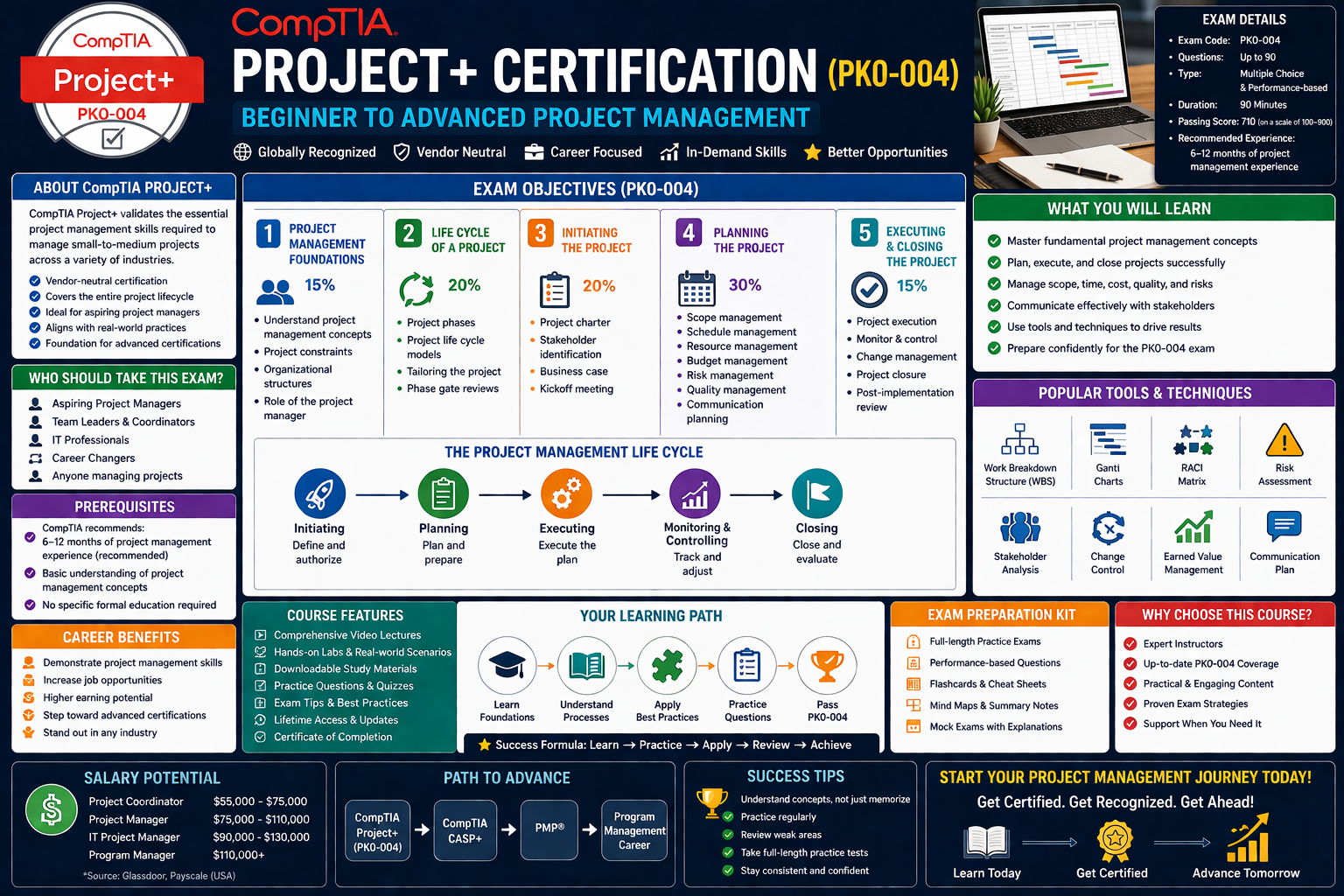
The project lifecycle represents the structured progression of a project from its initial conception through to its completion. It provides a framework that guides teams through distinct phases, each with specific objectives and deliverables. Understanding this lifecycle is essential for maintaining control, consistency, and clarity throughout the duration of a project.
The lifecycle typically begins with initiation, where the purpose and feasibility of the project are defined. This phase focuses on identifying the problem or opportunity that the project is intended to address. It establishes a high-level understanding of what needs to be achieved and why it is important.
Following initiation is the planning phase, which is one of the most detailed and critical stages. During planning, the project’s scope is defined, tasks are broken down, timelines are established, and resources are allocated. This phase serves as the blueprint for execution and helps minimize uncertainty by anticipating challenges in advance.
Execution is the phase where the actual work of the project is carried out. Teams implement the plans developed earlier, coordinating activities, managing resources, and producing deliverables. Effective execution depends heavily on communication, monitoring, and leadership to ensure that work remains aligned with project objectives.
Monitoring and controlling occur simultaneously with execution. This involves tracking progress, comparing actual performance against planned objectives, and making necessary adjustments. It ensures that deviations are identified early and corrected before they impact the overall outcome.
The final phase is closure, where the project is formally completed. Deliverables are finalized, documentation is reviewed, and outcomes are evaluated against initial objectives. This phase also includes the release of resources and the identification of lessons learned for future improvement.
Each phase of the lifecycle is interconnected, meaning that decisions made in earlier stages directly influence later outcomes. For example, incomplete planning can lead to challenges during execution, while poor monitoring can result in missed deadlines or budget overruns.
The lifecycle is not a rigid structure but a flexible framework that can be adapted depending on the nature of the project. However, the underlying principles remain consistent: clarity, structure, accountability, and continuous evaluation.
Project Initiation and Defining Objectives
Initiation is the foundation of any project and sets the direction for all subsequent activities. During this phase, the primary goal is to clearly define what the project aims to achieve and determine whether it is feasible to proceed. Without a strong initiation phase, projects often lack direction and face difficulties later in execution.
A critical aspect of initiation is identifying the problem or opportunity that the project addresses. This involves understanding the current situation, recognizing gaps or inefficiencies, and defining a desired future state. The clarity of this definition plays a significant role in shaping the success of the entire project.
Once the problem is identified, objectives must be established. These objectives serve as measurable targets that guide the project team throughout the lifecycle. Well-defined objectives are specific, realistic, and aligned with broader organizational goals. They provide a clear benchmark for evaluating success.
Stakeholder identification is another essential component of initiation. Stakeholders are individuals or groups who have an interest in the project outcome. They may include internal team members, management, clients, or external partners. Understanding stakeholder expectations early helps prevent misalignment later in the project.
Feasibility analysis is also conducted during initiation. This involves evaluating whether the project is technically possible, financially viable, and operationally practical. Factors such as budget constraints, resource availability, and time limitations are carefully considered before committing to the project.
In addition, initiation often includes the development of a high-level project overview. This overview outlines the scope, expected deliverables, and general approach. It does not contain detailed planning but provides enough structure to justify moving forward.
Approval is a key milestone in the initiation phase. Decision-makers review the project concept and determine whether it should proceed. This ensures that organizational resources are allocated only to projects with clear value and feasibility.
The strength of the initiation phase directly influences the success of all later stages. A well-defined beginning creates clarity, reduces ambiguity, and provides a strong foundation for planning and execution.
Stakeholders and Communication Frameworks
Effective communication is one of the most critical components of successful project management, and it is closely tied to the management of stakeholders. Stakeholders play a central role in shaping project expectations, providing resources, and evaluating outcomes. Their involvement must be carefully managed to ensure alignment throughout the project lifecycle.
Stakeholders can vary widely in their roles and influence. Some may have direct decision-making authority, while others may be indirectly affected by the project outcomes. Understanding these differences is essential for determining how and when to engage each group.
Communication frameworks are used to structure interactions between the project team and stakeholders. These frameworks define what information is shared, how frequently it is communicated, and through which channels. The goal is to ensure that all stakeholders receive the appropriate level of information without overwhelming them.
Clear communication helps prevent misunderstandings and reduces the risk of misaligned expectations. In complex projects, even small communication gaps can lead to significant delays or rework. Therefore, consistency and clarity are essential.
Different stakeholders often require different communication styles. For example, technical teams may need detailed operational updates, while executive stakeholders may prefer high-level summaries. A well-structured communication approach takes these differences into account.
Regular communication also supports transparency. When stakeholders are informed about progress, challenges, and changes, they are more likely to remain supportive and engaged. This transparency builds trust and strengthens collaboration.
In addition to planned communication, informal communication also plays a role in project success. Spontaneous discussions, quick clarifications, and collaborative problem-solving contribute to smoother project execution.
Conflict management is another important aspect of stakeholder communication. Differences in priorities or expectations can arise, and effective communication helps resolve these issues constructively. By addressing concerns early, project teams can prevent escalation.
Ultimately, communication frameworks ensure that information flows efficiently across all levels of the project. They provide structure while still allowing flexibility to adapt to changing project needs.
Project Constraints: Scope, Time, Cost, and Quality
Every project operates within certain limitations known as constraints. The most commonly recognized constraints are scope, time, cost, and quality. These elements are interconnected, meaning that changes to one often affect the others.
Scope defines what is included and excluded in a project. It establishes boundaries and ensures that efforts remain focused on agreed objectives. Managing scope effectively prevents uncontrolled expansion of work, which can lead to delays and increased costs.
Time refers to the schedule within which the project must be completed. Deadlines are often fixed, requiring careful planning to ensure that tasks are completed in the correct sequence. Time management is essential for maintaining momentum and meeting expectations.
Cost represents the financial resources allocated to the project. Budgeting must account for personnel, equipment, tools, and other operational expenses. Maintaining cost control ensures that the project remains financially viable.
Quality refers to the standard of deliverables produced by the project. High-quality outcomes meet predefined requirements and satisfy stakeholder expectations. Balancing quality with other constraints often requires careful decision-making.
These four constraints are often visualized as interconnected elements. Adjusting one constraint typically impacts the others. For example, increasing scope may require additional time and cost, while reducing time may affect quality or increase expenses.
Effective project management involves continuously balancing these constraints. Decisions must be made based on priorities, risks, and available resources. This requires both analytical thinking and practical judgment.
Understanding constraints also helps in setting realistic expectations. When stakeholders are aware of limitations, they are more likely to support informed decisions throughout the project lifecycle.
Planning Processes and Documentation Fundamentals
Planning is one of the most critical stages in project management, as it transforms conceptual ideas into actionable steps. It provides a structured roadmap that guides the entire project team from initiation to completion.
A key aspect of planning is defining tasks and breaking down the project into manageable components. This ensures that complex objectives are divided into smaller, more achievable activities.
Scheduling is another important component. It involves assigning timelines to tasks and establishing dependencies between activities. Proper scheduling helps maintain workflow efficiency and reduces delays.
Resource planning is also included in this phase. It involves identifying the people, tools, and materials required to complete the project. Ensuring resource availability is essential for smooth execution.
Documentation plays a central role in planning. It provides a written record of decisions, processes, and expectations. This ensures consistency and serves as a reference throughout the project lifecycle.
Planning also includes risk anticipation. Potential challenges are identified in advance, and strategies are developed to address them. This proactive approach reduces uncertainty during execution.
Communication planning ensures that all stakeholders understand how information will be shared throughout the project. This supports transparency and coordination.
Effective planning creates structure and clarity, allowing teams to move forward with confidence and alignment.
Structuring Work Through Breakdown Techniques
A well-organized project depends on the ability to convert broad objectives into smaller, manageable components. This is achieved through structured decomposition techniques that allow teams to clearly understand what needs to be delivered and how each part contributes to the overall outcome. Without this breakdown, projects often become difficult to control, as large and undefined tasks can create confusion, inefficiency, and misalignment among team members.
Work breakdown techniques focus on dividing the entire scope of a project into hierarchical levels. At the highest level, the project represents a single unified goal. As the structure is refined, this goal is divided into major deliverables, which are then further broken down into smaller work packages. Each work package represents a specific unit of work that can be assigned, tracked, and completed independently.
This structured decomposition allows project managers to gain better visibility into the complexity of the work involved. It becomes easier to estimate effort, allocate resources, and identify dependencies between tasks. It also helps in identifying areas where specialized skills or additional support may be required.
Another important benefit of structured breakdown is improved accountability. When tasks are clearly defined, individuals and teams understand exactly what is expected of them. This reduces ambiguity and ensures that responsibilities are distributed in a transparent manner.
Work breakdown also supports more accurate scheduling. By understanding the individual components of a project, it becomes possible to estimate how long each task will take and how tasks relate to one another. This leads to more realistic timelines and reduces the risk of unexpected delays.
In addition, structured breakdown techniques help improve risk visibility. Smaller tasks make it easier to identify potential issues at an early stage, as risks are often associated with specific activities rather than the project as a whole. This allows for targeted risk management strategies.
The process of decomposition also enhances communication within the project team. When everyone is working from the same structured framework, discussions become more focused and productive. Team members can refer to specific components of the breakdown structure when discussing progress or issues.
Ultimately, structured work breakdown provides the foundation for all other planning and control activities. It transforms abstract goals into actionable steps and ensures that complex projects remain manageable throughout their lifecycle.
Scheduling Methodologies and Time Management Control
Time management is a central aspect of project success, and scheduling methodologies provide the structure needed to organize activities over a defined timeline. A schedule serves as a roadmap that guides the sequence and duration of tasks, ensuring that work progresses in a logical and efficient manner.
Scheduling begins with identifying all tasks required to complete the project. These tasks are then arranged in a sequence based on dependencies, meaning that certain activities must be completed before others can begin. Understanding these relationships is essential for creating a realistic timeline.
Once dependencies are established, durations are assigned to each task. These estimates are based on factors such as resource availability, complexity of work, and historical data from similar projects. Accurate estimation is critical, as unrealistic durations can lead to schedule delays or resource overload.
Time management also involves identifying critical paths within the project schedule. The critical path represents the sequence of tasks that directly determines the total duration of the project. Any delay in these tasks will impact the overall completion time, making them a key focus for monitoring and control.
Float or slack time is another important concept in scheduling. It refers to the amount of time a task can be delayed without affecting subsequent activities or the overall project timeline. Understanding float helps project managers prioritize tasks more effectively.
Scheduling is not a one-time activity but an ongoing process. As the project progresses, adjustments may be required due to unforeseen circumstances, resource changes, or evolving requirements. Effective time management involves continuously updating the schedule to reflect current realities.
Communication plays an important role in maintaining schedule accuracy. Regular updates from team members help ensure that progress is tracked correctly and that any delays are identified early. This allows corrective actions to be taken before issues escalate.
In addition, scheduling methodologies help align team efforts. When all participants are working according to a shared timeline, coordination becomes more efficient, and the likelihood of overlap or conflict is reduced.
Time management control ultimately ensures that project objectives are achieved within the expected timeframe, balancing efficiency with flexibility.
Resource Allocation and Team Dynamics in Projects
Resource allocation is the process of assigning available resources in a way that maximizes efficiency and ensures successful project completion. Resources may include personnel, equipment, tools, technology, and budgetary support. Effective allocation ensures that each task has what it needs to be completed successfully without unnecessary waste or overload.
One of the primary challenges in resource allocation is balancing availability with demand. In many projects, resources are limited, and multiple tasks may compete for the same individuals or tools. This requires careful planning and prioritization.
Team composition plays a critical role in resource allocation. Selecting individuals with the appropriate skills and experience ensures that tasks are completed efficiently and to a high standard. It also reduces the need for rework and minimizes delays caused by skill gaps.
Team dynamics are equally important. The way team members interact, communicate, and collaborate has a direct impact on project performance. Positive dynamics encourage cooperation, knowledge sharing, and problem-solving, while poor dynamics can lead to conflict and inefficiency.
Leadership is a key factor in managing team dynamics. Effective leadership provides direction, resolves conflicts, and ensures that team members remain focused on project objectives. It also helps maintain motivation and engagement throughout the project lifecycle.
Resource allocation must also account for workload balance. Overloading certain individuals while underutilizing others can lead to burnout and reduced productivity. A balanced distribution of tasks helps maintain consistency and morale.
In addition, resource management involves contingency planning. Unexpected changes such as resource unavailability or shifting priorities require flexibility in allocation strategies. Having backup plans ensures that the project can continue smoothly despite disruptions.
Communication between team members is essential for effective resource utilization. Clear communication helps avoid duplication of effort and ensures that everyone understands their roles and responsibilities.
Ultimately, resource allocation and team dynamics work together to create an environment where project objectives can be achieved efficiently and collaboratively.
Risk Identification and Response Planning
Every project carries a degree of uncertainty, and risk management is the process of identifying, analyzing, and responding to potential issues that may impact project success. Effective risk management helps reduce the likelihood of negative outcomes and increases the chances of achieving project objectives.
Risk identification is the first step in this process. It involves systematically examining the project to identify potential threats and opportunities. These risks may arise from technical challenges, resource limitations, external dependencies, or environmental factors.
Once risks are identified, they are analyzed based on their likelihood and potential impact. This helps prioritize which risks require immediate attention and which can be monitored over time.
Risk response planning involves developing strategies to address identified risks. These strategies may include avoiding the risk, reducing its likelihood, transferring responsibility, or accepting it with contingency plans in place.
Contingency planning is an important aspect of risk management. It involves preparing alternative actions that can be implemented if a risk materializes. This ensures that the project can continue with minimal disruption.
Risk management is an ongoing process rather than a one-time activity. As the project progresses, new risks may emerge while existing risks may change in severity. Continuous monitoring is therefore essential.
Communication plays a key role in risk management. Keeping stakeholders informed about potential risks ensures transparency and allows for collaborative decision-making when issues arise.
Documentation is also important, as it provides a record of identified risks, analysis, and response strategies. This helps maintain consistency and supports future project learning.
Effective risk management contributes to project stability by reducing uncertainty and improving preparedness for unexpected events.
Change Management and Scope Control Mechanisms
Change is an inevitable part of any project, and managing it effectively is essential for maintaining control over scope, schedule, and resources. Change management provides a structured approach to evaluating and implementing modifications while minimizing disruption.
Scope control focuses on ensuring that only approved changes are incorporated into the project. Without proper control, projects can experience scope expansion, where additional requirements are added without proper evaluation. This often leads to delays and increased costs.
Change requests typically arise from stakeholders who identify new needs or adjustments to existing requirements. Each request must be carefully evaluated to determine its impact on the project.
Evaluation involves assessing how the proposed change will affect scope, time, cost, and quality. This helps decision-makers understand the full implications before approval.
Once a change is approved, it must be integrated into the project plan. This includes updating schedules, reallocating resources, and adjusting documentation.
Communication is essential throughout the change process. Stakeholders must be informed about approved changes and how they will affect project outcomes.
Control mechanisms ensure that all changes follow a standardized process. This reduces confusion and ensures consistency in decision-making.
Change management also helps maintain project alignment with original objectives. By carefully controlling modifications, projects remain focused and manageable.
Quality Assurance Practices in Project Environments
Quality assurance ensures that project deliverables meet defined standards and stakeholder expectations. It involves systematic processes designed to prevent errors and improve overall output quality.
Quality planning begins early in the project lifecycle, where standards and criteria are defined. These standards serve as benchmarks for evaluating performance.
Quality control involves monitoring deliverables to ensure they meet established requirements. This may include inspections, reviews, and testing activities.
Continuous improvement is an important aspect of quality management. Feedback from project activities is used to identify areas for enhancement and refine processes over time.
Quality assurance also emphasizes consistency. By following standardized procedures, teams can produce reliable and predictable results.
Documentation plays a significant role in quality management. It provides evidence that processes have been followed correctly and that deliverables meet required standards.
Training and skill development also contribute to quality assurance by ensuring that team members have the necessary expertise to perform their tasks effectively.
Ultimately, quality assurance ensures that project outputs are not only completed but also meet the expectations of stakeholders and end users.
Monitoring Performance and Progress Measurement Systems
Monitoring is essential for ensuring that a project remains on track throughout its lifecycle. It involves tracking performance, comparing actual progress against planned objectives, and identifying deviations.
Performance measurement systems use indicators to evaluate progress. These indicators may include task completion rates, resource utilization, and milestone achievement.
Regular monitoring allows project managers to detect issues early. Early detection enables corrective action before problems become critical.
Progress tracking also helps maintain accountability. When performance is measured consistently, team members are more aware of their responsibilities.
Reporting is an important part of monitoring. It provides stakeholders with updates on project status and highlights areas that require attention.
Monitoring systems also support decision-making by providing accurate and timely information. This allows managers to make informed adjustments to plans and resources.
Overall, monitoring ensures that projects remain aligned with objectives and that any deviations are addressed promptly.
Procurement and External Resource Coordination
Procurement involves acquiring goods and services needed to complete a project. This may include equipment, software, or external expertise. Effective procurement ensures that required resources are available when needed.
The procurement process begins with identifying requirements. This involves determining what resources are needed and when they are required.
Vendor selection is a key aspect of procurement. It involves evaluating potential suppliers based on criteria such as cost, quality, and reliability.
Contracts are used to formalize agreements with external providers. These agreements define expectations, deliverables, and timelines.
Coordination with external resources requires clear communication and monitoring. This ensures that suppliers meet their obligations and deliver as expected.
Procurement also involves risk management, as external dependencies can introduce uncertainty into the project.
Effective procurement supports project success by ensuring timely access to necessary resources.
Information Flow and Documentation Governance
Information management is essential for maintaining clarity and consistency throughout a project. Documentation governance ensures that information is accurate, accessible, and properly controlled.
Documentation includes all written records related to the project, such as plans, reports, and communication logs. These documents serve as a reference for decision-making and tracking progress.
Proper governance ensures that documentation is organized and updated regularly. This prevents confusion and ensures that all team members are working with current information.
Information flow refers to how data moves between stakeholders. Efficient flow ensures that the right information reaches the right people at the right time.
Controlled documentation supports transparency and accountability. It provides a clear record of project activities and decisions.
Integrating Constraints into Unified Project Control
Project constraints must be managed collectively rather than individually. Scope, time, cost, and quality are interconnected, and changes in one area affect the others.
Integrated control ensures that decisions consider all constraints simultaneously. This helps maintain balance and prevents unintended consequences.
Unified control systems rely on continuous monitoring and adjustment. They ensure that all aspects of the project remain aligned with overall objectives.
Effective integration of constraints leads to more stable and predictable project outcomes.
Project Execution and Real-World Implementation of Plans
Project execution is the phase where planning transitions into action, and theoretical structures are transformed into tangible results. At this stage, the focus shifts from designing the roadmap to actively completing the work defined earlier in the lifecycle. Execution is often considered the most resource-intensive phase because it involves coordinated effort from multiple teams, continuous decision-making, and constant alignment with objectives.
During execution, team members begin working on assigned tasks according to the schedule and structure established during planning. Each activity contributes to a larger deliverable, and progress is measured continuously to ensure alignment with expectations. While the plan serves as a guide, execution requires adaptability because real-world conditions rarely follow predictions perfectly.
One of the most important aspects of execution is coordination. In most projects, multiple tasks occur simultaneously, often with dependencies between them. This means that delays or changes in one area can affect several others. Effective coordination ensures that teams remain synchronized and that work flows smoothly across different phases.
Communication becomes especially critical during execution. Information must move quickly and clearly between stakeholders, team members, and leadership. Any gaps in communication can lead to misunderstandings, duplicated effort, or missed requirements. Regular updates help maintain transparency and ensure that everyone is working with accurate information.
Execution also requires strong leadership to maintain direction and focus. Leaders are responsible for resolving issues, removing obstacles, and ensuring that the team remains aligned with project objectives. They also play a key role in maintaining motivation and productivity, especially during long or complex projects.
As tasks are completed, deliverables are reviewed to ensure they meet defined requirements. This continuous validation helps maintain quality and prevents errors from accumulating. If issues are identified, corrective actions are taken immediately to avoid further impact.
Execution is not a static process; it is dynamic and constantly evolving. Changes in requirements, resource availability, or external conditions may require adjustments to the plan. Successful execution depends on the ability to respond to these changes without losing overall direction.
Ultimately, project execution is where planning is tested in real conditions. It requires discipline, coordination, and flexibility to transform structured plans into successful outcomes.
Leadership Roles and Decision-Making in Projects
Leadership in project environments plays a central role in guiding teams, resolving challenges, and ensuring that objectives are achieved effectively. Unlike traditional management roles that focus primarily on supervision, project leadership requires a balance of technical understanding, interpersonal skills, and strategic thinking.
One of the core responsibilities of project leadership is decision-making. Decisions must often be made quickly and with limited information, especially when unexpected challenges arise. These decisions can affect timelines, costs, resources, and overall project success. Strong leadership ensures that decisions are well-informed, timely, and aligned with project goals.
Leadership also involves setting direction. This means translating high-level objectives into actionable guidance for the team. Clear direction helps ensure that all team members understand their roles and how their work contributes to the broader goal.
Motivation is another important aspect of leadership. Projects often involve tight deadlines and complex tasks, which can create pressure on team members. Effective leaders support their teams by maintaining morale, recognizing achievements, and providing encouragement during difficult phases.
Conflict resolution is also a key leadership function. In project environments, disagreements may arise due to differences in opinion, priorities, or working styles. Leaders must address these conflicts constructively to prevent disruption and maintain team cohesion.
Delegation is another critical responsibility. Effective leaders understand that they cannot manage every task directly. Instead, they assign responsibilities based on skills and expertise, ensuring that tasks are handled efficiently by the right individuals.
Leadership also involves maintaining alignment with stakeholders. This requires balancing technical execution with business expectations, ensuring that project outcomes meet organizational needs.
Overall, leadership is the driving force that connects planning, execution, and delivery. It ensures that teams remain focused, coordinated, and productive throughout the project lifecycle.
Quality Control and Continuous Improvement Practices
Quality control is an essential component of project execution that ensures deliverables meet defined standards and expectations. It involves systematic evaluation of outputs to identify defects, inconsistencies, or deviations from requirements.
During execution, quality control activities are integrated into ongoing workflows rather than being treated as a final step. This approach allows issues to be detected and corrected early, reducing the cost and effort required for rework.
Inspections and reviews are commonly used methods for maintaining quality. These processes involve examining work outputs to verify that they align with established criteria. They help ensure consistency and reliability across all deliverables.
Testing is another important aspect of quality control, especially in technical projects. It involves evaluating functionality, performance, and stability under different conditions. Testing helps identify issues that may not be visible during normal operation.
Continuous improvement is closely linked to quality control. It involves using feedback from completed tasks to refine processes and enhance future performance. This creates a cycle of learning and improvement that strengthens overall project outcomes.
Documentation plays a key role in maintaining quality. By recording procedures, standards, and results, teams can ensure consistency and provide a reference for future projects.
Training and skill development also contribute to quality improvement. When team members have strong competencies, they are more likely to produce high-quality work with fewer errors.
Quality control is not only about identifying problems but also about preventing them. By establishing clear standards and processes, teams can reduce the likelihood of errors occurring in the first place.
Ultimately, quality control ensures that project outputs are reliable, consistent, and aligned with stakeholder expectations.
Risk Monitoring and Adaptive Response Strategies
Risk management does not end after initial planning; it continues throughout the entire project lifecycle. As conditions change, new risks may emerge, and existing risks may evolve in terms of likelihood or impact. Continuous monitoring is therefore essential for maintaining project stability.
Risk monitoring involves tracking identified risks and assessing whether they are still relevant. It also includes identifying new risks that may arise due to changes in scope, resources, or external factors.
Adaptive response strategies are used to address risks as they develop. These strategies are flexible and allow teams to adjust their approach based on current conditions. The goal is to minimize negative impacts while maintaining project progress.
Some risks require immediate action, while others may be monitored over time. Prioritization is important to ensure that attention is focused on the most critical issues.
Communication plays a key role in risk monitoring. Keeping stakeholders informed about potential risks ensures transparency and allows for collaborative decision-making when necessary.
Risk documentation is also important, as it provides a record of identified issues and responses. This information can be used to improve future projects and refine risk management practices.
Effective risk monitoring helps maintain control over uncertainty and ensures that projects remain on track despite changing conditions.
Stakeholder Engagement and Expectation Management
Stakeholder engagement is a continuous process that involves maintaining communication and building relationships with individuals or groups affected by the project. Effective engagement ensures that stakeholders remain informed, involved, and supportive throughout the project lifecycle.
Managing expectations is a critical part of stakeholder engagement. Stakeholders often have varying levels of understanding and different expectations regarding project outcomes. Clear communication helps align these expectations with realistic project capabilities.
Regular updates are essential for maintaining engagement. These updates provide stakeholders with information about progress, challenges, and changes. Transparency helps build trust and reduces uncertainty.
Feedback collection is another important aspect of engagement. Stakeholders provide valuable insights that can help improve project outcomes. Incorporating feedback ensures that the final deliverables meet real-world needs.
Conflicts in expectations may arise during the project. Effective engagement strategies help resolve these conflicts through discussion, clarification, and negotiation.
Stakeholder engagement also supports decision-making. When stakeholders are actively involved, they are more likely to support necessary changes or adjustments.
Ultimately, strong stakeholder engagement ensures alignment between project outcomes and organizational goals.
Project Closure and Transition Activities
Project closure marks the final stage of the project lifecycle, where all activities are completed, and deliverables are formally handed over. This phase ensures that the project is properly concluded and that all objectives have been addressed.
Closure begins with final verification of deliverables. This involves confirming that all requirements have been met and that outputs are complete and functional.
Documentation is finalized during this stage. All project records, including plans, reports, and communication logs, are organized and archived for future reference.
Resource release is another important activity. Team members, equipment, and other resources are reassigned or released for other projects.
Transition activities ensure that deliverables are handed over to operational teams or end users. This may include training, support documentation, or system handover procedures.
Project evaluation is also conducted during closure. This involves reviewing what was achieved, identifying successes, and analyzing challenges encountered during the lifecycle.
Lessons learned are documented to improve future projects. These insights help organizations refine processes and avoid repeating mistakes.
Formal closure ensures that the project is officially completed and no further work is required.
Integration of Project Management Concepts in Real Environments
In real-world environments, project management concepts do not operate in isolation. Instead, they are integrated into a continuous workflow that connects planning, execution, monitoring, and closure.
Each concept supports the others. Planning provides structure for execution, execution generates data for monitoring, and monitoring informs future planning decisions. Risk management, quality control, and communication are ongoing processes that operate across all phases.
This integration ensures that projects remain dynamic and adaptable while still maintaining structure and control. It allows organizations to respond effectively to changing conditions while staying focused on defined objectives.
Successful project environments rely on this interconnected system to deliver consistent results across different types of initiatives.
Conclusion
Project management plays a critical role in ensuring that structured work is delivered effectively within modern IT and business environments. Across all phases of a project, from initiation through planning, execution, monitoring, and closure, the discipline provides a consistent framework that helps teams transform ideas into measurable outcomes. Its importance continues to grow as organizations deal with increasing complexity, tighter deadlines, distributed teams, and rapidly changing technological demands.
A key takeaway from the project lifecycle is that success is not dependent on a single activity, but rather on the coordination of multiple interconnected processes. Clear initiation establishes direction, while detailed planning provides structure and clarity. Execution brings the plan into action, and monitoring ensures that progress remains aligned with expectations. Finally, closure ensures that work is properly finalized, documented, and transitioned for future use. Each stage builds on the previous one, creating a continuous flow of structured activity.
Another important aspect of project management is its emphasis on communication and stakeholder engagement. Projects rarely exist in isolation, and they typically involve multiple individuals or groups with different expectations and priorities. Effective communication ensures that everyone remains informed and aligned, reducing misunderstandings and improving collaboration. At the same time, managing stakeholder expectations helps maintain trust and supports smoother decision-making throughout the project lifecycle.
Resource management, scheduling, and risk control further strengthen the foundation of successful project delivery. By carefully allocating resources, teams can maintain efficiency and avoid unnecessary strain. Scheduling ensures that work progresses in an organized manner, while risk management prepares teams to handle uncertainty and unexpected challenges. These elements work together to create stability and predictability in environments that are often dynamic and uncertain.
Quality assurance also remains a central focus throughout all project phases. Ensuring that deliverables meet defined standards helps maintain consistency and reliability, while continuous improvement practices encourage learning and refinement over time. This contributes to long-term organizational growth and better outcomes in future initiatives.
Ultimately, project management is more than a set of processes; it is a structured way of thinking and working that enables organizations to achieve goals effectively. It brings order to complexity, aligns teams toward shared objectives, and ensures that resources are used efficiently. In environments where change is constant and expectations are high, strong project management practices provide the stability and direction needed to achieve sustained success.